


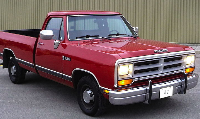
'99 360 Magnum swap into '87 W150


Thread Starter
|
Professional
Joined: Jul 2009
Posts: 120
Likes: 0
 '99 360 Magnum swap into '87 W150
I searched numerous forums, and kind of got an idea of what is needed, but nothing too specific to my situation. I'm getting a '99 5.9 Magnum from a 1500 and I plan to put it into my '87 W150.
From what I gather, it's easiest to just convert the 360 engine to carbureted. Also there was talk of getting a B&M flexplate due to balance issues. I've also read about "notching" the bellhousing on the 727 that the new engine will be bolting to for some sensor, but I'm not sure what that's all about.
What else will I need to finish the swap? Ignition? Computer from a newer manual transmission truck? A motor mount for one side from a newer truck? Sensor where the bellhousing is notched?
From what I gather, it's easiest to just convert the 360 engine to carbureted. Also there was talk of getting a B&M flexplate due to balance issues. I've also read about "notching" the bellhousing on the 727 that the new engine will be bolting to for some sensor, but I'm not sure what that's all about.
What else will I need to finish the swap? Ignition? Computer from a newer manual transmission truck? A motor mount for one side from a newer truck? Sensor where the bellhousing is notched?

Champion
Joined: Mar 2009
Posts: 2,639
Likes: 4
From: Bent Mountain Va
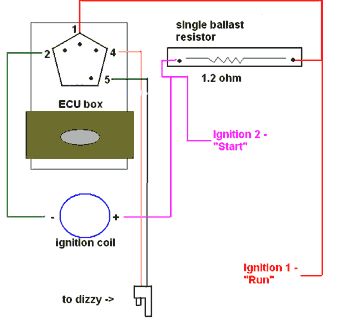
If you go to a carb you might as well get rid of the computer also. There will be no reason to modify the 727 bell housing since you will be eliminating the sensors when you get rid of the computer. If you don't want to mess with points go for a 4 pin engine controller with a single pick-up coil distributor and a single ballast resistor.
Last edited by SEAL; Jun 6, 2011 at 12:09 PM.
Thread Starter
|
Professional
Joined: Jul 2009
Posts: 120
Likes: 0
If you go to a carb you might as well get rid of the computer also. There will be no reason to modify the 727 bell housing since you will be eliminating the sensors when you get rid of the computer. If you don't want to mess with points go for a 4 pin engine controller with a single pick-up coil distributor and a single ballast resistor.
I also read somewhere about a fuel eccentric or an inline fuel pump. Is this needed if converting to a carburetor, or just if you plan to keep the EFI?
Also, will the serpentine belt setup on the magnum engine run all my components, or will I need to change the magnum to the v belt setup?

Legend


Joined: Jun 2009
Posts: 8,025
Likes: 72
From: orangeville ontario
although I'm not too familiar with what you're talking about, "4 pin engine controller with a single pick-up coil distributor and a single ballast resistor". Is there an ignition setup with all this on Summit or Jegs?
I also read somewhere about a fuel eccentric or an inline fuel pump. Is this needed if converting to a carburetor, or just if you plan to keep the EFI?
Also, will the serpentine belt setup on the magnum engine run all my components, or will I need to change the magnum to the v belt setup?
I also read somewhere about a fuel eccentric or an inline fuel pump. Is this needed if converting to a carburetor, or just if you plan to keep the EFI?
Also, will the serpentine belt setup on the magnum engine run all my components, or will I need to change the magnum to the v belt setup?
Thread Starter
|
Professional
Joined: Jul 2009
Posts: 120
Likes: 0
Thanks crazzywolfie. I hope that diagram will be more understandable when I get into it. If the carb suggested fuel pressure is 4-7 psi, would I be fine with getting a fuel pump that is 4-7 psi and no regulator? I don't see the need for getting a higher pressure fuel pump, only to lower it back down with a regulator, unless I'm missing something.
Thread Starter
|
Professional
Joined: Jul 2009
Posts: 120
Likes: 0
BTW, the end goal will be to make 450ish HP, then put a mild supercharger on next year. With that in mind, I'm thinking a 750 CFM carb, and I'm trying to figure out if I need to upgrade the ignition. Don't they make complete kits that replace everything with an ignition box? Would this do the trick ? http://www.summitracing.com/parts/DCC-3690428/
Legend
Joined: Jun 2009
Posts: 8,025
Likes: 72
From: orangeville ontario
that is just a conversion kit for if you have a point ignition system or if you have a truck with the computer behind the battery.
Trending Topics
Thread Starter
|
Professional
Joined: Jul 2009
Posts: 120
Likes: 0
Any idea on whether my 727 has a lockup torque converter? I'm thinking a 2400 stall torque converter should go nicely with the modified 360.
I know how to tell if I take the engine off from the transmission, but is there a way to tell so I can save my pennies and order the correct torque converter without taking it all apart?
I know how to tell if I take the engine off from the transmission, but is there a way to tell so I can save my pennies and order the correct torque converter without taking it all apart?
Last edited by DevilDogge; Jun 7, 2011 at 08:11 AM.
Champion
Joined: Mar 2009
Posts: 2,639
Likes: 4
From: Bent Mountain Va
Lock-up converters first came into use in 1978 for Chrysler. If you know what to look for the valve body is different. A lock-up module was added to the valve body to control the converter.
Be careful choosing a converter using stall speed. Stall speed is a variable and not a constant. The same converter will stall at different RPMs behind engines with different levels of torque. The value you need is called the K value. With the K value you can compute the stall speed of any converter for different engines with different torque capacity. Stall RPM equals the K value times the square root of the torque of the engine (expressed in FT. LBS.) and/or the K value equals the stall speed divided by the square root of the torque of the engine.
Be careful choosing a converter using stall speed. Stall speed is a variable and not a constant. The same converter will stall at different RPMs behind engines with different levels of torque. The value you need is called the K value. With the K value you can compute the stall speed of any converter for different engines with different torque capacity. Stall RPM equals the K value times the square root of the torque of the engine (expressed in FT. LBS.) and/or the K value equals the stall speed divided by the square root of the torque of the engine.
Last edited by SEAL; Jun 7, 2011 at 10:44 AM.
Thread Starter
|
Professional
Joined: Jul 2009
Posts: 120
Likes: 0
Lock-up converters first came into use in 1978 for Chrysler. If you know what to look for the valve body is different. A lock-up module was added to the valve body to control the converter.
Be careful choosing a converter using stall speed. Stall speed is a variable and not a constant. The same converter will stall at different RPMs behind engines with different levels of torque. The value you need is called the K value. With the K value you can compute the stall speed of any converter for different engines with different torque capacity. Stall RPM equals the K value times the square root of the torque of the engine (expressed in FT. LBS.) and/or the K value equals the stall speed divided by the square root of the torque of the engine.
Be careful choosing a converter using stall speed. Stall speed is a variable and not a constant. The same converter will stall at different RPMs behind engines with different levels of torque. The value you need is called the K value. With the K value you can compute the stall speed of any converter for different engines with different torque capacity. Stall RPM equals the K value times the square root of the torque of the engine (expressed in FT. LBS.) and/or the K value equals the stall speed divided by the square root of the torque of the engine.

