



Spark Plug Indexing


Veteran
Joined: Mar 2007
Posts: 281
Likes: 0
 RE: Spark Plug Indexing
I did it on a slant six that I had. Keep in mind it was a race only motor in my dart(well ok I had it on the street once in a while) and it made a 1 hp and 5 ftlb diffrence. That was all but I did notice a slight throttle responce. On these motors I doubt there will be any diffrence unless you have a super tuned motor Ie suprecharged ect.

Record Breaker
Joined: Feb 2006
Posts: 1,567
Likes: 0
From: Richmond, Va
RE: Spark Plug Indexing
I do it, but more as part of the hobby than anything else, and my feelings don't get real hurt if I'm 10* off.Idoubt that it does any noticeablegood in today's motors. I understand the idea to be to expose more spark to the compresseda/f mixture. At anything above 8:1, with decent fuel, and a pcm controlling spark advance, I have often wondered the same thing; worth it or hype. It may be worth the trouble the higher you go in the rpm spectrum, but, in the real world with shift points below 6k, it's probably ( for me anyway )more of an excuse to use my tools and not have to hear all the nonsense that goes on inside the house.

Professional
Joined: May 2006
Posts: 196
Likes: 0
From: Wisconsin
RE: Spark Plug Indexing
What do you mean by indexing the spark plugs? Has it got soemthing to do with the amount of gap you are setting or something completely different? If it refers to gapping, then gapping is what Ive always called it....if its somethign else i am drawing a blank.

Professional
Joined: Feb 2007
Posts: 229
Likes: 0
From: Ft. Hood Tx.
RE: Spark Plug Indexing
here is apiece out of a spark plug FAQ about indexing...
One Ram owner reported on ********* that he purchased 12 of the ZFR5F11 plugs
and "indexed" the 8 that 'by chance' stopped in the threaded hole with the
ground electrode post toward the fender side of the truck. This puts the open
gap toward the valves and is done that way in hope that it would aid
combustion speed. Increased combustion speed is generally a good thing, but if
the engine is already pinging this may increase detonation tendency.
If you put a piece of white tape around your sparkplug socket and make a black
mark on the tape, it is easy to insert the plug so that the ground electrode
post is lined up with the mark. this way you can see where the ground post
ends up.
One Ram owner reported on ********* that he purchased 12 of the ZFR5F11 plugs
and "indexed" the 8 that 'by chance' stopped in the threaded hole with the
ground electrode post toward the fender side of the truck. This puts the open
gap toward the valves and is done that way in hope that it would aid
combustion speed. Increased combustion speed is generally a good thing, but if
the engine is already pinging this may increase detonation tendency.
If you put a piece of white tape around your sparkplug socket and make a black
mark on the tape, it is easy to insert the plug so that the ground electrode
post is lined up with the mark. this way you can see where the ground post
ends up.

Joined: May 2004
Posts: 3,811
Likes: 3
From: Bett-neee
RE: Spark Plug Indexing
i cant see why indexing could possibly ADD to pinging... if anything i could only assume to help it.. add in more complete combustion and helps keep the cylinder clean,, there for keeping compression ratios at a constant
Trending Topics
Professional
Joined: Feb 2007
Posts: 229
Likes: 0
From: Ft. Hood Tx.
RE: Spark Plug Indexing
ORIGINAL: shott8283
i cant see why indexing could possibly ADD to pinging... if anything i could only assume to help it.. add in more complete combustion and helps keep the cylinder clean,, there for keeping compression ratios at a constant
i cant see why indexing could possibly ADD to pinging... if anything i could only assume to help it.. add in more complete combustion and helps keep the cylinder clean,, there for keeping compression ratios at a constant
gap toward the valves and is done that way in hope that it would aid
combustion speed. Increased combustion speed is generally a good thing, but if
the engine is already pinging this may increase detonation tendency.
i dont know either but what i think they are saying is that it will add to the Preignition problem because of the increased combustion speed....i just found this spark plug FAQ write up today myself deff. some interesting reading...

Record Breaker
Joined: Nov 2005
Posts: 1,827
Likes: 3
From: Ontario Canada
RE: Spark Plug Indexing
Back in 98 I pulled my plugs the first time and checked where the ground straps lined up.
3 had the gaps pointing at around 6:00
2 others were about 5 & 7:00
The last 3, one was close 11:00, the other two were pointing about 2 & 10:00
With the plugs indexed properly the idle smoothed outa bit compared to how it came from the factory.
Chances are it probably didnt add much but every hp or lb of torque you gain does help.
Ive always indexed any plugs Ive put in any of my vehicles. Costs nothing but time and can give slightly better performance and mileage. Win, win win sitiuation.
3 had the gaps pointing at around 6:00
2 others were about 5 & 7:00
The last 3, one was close 11:00, the other two were pointing about 2 & 10:00
With the plugs indexed properly the idle smoothed outa bit compared to how it came from the factory.
Chances are it probably didnt add much but every hp or lb of torque you gain does help.
Ive always indexed any plugs Ive put in any of my vehicles. Costs nothing but time and can give slightly better performance and mileage. Win, win win sitiuation.
Professional
Joined: Feb 2007
Posts: 229
Likes: 0
From: Ft. Hood Tx.
RE: Spark Plug Indexing
Here is some on indexing plugs....
HOW TO INDEX SPARK PLUGS
By John Pearson and Chirag Asaravala

There is a lot of debate and skepticism to whether or not spark plug indexing is worth the effort. Some studies have shown 1-2% of total engine power can be lost through poor spark direction. Perhaps that does not sound like enough power to be concerned about, but consider this: Chances are that you, like the majority of enthusiasts, have spent a fair amount of money on hotter coils, ignition boxes, better plugs, ignition wires, cap and rotor, and the list goes on. In fact many heads these days boast "revised spark plug angles" and "fast burn" chambers. Heck, you probably even made the extra effort to set all your plug gaps to the exact specification. Well if you believe all those things make a difference, and they probably do, than it is only logical to think that the spark needs to face the right direction in the combustion chamber!
Indexing spark plugs has been practiced by motoring enthusiasts for many years. The technique has been used by racers to obtain maximum combustion efficiency within each cylinder, and also to maintain consistent combustion between all cylinders. The object of indexing spark plugs is to ensure that a spark plugs ground electrode is not positioned in such a way where it is shielding the spark from the fuel/air charge or impeding the flame front as it travels away from the spark plug into the chamber. The ideal position of the plug in the head is such that the gap is facing towards the valves, so that the spark is fully visible to, and aimed at, the center of the combustion chamber.
Unfortunately with today's mass produced plugs and cylinder heads, there is absolutely no assurance that when you screw in a sparkplug it ends up in the correct orientation. The majority of people take this for granted, and probably feel the minimal horsepower gains is not worth the added effort. But then again, the guys winning races aren't just following the majority!
Indexing plugs is only valid on the conventional type of "gapped" plugs that have the ground strap that extends off the threaded portion of the plug. Some new style plugs, have no grounding electrode protruding from the threaded bushing, or have multiple electrodes. These plugs are self indexing, in that their position in the chamber is the same no matter how they are installed. While this may be a small benefit, the costs of these plugs is outrageous and has not been proven to be worth the expense.
This article illustrates how indexing can be done in a relatively cheap and easy manner. Of course there are methods of using special indexing washers to also position the depth of the plug into the chamber. However we'll stick to simply attaining proper spark orientation using nothing more than a permanent marker.
On most cylinder heads, the spark plug enters the chamber at an angle. This angle places the spark plug electrode near the wall of the combustion chamber. I try to keep the grounding electrode close to the chamber wall. This ensures that the plug gap will be fully exposed to the combustion chamber and not hidden by the ground electrode. To do this, I look at the plug and note the position of the grounding electrode in relation to the plugs upper porcelain body. On the Autolites that I use, I reference the ground electrode to the lettering on the porcelain body. For instance, I might find that the grounding electrode is in line with the letter "U" in the word Autolite that is written on the plug. This is my reference that shows me where the gap is located when I screw the plug into the head. After I have referenced the grounding electrode to markings on the plug body, I screw the plug into the head, finger tight, and note the position of my reference mark. I want my reference mark to be positioned facing up and just slightly towards the corner of the exhaust port for that cylinder. When this occurs, I know the gap is fully exposed to the combustion chamber and the spark will not be shielded, by the ground strap, from the fuel charge. If I find that my reference mark does not line up within 20 degrees or so, I try another cylinder until I find a cylinder that leaves the plug in a satisfactory position. If I can't find a cylinder that allows the plug to be positioned correctly, I have no use for that plug and set it aside for another motor. I feel it is not critical to be 'dead on' with the plug orientation. Within 20 to 30 degrees, either way, should be satisfactory. The main idea is to have the gap open to the chamber, so that the air/fuel charge is exposed to the maximum spark intensity in order to facilitate a fast burn.
In order to ensure I can index a plug to all cylinders, I usually buy several sets of plugs to work with. By buying several plugs, I am hoping to get plugs that have been made at different factories, or different threading machines, by getting plugs from different 'lots'. This way I feel I have a better chance of getting a plug indexed to all cylinders. After I have indexed a plug for each cylinder, I will scratch (or engrave) the cylinder number into the plugs metal housing or one of the flat sides of the hex nut surface for proper relocation. Indexing plugs is one of those cheap and easy methods of ensuring that your ignition system is delivering the maximum energy to all the combustion chambers. After all, it is that tiny spark that gets all that horse power going. Make sure your combustion chambers can see as much of the spark as possible and you will be assured maximum power. F/M
[align=right]

1. The ideal position of the plug is such that the gap is facing towards the valves, preferably the exhaust valve.
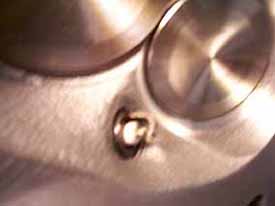
2. The object of indexing is to avoid this problem: when this plug fires the spark is directed towards the chamber wall, rather than the center of the combustion chamber.

3. Shown here are two Autolite (5144) plugs. Notice how the electrode position has no correlation to the "Autolite" script on the white porcelain section. There is also no guarantee the threads are positioned the same on both plugs, or that the threads in the head are consistent from chamber to chamber. In other words, chances are good if you screw this plug in, it won't put the electrode in the proper position.

4. Using a Sharpie pen, place a "index" mark on the plug body. The mark lines up with the electrode gap (see photo 3).
Then screw the plug into the head. If the mark is facing up as in this photo, and slightly towards the exhaust port, we know the electrode is in the proper orientation to the center of the chamber (as in photo 1.)

5. However if the index mark is facing downwards, as in this photo, or more than 20 degrees off the corner of the exhaust port, then you know the gap is not in the ideal location. Try this plug in the other chambers to see if it works better elsewhere. If not, set it aside and try another plug.
Another way to solve the problem is to use special copper indexing washers (available from Moroso). These washers come in varying thickness' and allow you to tailor the position and depth of the electrode.[/align]
HOW TO INDEX SPARK PLUGS
By John Pearson and Chirag Asaravala
There is a lot of debate and skepticism to whether or not spark plug indexing is worth the effort. Some studies have shown 1-2% of total engine power can be lost through poor spark direction. Perhaps that does not sound like enough power to be concerned about, but consider this: Chances are that you, like the majority of enthusiasts, have spent a fair amount of money on hotter coils, ignition boxes, better plugs, ignition wires, cap and rotor, and the list goes on. In fact many heads these days boast "revised spark plug angles" and "fast burn" chambers. Heck, you probably even made the extra effort to set all your plug gaps to the exact specification. Well if you believe all those things make a difference, and they probably do, than it is only logical to think that the spark needs to face the right direction in the combustion chamber!
Indexing spark plugs has been practiced by motoring enthusiasts for many years. The technique has been used by racers to obtain maximum combustion efficiency within each cylinder, and also to maintain consistent combustion between all cylinders. The object of indexing spark plugs is to ensure that a spark plugs ground electrode is not positioned in such a way where it is shielding the spark from the fuel/air charge or impeding the flame front as it travels away from the spark plug into the chamber. The ideal position of the plug in the head is such that the gap is facing towards the valves, so that the spark is fully visible to, and aimed at, the center of the combustion chamber.
Unfortunately with today's mass produced plugs and cylinder heads, there is absolutely no assurance that when you screw in a sparkplug it ends up in the correct orientation. The majority of people take this for granted, and probably feel the minimal horsepower gains is not worth the added effort. But then again, the guys winning races aren't just following the majority!
Indexing plugs is only valid on the conventional type of "gapped" plugs that have the ground strap that extends off the threaded portion of the plug. Some new style plugs, have no grounding electrode protruding from the threaded bushing, or have multiple electrodes. These plugs are self indexing, in that their position in the chamber is the same no matter how they are installed. While this may be a small benefit, the costs of these plugs is outrageous and has not been proven to be worth the expense.
This article illustrates how indexing can be done in a relatively cheap and easy manner. Of course there are methods of using special indexing washers to also position the depth of the plug into the chamber. However we'll stick to simply attaining proper spark orientation using nothing more than a permanent marker.
On most cylinder heads, the spark plug enters the chamber at an angle. This angle places the spark plug electrode near the wall of the combustion chamber. I try to keep the grounding electrode close to the chamber wall. This ensures that the plug gap will be fully exposed to the combustion chamber and not hidden by the ground electrode. To do this, I look at the plug and note the position of the grounding electrode in relation to the plugs upper porcelain body. On the Autolites that I use, I reference the ground electrode to the lettering on the porcelain body. For instance, I might find that the grounding electrode is in line with the letter "U" in the word Autolite that is written on the plug. This is my reference that shows me where the gap is located when I screw the plug into the head. After I have referenced the grounding electrode to markings on the plug body, I screw the plug into the head, finger tight, and note the position of my reference mark. I want my reference mark to be positioned facing up and just slightly towards the corner of the exhaust port for that cylinder. When this occurs, I know the gap is fully exposed to the combustion chamber and the spark will not be shielded, by the ground strap, from the fuel charge. If I find that my reference mark does not line up within 20 degrees or so, I try another cylinder until I find a cylinder that leaves the plug in a satisfactory position. If I can't find a cylinder that allows the plug to be positioned correctly, I have no use for that plug and set it aside for another motor. I feel it is not critical to be 'dead on' with the plug orientation. Within 20 to 30 degrees, either way, should be satisfactory. The main idea is to have the gap open to the chamber, so that the air/fuel charge is exposed to the maximum spark intensity in order to facilitate a fast burn.
In order to ensure I can index a plug to all cylinders, I usually buy several sets of plugs to work with. By buying several plugs, I am hoping to get plugs that have been made at different factories, or different threading machines, by getting plugs from different 'lots'. This way I feel I have a better chance of getting a plug indexed to all cylinders. After I have indexed a plug for each cylinder, I will scratch (or engrave) the cylinder number into the plugs metal housing or one of the flat sides of the hex nut surface for proper relocation. Indexing plugs is one of those cheap and easy methods of ensuring that your ignition system is delivering the maximum energy to all the combustion chambers. After all, it is that tiny spark that gets all that horse power going. Make sure your combustion chambers can see as much of the spark as possible and you will be assured maximum power. F/M
[align=right]
1. The ideal position of the plug is such that the gap is facing towards the valves, preferably the exhaust valve.
2. The object of indexing is to avoid this problem: when this plug fires the spark is directed towards the chamber wall, rather than the center of the combustion chamber.
3. Shown here are two Autolite (5144) plugs. Notice how the electrode position has no correlation to the "Autolite" script on the white porcelain section. There is also no guarantee the threads are positioned the same on both plugs, or that the threads in the head are consistent from chamber to chamber. In other words, chances are good if you screw this plug in, it won't put the electrode in the proper position.
4. Using a Sharpie pen, place a "index" mark on the plug body. The mark lines up with the electrode gap (see photo 3).
Then screw the plug into the head. If the mark is facing up as in this photo, and slightly towards the exhaust port, we know the electrode is in the proper orientation to the center of the chamber (as in photo 1.)
5. However if the index mark is facing downwards, as in this photo, or more than 20 degrees off the corner of the exhaust port, then you know the gap is not in the ideal location. Try this plug in the other chambers to see if it works better elsewhere. If not, set it aside and try another plug.
Another way to solve the problem is to use special copper indexing washers (available from Moroso). These washers come in varying thickness' and allow you to tailor the position and depth of the electrode.[/align]