


installed my 180 thermostat and now theres a gas smell


Champion
Joined: Apr 2007
Posts: 2,570
Likes: 0

Running the engine cooler is actually better for power. (and worse for emissions) Cooler air is denser, and has a higher oxygen content.. so, while the fuel may atomize better at higher temps, you have less oxy to play with....
The 'emissions' craze started back in the mid to late 70's..... and got REALLY bad toward the end... back when there was more emissions equipment under the hood, than there was engine.... It was concern before then, but, not so much so. Was emissions the ONLY reason for running the 'higher' temp? Probably not, but, it was right up there on the list.
The 'emissions' craze started back in the mid to late 70's..... and got REALLY bad toward the end... back when there was more emissions equipment under the hood, than there was engine....
It was concern before then, but, not so much so. Was emissions the ONLY reason for running the 'higher' temp? Probably not, but, it was right up there on the list.
Record Breaker
Joined: Mar 2004
Posts: 1,977
Likes: 1
From: DuQuoin,IL.
Running the engine cooler is actually better for power. (and worse for emissions) Cooler air is denser, and has a higher oxygen content.. so, while the fuel may atomize better at higher temps, you have less oxy to play with....
The 'emissions' craze started back in the mid to late 70's..... and got REALLY bad toward the end... back when there was more emissions equipment under the hood, than there was engine.... It was concern before then, but, not so much so. Was emissions the ONLY reason for running the 'higher' temp? Probably not, but, it was right up there on the list.
The 'emissions' craze started back in the mid to late 70's..... and got REALLY bad toward the end... back when there was more emissions equipment under the hood, than there was engine....
It was concern before then, but, not so much so. Was emissions the ONLY reason for running the 'higher' temp? Probably not, but, it was right up there on the list.
Grand Champion
Joined: Apr 2010
Posts: 5,011
Likes: 6
From: Meeker, CO
Duh. Unless you're running a waterless coolant a 210 degree thermostat would quickly lead to a grisly engine death due to nucleate boiling around the cylinders.
I don't know who "they" is, but it doesn't include the folks who make 215 degree thermostats for use with waterless coolant.

Record Breaker
Joined: Mar 2009
Posts: 2,181
Likes: 3
From: Battle Ground WA

Retired Moderator - RIP
Joined: May 2008
Posts: 18,729
Likes: 17
From: NH
Yep, a simple thing like the radiator cap is one of the most important components of the system. http://auto.howstuffworks.com/cooling-system7.htm
Last edited by zman17; Oct 3, 2010 at 06:23 PM.

Rookie
Joined: Aug 2010
Posts: 79
Likes: 0
From: Michigan
It always costs less, initially, to mickey mouse a halfass solution to the problem. The bill comes due later when the automatic transmission or the engine leave you on the side of the road waiting for a wrecker.

Changing the tstat for a lower temperature in this case is like using better spark plugs to improve ignition. Yeah, I can get better results by replacing the entire engine, but at this point I would rather be "halfassing"...
I don't know who "they" is, but it doesn't include the folks who make 215 degree thermostats for use with waterless coolant.
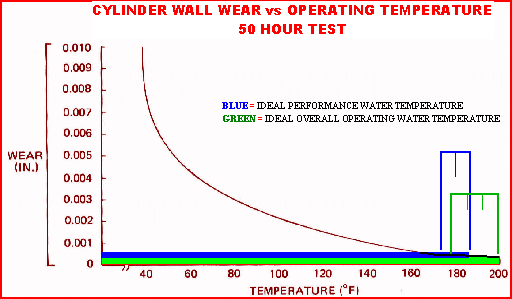
Some food for thought.
Record Breaker
Joined: Mar 2009
Posts: 2,181
Likes: 3
From: Battle Ground WA
Since it's a 50 hour test, I highly doubt it was a drag engine... Ford has done the studies too. If your coolant isn't getting hot enough, your oil will not get hot enough and you will increase wear, it isn't rocket science.
Not to mention the implications of running too cool with an EFI system and having it stuck in open loop.
Not to mention the implications of running too cool with an EFI system and having it stuck in open loop.
Grand Champion
Joined: Apr 2010
Posts: 5,011
Likes: 6
From: Meeker, CO
Running too cool is bad, running too hot is bad. That's easy enough to grasp, isn't it?
Rookie
Joined: Aug 2010
Posts: 79
Likes: 0
From: Michigan
Well, this conversation became way to academical, i.e. with no practical application whatsoever.
For the dyno fans, I am sure that every degree in either direction make some kind of geeky difference, but in the real world when towin heavy loads cooler engine is ALWAYS a plus. And I am not talking about cooler as in 150 degrees, but cooler as staying away from the 210 mark on the gauge. You guys keep on talking about this subject as a cold-start engine, i.e. you have obviously never towed heavy stuff.
UnregisteredUser - hook an 8,000lbs load behind your 1/2 ton and take it up a long hill, then come back here and share with us your findings Until you do so, this conversation is nothing but yarn.
For the dyno fans, I am sure that every degree in either direction make some kind of geeky difference, but in the real world when towin heavy loads cooler engine is ALWAYS a plus. And I am not talking about cooler as in 150 degrees, but cooler as staying away from the 210 mark on the gauge. You guys keep on talking about this subject as a cold-start engine, i.e. you have obviously never towed heavy stuff.
UnregisteredUser - hook an 8,000lbs load behind your 1/2 ton and take it up a long hill, then come back here and share with us your findings
Until you do so, this conversation is nothing but yarn.
Grand Champion
Joined: Apr 2010
Posts: 5,011
Likes: 6
From: Meeker, CO