


**Attention anyone experiencing a "bump" or "jolt" just before or after a stop**


Amateur
Joined: Nov 2012
Posts: 25
Likes: 0
From: Fort Worth TX

ok thanks for the advice. just had shoulder surgery this year so dont have the strength or flexibilty or the tools to do the whole process right now. but i do plan on it as soon as im able. hopefully shooting the grease in for now will work. any recommendations on a brand of spray grease i can get up in there for now?

Thread Starter
|
Veteran

Joined: Jun 2011
Posts: 387
Likes: 18
ok thanks for the advice. just had shoulder surgery this year so dont have the strength or flexibilty or the tools to do the whole process right now. but i do plan on it as soon as im able. hopefully shooting the grease in for now will work. any recommendations on a brand of spray grease i can get up in there for now?


Thread is 8 years old. The pics were probably hosted on photobucket (the standard on this forum for years) but then photobucket decided to start charging to host pictures and if you didn't pay up, your photos were "archived" so to speak. Not by us, but by them. Those pictures are probably long gone by now.
Thread Starter
|
Veteran
Joined: Jun 2011
Posts: 387
Likes: 18

Thread is 8 years old. The pics were probably hosted on photobucket (the standard on this forum for years) but then photobucket decided to start charging to host pictures and if you didn't pay up, your photos were "archived" so to speak. Not by us, but by them. Those pictures are probably long gone by now.


Record Breaker


Joined: Apr 2010
Posts: 1,745
Likes: 50
More often than not if I get a feeling like you describe on takeoff I find a busted driver side motor mount. Has nothing to do with the driveshaft or yoke, but as long gese trucks get older and the rubber deteriorates they do break

Registered User
Joined: Aug 2020
Posts: 5
Likes: 0
This problem had been bothering me for quite some time. As far back as I can remember with the truck. When I'm at a stop, after after letting the foot off the brake (truck begins rolling), and then pressing the accelerator, I would always feel what I describe as a "bump" or a "jolt" when I apply anything greater than the lightest accelerator pressure. I had always read that this (or the same but just before a stop) may be a failing u-joint, but I was never able to discern any noticeable play in any of the joints. So after a little more reading and searching on car boards of all manufacturers, I discovered it may be caused by another problem: A sticking slip yoke joint. Press the gas, truck lurches slightly rearward, rear suspension compresses, sticking slip yoke "unsticks" under pressure, causing the drivetrain to jolt. Only the lightest accelerator pressure wouldn't cause it until I gave it more.
I decided to give it a shot...Disconnecting the drive shaft at the pinion flange, slipping the yoke off the intermediate shaft (at center bearing output), and greasing that bad boy up. Result? No more goddamn bump. Smooth as a baby's *** on accel.
So I may as well write it up. Not a hard or time-consuming job by any means, just a little muscle getting the flange bolts unstuck, and making sure everything goes back in lined up the same way it came out to avoid any shaft balance or u-joint phasing issues.
First thing was to raise the rear. The driveway isn't perfectly 100% level, so instead of using jack stands and losing emergency brake stopping ability over ground, I used roll-on lifts for the rear, and chalked the front wheels (making sure the chalks were "loaded" slightly before setting the e-brake to make sure they were wedged nicely & won't come out). The truck has to be in neutral when doing the job (you don't want the drivetrain loaded by the Park lock or anything else), so every little bit helps to make sure it won't roll otherwise.
Anyway, now that the truck is up, slide under and look for the rear of the center bearing:

The top of the pic is facing rear, the bottom is facing forward. Just forward of the u-joint is the slip yoke, and under the dust boot toward the front of it is the slip joint. Now, I've read some people may have success by simply undoing the larger boot clamp on the rear side, sliding the boot forward, and shooting a bunch of grease inside and near the joint (then jumping on the bumper to help "work" it in). But I wanted to make sure both sides of the joint had good coverage with a decent amount of grease, and cleaning out what was left of the old crap, so for me it was the full removal. Take off or cut the rear boot clamp, and slide the boot over the forward lip of the slip yoke. MAKE SURE TO MARK THE TRANSMISSION OUTPUT SHAFT TO ENSURE IT IS IN THE SAME POSITION WHEN YOU REINSTALL THE REAR SHAFT. That is the shaft that runs between the center bearing and the transmission. IF THE TWO SHAFTS ARE NOT REINSTALLED TOGETHER IN THE SAME SPLINE POSITION AS THEY WERE BEFORE, YOU WILL CREATE DRIVESHAFT VIBRATION AND U-JOINT PHASING ISSUES. A simple reference mark/dab of paint/whatever at the very bottom of the transmission output shaft will suffice. If you end up rotating this shaft during the spline cleaning/greasing phase, all you have to do is make sure that mark is rotated to the very bottom again when you reconnect the two pieces of driveshaft. More on marking the rear driveshaft/pinion flanges for proper alignment in a bit, but as long as the truck or rear tires aren't allowed to spin at all during the process, and the rear flange marks are followed, the rear driveshaft will go in the same way it came out. It's just the transmission output shaft which will most likely be rotated at some point during the process and will become an alignment concern. Now to disconnecting the rear flange.
BEFORE GOING ANY FURTHER, YOU NEED TO MAKE A REFERENCE MARK ACROSS THE DRIVESHAFT FLANGE AND THE PINION FLANGE. This mark ensures the flanges go together in the same position they came out. If not, you will create driveshaft vibration and u-joint phasing issues. Here's my mark, right to left is the pinion flange, driveshaft flange, and driveshaft, using some old silver touch-up paint:

Again, and it cannot be stressed enough, every piece has to go back in facing the same way it did when it came out. Even 180 degrees one way or the other will throw off the balance between the shafts. Now, a good trick...got this from the brother who used to service Humvees in Iraq...was to run a ratchet strap or line under the driveshaft so it won't fall or damage itself (or you) when flange bolts come out. I ran a ratchet strap from one leaf spring to the other, not too tight, just enough to support the shaft once it's loose. The bolts themselves are 15mm, and per the service manual, are Loctited in place. They weren't too bad breaking loose, but there wasn't enough room around the head to get a direct shot with a socket & wrench, and not even a ratcheting wrench would fit. Had to use a straight box wrench to gain enough leverage to get them unstuck. Once they were loose, the socket/extension sufficed, even though it wasn't perfectly straight. With all four bolts out, the flange surfaces were still slightly mated due to age, so a little tap with a flathead screwdriver and hammer between the two was enough to dislodge them. Here's the front of the pinion flange after separation:
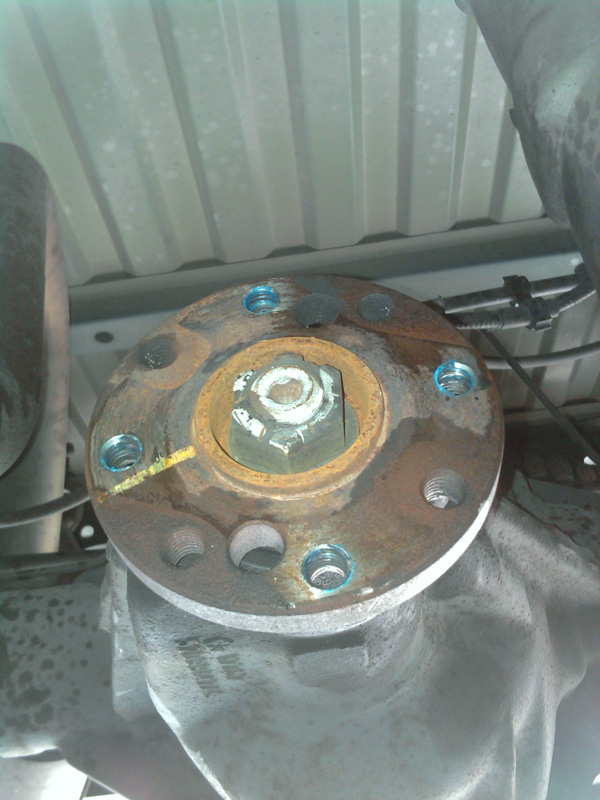
(You can see some of the old Loctite coming out of the threads)
With the driveshaft flange separated, and the rear slip joint boot clamp removed, the driveshaft simply pulls right off the transmission output shaft. If you fully remove the slip joint boot by separating the forward clamp and sliding the boot off, you'll see this, which is the tail end of the transmission output shaft (This is actually the "after" shot, having cleaned the shaft of old crud & re-greasing it):
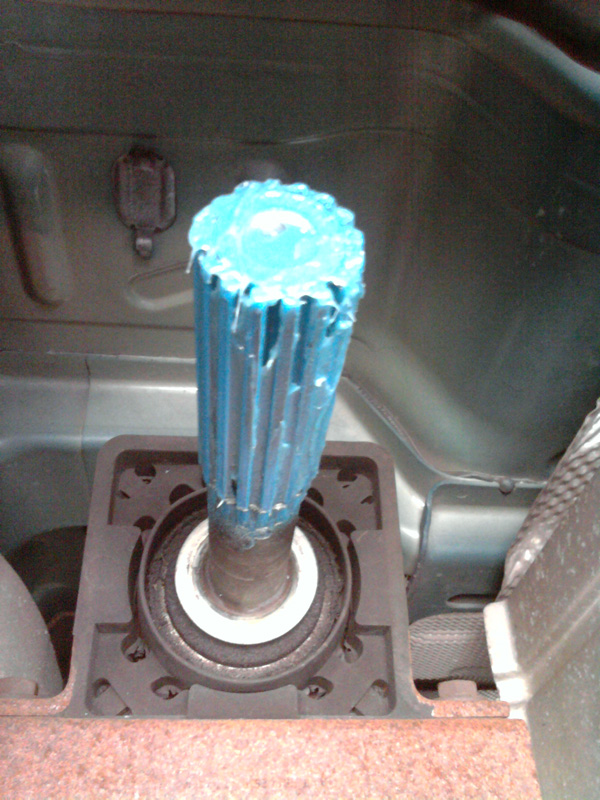
The output shaft will rotate freely as long as the truck is in neutral, and I used it to my advantage to inspect & clean it well. It comes coated with, what I can only describe as, some sort of "non-stick" hard blue plastic already on it. Once I ragged off what was left of the old grease and crud, I noticed quite a few rough spots in this coating, and a few places where it looked like some "excess" coating between and on the splines didn't drip all the way off at the factory. In particular, there was one "notch" in the coating, and I'm suspecting it might have been where the slip yoke was grabbing onto. It didn't go all the way into the metal, just felt like maybe a defect in the coating. This is what it looked like:

I brought it down with medium-grit sandpaper to where it felt smooth, and did the same to all the other rough spots on and between the splines. Finally, I wiped it clean and greased the crap out of it with some Yamalube multi-purpose extreme-temperature waterproof grease. The slip yoke was also cleaned out and greased thoroughly. These are the "before" shots:
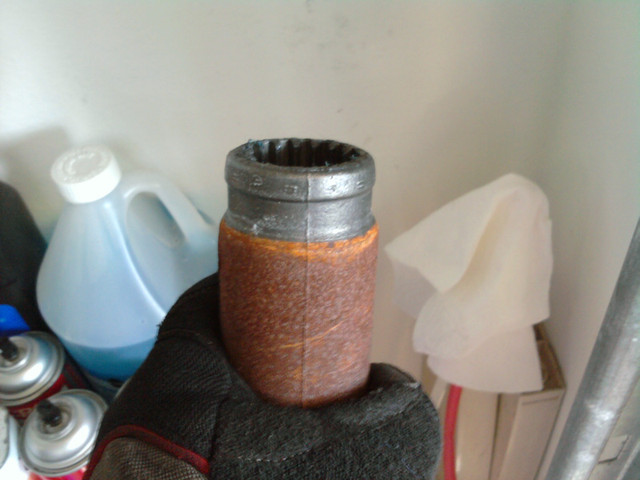

May as well inspect the u-joints too while you have the shaft out. Check that they're free in all directions, no play in any. Mine were still solid at 70k.
Now if you leave too much grease on either surface, you may have trouble pressing the yoke onto the transmission output shaft due to trapped air inside the yoke. I had to slip the yoke off twice to remove excess grease before the driveshaft flange had enough clearance in the back to get it in front of the pinion flange.
Once you're cleaned & lubed, it's time to reinstall. First, slip the boot back over the output shaft (smaller opening forward). You may have some trouble slipping it back on. It's tight, but it will go. At this step in the process, you can secure the forward part of the boot with a new clamp, since the old one will likely be trash. Hose clamps are ok, but a trick I had read about & used to avoid balance problems caused by a metal hose clamp was a heavy-duty plastic zip tie. (It's not holding pressurized water or oil, it just needs to stay in place.) This worked fine.
Next, sling the rear part of the driveshaft on the ratchet strap or line which should still be hanging under the truck from before, and get ready to slide the yoke back onto the output shaft. Here, again, is where alignment becomes critical. Rotate the mark you made on the output shaft all the way to the bottom, and while holding the driveshaft in as close to the same angle as it came out (using the flange marks you made as a reference), slip the yoke onto the output shaft until it's far enough forward to get the driveshaft yoke up against the pinion yoke. Here, you can put a bolt or two through the flanges, just enough so you don't have to hold it up while verifying proper output shaft alignment. Ensuring the driveshaft yoke/pinion yoke reference marks are lined up properly, move forward to the output shaft mark. If the mark is still bottom-center as when you first made it, you're good to go, having meshed the same splines as when you started. If the mark appears about 20 degrees (or more) to one side or the other from bottom-center, you're one or more splines off from where you started. (There are 16 possible spline positions, each being 22.5 degrees from the next.) Separate the yoke back off, rotate the output shaft mark back toward bottom, and reconnect. Line up the driveshaft/pinion flange marks again (using a bolt or two to hold them together), and re-check the output shaft mark. If it's now bottom-center with the rear flange marks aligned, you've nailed it. If not, try it again until you do. Apparently, many (most?) cars have one spline larger than the others to avoid this, but we don't have that luxury.
Shaft alignment complete, it's time to finish the job. A little fresh Loctite on each flange bolt, torqued to 85 ft-lbs per the service manual. (I have to admit, without being able to get a torque wrench properly on any bolt, I estimated.) At this point you can secure the other side of the slip joint boot with another zip-tie, but before doing so, I made it a point to shoot a little extra grease under the boot for posterity. The heads of both zip ties I faced on opposite sides of the boot, just in case they did give off a minuscule amount of throw-weight for balance concerns. Of course, don't forget to undo your ratchet strap or line.
And that's it. It may sound like a lot, but again, it's really not a hard or time-consuming job at all. Just paying attention to what you're doing so it all goes in right.
I don't think it's ever driven this well from a stop before. Since yesterday I've been looking for excuses to get in it and drive.
***EDIT - August 8th 2020, 8 years later and ~65,000 miles, the issue never returned!
I decided to give it a shot...Disconnecting the drive shaft at the pinion flange, slipping the yoke off the intermediate shaft (at center bearing output), and greasing that bad boy up. Result? No more goddamn bump. Smooth as a baby's *** on accel.
So I may as well write it up. Not a hard or time-consuming job by any means, just a little muscle getting the flange bolts unstuck, and making sure everything goes back in lined up the same way it came out to avoid any shaft balance or u-joint phasing issues.
First thing was to raise the rear. The driveway isn't perfectly 100% level, so instead of using jack stands and losing emergency brake stopping ability over ground, I used roll-on lifts for the rear, and chalked the front wheels (making sure the chalks were "loaded" slightly before setting the e-brake to make sure they were wedged nicely & won't come out). The truck has to be in neutral when doing the job (you don't want the drivetrain loaded by the Park lock or anything else), so every little bit helps to make sure it won't roll otherwise.
Anyway, now that the truck is up, slide under and look for the rear of the center bearing:
The top of the pic is facing rear, the bottom is facing forward. Just forward of the u-joint is the slip yoke, and under the dust boot toward the front of it is the slip joint. Now, I've read some people may have success by simply undoing the larger boot clamp on the rear side, sliding the boot forward, and shooting a bunch of grease inside and near the joint (then jumping on the bumper to help "work" it in). But I wanted to make sure both sides of the joint had good coverage with a decent amount of grease, and cleaning out what was left of the old crap, so for me it was the full removal. Take off or cut the rear boot clamp, and slide the boot over the forward lip of the slip yoke. MAKE SURE TO MARK THE TRANSMISSION OUTPUT SHAFT TO ENSURE IT IS IN THE SAME POSITION WHEN YOU REINSTALL THE REAR SHAFT. That is the shaft that runs between the center bearing and the transmission. IF THE TWO SHAFTS ARE NOT REINSTALLED TOGETHER IN THE SAME SPLINE POSITION AS THEY WERE BEFORE, YOU WILL CREATE DRIVESHAFT VIBRATION AND U-JOINT PHASING ISSUES. A simple reference mark/dab of paint/whatever at the very bottom of the transmission output shaft will suffice. If you end up rotating this shaft during the spline cleaning/greasing phase, all you have to do is make sure that mark is rotated to the very bottom again when you reconnect the two pieces of driveshaft. More on marking the rear driveshaft/pinion flanges for proper alignment in a bit, but as long as the truck or rear tires aren't allowed to spin at all during the process, and the rear flange marks are followed, the rear driveshaft will go in the same way it came out. It's just the transmission output shaft which will most likely be rotated at some point during the process and will become an alignment concern. Now to disconnecting the rear flange.
BEFORE GOING ANY FURTHER, YOU NEED TO MAKE A REFERENCE MARK ACROSS THE DRIVESHAFT FLANGE AND THE PINION FLANGE. This mark ensures the flanges go together in the same position they came out. If not, you will create driveshaft vibration and u-joint phasing issues. Here's my mark, right to left is the pinion flange, driveshaft flange, and driveshaft, using some old silver touch-up paint:
Again, and it cannot be stressed enough, every piece has to go back in facing the same way it did when it came out. Even 180 degrees one way or the other will throw off the balance between the shafts. Now, a good trick...got this from the brother who used to service Humvees in Iraq...was to run a ratchet strap or line under the driveshaft so it won't fall or damage itself (or you) when flange bolts come out. I ran a ratchet strap from one leaf spring to the other, not too tight, just enough to support the shaft once it's loose. The bolts themselves are 15mm, and per the service manual, are Loctited in place. They weren't too bad breaking loose, but there wasn't enough room around the head to get a direct shot with a socket & wrench, and not even a ratcheting wrench would fit. Had to use a straight box wrench to gain enough leverage to get them unstuck. Once they were loose, the socket/extension sufficed, even though it wasn't perfectly straight. With all four bolts out, the flange surfaces were still slightly mated due to age, so a little tap with a flathead screwdriver and hammer between the two was enough to dislodge them. Here's the front of the pinion flange after separation:
(You can see some of the old Loctite coming out of the threads)
With the driveshaft flange separated, and the rear slip joint boot clamp removed, the driveshaft simply pulls right off the transmission output shaft. If you fully remove the slip joint boot by separating the forward clamp and sliding the boot off, you'll see this, which is the tail end of the transmission output shaft (This is actually the "after" shot, having cleaned the shaft of old crud & re-greasing it):
The output shaft will rotate freely as long as the truck is in neutral, and I used it to my advantage to inspect & clean it well. It comes coated with, what I can only describe as, some sort of "non-stick" hard blue plastic already on it. Once I ragged off what was left of the old grease and crud, I noticed quite a few rough spots in this coating, and a few places where it looked like some "excess" coating between and on the splines didn't drip all the way off at the factory. In particular, there was one "notch" in the coating, and I'm suspecting it might have been where the slip yoke was grabbing onto. It didn't go all the way into the metal, just felt like maybe a defect in the coating. This is what it looked like:
I brought it down with medium-grit sandpaper to where it felt smooth, and did the same to all the other rough spots on and between the splines. Finally, I wiped it clean and greased the crap out of it with some Yamalube multi-purpose extreme-temperature waterproof grease. The slip yoke was also cleaned out and greased thoroughly. These are the "before" shots:
May as well inspect the u-joints too while you have the shaft out. Check that they're free in all directions, no play in any. Mine were still solid at 70k.
Now if you leave too much grease on either surface, you may have trouble pressing the yoke onto the transmission output shaft due to trapped air inside the yoke. I had to slip the yoke off twice to remove excess grease before the driveshaft flange had enough clearance in the back to get it in front of the pinion flange.
Once you're cleaned & lubed, it's time to reinstall. First, slip the boot back over the output shaft (smaller opening forward). You may have some trouble slipping it back on. It's tight, but it will go. At this step in the process, you can secure the forward part of the boot with a new clamp, since the old one will likely be trash. Hose clamps are ok, but a trick I had read about & used to avoid balance problems caused by a metal hose clamp was a heavy-duty plastic zip tie. (It's not holding pressurized water or oil, it just needs to stay in place.) This worked fine.
Next, sling the rear part of the driveshaft on the ratchet strap or line which should still be hanging under the truck from before, and get ready to slide the yoke back onto the output shaft. Here, again, is where alignment becomes critical. Rotate the mark you made on the output shaft all the way to the bottom, and while holding the driveshaft in as close to the same angle as it came out (using the flange marks you made as a reference), slip the yoke onto the output shaft until it's far enough forward to get the driveshaft yoke up against the pinion yoke. Here, you can put a bolt or two through the flanges, just enough so you don't have to hold it up while verifying proper output shaft alignment. Ensuring the driveshaft yoke/pinion yoke reference marks are lined up properly, move forward to the output shaft mark. If the mark is still bottom-center as when you first made it, you're good to go, having meshed the same splines as when you started. If the mark appears about 20 degrees (or more) to one side or the other from bottom-center, you're one or more splines off from where you started. (There are 16 possible spline positions, each being 22.5 degrees from the next.) Separate the yoke back off, rotate the output shaft mark back toward bottom, and reconnect. Line up the driveshaft/pinion flange marks again (using a bolt or two to hold them together), and re-check the output shaft mark. If it's now bottom-center with the rear flange marks aligned, you've nailed it. If not, try it again until you do. Apparently, many (most?) cars have one spline larger than the others to avoid this, but we don't have that luxury.
Shaft alignment complete, it's time to finish the job. A little fresh Loctite on each flange bolt, torqued to 85 ft-lbs per the service manual. (I have to admit, without being able to get a torque wrench properly on any bolt, I estimated.) At this point you can secure the other side of the slip joint boot with another zip-tie, but before doing so, I made it a point to shoot a little extra grease under the boot for posterity. The heads of both zip ties I faced on opposite sides of the boot, just in case they did give off a minuscule amount of throw-weight for balance concerns. Of course, don't forget to undo your ratchet strap or line.
And that's it. It may sound like a lot, but again, it's really not a hard or time-consuming job at all. Just paying attention to what you're doing so it all goes in right.
I don't think it's ever driven this well from a stop before. Since yesterday I've been looking for excuses to get in it and drive.
***EDIT - August 8th 2020, 8 years later and ~65,000 miles, the issue never returned!
I just did mine yesterday and WOOOOOOW!!!! What a difference. It’s like butter now. No more bumps!!!
Registered User
Joined: Aug 2020
Posts: 5
Likes: 0
This problem had been bothering me for quite some time. As far back as I can remember with the truck. When I'm at a stop, after after letting the foot off the brake (truck begins rolling), and then pressing the accelerator, I would always feel what I describe as a "bump" or a "jolt" when I apply anything greater than the lightest accelerator pressure. I had always read that this (or the same but just before a stop) may be a failing u-joint, but I was never able to discern any noticeable play in any of the joints. So after a little more reading and searching on car boards of all manufacturers, I discovered it may be caused by another problem: A sticking slip yoke joint. Press the gas, truck lurches slightly rearward, rear suspension compresses, sticking slip yoke "unsticks" under pressure, causing the drivetrain to jolt. Only the lightest accelerator pressure wouldn't cause it until I gave it more.
I decided to give it a shot...Disconnecting the drive shaft at the pinion flange, slipping the yoke off the intermediate shaft (at center bearing output), and greasing that bad boy up. Result? No more goddamn bump. Smooth as a baby's *** on accel.
So I may as well write it up. Not a hard or time-consuming job by any means, just a little muscle getting the flange bolts unstuck, and making sure everything goes back in lined up the same way it came out to avoid any shaft balance or u-joint phasing issues.
First thing was to raise the rear. The driveway isn't perfectly 100% level, so instead of using jack stands and losing emergency brake stopping ability over ground, I used roll-on lifts for the rear, and chalked the front wheels (making sure the chalks were "loaded" slightly before setting the e-brake to make sure they were wedged nicely & won't come out). The truck has to be in neutral when doing the job (you don't want the drivetrain loaded by the Park lock or anything else), so every little bit helps to make sure it won't roll otherwise.
Anyway, now that the truck is up, slide under and look for the rear of the center bearing:
The top of the pic is facing rear, the bottom is facing forward. Just forward of the u-joint is the slip yoke, and under the dust boot toward the front of it is the slip joint. Now, I've read some people may have success by simply undoing the larger boot clamp on the rear side, sliding the boot forward, and shooting a bunch of grease inside and near the joint (then jumping on the bumper to help "work" it in). But I wanted to make sure both sides of the joint had good coverage with a decent amount of grease, and cleaning out what was left of the old crap, so for me it was the full removal. Take off or cut the rear boot clamp, and slide the boot over the forward lip of the slip yoke. MAKE SURE TO MARK THE TRANSMISSION OUTPUT SHAFT TO ENSURE IT IS IN THE SAME POSITION WHEN YOU REINSTALL THE REAR SHAFT. That is the shaft that runs between the center bearing and the transmission. IF THE TWO SHAFTS ARE NOT REINSTALLED TOGETHER IN THE SAME SPLINE POSITION AS THEY WERE BEFORE, YOU WILL CREATE DRIVESHAFT VIBRATION AND U-JOINT PHASING ISSUES. A simple reference mark/dab of paint/whatever at the very bottom of the transmission output shaft will suffice. If you end up rotating this shaft during the spline cleaning/greasing phase, all you have to do is make sure that mark is rotated to the very bottom again when you reconnect the two pieces of driveshaft. More on marking the rear driveshaft/pinion flanges for proper alignment in a bit, but as long as the truck or rear tires aren't allowed to spin at all during the process, and the rear flange marks are followed, the rear driveshaft will go in the same way it came out. It's just the transmission output shaft which will most likely be rotated at some point during the process and will become an alignment concern. Now to disconnecting the rear flange.
BEFORE GOING ANY FURTHER, YOU NEED TO MAKE A REFERENCE MARK ACROSS THE DRIVESHAFT FLANGE AND THE PINION FLANGE. This mark ensures the flanges go together in the same position they came out. If not, you will create driveshaft vibration and u-joint phasing issues. Here's my mark, right to left is the pinion flange, driveshaft flange, and driveshaft, using some old silver touch-up paint:
Again, and it cannot be stressed enough, every piece has to go back in facing the same way it did when it came out. Even 180 degrees one way or the other will throw off the balance between the shafts. Now, a good trick...got this from the brother who used to service Humvees in Iraq...was to run a ratchet strap or line under the driveshaft so it won't fall or damage itself (or you) when flange bolts come out. I ran a ratchet strap from one leaf spring to the other, not too tight, just enough to support the shaft once it's loose. The bolts themselves are 15mm, and per the service manual, are Loctited in place. They weren't too bad breaking loose, but there wasn't enough room around the head to get a direct shot with a socket & wrench, and not even a ratcheting wrench would fit. Had to use a straight box wrench to gain enough leverage to get them unstuck. Once they were loose, the socket/extension sufficed, even though it wasn't perfectly straight. With all four bolts out, the flange surfaces were still slightly mated due to age, so a little tap with a flathead screwdriver and hammer between the two was enough to dislodge them. Here's the front of the pinion flange after separation:
(You can see some of the old Loctite coming out of the threads)
With the driveshaft flange separated, and the rear slip joint boot clamp removed, the driveshaft simply pulls right off the transmission output shaft. If you fully remove the slip joint boot by separating the forward clamp and sliding the boot off, you'll see this, which is the tail end of the transmission output shaft (This is actually the "after" shot, having cleaned the shaft of old crud & re-greasing it):
The output shaft will rotate freely as long as the truck is in neutral, and I used it to my advantage to inspect & clean it well. It comes coated with, what I can only describe as, some sort of "non-stick" hard blue plastic already on it. Once I ragged off what was left of the old grease and crud, I noticed quite a few rough spots in this coating, and a few places where it looked like some "excess" coating between and on the splines didn't drip all the way off at the factory. In particular, there was one "notch" in the coating, and I'm suspecting it might have been where the slip yoke was grabbing onto. It didn't go all the way into the metal, just felt like maybe a defect in the coating. This is what it looked like:
I brought it down with medium-grit sandpaper to where it felt smooth, and did the same to all the other rough spots on and between the splines. Finally, I wiped it clean and greased the crap out of it with some Yamalube multi-purpose extreme-temperature waterproof grease. The slip yoke was also cleaned out and greased thoroughly. These are the "before" shots:
May as well inspect the u-joints too while you have the shaft out. Check that they're free in all directions, no play in any. Mine were still solid at 70k.
Now if you leave too much grease on either surface, you may have trouble pressing the yoke onto the transmission output shaft due to trapped air inside the yoke. I had to slip the yoke off twice to remove excess grease before the driveshaft flange had enough clearance in the back to get it in front of the pinion flange.
Once you're cleaned & lubed, it's time to reinstall. First, slip the boot back over the output shaft (smaller opening forward). You may have some trouble slipping it back on. It's tight, but it will go. At this step in the process, you can secure the forward part of the boot with a new clamp, since the old one will likely be trash. Hose clamps are ok, but a trick I had read about & used to avoid balance problems caused by a metal hose clamp was a heavy-duty plastic zip tie. (It's not holding pressurized water or oil, it just needs to stay in place.) This worked fine.
Next, sling the rear part of the driveshaft on the ratchet strap or line which should still be hanging under the truck from before, and get ready to slide the yoke back onto the output shaft. Here, again, is where alignment becomes critical. Rotate the mark you made on the output shaft all the way to the bottom, and while holding the driveshaft in as close to the same angle as it came out (using the flange marks you made as a reference), slip the yoke onto the output shaft until it's far enough forward to get the driveshaft yoke up against the pinion yoke. Here, you can put a bolt or two through the flanges, just enough so you don't have to hold it up while verifying proper output shaft alignment. Ensuring the driveshaft yoke/pinion yoke reference marks are lined up properly, move forward to the output shaft mark. If the mark is still bottom-center as when you first made it, you're good to go, having meshed the same splines as when you started. If the mark appears about 20 degrees (or more) to one side or the other from bottom-center, you're one or more splines off from where you started. (There are 16 possible spline positions, each being 22.5 degrees from the next.) Separate the yoke back off, rotate the output shaft mark back toward bottom, and reconnect. Line up the driveshaft/pinion flange marks again (using a bolt or two to hold them together), and re-check the output shaft mark. If it's now bottom-center with the rear flange marks aligned, you've nailed it. If not, try it again until you do. Apparently, many (most?) cars have one spline larger than the others to avoid this, but we don't have that luxury.
Shaft alignment complete, it's time to finish the job. A little fresh Loctite on each flange bolt, torqued to 85 ft-lbs per the service manual. (I have to admit, without being able to get a torque wrench properly on any bolt, I estimated.) At this point you can secure the other side of the slip joint boot with another zip-tie, but before doing so, I made it a point to shoot a little extra grease under the boot for posterity. The heads of both zip ties I faced on opposite sides of the boot, just in case they did give off a minuscule amount of throw-weight for balance concerns. Of course, don't forget to undo your ratchet strap or line.
And that's it. It may sound like a lot, but again, it's really not a hard or time-consuming job at all. Just paying attention to what you're doing so it all goes in right.
I don't think it's ever driven this well from a stop before. Since yesterday I've been looking for excuses to get in it and drive.
***EDIT - August 8th 2020, 8 years later and ~65,000 miles, the issue never returned!
I decided to give it a shot...Disconnecting the drive shaft at the pinion flange, slipping the yoke off the intermediate shaft (at center bearing output), and greasing that bad boy up. Result? No more goddamn bump. Smooth as a baby's *** on accel.
So I may as well write it up. Not a hard or time-consuming job by any means, just a little muscle getting the flange bolts unstuck, and making sure everything goes back in lined up the same way it came out to avoid any shaft balance or u-joint phasing issues.
First thing was to raise the rear. The driveway isn't perfectly 100% level, so instead of using jack stands and losing emergency brake stopping ability over ground, I used roll-on lifts for the rear, and chalked the front wheels (making sure the chalks were "loaded" slightly before setting the e-brake to make sure they were wedged nicely & won't come out). The truck has to be in neutral when doing the job (you don't want the drivetrain loaded by the Park lock or anything else), so every little bit helps to make sure it won't roll otherwise.
Anyway, now that the truck is up, slide under and look for the rear of the center bearing:
The top of the pic is facing rear, the bottom is facing forward. Just forward of the u-joint is the slip yoke, and under the dust boot toward the front of it is the slip joint. Now, I've read some people may have success by simply undoing the larger boot clamp on the rear side, sliding the boot forward, and shooting a bunch of grease inside and near the joint (then jumping on the bumper to help "work" it in). But I wanted to make sure both sides of the joint had good coverage with a decent amount of grease, and cleaning out what was left of the old crap, so for me it was the full removal. Take off or cut the rear boot clamp, and slide the boot over the forward lip of the slip yoke. MAKE SURE TO MARK THE TRANSMISSION OUTPUT SHAFT TO ENSURE IT IS IN THE SAME POSITION WHEN YOU REINSTALL THE REAR SHAFT. That is the shaft that runs between the center bearing and the transmission. IF THE TWO SHAFTS ARE NOT REINSTALLED TOGETHER IN THE SAME SPLINE POSITION AS THEY WERE BEFORE, YOU WILL CREATE DRIVESHAFT VIBRATION AND U-JOINT PHASING ISSUES. A simple reference mark/dab of paint/whatever at the very bottom of the transmission output shaft will suffice. If you end up rotating this shaft during the spline cleaning/greasing phase, all you have to do is make sure that mark is rotated to the very bottom again when you reconnect the two pieces of driveshaft. More on marking the rear driveshaft/pinion flanges for proper alignment in a bit, but as long as the truck or rear tires aren't allowed to spin at all during the process, and the rear flange marks are followed, the rear driveshaft will go in the same way it came out. It's just the transmission output shaft which will most likely be rotated at some point during the process and will become an alignment concern. Now to disconnecting the rear flange.
BEFORE GOING ANY FURTHER, YOU NEED TO MAKE A REFERENCE MARK ACROSS THE DRIVESHAFT FLANGE AND THE PINION FLANGE. This mark ensures the flanges go together in the same position they came out. If not, you will create driveshaft vibration and u-joint phasing issues. Here's my mark, right to left is the pinion flange, driveshaft flange, and driveshaft, using some old silver touch-up paint:
Again, and it cannot be stressed enough, every piece has to go back in facing the same way it did when it came out. Even 180 degrees one way or the other will throw off the balance between the shafts. Now, a good trick...got this from the brother who used to service Humvees in Iraq...was to run a ratchet strap or line under the driveshaft so it won't fall or damage itself (or you) when flange bolts come out. I ran a ratchet strap from one leaf spring to the other, not too tight, just enough to support the shaft once it's loose. The bolts themselves are 15mm, and per the service manual, are Loctited in place. They weren't too bad breaking loose, but there wasn't enough room around the head to get a direct shot with a socket & wrench, and not even a ratcheting wrench would fit. Had to use a straight box wrench to gain enough leverage to get them unstuck. Once they were loose, the socket/extension sufficed, even though it wasn't perfectly straight. With all four bolts out, the flange surfaces were still slightly mated due to age, so a little tap with a flathead screwdriver and hammer between the two was enough to dislodge them. Here's the front of the pinion flange after separation:
(You can see some of the old Loctite coming out of the threads)
With the driveshaft flange separated, and the rear slip joint boot clamp removed, the driveshaft simply pulls right off the transmission output shaft. If you fully remove the slip joint boot by separating the forward clamp and sliding the boot off, you'll see this, which is the tail end of the transmission output shaft (This is actually the "after" shot, having cleaned the shaft of old crud & re-greasing it):
The output shaft will rotate freely as long as the truck is in neutral, and I used it to my advantage to inspect & clean it well. It comes coated with, what I can only describe as, some sort of "non-stick" hard blue plastic already on it. Once I ragged off what was left of the old grease and crud, I noticed quite a few rough spots in this coating, and a few places where it looked like some "excess" coating between and on the splines didn't drip all the way off at the factory. In particular, there was one "notch" in the coating, and I'm suspecting it might have been where the slip yoke was grabbing onto. It didn't go all the way into the metal, just felt like maybe a defect in the coating. This is what it looked like:
I brought it down with medium-grit sandpaper to where it felt smooth, and did the same to all the other rough spots on and between the splines. Finally, I wiped it clean and greased the crap out of it with some Yamalube multi-purpose extreme-temperature waterproof grease. The slip yoke was also cleaned out and greased thoroughly. These are the "before" shots:
May as well inspect the u-joints too while you have the shaft out. Check that they're free in all directions, no play in any. Mine were still solid at 70k.
Now if you leave too much grease on either surface, you may have trouble pressing the yoke onto the transmission output shaft due to trapped air inside the yoke. I had to slip the yoke off twice to remove excess grease before the driveshaft flange had enough clearance in the back to get it in front of the pinion flange.
Once you're cleaned & lubed, it's time to reinstall. First, slip the boot back over the output shaft (smaller opening forward). You may have some trouble slipping it back on. It's tight, but it will go. At this step in the process, you can secure the forward part of the boot with a new clamp, since the old one will likely be trash. Hose clamps are ok, but a trick I had read about & used to avoid balance problems caused by a metal hose clamp was a heavy-duty plastic zip tie. (It's not holding pressurized water or oil, it just needs to stay in place.) This worked fine.
Next, sling the rear part of the driveshaft on the ratchet strap or line which should still be hanging under the truck from before, and get ready to slide the yoke back onto the output shaft. Here, again, is where alignment becomes critical. Rotate the mark you made on the output shaft all the way to the bottom, and while holding the driveshaft in as close to the same angle as it came out (using the flange marks you made as a reference), slip the yoke onto the output shaft until it's far enough forward to get the driveshaft yoke up against the pinion yoke. Here, you can put a bolt or two through the flanges, just enough so you don't have to hold it up while verifying proper output shaft alignment. Ensuring the driveshaft yoke/pinion yoke reference marks are lined up properly, move forward to the output shaft mark. If the mark is still bottom-center as when you first made it, you're good to go, having meshed the same splines as when you started. If the mark appears about 20 degrees (or more) to one side or the other from bottom-center, you're one or more splines off from where you started. (There are 16 possible spline positions, each being 22.5 degrees from the next.) Separate the yoke back off, rotate the output shaft mark back toward bottom, and reconnect. Line up the driveshaft/pinion flange marks again (using a bolt or two to hold them together), and re-check the output shaft mark. If it's now bottom-center with the rear flange marks aligned, you've nailed it. If not, try it again until you do. Apparently, many (most?) cars have one spline larger than the others to avoid this, but we don't have that luxury.
Shaft alignment complete, it's time to finish the job. A little fresh Loctite on each flange bolt, torqued to 85 ft-lbs per the service manual. (I have to admit, without being able to get a torque wrench properly on any bolt, I estimated.) At this point you can secure the other side of the slip joint boot with another zip-tie, but before doing so, I made it a point to shoot a little extra grease under the boot for posterity. The heads of both zip ties I faced on opposite sides of the boot, just in case they did give off a minuscule amount of throw-weight for balance concerns. Of course, don't forget to undo your ratchet strap or line.
And that's it. It may sound like a lot, but again, it's really not a hard or time-consuming job at all. Just paying attention to what you're doing so it all goes in right.
I don't think it's ever driven this well from a stop before. Since yesterday I've been looking for excuses to get in it and drive.
***EDIT - August 8th 2020, 8 years later and ~65,000 miles, the issue never returned!
I just did mine yesterday and WOOOOOOW!!!! What a difference. It’s like butter now. No more bumps!!!

Registered User
Joined: Aug 2020
Posts: 5
Likes: 0
Did anybody experience vibrations after greasing it up? I think I added too much grease where the balance of the drive shaft is now off. I have 2 piece drive shaft with the rubber boot on the second drive shaft.