


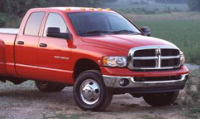
Was the 5.9l 360 only offered in 02 3rd gen?


Thread Starter
|
Professional
Joined: Mar 2008
Posts: 190
Likes: 1
From: South East Mo
 RE: Was the 5.9l 360 only offered in 02 3rd gen?
Well that sucks for trying to find performance parts. At least I did find the paxton supercharger though. If I wanted to pay half of what the truck cost for it...
I gotta do something though. This truck is way to underpowered to even be enjoyable. Especially getting 10mpg.
I gotta do something though. This truck is way to underpowered to even be enjoyable. Especially getting 10mpg.


Veteran
Joined: Mar 2008
Posts: 416
Likes: 0
From:
RE: Was the 5.9l 360 only offered in 02 3rd gen?
dude, be happy with that 360..right now its possible to build up a 360 cheaper than it is a hemi. There was a time I thought about pulling my hemi and having a 360 made into a stroker, then drop that in my truck....check jegs.com summitracing.com they all have stuff for the 360, from what I understand you can even get hemi heads for a 360..check the dakota r/t forums, they will be able to answer any question you have about the 360. There is ALOT available for you.

Administrator
Joined: Jul 2007
Posts: 24,686
Likes: 21
From: South Georgia/East Florida
RE: Was the 5.9l 360 only offered in 02 3rd gen?
The LA 318 (5.2) and 360 (5.9) and later "Magnum" engines are among the longest lived engines ever to remain in production. They debuted in the early 70's and remained a constant, although upgraded every few years, until the 5.9 was replaced by the Hemi in 2003.
There are a plethora of parts andbuild up kits available for them both and the earlier versions (before so much aluminum was introduced into them to save weight) are among the longest lived, most reliable engines ever offered, by any automaker...
There are a plethora of parts andbuild up kits available for them both and the earlier versions (before so much aluminum was introduced into them to save weight) are among the longest lived, most reliable engines ever offered, by any automaker...
Administrator
Joined: Jul 2007
Posts: 24,686
Likes: 21
From: South Georgia/East Florida
RE: Was the 5.9l 360 only offered in 02 3rd gen?
Here is some interesting reading about your Magnum 5.9L engine:
The 360 first appeared in 1971, with a two barrel carb. The 360 was relatively tame through 1974, when it received some 340 performance parts and a four-barrel carb. In recent years, the 360 has been Chrysler's performance truck engine, making the Grand Cherokee 5.9 Limited the fastest SUV and powering top-of-the-line Dakotas and Durangos. For some time, the 360 was also used as a 340 substitute in vehicles such as patrol cars and the Volare Roadrunner. In 1987, a number of 360s were used in Diplomats and Gran Furys; some say that some of these engines were labelled as 318s, but that's a tough one to track down.
Vince Spinelli and Jack Perkins added: “There are squad car heads, and there are interceptor heads. Squad car (cruiser) heads are 360 heads with little to no modification depending on whom you talk to. Interceptor heads are high compression heads, identical in every way to standard 318 heads of the era, but with a smidge tighter combustion chamber. Compression works out to high 9s to 1, as opposed to the standard 318 head at about 8.5 to 1. Interceptor heads also have slightly large valve aperatures.”
Dave Lyle expanded on this: “The heads that came in cop cars were J heads, and they were essentially the same as regular 360 heads, except for bigger intake valves (1.88) and better springs.”
In 1978, Chrysler wrote: “This is a larger displacement version of the compact 318 V-8. The cylinder bore is 4.00" (compared with 3.91" for the 318), and the stroke is 3.58" (compared with 3.31" for the 318). The extra displacement gives the 360 V-8 more horsepower and torque than the 318. Valve timing, valve lift and length of time the valves remain open are carefully engineered for low emissions, power, and smooth operation at all speeds. Hydraulic valve lifters require no periodic adjustments. This engine has a single exhaust system. The camshaft is designed to seat the valves smoothly to decrease the possibility of valve bounce and the stress it causes in valve stems.” In 1978, the 360 gained dual concentric throttle return springs in addition to a torsion throttle spring.
The 1978 California version “comes equipped with an air pump as well as a catalytic converter. It can be ordered for use at low altitudes and outside the state of California, but only with the N96 emission-control package. All versions of this engine are equipped with a single exhaust.”
See the 318 section for changes to the 360 in 1989, when it switched to roller cams and throttle-body fuel injection; and see the Magnum section, later in this page, for details on the "5.9" or 360 Magnum engines.
All 360 production was movedto Mexico in 1980, according to Rodolfo Rodriguez. United States use of the 360 ended in December 2002.
The 360 first appeared in 1971, with a two barrel carb. The 360 was relatively tame through 1974, when it received some 340 performance parts and a four-barrel carb. In recent years, the 360 has been Chrysler's performance truck engine, making the Grand Cherokee 5.9 Limited the fastest SUV and powering top-of-the-line Dakotas and Durangos. For some time, the 360 was also used as a 340 substitute in vehicles such as patrol cars and the Volare Roadrunner. In 1987, a number of 360s were used in Diplomats and Gran Furys; some say that some of these engines were labelled as 318s, but that's a tough one to track down.
Vince Spinelli and Jack Perkins added: “There are squad car heads, and there are interceptor heads. Squad car (cruiser) heads are 360 heads with little to no modification depending on whom you talk to. Interceptor heads are high compression heads, identical in every way to standard 318 heads of the era, but with a smidge tighter combustion chamber. Compression works out to high 9s to 1, as opposed to the standard 318 head at about 8.5 to 1. Interceptor heads also have slightly large valve aperatures.”
Dave Lyle expanded on this: “The heads that came in cop cars were J heads, and they were essentially the same as regular 360 heads, except for bigger intake valves (1.88) and better springs.”
In 1978, Chrysler wrote: “This is a larger displacement version of the compact 318 V-8. The cylinder bore is 4.00" (compared with 3.91" for the 318), and the stroke is 3.58" (compared with 3.31" for the 318). The extra displacement gives the 360 V-8 more horsepower and torque than the 318. Valve timing, valve lift and length of time the valves remain open are carefully engineered for low emissions, power, and smooth operation at all speeds. Hydraulic valve lifters require no periodic adjustments. This engine has a single exhaust system. The camshaft is designed to seat the valves smoothly to decrease the possibility of valve bounce and the stress it causes in valve stems.” In 1978, the 360 gained dual concentric throttle return springs in addition to a torsion throttle spring.
The 1978 California version “comes equipped with an air pump as well as a catalytic converter. It can be ordered for use at low altitudes and outside the state of California, but only with the N96 emission-control package. All versions of this engine are equipped with a single exhaust.”
See the 318 section for changes to the 360 in 1989, when it switched to roller cams and throttle-body fuel injection; and see the Magnum section, later in this page, for details on the "5.9" or 360 Magnum engines.
All 360 production was movedto Mexico in 1980, according to Rodolfo Rodriguez. United States use of the 360 ended in December 2002.
Trending Topics
Thread Starter
|
Professional
Joined: Mar 2008
Posts: 190
Likes: 1
From: South East Mo
RE: Was the 5.9l 360 only offered in 02 3rd gen?
Sooo. I have a 318 or a mexican 360? I wish I knew more about stroker kits and heads and all that good ****. It gets very confusing to me.
I read that last part wrong. So I have the last of the production 360s? I'm not sure how I should feel about that...
I read that last part wrong. So I have the last of the production 360s? I'm not sure how I should feel about that...
Administrator
Joined: Jul 2007
Posts: 24,686
Likes: 21
From: South Georgia/East Florida
RE: Was the 5.9l 360 only offered in 02 3rd gen?
Although the 5.9's have about 100 HP less output than the Hemi (although roughly the same torque) AND get worse gas mileage, I wouldn't worry too much about it failing you. The Magnums are not considered as reliable as the earlier "LA's", because some good old fashioned, strong steel/iron components were changed to aluminum ones in the Magnums (mainly in the heads) for weight and fuel consumption considerations. Cracked heads and block issues are more common in this newer version.
But just because they are more common, still doesn't mean they are very common. If you take care of it, you should get many more years of reliable service out of it. I had a '98 RCSB 4x4 with the Magnum 5.9 in it and when I traded it with 69k miles on it, it had never had a single issue. I've got ahunting/off-road buddywith a '96 with about 240,000 miles on it, he's on tranny #3, but aside from a couple water pumps and a fuel pump replacement,it's still running strong...
But just because they are more common, still doesn't mean they are very common. If you take care of it, you should get many more years of reliable service out of it. I had a '98 RCSB 4x4 with the Magnum 5.9 in it and when I traded it with 69k miles on it, it had never had a single issue. I've got ahunting/off-road buddywith a '96 with about 240,000 miles on it, he's on tranny #3, but aside from a couple water pumps and a fuel pump replacement,it's still running strong...

Champion
Joined: Aug 2005
Posts: 3,313
Likes: 8
RE: Was the 5.9l 360 only offered in 02 3rd gen?
The Magnum 5.9 V8 is
according to Chrysler's press release
about 8 to 12% less fuel efficient
than the 5.7
The 2002+ Ram body
has about a 0.528 aerodynamic Cd
compared to the 0.42 to 0.47 aerodynamic Cd
of the 1994 to 2001 Rams body
So a 2002 or 2003 with a 5.9V8
has 'the worst of both worlds'
as far as highway MPG is concerned
Car and Driver did a one year test on one:
http://www.caranddriver.com/reviews/...term_road_test
according to Chrysler's press release
about 8 to 12% less fuel efficient
than the 5.7
The 2002+ Ram body
has about a 0.528 aerodynamic Cd
compared to the 0.42 to 0.47 aerodynamic Cd
of the 1994 to 2001 Rams body
So a 2002 or 2003 with a 5.9V8
has 'the worst of both worlds'
as far as highway MPG is concerned
Car and Driver did a one year test on one:
http://www.caranddriver.com/reviews/...term_road_test