


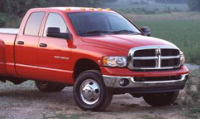
Factory 3.92 gears with 285/17/70 Cooper ATRS


Champion
Joined: Aug 2005
Posts: 3,313
Likes: 8

Notice that you can actually INCREASE
your maximum towing rating
while at the same time INCREASING MPG
if you use a differential ratio as low as 3.08
with the right 6 speed transmission:
Notice who ordered this done
Engineer, Marine Fighter Pilot, father of the 2nd Gen Ram pickup
"Maximum Bob" Lutz
(who was 'golden parachuted' away from Chrysler by Germans)
http://jalopnik.com/400237/chevy-gmc...yukon-for-2009
sample quote
GM's more efficient full-size pickups and SUVs are powered by a 5.3L FlexFuel V-8 (LC9) engine that's built with a mass-reducing aluminum cylinder block and heads. It is rated at 315 hp/235 kW and 338 lb-ft/458 Nm in Silverado and Sierra.
The engine is backed by a Hydra-Matic 6L80 six-speed automatic transmission (with high-capacity cooling on Silverado and Sierra).
A rear axle equipped with a fuel-saving 3.08 ratio is also standard on all XFE models. Lightweight aluminum wheels and low rolling resistance tires (with higher tire pressure) also are included on all models.
Other unique content and features for Silverado XFE and Sierra XFE include:
Soft tonneau cover (improves aerodynamics)
Extended front lower air dam (improves aerodynamics)
Lowered suspension and revised chassis tuning (improve aerodynamics)
Aluminum lower control arms (reduce mass)
Aluminum spare wheel (reduces mass)
Seventeen-inch aluminum wheels (reduce mass)
Automatic locking rear differential
Trailering package
Low rolling resistance tires
your maximum towing rating
while at the same time INCREASING MPG
if you use a differential ratio as low as 3.08
with the right 6 speed transmission:
Notice who ordered this done
Engineer, Marine Fighter Pilot, father of the 2nd Gen Ram pickup
"Maximum Bob" Lutz
(who was 'golden parachuted' away from Chrysler by Germans)
http://jalopnik.com/400237/chevy-gmc...yukon-for-2009
sample quote
GM's more efficient full-size pickups and SUVs are powered by a 5.3L FlexFuel V-8 (LC9) engine that's built with a mass-reducing aluminum cylinder block and heads. It is rated at 315 hp/235 kW and 338 lb-ft/458 Nm in Silverado and Sierra.
The engine is backed by a Hydra-Matic 6L80 six-speed automatic transmission (with high-capacity cooling on Silverado and Sierra).
A rear axle equipped with a fuel-saving 3.08 ratio is also standard on all XFE models. Lightweight aluminum wheels and low rolling resistance tires (with higher tire pressure) also are included on all models.
Other unique content and features for Silverado XFE and Sierra XFE include:
Soft tonneau cover (improves aerodynamics)
Extended front lower air dam (improves aerodynamics)
Lowered suspension and revised chassis tuning (improve aerodynamics)
Aluminum lower control arms (reduce mass)
Aluminum spare wheel (reduces mass)
Seventeen-inch aluminum wheels (reduce mass)
Automatic locking rear differential
Trailering package
Low rolling resistance tires

Rookie
Joined: Feb 2008
Posts: 55
Likes: 0
One comment about better towing in the higher gear ranges is this. On stock Dodge 2500's the gear ratio is 3:73 and on the 1500's it is 3:96.
I asked my Brother-in-law about this and his comment was that the 3:73 gears most likely are heavier duty parts than the 3:96. However, he quickly commented that he has no direct knowledge of such and was simply guessing.
I asked my Brother-in-law about this and his comment was that the 3:73 gears most likely are heavier duty parts than the 3:96. However, he quickly commented that he has no direct knowledge of such and was simply guessing.

Registered User
Joined: Jul 2008
Posts: 37
Likes: 0
From: Midland, MI / Charlotte, NC / WPB, FL
I understand how gears affect power. What I am saying is I just want to know where the number came from because tires do not affect gear ratio as a number. The crank->transmission->pinion->ring-gear still turn the exact same amount of times to make one revolution of the wheel/tire. I can understand that larger tires without changing gears may feels much like stock tires will a lower numerical ratio. I just want to know where the number came from.
it's a theoretical reduction in gearing. not that you are actually getting a lower gear ratio, but making it feel as though you are now undergeared by having a larger tire... by going from a 31" to a 33", it'll make it feel as though you now have undergeared your truck. the shorted gearing will give the truck a more stocklike feel and return the lost power.
you are right that the actual gear ratio has not changed, and will not change till someone actually goes in a physically changes.

Administrator
Joined: Jul 2007
Posts: 24,686
Likes: 21
From: South Georgia/East Florida
That's why it's commonly referred to as "Effective Gear Ratio", look back to the formula I posted:
Effective Gear Ratio = Original Tire Size/New Tire Size X Axle Gear Ratio
Effective Gear Ratio = Original Tire Size/New Tire Size X Axle Gear Ratio
Champion
Joined: Aug 2005
Posts: 3,313
Likes: 8
the following has been in the FAQ for several years:
-----
Gearing
Before discussing gearing, one tip to beginners is to drop all
confusing talk of 3.55/3.92/4.10 differential ratios, tire heights,
'effective' ratios, and so forth. It is much less confusing in the long run
to talk about gearing in terms of vehicle speed per 1000 rpm. This is
especially true if the tires have been changed out from the typical 30
inches of factory installed rubber to the 34-38 inch diameter that some
"My self esteem is low but my truck is the tallest"
Ram owners install on ridiculously lifted & unsafe pickups that seldom
if ever leave the blacktop.
If your stock Ram in top gear was showing 1500 rpm on the tachometer
when the speedometer was showing 60 mph, then your gearing was (60/1.5)
or 40 mph per 1000 rpm. This way it is easy to see that if you speeded up
to where your tachometer was showing 2000 rpm, you would be at 80 mph.
In a similar way if you turned your OD off and dropped down to 'direct drive'
third gear you can find the mph/1000 rpm for that gear too. If the tach now
read 2250 rpm at a speed of 60 mph, the gearing for your truck's third gear
is (60/2.250) or about 27 mph per 1000 rpm. You can quickly see that at
4000 rpm you would be going about 108 mph.
It is worthwhile finding this out for all your transmission's gears.
Even better, find out for yourself
where your engine's rpm of
Maximum Torque, then
Maximum Horsepower,
falls in speed (MPH) for each of the transmission's gears.
At this point after figuring out your truck's gearing you should notice that
Dodge engineers felt that to get best MPG at highway cruise the top gearing
needs to be at least around 40 mph/1000rpm or more,
and for acceleration in most "real world" conditions second gear should be
about 17 mph/1000 rpm - which puts second gear at about 30 mph at 1800
rpm where the unlocked torque converter is designed to 'stall' and goes up
to around 90 mph in the 6000 rpm range when you take into account
the percent slip of the unlocked torque converter at high horsepower.
Keep these numbers of 40 and 17 in mind if you intend to modify your
truck's tire sizes or differential gears later. If you have an interest, I
suggest you figure out for yourself what MPH/1000 rpm you should have
in 2nd gear if you want your 0-60 time to be the fastest possible - here
60 mph should occur near your "redline" rpm but you should figure in about
8% slip in the torque converter. In a similar way you can guess where
your quarter mile terminal speed will be and what MPH/1000 rpm
would be best for overall gearing if winning at the dragstrip was at the top
of your wishlist. Should that gear be 3rd or Overdrive 4th?
Now lets discuss gearing and fuel economy.
In city driving gearing doesn't matter nearly as much as not having a
'heavy foot' or hauling a lot of weight in the bed of the truck.
A vehicle that is either overgeared or undergeared will lose MPG at highway
cruise.
An engine is numerically overgeared if it is not cruising at about
60-75% open throttle.
An engine is undergeared and "too weak for the job"
if it has to operate with its pistons going faster than an average of about
1200 feet per minute when at 75% throttle.
Note that you could reduce engine weakness by turbocharging
as well as the much more common thought to just make the engine larger in
cubic inches. This is the reason nearly all diesels have become turbocharged
in the last 20 years.
How do you calculate this average piston speed?
Multiply the stroke of the engine in inches by two (because the piston goes
both up and down on one rpm) and then divide by 12 to convert inches to
feet. Multiply this by the rpm.
So where does 1200 feet per minute end up for various engines?
Here some examples:
For the 3.58 stroke of 3.7, 5.7, 5.9 Dodge engines:
2011 rpm = 1200 ft/min /( 2 x 3.58 inches/12 inches per ft)
For the 3.405 stroke of the Dodge 4.7V8
2114 rpm = 1200/(2x3.405/12)
For the 3.00 stroke of the Ford 5.0L V8
2400 rpm = 1200/(2x3.00/12)
For the 4.72 stroke of the Cummins Inline 6 diesel
1525 rpm = 1200/(2x4.72/12)
Is it possible for an engine to be made to get its best fuel economy at a
piston speed above the typical 1200 feet per minute?
Yes.
Very thin piston rings, using less than the normal 3 rings,
slippery coatings on piston skirts, extremely hard but slick coatings
on bore walls like "NikoSil" and keeping the bore walls very hot
so that the oil there will be thin and less viscous can all allow the
'best economy' piston speed to be raised but even 'state of the art'
giant marine diesel where nearly every trick is used seldom exceed
1500 feet per minute.
Honda has announced that over the next 5 year period that the major
part of their engine research $ will be spent on ways to reduce internal
engine friction, and this is from a company that NASCAR engine builders
already admit has the best rod and crankshaft bearing material for sale.
Which is more important: having the rpms near this 1200 foot per minute
speed for the pistons, or having the throttle in the 65-75% open range?
Answer: it is more important to be in the 70% throttle range and you should
slow down the rpms to get there. There is not much change in efficiency
when piston speed drops from 1200 down to 800 ft/minute but there is a big
change in efficiency when the throttle goes from 70% open to 40% open.
Why?
Imagine that you have a disassembled engine in front of you. Put a loose
piston in a bore and pull it down against the friction of the rings. It won't
be very hard. Now imagine that same piston in the bore has the top of the
bore sealed off and has a vacuum sucked of 12 inches of Mercury.
12 inches of vacuum is about 6 psi of negative pressure. If the piston is
4.00 inches in diameter it has an area of about 12.5 square inches
(remember pi R squared but most cherry pies are round?)
6 pounds per square inch times 12.5 square inches = 75 pounds would be
required to pull the piston down - you probably couldn't do it with the grip
of just a couple fingers! An engine running with a high vacuum in the intake
manifold has to do just this, and for eight cylinders!
Engineers refer to this as one of the two parts of "Pumping Losses". The
other part of Pumping Losses is due to pushing the exhaust out the tailpipe.
Most engine owners easily imagine that exhaust loss, accept it, and spend
a lot of time and money on mufflers, headers, Y pipes etc. These same
engine owners would do well to remember the "Pumping Loss" on the intake side
and try to keep it low during highway cruise conditions.
-----
Gearing
Before discussing gearing, one tip to beginners is to drop all
confusing talk of 3.55/3.92/4.10 differential ratios, tire heights,
'effective' ratios, and so forth. It is much less confusing in the long run
to talk about gearing in terms of vehicle speed per 1000 rpm. This is
especially true if the tires have been changed out from the typical 30
inches of factory installed rubber to the 34-38 inch diameter that some
"My self esteem is low but my truck is the tallest"
Ram owners install on ridiculously lifted & unsafe pickups that seldom
if ever leave the blacktop.
If your stock Ram in top gear was showing 1500 rpm on the tachometer
when the speedometer was showing 60 mph, then your gearing was (60/1.5)
or 40 mph per 1000 rpm. This way it is easy to see that if you speeded up
to where your tachometer was showing 2000 rpm, you would be at 80 mph.
In a similar way if you turned your OD off and dropped down to 'direct drive'
third gear you can find the mph/1000 rpm for that gear too. If the tach now
read 2250 rpm at a speed of 60 mph, the gearing for your truck's third gear
is (60/2.250) or about 27 mph per 1000 rpm. You can quickly see that at
4000 rpm you would be going about 108 mph.
It is worthwhile finding this out for all your transmission's gears.
Even better, find out for yourself
where your engine's rpm of
Maximum Torque, then
Maximum Horsepower,
falls in speed (MPH) for each of the transmission's gears.
At this point after figuring out your truck's gearing you should notice that
Dodge engineers felt that to get best MPG at highway cruise the top gearing
needs to be at least around 40 mph/1000rpm or more,
and for acceleration in most "real world" conditions second gear should be
about 17 mph/1000 rpm - which puts second gear at about 30 mph at 1800
rpm where the unlocked torque converter is designed to 'stall' and goes up
to around 90 mph in the 6000 rpm range when you take into account
the percent slip of the unlocked torque converter at high horsepower.
Keep these numbers of 40 and 17 in mind if you intend to modify your
truck's tire sizes or differential gears later. If you have an interest, I
suggest you figure out for yourself what MPH/1000 rpm you should have
in 2nd gear if you want your 0-60 time to be the fastest possible - here
60 mph should occur near your "redline" rpm but you should figure in about
8% slip in the torque converter. In a similar way you can guess where
your quarter mile terminal speed will be and what MPH/1000 rpm
would be best for overall gearing if winning at the dragstrip was at the top
of your wishlist. Should that gear be 3rd or Overdrive 4th?
Now lets discuss gearing and fuel economy.
In city driving gearing doesn't matter nearly as much as not having a
'heavy foot' or hauling a lot of weight in the bed of the truck.
A vehicle that is either overgeared or undergeared will lose MPG at highway
cruise.
An engine is numerically overgeared if it is not cruising at about
60-75% open throttle.
An engine is undergeared and "too weak for the job"
if it has to operate with its pistons going faster than an average of about
1200 feet per minute when at 75% throttle.
Note that you could reduce engine weakness by turbocharging
as well as the much more common thought to just make the engine larger in
cubic inches. This is the reason nearly all diesels have become turbocharged
in the last 20 years.
How do you calculate this average piston speed?
Multiply the stroke of the engine in inches by two (because the piston goes
both up and down on one rpm) and then divide by 12 to convert inches to
feet. Multiply this by the rpm.
So where does 1200 feet per minute end up for various engines?
Here some examples:
For the 3.58 stroke of 3.7, 5.7, 5.9 Dodge engines:
2011 rpm = 1200 ft/min /( 2 x 3.58 inches/12 inches per ft)
For the 3.405 stroke of the Dodge 4.7V8
2114 rpm = 1200/(2x3.405/12)
For the 3.00 stroke of the Ford 5.0L V8
2400 rpm = 1200/(2x3.00/12)
For the 4.72 stroke of the Cummins Inline 6 diesel
1525 rpm = 1200/(2x4.72/12)
Is it possible for an engine to be made to get its best fuel economy at a
piston speed above the typical 1200 feet per minute?
Yes.
Very thin piston rings, using less than the normal 3 rings,
slippery coatings on piston skirts, extremely hard but slick coatings
on bore walls like "NikoSil" and keeping the bore walls very hot
so that the oil there will be thin and less viscous can all allow the
'best economy' piston speed to be raised but even 'state of the art'
giant marine diesel where nearly every trick is used seldom exceed
1500 feet per minute.
Honda has announced that over the next 5 year period that the major
part of their engine research $ will be spent on ways to reduce internal
engine friction, and this is from a company that NASCAR engine builders
already admit has the best rod and crankshaft bearing material for sale.
Which is more important: having the rpms near this 1200 foot per minute
speed for the pistons, or having the throttle in the 65-75% open range?
Answer: it is more important to be in the 70% throttle range and you should
slow down the rpms to get there. There is not much change in efficiency
when piston speed drops from 1200 down to 800 ft/minute but there is a big
change in efficiency when the throttle goes from 70% open to 40% open.
Why?
Imagine that you have a disassembled engine in front of you. Put a loose
piston in a bore and pull it down against the friction of the rings. It won't
be very hard. Now imagine that same piston in the bore has the top of the
bore sealed off and has a vacuum sucked of 12 inches of Mercury.
12 inches of vacuum is about 6 psi of negative pressure. If the piston is
4.00 inches in diameter it has an area of about 12.5 square inches
(remember pi R squared but most cherry pies are round?)
6 pounds per square inch times 12.5 square inches = 75 pounds would be
required to pull the piston down - you probably couldn't do it with the grip
of just a couple fingers! An engine running with a high vacuum in the intake
manifold has to do just this, and for eight cylinders!
Engineers refer to this as one of the two parts of "Pumping Losses". The
other part of Pumping Losses is due to pushing the exhaust out the tailpipe.
Most engine owners easily imagine that exhaust loss, accept it, and spend
a lot of time and money on mufflers, headers, Y pipes etc. These same
engine owners would do well to remember the "Pumping Loss" on the intake side
and try to keep it low during highway cruise conditions.


I Beat Tetris
Joined: Jan 2008
Posts: 2,953
Likes: 2
From: Orlando
You know the less you post, the more intelligent you sound? Maybe you should learn some physics, and learn to look up information somewhere other than the Federal Bureau for Pulling Statistics Out of your ***. With your combination of ignorance and arrogance, you ought quit your job as a mechanic and run for congress.
Last edited by Pyro; Aug 19, 2008 at 03:13 PM.
