


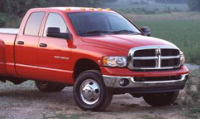
HEMI what octane gas do you use????


Joined: Mar 2005
Posts: 35
Likes: 0
From:
 RE: HEMI what octane gas do you use????
well i've only used 87 since i've gotten the truck. i dont see a reason to put anything above since i run through it in a week. i'm not spending extra money on some gas that is states in the manual 87 and above will work. plus i have a warrenty so if anything screws up then dogde can fix it. i like the style of the truck, but have been displeased with the proformace of the truck. mine has been the shop 4 times in the past 2 months. the had to fix my doors (weren't aligned right), side mirror has already been replaced b/c of loud noise of the mirror (sounds like motor), & 2 times for the dying of my truck just sitting (replaced a senor in the gas pedal & flashed my computer the 2nd). my truck only had 9 miles on it when i got it in Nov. & its at 7,000 now.

Professional
Joined: Feb 2005
Posts: 122
Likes: 0
From:
RE: HEMI what octane gas do you use????
You didn't read your manual thoroughly. 2005 states 87 octane. I find that Shell produces the best MPG .3-.5 mpg greater than other brands. Since all gas is $2.00 a gallon why would anyone not buy a brand?

Amateur
Joined: Dec 2004
Posts: 29
Likes: 0
From:
RE: HEMI what octane gas do you use????
ORIGINAL: goodestuff
i go onpost for my gas. so if they have bad gas guess who's paying for my car (government)?
i go onpost for my gas. so if they have bad gas guess who's paying for my car (government)?
If there's a question about the quality of gas on-base, I'd rather get it off-base. In fact, I get my gas local (Leesburg, VA). My wife got her gas at Ft. Belvoir the other day and stated their 87oct gas was like $2.09/gal or something like that. I got Sunoco 87oct for $1.99/gal, so there is good, cheap gas (cheaper than gov't gas) to be found, depending on where you live.
Joined: Mar 2005
Posts: 35
Likes: 0
From:
RE: HEMI what octane gas do you use????
don't know who you've dealt with, but you need to know where to go if you seem to have a problem with the gov. paying. they had a few months back where the onpost gas had alot of water or something in it, so they had to fix some cars & of course fix the problem. PCS moves we've had broken stuff, but the military has always paid. don't stop your complaints at one place, if need be go to IG. they take care of alot of things. i don't mess with little people if i feel they can't accomplish the problem i have, i go up.

Rookie
Joined: Jan 2005
Posts: 87
Likes: 0
From:
RE: HEMI what octane gas do you use????
Silver Eagle - I was taught in college that Heptane was the portion of galoline that made up the other % of octane; i.e. 87 octane was comprise of 87% iso-octane and heptane 13%. Since, as you say heptane has an octane rating of 0, it makes sense. I looked up heptane in the Shell Web page since a few guys were throwing that name around and here's what I found.
and from Chemical & Enigineering under Scinece and Technology
The C4-C8 straight-chain alkanes refered to above are heptanes. Here's the chemical make-up of normal heptane:
----H H H H H H H
----| | | | | | |
H -C-C- C-C-C- C- C- H
----| | | | | | |
----H H H H H H H
normal heptane
All the reading I've been doing suggests that n-heptane is still being used as the counter part to iso-octane as well as a bunch of other crap like for EPA standards in our major cities.
Iso-octane
Often and misleadingly referred to in industry jargon simply as "octane", which results in confusion with a fuel's octane number or anti-knock capability. Iso-octane is an actual substance. An engine's octane number is determined by comparing a test engine's knocking (or lack of knocking) while burning a measured blend of iso-octane, whose octane equivalent is arbitrarily defined as 100, and n-heptane, whose octane equivalent is zero. To avoid confusion, remember that you can pour iso-octane but you can't pour octane because it's simply a number.
Often and misleadingly referred to in industry jargon simply as "octane", which results in confusion with a fuel's octane number or anti-knock capability. Iso-octane is an actual substance. An engine's octane number is determined by comparing a test engine's knocking (or lack of knocking) while burning a measured blend of iso-octane, whose octane equivalent is arbitrarily defined as 100, and n-heptane, whose octane equivalent is zero. To avoid confusion, remember that you can pour iso-octane but you can't pour octane because it's simply a number.
and from Chemical & Enigineering under Scinece and Technology
Gasoline in the U.S. is usually blended from straight run gasoline, reformate, alkylate, and some butane. The approximate composition is 15% C4–C8 straight-chain alkanes, 25 to 40% C4–C10 branched alkanes, 10% cycloalkanes, less than 25% aromatics (benzene less than 1.0%), and 10% straight-chain and cyclic alkenes.
----H H H H H H H
----| | | | | | |
H -C-C- C-C-C- C- C- H
----| | | | | | |
----H H H H H H H
normal heptane
All the reading I've been doing suggests that n-heptane is still being used as the counter part to iso-octane as well as a bunch of other crap like for EPA standards in our major cities.


3rd gen Ram, Newbies
Joined: May 2008
Posts: 3,815
Likes: 0
From: Chicago
RE: HEMI what octane gas do you use????
cuz they're idiots and are just telling you whats in the manual. no joke, that's the real reason. it's not going to hurt you at all if you put in 91 instead of 89.
