


Why are tires over 35" bad on a IFS


Administrator
Joined: Jul 2007
Posts: 24,686
Likes: 21
From: South Georgia/East Florida

Just out of curiosity, Did you all know you were going to lift the truck when you purchased it? IMO, if I knew I was going to lift it bigger than 4" I would probably got a 2500 or 3500 long bed. That way you have all the beef when it comes to the extra weight. Luckdt.. Your truck looks badass as it sits, the proportions look good with the tire to lift size. Id say leave it.
When I bought my '04 new off the showroom floor I had just come off having a 2nd Gen 1500, which was a SFA truck which came after a Furd diesel (also a SFA truck).
I knew I didn't need a 3/4 ton truck as the heaviest thing I had to tow was a 2700 lb. bass boat and trailer combo. I knew the 3rd Gen 1500s were IFS, but never stopped to consider the "shortcomings" it would present.
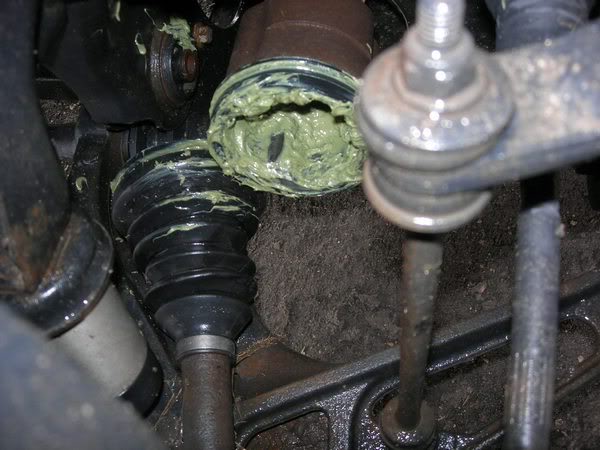
CV axles or "half shafts" are designed for a car like ride and do not have the strength for large tires. Not only does the weight of the tire wear on them, but also just the physics of a larger rolling diameter and torque applied to the ground by such a tire. Obviously 'Weed and the 4x2 owners don't have a CV to worry about, but they will still wear out components at a faster rate.
Can you "get away" with running a large tire? Sure... But even a 35" tire will wear front end components faster than a stock tire and still may cause a CV joint to break ESPECIALLY if the angle of the CV is increased via a leveling kit or poorly designed suspension lift.
The larger you go, the greater the chances of failure.
Obviously a "pavement queen" running large tires is less apt to have a catastrophic failure than someone who uses his 4 wheel drive as it was intended to be used, but you'll still wear component much faster.
If you can change out ball joints, tie rods and CV axles in the field, you probably should carry a spare if you intend to go large with an IFS truck.
If you can fix this in the field or have deep pockets, then go for it...


Professional
Joined: Feb 2010
Posts: 139
Likes: 1
From: New Bedford MA
weedaho have you ever had any issued with your front end since the lift / tires

Champion
Joined: Nov 2005
Posts: 2,875
Likes: 1
From: North Eastern England
It's interesting that a lot of people mention that the IFS front ends are weak and should not use 35's, because of this reason.
A lot of people re-gear their trucks to take into account these heavier weights and also fit either a DTT or an Aurburn LSD at the same time, to maximise traction and get rid of the crappy stock LSD.
If you look at the DTT LSD, they also have a size restriction for tyres as well.
I can't remember what it is, but it's clearly written in the DTT instructions not to run oversized wheels and tyres with their unit.
I have as yet to here of anyone having a failure with the DTT, for running oversize tyres and wheels though.
Al.
A lot of people re-gear their trucks to take into account these heavier weights and also fit either a DTT or an Aurburn LSD at the same time, to maximise traction and get rid of the crappy stock LSD.
If you look at the DTT LSD, they also have a size restriction for tyres as well.
I can't remember what it is, but it's clearly written in the DTT instructions not to run oversized wheels and tyres with their unit.
I have as yet to here of anyone having a failure with the DTT, for running oversize tyres and wheels though.
Al.

Administrator
Joined: Jul 2007
Posts: 24,686
Likes: 21
From: South Georgia/East Florida
It's interesting that a lot of people mention that the IFS front ends are weak and should not use 35's, because of this reason.
A lot of people re-gear their trucks to take into account these heavier weights and also fit either a DTT or an Aurburn LSD at the same time, to maximise traction and get rid of the crappy stock LSD.
If you look at the DTT LSD, they also have a size restriction for tyres as well.
I can't remember what it is, but it's clearly written in the DTT instructions not to run oversized wheels and tyres with their unit.
I have as yet to here of anyone having a failure with the DTT, for running oversize tyres and wheels though.
Al.
A lot of people re-gear their trucks to take into account these heavier weights and also fit either a DTT or an Aurburn LSD at the same time, to maximise traction and get rid of the crappy stock LSD.
If you look at the DTT LSD, they also have a size restriction for tyres as well.
I can't remember what it is, but it's clearly written in the DTT instructions not to run oversized wheels and tyres with their unit.
I have as yet to here of anyone having a failure with the DTT, for running oversize tyres and wheels though.
Al.
DTT spec's not to use the product with tires over 33", although I know of guys with 37s who have one and don't have any issues.
Discussed this with an Auburn rep at a truck show a few years ago who stated that he knew of no restrictions for tire size, although he stated that the more the unit engaged on larger tires, the faster the clutch packs would wear.

Thread Starter
|
Professional
Joined: Aug 2007
Posts: 230
Likes: 0
From: New Orleans, LA
So if you mainly use your truck as a pavement queen, you shouldn't have much wear and tear on the CV joints but it will wear on other things. I've got a little bit of skills but it's basically a drive way mechanic kind of thing. I read a book or a forum post and will attempt to fix anything except major engine work. Can someone give me some pics of what parts I should be looking at under my truck to see if there is any wear on them? Like I said earlier I'm not looking for new tires right now but when I do I would really think of going up to 37s as I really don't go off road very much.
And on a side note, I have had my Cooper STTs for over 3 years and have driven over 40k miles on them and I still have more than a 1/4" of tread left on em. They are pretty quiet on the road at 70+ mph compared to other mud tires that I've heard.
And on a side note, I have had my Cooper STTs for over 3 years and have driven over 40k miles on them and I still have more than a 1/4" of tread left on em. They are pretty quiet on the road at 70+ mph compared to other mud tires that I've heard.

Record Breaker
Joined: Nov 2008
Posts: 1,751
Likes: 0
From: Dayton, Ohio
So if you mainly use your truck as a pavement queen, you shouldn't have much wear and tear on the CV joints but it will wear on other things. I've got a little bit of skills but it's basically a drive way mechanic kind of thing. I read a book or a forum post and will attempt to fix anything except major engine work. Can someone give me some pics of what parts I should be looking at under my truck to see if there is any wear on them? Like I said earlier I'm not looking for new tires right now but when I do I would really think of going up to 37s as I really don't go off road very much.
And on a side note, I have had my Cooper STTs for over 3 years and have driven over 40k miles on them and I still have more than a 1/4" of tread left on em. They are pretty quiet on the road at 70+ mph compared to other mud tires that I've heard.
And on a side note, I have had my Cooper STTs for over 3 years and have driven over 40k miles on them and I still have more than a 1/4" of tread left on em. They are pretty quiet on the road at 70+ mph compared to other mud tires that I've heard.
Administrator
Joined: Jul 2007
Posts: 24,686
Likes: 21
From: South Georgia/East Florida
I'd say to a point, the chances of snapping a CV would be less on pavement than when wheeling, because certain situations would put more torque on the tires, however it's the angle of the shafts that are at issue. I wouldn't discount snapping one just because you don't off-road.
I'm not saying you can't run a 37" tire, just making y'all aware of the increased maintenance cost and the likelihood of having a major failure. Guys do it and don't have problems, but the chances are greater and increase over time as components wear at a much faster rate...
I'm not saying you can't run a 37" tire, just making y'all aware of the increased maintenance cost and the likelihood of having a major failure. Guys do it and don't have problems, but the chances are greater and increase over time as components wear at a much faster rate...
Last edited by HammerZ71; Aug 4, 2010 at 03:13 PM.
![[meph]'s Avatar](https://dodgeforum.com/forum/customavatars/avatar143384_3.gif)
Professional
Joined: Aug 2010
Posts: 120
Likes: 0
From: indiana
my cv's are actually VERY close to being parallel with the ground and i'm at 8" of suspension lift out front, and i'm not too worried about them breaking considering i rarely even use the 4wd. now, if i'm playin in the mud and they break, well i had that comin lol.