


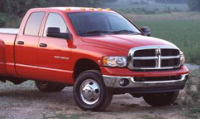
20" WHEEL SWAP


Moderate User


Joined: Oct 2008
Posts: 17,003
Likes: 21
From: Albany, NY

Not according to Dodge, I've had this conversation with an engineer in a chat room. I also had a guide from the insurance underwriters association that insurance companies go by. My cousin is an exec with an insurance company and gave it to me. I'll have to see if I can get her to send me another one and I'll scan and .pdf it.
I know when I checked it, my towing capacity INCREASED with 35" tires and 4.56 gears over my stock 31.5" tires and 3.92 gears. (17" wheels in both cases).
There are other factors besides just tire diameter and it gives all different equipment scenarios, it's actually great reading because you can use it to compare just how much some companies inflate their advertised towing capacities (can you say "TOYOTA", LOL)...
But regardless, if you own a 4x4 and off-road at all (and I'm not talking hard-core, Baja stuff - I mean going through the mud or sand fishing, etc.) and you aren't running as much tire sidewall (smallest wheel to tire size) you can, then you're just being foolish, IMO. I'd be running 15" wheels with my 35" tires if they'd clear the calipers...
I know when I checked it, my towing capacity INCREASED with 35" tires and 4.56 gears over my stock 31.5" tires and 3.92 gears. (17" wheels in both cases).
There are other factors besides just tire diameter and it gives all different equipment scenarios, it's actually great reading because you can use it to compare just how much some companies inflate their advertised towing capacities (can you say "TOYOTA", LOL)...
But regardless, if you own a 4x4 and off-road at all (and I'm not talking hard-core, Baja stuff - I mean going through the mud or sand fishing, etc.) and you aren't running as much tire sidewall (smallest wheel to tire size) you can, then you're just being foolish, IMO. I'd be running 15" wheels with my 35" tires if they'd clear the calipers...
Dodge can claim whatever they want. Insurance comapnies are clueless to the whole idea.
The reason you gained with 35's is because you aided those 35's with the 4:56gears. That helped the torque numbers and lowered them on a dyno. So, you could produce the torque needed to tow at a much lower rpm than what you would have with stock gears....but I think this part you are already aware of.

Champion
Joined: Aug 2007
Posts: 4,702
Likes: 2
From: N. Florida
Not necessarily. Wheel diameter does not affect the speedo/odo.

It's the construction of the wheel itself that diminishes the towing capacity. A 17" rim has less distance at the weak points to travel to the center of the wheel. This makes them stronger. The spokes become this weak point. I'd guess if your wheel was uncut solid steel without spokes your physics may apply. But you'll never find an approved racing wheel in 20" because they are too weak to handle the load.

Registered User
Joined: Oct 2011
Posts: 6
Likes: 0
IF you have a LT rated tire your towing capacity will go back up! I have the towing chart and did massive research on this since I tow a boat and a fifth wheel when mine and have the factory 20's on mine. BUT you need to make sure the gear ratio is 3.92 for the 20's to have max towing.

Administrator
Joined: Jul 2007
Posts: 24,686
Likes: 21
From: South Georgia/East Florida
Physics?
Since you brought it up, let's just start with rotational mass, whereas there is less energy required to rotate a wheel where the majority of the weight is closer to the center of the object. Last I checked, 17" wheels had their weight closer to the center of the hub than 20" wheels.
Rotating components add effective mass which impacts greatly in moving that object (in this case a truck) forward in a straight line. I believe the proper "law of physics" would be: m_{\mathrm{rot}} = I / r^2
Wheel weight plays every bit as much a part in determining towing capacity than tire diameter does. Where over-all tire diameter is reflected in effective gear ratio, wheel weight is reflected in effective mass. If you put a tire that weighs say 10 lbs. more than the stock tire and is 3" larger in diameter, then the engine will have to produce enough energy to actually push an additional 60 lbs to achieve the same acceleration/speed. Now multiply this times four because there are four wheels...
Last edited by HammerZ71; Feb 16, 2012 at 10:56 PM.

Record Breaker
Joined: May 2009
Posts: 1,130
Likes: 1
From: Eastern, NC
There are several elements that have an effect here and perhaps there are aftermarket ways to get around some of them. But I was told, and Dodge customer service confirmed, that if you buy 2 trucks, identical in every other way, one with 17's and one with 20's, off the lot, the one with 20's has 1000lb lower towing capacity. I've been fortunate that the RV's I've owned have still not been heavy enough to be an issue. Still, I'm over the look of the stock 20" daisies and the prices of the tires. At my next tire swap, I'm going with aftermarket 17" rims.


Moderate User
Joined: Oct 2008
Posts: 17,003
Likes: 21
From: Albany, NY
Rotating mass does play a role at high rpm and fast acceleration, but the amount of difference needs to be more significant than the difference between the 2 sets of wheels.
If we discuss rotating mass, the biggest factor is that the farther away from the centerline causes more difference than when your closest. Add bigger tires, this adds rotating mass further away from the centerline which is where the 20's are to begin with. I understad the rim itself, but again, it's minor in the grand scheme of things.
Stock 17" rims with a decent 33" A/T tire weighs the same as Stock 20's do! Which is ~76lbs. Go throw 35's on those 17's and now your up to 86lbs...10lbs over 20's plus a rotating mass thats further away from the centerline as well.
I think we are both right in a sense that they will deplete towing ratings. I just think that diameter plays a larger role when the whole gear reduction comes into play.
Now, the manufacturer doesn't say...If you add an A/T tire that weighs more your tow ratings go down...etc BUT I do think if you have a 17" and a 20" with the same size/brand/width/color/wear..etc that the 17's would slightly outperform, but it would be a much smaller difference as compared to 31.5's vs 33's that would be quite noticeable.
So, 3:55's w/stock 17's and 3:92's w/stock 20's have a very close overall effective gear ratio. This is why when guys with 3:55 gears have 20's, they lose towing capacity! So, 17's with 33" rubber for guys that have 3:55's essentially have the same towing capacity as stock 20's do with 3:55's.
Rotating mass will play a bigger role in an average driver(not a racecar truck driver..lol) when it comes to braking because that rotating mass is stored(stolen) energy and takes more energy to come to a stop. So, it's easier to burn/glaze your pads and wear down your rotors with larger diameter tires. THAT is where the rotating mass comes into more noticeable play than when towing.
So, to sum it up..I agree with you Hammer. I was trying to be simplistic for guys to understand and a rule of thumb to "run" with. Just as the manufacturer does.
If we discuss rotating mass, the biggest factor is that the farther away from the centerline causes more difference than when your closest. Add bigger tires, this adds rotating mass further away from the centerline which is where the 20's are to begin with. I understad the rim itself, but again, it's minor in the grand scheme of things.
Stock 17" rims with a decent 33" A/T tire weighs the same as Stock 20's do! Which is ~76lbs. Go throw 35's on those 17's and now your up to 86lbs...10lbs over 20's plus a rotating mass thats further away from the centerline as well.
I think we are both right in a sense that they will deplete towing ratings. I just think that diameter plays a larger role when the whole gear reduction comes into play.
Now, the manufacturer doesn't say...If you add an A/T tire that weighs more your tow ratings go down...etc BUT I do think if you have a 17" and a 20" with the same size/brand/width/color/wear..etc that the 17's would slightly outperform, but it would be a much smaller difference as compared to 31.5's vs 33's that would be quite noticeable.
So, 3:55's w/stock 17's and 3:92's w/stock 20's have a very close overall effective gear ratio. This is why when guys with 3:55 gears have 20's, they lose towing capacity! So, 17's with 33" rubber for guys that have 3:55's essentially have the same towing capacity as stock 20's do with 3:55's.
Rotating mass will play a bigger role in an average driver(not a racecar truck driver..lol) when it comes to braking because that rotating mass is stored(stolen) energy and takes more energy to come to a stop. So, it's easier to burn/glaze your pads and wear down your rotors with larger diameter tires. THAT is where the rotating mass comes into more noticeable play than when towing.
So, to sum it up..I agree with you Hammer. I was trying to be simplistic for guys to understand and a rule of thumb to "run" with. Just as the manufacturer does.
Administrator
Joined: Jul 2007
Posts: 24,686
Likes: 21
From: South Georgia/East Florida
Rotating mass does play a role at high rpm and fast acceleration, but the amount of difference needs to be more significant than the difference between the 2 sets of wheels.
If we discuss rotating mass, the biggest factor is that the farther away from the centerline causes more difference than when your closest. Add bigger tires, this adds rotating mass further away from the centerline which is where the 20's are to begin with. I understad the rim itself, but again, it's minor in the grand scheme of things.
Stock 17" rims with a decent 33" A/T tire weighs the same as Stock 20's do! Which is ~76lbs. Go throw 35's on those 17's and now your up to 86lbs...10lbs over 20's plus a rotating mass thats further away from the centerline as well.
I think we are both right in a sense that they will deplete towing ratings. I just think that diameter plays a larger role when the whole gear reduction comes into play.
Now, the manufacturer doesn't say...If you add an A/T tire that weighs more your tow ratings go down...etc BUT I do think if you have a 17" and a 20" with the same size/brand/width/color/wear..etc that the 17's would slightly outperform, but it would be a much smaller difference as compared to 31.5's vs 33's that would be quite noticeable.
So, 3:55's w/stock 17's and 3:92's w/stock 20's have a very close overall effective gear ratio. This is why when guys with 3:55 gears have 20's, they lose towing capacity! So, 17's with 33" rubber for guys that have 3:55's essentially have the same towing capacity as stock 20's do with 3:55's.
Rotating mass will play a bigger role in an average driver(not a racecar truck driver..lol) when it comes to braking because that rotating mass is stored(stolen) energy and takes more energy to come to a stop. So, it's easier to burn/glaze your pads and wear down your rotors with larger diameter tires. THAT is where the rotating mass comes into more noticeable play than when towing.
So, to sum it up..I agree with you Hammer. I was trying to be simplistic for guys to understand and a rule of thumb to "run" with. Just as the manufacturer does.
If we discuss rotating mass, the biggest factor is that the farther away from the centerline causes more difference than when your closest. Add bigger tires, this adds rotating mass further away from the centerline which is where the 20's are to begin with. I understad the rim itself, but again, it's minor in the grand scheme of things.
Stock 17" rims with a decent 33" A/T tire weighs the same as Stock 20's do! Which is ~76lbs. Go throw 35's on those 17's and now your up to 86lbs...10lbs over 20's plus a rotating mass thats further away from the centerline as well.
I think we are both right in a sense that they will deplete towing ratings. I just think that diameter plays a larger role when the whole gear reduction comes into play.
Now, the manufacturer doesn't say...If you add an A/T tire that weighs more your tow ratings go down...etc BUT I do think if you have a 17" and a 20" with the same size/brand/width/color/wear..etc that the 17's would slightly outperform, but it would be a much smaller difference as compared to 31.5's vs 33's that would be quite noticeable.
So, 3:55's w/stock 17's and 3:92's w/stock 20's have a very close overall effective gear ratio. This is why when guys with 3:55 gears have 20's, they lose towing capacity! So, 17's with 33" rubber for guys that have 3:55's essentially have the same towing capacity as stock 20's do with 3:55's.
Rotating mass will play a bigger role in an average driver(not a racecar truck driver..lol) when it comes to braking because that rotating mass is stored(stolen) energy and takes more energy to come to a stop. So, it's easier to burn/glaze your pads and wear down your rotors with larger diameter tires. THAT is where the rotating mass comes into more noticeable play than when towing.
So, to sum it up..I agree with you Hammer. I was trying to be simplistic for guys to understand and a rule of thumb to "run" with. Just as the manufacturer does.
