


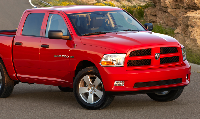
Been getting bad gas milage!! Please help!!


Thread Starter
|
Registered User
Joined: Jun 2009
Posts: 9
Likes: 0
 Been getting bad gas milage!! Please help!!
Ok i have a Dodge Ram 1500 Sport with about 8000 miles on it. I add a mufflex 18" muffler when the truck had about 4000 miles on it. I was getting around 18 mpg. About two months ago i add a k & n air filter to my truck never had the truck out on the highway for awhile so i didnt know what i was getting for highway fuel milage. Just recently i took about 4 long trips that were about 250 miles a piece. Weather conditions where around 0 to 10 degrees F (i dont know if this plays any effect on it or not) Ive been getting only 15 to 16 mpg. Could my (MAF) sensor have oil on it from the filter? Is it due to the drop of weather conditions? Or something else? Please Help


Veteran
Joined: Oct 2005
Posts: 461
Likes: 0
From: NW Arkansas
There's no MAF (mass air flow) sensor on these motors only a MAP (manifold absolute pressure) sensor. The MAP sensor isn't as prone to issues due to filter oil as the MAF because the MAF is usually a very small wire that is used to sample the air. This wire gets coated with oil and no longer reads correctly.
The cold air is more dense so the computer adds more fuel to compensate.
The cold air is more dense so the computer adds more fuel to compensate.

Champion
Joined: Dec 2007
Posts: 3,563
Likes: 0
From: Ontario, Canada
There's no MAF (mass air flow) sensor on these motors only a MAP (manifold absolute pressure) sensor. The MAP sensor isn't as prone to issues due to filter oil as the MAF because the MAF is usually a very small wire that is used to sample the air. This wire gets coated with oil and no longer reads correctly.
The cold air is more dense so the computer adds more fuel to compensate.
The cold air is more dense so the computer adds more fuel to compensate.

Professional
Joined: Oct 2007
Posts: 226
Likes: 0
I have noticed the same thing with mine only much much worse. The last few weeks I am sitting around 11.5mpg at best (half of which was highway driving). I would be excited if I was getting 16mpg!
I recently inquired at the dealership as to why my fuel economy was so bad...they took a look and couldn't find anything wrong but I know for a fact my 2008 QC 4X4 had much better fuel mileage when the engine only had 4000K on it. I am going to give it a bit to see if things improve but I have a hard time believing that 11-12mpg is the best I can get in the cold.
I recently inquired at the dealership as to why my fuel economy was so bad...they took a look and couldn't find anything wrong but I know for a fact my 2008 QC 4X4 had much better fuel mileage when the engine only had 4000K on it. I am going to give it a bit to see if things improve but I have a hard time believing that 11-12mpg is the best I can get in the cold.
Last edited by Medic1; Dec 17, 2009 at 01:38 AM.
Trending Topics

Registered User
Joined: Nov 2009
Posts: 3
Likes: 0
From: NH
I have often wondered this too about cold weather MPG's...here is some more (cut and paste) info:
A 10-degree (F) change in ambient temperature equates to a 1 psi change in tire pressure. Fuel economy declines 0.4 percent for every 1 psi drop
Engine oil thickens as it cools. So does transmission and differential fluids and even bearing grease. Significantly more energy is needed to overcome the added drag these cold lubricants cause. Using synthetic fluids can address this problem, since their viscosity changes less at extreme temperatures than traditional mineral fluids.
Gasoline doesn't vaporize readily at very cold temperatures. So oil companies formulate fuel differently for cold-weather markets in the winter. Unfortunately, the changes that provide better cold vaporization characteristics also result in less available energy for combustion. You won't get as far on a liter of winter gas as you will on a liter of summer gas.
No, I'm not referring to the layer of snow you're too lazy to brush off the top of the car (though that would hurt mpg too). A vehicle’s aerodynamic drag is proportional to air density, and the density increases as temperature drops. For every 10 degree F drop in temperature, aerodynamic drag increases by 2%
A 10-degree (F) change in ambient temperature equates to a 1 psi change in tire pressure. Fuel economy declines 0.4 percent for every 1 psi drop
Engine oil thickens as it cools. So does transmission and differential fluids and even bearing grease. Significantly more energy is needed to overcome the added drag these cold lubricants cause. Using synthetic fluids can address this problem, since their viscosity changes less at extreme temperatures than traditional mineral fluids.
Gasoline doesn't vaporize readily at very cold temperatures. So oil companies formulate fuel differently for cold-weather markets in the winter. Unfortunately, the changes that provide better cold vaporization characteristics also result in less available energy for combustion. You won't get as far on a liter of winter gas as you will on a liter of summer gas.
No, I'm not referring to the layer of snow you're too lazy to brush off the top of the car (though that would hurt mpg too). A vehicle’s aerodynamic drag is proportional to air density, and the density increases as temperature drops. For every 10 degree F drop in temperature, aerodynamic drag increases by 2%
Last edited by stevo7; Dec 18, 2009 at 06:34 AM.

Rookie
Joined: May 2009
Posts: 97
Likes: 0
From: San Antonio, TX
I have often wondered this too about cold weather MPG's...here is some more (cut and paste) info:
A 10-degree (F) change in ambient temperature equates to a 1 psi change in tire pressure. Fuel economy declines 0.4 percent for every 1 psi drop
Engine oil thickens as it cools. So does transmission and differential fluids and even bearing grease. Significantly more energy is needed to overcome the added drag these cold lubricants cause. Using synthetic fluids can address this problem, since their viscosity changes less at extreme temperatures than traditional mineral fluids.
Gasoline doesn't vaporize readily at very cold temperatures. So oil companies formulate fuel differently for cold-weather markets in the winter. Unfortunately, the changes that provide better cold vaporization characteristics also result in less available energy for combustion. You won't get as far on a gallon of winter gas as you will on a liter of summer gas.
No, I'm not referring to the layer of snow you're too lazy to brush off the top of the car (though that would hurt mpg too). A vehicle’s aerodynamic drag is proportional to air density, and the density increases as temperature drops. For every 10 degree F drop in temperature, aerodynamic drag increases by 2%
A 10-degree (F) change in ambient temperature equates to a 1 psi change in tire pressure. Fuel economy declines 0.4 percent for every 1 psi drop
Engine oil thickens as it cools. So does transmission and differential fluids and even bearing grease. Significantly more energy is needed to overcome the added drag these cold lubricants cause. Using synthetic fluids can address this problem, since their viscosity changes less at extreme temperatures than traditional mineral fluids.
Gasoline doesn't vaporize readily at very cold temperatures. So oil companies formulate fuel differently for cold-weather markets in the winter. Unfortunately, the changes that provide better cold vaporization characteristics also result in less available energy for combustion. You won't get as far on a gallon of winter gas as you will on a liter of summer gas.
No, I'm not referring to the layer of snow you're too lazy to brush off the top of the car (though that would hurt mpg too). A vehicle’s aerodynamic drag is proportional to air density, and the density increases as temperature drops. For every 10 degree F drop in temperature, aerodynamic drag increases by 2%
Jason
Registered User
Joined: Nov 2009
Posts: 3
Likes: 0
From: NH
here is a link to a site....there are sources in the article you can click on for more info:
http://www.metrompg.com/posts/winter-mpg.htm
http://www.metrompg.com/posts/winter-mpg.htm