


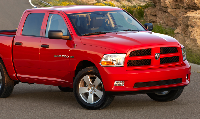
Trying to decide on half ton- reliability?


Captain
Joined: Sep 2010
Posts: 664
Likes: 0
From: Wisconsin

I think Texas is the Ford capital, seemed like nine out every ten trucks were Ford's trucks on the roads down there.
I own a Ford with the 4.6 V8, unless you floor it off the line, there is absolutely no power in the mid-range with the 3V 4.6. It progressed to be worse after I had the TCM reflashed due to belated down shifting when at a complete stop causing the truck to surge forward as if someone rear-ended you "surging." So they retarded all the shift points, now it can't decide what gear to stay in when driving between speeds of 25-35 mph, and it's driving me batty.
I own a Ford with the 4.6 V8, unless you floor it off the line, there is absolutely no power in the mid-range with the 3V 4.6. It progressed to be worse after I had the TCM reflashed due to belated down shifting when at a complete stop causing the truck to surge forward as if someone rear-ended you "surging." So they retarded all the shift points, now it can't decide what gear to stay in when driving between speeds of 25-35 mph, and it's driving me batty.

Professional
Joined: Oct 2011
Posts: 134
Likes: 0
From: WMASS
Yea, Hammer posted an issue with the Ford trans. I did quite a bit of internet searching tonight and the F-150's present to the late 90's, if not farther, have had significant trans. problems. Many report slipage, to no power to hard shifting to major catastrophic failure, I never knew about this until tonight. I have been reading many F-150 forums tonight and the F-150 owners are having it bad. Many of the 11' F-150's have had catastrophic failure in the first few hundred miles. I just read about 1/2 hour ago a dude in Kentucky just bought an 11' crewcab, loaded, with the 5.0 engine. He starts the thing, pulls out of the dealer lot, stops at a stop sign, goes to pull out in traffic, no power. Trans. blew with trans. fluid all over the street. This rig blew up in front of the dealer with 8 miles on it. I have to give another shout out to hammer, he is on to something that us Ram owners have knowledge of now. This is a Dodge site, I could not imagine my truck blowing up in my dealers lot.

All Star
Joined: Jan 2010
Posts: 824
Likes: 1
From: Alberta
Personally I think their main issue is the fact that they have these trucks with these v6 eco-boosts running at such high RPMS that the tranny just cant keep up. They just have not incorporated the fact that the your trannys gonna have to be able to support the torque and HP at those high RPMS. Also with my understanding they started using these motors on the flex and Taurus in 09? Granted this is the first year in a truck, but they should at least have some insight as to how the motor performs and what they would need to change. But its not just tranny issues im hearing, constant ticking, loss of power (probably due to the turbos not spooling right) AND guys are replacing turbos at less then 150k! I think that this is the only reason Ford does so well, They design them to work pretty fair under warranty but after that, NOTHING!
Hammer, at least with the Hemi it was not 100% new technology. They still had some insight from the early Hemis. They just had to take that old concept and make it work with fuel injection and modern day technology. I think the bigger step was in 06 when they incorporated MDS. No one could have known how it would perform then, but now they definitely have er figured out now.
With Ford its brand new never been used. Direct injection, never been done (in the ford industry) It had been tried but failed due to the lack of technology, so they tried it again! The fact is, it creates a more efficient burn, but I think there are power losses. Which creates the need for turbos, but still does not provide that low end low rpm torque. This idea has been done in supercars (like ferrari, BMW for example), but they don't need that low end torque. They are designed to run at those high rpms for speed. This has never been done for pulling, I think Ford is making a mistake, but thats JMO.
I think Dodge has it right, especially with the HEMI. A nice balance of power and economy, every truck owners dream. Not to mentions its more reliable, AND will definitely need less maintenance to your common driver. Vs those who don't know that the turbos need time to cool before working them hard again. Just another way for Ford to make a profit.
Hammer, at least with the Hemi it was not 100% new technology. They still had some insight from the early Hemis. They just had to take that old concept and make it work with fuel injection and modern day technology. I think the bigger step was in 06 when they incorporated MDS. No one could have known how it would perform then, but now they definitely have er figured out now.
With Ford its brand new never been used. Direct injection, never been done (in the ford industry) It had been tried but failed due to the lack of technology, so they tried it again! The fact is, it creates a more efficient burn, but I think there are power losses. Which creates the need for turbos, but still does not provide that low end low rpm torque. This idea has been done in supercars (like ferrari, BMW for example), but they don't need that low end torque. They are designed to run at those high rpms for speed. This has never been done for pulling, I think Ford is making a mistake, but thats JMO.
I think Dodge has it right, especially with the HEMI. A nice balance of power and economy, every truck owners dream. Not to mentions its more reliable, AND will definitely need less maintenance to your common driver. Vs those who don't know that the turbos need time to cool before working them hard again. Just another way for Ford to make a profit.

Captain
Joined: Mar 2005
Posts: 639
Likes: 0
From: Dyess, TX
Nate this is going to seem like a bash but it is not intended that way: you have no idea what you are talking about.
Firstly ford has been working on direct injection motors since before 2001. They have been selling them to the public since 2003.
Secondly direct injection in no way limits torque or horsepower. Quite the opposite in fact. The best comparison I can think of is the GM 3.6 High Feature v6. Without DI (LY7) in the Holden Commodore (Pontiac G8/Chevy Camaro Chassis) it produced 235 hp and 240 tq. In the current Camaro with DI (LLT) it produces 312 and 278. Peak TQ is shifted to the right but it makes more tq across the entire band.
Thirdly the Turbos are there to allow a V6 motor to make V8 like numbers and to increase fuel efficiency. Turbo motors are more fuel efficient.
Fourthly the ecoboost in the Ford trucks have ridiculous tq off the line and IIRC put out more from about 2500 to redline than the new 5.0.
Fifthly the transmission is not getting spun up high and there is no turbo. These are dinky little turbos on a relatively large 6. Yes it is a blatant rippoff of the bmw 335 imho but hey that is an awesome motor.
Finally your argument about not having TQ in fast cars is nonsensical. The supercar BMW (since when do they make supercars) M5 uses a direct injection twin turbo motor and puts out 500 lb foot of tq.
Generally adding DI increases HP and TQ by 10-15%. It increases fuel efficiency by a similar amount. The key way that DI improves over current/previous gen tech is that it allows far far more precise metering of the fuel (better efficiency and output) and higher compression ratios (better efficiency) due to better heat resistance amongst other factors.
TO sum up. Ecoboost fords work great at low rpm. The transmissions are not being pushed to ranges higher than the ford mod motors. Supercars love tq. DI is not new tech. DI improves output and efficiency across the entire rev range.
You have given really good advice to a lot of people on a lot of issues. This was definitely the least knowledgeable and most flat out wrong post I have ever seen from you.
Not that I do not think Ford makes crap trannies. I do.
Firstly ford has been working on direct injection motors since before 2001. They have been selling them to the public since 2003.
Secondly direct injection in no way limits torque or horsepower. Quite the opposite in fact. The best comparison I can think of is the GM 3.6 High Feature v6. Without DI (LY7) in the Holden Commodore (Pontiac G8/Chevy Camaro Chassis) it produced 235 hp and 240 tq. In the current Camaro with DI (LLT) it produces 312 and 278. Peak TQ is shifted to the right but it makes more tq across the entire band.
Thirdly the Turbos are there to allow a V6 motor to make V8 like numbers and to increase fuel efficiency. Turbo motors are more fuel efficient.
Fourthly the ecoboost in the Ford trucks have ridiculous tq off the line and IIRC put out more from about 2500 to redline than the new 5.0.
Fifthly the transmission is not getting spun up high and there is no turbo. These are dinky little turbos on a relatively large 6. Yes it is a blatant rippoff of the bmw 335 imho but hey that is an awesome motor.
Finally your argument about not having TQ in fast cars is nonsensical. The supercar BMW (since when do they make supercars) M5 uses a direct injection twin turbo motor and puts out 500 lb foot of tq.
Generally adding DI increases HP and TQ by 10-15%. It increases fuel efficiency by a similar amount. The key way that DI improves over current/previous gen tech is that it allows far far more precise metering of the fuel (better efficiency and output) and higher compression ratios (better efficiency) due to better heat resistance amongst other factors.
TO sum up. Ecoboost fords work great at low rpm. The transmissions are not being pushed to ranges higher than the ford mod motors. Supercars love tq. DI is not new tech. DI improves output and efficiency across the entire rev range.
You have given really good advice to a lot of people on a lot of issues. This was definitely the least knowledgeable and most flat out wrong post I have ever seen from you.
Not that I do not think Ford makes crap trannies. I do.
Captain
Joined: Sep 2010
Posts: 664
Likes: 0
From: Wisconsin
GM is utilizing this technology now in there Regal 2.0 Turbo. This happens to be what my wife drives, and with just 15 lbs of boost the power is incredible for a 2.0, considering it's a 3,700 lbs.
The GS editions ate running the same motor but with 20 lbs of boost are putting down an additional 50+ at the wheels.
The GS editions ate running the same motor but with 20 lbs of boost are putting down an additional 50+ at the wheels.
Nate this is going to seem like a bash but it is not intended that way: you have no idea what you are talking about.
Firstly ford has been working on direct injection motors since before 2001. They have been selling them to the public since 2003.
Secondly direct injection in no way limits torque or horsepower. Quite the opposite in fact. The best comparison I can think of is the GM 3.6 High Feature v6. Without DI (LY7) in the Holden Commodore (Pontiac G8/Chevy Camaro Chassis) it produced 235 hp and 240 tq. In the current Camaro with DI (LLT) it produces 312 and 278. Peak TQ is shifted to the right but it makes more tq across the entire band.
Thirdly the Turbos are there to allow a V6 motor to make V8 like numbers and to increase fuel efficiency. Turbo motors are more fuel efficient.
Fourthly the ecoboost in the Ford trucks have ridiculous tq off the line and IIRC put out more from about 2500 to redline than the new 5.0.
Fifthly the transmission is not getting spun up high and there is no turbo. These are dinky little turbos on a relatively large 6. Yes it is a blatant rippoff of the bmw 335 imho but hey that is an awesome motor.
Finally your argument about not having TQ in fast cars is nonsensical. The supercar BMW (since when do they make supercars) M5 uses a direct injection twin turbo motor and puts out 500 lb foot of tq.
Generally adding DI increases HP and TQ by 10-15%. It increases fuel efficiency by a similar amount. The key way that DI improves over current/previous gen tech is that it allows far far more precise metering of the fuel (better efficiency and output) and higher compression ratios (better efficiency) due to better heat resistance amongst other factors.
TO sum up. Ecoboost fords work great at low rpm. The transmissions are not being pushed to ranges higher than the ford mod motors. Supercars love tq. DI is not new tech. DI improves output and efficiency across the entire rev range.
You have given really good advice to a lot of people on a lot of issues. This was definitely the least knowledgeable and most flat out wrong post I have ever seen from you.
Not that I do not think Ford makes crap trannies. I do.
Firstly ford has been working on direct injection motors since before 2001. They have been selling them to the public since 2003.
Secondly direct injection in no way limits torque or horsepower. Quite the opposite in fact. The best comparison I can think of is the GM 3.6 High Feature v6. Without DI (LY7) in the Holden Commodore (Pontiac G8/Chevy Camaro Chassis) it produced 235 hp and 240 tq. In the current Camaro with DI (LLT) it produces 312 and 278. Peak TQ is shifted to the right but it makes more tq across the entire band.
Thirdly the Turbos are there to allow a V6 motor to make V8 like numbers and to increase fuel efficiency. Turbo motors are more fuel efficient.
Fourthly the ecoboost in the Ford trucks have ridiculous tq off the line and IIRC put out more from about 2500 to redline than the new 5.0.
Fifthly the transmission is not getting spun up high and there is no turbo. These are dinky little turbos on a relatively large 6. Yes it is a blatant rippoff of the bmw 335 imho but hey that is an awesome motor.
Finally your argument about not having TQ in fast cars is nonsensical. The supercar BMW (since when do they make supercars) M5 uses a direct injection twin turbo motor and puts out 500 lb foot of tq.
Generally adding DI increases HP and TQ by 10-15%. It increases fuel efficiency by a similar amount. The key way that DI improves over current/previous gen tech is that it allows far far more precise metering of the fuel (better efficiency and output) and higher compression ratios (better efficiency) due to better heat resistance amongst other factors.
TO sum up. Ecoboost fords work great at low rpm. The transmissions are not being pushed to ranges higher than the ford mod motors. Supercars love tq. DI is not new tech. DI improves output and efficiency across the entire rev range.
You have given really good advice to a lot of people on a lot of issues. This was definitely the least knowledgeable and most flat out wrong post I have ever seen from you.
Not that I do not think Ford makes crap trannies. I do.

Veteran
Joined: Mar 2009
Posts: 498
Likes: 0
From: back woods of Chester County PA
I left Ford in 09 for the 4th gen Ram. Had purchased 3 F150's prior and was looking at another 1/2 ton and keep the 06 for my son so we looked at all brands. Still think the Ram sport is nicest 1/2 ton available today for what I need a truck for. My brother has an FX4 with the ecoboost with 3.73 gears 20" rims and I am very interested in this truck. Both are daily driver trucks. I think this MDS crap sucks, mine has been disabled for years now, and a boosted V6 makes better sense. All these brands have issues, his has been great so far, just like my Ram.
Last edited by kddsRam; Dec 8, 2011 at 09:14 AM.

Registered User
Joined: Nov 2011
Posts: 2
Likes: 0
I too, was a dyed in the wool Ford man....Mustangs, and a couple of F250 powerstrokes..7.3's....Those were great trucks, but the 4R100 was crap. I babied my truck and still with moderate towing it still gave out. The second one was on its way out when I traded it for the Dodge. I looked long and hard at the Ford F150, both the v8 and the Ecoboost. I just could not wrap my brain around that eco boost. It was a peppy, strong running truck and the specs are the best out there for a 1/2 truck. But, its still new tech and I've been burned by Ford's "new tech" before. So far, I am really impressed with my Dodge Ram 1500 Sport 4x4. It is a beautiful truck, tight, peppy and fun to drive. And with only 1000 miles, I am already getting 17 mpg in mixed city and highway driving. And the price was better than the Ford.

Administrator
Joined: Jul 2007
Posts: 24,686
Likes: 21
From: South Georgia/East Florida
I was a die hard Ford guy too. Had three of 'em, an '84 F150, a '91 7.3 diesel and a '97 F150. It was the '97 that did me in with Ford for good. Not only did the thing basically blow the engine at 14,000 miles, but the ensuing fight with the dealership and Ford themselves first over the warranty and then over how they were handling the repair itself made me swear off the product - for good...
All Star
Joined: Jan 2010
Posts: 824
Likes: 1
From: Alberta
I did mention that this is the first time in truck did I not? I think I also mentioned that Ford had been using them in previous models, just not the trucks as of yet? Just to clarify. And ya its just a friendly argument!
I'm not trying to say that DI doesn't produce torque, I know it does but in different areas. Like you say that the TQ curve has shifted. That what I am saying with higher rpms. Im not talking by like 4000rpm, but even an extra 500 from regular is enough. According to just people driving them it seems that their trucks are running higher then any other truck they have driven. I can't read fords stupid website design but to me it also seems higher rpm according to their charts. Which in a truck, I don't think is the best thing. When I think truck I think towing, as soon as your on the highway im sure it would be fine, but im sure pulling in the city I think would be horrendous. That motors gonna have to work harder then any truck motor in comparison. Thats what I was trying to get at. Take the V6 Ecoboost and compare that to say a HEMI, its gonna be working a harder to get that same power. They might create the same power but that Hemi is running much smoother, because its a V8 and thats what its been built for. It has that raw NON TURBO power, pure V8. Therefore increasing the reliability of the motor. Look at fuel consumption, it proves that. The HEMI "seems" to be getting 2-4 better then the ecoboost. I might still be on the wrong thought, but the thought of a V6 pulling the same weight of a V8 without any consequence is beyond me...It might be the better truck unloaded and not pulling, but IMO thats not why you buy a truck.
As far as reliability is concerned I still believe that the DI motors might be more efficient, but are less reliable to the common driver. Because most of those now a days are made with a what? A turbo. You and I both know that a turbo has to spool before the motor starts producing some real power. But if you took 10 random people, and gave them a turbocharged vehicle and told them to run it hard (go out and do some racing). How many of them when its done would just shut that motor off? Again we know that that turbo is going to be red hot, and needs some running time to cool off. How many of those 10 random people would know that? I think that thats where reliability goes down, because most people in this world don't even know how the motor runs let alone how a turbo operates. Sorry to say that but its a fact, and it comes from mechanics everywhere! If people learned how to properly drive a vehicle with a turbo then ya everything would be better, but thats not the case at all. I think thats where Ford is going to start making money, unless they put in a motor delay. People who can't drive them properly are going to be putting new ones in AFTER warranty. IMO
As far as the whole super car thing goes. How many of them are a 6 cylinder motor? I am pretty sure not many. Now im talking 500HP+ cars. I was under the understanding that the BMW M5 had a V10 under the hood? Which again is not plausible in regular passenger sport cars. But again they all seem to have turbo on them. Just a regular DI motor would be producing substantially less without a turbo.
This is probably all just gibberish but in my mind its all sane...so I could insane but w/e haha
I'm not trying to say that DI doesn't produce torque, I know it does but in different areas. Like you say that the TQ curve has shifted. That what I am saying with higher rpms. Im not talking by like 4000rpm, but even an extra 500 from regular is enough. According to just people driving them it seems that their trucks are running higher then any other truck they have driven. I can't read fords stupid website design but to me it also seems higher rpm according to their charts. Which in a truck, I don't think is the best thing. When I think truck I think towing, as soon as your on the highway im sure it would be fine, but im sure pulling in the city I think would be horrendous. That motors gonna have to work harder then any truck motor in comparison. Thats what I was trying to get at. Take the V6 Ecoboost and compare that to say a HEMI, its gonna be working a harder to get that same power. They might create the same power but that Hemi is running much smoother, because its a V8 and thats what its been built for. It has that raw NON TURBO power, pure V8. Therefore increasing the reliability of the motor. Look at fuel consumption, it proves that. The HEMI "seems" to be getting 2-4 better then the ecoboost. I might still be on the wrong thought, but the thought of a V6 pulling the same weight of a V8 without any consequence is beyond me...It might be the better truck unloaded and not pulling, but IMO thats not why you buy a truck.
As far as reliability is concerned I still believe that the DI motors might be more efficient, but are less reliable to the common driver. Because most of those now a days are made with a what? A turbo. You and I both know that a turbo has to spool before the motor starts producing some real power. But if you took 10 random people, and gave them a turbocharged vehicle and told them to run it hard (go out and do some racing). How many of them when its done would just shut that motor off? Again we know that that turbo is going to be red hot, and needs some running time to cool off. How many of those 10 random people would know that? I think that thats where reliability goes down, because most people in this world don't even know how the motor runs let alone how a turbo operates. Sorry to say that but its a fact, and it comes from mechanics everywhere! If people learned how to properly drive a vehicle with a turbo then ya everything would be better, but thats not the case at all. I think thats where Ford is going to start making money, unless they put in a motor delay. People who can't drive them properly are going to be putting new ones in AFTER warranty. IMO
As far as the whole super car thing goes. How many of them are a 6 cylinder motor? I am pretty sure not many. Now im talking 500HP+ cars. I was under the understanding that the BMW M5 had a V10 under the hood? Which again is not plausible in regular passenger sport cars. But again they all seem to have turbo on them. Just a regular DI motor would be producing substantially less without a turbo.
This is probably all just gibberish but in my mind its all sane...so I could insane but w/e haha
Captain
Joined: Mar 2005
Posts: 639
Likes: 0
From: Dyess, TX
A'ight I will start with the small... the current M5 is a v8 turbo.
The current 335 is a v6 turbo and has no turbo lag whatsoever. Turbo lag is a product of overly large turbos with insufficiently large displacement. Seriously go drive a bmw 335i... the car is shocking. Better yet go drive a new Taurus SHO, seamless power and torque *******ly undetectable lag.
The hemi may seem to get better gas mileage, but in reality it gets worse. The only way for a hemi to get better gas mileage is to be in 4 cylinder mode... which it has a hard time doing whilst towing.
You are completely right about the extra care an precautions needed for a turbo motor. Honestly there should be a factory turbo timer on them. Still unless you come screaming up your driveway with the turbos maxed out then shut it off immediately the effects of premature shutdown can be minimised.
As to shifting the TQ curve, I said it shifted UP and right. That is to say that on a DI vs non DI motor the TQ at any given point is higher, but that peak tq arrives later.
If as stated a 500 rpm shift in operating range were the killer deal on a tranny then you would only be able to run one rear end... shifting from say a 3.92 to a 3.21 is going to shift the operating range way more than that.
The Cummins is an example of a V6 doing V8 work through DI and Turbos... The Buick grand national is an example of a v6 turbo doing v8 work...
As to turbo supercars... are you familiar with the 911...
The current 335 is a v6 turbo and has no turbo lag whatsoever. Turbo lag is a product of overly large turbos with insufficiently large displacement. Seriously go drive a bmw 335i... the car is shocking. Better yet go drive a new Taurus SHO, seamless power and torque *******ly undetectable lag.
The hemi may seem to get better gas mileage, but in reality it gets worse. The only way for a hemi to get better gas mileage is to be in 4 cylinder mode... which it has a hard time doing whilst towing.
You are completely right about the extra care an precautions needed for a turbo motor. Honestly there should be a factory turbo timer on them. Still unless you come screaming up your driveway with the turbos maxed out then shut it off immediately the effects of premature shutdown can be minimised.
As to shifting the TQ curve, I said it shifted UP and right. That is to say that on a DI vs non DI motor the TQ at any given point is higher, but that peak tq arrives later.
If as stated a 500 rpm shift in operating range were the killer deal on a tranny then you would only be able to run one rear end... shifting from say a 3.92 to a 3.21 is going to shift the operating range way more than that.
The Cummins is an example of a V6 doing V8 work through DI and Turbos... The Buick grand national is an example of a v6 turbo doing v8 work...
As to turbo supercars... are you familiar with the 911...