


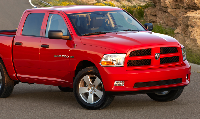
Converting 2011 5.7 to run on cng


Thread Starter
|
Rookie
Joined: Feb 2010
Posts: 68
Likes: 0

Ok now let me get a few facts out here on this..
Reg. gas with my 2011 QC 5.7 4x4 Outdoorsman I get an average of about 17 mpgs city/hiway mixed.
CNG on this same PU I get around 15.5 mpgs under the same conditions.
Checked oil after 5,000 miles and it looks like it did they day it was put in. No carbon burn with cng.
In Oklahoma City area there are prob. 10-12 stations that sell cng. $1.25 - $1.85 per gge.
I have a 24 gge tank installed and I can get around 17 gges on most days this time of year. As the weather warms up I will be able to get more cng in the tank.
Install price for cng kit with new 24 gge tank is approx. $10k. When I had the kit installed the price of cng was .85 cents a gge. They just hit us with a .50 per gge road tax and that is why the cng price jumped up. Criminal if you ask me because they waited till people started doing all these conversions then slapped that huge tax on the gas. I am sure this will slow the conversions down.
But my PU runs pretty close to the same on cng as it does gas. I lose a little power but with a 400 HP beast you still have all the power you need. I have an injected kit where I have the regular set of gas injectors and an added set of cng injectors. I can run on either fuel I chose. If I run out of cng it will auto switch to gas. I have around 8,000 miles on the clock.
Reg. gas with my 2011 QC 5.7 4x4 Outdoorsman I get an average of about 17 mpgs city/hiway mixed.
CNG on this same PU I get around 15.5 mpgs under the same conditions.
Checked oil after 5,000 miles and it looks like it did they day it was put in. No carbon burn with cng.
In Oklahoma City area there are prob. 10-12 stations that sell cng. $1.25 - $1.85 per gge.
I have a 24 gge tank installed and I can get around 17 gges on most days this time of year. As the weather warms up I will be able to get more cng in the tank.
Install price for cng kit with new 24 gge tank is approx. $10k. When I had the kit installed the price of cng was .85 cents a gge. They just hit us with a .50 per gge road tax and that is why the cng price jumped up. Criminal if you ask me because they waited till people started doing all these conversions then slapped that huge tax on the gas. I am sure this will slow the conversions down.
But my PU runs pretty close to the same on cng as it does gas. I lose a little power but with a 400 HP beast you still have all the power you need. I have an injected kit where I have the regular set of gas injectors and an added set of cng injectors. I can run on either fuel I chose. If I run out of cng it will auto switch to gas. I have around 8,000 miles on the clock.


Registered User
Joined: Jul 2011
Posts: 22
Likes: 0
From: WV
If you consider they are talking gas being 4.25 by Memorial Day this year, and there is that little bit of wear on the engine, 10K sounds high, but its not. I could run this in a daily driver 3 times longer than I would a gas engine. I think it would pay for itself and more, long term.

Champion
Joined: May 2009
Posts: 3,497
Likes: 1
From: MN
At current gas prices of $3.41 where I live, you would have to run through 4600 gallons of $1.25 cng to break even - and that is assuming the mpg was the same for the gas and cng. (78K miles assuming 17mpg)
At $5 a gallon gas it would take 2666 gallons to break even. (45K miles assuming 17mpg)
Those are about the most optimistic happy path numbers I could come up with. So I guess it depends on how long you intend to keep the thing, how much warranty work you might have given up by voiding out your engine warranty and if you cna put up with trying to find cng fill locations when you leave your known area.
At $5 a gallon gas it would take 2666 gallons to break even. (45K miles assuming 17mpg)
Those are about the most optimistic happy path numbers I could come up with. So I guess it depends on how long you intend to keep the thing, how much warranty work you might have given up by voiding out your engine warranty and if you cna put up with trying to find cng fill locations when you leave your known area.

Administrator
Joined: Jul 2007
Posts: 24,686
Likes: 21
From: South Georgia/East Florida
It's not mainstream here, nor will it ever be IMO, because the oil companies & politicians won't let it. Now on another forum I'm on, there are a number of guys in western Europe who have done this. Cost of the conversion is less (about $4500 converted to US dollars), gas is higher (some of these guys are saying $11+ per gallon (converted) while CNG is relatively the same price it is here and more readily available.
I think it's a really cool mod to do here, but realistically you'd need to be able to run both fuels (which means losing the bed to a 2nd tank) and pretty much forget doing it solely as a cost saving mod...
I think it's a really cool mod to do here, but realistically you'd need to be able to run both fuels (which means losing the bed to a 2nd tank) and pretty much forget doing it solely as a cost saving mod...
Champion
Joined: May 2009
Posts: 3,497
Likes: 1
From: MN
About the only way it works as a cost savings mod is either as a fleet (schwanns trucks) or as a DIY on a carb system. Plenty of jeep/offroad guys who do cng/propane conversions on carb motors and it only costs about $600 + tanks with impco stuff, but they do it because a propane mixer will run at angles that give a carb fits.
Thread Starter
|
Rookie
Joined: Feb 2010
Posts: 68
Likes: 0
I drive a lot of miles so there is a huge savings for me using cng. I figured that I would save aprox. $15,000 if I put 150,000 miles on the truck. I will do that in no more than 5 yrs. That's $15,000 in my pocket after the conversion cost. In other words,I would have spent (at todays gas prices) $15,000 more if I was running on regular gas. So to the guy that stated what a waste of money doesn't have a clue. BTW, I lose about 2 ft of space (cab to wheel well) in the bed behind the cab for the tank. The new lighter smaller tanks are the most expensive part at around $3700.00. So if you wanted to use a used tank you could get out much cheaper. This tank that I have is good for 20 years.
Last edited by Rickram; Feb 20, 2012 at 11:26 AM.
Thread Starter
|
Rookie
Joined: Feb 2010
Posts: 68
Likes: 0
Forgot to add that I had to disable the MDS. Since the SuperChips tuner doesn't work with 2011+ this had to be done manually. I would be so much easier if they had a tuner for these new PUs. My only other option would be to get an ecu from a 2010 model and a sc tuner. I think it would be much easier to convert a 4.7 and also cheaper.
Last edited by Rickram; Feb 20, 2012 at 11:27 AM.

Professional
Joined: Sep 2011
Posts: 163
Likes: 0
If you do a lot of driving, and plan to keep the vehicle a reasonable length of time, a CNG conversion will pay for itself in several years and then you start banking thousands of dollars in fuel savings. Not to mention a cleaner burning engine.
When I first saw this post, I thought $10K sounded like a lot of money but when I did the math (I'm a high-mileage driver) the payback was less than 3 years. Essentially, if you keep the truck for 6 years you would save $10,000.00...after paying for the conversion.
I just started looking into this (I live north of Toronto) and one concern is the availability of CNG at filling stations. The conversions are dual-fuel meaning you can run gas or CNG so you're not going to get stuck. Our local gas utility provides a kit that allows you to fill up at home. Since you're filling up at home, you don't pay the retailers mark-up. The price quoted to "fill at home" is $0.58 per litre, while mid-range gas is currently $1.36 per litre here. I haven't had a chance to check into this in a lot of detail, but I believe there may also be government and/or utility incentives to offset some of the cost.
When I first saw this post, I thought $10K sounded like a lot of money but when I did the math (I'm a high-mileage driver) the payback was less than 3 years. Essentially, if you keep the truck for 6 years you would save $10,000.00...after paying for the conversion.
I just started looking into this (I live north of Toronto) and one concern is the availability of CNG at filling stations. The conversions are dual-fuel meaning you can run gas or CNG so you're not going to get stuck. Our local gas utility provides a kit that allows you to fill up at home. Since you're filling up at home, you don't pay the retailers mark-up. The price quoted to "fill at home" is $0.58 per litre, while mid-range gas is currently $1.36 per litre here. I haven't had a chance to check into this in a lot of detail, but I believe there may also be government and/or utility incentives to offset some of the cost.