


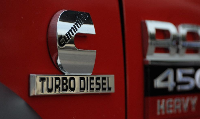
2007 Ram 2500 6.7 l. emmisions nightmare!


Joined: Jul 2006
Posts: 2,800
Likes: 0
From: Swollen Beaver, OR
 RE: 2007 Ram 2500 6.7 l. emmisions nightmare!
Basically, what he is saying is ............
Get that puppy on the highway, either with a load or keep it out of OD so the exhaust temp can build and burn that crud out.
If you're under 20 mph, the vehicle does not go into regeneration mode (AKA Flame Thrower PSD Style).
Get that puppy on the highway, either with a load or keep it out of OD so the exhaust temp can build and burn that crud out.
If you're under 20 mph, the vehicle does not go into regeneration mode (AKA Flame Thrower PSD Style).

Veteran
Joined: Mar 2004
Posts: 280
Likes: 0
From: Dallas, GA
RE: 2007 Ram 2500 6.7 l. emmisions nightmare!
In my case, I have a big camper to pull around on weekends and vacations which is why I bought the truck. I needed a reliable truck to tow a 10k pound camper but I also use this truck as a daily driver. The "image" of driving a Cummins certainly is a nice added benefit, but not the only reason to buy this truck.
Regarding the new emmissions, the reality is they work perfectly for a narrow segment of the driving population. But even many work trucks that sit and idle have issues with the DPF clogging. How does one get up to speed when working miles from a paved highway? Simply, the design of this emissions system does not accomodate the 80% of the market that has purchased this truck. Therefore, the rest of us need to learn what the system needs and adjust our driving habits accordingly ... or buy a gasser.
Finally, perhaps some testing should have been done in Atlanta where even the interstates are stop and go traffic, 5 lanes of it or more. Even with a load you'd never be able to hit a regen cycle. You'd have to drive OUT of town to get up to speed to cause a regen.
Mike
Regarding the new emmissions, the reality is they work perfectly for a narrow segment of the driving population. But even many work trucks that sit and idle have issues with the DPF clogging. How does one get up to speed when working miles from a paved highway? Simply, the design of this emissions system does not accomodate the 80% of the market that has purchased this truck. Therefore, the rest of us need to learn what the system needs and adjust our driving habits accordingly ... or buy a gasser.
Finally, perhaps some testing should have been done in Atlanta where even the interstates are stop and go traffic, 5 lanes of it or more. Even with a load you'd never be able to hit a regen cycle. You'd have to drive OUT of town to get up to speed to cause a regen.
Mike

Joined: Mar 2008
Posts: 7
Likes: 0
From:
RE: 2007 Ram 2500 6.7 l. emmisions nightmare!
It is hardly possible to get the exhaust gas hot enough to burn off the soot on the filter, all that is needed it to get the oxidation catalyst up to 600F. Once at that temperature, the PCM will inject additional fuel during the exhaust stroke, basically releasing unburnt hydrocarbons into the exhaust. These hydrocarbons react with the platinum / paladium on the catalyst and ignite. This creates an exothermic reaction. The PCM tracks the exothermic reaction to maintain an exit temperature of the catalyst in the 1100F range. This is hot enough to get the soot on the filter burning. Think about what it takes to ignite anthracite coal. This is the same deal.
The flaw in this whole discussion is that one absolutely has to get the exhaust temperature up high enough for the catalyst to "lite off", which is the 600F number. If this condition is met reliably under driving conditions, you have no problem. If not, you have trouble coming. The cummins is a powerful engine and it does take a certain load and time to get the system hot enough. If you drive only a few miles, this will not work. If the system is to work for everyone, there would have to be electrical heaters in the emissions system to maintain the temperature high enough under any conditions. To provide the required power, would require a much bigger battery and alternator and add a lot of cost.
The right answer to all of this is simply a smaller diesel of maybe 3.5l swept volume which would be more than enough motor for the needs of 80% of the buyers. Unfortunately, the fact that fuel was just over $1/gal just a few years ago resulted in there being no demand for smaller motors since buyers expected their 6000lb trucks to drive like dragsters and they could afford to fill the tanks with that cheap fuel. Now everyone is tripping over each other playing catchup and the smaller motors will only hit the market in 2010. From that point on consumers will have a lot more choice than they do now.
The flaw in this whole discussion is that one absolutely has to get the exhaust temperature up high enough for the catalyst to "lite off", which is the 600F number. If this condition is met reliably under driving conditions, you have no problem. If not, you have trouble coming. The cummins is a powerful engine and it does take a certain load and time to get the system hot enough. If you drive only a few miles, this will not work. If the system is to work for everyone, there would have to be electrical heaters in the emissions system to maintain the temperature high enough under any conditions. To provide the required power, would require a much bigger battery and alternator and add a lot of cost.
The right answer to all of this is simply a smaller diesel of maybe 3.5l swept volume which would be more than enough motor for the needs of 80% of the buyers. Unfortunately, the fact that fuel was just over $1/gal just a few years ago resulted in there being no demand for smaller motors since buyers expected their 6000lb trucks to drive like dragsters and they could afford to fill the tanks with that cheap fuel. Now everyone is tripping over each other playing catchup and the smaller motors will only hit the market in 2010. From that point on consumers will have a lot more choice than they do now.

Veteran
Joined: May 2006
Posts: 358
Likes: 0
From: Linwood,MI
RE: 2007 Ram 2500 6.7 l. emmisions nightmare!
Back in the old days, we'd take the old car out on the freeway late one night and "burn the gunk out" so to speak. Sounds like its come full circle. Might be kinda hard explaining to the officer the need to run 100 mph for 10 miles to clean out the filter. Of coarse there is another way to do it.[sm=burnout.gif]
Of coarse there is another way to do it.[sm=burnout.gif]

Thread Starter
Joined: Mar 2008
Posts: 5
Likes: 0
RE: 2007 Ram 2500 6.7 l. emmisions nightmare!
This forum has become very educational for me...thank you Keith. I would agree to some extent about the buyers "image" concern. I see buyers excited about our 6.7 l. engine...the great horse power, quiet operation, low emmisions and of course, Cummins reliability and reputation. That's why I drive a Dodge. What is the best way to get a complete regen accomplished without hooking up the boat? It's my daily driver to work....no hills to pull. I have periodically been dropping down to 3rd-4th gear on the highway, higher rpms for several miles at a time.
Lemme know...
Lemme know...

Joined: Oct 2007
Posts: 3
Likes: 0
RE: 2007 Ram 2500 6.7 l. emmisions nightmare!
Bro, you know we both love our DODGE trucks, but I won't lie......they are not the best when it comes to dependability. My engine light came on after just 50000 miles and turns out its 4 sensors I have to replace for a grand total of about 1500 bucks.
I mean come on, 50000 miles. Still I just can't love any other truck besides my RAM, no truck looks as tough as ours do. I guess next time I won't buy DODGE though . I will probably buy a Toyota Tundra or something dependable.
Chuck
I mean come on, 50000 miles. Still I just can't love any other truck besides my RAM, no truck looks as tough as ours do. I guess next time I won't buy DODGE though
. I will probably buy a Toyota Tundra or something dependable.Chuck

Joined: Apr 2008
Posts: 1
Likes: 0
RE: 2007 Ram 2500 6.7 l. emmisions nightmare!
What about Fuel? emissions are controlled by the fuel content? Seeing that Bio is or has different properties does this not affect the sludge? or seeing that your rig is new does it control sensors in the fuel system that can cause false readings in the sensors controling the turbo?