


PERFORMANCE QUESTION


Thread Starter
Joined: Feb 2006
Posts: 7
Likes: 0
 PERFORMANCE QUESTION
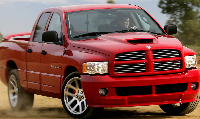
Ok I'm new here I just got a 05 Quad cab with only 150 miles.
I now have 700 miles on it after 2 weeks. Needless to say I enjoy the truck.
However, is it just me or is thinking I should be able to floor it at a stop sign and smoke the tires. Well I have tried exactly that multiple times and get nothing more that a 2 second squeak of the tires!
I have an automatic, but with 525 lbs of torque and an empty bed I would image it would spin the tires for no go reason. It just seems like a lot of growl under the hood, but not much movement forward.
I took it to the service department and get this.... they tell me that the truck's engine management program limits it for the first 6,000 miles. That is to save the motor from getting abused. To me 6,000 miles is Waaay too long of a break in period.
It may just be me, but for 40+ thousand dollars and a viper motor I would imagine I should be able to roast my rear tires standing in place by just slamming the pinning the pedal. NOT that I am looking to replace the rear tires in the near future, but for the cost of the truck, the point is you could if you wanted to right?
So all this to say, is there anyone out there with an automatic that can replicate what you see in the commercials and demonstrations Dodge has put on displaying the power of the SRT line-up?
I now have 700 miles on it after 2 weeks. Needless to say I enjoy the truck.
However, is it just me or is thinking I should be able to floor it at a stop sign and smoke the tires. Well I have tried exactly that multiple times and get nothing more that a 2 second squeak of the tires!
I have an automatic, but with 525 lbs of torque and an empty bed I would image it would spin the tires for no go reason. It just seems like a lot of growl under the hood, but not much movement forward.
I took it to the service department and get this.... they tell me that the truck's engine management program limits it for the first 6,000 miles. That is to save the motor from getting abused. To me 6,000 miles is Waaay too long of a break in period.
It may just be me, but for 40+ thousand dollars and a viper motor I would imagine I should be able to roast my rear tires standing in place by just slamming the pinning the pedal. NOT that I am looking to replace the rear tires in the near future, but for the cost of the truck, the point is you could if you wanted to right?
So all this to say, is there anyone out there with an automatic that can replicate what you see in the commercials and demonstrations Dodge has put on displaying the power of the SRT line-up?

Veteran
Joined: Dec 2004
Posts: 439
Likes: 0
From:
RE: PERFORMANCE QUESTION
Yes, apparently Dodge has programmed the PCM to run on the rich side to protect the engine early on. The tune leans out as mileage accumulates making more and more power. Still, there is plenty of "umph" there to get into trouble. Probably the two biggest limitations on the auto trans is the PCM shift settings and the torque converter.
There is a PCM upgrade from Mopar Performance and several others from after market vendors that make the shift points much more crisp. These upgrades also open up a lot of bottom end torque.
Your torque converter absorbs a lot of power at low rpms. Think of a torque converter as two opposing fans like you would use in your living room on a hot day. If one is spinning under power and blowing directly at the other, it will eventually reach a velocity where it spins the other fan. The faster it spins, the harder it will push the opposing fan. Theoretically, if it spins fast enough, it is almost like they are directly connected. This is what is happening in your torque converter but instead of air, it's hydraulic fluid. The rpm where the first fan pushes enough hydraulic fluid to turn the opposite fan hard enough to move the car or truck forward is the stall speed of that converter. By applying the brakes and giving it some gas you pre-load the converter. The more gas you give it the more you can feel it wanting to move. Power braking in drag racing, is where you pre-load the converter in this way just below the point where it overpowers the brakes and then release the brakes when the light turns green. In the case of your truck, the first fan isn't pushing hard enough at low rpms and there is "slippage." The faster the engine turns the less slippage in the converter. Bottom line, if you want to fry tires with your set-up, power brake it a little and you'll roast them all the way down the block. Remember, however, too much of that can be hard on the converter.
As far as the empty bed goes, these trucks are weight balanced much better than normal trucks. The weight distribution on a RC is 55/45. That's better than most cars. We can't blame our traction problems on an empty bed. It's simply that we're asking street tires to hook up with 525 ft/lbs - or higher.
Hope this helps.
There is a PCM upgrade from Mopar Performance and several others from after market vendors that make the shift points much more crisp. These upgrades also open up a lot of bottom end torque.
Your torque converter absorbs a lot of power at low rpms. Think of a torque converter as two opposing fans like you would use in your living room on a hot day. If one is spinning under power and blowing directly at the other, it will eventually reach a velocity where it spins the other fan. The faster it spins, the harder it will push the opposing fan. Theoretically, if it spins fast enough, it is almost like they are directly connected. This is what is happening in your torque converter but instead of air, it's hydraulic fluid. The rpm where the first fan pushes enough hydraulic fluid to turn the opposite fan hard enough to move the car or truck forward is the stall speed of that converter. By applying the brakes and giving it some gas you pre-load the converter. The more gas you give it the more you can feel it wanting to move. Power braking in drag racing, is where you pre-load the converter in this way just below the point where it overpowers the brakes and then release the brakes when the light turns green. In the case of your truck, the first fan isn't pushing hard enough at low rpms and there is "slippage." The faster the engine turns the less slippage in the converter. Bottom line, if you want to fry tires with your set-up, power brake it a little and you'll roast them all the way down the block. Remember, however, too much of that can be hard on the converter.
As far as the empty bed goes, these trucks are weight balanced much better than normal trucks. The weight distribution on a RC is 55/45. That's better than most cars. We can't blame our traction problems on an empty bed. It's simply that we're asking street tires to hook up with 525 ft/lbs - or higher.
Hope this helps.

Joined: Feb 2006
Posts: 2
Likes: 0
RE: PERFORMANCE QUESTION
well explained mate im new to this aswell
ORIGINAL: big asp
Yes, apparently Dodge has programmed the PCM to run on the rich side to protect the engine early on. The tune leans out as mileage accumulates making more and more power. Still, there is plenty of "umph" there to get into trouble. Probably the two biggest limitations on the auto trans is the PCM shift settings and the torque converter.
There is a PCM upgrade from Mopar Performance and several others from after market vendors that make the shift points much more crisp. These upgrades also open up a lot of bottom end torque.
Your torque converter absorbs a lot of power at low rpms. Think of a torque converter as two opposing fans like you would use in your living room on a hot day. If one is spinning under power and blowing directly at the other, it will eventually reach a velocity where it spins the other fan. The faster it spins, the harder it will push the opposing fan. Theoretically, if it spins fast enough, it is almost like they are directly connected. This is what is happening in your torque converter but instead of air, it's hydraulic fluid. The rpm where the first fan pushes enough hydraulic fluid to turn the opposite fan hard enough to move the car or truck forward is the stall speed of that converter. By applying the brakes and giving it some gas you pre-load the converter. The more gas you give it the more you can feel it wanting to move. Power braking in drag racing, is where you pre-load the converter in this way just below the point where it overpowers the brakes and then release the brakes when the light turns green. In the case of your truck, the first fan isn't pushing hard enough at low rpms and there is "slippage." The faster the engine turns the less slippage in the converter. Bottom line, if you want to fry tires with your set-up, power brake it a little and you'll roast them all the way down the block. Remember, however, too much of that can be hard on the converter.
As far as the empty bed goes, these trucks are weight balanced much better than normal trucks. The weight distribution on a RC is 55/45. That's better than most cars. We can't blame our traction problems on an empty bed. It's simply that we're asking street tires to hook up with 525 ft/lbs - or higher.
Hope this helps.
Yes, apparently Dodge has programmed the PCM to run on the rich side to protect the engine early on. The tune leans out as mileage accumulates making more and more power. Still, there is plenty of "umph" there to get into trouble. Probably the two biggest limitations on the auto trans is the PCM shift settings and the torque converter.
There is a PCM upgrade from Mopar Performance and several others from after market vendors that make the shift points much more crisp. These upgrades also open up a lot of bottom end torque.
Your torque converter absorbs a lot of power at low rpms. Think of a torque converter as two opposing fans like you would use in your living room on a hot day. If one is spinning under power and blowing directly at the other, it will eventually reach a velocity where it spins the other fan. The faster it spins, the harder it will push the opposing fan. Theoretically, if it spins fast enough, it is almost like they are directly connected. This is what is happening in your torque converter but instead of air, it's hydraulic fluid. The rpm where the first fan pushes enough hydraulic fluid to turn the opposite fan hard enough to move the car or truck forward is the stall speed of that converter. By applying the brakes and giving it some gas you pre-load the converter. The more gas you give it the more you can feel it wanting to move. Power braking in drag racing, is where you pre-load the converter in this way just below the point where it overpowers the brakes and then release the brakes when the light turns green. In the case of your truck, the first fan isn't pushing hard enough at low rpms and there is "slippage." The faster the engine turns the less slippage in the converter. Bottom line, if you want to fry tires with your set-up, power brake it a little and you'll roast them all the way down the block. Remember, however, too much of that can be hard on the converter.
As far as the empty bed goes, these trucks are weight balanced much better than normal trucks. The weight distribution on a RC is 55/45. That's better than most cars. We can't blame our traction problems on an empty bed. It's simply that we're asking street tires to hook up with 525 ft/lbs - or higher.
Hope this helps.

Joined: Mar 2006
Posts: 1
Likes: 0
From:
RE: PERFORMANCE QUESTION
I agree I have a 2005 quad cab srt10 and i have 9000 miles it gets better .I just purchaced the new computer flash and volant im hoping to get a grin on my face ,Does nayone know anything on the flash it says 90 hp plus 100 pd of tq ??

Joined: May 2005
Posts: 24
Likes: 0
From:
RE: PERFORMANCE QUESTION
ORIGINAL: oncebitten
I agree I have a 2005 quad cab srt10 and i have 9000 miles it gets better .I just purchaced the new computer flash and volant im hoping to get a grin on my face ,Does nayone know anything on the flash it says 90 hp plus 100 pd of tq ??
I agree I have a 2005 quad cab srt10 and i have 9000 miles it gets better .I just purchaced the new computer flash and volant im hoping to get a grin on my face ,Does nayone know anything on the flash it says 90 hp plus 100 pd of tq ??

Veteran
Joined: Oct 2004
Posts: 426
Likes: 0
From: Santa Monica
RE: PERFORMANCE QUESTION
ORIGINAL: big asp
Yes, apparently Dodge has programmed the PCM to run on the rich side to protect the engine early on. The tune leans out as mileage accumulates making more and more power. Still, there is plenty of "umph" there to get into trouble. Probably the two biggest limitations on the auto trans is the PCM shift settings and the torque converter.
There is a PCM upgrade from Mopar Performance and several others from after market vendors that make the shift points much more crisp. These upgrades also open up a lot of bottom end torque.
Your torque converter absorbs a lot of power at low rpms. Think of a torque converter as two opposing fans like you would use in your living room on a hot day. If one is spinning under power and blowing directly at the other, it will eventually reach a velocity where it spins the other fan. The faster it spins, the harder it will push the opposing fan. Theoretically, if it spins fast enough, it is almost like they are directly connected. This is what is happening in your torque converter but instead of air, it's hydraulic fluid. The rpm where the first fan pushes enough hydraulic fluid to turn the opposite fan hard enough to move the car or truck forward is the stall speed of that converter. By applying the brakes and giving it some gas you pre-load the converter. The more gas you give it the more you can feel it wanting to move. Power braking in drag racing, is where you pre-load the converter in this way just below the point where it overpowers the brakes and then release the brakes when the light turns green. In the case of your truck, the first fan isn't pushing hard enough at low rpms and there is "slippage." The faster the engine turns the less slippage in the converter. Bottom line, if you want to fry tires with your set-up, power brake it a little and you'll roast them all the way down the block. Remember, however, too much of that can be hard on the converter.
As far as the empty bed goes, these trucks are weight balanced much better than normal trucks. The weight distribution on a RC is 55/45. That's better than most cars. We can't blame our traction problems on an empty bed. It's simply that we're asking street tires to hook up with 525 ft/lbs - or higher.
Hope this helps.
Yes, apparently Dodge has programmed the PCM to run on the rich side to protect the engine early on. The tune leans out as mileage accumulates making more and more power. Still, there is plenty of "umph" there to get into trouble. Probably the two biggest limitations on the auto trans is the PCM shift settings and the torque converter.
There is a PCM upgrade from Mopar Performance and several others from after market vendors that make the shift points much more crisp. These upgrades also open up a lot of bottom end torque.
Your torque converter absorbs a lot of power at low rpms. Think of a torque converter as two opposing fans like you would use in your living room on a hot day. If one is spinning under power and blowing directly at the other, it will eventually reach a velocity where it spins the other fan. The faster it spins, the harder it will push the opposing fan. Theoretically, if it spins fast enough, it is almost like they are directly connected. This is what is happening in your torque converter but instead of air, it's hydraulic fluid. The rpm where the first fan pushes enough hydraulic fluid to turn the opposite fan hard enough to move the car or truck forward is the stall speed of that converter. By applying the brakes and giving it some gas you pre-load the converter. The more gas you give it the more you can feel it wanting to move. Power braking in drag racing, is where you pre-load the converter in this way just below the point where it overpowers the brakes and then release the brakes when the light turns green. In the case of your truck, the first fan isn't pushing hard enough at low rpms and there is "slippage." The faster the engine turns the less slippage in the converter. Bottom line, if you want to fry tires with your set-up, power brake it a little and you'll roast them all the way down the block. Remember, however, too much of that can be hard on the converter.
As far as the empty bed goes, these trucks are weight balanced much better than normal trucks. The weight distribution on a RC is 55/45. That's better than most cars. We can't blame our traction problems on an empty bed. It's simply that we're asking street tires to hook up with 525 ft/lbs - or higher.
Hope this helps.
Hi Phil
Quick