


Wheel Bearings


Captain
Joined: Feb 2012
Posts: 515
Likes: 5
From: N. KY

what I know is that when the piston pressure is released (brake pedal off), and the piston does NOT withdraw. A VERY little wheel wobble (caused by slightly loose wheel bearing) will push out the pad slightly, as the wheel rotates, so the pads do not drag hard on the rotor, but they are always almost in contact with the rotor. Those pads might be sticking in the caliper, not moving freely back and forth... as I mentioned sometimes I find I have to grind excess metal from the pad backing to get the pads to actually slide back and forth in the calipers. When replacing the pads often you will see one half of the pad gone but the other half still there as if the pad wore crooked... I think that is caused by the pad not sliding in the caliper when the piston (brake pedal) is released.
The pads I am talking about have an "ear" that slides within the caliper. I have 3 Toyotas and my Dodge... I might be getting the pads mixed up some from one make to the other... but the pads should be able to be moved a little back from the rotor with only slight pressure from your finger or a screwdriver if you spin the rotor with the wheel off so that you have access to the pad.
Again, I am not a mechanic, but I have learned (I THINK) to know what to look for when doing brakes... IF I AM WRONG ABOUT THIS then SOMEONE let us both know! THX
The pads I am talking about have an "ear" that slides within the caliper. I have 3 Toyotas and my Dodge... I might be getting the pads mixed up some from one make to the other... but the pads should be able to be moved a little back from the rotor with only slight pressure from your finger or a screwdriver if you spin the rotor with the wheel off so that you have access to the pad.
Again, I am not a mechanic, but I have learned (I THINK) to know what to look for when doing brakes... IF I AM WRONG ABOUT THIS then SOMEONE let us both know! THX

Thread Starter
|
Rookie
Joined: Oct 2011
Posts: 56
Likes: 0
I hear what you're saying about the "ear" on the pad. But, I had to use a C-clamp to get the piston to retract back into the caliper. Is that normal?
p.s. It sort of irks me that parts that are "new" are not operating as they should. (unless I'm doing something wrong to make the parts work right.)
I can get video of what I'm talking about and post it here (or on youtube) in the next few days, if that would help.
p.s. It sort of irks me that parts that are "new" are not operating as they should. (unless I'm doing something wrong to make the parts work right.)
I can get video of what I'm talking about and post it here (or on youtube) in the next few days, if that would help.
Last edited by jpian0923; Jun 15, 2013 at 12:58 AM.

All Star
Joined: Mar 2012
Posts: 933
Likes: 1
From: South Kentucky
You can tell if the drag (brake drag + wheel bearing tension) is correct by spinning the complete wheel/tire/rotor/brake assembly. You should not be able to feel any slack if you grab and try to shake it and it should take between 1 - 2 minutes to spin down to a stop if you give it a hard spin. If it stops before this, I would say that the wheel bearings are bad, or overtightened, or the brake pads are dragging.
Last edited by blackvan; Jun 15, 2013 at 01:37 AM.
Thread Starter
|
Rookie
Joined: Oct 2011
Posts: 56
Likes: 0
Yeah, so, with the pads off I can spin the tire and it will go for a while without stopping ( after I backed off the rotor nut 1/6 of a turn).
There is not play in the bearings when I wiggle the rotor.
Can I post video here?
There is not play in the bearings when I wiggle the rotor.
Can I post video here?
Captain
Joined: Feb 2012
Posts: 515
Likes: 5
From: N. KY

Yes it is normal to use a C clamp to get the piston to retract... that is SOP when doing brakes. Disk brakes do not work like drum brakes where they are either on or off... disk brake pads are always in contact, or in very close proximity to the rotors... they do not retract, but are also not clamped onto the rotor as when brake pedal is applied. This can only happen if the pad backing metal can slide within the caliper.
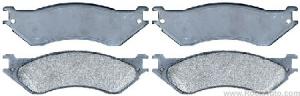
This pic may not be your pad, but the "ears" are the metal backing and stick out of the sides.These should be shaped exactly like the slide within the caliper, but are often just too tight to fit the slide correctly and actually slide in that groove. Grinding off a little excess metal might be necessary to allow that slide movement, so that the pads are not being pressed onto the rotor when the brake pedal is released. If they do not slide, then they continue to press on the rotor.
I like blackvan's description of how wheels should turn
This pic may not be your pad, but the "ears" are the metal backing and stick out of the sides.These should be shaped exactly like the slide within the caliper, but are often just too tight to fit the slide correctly and actually slide in that groove. Grinding off a little excess metal might be necessary to allow that slide movement, so that the pads are not being pressed onto the rotor when the brake pedal is released. If they do not slide, then they continue to press on the rotor.
I like blackvan's description of how wheels should turn
Last edited by rsdata; Jun 15, 2013 at 01:24 AM. Reason: correction
Thread Starter
|
Rookie
Joined: Oct 2011
Posts: 56
Likes: 0
Thanks. Hopefully in the next day or so I can get video and post it to see what you guys think. I did spend a few hours today working on it...don't know how motivated I'll be tomorrow. My working conditions are horrible...gravel, uneven driveway and dirty as hell.
I never considered the rears, but I'll give them a look see. I can "feel" it in the front. Might be wrong though.
I never considered the rears, but I'll give them a look see. I can "feel" it in the front. Might be wrong though.
Last edited by jpian0923; Jun 15, 2013 at 01:37 AM.
Captain
Joined: Feb 2012
Posts: 515
Likes: 5
From: N. KY

I still have the noise/rubbing/pulsing. The pulsing though, isn't when I break, it's when I'm not breaking. It's very smooth when I brake.
As tough as it is, the brake is not together and testable, unless the wheel is bolted to the rim. The added leverage of the wheel, when you pull on it has to be there to be able to test the drag on the rotor and the pressure on the wheel bearing.
Ok, well don't rule out it being a rear wheel bearing as its not always easy to tell where the sound is actually coming from.
If you are not using air tools, an impact wrench at the least, then I can understand your reluctance to do this work.

Go to the local big box lumber store and purchase a piece of rigid insulation 3/4 inch thick or so and a 2' x 4' or 4'x4' piece of plywood. Put the plywood down as a work surface over the gravel, and kneel on the rigid insulation for some relief on your knees. A small stool helps to sit on also when doing brake work. I do some of my work on gravel and cannot live without my insulation...
Last edited by rsdata; Jun 15, 2013 at 01:53 AM. Reason: additional info