


View Poll Results: What's in your engine?


Voters: 177. You may not vote on this poll
Motor Oil


#62
 03-11-2010, 09:23 AM

Grand Champion
Join Date: Apr 2008
Location: Lee County, North Carolina
Posts: 7,055
Likes: 0
Received 5 Likes
on
5 Posts

I found an interesting site about oil that should be read when time permits, you might learn something. http://www.carbibles.com/engineoil_bible.html
Also read the additives pages
http://www.carbibles.com/snakeoil.html
http://www.carbibles.com/additives.html
Here's a couple quotes from the site.
So what should I buy?
Quality Counts! You've splashed the cash and taken out an auto refinance loan on your new pride and joy, so don't cheap out on the oil or be persuaded by gimmicks. It doesn't matter what sort of fancy marketing goes into an engine oil, or how many naked babes smear it all over their bodies, or how bright and colourful the packaging is, it's what's written on the packaging which counts. Specifications and approvals are everything. There are two established testing bodies. The API (American Petroleum Institute), and the European counterpart, the ACEA (Association des Constructeurs Europeens d'Automobiles - which was the CCMC). You've probably never heard of either of them, but their stamp of approval will be seen on the side of every reputable can of engine oil.
The API The API classifications are different for petrol and diesel engines:
If I put new, fully synthetic oil in my older engine, will the seals leak?
The short answer: generally speaking, not any more. The caveat is that your engine must be in good working order and not be leaking right now. If that's the case, most modern oils are fully compatible with the elastomeric materials that engine seals are made from, and you shouldn't have any issues with leaks. The longer answer:
Mixing Mineral and Synthetic oils - the old and busted concepts
For the longest time, I had this to say about mixing mineral and synthetic oils:
What happens when an engine is overfilled with oil?
So you topped up the engine when it was warm after getting a faulty dipstick reading, or you put too much oil in when you changed it yourself. What's the worst that could happen? Well the problem with this is that the next time the engine is run, the windage in the crankcase and other pressures generated by the oil pump, etc. place a great strain on the seal on the rear main bearing.
Eventually, often much sooner than the ordinary man in the street might expect, the rear main bearing seal ruptures, and the engine becomes a 'leaker'. If you've got a manual gearbox, this means one thing: this oil goes right onto the flywheel and the face of the clutch disc. A lubricated clutch is A Bad Thing. If this still goes unnoticed, the front seal is the next to go, and the engine then becomes a 'gusher' (or to be more colourful, it starts pissing oil all over the place). As well as smothering the clutch with oil from the rear, the oil now coming from the front leak will be neatly distributed about the engine bay as it hits the front pulley - often propelling it out as far as the brake discs. At the same time as this Hollywood disaster movie is unfolding outside the engine, things aren't working out any better on the inside. As you can see from the diagram, the correct oil level is really close to the rotating crank. Overfilling will mean the crank dips into the oil and churns it into a froth. Froth is good on certain types of coffee but not good in an engine. The mixture of aerated oil will be forced into the bearings and in case you didn't know, air is not a lubricant. Typically this means that bearing damage will follow quite rapidly, especially if you are driving on a motorway. You'll know bearing damage when you get it. The engine smells like a garage mechanic cooking over an open flame and the noise coming from the engine is the sort of thing you'd normally hear in vaudeville plays when a piano is pushed down a flight of stairs. As if that all wasn't bad enough, the excess oil gets thrown up into the piston bores where the piston rings have a hard time coping with the excess oil and pressure. It gets into the combustion chamber and some of it will get out into the exhaust system unburned resulting in a nice patina of oil all over the platinum surfaces of your catalytic converter. This renders it utterly useless for good.
Well, you did ask.
Also read the additives pages
http://www.carbibles.com/snakeoil.html
http://www.carbibles.com/additives.html
Here's a couple quotes from the site.
So what should I buy?
Quality Counts! You've splashed the cash and taken out an auto refinance loan on your new pride and joy, so don't cheap out on the oil or be persuaded by gimmicks. It doesn't matter what sort of fancy marketing goes into an engine oil, or how many naked babes smear it all over their bodies, or how bright and colourful the packaging is, it's what's written on the packaging which counts. Specifications and approvals are everything. There are two established testing bodies. The API (American Petroleum Institute), and the European counterpart, the ACEA (Association des Constructeurs Europeens d'Automobiles - which was the CCMC). You've probably never heard of either of them, but their stamp of approval will be seen on the side of every reputable can of engine oil.
The API
The API classifications are different for petrol and diesel engines: - For petrol, listings start with 'S' (meaning Service category, but you can also think of it as Spark-plug ignition), followed by another code to denote standard. 'SM' is the current top grade, which recently replaced 'SL' and 'SH'. 'SH' will be found on most expensive oils, and almost all the new synthetics. It's basically an upgraded 'SG' oil which has been tested more sternly.
If I put new, fully synthetic oil in my older engine, will the seals leak?
The short answer: generally speaking, not any more. The caveat is that your engine must be in good working order and not be leaking right now. If that's the case, most modern oils are fully compatible with the elastomeric materials that engine seals are made from, and you shouldn't have any issues with leaks. The longer answer:
Mixing Mineral and Synthetic oils - the old and busted concepts
For the longest time, I had this to say about mixing mineral and synthetic oils:
- If you've been driving around with mineral oil in your engine for years, don't switch to synthetic oil without preparation. Synthetic oils have been known to dislodge the baked-on deposits from mineral oils and leave them floating around your engine - not good. It's wise to use a flushing oil first.
- If you do decide to change, only go up the scale. If you've been running around on synthetic, don't change down to a mineral-based oil - your engine might not be able to cope with the degradation in lubrication. Consequently, if you've been using mineral oil, try a semi or a full synthetic oil. By degradation, I'm speaking of the wear tolerances that an engine develops based on the oil that it's using. Thicker mineral oils mean thicker layers of oil coating the moving parts (by microns though). Switching to a thinner synthetic oil can cause piston rings to leak and in some very rare cases, piston slap or crank vibration.
- Gaskets and seals! With the makeup of synthetic oils being different from mineral oils, mineral-oil-soaked gaskets and seals have been known to leak when exposed to synthetic oils. Perhaps not that common an occurrence, but worth bearing in mind nevertheless.
What happens when an engine is overfilled with oil?
So you topped up the engine when it was warm after getting a faulty dipstick reading, or you put too much oil in when you changed it yourself. What's the worst that could happen? Well the problem with this is that the next time the engine is run, the windage in the crankcase and other pressures generated by the oil pump, etc. place a great strain on the seal on the rear main bearing.
Eventually, often much sooner than the ordinary man in the street might expect, the rear main bearing seal ruptures, and the engine becomes a 'leaker'. If you've got a manual gearbox, this means one thing: this oil goes right onto the flywheel and the face of the clutch disc. A lubricated clutch is A Bad Thing. If this still goes unnoticed, the front seal is the next to go, and the engine then becomes a 'gusher' (or to be more colourful, it starts pissing oil all over the place). As well as smothering the clutch with oil from the rear, the oil now coming from the front leak will be neatly distributed about the engine bay as it hits the front pulley - often propelling it out as far as the brake discs. At the same time as this Hollywood disaster movie is unfolding outside the engine, things aren't working out any better on the inside. As you can see from the diagram, the correct oil level is really close to the rotating crank. Overfilling will mean the crank dips into the oil and churns it into a froth. Froth is good on certain types of coffee but not good in an engine. The mixture of aerated oil will be forced into the bearings and in case you didn't know, air is not a lubricant. Typically this means that bearing damage will follow quite rapidly, especially if you are driving on a motorway. You'll know bearing damage when you get it. The engine smells like a garage mechanic cooking over an open flame and the noise coming from the engine is the sort of thing you'd normally hear in vaudeville plays when a piano is pushed down a flight of stairs. As if that all wasn't bad enough, the excess oil gets thrown up into the piston bores where the piston rings have a hard time coping with the excess oil and pressure. It gets into the combustion chamber and some of it will get out into the exhaust system unburned resulting in a nice patina of oil all over the platinum surfaces of your catalytic converter. This renders it utterly useless for good.
Well, you did ask.
#63
03-11-2010, 03:40 PM

Legend
I just put some of that new Pennzoil Ultra synthetic oil in the S-10. First thing I notice is that the engine is MUCH quieter and is smoother (Compared to Pennzoil Platinum). The rattle from the loose timing chain (161,000 miles) is not as loud. Good oil, I'm gonna see how much it does clean the motor out after 3,000 miles. It was only $28 for a 5 qt jug @ Walmart.
My Walmart just got some Shell Rotella T5 Synthetic blend 10W-30 oil. Gonna try that in Purpl next.
My Walmart just got some Shell Rotella T5 Synthetic blend 10W-30 oil. Gonna try that in Purpl next.
#64
03-12-2010, 03:41 PM

Registered User
Join Date: Mar 2009
Location: Savannah, GA
Posts: 16
Likes: 0
Received 0 Likes
on
0 Posts
Another Oil Thread
I tried to add the thread in FAQs, but the forum didn't let me.
The trouble with reading about oil in most forums is that there's so few folks that really know oils and the science of lubrication...tribiology, or something like that. The center for all oil knowledge fabulousity is www.BobIsTheOilGuy.com, or BITOG for short. That's were the tribiologists hang out.
It's useless for folks to talk about oil if they're not talking about chemistry, physical properties of the oil, and how bearings and rocker/cams/tappets wear. The whole "I use <brand X> and it's terrific" approach is just foolishness.
I'm no tribiologist, nor am I a chemical engineer.
Here's a place to get started...http://www.Gress.org/Home/Cars/Track...l%20Debate.htm
Note that there is some talk about viscosity on my Gress.org page. It was written with a target audience of BMW racers in mind and we have different viscosity needs because our bearings aren't as tight as a Ram's.
Oil is complicated. There's just tons to know.
The biggest problem facing us Ram owners and our oil choices is the lack of ZDDP in modern oils. ZDDP is a zinc phosphorus compound that forms a sacrificial layer on cams, rockers and tappets. Modern oil certifications reduce the allowable amount of ZDDP because the Feds think that ZDDP is hard on cars. Therefore oils with modern certifications are hard on cams, rockers, and tappets.
I've pulled about 4 BMWs engines in the last year and all had worn out rockers and cams. Although it's a different engine design, the lubrication issues are the same. This isn't such a big deal with more modern engines because they have rollers on the rockers and no flat tappets.
Oil recommendations. The two major brands I'd go with for a 2nd gen Ram is Amsoil and Redline. There's some boutique outfits that make workable products, but they're expensive.
Currently BITOG seems to like Pennzoil Platinum as #1 and maybe Mobil1 as #2? But neither of those have enough ZDDP for us, so they're better solutions for more modern engines. Although you could fix that with some engine break-in additive if you were careful. Too much ZDDP is bad too....you want around 1300-1400ppm ZDDP.
Good, bad, right and wrong. It's more then just a matter of selecting a good oil, you have to select a "right" oil.
Viscosity grading. xWy, like 10W30. The x is the cold visc and the y is the hot visc. So a 5W30 is a better winter oil then 10W30. On the other hand, the 10W30, all else being equal, would be a little better for a summer oil because it has more slippery stuff in it. The way multi-visc oils are made, you start with W30 base product and then put visc modifiers into the oil's "additive package". The more visc modifiers in a quart, the less slippery stuff.
Too different 10W30 oils can be entirely different in every way you can possibly imagine. Even the visc of two different 10W30 oils can be fairly different. You can't take anything for granted.
Viscosity is a matter of temperature. Visc charts will show you at a glance that when high visc oils get cold, they don't flow worth a crap. So it really is important that you use lower visc oils in winter.
OIC, TBN and additive package's detergent content. Acids build up in the oil. Additive packages contain detergents to neutralize the acidity. Total Base Number is a measure of how much ability remains to neutralize oil. So if you get an oil analysis done, if the TBN is pretty high, then you've got a decent amount of detergent left.
OEM's are now paying for oil chances so they like long Oil Change Intervals. That requires lots of detergent. More detergent means less slippery stuff. So OEMs are recommending oils with less slippery stuff.
OEMs are also recommending low visc oils for higher fleet gas mileage. Lower visc oils increase the chance of bearing wipe. This is especially risky with old bearings because as they wear the spacing between them goes up and a thick oil is needed to maintain the "hydroscopic wedge" that bearing lubrication requires.
If you change your oil regularly, look for an oil with less detergent.
Don't use additives unless you reallly know what you are doing. Additive packages are created with care. Different compounds work together in the oil and if you mess with the chemistry, the results won't be what the oil was designed to do.
It is surprisingly difficult to get good info on oils. Some manufacturers don't publish much, which is a reason to not trust them. Pennzoil comes to mind. Other manufacturers are slow to update their websites so what you are reading is not what you are pouring into your engine. Often you will find a terrific article analyzing oils, only to find that the oils changed their additive packages some time after the article was written. That happened to me with Valvoline Premium Blue. About the best way to get good scoop is to spend some time reading about your oil of choice at BITOG. And check out their oil analysis section and find someone that tested your oil and analyzed the results.
Ok, that will get you started. You could read all the info on my website in an evening, but the real deal is at BITOG and that would take as much time as you're willing to give it. Oil is complicated. Don't accept anyone's advice on oil unless they are willing to talk about the physical properties (like high temp shear testing) and chemical properties (like ZDDP and TBN) of the oil.
The trouble with reading about oil in most forums is that there's so few folks that really know oils and the science of lubrication...tribiology, or something like that. The center for all oil knowledge fabulousity is www.BobIsTheOilGuy.com, or BITOG for short. That's were the tribiologists hang out.
It's useless for folks to talk about oil if they're not talking about chemistry, physical properties of the oil, and how bearings and rocker/cams/tappets wear. The whole "I use <brand X> and it's terrific" approach is just foolishness.
I'm no tribiologist, nor am I a chemical engineer.
Here's a place to get started...http://www.Gress.org/Home/Cars/Track...l%20Debate.htm
Note that there is some talk about viscosity on my Gress.org page. It was written with a target audience of BMW racers in mind and we have different viscosity needs because our bearings aren't as tight as a Ram's.
Oil is complicated. There's just tons to know.
The biggest problem facing us Ram owners and our oil choices is the lack of ZDDP in modern oils. ZDDP is a zinc phosphorus compound that forms a sacrificial layer on cams, rockers and tappets. Modern oil certifications reduce the allowable amount of ZDDP because the Feds think that ZDDP is hard on cars. Therefore oils with modern certifications are hard on cams, rockers, and tappets.
I've pulled about 4 BMWs engines in the last year and all had worn out rockers and cams. Although it's a different engine design, the lubrication issues are the same. This isn't such a big deal with more modern engines because they have rollers on the rockers and no flat tappets.
Oil recommendations. The two major brands I'd go with for a 2nd gen Ram is Amsoil and Redline. There's some boutique outfits that make workable products, but they're expensive.
Currently BITOG seems to like Pennzoil Platinum as #1 and maybe Mobil1 as #2? But neither of those have enough ZDDP for us, so they're better solutions for more modern engines. Although you could fix that with some engine break-in additive if you were careful. Too much ZDDP is bad too....you want around 1300-1400ppm ZDDP.
Good, bad, right and wrong. It's more then just a matter of selecting a good oil, you have to select a "right" oil.
Viscosity grading. xWy, like 10W30. The x is the cold visc and the y is the hot visc. So a 5W30 is a better winter oil then 10W30. On the other hand, the 10W30, all else being equal, would be a little better for a summer oil because it has more slippery stuff in it. The way multi-visc oils are made, you start with W30 base product and then put visc modifiers into the oil's "additive package". The more visc modifiers in a quart, the less slippery stuff.
Too different 10W30 oils can be entirely different in every way you can possibly imagine. Even the visc of two different 10W30 oils can be fairly different. You can't take anything for granted.
Viscosity is a matter of temperature. Visc charts will show you at a glance that when high visc oils get cold, they don't flow worth a crap. So it really is important that you use lower visc oils in winter.
OIC, TBN and additive package's detergent content. Acids build up in the oil. Additive packages contain detergents to neutralize the acidity. Total Base Number is a measure of how much ability remains to neutralize oil. So if you get an oil analysis done, if the TBN is pretty high, then you've got a decent amount of detergent left.
OEM's are now paying for oil chances so they like long Oil Change Intervals. That requires lots of detergent. More detergent means less slippery stuff. So OEMs are recommending oils with less slippery stuff.
OEMs are also recommending low visc oils for higher fleet gas mileage. Lower visc oils increase the chance of bearing wipe. This is especially risky with old bearings because as they wear the spacing between them goes up and a thick oil is needed to maintain the "hydroscopic wedge" that bearing lubrication requires.
If you change your oil regularly, look for an oil with less detergent.
Don't use additives unless you reallly know what you are doing. Additive packages are created with care. Different compounds work together in the oil and if you mess with the chemistry, the results won't be what the oil was designed to do.
It is surprisingly difficult to get good info on oils. Some manufacturers don't publish much, which is a reason to not trust them. Pennzoil comes to mind. Other manufacturers are slow to update their websites so what you are reading is not what you are pouring into your engine. Often you will find a terrific article analyzing oils, only to find that the oils changed their additive packages some time after the article was written. That happened to me with Valvoline Premium Blue. About the best way to get good scoop is to spend some time reading about your oil of choice at BITOG. And check out their oil analysis section and find someone that tested your oil and analyzed the results.
Ok, that will get you started. You could read all the info on my website in an evening, but the real deal is at BITOG and that would take as much time as you're willing to give it. Oil is complicated. Don't accept anyone's advice on oil unless they are willing to talk about the physical properties (like high temp shear testing) and chemical properties (like ZDDP and TBN) of the oil.
#65
03-15-2010, 08:17 PM

Professional
Join Date: Nov 2009
Location: Central Florida
Posts: 112
Likes: 0
Received 0 Likes
on
0 Posts
#66
03-16-2010, 12:07 AM

Champion
How do you like that? I just bought a bunch off pcfixer. After running the normal oil with the break in lube 2 times I'm gonna switch to the RP. Gonna be a bitch from then on having to stick with it but oh well
#67
04-16-2010, 10:25 AM

yes i did take the class...it showed comparisons to other oils, but not against Amsoil or Royal Purple...and they truly made me believe that Mobil 1 was the best. The class was required for at the garage i worked at we switched from Kendall Motor oil to Mobil 1, so the employess from all the garages (chain buisness) had to meet up and have a big meeting, and it was the CEO of Mobil 1 Oils speaking to us.
After alot of discussion with a certain member on this forum, ive learned new and interesting things about oil, and the fact when i used Mobil 1, and the oil was still light brown after 3700 miles, i found that that was a BAD thing. Its good for the oil to get really black, that means its doing it job, and cleaning the motor.
Some oils are made for some vehicles, and the detergents that are in them can affect vehicles differently. Like with those graphs, they probably didnt test those on a Dodge Ram motor. So those results can be not related to our trucks in any way. You would need to get test results for the oils on OUR motors to get accurate results.
So dont listen to the graphs, thats inaccurate. And i have been switching up my oils latly, and ive had best results with Quaker State 10w30 Horsepower Full Synthetic, with a Mopar Filter. My oil pressure is 45-50 at idle, and when on the gas the needle is past the 0 in 40. So i assume around 65-70 PSI. and this is consistant. With Mobil 1 full syn 10w30 and a Mobil 1 filter i was getting 40 at idle and about 45-50 PSI when on the gas, and that was consistant. So the Quaker state, and Mopar filter DID show a big difference.
So you all can be the judge
#68
04-18-2010, 03:50 AM

The graphs are accurate however, there's one thing that must be taken into consideration and that is, the fact that most older engines have hydraulic lifters along with the fact the motor was designed to be run with dino oil- not synthetics and, since synthetics (most anyway) do not contain detergents (unless you purchase them separately and add them in to your oil), this represents a new problem that was not to be seen when using conventional motor oil and that is, lifter ticking and, the other issue is, over time, the engine parts build up a hard crust in the valve train area.
This I know for a fact after witnessing this on my own Dodge after using nothing but synthetics for 200K miles. After removing and replacing the heads and intake, the lifter valley was totally crusted up as were the old heads.
Now, at the time I discovered this, I called Rob Stark ( an Indy car builder and classic car restoration specialist and, in my opinion, THE best mechanic I've yet to encounter -bar none) www.robstark.com and, I asked him what the deal was with this. He told me it's from running synthetics.
That was also backed up by three engines that were tore down that also had the same issue at California Horsepower. The owner swore up and down never to use synthetics and, while at his shop, he presented a rather strong argument along with physical evidence that the synthetics are not designed to clean the engine for one and, secondly, they fail to hold hydraulic pressure at the lifter thus leading to premature lifter collapse or, intermittent lifter ticking and rough idle conditions. He had a new, Chevy vette and, it had been failing to hold pressure due to they now come from the factory running 100% synthetic motor oil. He changed the oil- problem solved.
Now, I must admit, I didn't know how to respond because, this was knew to me. I let him present his case along with the evidence along with conducting some real world tests on my own Dodge. I listened, I observed and I asked some questions. I found it rather eye opening to say the least so, I went home and experimented.
I ran 0-W -30 Amsoil full synthetic for test 1. I had noted noise and clatter at startup (Sharps). It did not work well. It was way too watery at hot and, I had noted rough idle and lifter ticking that was sporadic. Keep in mind - I do have over 200K. With new lifters, this probably would not have been an issue so much as it was. Due to serious time constraints, I did not have time to change the lifters.
I noted premature lifter collapse under heavy loading and valve popping due to that as well. Not something that I like to hear. This was partially due to larger compression forces / larger springs at the valves.
I removed the oil and filter and displaced all motor oil with conventional 10-40. Now, yes, it's a heavier weight and, I am aware of viscosity index but, hang on just a moment until we get to the next test which was 20-50 Amsoil full synthetic.
When running Valvoline 10-40-dino oil, it was smooth, quiet and idled perfectly. I ran this across country for 7000 miles (changing it of course on both ends of the trip) I didn't use all but a half quart on the way out and another half quart on the way back. This includes mileage to and from Boston to NY as well on the weekends. When using synthetics, I had to keep refilling it as it would thin out and make it's way past the seals, rings and valve guides.
Next test was to run Amsoil 20-50 100% synthetic. NOTE: While better than their 30W, I still noted startup noise and occasional lifter tick and valve clatter.
I purged out the regular motor oil and changed the filter as I did in the previous test.
I filled it to MAX using 20-50 as noted above. I ran it, noted startup noise, erratic oil pressure and worst yet, rough idle due to sporadic loss of hydraulic pressure at the lifters.
I immediately removed it after only a few days and repackaged it.
I replaced it with Valvoline 20-50 and noted it's smooth as silk, no lifter noise, no valve train noise either.
Now, in no way during any of this testimonial am I inferring that synthetic does not protect the engine as it surely does however, it's not just a matter of protection as far as lubrication is concerned, there's some other considerations to think about when using synthetic motor oil in an older vehicle that does not run solid lifters but, old, hydraulic lifters that were designed around dino oil.
One of the issues is, full synthetics have tendency to drain out of the lifters thus not holding hydraulic pressure at time of startup thus the clacking, or, worse yet, while operational hence, lifter collapse. Couple that with roller rockers and you've got more noise.
Now, again, I am not advocating one over the other just yet and, I am still going to run another run of their 20-50 with a modifier and possible detergent. Work in progress on that one and, in time, I hope to have some results.
CM
This I know for a fact after witnessing this on my own Dodge after using nothing but synthetics for 200K miles. After removing and replacing the heads and intake, the lifter valley was totally crusted up as were the old heads.
Now, at the time I discovered this, I called Rob Stark ( an Indy car builder and classic car restoration specialist and, in my opinion, THE best mechanic I've yet to encounter -bar none) www.robstark.com and, I asked him what the deal was with this. He told me it's from running synthetics.
That was also backed up by three engines that were tore down that also had the same issue at California Horsepower. The owner swore up and down never to use synthetics and, while at his shop, he presented a rather strong argument along with physical evidence that the synthetics are not designed to clean the engine for one and, secondly, they fail to hold hydraulic pressure at the lifter thus leading to premature lifter collapse or, intermittent lifter ticking and rough idle conditions. He had a new, Chevy vette and, it had been failing to hold pressure due to they now come from the factory running 100% synthetic motor oil. He changed the oil- problem solved.
Now, I must admit, I didn't know how to respond because, this was knew to me. I let him present his case along with the evidence along with conducting some real world tests on my own Dodge. I listened, I observed and I asked some questions. I found it rather eye opening to say the least so, I went home and experimented.
I ran 0-W -30 Amsoil full synthetic for test 1. I had noted noise and clatter at startup (Sharps). It did not work well. It was way too watery at hot and, I had noted rough idle and lifter ticking that was sporadic. Keep in mind - I do have over 200K. With new lifters, this probably would not have been an issue so much as it was. Due to serious time constraints, I did not have time to change the lifters.
I noted premature lifter collapse under heavy loading and valve popping due to that as well. Not something that I like to hear. This was partially due to larger compression forces / larger springs at the valves.
I removed the oil and filter and displaced all motor oil with conventional 10-40. Now, yes, it's a heavier weight and, I am aware of viscosity index but, hang on just a moment until we get to the next test which was 20-50 Amsoil full synthetic.
When running Valvoline 10-40-dino oil, it was smooth, quiet and idled perfectly. I ran this across country for 7000 miles (changing it of course on both ends of the trip) I didn't use all but a half quart on the way out and another half quart on the way back. This includes mileage to and from Boston to NY as well on the weekends. When using synthetics, I had to keep refilling it as it would thin out and make it's way past the seals, rings and valve guides.
Next test was to run Amsoil 20-50 100% synthetic. NOTE: While better than their 30W, I still noted startup noise and occasional lifter tick and valve clatter.
I purged out the regular motor oil and changed the filter as I did in the previous test.
I filled it to MAX using 20-50 as noted above. I ran it, noted startup noise, erratic oil pressure and worst yet, rough idle due to sporadic loss of hydraulic pressure at the lifters.
I immediately removed it after only a few days and repackaged it.
I replaced it with Valvoline 20-50 and noted it's smooth as silk, no lifter noise, no valve train noise either.
Now, in no way during any of this testimonial am I inferring that synthetic does not protect the engine as it surely does however, it's not just a matter of protection as far as lubrication is concerned, there's some other considerations to think about when using synthetic motor oil in an older vehicle that does not run solid lifters but, old, hydraulic lifters that were designed around dino oil.
One of the issues is, full synthetics have tendency to drain out of the lifters thus not holding hydraulic pressure at time of startup thus the clacking, or, worse yet, while operational hence, lifter collapse. Couple that with roller rockers and you've got more noise.
Now, again, I am not advocating one over the other just yet and, I am still going to run another run of their 20-50 with a modifier and possible detergent. Work in progress on that one and, in time, I hope to have some results.
CM
#69
04-19-2010, 10:16 AM
Grand Champion
Join Date: Apr 2008
Location: Lee County, North Carolina
Posts: 7,055
Likes: 0
Received 5 Likes
on
5 Posts
Well that makes me re-think using the valvoline synpower full synthetic 5w30 that I've used for the last couple oil changes.
I had that crusty baked on oil all in my lifter valley and the valve train.
actually, I have pictures of it to back up what you're saying. I've run full synthetic for 54,000 miles.
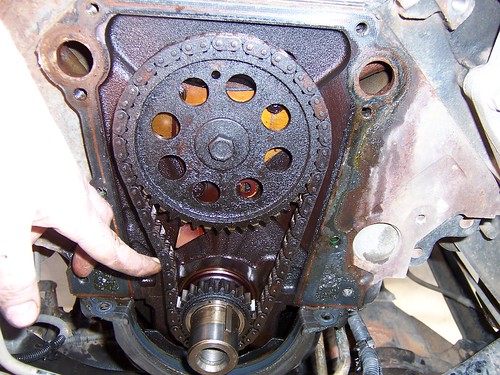

The picture I have of the lifter valley has shop rags stuffed in it, but it looked like the timing chain.
I had that crusty baked on oil all in my lifter valley and the valve train.
actually, I have pictures of it to back up what you're saying. I've run full synthetic for 54,000 miles.
The picture I have of the lifter valley has shop rags stuffed in it, but it looked like the timing chain.