
Challenger Hellcat Widebody From a Lifelong Mopar Lover’s View
Widebody Comes Home
A short time later, I was back home in Metro Detroit, scheduling my next batch of test cars and one of those cars was the Octane Red 2018 Dodge Challenger SRT Hellcat Widebody that we have all seen in online ads. As luck would have it, I got to drive the gorgeous deep red muscle car for two weeks and within that time period was the Woodward Dream Cruise.
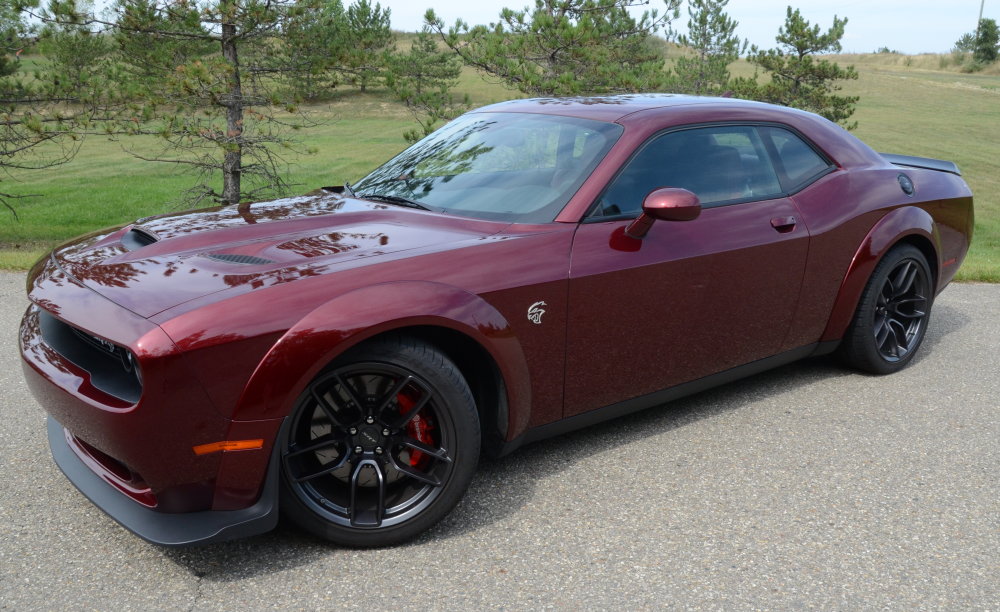
This meant that not only would I be among the first people to have an extended test session with a Widebody Challenger Hellcat, but I would be cruising Woodward at the area’s biggest annual event and since they had just started hitting media fleets around the country, almost no one had seen one of these cars in person. With that in mind, I knew that this car would draw plenty of attention, but I was not prepared for just how many people would be drawn to one of the first Widebody Hellcats in the world.
Driving the Widebody
In case you didn’t know, the 2018 Dodge Challenger SRT Hellcat Widebody is very similar to the original Hellcat cars. It is powered by the same supercharged 6.2-liter Hellcat Hemi with 707 horsepower and 650 lb-ft of torque with power being sent to the rear wheels by means of the same eight-speed automatic transmission. It has the same loaded interior an much of the same exterior design.

Where the Widebody Hellcat differs is, of course, in the introduction of the flared body panels. The front and rear wheel openings have large flares that allowed the SRT engineers to add wider wheels and tires, with 305-millimeter Pirelli PZero tires at all four corners. The wider rear rubber allows this Challenger to get off of the line a bit quicker, with the Widebody typically getting to 60 on the street in the 3.3-3.4 range while a Hellcat in the same situation is typically in the 3.6-3.7 range.
Also, when you factor in the wider tires with the returned suspension setup and the new Hellcat electronic power steering, this is comfortably the best-handling modern Mopar muscle car. I learned that on the road course at Indianapolis Motor Speedway.
That handling advantage really doesn’t transfer all that well to the street, but the ability to pull stunning 0-60 times does make a big difference in spirited on-road driving. You can launch the Widebody car quite a bit harder than the original Hellcat Challenger with greater expectations of grip and that makes the widened muscle car even more enjoyable to drive. Where the original Hellcat spins the tires, the Widebody spins them a bit less and translates more of that wheel spin into forward motion.

The Widebody package makes the Hellcat’s power more useable and at the same time, it offers the same connected ride quality that you get with all of the modern SRT vehicles. The Widebody Challenger also offers comparable “wow factor” when cruising through Metro Detroit, but when I had the test car, there were only a few on the street anywhere in the world and I expected that it would draw some attention, but it drew more attention than any car that I had ever driven.
Mind you, I’ve gotten to drive cars from the FCA Historical Collection including a 1971 Hemi Shaker Challenger, a 1969 Charger Daytona, a 1968 Hemi Charger and many others. Yet nothing I’ve ever driven drew a crowd like that first Widebody test car.

You must be logged in to post a comment.