


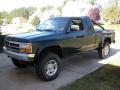
my 4x4 dakota


Rookie
Joined: Feb 2011
Posts: 94
Likes: 0
From: AZ

LOL! Oh yes they will give you a harsher ride. You may not feel it depending on how much you crank on them. You are twisting the bar more which increases its tension which causes the truck to go up. If you don't believe do your research all the lift kit manufactures will warn about the ride change.
It doesn't matter what anyone says, it's physics, think about it. Yes you are twisting the bar, both ends move the same amount. The only way you are going to put more tension on the bar is to increase the load on it. Changing the rear position of the bar will not put any more tension on it at all it will just change the overall rotation of the bar.
Attachment 12431
Example: If you have 200# at 6" off the ground and 200# at 6' off the ground you still have only 200# so why do you think rotating one end of the bar will put more tension on the bar?
Last edited by verdesardog; Mar 30, 2011 at 09:24 PM.
Rookie
Joined: Feb 2011
Posts: 94
Likes: 0
From: AZ
Yes if you drive so aggressive that you top out you won't be happy at all.
I put heavy V8 torsion bars on my V6 truck to get higher spring rate ( stiffer) due to the added weight of a winch in front of my front bumper, I tweaked the bars to get the same 2" rise in front as the 2" blocks in the rear. I have plenty of travel and have not topped out my suspension. The truck still has a very soft ride for an off road truck.
It is my daily driver and also my off road search and rescue truck.

Rookie
Joined: May 2010
Posts: 74
Likes: 0
Yes if you drive so aggressive that you top out you won't be happy at all.
I put heavy V8 torsion bars on my V6 truck to get higher spring rate ( stiffer) due to the added weight of a winch in front of my front bumper, I tweaked the bars to get the same 2" rise in front as the 2" blocks in the rear. I have plenty of travel and have not topped out my suspension. The truck still has a very soft ride for an off road truck.
It is my daily driver and also my off road search and rescue truck.
I put heavy V8 torsion bars on my V6 truck to get higher spring rate ( stiffer) due to the added weight of a winch in front of my front bumper, I tweaked the bars to get the same 2" rise in front as the 2" blocks in the rear. I have plenty of travel and have not topped out my suspension. The truck still has a very soft ride for an off road truck.
It is my daily driver and also my off road search and rescue truck.

Rookie
Joined: Feb 2011
Posts: 94
Likes: 0
From: AZ
Rookie
Joined: Feb 2011
Posts: 94
Likes: 0
From: AZ
That's the major problem with this IFS, it has limited suspension travel. You can only do so much with it before it maxes out. My next truck (soon, I hope) will be either a ram 2500 cummins of Ford 250 diesel both have solid front axles.

Rookie
Joined: Jan 2011
Posts: 83
Likes: 0
From: BC, Canada
It doesn't matter what anyone says, it's physics, think about it. Yes you are twisting the bar, both ends move the same amount. The only way you are going to put more tension on the bar is to increase the load on it. Changing the rear position of the bar will not put any more tension on it at all it will just change the overall rotation of the bar.
Attachment 12431
Example: If you have 200# at 6" off the ground and 200# at 6' off the ground you still have only 200# so why do you think rotating one end of the bar will put more tension on the bar?
Attachment 12431
Example: If you have 200# at 6" off the ground and 200# at 6' off the ground you still have only 200# so why do you think rotating one end of the bar will put more tension on the bar?
It is true however that you will end up with more suspension travel and less rebound travel.
Champion

Joined: May 2008
Posts: 4,839
Likes: 5
From: Apex, NC
It doesn't matter what anyone says, it's physics, think about it. Yes you are twisting the bar, both ends move the same amount. The only way you are going to put more tension on the bar is to increase the load on it. Changing the rear position of the bar will not put any more tension on it at all it will just change the overall rotation of the bar.
Attachment 12431
Example: If you have 200# at 6" off the ground and 200# at 6' off the ground you still have only 200# so why do you think rotating one end of the bar will put more tension on the bar?
Attachment 12431
Example: If you have 200# at 6" off the ground and 200# at 6' off the ground you still have only 200# so why do you think rotating one end of the bar will put more tension on the bar?
So, in conclusion, the only thing you said that was correct is that it is physics... cause it most certainly is physics. Unfortunately, you sir, don't know physics, nor how to apply it to engineering concepts.
Last edited by 95_318SLT; Mar 28, 2011 at 08:26 AM.
Rookie
Joined: May 2010
Posts: 74
Likes: 0
Wow... I don't know where you took physics, but last time I checked, the spring equation is: F=kx, where F is the total force on the spring at any given point, k is the constant spring rate, and x is the distance traveled from free length. On a torsion bar, x is an angular measurement, not a linear measurement, but its the same concept. Yes, any spring has a spring constant, and by twisting the bar, you are not changing that constant, but you are increasing x, which increases the overall force on the bar. When the truck is at rest, the force on that bar is called preload, which simply refers to the load required to hold the weight of the truck at a certain point. When the suspension is flexxed while driving, you are adding an addition load to that preload. By changing the preload, you are causing F to be greater at rest, which means it will take an even greater overall force to change x when the suspension travels, and that greater force needed to increase x beyond the preload point is what causes the harsher ride.
So, in conclusion, the only thing you said that was correct is that it is physics... cause it most certainly is physics. Unfortunately, you sir, don't know physics, nor how to apply it to engineering concepts.
So, in conclusion, the only thing you said that was correct is that it is physics... cause it most certainly is physics. Unfortunately, you sir, don't know physics, nor how to apply it to engineering concepts.


Veteran
Joined: Mar 2009
Posts: 438
Likes: 0
From: Mandan, ND
going to stay out of the tbar argument...
