


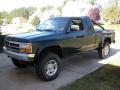
my 4x4 dakota

Champion

Joined: May 2008
Posts: 4,839
Likes: 5
From: Apex, NC

Thats your problem, you are thinking of a coil spring. You're comparing apples to oranges. Its like you exist in a y=x world where everything is simple and linear. If you put a block under a coil spring, yes, you are not changing the force applied to that spring, but torsion bars deal with TORQUE. And TORQUE requires both FORCE and DISTANCE. If you increase either one of those, the torque is changed. So yes, I agree that you are keeping force constant, but when you change the suspension angles and height of the truck, you are changing where that force is applied to the spring and suspension system as a whole and therefore torque changes. When I was referring earlier to the increase in force, I was referring to torque, just simplifying my terminology a little bit.
So since this debate just got so technical, lets let all the dogs out and write the equation how it should be without simplifying the concepts:
Fd=ks, where F is the Force applied to the spring at a distance d, k is the spring constant, and s is the rotational displacement of the spring from rest.
F is a constant while the truck is at rest, k is a constant, but d and s change proportionally to the equation (I say proportionally, because d and s are have different units of measure and therefore are on different scales, so they cannot change equally). As you crank the bars, you are changing the suspension angles and height of the truck, and therefore you are changing where the weight of the truck is applied to the spring and to the suspension system as a whole. Remember we are not dealing with a truck sitting directly over a solid axle and simply pushing the truck up from the axle like that y=x world you live in, we are dealing with rotating suspension arms and we have to change the torque applied to the spring to rotate those arms. As you turn the bar, d undeniably changes, so your statement about constants is thrown out the window.
And if that doesn't convince you, consider this: the torsion bar anchor cam is on a different axis than the suspension arm. The cams rotate around the torsion bar, whereas the control arms rotate around their own pivots and the torsion bar is a couple inches offset from that rotation point, so you therefore cannot say that the control arm and torsion bar anchor cam rotate equally as you turn the bolt, because they are turning around two different offset axis. Also, since the torsion bar anchor cam has a smaller turning radius than the control arm, AND they are on two seperate axis, you can think of it like a small gear turning a large gear... the small gear has to turn further to turn the large gear a specified amount in terms of angular displacement, so that shows that s does indeed increase.
Broaden your mind... y does not always equal x... in other words, not everything is linear and symmetric.
So since this debate just got so technical, lets let all the dogs out and write the equation how it should be without simplifying the concepts:
Fd=ks, where F is the Force applied to the spring at a distance d, k is the spring constant, and s is the rotational displacement of the spring from rest.
F is a constant while the truck is at rest, k is a constant, but d and s change proportionally to the equation (I say proportionally, because d and s are have different units of measure and therefore are on different scales, so they cannot change equally). As you crank the bars, you are changing the suspension angles and height of the truck, and therefore you are changing where the weight of the truck is applied to the spring and to the suspension system as a whole. Remember we are not dealing with a truck sitting directly over a solid axle and simply pushing the truck up from the axle like that y=x world you live in, we are dealing with rotating suspension arms and we have to change the torque applied to the spring to rotate those arms. As you turn the bar, d undeniably changes, so your statement about constants is thrown out the window.
And if that doesn't convince you, consider this: the torsion bar anchor cam is on a different axis than the suspension arm. The cams rotate around the torsion bar, whereas the control arms rotate around their own pivots and the torsion bar is a couple inches offset from that rotation point, so you therefore cannot say that the control arm and torsion bar anchor cam rotate equally as you turn the bolt, because they are turning around two different offset axis. Also, since the torsion bar anchor cam has a smaller turning radius than the control arm, AND they are on two seperate axis, you can think of it like a small gear turning a large gear... the small gear has to turn further to turn the large gear a specified amount in terms of angular displacement, so that shows that s does indeed increase.
Broaden your mind... y does not always equal x... in other words, not everything is linear and symmetric.
Last edited by 95_318SLT; Mar 29, 2011 at 09:32 AM.

Rookie
Joined: Feb 2011
Posts: 94
Likes: 0
From: AZ
I'm sorry I have confused you guys with facts. Coil springs and torsion bars are exactly the same thing and operate exactly the same way. The only difference is the movement of a coil spring is measured in length and the movemnt of a torsion bar is measured in rotational flex. If force on a torsion bar is constant the flex will be constant. Changing the rotation of the rear of the torsion bar will not put more force on it, the only way to put more force on it is to increase the weight on it.
I dorve my truck with the bars tweaked up for a couple of years, there was no difference in ride. I then put on heavy duty V8 torsion bars and tweaked them to get the same lift, there is now a slightly stiffer ride due to the higher spring weigh.
You can continue to be ignorant or you can really think about the physics and come to the correct conclusion that just changing the rotation of the rear of a torsion bar will not affect the tension on that bar unless the other end of the bar cannot move, but it does move in a truck suspension, that's what gives you the lift! How much simpler can it be explained?
I dorve my truck with the bars tweaked up for a couple of years, there was no difference in ride. I then put on heavy duty V8 torsion bars and tweaked them to get the same lift, there is now a slightly stiffer ride due to the higher spring weigh.
You can continue to be ignorant or you can really think about the physics and come to the correct conclusion that just changing the rotation of the rear of a torsion bar will not affect the tension on that bar unless the other end of the bar cannot move, but it does move in a truck suspension, that's what gives you the lift! How much simpler can it be explained?
Champion
Joined: May 2008
Posts: 4,839
Likes: 5
From: Apex, NC
...or you can really think about the physics and come to the correct conclusion that just changing the rotation of the rear of a torsion bar will not affect the tension on that bar unless the other end of the bar cannot move, but it does move in a truck suspension, that's what gives you the lift! How much simpler can it be explained?
Rookie
Joined: Feb 2011
Posts: 94
Likes: 0
From: AZ
yes the WHOLE bar twists equally there is not any more displacement between the front and rear of the bar, thats what gives the lift.

Veteran
Joined: Mar 2009
Posts: 438
Likes: 0
From: Mandan, ND
 I have seen people get "vacations" from forums for things like this.
Now Im back out of the way before I get drug into this.


Rookie
Joined: Feb 2011
Posts: 94
Likes: 0
From: AZ
I think I might have realised what the confusion is about...linear movement.
How can a small movment of the frame end of a t bar cause a large movement of the suspension? Leverage. the "Key" is a short lever and the suspension is a much longer lever. The same angular displacement about the fulcrum of a lever will cause a larger movement at the free end of a long lever than the free end of a short lever. Small linear movement of the "key" = longer linear movement of the suspension.
How can a small movment of the frame end of a t bar cause a large movement of the suspension? Leverage. the "Key" is a short lever and the suspension is a much longer lever. The same angular displacement about the fulcrum of a lever will cause a larger movement at the free end of a long lever than the free end of a short lever. Small linear movement of the "key" = longer linear movement of the suspension.
Rookie
Joined: Feb 2011
Posts: 94
Likes: 0
From: AZ
Don't confuse ignorance with stupidity. Ignorance is lack of knowledge and can be corrected with teaching. Stupidity is just that.... stupid and cannot be corrected by any means.
At one time everyone thought the world was flat. If you didn't believe that you were considered stupid and even called a heretic. Did that change the fact that the world was indeed not flat? If you were one of the ones that thought the world was flat did that make you stupid? NO, just ignorant. There's nothing wrong with being ignorant of some things as long as you have the ability and willingness to learn....
At one time everyone thought the world was flat. If you didn't believe that you were considered stupid and even called a heretic. Did that change the fact that the world was indeed not flat? If you were one of the ones that thought the world was flat did that make you stupid? NO, just ignorant. There's nothing wrong with being ignorant of some things as long as you have the ability and willingness to learn....
Last edited by verdesardog; Mar 29, 2011 at 11:57 AM.
Rookie
Joined: Feb 2011
Posts: 94
Likes: 0
From: AZ
I didn't meat to ruffle anyone's feathers, I was just trying to make a point.
If my words hurt any feelings I apologize.
If you want to continue to believe the falsity of more tension on a torsion bar by rotating one end while the other end is free to move, go ahead. Just remember the world is not flat!
If my words hurt any feelings I apologize.
If you want to continue to believe the falsity of more tension on a torsion bar by rotating one end while the other end is free to move, go ahead. Just remember the world is not flat!