


Coolant Type


Thread Starter
|
Registered User
Joined: Jan 2008
Posts: 23
Likes: 0
 Coolant Type
Dropped my 2001 Durango at mechanic. Asked for price of a radiator flush he told me $212.00 for flushing and changing thermostat. He asked me what coolant i was using. Told him the regular one green color. He said STOP! Don't use that one anymore as it can mess intake manifold by corroding the gaskets. Told me to get a blue colored one. My truck has 64750 miles on it. Bought it used in 04 w/27000 miles on, and have always refilled reserve tank with the 50/50 anti-freeze from Prestone. Never had a problem. What can anybody tell me about this?

THE ULTI-MOD


Joined: Jan 2007
Posts: 19,797
Likes: 36
From: Union NJ
your using the same stuff we use(prestone, yellowish green color iirc), and we have never had a problem like that. (5 dodge trucks, 4 dakotas and my durango, 3 daks were 120k 100k 197k when we got rid of them, the other two we still own)
time for a new mechanic IMO
time for a new mechanic IMO
THE ULTI-MOD
Joined: Jan 2007
Posts: 19,797
Likes: 36
From: Union NJ

Trending Topics

Champion
Joined: Jun 2006
Posts: 4,822
Likes: 4
From: Indiana
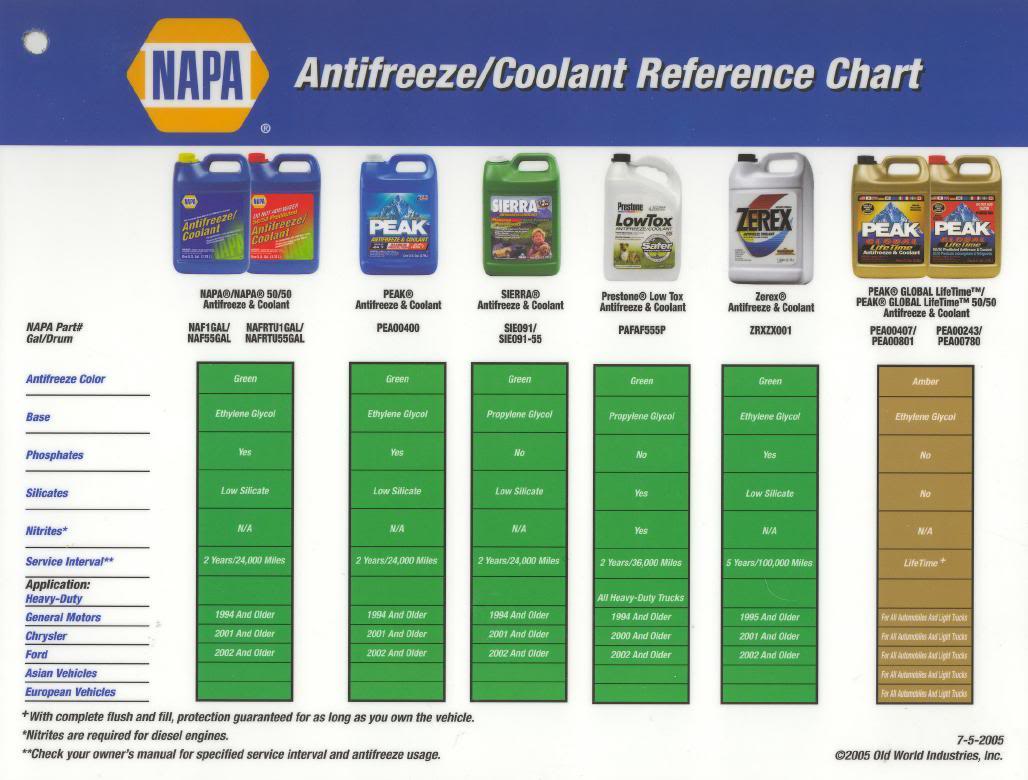
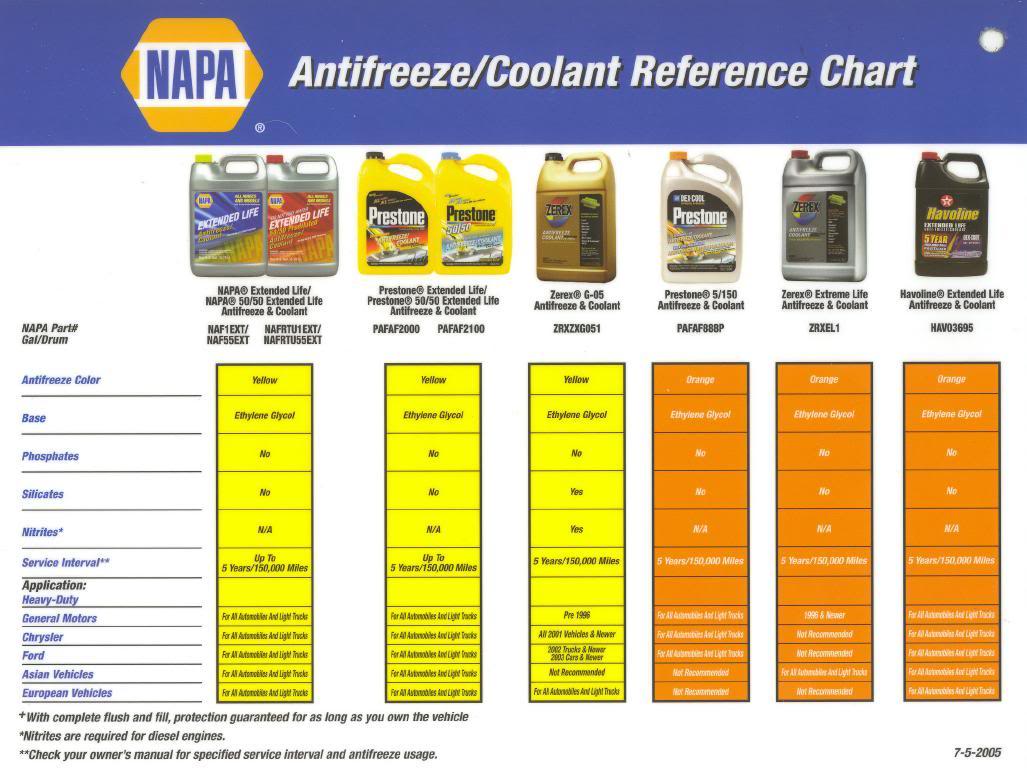
Unfortunately, identifying the type of coolant that is in the cooling system is not always easy. You can't go by color because it varies, Most conventional two-year antifreezes for north American domestic vehicles is dyed green. But Saturn and some European makers also use green dye for their extended life coolants. Dex-Cool extended life coolant, which is used in new GM vehicles, is dyed orange to distinguish it from ordinary antifreeze. If intermixed with other types of antifreeze, the color may or may not change depending on the dosage. GM warns that intermixing extended life coolant with ordinary coolant reduces the coolant's life to that of the ordinary coolant.
To add to the color confusion, some European and Korean coolants are dyed blue. Mercedes uses a yellow dye in its coolant. Toyota's new extended life coolant is dyed red. Intermix any of the above and its hard to tell what color the coolant may become.
The real difference between all these EG coolants is in the additive package. Traditional antifreeze formulas for domestic applications with aluminum radiators, cylinder heads or blocks contain a high level of silicates (which is not really needed in cast iron engines with copper/brass radiators). Silicates form a protective barrier on aluminum that protects the metal. The additives in European and Asian OEM antifreezes, however, contain less silicates and rely mostly on borates to inhibit corrosion. European antifreezes also contains no phosphates because hard water can react with phosphates to form calcium and magnesium sediments. The Asians use phosphates but no borates and low or no silicates because they say borates may actually add to the aluminum corrosion problem if the coolant is neglected.
The extended life coolants use an entirely different corrosion inhibiting chemistry that uses carboxylate organic acids instead of the silicates, phosphates or borates.
To add to the color confusion, some European and Korean coolants are dyed blue. Mercedes uses a yellow dye in its coolant. Toyota's new extended life coolant is dyed red. Intermix any of the above and its hard to tell what color the coolant may become.
The real difference between all these EG coolants is in the additive package. Traditional antifreeze formulas for domestic applications with aluminum radiators, cylinder heads or blocks contain a high level of silicates (which is not really needed in cast iron engines with copper/brass radiators). Silicates form a protective barrier on aluminum that protects the metal. The additives in European and Asian OEM antifreezes, however, contain less silicates and rely mostly on borates to inhibit corrosion. European antifreezes also contains no phosphates because hard water can react with phosphates to form calcium and magnesium sediments. The Asians use phosphates but no borates and low or no silicates because they say borates may actually add to the aluminum corrosion problem if the coolant is neglected.
The extended life coolants use an entirely different corrosion inhibiting chemistry that uses carboxylate organic acids instead of the silicates, phosphates or borates.
