


2003 4.7 Durango engine noise


Thread Starter
|
Rookie
Joined: Aug 2006
Posts: 73
Likes: 0
From: Whitmore Lake, MI

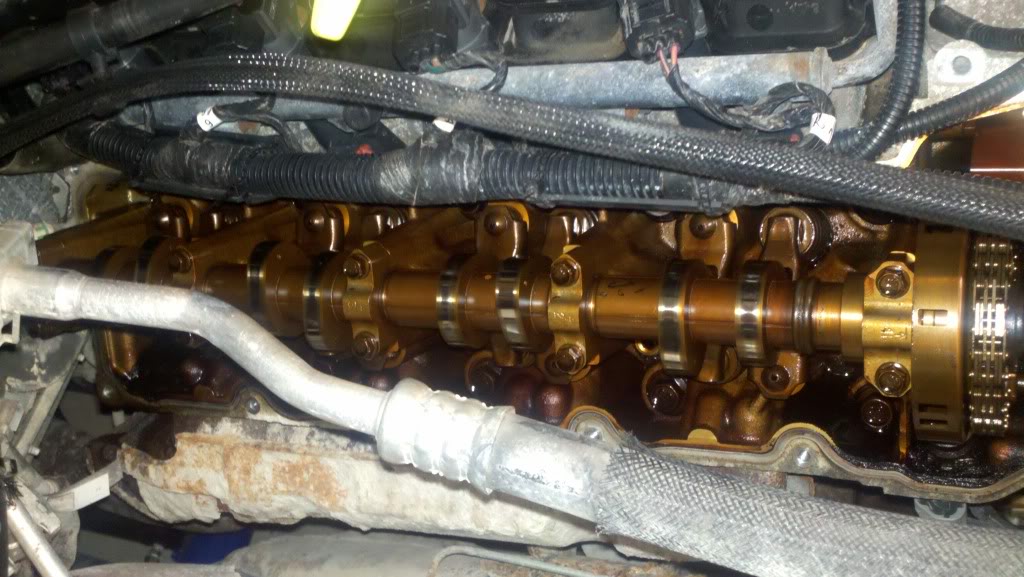
Here is a photo under the right side valve cover...everything appears normal. I will order the timing set today and install it.
http://i295.photobucket.com/albums/m...1/Durango5.jpg
http://i295.photobucket.com/albums/m...1/Durango5.jpg
Last edited by shrpshtr325; Jun 9, 2011 at 11:10 AM. Reason: show pictires

Veteran
Joined: Sep 2010
Posts: 396
Likes: 2
From: Buffalo, NY
To keep the two threads easier to read, I'll repost what I put in the other one first:
***********************
The tensioners service life is measured by the thickness of the pad pushing on the chain. I don't have that measurement here, but it's listed in the Haynes manual and should be in Chiltons also. The way they work is that the spring pushes them out and the ratchet pawl holds them there. If the spring is weak they can't go back in, but they also wont go out any further either. You can pull them off to examine them closer, use a small piece of wire inserted in the hole in them to hold them closed while you install them. I believe they are also fed with oil from the mounting face.
Check out your guides for large grooves - it indicates that the chain is slapping on them. You need to pull your valve covers as well and take a look under them. FWIW, low oil pressure / oil restriction (sludge, blocked filter, etc) will also cause the 4.7 to make a racket while starting.
**************************
After looking at the head pic, what are the marks on the camshaft after the first two lobes? Looks like vice grip marks? Not a problem with it, I'm just wondereing if the motor was worked on in the past and you're not aware of it?
Anyways, to prevent marks in the future either use the tool designed for holding the cam sprocket (available at a dealer) or wrap the cam with a piece of old leather belt before putting vice grips on it.
Even though there's nothing visible, you can pull the bearing surface caps (one at a time) and have a look at the journal surfaces. Any evidence of scoring or wear should be pretty easy to see. Put each cap back on and torque it before moving onto the next one.
Bob
***********************
The tensioners service life is measured by the thickness of the pad pushing on the chain. I don't have that measurement here, but it's listed in the Haynes manual and should be in Chiltons also. The way they work is that the spring pushes them out and the ratchet pawl holds them there. If the spring is weak they can't go back in, but they also wont go out any further either. You can pull them off to examine them closer, use a small piece of wire inserted in the hole in them to hold them closed while you install them. I believe they are also fed with oil from the mounting face.
Check out your guides for large grooves - it indicates that the chain is slapping on them. You need to pull your valve covers as well and take a look under them. FWIW, low oil pressure / oil restriction (sludge, blocked filter, etc) will also cause the 4.7 to make a racket while starting.
**************************
After looking at the head pic, what are the marks on the camshaft after the first two lobes? Looks like vice grip marks? Not a problem with it, I'm just wondereing if the motor was worked on in the past and you're not aware of it?
Anyways, to prevent marks in the future either use the tool designed for holding the cam sprocket (available at a dealer) or wrap the cam with a piece of old leather belt before putting vice grips on it.
Even though there's nothing visible, you can pull the bearing surface caps (one at a time) and have a look at the journal surfaces. Any evidence of scoring or wear should be pretty easy to see. Put each cap back on and torque it before moving onto the next one.
Bob

Veteran
Joined: Sep 2010
Posts: 396
Likes: 2
From: Buffalo, NY
Indy,
I don't believe there really is a way to check or adjust lashing pressure on the 4.7 , I don't recall any adjustments on it. The lash adjusters are hydraulic and are "pumped up" with engine oil and (should) remain full. If they're not working / leaking they just get replaced. I'm sure that there is some sort of official "leakdown" test for them somewhere, but I'm not aware of it. If they're completely trashed it's pretty obvious because it'll rattle like hell and not subside after a few moments (if they don't self destruct!)
Common causes for valve noise is low (and high!) oil level, dirty oil, low pressure, contamination, and the dreaded sludge. A lot of the oil passages on this motor are quite small and can get constricted easily. BTW, high oil level can cause air bubbles to be trapped in the oil and taken into the lash adjusters causing them to "pump down".
Bob
I don't believe there really is a way to check or adjust lashing pressure on the 4.7 , I don't recall any adjustments on it. The lash adjusters are hydraulic and are "pumped up" with engine oil and (should) remain full. If they're not working / leaking they just get replaced. I'm sure that there is some sort of official "leakdown" test for them somewhere, but I'm not aware of it. If they're completely trashed it's pretty obvious because it'll rattle like hell and not subside after a few moments (if they don't self destruct!)
Common causes for valve noise is low (and high!) oil level, dirty oil, low pressure, contamination, and the dreaded sludge. A lot of the oil passages on this motor are quite small and can get constricted easily. BTW, high oil level can cause air bubbles to be trapped in the oil and taken into the lash adjusters causing them to "pump down".
Bob
Thread Starter
|
Rookie
Joined: Aug 2006
Posts: 73
Likes: 0
From: Whitmore Lake, MI
What you see on the cam is a "clean" spot I wiped...I haven't touched the cam with anything yet. I have parts on order...should be here Monday/Tuesday.
I need to see what you guys recommend for sealant on the timing cover.
I had a gasket that was a full surface area metal piece with silicone on it...but there was no gasket on mine so I have ordered the two O rings and crank seal kit. I don't want to pull the gears and chains off until I receive the kit.
I need to see what you guys recommend for sealant on the timing cover.
I had a gasket that was a full surface area metal piece with silicone on it...but there was no gasket on mine so I have ordered the two O rings and crank seal kit. I don't want to pull the gears and chains off until I receive the kit.
Veteran
Joined: Sep 2010
Posts: 396
Likes: 2
From: Buffalo, NY
A thin bead of blue silicone form-a-gasket is fine. I think the Fel-Pro kit for it comes with a small tube of black silicone sealer along with the rubber O-rings.
Bob
Bob


Hall Of Fame


Joined: Jun 2005
Posts: 14,228
Likes: 19
From: Riverton, UT
Sounds like classic chain wear and worn sprockets. Tight at one spot and loose at another. Remember to ensure the motor is at #1 TDC and timing marks lined up before tear down of timing components. I think you said you are ordering the whole set up, but I was unsure.
You should take a look at the Service Manual http://www.mediafire.com/?fqnnjdzq252
You should take a look at the Service Manual http://www.mediafire.com/?fqnnjdzq252