


1 Gen Durango Heater Flow


Thread Starter
|
Rookie
Joined: Oct 2010
Posts: 93
Likes: 1
 1 Gen Durango Heater Flow
Hi all -I'm having problem above...
I was an industrial troubleshooter for years, and have literally tried everything over the years: flushes, acids, filling and quick connects, filling on stands, boiled thermostats on the stove for opening temp (never a bad one), house water pressure flows out of hoses through core about a foot (5/8 wide and about the same as house hose alone) either direction. The core is not the problem.
I still have apparently minimal flow except during a rpm change (up or down). (I end up reving alot to heat when with the wife, but obviously this kills the mileage.) This all convinces me it's a supply differential pressure problem.
So, I tested to see which supply side fitting had more pressure and which had suction - neither - both are pressure with an open system. (I tried house water filling into radiator, and held both supplies hoses up in the air during idle.) One side flowed up in the air say 3 inches and the other say 2 inches - a very small differential (I couldn't rev at the time) which would account for the low flow. I also tried letting engine push water either way 1 at a time - again decent flows individually, but logic says they would cancel each other out when both are hooked up.
So... I think they (Dodge) picked a very marginal place to try to grab a small pressure differential to cause flow through the core (or I have an internal flow problem).
Has anyone worked out a solution along these lines? Maybe selecting another place to take off pressure supply or (relative or actual) suction return, blocked something to cause more of a differential to core, anything that really worked? I see a lot of posts on this (and read them all) but no real solution.
THX for listening! Hoping for a universal cure!
I was an industrial troubleshooter for years, and have literally tried everything over the years: flushes, acids, filling and quick connects, filling on stands, boiled thermostats on the stove for opening temp (never a bad one), house water pressure flows out of hoses through core about a foot (5/8 wide and about the same as house hose alone) either direction. The core is not the problem.
I still have apparently minimal flow except during a rpm change (up or down). (I end up reving alot to heat when with the wife, but obviously this kills the mileage.) This all convinces me it's a supply differential pressure problem.
So, I tested to see which supply side fitting had more pressure and which had suction - neither - both are pressure with an open system. (I tried house water filling into radiator, and held both supplies hoses up in the air during idle.) One side flowed up in the air say 3 inches and the other say 2 inches - a very small differential (I couldn't rev at the time) which would account for the low flow. I also tried letting engine push water either way 1 at a time - again decent flows individually, but logic says they would cancel each other out when both are hooked up.
So... I think they (Dodge) picked a very marginal place to try to grab a small pressure differential to cause flow through the core (or I have an internal flow problem).
Has anyone worked out a solution along these lines? Maybe selecting another place to take off pressure supply or (relative or actual) suction return, blocked something to cause more of a differential to core, anything that really worked? I see a lot of posts on this (and read them all) but no real solution.
THX for listening! Hoping for a universal cure!
Last edited by tshephard; Mar 15, 2013 at 08:25 AM.

Captain
Joined: Jan 2011
Posts: 725
Likes: 2
From: Central Missouri
I'm kind of on the same path. I have tried everything you have tried, and on both my 1998 Ram and my 1998 Durango. The Durango has even had two new heater cores over the years and I still have not had heat for many years.
I'm thinking the engine is the flow problem. If I am reading the flow correctly, the heater core gets the hot fluid after it has gone through the engine. I think over time, lime and scale have build up in the block...limiting the flow at the end of the cycle.
My next plan this Spring, is to drain the system, and let it sit with a mild acid or Vinegar for a night or two to dissolve anything inside the block that might be hindering flow. It'll be flushed afterwards of course but it's the only thing I haven't tried or checked or replaced.
I'm thinking the engine is the flow problem. If I am reading the flow correctly, the heater core gets the hot fluid after it has gone through the engine. I think over time, lime and scale have build up in the block...limiting the flow at the end of the cycle.
My next plan this Spring, is to drain the system, and let it sit with a mild acid or Vinegar for a night or two to dissolve anything inside the block that might be hindering flow. It'll be flushed afterwards of course but it's the only thing I haven't tried or checked or replaced.

Thread Starter
|
Rookie
Joined: Oct 2010
Posts: 93
Likes: 1
Hey Sooper (and THX O_S). There are so many threads where so many have problems...
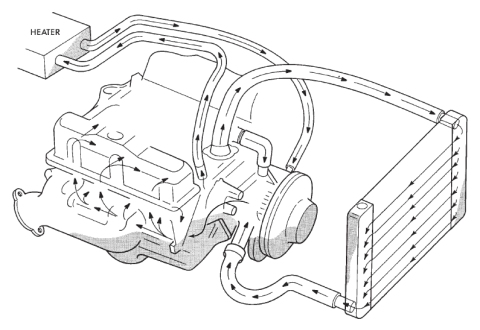
I have the manual (O_S's pic), and from it and water pump pics on the web it appears that from the pump each side's cylinders and heads are in series, then paralleled together through the manifold, then seriesed to the bypass and heater (always in parallel); and the thermostat 'adds' the radiator also in parallel. I don't think that little hose has much of a chance at flow at best once the stat opens. (I also think that explains why so many get gunked up.)
I'm left wondering...
Closing the bypass. Next trip I'll clamp my small visegrips on.
If we all have replacement waterpumps and they somehow cheapened a critical spec, impeller, etc. Anyone with their OE pump having trouble with flow? (I did have to add that tube back to the side of the replacement pump - I wonder if it went too far in?)
I have the manual (O_S's pic), and from it and water pump pics on the web it appears that from the pump each side's cylinders and heads are in series, then paralleled together through the manifold, then seriesed to the bypass and heater (always in parallel); and the thermostat 'adds' the radiator also in parallel. I don't think that little hose has much of a chance at flow at best once the stat opens. (I also think that explains why so many get gunked up.)
I'm left wondering...
Closing the bypass. Next trip I'll clamp my small visegrips on.
If we all have replacement waterpumps and they somehow cheapened a critical spec, impeller, etc. Anyone with their OE pump having trouble with flow? (I did have to add that tube back to the side of the replacement pump - I wonder if it went too far in?)
Last edited by tshephard; Mar 15, 2013 at 12:06 PM.
Captain
Joined: Jan 2011
Posts: 725
Likes: 2
From: Central Missouri
Hey Sooper (and THX O_S). There are so many threads where so many have problems...
I have the manual (O_S's pic), and from it and water pump pics on the web it appears that from the pump each side's cylinders and heads are in series, then paralleled together through the manifold, then seriesed to the bypass and heater (always in parallel); and the thermostat 'adds' the radiator also in parallel. I don't think that little hose has much of a chance at flow at best once the stat opens. (I also think that explains why so many get gunked up.)
I'm left wondering...
Closing the bypass. Next trip I'll clamp my small visegrips on.
If we all have replacement waterpumps and they somehow cheapened a critical spec, impeller, etc. Anyone with their OE pump having trouble with flow? (I did have to add that tube back to the side of the replacement pump - I wonder if it went too far in?)
I have the manual (O_S's pic), and from it and water pump pics on the web it appears that from the pump each side's cylinders and heads are in series, then paralleled together through the manifold, then seriesed to the bypass and heater (always in parallel); and the thermostat 'adds' the radiator also in parallel. I don't think that little hose has much of a chance at flow at best once the stat opens. (I also think that explains why so many get gunked up.)
I'm left wondering...
Closing the bypass. Next trip I'll clamp my small visegrips on.
If we all have replacement waterpumps and they somehow cheapened a critical spec, impeller, etc. Anyone with their OE pump having trouble with flow? (I did have to add that tube back to the side of the replacement pump - I wonder if it went too far in?)
My 1998 Durango still has the original pump. My 1998 Ram HAD it's original pump up until a few weeks ago. I changed it hoping there would be a difference. No change, good or bad.
Let's brainstorm things to try.
My next step is to fill the engine with a solution that will help dissolve any buildup in the engine. I've already done a 'flush' with a solvent designed for heater core maintenance and it made zero difference.
Anyone think CLR would be a bad idea in an engine block? Vinegar is my next idea. Some kind of a mild acid would be something I'd look into too if it wouldn't harm the pump or upper gaskets.
Thread Starter
|
Rookie
Joined: Oct 2010
Posts: 93
Likes: 1
I've CLR'ed and vinegar'ed at different times. No problems, CLR gets better results on pure rust (vinegar for coffee pot, organics, potables, etc).
Good to hear OE pump, won't have to take that off to look!
After looking, I'm very suspicious of return pipe at near right angle to bypass in pump casting... I might try a DIY flow diverter.
Good to hear OE pump, won't have to take that off to look!
After looking, I'm very suspicious of return pipe at near right angle to bypass in pump casting... I might try a DIY flow diverter.
Captain
Joined: Jan 2011
Posts: 725
Likes: 2
From: Central Missouri
I've CLR'ed and vinegar'ed at different times. No problems, CLR gets better results on pure rust (vinegar for coffee pot, organics, potables, etc).
Good to hear OE pump, won't have to take that off to look!
After looking, I'm very suspicious of return pipe at near right angle to bypass in pump casting... I might try a DIY flow diverter.
Good to hear OE pump, won't have to take that off to look!
After looking, I'm very suspicious of return pipe at near right angle to bypass in pump casting... I might try a DIY flow diverter.
Don't forget, the heat USED to work great. When new the heat was more than enough to quickly defrost itself, and warm the cabin enough so that I had to lower temps to stay comfortable.
That simply just doesn't happen anymore, and it seems to be a very common problem regardless of what mods have been done.
I guess we need to hear from some guys who have rebuilt their engines or replaced them with new engines. I'm still thinking it's buildup in the block that's restricting flow of hot coolant through the core.
The biggest reason I say that is because my Durango has had the core replaced. The new ones are SUPER hot to the touch. Plenty of air flows through the vents. Using a hose, flow through the core is great both ways. Hot fluid is getting to the core but I don't think it's moving through the core.
This may be another reason that air gets trapped in the core so easily over time. The flow diminishes to the point that it can't carry away the air bubbles.
Trending Topics

Registered User
Joined: Mar 2013
Posts: 6
Likes: 0
I have same problem even after changing engine and pump. Guys at advanced auto said its could be a resister that's i have'nt be able to get to its located behind the dash in center above the heater air conditioning housing. They said that was fairly commomon these. I have 98 318 love it.but can't start it ordering pcm tomarrow seem's all test done point to that. One thing i can best car i ever drove through snow!!as deep as the top of hood!
I have same problem even after changing engine and pump. Guys at advanced auto said its could be a resister that's i have'nt be able to get to its located behind the dash in center above the heater air conditioning housing. They said that was fairly commomon these. I have 98 318 love it.but can't start it ordering pcm tomarrow seem's all test done point to that. One thing i can best car i ever drove through snow!!as deep as the top of hood!
The resistor they are talking about is the blower motor resister and it would have NO effect on the flow... the only thing it controls are the blower motor speed.. If you are having a issue with the fan no blowing in hi, med, or low then that would be it other than that it should not be effecting anything else.

Record Breaker

Joined: Jun 2011
Posts: 2,387
Likes: 41
From: Bismarck, ND
Great to hear I'm not the only one with this issue. I have tried flushing it multiple times with no effect. I run cardboard all winter and still nothing. I think we are all in consensus there is an issue with the pump design or in the block something getting blocked. Pressure always takes the path of least resistance, I noticed that I can feel when my thermostat opens the air gets much cooler. Leads me to believe there is a passage in the block that is blocking flow. Just my 2cents.