


Neon Facts


Thread Starter
|
Record Breaker

Joined: Nov 2006
Posts: 1,791
Likes: 0
From: Detroit Michigan
 Neon Facts
The Neon was a compact car sold from 1994 (as a 1995 model year vehicle) through 2005 by DaimlerChrysler's Dodge and Plymouth brands. For a brief time in Canada and export markets outside the United States, it carried Chrysler badges. It was produced as a front wheel drive car to replace the Dodge Shadow/Plymouth Sundance/Plymouth Duster, as well as the Dodge/Plymouth Colt. The Dodge Neon came in many different versions throughout its production.
[/align]
//
1994–1999
The first generation Neon was introduced in January 1994 and manufactured for model years 1995 to 1999. It was available as a 4-door sedan or 2-door coupe. It was powered by either a 132hp (98kW) @ 6000rpm and 129ft·lbf (175N•m) @ 5000rpm SAE 2.0L SOHC or a 150hp (112kW) @ 6500rpm and 133ft·lbf (180N•m) @ 5600rpm SAE 2.0L DOHC 4-cylinder engine. The Neon was available with a 3-speed automatic transmission or a 5-speed manual transmission and was sold as a Dodge and Plymouth in the United States and Canada, and as the Chrysler Neon outside of the United States.

 [/align]1st-gen Plymouth Neon coupe[/align][/align][/align]

[/align]Plymouth Neon sedan[/align][/align][/align]Often neglected in discussions of the Neon is the relative power compared to other cars of the day - the Civic DX at 102 hp (76 kW), the Civic EX at 125 hp (93 kW), the Sentra, the Escort ZX2 at 130 hp (97 kW), the Corolla at 115 hp (86 kW), etc. The Neon's torque output was also higher than competitors. At the Neon's release, then chairman of Chrysler Corporation Robert Lutz said, "There's an old saying in Detroit: 'Good, fast, or cheap. Pick any two.' We refuse to accept that." Indeed, the Neon made a sizable profit - the only recent American car in its class to do so.

[/align]1st-gen Neon with bubble hubcaps[/align][/align][/align]First-generation Neons are highly competitive in SCCA Solo autocross.[1] Available with both the SOHC (sedan) or DOHC (coupe) the ACR was one of the most competitive in its class, and featured four-wheel disc brakes, Arvin non-adjustable struts for 95-96 models and Koni adjustable dampers for 97-99 models, thicker anti-sway bars, fast-ratio steering, heavy-duty front wheel hubs, and a 5-speed manual transmission with a numerically higher .81 fifth gear and final drive ratio of 3.94 for quicker acceleration. 1995 through 1997 models featured adjustable camber. The computer-controlled speed limiter was also completely removed from 1995 ACR models, and raised from the standard 190km/h (118mph) to 210km/h (130mph) for subsequent years. The ACR offers no badging to distinguish it from other Neon models; the only visible difference is a bumper with fog light holes, but no fog lights. In 1995, the ACR was only offered to SCCA members, but in subsequent years it was available to the general public. The name "ACR" was initially the internal ordering code for the "Competition Package", as it was termed in dealer materials; however, as knowledge of the model spread, the ACR name stuck, and backronyms such as "American Club Racer" were given to it by fans.
The R/T model (Road/Track) debuted in the 1998 model year featuring many of the ACR's mechanical upgrades such as the numerically higher ratio 3.94 5 speed manual transmission with the .81 5th gear. The R/T, however, was intended for the street, with many more comfort and convenience features standard or available, and specialized racing parts like the adjustable dampers removed. The R/T also featured bold stripes over the top of the car, and prominent "R/T" badging and was only available as in a DOHC 5 speed configuration.
Early Neons had a number of reliability problems, the most famous being head gasket failures. By November 1998, the head gasket had been replaced with a new MLS (Multi Layer Steel) design which proved to be much more reliable and was standard in most 1999 models and was also retrofitted to earlier models. Many early Neons suffered from poor paint finish quality, where the paint became brittle and peeled off in sheets, partly because of teething problems with a new environmentally-friendly "dry painting" process. Either way, by the end of the first generation, most problems had been sorted out and the Neon proved to be a reliable car. Unfortunately, the Neon's early reputation for poor reliability persists even today, possibly because Chrysler failed to adequately publicize its improvements or proactively reach out to customers who had experienced failures.
Neons also suffered from some interesting design choices, including the impossibility of gaining power windows in the rear doors, and a climate control system which had drivers move the fan **** in one direction for air conditioning and the other for vent. The latter caused less conscious drivers to drive consistently with the air conditioner on, which greatly hurt power and fuel economy, since the unit was quite powerful. Also, the car automatically turned on the air conditioning whenever the defogger was used, regardless of which side the fan control was set on. Owners often would disable the contact on the selector **** allowing them to use the defogger without air conditioning. The air conditioning evaporator proved to be prone to failure after warranties expired (a problem addressed in later years), which is an expensive repair since it is relatively inaccessible.
Certain color Neons, such as red and black, had bumper covers molded in color rather than painted. These covers would not shine like paint, but they absorbed scuffs and scrapes with less notice. The mid-level Highline models were well known for their unique "bubble" hubcap design.
The Australian-market Chrysler Neon came in two models, the SE and the better equipped LX. Later, the LX model was replaced by the LE with the updated model in 1999. In the United States, the lineup started out as Base, Highline, and Sport, with different styles and options in each line, but the lineup titles changed frequently (other trim lines included Expresso, SE, ES, SXT, ACR, and R/T). In Europe, the car was also available with a 1.8L engine and was fitted with glass headlights. Europe received one limited edition model, the CS, which only came in Platinum paint. Fitted with the 131 bhp DOHC engine, American R/T specification suspension, rear spoiler and unique alloy wheels it was the best performing first generation Neon available in Right Hand Drive.
[edit] Trim levels
Plymouth Neon:1995-1999
[ul][*]base - 1995-1997[*]Highline - 1995-1999[*]Sport - 1995-1996[*]Expresso - 1996-1999[*]EX - 1998-1999[*]Competition - 1998-1999[*]Style - 1998 [/ul]
Dodge Neon:1995-1999
[ul][*]base - 1995-1997[*]Highline - 1995-1999[*]Sport - 1995-1999[*]EX- 1998-1999[*]Competition - 1998-1999[*]R/T - 1998-1999 [/ul]
[ul][*]note: In Canada, both Dodge and Plymouth models were available in an Ex package, similar to the Expresso (which was also available). These models generally featured chrome "EX" badging, along with the "power bulge" hood, among other standard options. [/ul]
Chrysler Neon (Europe):1995-1999
[ul][*]SE - 1995-1999[*]LX - 1995-1999[*]CS - 1998[/ul]
2000–2005
Second generation
Also called
Chrysler Neon
Dodge SX 2.0
Plymouth Neon
Production
2000-2005
Body style(s)
4-door sedan
Engine(s)
2.0 L A588 I4
Transmission(s)
5-speed NVG T-350 manual
3-speed 31TH automatic
4-speed 41TE automatic
Wheelbase
105.0 in (2667 mm)
Length
174.4 in (4430 mm)
Width
67.4 in (1890 mm)
Height
56.0 in (1422 mm)
Related
Dodge SRT-4

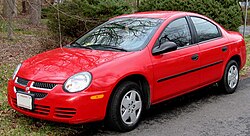
[/align]Pre-facelift 2nd-gen Dodge Neon[/align][/align][/align]Sales of the second generation model started with model year 2000 and production ended with the 2005 model year. The second generation Neon was only available as a 4-door sedan. In some regions, including the United States, the sole engine was the 2.0L SOHC engine, with an optional Magnum configuration (including an active intake manifold) that produced 150hp.
The second generation was much more refined than the first generation car. It was advertised that the second generation Neon had over 1,000 refinements from the original generation. The first generation's frameless windows (which would pull away from the door in a strong crosswind) were replaced with a full-framed door. Numerous other NVH refinements led to a much quieter and enjoyable passenger car. The more refined interior and greater size did, however, come at the cost of increased weight. This, along with the discontinuance of the DOHC engine, caused the second generation car to be less competitive on the race track.
In 2001, The R/T trim returned after a one year hiatus. The R/T consisted on a new 150 horsepower (112 kW) SOHC Magnum 2.0 Liter Engine, 16 inch wheels, spoiler, dual chrome exhaust tips, quicker steering box and stiffer springs. The 2001 R/T had a one-year-only aircraft style spoiler -- for 2002-, the R/T models wore a rounded spoiler (a smaller version of the SRT-4 wing). The Neon also offered a Sport package for the 2001 model year only. It consisted of an R/T wing, R/T 16 inch wheels, R/T springs, white instrument cluster and R/T steering box. It was an R/T visually except for the lack of dual exhaust, R/T lower mouldings, fog lamps and R/T exclusive front bumper. The Sport only came equipped with the base model's 132 horsepower engine and was available with an automatic tranmission (unlike the manual-only R/T model). 2001 was the last year for the Plymouth Neon, and the Plymouth brand as well, the last Plymouth Neon (which was also the last Plymouth), a silver 4-door sedan, rolled off the assembly line on June 28, 2001.
When DaimlerChrysler discontinued the Plymouth brand, the former Dodge and Plymouth Neon were briefly sold under the Chrysler name in Canada from 2000 to 2002, until being replaced by the SX 2.0. In Europe, Australia, and Asia, the car has always been sold as a Chrysler, as Dodge and Plymouth marque names were not marketed there. Besides the 2.0L engine, it also used the same Tritec 1.6L unit found in the BMW MINI prior to 2007. The 1.6L unit is a variation of the 2.0L SOHC engine designed by Chrysler and built jointly by Chrysler and Rover.
Originally, the second generation Neon featured a five-speed manual transmission using the former ACR gear ratios to make up for the acceleration loss caused by greater weight. However, this hurt gas mileage and made the car noisier on the highway, and eventually the original gear ratios were restored along with the original gas mileage. A four-speed automatic made its way into the Neon in the 2002 model year, with moderately poorly set up gearing. This was improved a year later. The Neon never did get rear power windows, making do with manual rear windows and front power windows.
The Neon's name was changed to SX2.0 in Canada in 2003. In Australia and Canada, the Chrysler Neon was discontinued in 2002, due to declining sales and expensive price compared to its competitors. In 2002, the front clip was changed to match the R/T and ACR front clip. The Neon was facelifted again for 2003 with large "crosseyed" headlights and crosshair grille. The ACR model was discontinued for 2003; the R/T model for 2005. The Chrysler Neon continued to be sold in Europe until 2004.
In Brazil, the Neon was marketed as a luxury mid-size saloon; for Mexico it was a competitor to the Ford Escort, and sold as a Chrysler with either the 1.6- or 2.0-liter engine and European-style taillights (with separate amber indicator lights), expect for the R/T model, which was a Dodge, with US-style taillights.
Trim levels
Dodge Neon:2000-2005
[ul][*]Highline - 2000-2001[*]ES - 2000-2002[*]SE - 2001-2005[*]ACR - 2001-2002[*]R/T - 2001-2004[*]base - 2002[*]S - 2002[*]SXT - 2002-2005 [/ul]
Plymouth Neon:2000-2001
[ul][*]Highline - 2000-2001[*]LX - 2000-2001 [/ul]
Chrysler Neon:2000-2004 (Europe)
[ul][*]R/T - 2000-2003[*]LX - 2000-2004[*]SE - 2000-2003 [/ul]
2006
DaimlerChrysler discontinued the Neon, with the final cars assembled on September 23, 2005 at the Belvidere Assembly plant in Belvidere, Illinois. [2] The Dodge Neon was replaced in the spring of 2006 with the 2007 Dodge Caliber, which is based on the shared Chrysler/Mitsubishi Motors GS platform. Like the Neon, the Caliber will have a turbocharged SRT-4 variant making 300 hp. The Belvidere plant underwent retooling for the Caliber, Jeep Compass and Patriot.
Neon sales continued on throughout the first half of 2006 at many dealerships throughout North America in order to clear out remaining inventory. Because production ended in late September 2005, limited numbers of Neons were sold as 2006 models. Little advertising was given towards the Neon as focus shifted from it to the Caliber.
In markets like Australia and Brazil the Neon range was reduced to either 2.0 LX or 2.0 SE models.
[/align]
//
1994–1999
The first generation Neon was introduced in January 1994 and manufactured for model years 1995 to 1999. It was available as a 4-door sedan or 2-door coupe. It was powered by either a 132hp (98kW) @ 6000rpm and 129ft·lbf (175N•m) @ 5000rpm SAE 2.0L SOHC or a 150hp (112kW) @ 6500rpm and 133ft·lbf (180N•m) @ 5600rpm SAE 2.0L DOHC 4-cylinder engine. The Neon was available with a 3-speed automatic transmission or a 5-speed manual transmission and was sold as a Dodge and Plymouth in the United States and Canada, and as the Chrysler Neon outside of the United States.
 [/align]1st-gen Plymouth Neon coupe[/align][/align][/align]
 [/align]Plymouth Neon sedan[/align][/align][/align]Often neglected in discussions of the Neon is the relative power compared to other cars of the day - the Civic DX at 102 hp (76 kW), the Civic EX at 125 hp (93 kW), the Sentra, the Escort ZX2 at 130 hp (97 kW), the Corolla at 115 hp (86 kW), etc. The Neon's torque output was also higher than competitors. At the Neon's release, then chairman of Chrysler Corporation Robert Lutz said, "There's an old saying in Detroit: 'Good, fast, or cheap. Pick any two.' We refuse to accept that." Indeed, the Neon made a sizable profit - the only recent American car in its class to do so.
 [/align]1st-gen Neon with bubble hubcaps[/align][/align][/align]First-generation Neons are highly competitive in SCCA Solo autocross.[1] Available with both the SOHC (sedan) or DOHC (coupe) the ACR was one of the most competitive in its class, and featured four-wheel disc brakes, Arvin non-adjustable struts for 95-96 models and Koni adjustable dampers for 97-99 models, thicker anti-sway bars, fast-ratio steering, heavy-duty front wheel hubs, and a 5-speed manual transmission with a numerically higher .81 fifth gear and final drive ratio of 3.94 for quicker acceleration. 1995 through 1997 models featured adjustable camber. The computer-controlled speed limiter was also completely removed from 1995 ACR models, and raised from the standard 190km/h (118mph) to 210km/h (130mph) for subsequent years. The ACR offers no badging to distinguish it from other Neon models; the only visible difference is a bumper with fog light holes, but no fog lights. In 1995, the ACR was only offered to SCCA members, but in subsequent years it was available to the general public. The name "ACR" was initially the internal ordering code for the "Competition Package", as it was termed in dealer materials; however, as knowledge of the model spread, the ACR name stuck, and backronyms such as "American Club Racer" were given to it by fans.
The R/T model (Road/Track) debuted in the 1998 model year featuring many of the ACR's mechanical upgrades such as the numerically higher ratio 3.94 5 speed manual transmission with the .81 5th gear. The R/T, however, was intended for the street, with many more comfort and convenience features standard or available, and specialized racing parts like the adjustable dampers removed. The R/T also featured bold stripes over the top of the car, and prominent "R/T" badging and was only available as in a DOHC 5 speed configuration.
Early Neons had a number of reliability problems, the most famous being head gasket failures. By November 1998, the head gasket had been replaced with a new MLS (Multi Layer Steel) design which proved to be much more reliable and was standard in most 1999 models and was also retrofitted to earlier models. Many early Neons suffered from poor paint finish quality, where the paint became brittle and peeled off in sheets, partly because of teething problems with a new environmentally-friendly "dry painting" process. Either way, by the end of the first generation, most problems had been sorted out and the Neon proved to be a reliable car. Unfortunately, the Neon's early reputation for poor reliability persists even today, possibly because Chrysler failed to adequately publicize its improvements or proactively reach out to customers who had experienced failures.
Neons also suffered from some interesting design choices, including the impossibility of gaining power windows in the rear doors, and a climate control system which had drivers move the fan **** in one direction for air conditioning and the other for vent. The latter caused less conscious drivers to drive consistently with the air conditioner on, which greatly hurt power and fuel economy, since the unit was quite powerful. Also, the car automatically turned on the air conditioning whenever the defogger was used, regardless of which side the fan control was set on. Owners often would disable the contact on the selector **** allowing them to use the defogger without air conditioning. The air conditioning evaporator proved to be prone to failure after warranties expired (a problem addressed in later years), which is an expensive repair since it is relatively inaccessible.
Certain color Neons, such as red and black, had bumper covers molded in color rather than painted. These covers would not shine like paint, but they absorbed scuffs and scrapes with less notice. The mid-level Highline models were well known for their unique "bubble" hubcap design.
The Australian-market Chrysler Neon came in two models, the SE and the better equipped LX. Later, the LX model was replaced by the LE with the updated model in 1999. In the United States, the lineup started out as Base, Highline, and Sport, with different styles and options in each line, but the lineup titles changed frequently (other trim lines included Expresso, SE, ES, SXT, ACR, and R/T). In Europe, the car was also available with a 1.8L engine and was fitted with glass headlights. Europe received one limited edition model, the CS, which only came in Platinum paint. Fitted with the 131 bhp DOHC engine, American R/T specification suspension, rear spoiler and unique alloy wheels it was the best performing first generation Neon available in Right Hand Drive.
[edit] Trim levels
Plymouth Neon:1995-1999
[ul][*]base - 1995-1997[*]Highline - 1995-1999[*]Sport - 1995-1996[*]Expresso - 1996-1999[*]EX - 1998-1999[*]Competition - 1998-1999[*]Style - 1998 [/ul]
Dodge Neon:1995-1999
[ul][*]base - 1995-1997[*]Highline - 1995-1999[*]Sport - 1995-1999[*]EX- 1998-1999[*]Competition - 1998-1999[*]R/T - 1998-1999 [/ul]
[ul][*]note: In Canada, both Dodge and Plymouth models were available in an Ex package, similar to the Expresso (which was also available). These models generally featured chrome "EX" badging, along with the "power bulge" hood, among other standard options. [/ul]
Chrysler Neon (Europe):1995-1999
[ul][*]SE - 1995-1999[*]LX - 1995-1999[*]CS - 1998[/ul]
2000–2005
Second generation

Also called
Chrysler Neon
Dodge SX 2.0
Plymouth Neon
Production
2000-2005
Body style(s)
4-door sedan
Engine(s)
2.0 L A588 I4
Transmission(s)
5-speed NVG T-350 manual
3-speed 31TH automatic
4-speed 41TE automatic
Wheelbase
105.0 in (2667 mm)
Length
174.4 in (4430 mm)
Width
67.4 in (1890 mm)
Height
56.0 in (1422 mm)
Related
Dodge SRT-4
 [/align]Pre-facelift 2nd-gen Dodge Neon[/align][/align][/align]Sales of the second generation model started with model year 2000 and production ended with the 2005 model year. The second generation Neon was only available as a 4-door sedan. In some regions, including the United States, the sole engine was the 2.0L SOHC engine, with an optional Magnum configuration (including an active intake manifold) that produced 150hp.
The second generation was much more refined than the first generation car. It was advertised that the second generation Neon had over 1,000 refinements from the original generation. The first generation's frameless windows (which would pull away from the door in a strong crosswind) were replaced with a full-framed door. Numerous other NVH refinements led to a much quieter and enjoyable passenger car. The more refined interior and greater size did, however, come at the cost of increased weight. This, along with the discontinuance of the DOHC engine, caused the second generation car to be less competitive on the race track.
In 2001, The R/T trim returned after a one year hiatus. The R/T consisted on a new 150 horsepower (112 kW) SOHC Magnum 2.0 Liter Engine, 16 inch wheels, spoiler, dual chrome exhaust tips, quicker steering box and stiffer springs. The 2001 R/T had a one-year-only aircraft style spoiler -- for 2002-, the R/T models wore a rounded spoiler (a smaller version of the SRT-4 wing). The Neon also offered a Sport package for the 2001 model year only. It consisted of an R/T wing, R/T 16 inch wheels, R/T springs, white instrument cluster and R/T steering box. It was an R/T visually except for the lack of dual exhaust, R/T lower mouldings, fog lamps and R/T exclusive front bumper. The Sport only came equipped with the base model's 132 horsepower engine and was available with an automatic tranmission (unlike the manual-only R/T model). 2001 was the last year for the Plymouth Neon, and the Plymouth brand as well, the last Plymouth Neon (which was also the last Plymouth), a silver 4-door sedan, rolled off the assembly line on June 28, 2001.
When DaimlerChrysler discontinued the Plymouth brand, the former Dodge and Plymouth Neon were briefly sold under the Chrysler name in Canada from 2000 to 2002, until being replaced by the SX 2.0. In Europe, Australia, and Asia, the car has always been sold as a Chrysler, as Dodge and Plymouth marque names were not marketed there. Besides the 2.0L engine, it also used the same Tritec 1.6L unit found in the BMW MINI prior to 2007. The 1.6L unit is a variation of the 2.0L SOHC engine designed by Chrysler and built jointly by Chrysler and Rover.
Originally, the second generation Neon featured a five-speed manual transmission using the former ACR gear ratios to make up for the acceleration loss caused by greater weight. However, this hurt gas mileage and made the car noisier on the highway, and eventually the original gear ratios were restored along with the original gas mileage. A four-speed automatic made its way into the Neon in the 2002 model year, with moderately poorly set up gearing. This was improved a year later. The Neon never did get rear power windows, making do with manual rear windows and front power windows.
The Neon's name was changed to SX2.0 in Canada in 2003. In Australia and Canada, the Chrysler Neon was discontinued in 2002, due to declining sales and expensive price compared to its competitors. In 2002, the front clip was changed to match the R/T and ACR front clip. The Neon was facelifted again for 2003 with large "crosseyed" headlights and crosshair grille. The ACR model was discontinued for 2003; the R/T model for 2005. The Chrysler Neon continued to be sold in Europe until 2004.
In Brazil, the Neon was marketed as a luxury mid-size saloon; for Mexico it was a competitor to the Ford Escort, and sold as a Chrysler with either the 1.6- or 2.0-liter engine and European-style taillights (with separate amber indicator lights), expect for the R/T model, which was a Dodge, with US-style taillights.
Trim levels
Dodge Neon:2000-2005
[ul][*]Highline - 2000-2001[*]ES - 2000-2002[*]SE - 2001-2005[*]ACR - 2001-2002[*]R/T - 2001-2004[*]base - 2002[*]S - 2002[*]SXT - 2002-2005 [/ul]
Plymouth Neon:2000-2001
[ul][*]Highline - 2000-2001[*]LX - 2000-2001 [/ul]
Chrysler Neon:2000-2004 (Europe)
[ul][*]R/T - 2000-2003[*]LX - 2000-2004[*]SE - 2000-2003 [/ul]
2006
DaimlerChrysler discontinued the Neon, with the final cars assembled on September 23, 2005 at the Belvidere Assembly plant in Belvidere, Illinois. [2] The Dodge Neon was replaced in the spring of 2006 with the 2007 Dodge Caliber, which is based on the shared Chrysler/Mitsubishi Motors GS platform. Like the Neon, the Caliber will have a turbocharged SRT-4 variant making 300 hp. The Belvidere plant underwent retooling for the Caliber, Jeep Compass and Patriot.
Neon sales continued on throughout the first half of 2006 at many dealerships throughout North America in order to clear out remaining inventory. Because production ended in late September 2005, limited numbers of Neons were sold as 2006 models. Little advertising was given towards the Neon as focus shifted from it to the Caliber.
In markets like Australia and Brazil the Neon range was reduced to either 2.0 LX or 2.0 SE models.


