


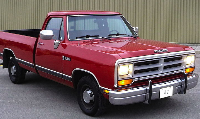
1981 Ram slow to start


Thread Starter
|
Registered User
Joined: Oct 2011
Posts: 9
Likes: 0
 1981 Ram slow to start
Hi,
I've a 1981 Ram slant 6 which starts reliably if it has been used within several days prior. But, if it sits for weeks at a time it takes a very long time (30 secs) for the gas to get to the carburetor. The fuel pump was replaced about a year ago by a professional, but it did not seem to make any difference.
Is there a check valve failing some where on the fuel line ? Or, is there a foot valve in the gas tank itself ?
If so, are these parts still available ? Any suggestions as to a good place to start looking ?
Thanks,
LesCarlson
I've a 1981 Ram slant 6 which starts reliably if it has been used within several days prior. But, if it sits for weeks at a time it takes a very long time (30 secs) for the gas to get to the carburetor. The fuel pump was replaced about a year ago by a professional, but it did not seem to make any difference.
Is there a check valve failing some where on the fuel line ? Or, is there a foot valve in the gas tank itself ?
If so, are these parts still available ? Any suggestions as to a good place to start looking ?
Thanks,
LesCarlson

Champion
Joined: Mar 2009
Posts: 2,639
Likes: 4
From: Bent Mountain Va
There is an outlet valve in the fuel pump. Tee in a gauge between the carb and the pump and check the fuel pressure. It should be 2.5 to 8 PSI. When you shut off the engine the pressure should return slowly to zero. If the pressure immediately drops to zero the outlet valve in the fuel pump is bad. Has this problem just started or has it been happening for a while? What was the reason the fuel pump was changed before?
Thread Starter
|
Registered User
Joined: Oct 2011
Posts: 9
Likes: 0
The problem has been there for many years, but not so severe. It would maybe have to crank for 5-10 seconds to get fuel. Now it's much worse, to the point I'm sure the battery won't keep up when the temperatures get below zero. In fact, the last start (after sitting for over a week) I had drip a bit a gas directly into the carb just to get it to turn over enough to finally get gas pumped to it.
Before the fuel pump was replaced the truck ran weak and couldn't keep its rpm up. So I had the pump replaced, new plugs, wires, etc. That problem went away, but looking back, I think it was a bunch of bad gas.
I was just under the truck and noticed there are 3 lines going back to the tank. One to the pump inlet, another to the fuel filter (on the side) between the pump and carb, and one more from a 6 inch black canister mounted to the side under the hood (some sort of pollution deal). That 3rd line (to the canister) was disconnected. Is there any way that might have any thing to do with it ?
My guess is that the check valve is part of the outlet valve you mentioned? Is there is anything else (check valve or foot valve) between the pump outlet valve and the gas tank ?
Thanks for your input.
Before the fuel pump was replaced the truck ran weak and couldn't keep its rpm up. So I had the pump replaced, new plugs, wires, etc. That problem went away, but looking back, I think it was a bunch of bad gas.
I was just under the truck and noticed there are 3 lines going back to the tank. One to the pump inlet, another to the fuel filter (on the side) between the pump and carb, and one more from a 6 inch black canister mounted to the side under the hood (some sort of pollution deal). That 3rd line (to the canister) was disconnected. Is there any way that might have any thing to do with it ?
My guess is that the check valve is part of the outlet valve you mentioned? Is there is anything else (check valve or foot valve) between the pump outlet valve and the gas tank ?
Thanks for your input.


Champion
Joined: Mar 2009
Posts: 2,639
Likes: 4
From: Bent Mountain Va
The black canister is your charcoal vapor canister. It traps fuel vapors from the fuel system and stores them until the correct parameters are met and then the engine burns the vapors. I would reconnect it and find out why it was disconnected. The canister may be plugged up.
Where is the fuel inlet on your carb located. Some were located low on the fuel bowl and have a rotary valve in the inlet that can fail and allow fuel to drain out of the bowl. (Carter BBD)
Where is the fuel inlet on your carb located. Some were located low on the fuel bowl and have a rotary valve in the inlet that can fail and allow fuel to drain out of the bowl. (Carter BBD)
Thread Starter
|
Registered User
Joined: Oct 2011
Posts: 9
Likes: 0
"do you pump the gas before you try to start it?
Yes, I pump like crazy and that used to do the trick. But now I don't think the gas is there.
"Where is the fuel inlet on your carb located."
It's hard to tell where the fuel bowl is. Can you tell if the inlet is located low as you mentioned ? (see pic)

Yes, I pump like crazy and that used to do the trick. But now I don't think the gas is there.
"Where is the fuel inlet on your carb located."
It's hard to tell where the fuel bowl is. Can you tell if the inlet is located low as you mentioned ? (see pic)
Champion
Joined: Mar 2009
Posts: 2,639
Likes: 4
From: Bent Mountain Va
Sorry I can't use your pic as it is an invalid Attachment. Look at the top of the carb. The throat takes up some of the space and the bowl is the rest of it. The fuel inlet goes into the bowl. Does the fuel supply line go into the top or the bottom of that bowl? Yes you can tell by looking at it.
Trending Topics
Thread Starter
|
Registered User
Joined: Oct 2011
Posts: 9
Likes: 0
Sorry the picture didn't come through. Here is a link to the picture:
https://dodgeforum.com/forum/attachm...1&d=1318440619
I'm going to replace the gas line between the fuel pump and the tank. I'm thinking a small hole in the line might be the reason it takes so long for the gas to arrive at the carburetor.
https://dodgeforum.com/forum/attachm...1&d=1318440619
I'm going to replace the gas line between the fuel pump and the tank. I'm thinking a small hole in the line might be the reason it takes so long for the gas to arrive at the carburetor.
Champion
Joined: Mar 2009
Posts: 2,639
Likes: 4
From: Bent Mountain Va
I can't get that link either. A leak in the line before the pump would not give you these symptoms. With a line leak before the pump you would still have fuel in the bowl and in the line after the pump and that would allow the engine to start fine. It might stumble after the start due to fuel starvation but it would start. It sounds like the fuel is slowly draining from the bowl for some reason. What carb is on the engine?
Last edited by SEAL; Oct 14, 2011 at 07:43 AM.
Thread Starter
|
Registered User
Joined: Oct 2011
Posts: 9
Likes: 0
Here is a link to the carburetor from different locations:
http://pic.atpic.com/2351972/600
http://46.4.24.136/atpic2/3019/45925/0/2351972/600.jpg
"With a line leak before the pump you would still have fuel in the bowl and in the line after the pump and that would allow the engine to start fine"
That makes sense. Can you tell by the picture if the line is connected high or low to the bowl? Can you tell what kind of carb it is?
Do you have any idea how long the engine should crank to get gas to the carb if the bowl was empty ? I'm thinking it shouldn't be more than a few seconds, but I don't know.
http://pic.atpic.com/2351972/600
http://46.4.24.136/atpic2/3019/45925/0/2351972/600.jpg
"With a line leak before the pump you would still have fuel in the bowl and in the line after the pump and that would allow the engine to start fine"
That makes sense. Can you tell by the picture if the line is connected high or low to the bowl? Can you tell what kind of carb it is?
Do you have any idea how long the engine should crank to get gas to the carb if the bowl was empty ? I'm thinking it shouldn't be more than a few seconds, but I don't know.