


Question on Vacuum Hoses After Edelbrock 1406 Install


Thread Starter
|
Professional
Joined: Oct 2011
Posts: 154
Likes: 2
From: Falls Church, VA
 Question on Vacuum Hoses After Edelbrock 1406 Install
Vehicle: 1982 Ram D350, 318 Engine.
Last October I replaced my leaking Carter TQ Carburetor with an Edelbrock 1406 non-EGR carburetor. I did not know better at the time, but I should have gotten the 1400 that was for engines with an EGR. So far, it seems what is different between the 1406 and the 1400 is the 1400 had a port to the charcoal canisters for the fumes. Now my carb cannot vent fumes. The engine seems to run fine, there is a hint of gas fume smell under the hood at times though. In an effort to ensure that my vacuum hoses are properly connected (or removed if possible) I have the following questions. For what it is worth, I do not have an emissions test requirement for the truck since it is over 25 years old.
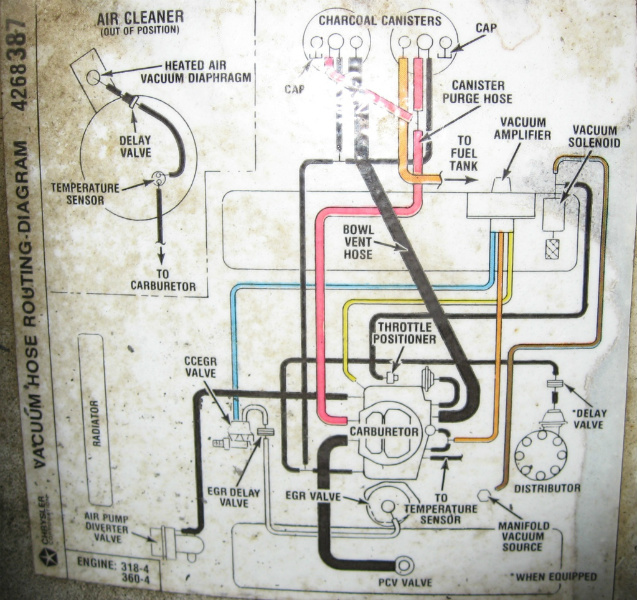
What should I do with the Vacuum Solenoid? The Vacuum Solenoid has two hoses, Brown and Black. The brownhose comes from the manifold vacuum source and the black used to go to the Carter TQ's Throttle Positioner, which I don't have on the Edelbrock. Do I still need the Vacuum Solenoid?
Another question, how much does the Vacuum Amplifier increase the vacuum by? What do the yellow and the gold hoses do? The engine was running a little rough, so I took it to have some things checked and the mechanic cut the blue hose that connected the Vacuum Amplifier to the CCEGR Valve and connected the CCEGR Valve directly to the Timed Vacuum Port (via Distributer Advance Hose), which by looking at the diagram, makes it look like the Vacuum Amplifier is no longer in use. What harm will occur if I removed the Vacuum Amplifier now that the CCEGR is connected to the Timed Vacuum Port?
My under the hood vacuum diagram is below.
Last October I replaced my leaking Carter TQ Carburetor with an Edelbrock 1406 non-EGR carburetor. I did not know better at the time, but I should have gotten the 1400 that was for engines with an EGR. So far, it seems what is different between the 1406 and the 1400 is the 1400 had a port to the charcoal canisters for the fumes. Now my carb cannot vent fumes. The engine seems to run fine, there is a hint of gas fume smell under the hood at times though. In an effort to ensure that my vacuum hoses are properly connected (or removed if possible) I have the following questions. For what it is worth, I do not have an emissions test requirement for the truck since it is over 25 years old.
What should I do with the Vacuum Solenoid? The Vacuum Solenoid has two hoses, Brown and Black. The brownhose comes from the manifold vacuum source and the black used to go to the Carter TQ's Throttle Positioner, which I don't have on the Edelbrock. Do I still need the Vacuum Solenoid?
Another question, how much does the Vacuum Amplifier increase the vacuum by? What do the yellow and the gold hoses do? The engine was running a little rough, so I took it to have some things checked and the mechanic cut the blue hose that connected the Vacuum Amplifier to the CCEGR Valve and connected the CCEGR Valve directly to the Timed Vacuum Port (via Distributer Advance Hose), which by looking at the diagram, makes it look like the Vacuum Amplifier is no longer in use. What harm will occur if I removed the Vacuum Amplifier now that the CCEGR is connected to the Timed Vacuum Port?
My under the hood vacuum diagram is below.
Last edited by pumbu; Mar 5, 2012 at 01:09 PM.
Thread Starter
|
Professional
Joined: Oct 2011
Posts: 154
Likes: 2
From: Falls Church, VA
I think I have most of my vacuum issues resolved. I put the distributer and the charcoal canistor on the ported like the picture above, the rest I have run to the right side port. Lots of "T"'s. Can any of the vacuum hoses that went to the Carter TQ's multiple ports now instead go straight to the outlet off of the manifold, where the power brakes and the vaccum manifold get their vacuum?

Registered User
Joined: Mar 2024
Posts: 1
Likes: 0
So any idea how much vacuum is supposed to be pulling thru the hose coming from the engine,my hose is in a very small port on the vacuum nipple,doesn’t seem like I’m getting enough to the control panel to make anything switch


