


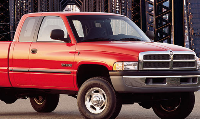
Can I use the 4X4 my 1996 Dodge Ram on dry pavement?


Thread Starter
|
Captain
Joined: May 2009
Posts: 615
Likes: 0
From: Phoenix, AZ
 Can I use the 4X4 my 1996 Dodge Ram on dry pavement?
I was wondering if I can use my four wheel drive on dry pavement. I just bought this 1996 Dodge Ram, and I have no idea if it's okay to use it or not, since I have heard many people say both ways. Some say it's for off-road only, but others say that you will need it for towing. My truck is not an off-road edition Dodge Ram. Thank you guys very much for the help.

Banned
Joined: Apr 2009
Posts: 2,816
Likes: 4
From: Los Angeles, CA

Four wheel drive is designed to be used on surfaces with reduced traction. Obviously, dry pavement does not fit this criteria. There are some full-time systems that can be engaged in 4 wheel drive all the time, but most of these systems suffer from premature wear on drive components. Unless your system was designed for full-time 4WD use, putting it into 4WD, high or low, while on dry pavement will result in the breaking of some very expensive driveline parts. Read your owner's manual to be sure. There really is no need for 4WD on a dry, hard surface.
Site Moderator
Joined: Jan 2008
Posts: 8,374
Likes: 28
From: Sioux Falls, SD
All Wheel Drive or Full Time 4WD is one thing, but these trucks have Part Time 4WD.
Part Time 4WD = Power to both axles, axles are locked together. That means that the axles are forced to rotate at the same speed which is bad on dry pavement.
Full Time 4WD = Power to both axles, axles are not locked together. This is regarded as OK on dry pavement.
All Wheel Drive = Power to all wheels, IIRC, each wheel can be independent from the other. This is OK on dry pavement, even more so than Full Time 4WD (although you get less traction).
I'm a little shady on the All Wheel Drive description (its been a while), so someone correct me if I'm mistaken on that.
Do not use 4WD when towing unless you are in a low traction environment, e.g. in the mud or snow trying to pull someone out of the mud or snow.
Part Time 4WD = Power to both axles, axles are locked together. That means that the axles are forced to rotate at the same speed which is bad on dry pavement.
Full Time 4WD = Power to both axles, axles are not locked together. This is regarded as OK on dry pavement.
All Wheel Drive = Power to all wheels, IIRC, each wheel can be independent from the other. This is OK on dry pavement, even more so than Full Time 4WD (although you get less traction).
I'm a little shady on the All Wheel Drive description (its been a while), so someone correct me if I'm mistaken on that.
Do not use 4WD when towing unless you are in a low traction environment, e.g. in the mud or snow trying to pull someone out of the mud or snow.

Hall Of Fame
Joined: Jul 2006
Posts: 12,204
Likes: 10
From: Gainesville, Ga.
no.
our trucks have no center differential, so you develop drive line bindup between the front and rear diff. so something has to give, either the tires have to slip, or something has to break. tires slip easily on dirt, mud, snow. not as easily on dry pavement.
welcome to df.
our trucks have no center differential, so you develop drive line bindup between the front and rear diff. so something has to give, either the tires have to slip, or something has to break. tires slip easily on dirt, mud, snow. not as easily on dry pavement.
welcome to df.

Captain
Joined: Sep 2008
Posts: 540
Likes: 0
From: Fargo, ND
Example:
My wife has a 99 Mountaineer. We were going down the highway at about 60 when all of a sudden there was a BANG and the front end felt like it pulled down for a second. It scared the **** out of both of us. It turns out my sweet, darling, and otherwise adorable wife had it in 4WD. Ever since then there has been an intermittant whine coming from the front end when turning in 4WD. I'm pretty sure that something got damaged in the front diff, but I'm letting it go for now. The damn thing is not easy to get to, and it also looks like you have to split the case to get into it-- i.e. no removable cover.
Moral: Don't drive on dry pavement in 4WD or you'll end up f**king something up (as mentioned above).
Have fun!
My wife has a 99 Mountaineer. We were going down the highway at about 60 when all of a sudden there was a BANG and the front end felt like it pulled down for a second. It scared the **** out of both of us. It turns out my sweet, darling, and otherwise adorable wife had it in 4WD. Ever since then there has been an intermittant whine coming from the front end when turning in 4WD. I'm pretty sure that something got damaged in the front diff, but I'm letting it go for now. The damn thing is not easy to get to, and it also looks like you have to split the case to get into it-- i.e. no removable cover.
Moral: Don't drive on dry pavement in 4WD or you'll end up f**king something up (as mentioned above).
Have fun!

Professional
Joined: Jan 2007
Posts: 205
Likes: 0
From: Kitchener, ON, Canada
Personally, I can't understand why anyone would want to use 4wd when not needed? Half the time I offroad in 2wd. I only engage 4wd if I'm stuck, or if I'm trying to pull someone out, etc.
If you're towing something, all the weight "shifts" to the rear axle anyways, so unless your rear wheels are in a lake, off the loading ramp or something, I can't see why you would want to be in 4wd. Sure, if you don't have enough traction to pull a boat out of the water or something, I can understand, but otherwise, I'm stumped.
If you're towing something, all the weight "shifts" to the rear axle anyways, so unless your rear wheels are in a lake, off the loading ramp or something, I can't see why you would want to be in 4wd. Sure, if you don't have enough traction to pull a boat out of the water or something, I can understand, but otherwise, I'm stumped.
Trending Topics
Banned
Joined: Apr 2009
Posts: 2,816
Likes: 4
From: Los Angeles, CA
Personally, I can't understand why anyone would want to use 4wd when not needed? Half the time I offroad in 2wd. I only engage 4wd if I'm stuck, or if I'm trying to pull someone out, etc.
If you're towing something, all the weight "shifts" to the rear axle anyways, so unless your rear wheels are in a lake, off the loading ramp or something, I can't see why you would want to be in 4wd. Sure, if you don't have enough traction to pull a boat out of the water or something, I can understand, but otherwise, I'm stumped.
If you're towing something, all the weight "shifts" to the rear axle anyways, so unless your rear wheels are in a lake, off the loading ramp or something, I can't see why you would want to be in 4wd. Sure, if you don't have enough traction to pull a boat out of the water or something, I can understand, but otherwise, I'm stumped.


