


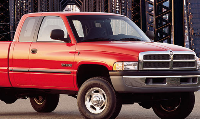
Climate control/vacuum line problem


Registered User
Joined: Aug 2017
Posts: 9
Likes: 0
 What did you just say?
Some of the actuators in the hvac box are spring loaded. Vac overcomes the tension on the spring and moves the actuator. Any time the vac gets low it will go back to the default position witch is defrost. You should have two check valves one on the passenger side of the intake and the other by the ac lines going into the firewall. Also you need to check the line going to the vac reservoir. Keep in mind your engine produces no vac on acceleration so the system relies on the the vac in the reservoir. Also if you have a leak anywhere in the cab(actuators or vac lines) you loose vac and it goes to defrost. Use the tsb for reference it is for the early rams that didn't have the second check valve.
http://dodgeram.info/tsb/1996/24-01-96a.htm
http://dodgeram.info/tsb/1996/24-01-96a.htm
Registered User
Joined: Aug 2017
Posts: 9
Likes: 0
Ok I get it now.
Some of the actuators in the hvac box are spring loaded. Vac overcomes the tension on the spring and moves the actuator. Any time the vac gets low it will go back to the default position witch is defrost. You should have two check valves one on the passenger side of the intake and the other by the ac lines going into the firewall. Also you need to check the line going to the vac reservoir. Keep in mind your engine produces no vac on acceleration so the system relies on the the vac in the reservoir. Also if you have a leak anywhere in the cab(actuators or vac lines) you loose vac and it goes to defrost. Use the tsb for reference it is for the early rams that didn't have the second check valve.
http://dodgeram.info/tsb/1996/24-01-96a.htm
http://dodgeram.info/tsb/1996/24-01-96a.htm

Administrator


Joined: Apr 2010
Posts: 87,548
Likes: 4,230
From: Clayton MI
A new engine won't change the problem. All of the HVAC controls are vacuum powered. (except the blend door) If you don't have vacuum, they don't work. It really is that easy. The problem you are experiencing is because at large throttle openings/high load, manifold vacuum is essentially zero. So, no vacuum to hold your vents in place. The idea with the check valves is, so vacuum doesn't bleed off quite so rapidly when manifold vacuum is essentially nonexistent.
Registered User
Joined: Aug 2017
Posts: 9
Likes: 0
Thanks
A new engine won't change the problem. All of the HVAC controls are vacuum powered. (except the blend door) If you don't have vacuum, they don't work. It really is that easy. The problem you are experiencing is because at large throttle openings/high load, manifold vacuum is essentially zero. So, no vacuum to hold your vents in place. The idea with the check valves is, so vacuum doesn't bleed off quite so rapidly when manifold vacuum is essentially nonexistent.
Registered User
Joined: Aug 2017
Posts: 9
Likes: 0
Further explanation
open loop is engaged when I go uphill everyday. I know because my rpm goes from somewhere around 2000 to somewhere around (or above) 3000 rpm and my heater/ac switched to dash. I just installed a fuel pump so that fixed the starting problem. Now I crank it one time to start it. It is acting like it's not getting enough fuel under load when it switches from closed loop to open loop. Does fine at lower speeds before it engages closed loop and cruises ok too. It's when I hit the gas on level surface it acts like I'm pulling a trailer too. Right up to 3k rpm even on a level surface.
Last edited by David Underwood; Aug 29, 2017 at 03:27 PM.
Administrator
Joined: Apr 2010
Posts: 87,548
Likes: 4,230
From: Clayton MI
I think you are confusing terms.
Closed loop is when the PCM is paying attention to the O2 sensor. Open loop, it is not. Once the engine and sensors reach operating temp, the only time the engine drops out of closed loop is when you step on the gas hard enough, which may also convince the trans to drop out of Overdrive. Which would account for the big jump on the tach.
Closed loop is when the PCM is paying attention to the O2 sensor. Open loop, it is not. Once the engine and sensors reach operating temp, the only time the engine drops out of closed loop is when you step on the gas hard enough, which may also convince the trans to drop out of Overdrive. Which would account for the big jump on the tach.
Registered User
Joined: Aug 2017
Posts: 9
Likes: 0
Yes this is confusing to me
I think you are confusing terms.
Closed loop is when the PCM is paying attention to the O2 sensor. Open loop, it is not. Once the engine and sensors reach operating temp, the only time the engine drops out of closed loop is when you step on the gas hard enough, which may also convince the trans to drop out of Overdrive. Which would account for the big jump on the tach.
Closed loop is when the PCM is paying attention to the O2 sensor. Open loop, it is not. Once the engine and sensors reach operating temp, the only time the engine drops out of closed loop is when you step on the gas hard enough, which may also convince the trans to drop out of Overdrive. Which would account for the big jump on the tach.
Registered User
Joined: Aug 2017
Posts: 9
Likes: 0
No codes
I already put a new cat on because it failed. New O2 sensors too. Same problem. Then my fuel pump. I might just change all these sensors just for the hell of it when I pull this thing out to clean it. The problem with the cat was overheating. It either got clogged or ran too lean or both. Back to problem with open loop. I think I am running lean in open loop.
Last edited by David Underwood; Aug 30, 2017 at 10:01 AM.