


How does the clutch master cylinder fit?


Thread Starter
|
Captain

Joined: Oct 2005
Posts: 568
Likes: 8
From: The Summit, Queensland, Australia
 How does the clutch master cylinder fit?
I am on the verge of fitting an NV4500 to my B350 van, this of course has a mechanical clutch and I need to change to a hydraulic clutch.
I have purchased the complete slave and master cylinder setup and it's going to be in my possession in about three weeks. But I want to prepare for its arrival as I will have very limited time to do the installation work when it comes.
Looking at the diagram in the online manual...
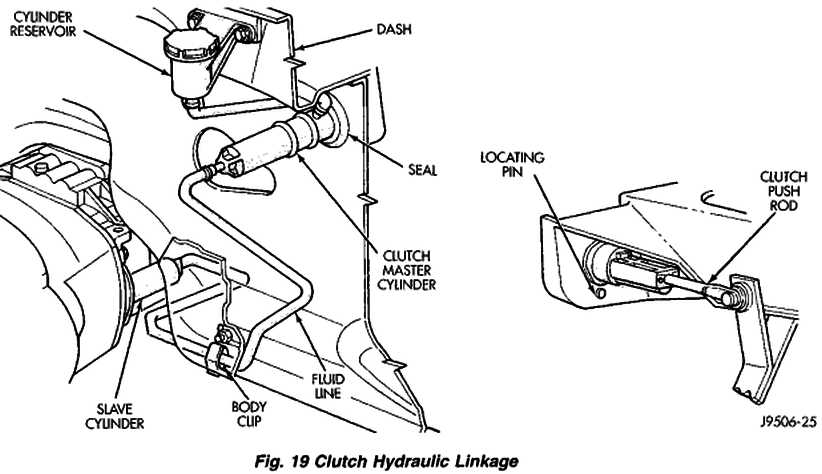
...and reading the text it seems that the master cylinder sits in a rubber/neoprene sleeve of some kind and that locates it in the firewall.
I don't think I can put the master cylinder into the firewall as the space in front of it is all taken up with power booster. So my plan is to use a part of the mechanical linkage under the floor and mount the master from a bracket under the driver's seat.
But whichever way I do it or wherever I mount it, I need to have the dimensions of the hole in the firewall of the pickup for which this mount is designed. Any any other detail there might be of the hole, In one diagram it appears to simply be a round hole...
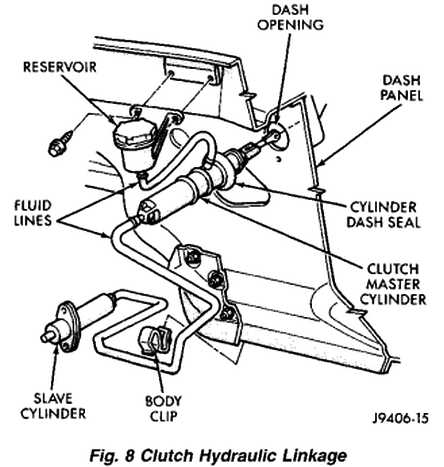
...and it has a small hole below it. Is that right?
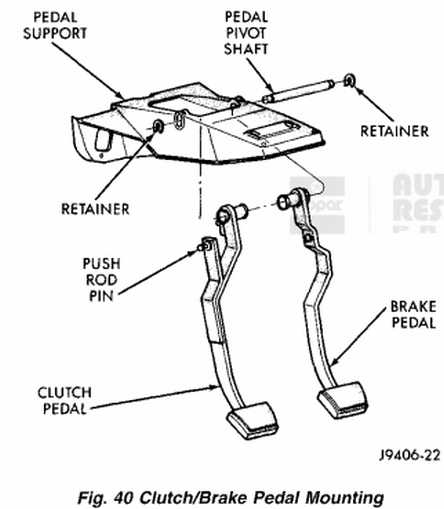
Or is it squared off as it appears in this one?
So how does the master cylinder stay in place while under pressure? Are there any flanges? Is it black magic?
Also, roughly how much stroke of the cylinder does it take to operate the clutch? 1"? 1.5"? That looks pretty unlikely when you look at the diagram of the clutch pedal and see how close the pin working the clutch is to the upper pivot of the pedal. Just looking at the diagrams it appears that there's a ratio of about 6:1 length of pedal to distance between the pivot and the clutch rod. If the pedal was able to be depressed 6" then you would get 1" of travel, or so it would seem.
If anyone can help I'd really appreciate it. Someone with a wrecked truck in their backyard could probably best answer these questions, but someone familiar with doing the work on them would too. And it appears that where the hole goes through the 'dash' that it's double-skinned, so it would be good to know the thickness of the panel there with the double-skinning.-
Any help would be greatly appreciated...
I have purchased the complete slave and master cylinder setup and it's going to be in my possession in about three weeks. But I want to prepare for its arrival as I will have very limited time to do the installation work when it comes.
Looking at the diagram in the online manual...
...and reading the text it seems that the master cylinder sits in a rubber/neoprene sleeve of some kind and that locates it in the firewall.
I don't think I can put the master cylinder into the firewall as the space in front of it is all taken up with power booster. So my plan is to use a part of the mechanical linkage under the floor and mount the master from a bracket under the driver's seat.
But whichever way I do it or wherever I mount it, I need to have the dimensions of the hole in the firewall of the pickup for which this mount is designed. Any any other detail there might be of the hole, In one diagram it appears to simply be a round hole...
...and it has a small hole below it. Is that right?
Or is it squared off as it appears in this one?
So how does the master cylinder stay in place while under pressure? Are there any flanges? Is it black magic?
Also, roughly how much stroke of the cylinder does it take to operate the clutch? 1"? 1.5"? That looks pretty unlikely when you look at the diagram of the clutch pedal and see how close the pin working the clutch is to the upper pivot of the pedal. Just looking at the diagrams it appears that there's a ratio of about 6:1 length of pedal to distance between the pivot and the clutch rod. If the pedal was able to be depressed 6" then you would get 1" of travel, or so it would seem.
If anyone can help I'd really appreciate it. Someone with a wrecked truck in their backyard could probably best answer these questions, but someone familiar with doing the work on them would too. And it appears that where the hole goes through the 'dash' that it's double-skinned, so it would be good to know the thickness of the panel there with the double-skinning.-
Any help would be greatly appreciated...

Legend


Joined: Nov 2014
Posts: 8,098
Likes: 318
I am on the verge of fitting an NV4500 to my B350 van, this of course has a mechanical clutch and I need to change to a hydraulic clutch.
I have purchased the complete slave and master cylinder setup and it's going to be in my possession in about three weeks. But I want to prepare for its arrival as I will have very limited time to do the installation work when it comes.
Looking at the diagram in the online manual...
...and reading the text it seems that the master cylinder sits in a rubber/neoprene sleeve of some kind and that locates it in the firewall.
I don't think I can put the master cylinder into the firewall as the space in front of it is all taken up with power booster. So my plan is to use a part of the mechanical linkage under the floor and mount the master from a bracket under the driver's seat.
But whichever way I do it or wherever I mount it, I need to have the dimensions of the hole in the firewall of the pickup for which this mount is designed. Any any other detail there might be of the hole, In one diagram it appears to simply be a round hole...
...and it has a small hole below it. Is that right?
Or is it squared off as it appears in this one?
So how does the master cylinder stay in place while under pressure? Are there any flanges? Is it black magic?
Also, roughly how much stroke of the cylinder does it take to operate the clutch? 1"? 1.5"? That looks pretty unlikely when you look at the diagram of the clutch pedal and see how close the pin working the clutch is to the upper pivot of the pedal. Just looking at the diagrams it appears that there's a ratio of about 6:1 length of pedal to distance between the pivot and the clutch rod. If the pedal was able to be depressed 6" then you would get 1" of travel, or so it would seem.
If anyone can help I'd really appreciate it. Someone with a wrecked truck in their backyard could probably best answer these questions, but someone familiar with doing the work on them would too. And it appears that where the hole goes through the 'dash' that it's double-skinned, so it would be good to know the thickness of the panel there with the double-skinning.-
Any help would be greatly appreciated...
I have purchased the complete slave and master cylinder setup and it's going to be in my possession in about three weeks. But I want to prepare for its arrival as I will have very limited time to do the installation work when it comes.
Looking at the diagram in the online manual...
...and reading the text it seems that the master cylinder sits in a rubber/neoprene sleeve of some kind and that locates it in the firewall.
I don't think I can put the master cylinder into the firewall as the space in front of it is all taken up with power booster. So my plan is to use a part of the mechanical linkage under the floor and mount the master from a bracket under the driver's seat.
But whichever way I do it or wherever I mount it, I need to have the dimensions of the hole in the firewall of the pickup for which this mount is designed. Any any other detail there might be of the hole, In one diagram it appears to simply be a round hole...
...and it has a small hole below it. Is that right?
Or is it squared off as it appears in this one?
So how does the master cylinder stay in place while under pressure? Are there any flanges? Is it black magic?
Also, roughly how much stroke of the cylinder does it take to operate the clutch? 1"? 1.5"? That looks pretty unlikely when you look at the diagram of the clutch pedal and see how close the pin working the clutch is to the upper pivot of the pedal. Just looking at the diagrams it appears that there's a ratio of about 6:1 length of pedal to distance between the pivot and the clutch rod. If the pedal was able to be depressed 6" then you would get 1" of travel, or so it would seem.
If anyone can help I'd really appreciate it. Someone with a wrecked truck in their backyard could probably best answer these questions, but someone familiar with doing the work on them would too. And it appears that where the hole goes through the 'dash' that it's double-skinned, so it would be good to know the thickness of the panel there with the double-skinning.-
Any help would be greatly appreciated...

All Star
Joined: Sep 2012
Posts: 803
Likes: 87
From: Europe
Someone was just recently looking for a p/n for that part which mounts the cylinder, but nobody knew it.
98 and forward trucks have a master cylinder that bolts to the firewall with two studs.
One thing that came to mind... Even if you could mount the master next to the brake booster, and you use master/slave setup from a truck, I think the hose will be too short as the Van has firewall much more forward from bellhousing than on a truck.
98 and forward trucks have a master cylinder that bolts to the firewall with two studs.
One thing that came to mind... Even if you could mount the master next to the brake booster, and you use master/slave setup from a truck, I think the hose will be too short as the Van has firewall much more forward from bellhousing than on a truck.
Thread Starter
|
Captain
Joined: Oct 2005
Posts: 568
Likes: 8
From: The Summit, Queensland, Australia
I think I would be capable of working out a way to extend the line if necessary...
But other factors like battery location and so on make it a nightmare possibility.
Anyway, the point is now that I do need to get some details on this mounting. I'll work out where to put it when the time comes. Thanks for your response.
What I am up against here is that this will be the only one in the country and no vehicle using this setup exists here to my knowledge, there is nowhere I can go locally to measure the thing or look at it.
But other factors like battery location and so on make it a nightmare possibility.
Anyway, the point is now that I do need to get some details on this mounting. I'll work out where to put it when the time comes. Thanks for your response.
What I am up against here is that this will be the only one in the country and no vehicle using this setup exists here to my knowledge, there is nowhere I can go locally to measure the thing or look at it.

Registered User
Joined: Jan 2020
Posts: 10
Likes: 0
From: Canada
I just did a manual swap in my truck. The hole in the firewall is round. The hole in the pedal assemble is rectangular ish. The master cylinder pushes in rotated 45 degrees and you twist it to lock into the pedal assembly. Some auto trucks came with the pedal assembly like a manual and you just have to knock out the shaft and I stall the leavers.... apparently. Mine did not. I had to swap out the entire pedal assembly as there was a hole for the master cylinder but it was round. No way to turn and lock the cylinder in. Maybe a year difference thing. Not sure how it would work out in a van. I have pictures of the two I'll try a d post.
Registered User
Joined: Jan 2020
Posts: 10
Likes: 0
From: Canada

Trending Topics
Thread Starter
|
Captain
Joined: Oct 2005
Posts: 568
Likes: 8
From: The Summit, Queensland, Australia
You were posting the pics as I posted my last one...
Thanks for that. That's obviously a die-cast piece. So do the, I guess you can call them, smaller ID sections of the die-cast hole come in smaller than the straight round hole in the 'dash panel'?
Thanks for that. That's obviously a die-cast piece. So do the, I guess you can call them, smaller ID sections of the die-cast hole come in smaller than the straight round hole in the 'dash panel'?
Thread Starter
|
Captain
Joined: Oct 2005
Posts: 568
Likes: 8
From: The Summit, Queensland, Australia
By the way, you say that getting the pedals out was the hardest part...
Count your lucky stars you don't have a van! In the van the pedal and the cross-shaft are one piece, just like a lot of older Mopars. But in the van there's such a tangle of wires to prevent you pulling the pedal and shaft through it's an absolute nightmare. I don't ever want to have to take that out again!
Another reason to mount it under the floor. There's room under there and I can set up a lever operated by the original linkages (which I have incidentally modified by fitting rod ends) and it keeps the master cylinder close enough to the slave cylinder that the line won't be a problem.
But this is why I need to know about travel and the mount details.
Count your lucky stars you don't have a van! In the van the pedal and the cross-shaft are one piece, just like a lot of older Mopars. But in the van there's such a tangle of wires to prevent you pulling the pedal and shaft through it's an absolute nightmare. I don't ever want to have to take that out again!
Another reason to mount it under the floor. There's room under there and I can set up a lever operated by the original linkages (which I have incidentally modified by fitting rod ends) and it keeps the master cylinder close enough to the slave cylinder that the line won't be a problem.
But this is why I need to know about travel and the mount details.