


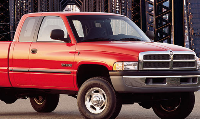
Bigger tires, More Gas?


Thread Starter
Joined: Nov 2006
Posts: 46
Likes: 0
From:
 Bigger tires, More Gas?
I just had a 5 inch Super Jacker lift kit installed on my 99 5.2 4x4 ext cab sport ram and Im looking to get 35s put on what kind of Gas mileage hwy/cty can I expect now? and what kind of engine mods can I get to counter any loss of fuel efficiency that aren't to ridiculously expensive ?

Champion
Joined: Aug 2005
Posts: 3,313
Likes: 8
RE: Bigger tires, More Gas?
The extra five inches of height will make your truck harder to push through the wind.
The lift mainly does this by allowing more air to flow underneath the truck where it is not streamlined.
In addition, the lift exposes more of the front of the tires out from the fender down into the wind.
Since this part of the tire is moving forward and downward,
and tire tread is very rough and unstreamlined,
the extra exposure of a total of 4 tires creates more drag to the oncoming air
than many would guess.
If all other things were equal
a 35 inch diameter tire would actually roll easier than a 29 inch tire.
{this is why those old bicycles of 1890 had huge front wheels}
But mud tires are quite different construction than street tires.
A lot of the rolling resistance of a tire is due to the depth of its tread,
and whether the tread is a straight 'rib'
or a blocky gripping tread.
Mud tires usually have deep tread and blocky cleats,
and this makes their rolling resistance higher than the same diameter 'commercial vehicle' rib tread tire.
Many times the mud tire is also wider,
which both increases wind drag a bit more,
and calls for a lower air pressure like 28-35 psi,
which further makes rolling resistance worse,
compared to a 70 psi load range D or E street tire.
The only engine mod that makes a really big efficiency change
is to increase the compression ratio,
and the ultimate is to go to a diesel with compression ratio of 17
versus the 9 or so of a gasoline engine
{although the Ford Escape Hybrid 4 cyl and the Honda Insight 3 cyl have 11.8 to 1}
But you can do several different mods to a gasoline engine
that each improve the fuel efficiency a few percent at a time.
Even companies that are fighting for bragging rights
about having the 'world's best engines' like Honda and BMW
seldom can improve engine fuel efficiency more than 1% per year.
The design for the 5.2/5.9 Magnum V8s was completed in 1991.
The design for the 5.7 Hemi V8 was completed in 2002.
Chrysler's official press release says the 5.7 Hemi is 8% more fuel efficient than the 5.9V8.
There is a very long article about several dozen mods
in all three areas of
wind drag, tire rolling resistance and engine/drive train mods
at this weblink:
https://dodgeforum.com/m_447500/tm.htm
Print this out, put it by the toilet, and read it at least 3 times,
absorbing & thinking about what mods you are comfortable doing.
You may get suggestions to re-gear both your differentials
at a cost of $1000-1400
but this mainly improves your crawl ratio off road at slow speeds
and your maximum acceleration at wide open throttle,
neither of which is famous for getting good MPG.
If someone tells you that a higher numerical diff ratio improves MPG
ask them why current GM Vice President Bob Lutz changed the diff ratio
of the 2007 Silverado from the traditional 3.73 of past years down to 3.42 ?
Bob Lutz used to be VP of Chrysler (and of Ford and BMW America)
and he is one of the 'fathers' of the 1994-2002 Ram design
of the Viper, and its V10 engine
and also the man who gave the 'go ahead' for the 5.7 Hemi in 1997.
The lift mainly does this by allowing more air to flow underneath the truck where it is not streamlined.
In addition, the lift exposes more of the front of the tires out from the fender down into the wind.
Since this part of the tire is moving forward and downward,
and tire tread is very rough and unstreamlined,
the extra exposure of a total of 4 tires creates more drag to the oncoming air
than many would guess.
If all other things were equal
a 35 inch diameter tire would actually roll easier than a 29 inch tire.
{this is why those old bicycles of 1890 had huge front wheels}
But mud tires are quite different construction than street tires.
A lot of the rolling resistance of a tire is due to the depth of its tread,
and whether the tread is a straight 'rib'
or a blocky gripping tread.
Mud tires usually have deep tread and blocky cleats,
and this makes their rolling resistance higher than the same diameter 'commercial vehicle' rib tread tire.
Many times the mud tire is also wider,
which both increases wind drag a bit more,
and calls for a lower air pressure like 28-35 psi,
which further makes rolling resistance worse,
compared to a 70 psi load range D or E street tire.
The only engine mod that makes a really big efficiency change
is to increase the compression ratio,
and the ultimate is to go to a diesel with compression ratio of 17
versus the 9 or so of a gasoline engine
{although the Ford Escape Hybrid 4 cyl and the Honda Insight 3 cyl have 11.8 to 1}
But you can do several different mods to a gasoline engine
that each improve the fuel efficiency a few percent at a time.
Even companies that are fighting for bragging rights
about having the 'world's best engines' like Honda and BMW
seldom can improve engine fuel efficiency more than 1% per year.
The design for the 5.2/5.9 Magnum V8s was completed in 1991.
The design for the 5.7 Hemi V8 was completed in 2002.
Chrysler's official press release says the 5.7 Hemi is 8% more fuel efficient than the 5.9V8.
There is a very long article about several dozen mods
in all three areas of
wind drag, tire rolling resistance and engine/drive train mods
at this weblink:
https://dodgeforum.com/m_447500/tm.htm
Print this out, put it by the toilet, and read it at least 3 times,
absorbing & thinking about what mods you are comfortable doing.
You may get suggestions to re-gear both your differentials
at a cost of $1000-1400
but this mainly improves your crawl ratio off road at slow speeds
and your maximum acceleration at wide open throttle,
neither of which is famous for getting good MPG.
If someone tells you that a higher numerical diff ratio improves MPG
ask them why current GM Vice President Bob Lutz changed the diff ratio
of the 2007 Silverado from the traditional 3.73 of past years down to 3.42 ?
Bob Lutz used to be VP of Chrysler (and of Ford and BMW America)
and he is one of the 'fathers' of the 1994-2002 Ram design
of the Viper, and its V10 engine
and also the man who gave the 'go ahead' for the 5.7 Hemi in 1997.