


GOT STUCK on dry pavement with my 4X4 ????


Section Moderator
Joined: May 2012
Posts: 1,564
Likes: 9
From: Concord, CA

This is not correct. They are all "drive wheels" and will all drive equally, as long as they have equal traction. But if one wheel spins, all the torque will "escape" through the wheel with no traction, regardless of which side it's on.

Thread Starter
|
Registered User
Joined: Feb 2014
Posts: 15
Likes: 0
Sorry we had so much fun at your expense.
To quote Joe Dirt's dad:
"...how does a posi-trac rear end work on a Chrysler? I don't know, it just does!"
Very few people actually know how or why basic diffs work the way they do.
BTW Locking hubs and locking diffs are different.
To quote Joe Dirt's dad:
"...how does a posi-trac rear end work on a Chrysler? I don't know, it just does!"
Very few people actually know how or why basic diffs work the way they do.
BTW Locking hubs and locking diffs are different.
And at least I found I was not the only one who did not know about this.
BUT, now you throw locking hubs vs locking diffs at me ???
I best go find my big orange pills for this


No need to be sorry, my post was in jest only .... but for some reason smilies were not working when I posted so I had to just leave an "LOL" ....
And at least I found I was not the only one who did not know about this.
BUT, now you throw locking hubs vs locking diffs at me ???
I best go find my big orange pills for this
And at least I found I was not the only one who did not know about this.
BUT, now you throw locking hubs vs locking diffs at me ???
I best go find my big orange pills for this
Because many 4WD vehicles, especially heavy duty 4×4 trucks, do not have a center differential or equivalent (e.g., a viscous coupling ), they should be used in 4WD mode only when traction is limited: small differences in rotational speed between the front and rear wheels that occur when driving in 4WD on a dry, hard surface (such as pavement) cause a torque to be applied across the transmission, a phenomenon known as transmission wind up can occur, and can cause considerable damage to the transmission or drive train; on loose surfaces (dirt, snow, mud, gravel), these rotational speed differences are absorbed by tire slippage.
Many of these vehicles will spend most of their time in 2WD: locking hubs allow the parts of the drivetrain that are used for 4-wheel-drive to be disconnected. With the hubs disengaged, and the transfer case in 2WD, the entire front axle and differential are inactive.
Last edited by jkeaton; Feb 22, 2014 at 05:13 PM.

 Keaton.

Hall Of Fame
Joined: Aug 2007
Posts: 10,923
Likes: 19
From: NM
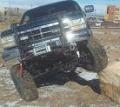
Lol there is a conversion, called a SAS. I have locking hubs on my front axle due to my SAS; so yes hello to 2wd low. Ha Ha, suckers!
Hall Of Fame
Joined: Aug 2007
Posts: 10,923
Likes: 19
From: NM
I agree solid axles have some disadvantages, but in my case the advantages outweighs the cons. Mainly in the form of a much larger and beefier axle internals, ring and pinion, and carrier, spiders, cross-pin shaft. The stock IFS diff couldn't handle the power of my 5.9 V8 Magnum with 33's and lockers. The stock internals blew up three times till I called it quits, the CV axle shafts or any IFS parts never failed. IFS is great (if properly built it can be better than solid axles), but not when auto manufacturers use inferior (small/weak) parts in the purpose of saving $ to make more $.

