


Air filters getting wet ugg


Thread Starter
|
Rookie
Joined: Feb 2012
Posts: 76
Likes: 0
From: Milwaukee
 Air filters getting wet ugg
Well i took the time to build it and was happy with it until today when it rained, I
noticed on the tip of the cone there was drops of water and also a bit of water around it,for some magical reason i thought it would not get wet now i am up in the air on what to do, I guess my options are get rid of it all together and waste the 60 bucks,buy a rain hat and cross my fingers,cut the tube so it sits farther back above the wheel well,mod the factory box so it sits in there,I could go on and on ,my idea was to get it to sit as close as to where the stock box inlet was so it catches air off the wheel well ect, anywho just looking for suggestions or the obvious ,maybe its not even a big deal? put some oil on it and go? far as i no water in or on the air filter is bad news, I see the 300$ ones come with that heat shield and it looks like that covers ONE of the big open areas where i am most likely picking up water from, I did the basic 3'' intake out of the DIY section.
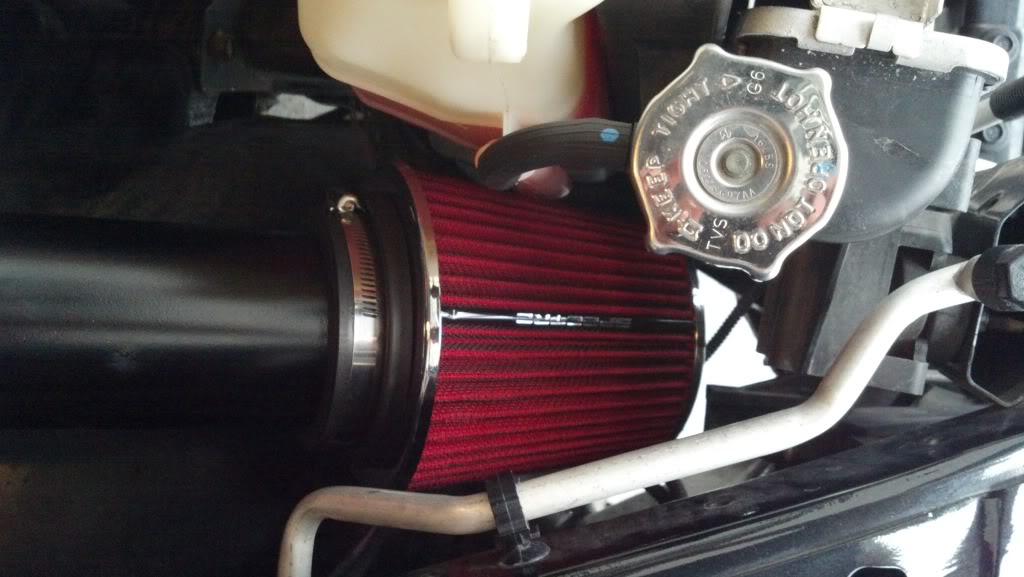
noticed on the tip of the cone there was drops of water and also a bit of water around it,for some magical reason i thought it would not get wet now i am up in the air on what to do, I guess my options are get rid of it all together and waste the 60 bucks,buy a rain hat and cross my fingers,cut the tube so it sits farther back above the wheel well,mod the factory box so it sits in there,I could go on and on ,my idea was to get it to sit as close as to where the stock box inlet was so it catches air off the wheel well ect, anywho just looking for suggestions or the obvious ,maybe its not even a big deal? put some oil on it and go? far as i no water in or on the air filter is bad news, I see the 300$ ones come with that heat shield and it looks like that covers ONE of the big open areas where i am most likely picking up water from, I did the basic 3'' intake out of the DIY section.


Administrator
Joined: Jul 2007
Posts: 24,686
Likes: 21
From: South Georgia/East Florida
You got a few options, you can cut back the tube to get it out from where the tire is spraying water at the wheel well, you could simply fab up a shield, you could get a pre-filter or put it in the stock airbox. Don't worry it's an easy fix...

All Star
Joined: Apr 2008
Posts: 777
Likes: 1
From: NH
I would just cut the tube shorter. It's not like if the filter was 8" farther back that you would be losing Horsepower.
But it's exactly this issue as to why i opted to not go with a cone filter (and the fact they don't filter as well as paper). I went with the Airaid modular intake tube. It connects to the throttle body and then the stock airbox. An improvement over stock but no risk of water infiltration and i can use better filtering paper filters.
Having seen chassis dyno results on stock cars vs cars with CAI kits installed and Gauze type filters, i am not impressed. HP increases are typically under 10HP. And having seen my own lube oil sample test results (on another truck i had) and how high the silica jumped when going with a K&N style filter, ill stick with paper. A few less HP vs longer engine life is a no brainer for me.
But it's exactly this issue as to why i opted to not go with a cone filter (and the fact they don't filter as well as paper). I went with the Airaid modular intake tube. It connects to the throttle body and then the stock airbox. An improvement over stock but no risk of water infiltration and i can use better filtering paper filters.
Having seen chassis dyno results on stock cars vs cars with CAI kits installed and Gauze type filters, i am not impressed. HP increases are typically under 10HP. And having seen my own lube oil sample test results (on another truck i had) and how high the silica jumped when going with a K&N style filter, ill stick with paper. A few less HP vs longer engine life is a no brainer for me.
Administrator
Joined: Jul 2007
Posts: 24,686
Likes: 21
From: South Georgia/East Florida
I would just cut the tube shorter. It's not like if the filter was 8" farther back that you would be losing Horsepower.
But it's exactly this issue as to why i opted to not go with a cone filter (and the fact they don't filter as well as paper). I went with the Airaid modular intake tube. It connects to the throttle body and then the stock airbox. An improvement over stock but no risk of water infiltration and i can use better filtering paper filters.
Having seen chassis dyno results on stock cars vs cars with CAI kits installed and Gauze type filters, i am not impressed. HP increases are typically under 10HP. And having seen my own lube oil sample test results (on another truck i had) and how high the silica jumped when going with a K&N style filter, ill stick with paper. A few less HP vs longer engine life is a no brainer for me.
But it's exactly this issue as to why i opted to not go with a cone filter (and the fact they don't filter as well as paper). I went with the Airaid modular intake tube. It connects to the throttle body and then the stock airbox. An improvement over stock but no risk of water infiltration and i can use better filtering paper filters.
Having seen chassis dyno results on stock cars vs cars with CAI kits installed and Gauze type filters, i am not impressed. HP increases are typically under 10HP. And having seen my own lube oil sample test results (on another truck i had) and how high the silica jumped when going with a K&N style filter, ill stick with paper. A few less HP vs longer engine life is a no brainer for me.
I've also had Blackstone test my oil twice in my Truck (K&N cone) and twice in my Jeep (K&N drop-in) and saw no such silica levels. I'll have to see if I can dig up my tests, but if not, I have two Blackstone bottles sitting here waiting on my next oil changes. I've tested my vehicles on Mobil 1 and Royal Purple and am running Valvoline SynPower now and am getting it tested for comparison purposes.
Where I will agree is that a CAI by itself doesn't offer much in gains as any dynos I've personally seen run actually show less than the 10 HP you say. It's more like 5-8 RWHP. BUT when you upgrade enough components that will actually use the greater airflow (and a cone filter has MUCH greater airflow just due to surface area alone - regardless of filter material) then the CAI starts to shine. There are both CAM and ported head manufacturers who spec a CAI when installing their products. I also agree that in a stock to mostly stock truck a flat, paper filter flows more than enough air and a cone or CAI just isn't going to give any significant benefit.
Now if I wasn't running a 7+ year old K&N which is still in as-new condition, I would purchase one of the newer premium dry flow cone or flat filters. There have been HUGE advances in dry filter technology and current products by companies such as Amsoil and AEM offer just as good a flow and as good if not better filtration as the best oiled filters on the market. Most importantly you don't have to deal with the mess of re-oiling.
Just my observations...
Last edited by HammerZ71; Feb 29, 2012 at 03:53 PM.
All Star
Joined: Apr 2008
Posts: 777
Likes: 1
From: NH
Hammer, my issues with K&N's were on an 01.5' CTD with a K&N RE-0880 filter.
My reason for prefering a paper filter is the fact that it does not rely on oil to provide effective filtration. I know a K&N will flow more air, no question on that. But as you said, unless you have some major mods, the extra airflow you get is not needed. And oiled gauze will not trap dirt as effectivley as paper. This is already a well proven fact. Railroads and heavy equipment manufacturers spend MILLIONS evey year on air filters that have to often be thrown away. If oiled gauze was truly as effective, or better then paper, they would use them. And as i mentioned in another thread on K&N filters, the logic that buying a K&N will save money on air filters was easily debunked. Taking into the account the cost of the K&N itself and the cleaning/oil kit. You could buy paper filters and replace them at the manufacturers reccomended intervals almost 6 times for the price of the K&N. It would take on average 5 years to get your money back on the investment. And that is just cost. The labor and time involved in cleaning, drying and oiling a K&N vs throwing away a paper filter and dropping a new one is huge.
A fantasitc air filter review from a reputable website that is competley unbiased and worth a read:
http://www.bobistheoilguy.com/airfilter/airtest1.htm
As always, just use what you like. I am simply explaining my reasoning. Not suggesting in any way that i am doing things the right way and everyone else is wrong.
My reason for prefering a paper filter is the fact that it does not rely on oil to provide effective filtration. I know a K&N will flow more air, no question on that. But as you said, unless you have some major mods, the extra airflow you get is not needed. And oiled gauze will not trap dirt as effectivley as paper. This is already a well proven fact. Railroads and heavy equipment manufacturers spend MILLIONS evey year on air filters that have to often be thrown away. If oiled gauze was truly as effective, or better then paper, they would use them. And as i mentioned in another thread on K&N filters, the logic that buying a K&N will save money on air filters was easily debunked. Taking into the account the cost of the K&N itself and the cleaning/oil kit. You could buy paper filters and replace them at the manufacturers reccomended intervals almost 6 times for the price of the K&N. It would take on average 5 years to get your money back on the investment. And that is just cost. The labor and time involved in cleaning, drying and oiling a K&N vs throwing away a paper filter and dropping a new one is huge.
A fantasitc air filter review from a reputable website that is competley unbiased and worth a read:
http://www.bobistheoilguy.com/airfilter/airtest1.htm
As always, just use what you like. I am simply explaining my reasoning. Not suggesting in any way that i am doing things the right way and everyone else is wrong.
Administrator
Joined: Jul 2007
Posts: 24,686
Likes: 21
From: South Georgia/East Florida
Cost of K&N cone in 2004 was $35, I've cleaned/re-oiled it twice. Cost of K&N drop-in in 2006 was $30, I've cleaned/re-oiled it twice and with same kit I bought for truck. I used it up at last cleaning so I'll have to buy a new one next time. Cost for the kit was $11.
So now I'm at $76 total for my air filters and maintenance.
Rounded off I'm at 55k miles on the truck, 105k miles on the Jeep, but I bought the Jeep with 60k on it so I've put 45k miles on it.
Purolator air filter for Ram is $9.95 at Advance and Purolator filter for the Jeep (4.7 HO) is $12.95 at Advance (I called). Now I always used to change my paper filters at 15k cost for the truck would have been on it's 4th filter now so that's roughly $39.80, Jeep would now be on filter number five so I'd have $64.75. To date, I would have spent $104.55 on paper filters.
I wouldn't call that "debunked"...
So now I'm at $76 total for my air filters and maintenance.
Rounded off I'm at 55k miles on the truck, 105k miles on the Jeep, but I bought the Jeep with 60k on it so I've put 45k miles on it.
Purolator air filter for Ram is $9.95 at Advance and Purolator filter for the Jeep (4.7 HO) is $12.95 at Advance (I called). Now I always used to change my paper filters at 15k cost for the truck would have been on it's 4th filter now so that's roughly $39.80, Jeep would now be on filter number five so I'd have $64.75. To date, I would have spent $104.55 on paper filters.
I wouldn't call that "debunked"...
Trending Topics
All Star
Joined: Apr 2008
Posts: 777
Likes: 1
From: NH
You are making a different comparison. You are including multiple vehicles and using the same filter from one vehicle to the next. I am talking value wise straight up to buy it for your Ram as a first time filter owner. I am not suggesting that a K&N will NEVER be a good value. If you have more then one car that uses them and you change your filter often, they can make sense. But i am talking for an initial user.
In other words, Joe Schmo buys a new Ram and wants to buy his first K&N filter. Using my year as an example. 2006. You are going to pay about $50.00 for the filter. The recharge kit will cost avout $10.00 So you have $60.00 invested in using a K&N.
Using your service interval of changing the filter every 15k miles, here is the math.
You can get paper filters in many places for $10.00, right off the bat, i can buy 6 paper filters for the price of the K&N and the cleaning/recharge kit.
If i replace my paper filter every 15k miles then i will still be saving money over buying a K&N untill i hit 90k miles. And unlike with a K&N, their is no labor whatsoever in changing the filter. Pop the air box open (no tools) and throw the old filter out, drop a new one in and your done. With a K&N, the filter needs to sprayed with cleaner and rinsed and any heavy debris removed. Then it has to be dried, then it has to be re-oiled. All of the above is messy and takes well over an hour when you take into account drying time.
With all of that being said, if i have no performance mods, then i gain NOTHING performance wise with a K&N in the stock air box. And i actually lose filtration (a proven fact, check the review i posted and their are plenty of others). Many people do not keep vehicles much past 100-125k since the trade in/resale value becomes so low. So at most, ill need one or two more paper filters to keep up with the service interval and still have none of the mess assoicated with cleaning the filters.
As for keeping the filter and using it on your next vehicle to maintain the value of it? Nice idea, if the next vehicle you buy uses the same type of filter. But even if you buy another Dodge, that does not mean it will always work with the next truck you buy. If you sell that car or truck with less then 90k miles and your new vehicle does not use the same filter, you actually lose money.
Again, if they work for you, use them. No problem here. And if i had a bunch of mods on my truck, i would have one too. I am just pointing out that for the average person who wants a reliable car or truck without having any hassles with upkeep, a K&N is not worth it. They do not increase your MPG, do not add HP (On stock setups) and do not offer better filtration over paper. This is all documented.
In other words, Joe Schmo buys a new Ram and wants to buy his first K&N filter. Using my year as an example. 2006. You are going to pay about $50.00 for the filter. The recharge kit will cost avout $10.00 So you have $60.00 invested in using a K&N.
Using your service interval of changing the filter every 15k miles, here is the math.
You can get paper filters in many places for $10.00, right off the bat, i can buy 6 paper filters for the price of the K&N and the cleaning/recharge kit.
If i replace my paper filter every 15k miles then i will still be saving money over buying a K&N untill i hit 90k miles. And unlike with a K&N, their is no labor whatsoever in changing the filter. Pop the air box open (no tools) and throw the old filter out, drop a new one in and your done. With a K&N, the filter needs to sprayed with cleaner and rinsed and any heavy debris removed. Then it has to be dried, then it has to be re-oiled. All of the above is messy and takes well over an hour when you take into account drying time.
With all of that being said, if i have no performance mods, then i gain NOTHING performance wise with a K&N in the stock air box. And i actually lose filtration (a proven fact, check the review i posted and their are plenty of others). Many people do not keep vehicles much past 100-125k since the trade in/resale value becomes so low. So at most, ill need one or two more paper filters to keep up with the service interval and still have none of the mess assoicated with cleaning the filters.
As for keeping the filter and using it on your next vehicle to maintain the value of it? Nice idea, if the next vehicle you buy uses the same type of filter. But even if you buy another Dodge, that does not mean it will always work with the next truck you buy. If you sell that car or truck with less then 90k miles and your new vehicle does not use the same filter, you actually lose money.
Again, if they work for you, use them. No problem here. And if i had a bunch of mods on my truck, i would have one too. I am just pointing out that for the average person who wants a reliable car or truck without having any hassles with upkeep, a K&N is not worth it. They do not increase your MPG, do not add HP (On stock setups) and do not offer better filtration over paper. This is all documented.
Administrator
Joined: Jul 2007
Posts: 24,686
Likes: 21
From: South Georgia/East Florida
I have never carried a filter over to another vehicle, I have a K&N cone in a CAI in my truck and a K&N drop-in in my Jeep, I paid $35 for the cone and $30 for the drop-in (well I think $28 actually).
I don't think cleaning and re-oiling is much of a hassle, but I'm **** about maintenance and am always cleaning, lubricating, waxing, etc. I DO acknowledge that to a novice, re-oiling can be a PIA and using the right amount can be confusing which is why if I were buying today, I'd use a premium, cleanable dry filter. But back when I bought, they were not anywhere near as good as they are today. If/when I ever replace mine, I'll no doubt go with Amsoil premium dry filters.
I agree, the average truck owner sees no real benefit from a CAI or even a premium filter for that matter, although I think making your own is a cool mod and gives a certain personal touch to your vehicle and it certainly doesn't impede performance. I do advocate the use of a pre-filter if the filter isn't boxed though. You get much better protection/filtration at just a fraction of air flow loss.
I'm not really disagreeing with you, just pointing out in MY case I see a benefit in the added air, especially in my truck with a ported TB, headers and a relatively open, free flowing exhaust and my over-all cost is actually less than buying paper filters every 15k miles.
Last year, I had the opportunity to be down in the car areas at Daytona in the week preceding the race and EVERY car had a CAI system, and I can see why they need to dry the track even without the traction issue, they all take air from under the front bumper, way out front and way down low. Must be a reason racing applications all use CAI systems, with all that money on the line, if it gained them no benefit, they wouldn't all be using it. I know, before you say it - apples to oranges as these are ALL highly modified cars, but my point is when the mods bear it out, CAIs offer huge benefits.
I'm a couple of weeks away from sending my samples to Blackstone and will post the reports when I get them, good or bad...
I don't think cleaning and re-oiling is much of a hassle, but I'm **** about maintenance and am always cleaning, lubricating, waxing, etc. I DO acknowledge that to a novice, re-oiling can be a PIA and using the right amount can be confusing which is why if I were buying today, I'd use a premium, cleanable dry filter. But back when I bought, they were not anywhere near as good as they are today. If/when I ever replace mine, I'll no doubt go with Amsoil premium dry filters.
I agree, the average truck owner sees no real benefit from a CAI or even a premium filter for that matter, although I think making your own is a cool mod and gives a certain personal touch to your vehicle and it certainly doesn't impede performance. I do advocate the use of a pre-filter if the filter isn't boxed though. You get much better protection/filtration at just a fraction of air flow loss.
I'm not really disagreeing with you, just pointing out in MY case I see a benefit in the added air, especially in my truck with a ported TB, headers and a relatively open, free flowing exhaust and my over-all cost is actually less than buying paper filters every 15k miles.
Last year, I had the opportunity to be down in the car areas at Daytona in the week preceding the race and EVERY car had a CAI system, and I can see why they need to dry the track even without the traction issue, they all take air from under the front bumper, way out front and way down low. Must be a reason racing applications all use CAI systems, with all that money on the line, if it gained them no benefit, they wouldn't all be using it. I know, before you say it - apples to oranges as these are ALL highly modified cars, but my point is when the mods bear it out, CAIs offer huge benefits.
I'm a couple of weeks away from sending my samples to Blackstone and will post the reports when I get them, good or bad...
Last edited by HammerZ71; Mar 1, 2012 at 01:03 PM.