


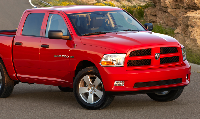
How to turn 2010 Ram 1500 Hemi into flex fuel vehicle?


Captain
Joined: Mar 2005
Posts: 639
Likes: 0
From: Dyess, TX

Why would anyone want to run E85? Even more so why would anyone want to run a HEMI on E85? And beyond that, why oh why would anyone even want the stupid badge giving people the impression that you could run E85?? Some things in this world I will never understand...

Not recommended as it is quite corrosive and has a low BTU output which in turn requires much more fuel to make the same power so you actually spend more running E85 because your mpg drops almost in half. It also requires a special tune to dump more fuel into the cylinders.
It's not so much a wear issue in the engine, it is just very inefficient and a waste of good food
It's not so much a wear issue in the engine, it is just very inefficient and a waste of good food
Consider that on average for my area, E85 is about 10% cheaper than normal 85 octane gas and based on a study published back in 09, a motor that runs E85 will be about 20% less efficient over the course of a year compared to the same motor that was running E85... Long haul tells you that you'll be using 10% more gas and spending 10% more as well.

Champion
Joined: Dec 2007
Posts: 3,563
Likes: 0
From: Ontario, Canada
We have an Avenger that runs both E85 and Gas and well we have never bothered in fact we debadged the e85 sticker(sorry farmers) To me it's a way the government is trying to keep the price of corn up so they don't have to subsidize the farmers.
If anything in the HEMI if you can find pure gas no ethanol you would like that. I think Shell and Canadian Tire in Canada had it don't know anymore.
If anything in the HEMI if you can find pure gas no ethanol you would like that. I think Shell and Canadian Tire in Canada had it don't know anymore.

Captain
Joined: Mar 2005
Posts: 639
Likes: 0
From: Dyess, TX
Firstly energy density of e85 is approximately 25.7 MJ/L gasoline is 34.2, that is closer to 76% than the 66% cited.
"2009–2010 Ford F-Series, 3-valve SOHC, 320 hp (239 kW) and 390 lb·ft (529 N·m) ratings on e85 biofuel."
Ford makes 70 more HP on ethanol than on gas. If you cast your mind back about 15 years ford made the super stallion concept which made 590 on ethanol but only 545 on 93 octane.
I cite these two examples for this reason: they demonstrate that you can run far more advance (on an NA motor like the F series) or far more boost (super stallion) without running into detonation, as e85 has a very high anti knock rating as compared to conventional gasoline (rated as high as 113, though the methodology is questionable).
Energy density has little to do with horsepower. The best analogy is that lower energy density fuels are thinner or lighter than higher energy fuels (think diesel as opposed to gasoline). This means that for a given volume they have lesser stored "mass" of energy. All that means is that to get the same energy out of the motor you have to burn more fuel (but the same amount of air). All that means is that you have to run richer, and that you get worse gas mileage per gallon.
GM made the conscious decision to not increase timing on their e85 motors to take advantage of the extra power potential, as they wanted e85 operation to feel seamless. Ford took the strategy that more power when available was better.
Long story short, in high load conditions under high temperatures or high boost, where the knock sensors come into play, e85 will make more HP on just about any motor, as it will not have to pull timing as soon to protect itself.
To sum up; energy density affects gas mileage, but a much smaller effect on HP. Knock resistance has a large affect on potential horsepower and *******ly none on gas mileage. They are two separate issues that are being confused here.

Site Moderator


Joined: May 2008
Posts: 9,657
Likes: 24
From: Louisville, Ky
That Super Stallion was supercharged which makes a big difference in octane ratings and tuning.
E85 does have a higher octane rating per se, but like mentioned earlier, it takes much more fuel to make the same power. Jack Roush has a Mustang drag car with a 7L version of the new Ford 6.2L. It is naturally aspirated and runs 9sec 1/4 mile time on E85. It uses 2 injectors per cylinder to get enough E85 into the engine to make that kind of power. It makes close to 800hp.
Look at a flexfuel car's window sticker at miles per tank, in small print on E85, the distance is between 50% and 70% of the Gasoline miles per tank.
Now if E85 was about $1.25 a gallon, then it would be worth it for me to invest in a E85 vehicle, but since it isn't much less than regular gasoline, then you are shooting yourself in the foot (and wallet) buy using it.
Just a note, to keep your Hemi happy and to live a long life, it is recommended to use 89 octane gasoline. Even says so in the 08 owners manual. Not sure if it does in the 09-up or not.
Last edited by lxman1; Jul 4, 2011 at 07:46 PM.
Captain
Joined: Mar 2005
Posts: 639
Likes: 0
From: Dyess, TX
I got my traces crossed on that one and put my foot in my mouth... that should indeed be 10 HP.
I should have quoted the whole thing... the motor pics up 25 TQ on e85, a very noticeable difference... about the same as a set of long tube headers or a dyno tune. If you factor the installed price of a set of headers in versus the amortized cost of e85 you will be way ahead with e85.
If you are building an all out HP motor, e85 is a better fuel.
It is important for me to note at this time that I am basically anti-ethanol. It is a silly fuel source for what the US govt is trying to make us do with it. That said I abhor misinformation which is why I addressed Secret Agent Man's post.
I should have quoted the whole thing... the motor pics up 25 TQ on e85, a very noticeable difference... about the same as a set of long tube headers or a dyno tune. If you factor the installed price of a set of headers in versus the amortized cost of e85 you will be way ahead with e85.
If you are building an all out HP motor, e85 is a better fuel.
It is important for me to note at this time that I am basically anti-ethanol. It is a silly fuel source for what the US govt is trying to make us do with it. That said I abhor misinformation which is why I addressed Secret Agent Man's post.

Captain
Joined: Jan 2009
Posts: 505
Likes: 0
From: Dayton, OH suburbs
See this is why it is important to know what you are talking about before you say something stupid (note the comment seemed stupid not the poster, lack of information can lead to this situation).
Firstly energy density of e85 is approximately 25.7 MJ/L gasoline is 34.2, that is closer to 76% than the 66% cited.
"2009–2010 Ford F-Series, 3-valve SOHC, 320 hp (239 kW) and 390 lb·ft (529 N·m) ratings on e85 biofuel."
Ford makes 70 more HP on ethanol than on gas. If you cast your mind back about 15 years ford made the super stallion concept which made 590 on ethanol but only 545 on 93 octane.
I cite these two examples for this reason: they demonstrate that you can run far more advance (on an NA motor like the F series) or far more boost (super stallion) without running into detonation, as e85 has a very high anti knock rating as compared to conventional gasoline (rated as high as 113, though the methodology is questionable).
Energy density has little to do with horsepower. The best analogy is that lower energy density fuels are thinner or lighter than higher energy fuels (think diesel as opposed to gasoline). This means that for a given volume they have lesser stored "mass" of energy. All that means is that to get the same energy out of the motor you have to burn more fuel (but the same amount of air). All that means is that you have to run richer, and that you get worse gas mileage per gallon.
GM made the conscious decision to not increase timing on their e85 motors to take advantage of the extra power potential, as they wanted e85 operation to feel seamless. Ford took the strategy that more power when available was better.
Long story short, in high load conditions under high temperatures or high boost, where the knock sensors come into play, e85 will make more HP on just about any motor, as it will not have to pull timing as soon to protect itself.
To sum up; energy density affects gas mileage, but a much smaller effect on HP. Knock resistance has a large affect on potential horsepower and *******ly none on gas mileage. They are two separate issues that are being confused here.
Firstly energy density of e85 is approximately 25.7 MJ/L gasoline is 34.2, that is closer to 76% than the 66% cited.
"2009–2010 Ford F-Series, 3-valve SOHC, 320 hp (239 kW) and 390 lb·ft (529 N·m) ratings on e85 biofuel."
Ford makes 70 more HP on ethanol than on gas. If you cast your mind back about 15 years ford made the super stallion concept which made 590 on ethanol but only 545 on 93 octane.
I cite these two examples for this reason: they demonstrate that you can run far more advance (on an NA motor like the F series) or far more boost (super stallion) without running into detonation, as e85 has a very high anti knock rating as compared to conventional gasoline (rated as high as 113, though the methodology is questionable).
Energy density has little to do with horsepower. The best analogy is that lower energy density fuels are thinner or lighter than higher energy fuels (think diesel as opposed to gasoline). This means that for a given volume they have lesser stored "mass" of energy. All that means is that to get the same energy out of the motor you have to burn more fuel (but the same amount of air). All that means is that you have to run richer, and that you get worse gas mileage per gallon.
GM made the conscious decision to not increase timing on their e85 motors to take advantage of the extra power potential, as they wanted e85 operation to feel seamless. Ford took the strategy that more power when available was better.
Long story short, in high load conditions under high temperatures or high boost, where the knock sensors come into play, e85 will make more HP on just about any motor, as it will not have to pull timing as soon to protect itself.
To sum up; energy density affects gas mileage, but a much smaller effect on HP. Knock resistance has a large affect on potential horsepower and *******ly none on gas mileage. They are two separate issues that are being confused here.
Read my post again... I said ETHANOL has approximately 2/3 the energy density of regular gasoline. Gasoline contains approximately 34.8 MJ/l (125,000 BTUs per US gallon) whereas ethanol contains 23.5 MJ/l (84,600 BTUs per US gallon)gal)—ethanol contains 32.5% less energy per unit volume. Therefore, E85, a blend of 85% ethanol and 15% gasoline, has an energy content 71.95% that of gasoline. This is all per the EPA. You were in the right ballpark about E85, but I was talking about the energy density of ethanol. Please read more carefully in the future before deeming a comment stupid.
As far as the HP gains out of running pure ethanol, in my research it only appears this is possible when engines are designed for ethanol, not dual purpose like the flex fuel engines. This seems to agree with your above post. The thing is, we were talking about a dual purpose Hemi designed originally for gas and adapted for ethanol. Therefore nobody is going to make any hp gains from ethanol in a hemi.
Captain
Joined: Mar 2005
Posts: 639
Likes: 0
From: Dyess, TX
The only part of your post I was calling ignorant (I apologise for the language it was uncalled for) was the HP part.
The subject of this post was e85, which is fairly regularly (if incorrectly) referred to as ethanol.
Ford flex fuel vehicles make more hp on ethanol than on gasoline.
Any flex fuel vehicle tuned for identical hp on ethanol and gasoline will still make more HP on ethanol under conditions that would cause detonation (high load/high temp). The e85 equipped motor will be able to continue running advanced timing well after the gas motor pulls timing and looses power.
The central theme of your post was wrong. It is extremely easy to make more HP with a lower energy fuel on an internal combustion motor: run more compression, boost or timing. Even a converted motor will make more power... go into the tables and reset the timing baseline for an appropriate amount of advance. You will have to tune the motor anyway, as air fuel ratios and volumes will have to be adjusted for the new fuel.
The subject of this post was e85, which is fairly regularly (if incorrectly) referred to as ethanol.
Ford flex fuel vehicles make more hp on ethanol than on gasoline.
Any flex fuel vehicle tuned for identical hp on ethanol and gasoline will still make more HP on ethanol under conditions that would cause detonation (high load/high temp). The e85 equipped motor will be able to continue running advanced timing well after the gas motor pulls timing and looses power.
The central theme of your post was wrong. It is extremely easy to make more HP with a lower energy fuel on an internal combustion motor: run more compression, boost or timing. Even a converted motor will make more power... go into the tables and reset the timing baseline for an appropriate amount of advance. You will have to tune the motor anyway, as air fuel ratios and volumes will have to be adjusted for the new fuel.

