


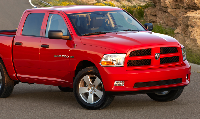
Cold weather, Recommended Tire Pressure


Thread Starter
|
Rookie
Joined: Aug 2010
Posts: 79
Likes: 0
 Cold weather, Recommended Tire Pressure
It dipped to -9 here and the morning I started the truck, my tire sensor monitor went off on the dash stating that I have low PSI. I checked them on the EVIC and it stated they were at 32, 31, 30, and 32.
What's a good tire pressure to have on the tire. I looked on them and it stated 50. Which, seems like a lot.
What's a good tire pressure to have on the tire. I looked on them and it stated 50. Which, seems like a lot.

Administrator
Joined: Jul 2007
Posts: 24,686
Likes: 21
From: South Georgia/East Florida
Sounds like a "D" load range tire. I run my 35" Cepeks ("D" tire, max 50 psi also) at 40 lbs. for normal daily use. I've always found that running a tire at about 80% of it's max rating balances fuel economy/performance/wear pretty well. Obviously when it's cooler (although south Georgia/north Florida doesn't get to -9*) I'll have to add a little air and take some out when it's hot out...

All Star
Joined: Jan 2010
Posts: 824
Likes: 1
From: Alberta
I have nitrogen filled tires so it might be different for me. But I run 42 on everything and I have not had any monitors go off and its been -20 here some days. I think it has to do a lot with the nitrogen, but when its cold those sensors just don't work properly. I know guys running other dodges with sensors on them, some of them have this issue some not. At least the pressures are still ok, it just seems to give a warning on theirs...I have no idea what kind of pressure they have no...
Administrator
Joined: Jul 2007
Posts: 24,686
Likes: 21
From: South Georgia/East Florida
I have nitrogen filled tires so it might be different for me. But I run 42 on everything and I have not had any monitors go off and its been -20 here some days. I think it has to do a lot with the nitrogen, but when its cold those sensors just don't work properly. I know guys running other dodges with sensors on them, some of them have this issue some not. At least the pressures are still ok, it just seems to give a warning on theirs...I have no idea what kind of pressure they have no...
I run nitrogen in my tires also, but I'm very strict on the exact amount. I painstakingly make sure to run EXACTLY 78.084% nitrogen in my tires, no more - no less!!!

All Star
Joined: Jan 2010
Posts: 824
Likes: 1
From: Alberta
For me it was part of dodges roadside assistance program for tires. They fill the tires with nitrogen around 78% as hammer stated, and if I ever blow a tire or rim its all paid for, up to an amount of 5000 bucks over 3 years.
But basically the nitrogen contains less moisture then air does, and are bigger molecules then oxygen. So theoretically you will get less air leakage. The biggest reason for nitrogen tho is the varying temperatures. It helps the tire to maintain equal pressure during fast temperature changes.
Some people say its a gimmic, just another way to earn cash. But since I have purchased the truck I have not filled the air myself and I think maybe they were topped up on my first oilchange. So I can see it working, but I have no comparison...
But basically the nitrogen contains less moisture then air does, and are bigger molecules then oxygen. So theoretically you will get less air leakage. The biggest reason for nitrogen tho is the varying temperatures. It helps the tire to maintain equal pressure during fast temperature changes.
Some people say its a gimmic, just another way to earn cash. But since I have purchased the truck I have not filled the air myself and I think maybe they were topped up on my first oilchange. So I can see it working, but I have no comparison...

Rookie
Joined: May 2009
Posts: 70
Likes: 0
From: WNY

Trending Topics


Registered User
Joined: Sep 2010
Posts: 16
Likes: 0
From: Tallahassee, FL
I think Hammer was being a "S. GA. smart-butt" and pointing-out that the air in the atmosphere is about 78% nitrogen
The moisture thing is accurate though. Nitrogen won't contain the moisture which you get from compressed air out of a compressor
The moisture thing is accurate though. Nitrogen won't contain the moisture which you get from compressed air out of a compressor
Administrator
Joined: Jul 2007
Posts: 24,686
Likes: 21
From: South Georgia/East Florida
You guys just don't get it.... right over your heads!!! Well a couple of y'all obviously used your heads in school for something other than to rest the dunce cap.
Oxygen 20.9476%
Argon 0.934%
Carbon Dioxide .0314%
Neon .001818%
Helium .000524%
Methane .0002%2
Krypton .000114%
Hydrogen .00005%
Xenon .0000087%
But seriously, 100% pure nitrogen molecules do not react to atmospheric changes nearly as much as plain air. Oxegen molecules are very volatile and the molecules expand and contract greatly as temperature, atmospheric pressures and moisture (humidity) changes. As a rule, those who opt for pure nitrogen in their tires don't have to check and adjust the PSI in their tires unless the temperature changes are pretty extreme. Also, O2 molecules are smaller and over time will "seep" through the sub-microscopic spaces between the molecules that make up the tire's compound. Ever wonder why a tire left in one place gets low over time? By rotating (heating) the tire, the oxygen molecules aren't allowed to contract and seep through the tire.
I just run pure out air and I check my tires regularly. It's good for those who aren't the "maintenance type" though. Now if it was FREE- 'nuther story...
Composition of the Earth's Atmosphere
Source: Definition of the U.S. Standard Atmosphere
Nitrogen 78.084%Source: Definition of the U.S. Standard Atmosphere
Oxygen 20.9476%
Argon 0.934%
Carbon Dioxide .0314%
Neon .001818%
Helium .000524%
Methane .0002%2
Krypton .000114%
Hydrogen .00005%
Xenon .0000087%
But seriously, 100% pure nitrogen molecules do not react to atmospheric changes nearly as much as plain air. Oxegen molecules are very volatile and the molecules expand and contract greatly as temperature, atmospheric pressures and moisture (humidity) changes. As a rule, those who opt for pure nitrogen in their tires don't have to check and adjust the PSI in their tires unless the temperature changes are pretty extreme. Also, O2 molecules are smaller and over time will "seep" through the sub-microscopic spaces between the molecules that make up the tire's compound. Ever wonder why a tire left in one place gets low over time? By rotating (heating) the tire, the oxygen molecules aren't allowed to contract and seep through the tire.
I just run pure out air and I check my tires regularly. It's good for those who aren't the "maintenance type" though. Now if it was FREE- 'nuther story...
Last edited by HammerZ71; Dec 11, 2011 at 11:28 AM.