


20" wheels, I can't decide which ones


Registered User
Joined: Jul 2013
Posts: 3
Likes: 0

I'm considering 245/50 - 20's for taller sidewalls when I pull the trigger on new meats.
They would be 1" bigger in diameter which means ~3.5% slower speedo reading . From what I've read, most speedo's are set high from the factory, especially in Europe, so I'm hoping the actual error would be less. I would be interested to know if anyone has checked their late model GC's speedo for accuracy.
They would be 1" bigger in diameter which means ~3.5% slower speedo reading . From what I've read, most speedo's are set high from the factory, especially in Europe, so I'm hoping the actual error would be less. I would be interested to know if anyone has checked their late model GC's speedo for accuracy.

Thread Starter
|
Amateur
Joined: Jul 2012
Posts: 29
Likes: 0
I'm considering 245/50 - 20's for taller sidewalls when I pull the trigger on new meats.
They would be 1" bigger in diameter which means ~3.5% slower speedo reading . From what I've read, most speedo's are set high from the factory, especially in Europe, so I'm hoping the actual error would be less. I would be interested to know if anyone has checked their late model GC's speedo for accuracy.
They would be 1" bigger in diameter which means ~3.5% slower speedo reading . From what I've read, most speedo's are set high from the factory, especially in Europe, so I'm hoping the actual error would be less. I would be interested to know if anyone has checked their late model GC's speedo for accuracy.
I drive a bunch of miles/year. I'll probably be replacing the new tires some time late next year and I'll probably go with a 50 series then.

Registered User
Joined: Aug 2012
Posts: 16
Likes: 0
These tire sizes have been tried and no issues with rubbing. Ride comfort is better than OEM diameter sizing due to more sidewall on a 20" wheel. It seems a maximum diameter of 30" and below works.
Go wide for dry traction, go taller for more comfort. For winter/rain don't go wide to cut through snow/rain vs. float. Wider = more road feel too so if you have any shimmy's it will just amplify.
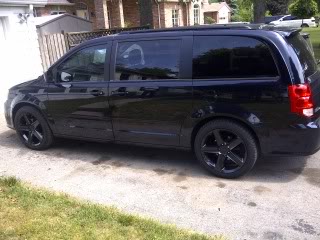
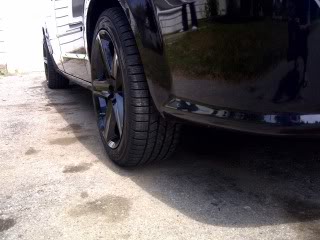
Here is 255/45/20 on SRT8 Replica's:


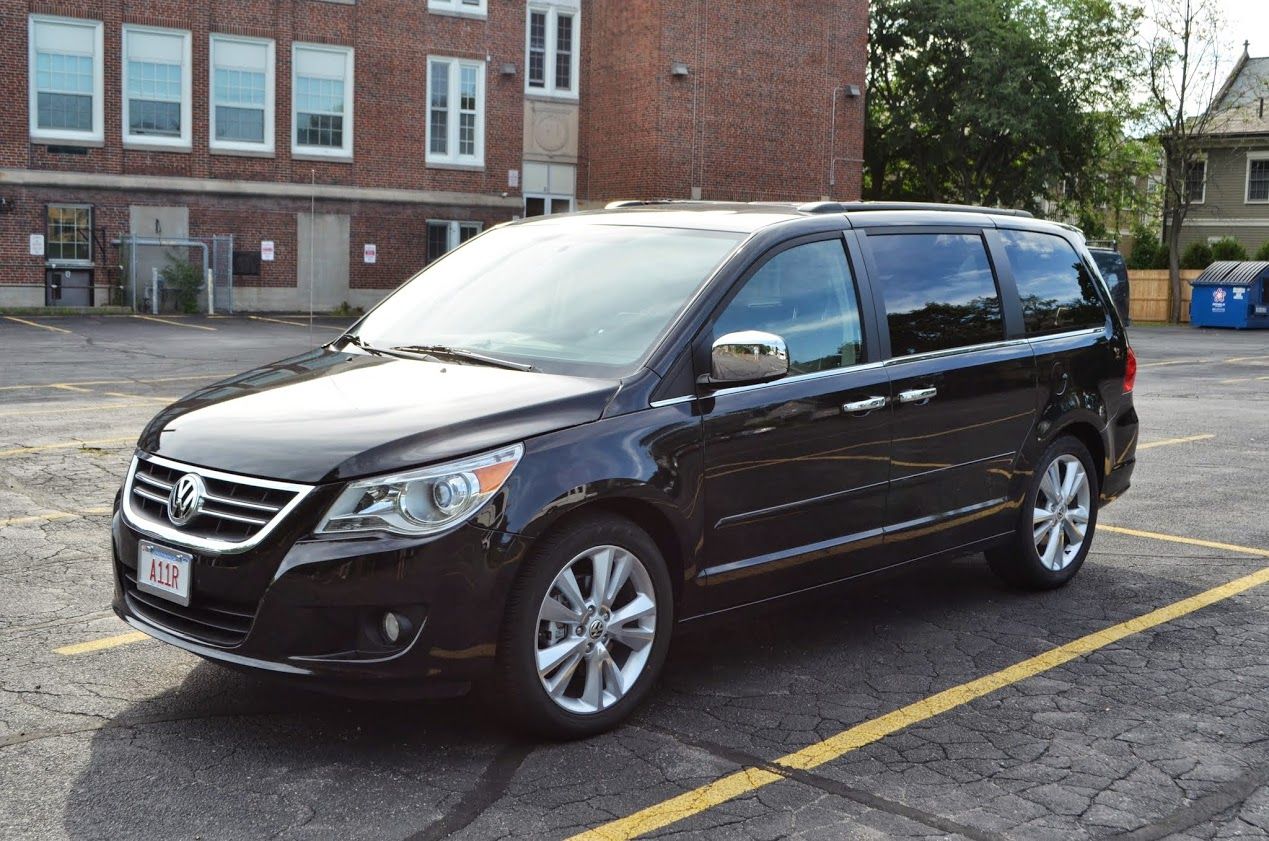
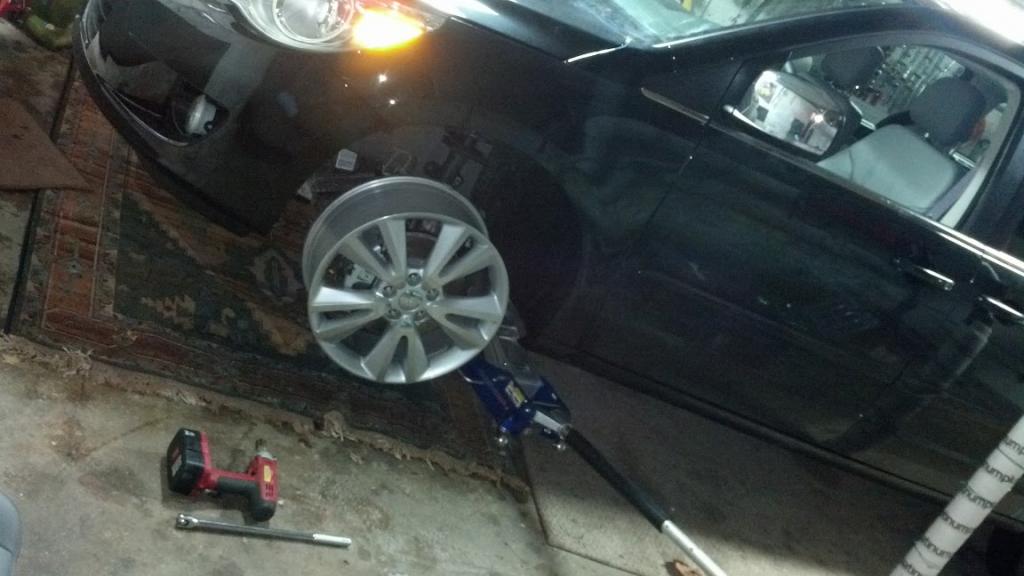
Here is 245/50/20:
I tried to see if OEM SRT8 rear wheels would fit either front or rear, but it won't. Too wide.


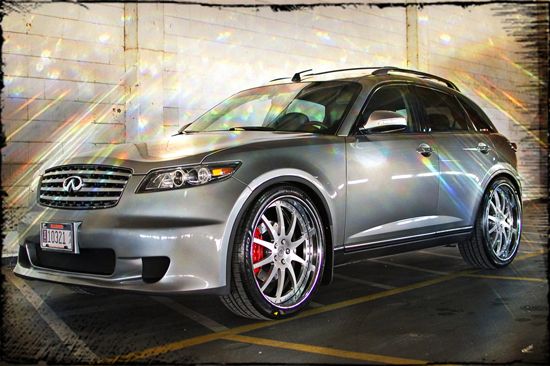
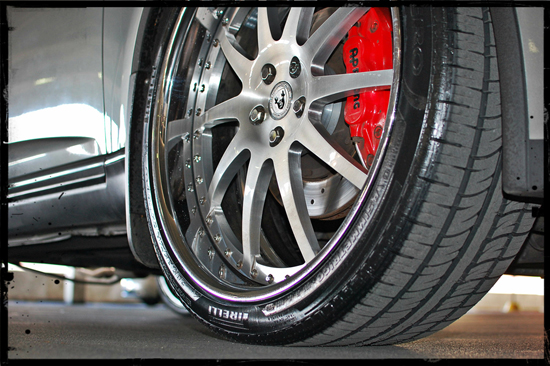
I'm a bit new to this forum, here's my last car with 24's. Through trial and error, I found the tire size and fitment that worked best. My next project is this minivan:
Watch the tire pressures on the replica's -- I've read reports online (not a lot, but they are out there), on losing tire pressure, so slow leaks on the Jeep forums.
You also have a 40 series tire, so almost rubber band territory, so I'd make sure it's over inflated slightly to 40 psi cold or even 41/42. You're going to stress your suspension more, but I'd rather have that then a dented wheel.
Lscman has a lot of view good points and is technically right on all aspects. If I wanted the best performing, safest wheel -- I'd buy the smallest wheel diameter I could find that is forged, then throw a tire the exact diameter as possible to OEM.
Since rubber is lighter than metal, the rotating mass saved would increase acceleration, decrease braking distance, better comfort, etc...
There is a fine balance to do things correctly so you don't change the geometry too drastically that the ECU cannot handle the variances (or the car itself).
Daily driving, all these mods if done right are fine. If you're doing some heavy hauling/towing and taking your minivan to the track -- forget it! Stick with OEM items.
OEM wheels go through extensive testing, the replicas and most aftermarket are cast wheels that are made in China out of a mold. Quality control is up in the air.
If you go quality like HRE or iForged, not much to worry -- they will be stronger and lighter than your OEM.
Happy modding...
Go wide for dry traction, go taller for more comfort. For winter/rain don't go wide to cut through snow/rain vs. float. Wider = more road feel too so if you have any shimmy's it will just amplify.
Here is 255/45/20 on SRT8 Replica's:


Here is 245/50/20:


I tried to see if OEM SRT8 rear wheels would fit either front or rear, but it won't. Too wide.
I'm a bit new to this forum, here's my last car with 24's. Through trial and error, I found the tire size and fitment that worked best. My next project is this minivan:


Watch the tire pressures on the replica's -- I've read reports online (not a lot, but they are out there), on losing tire pressure, so slow leaks on the Jeep forums.
You also have a 40 series tire, so almost rubber band territory, so I'd make sure it's over inflated slightly to 40 psi cold or even 41/42. You're going to stress your suspension more, but I'd rather have that then a dented wheel.
Lscman has a lot of view good points and is technically right on all aspects. If I wanted the best performing, safest wheel -- I'd buy the smallest wheel diameter I could find that is forged, then throw a tire the exact diameter as possible to OEM.
Since rubber is lighter than metal, the rotating mass saved would increase acceleration, decrease braking distance, better comfort, etc...
There is a fine balance to do things correctly so you don't change the geometry too drastically that the ECU cannot handle the variances (or the car itself).
Daily driving, all these mods if done right are fine. If you're doing some heavy hauling/towing and taking your minivan to the track -- forget it! Stick with OEM items.
OEM wheels go through extensive testing, the replicas and most aftermarket are cast wheels that are made in China out of a mold. Quality control is up in the air.
If you go quality like HRE or iForged, not much to worry -- they will be stronger and lighter than your OEM.
Happy modding...

Veteran
Joined: May 2011
Posts: 394
Likes: 3
The factory 65 series tires used on the stock 16" setups is roughly 27.5" while the larger 17" setups use tires with about 28.5" diameter. In order to achieve an identical tire sidewall height on 20" wheels, the tire diameter would need to be exactly 31.5". If you are running a tire on a 20" wheel with only 30" diameter, it will have over 10% less sidewall than stock. In order to maintain similar tire sidewall heights and flex when switching from 16" to 20", you would need to increase the tire diameter roughly 4", not 2-1/2". I'm not saying 10% less sidewall height is going to cause a bone-jarring ride, but it should not improve it. New tires invariably improve ride quality and other things come into play too like sidewall construction and total diameter.
Last edited by Lscman; Jul 28, 2013 at 11:59 AM.

Registered User
Joined: Jan 2025
Posts: 4
Likes: 0
From: North Vancouver
All that matters is the height of the tire which can be easily compared on Tirerack website. Wheel size is not relevant.
Changing wheels to 20" on a minivan has to be the most silly thing I've ever heard today. The lateral G forces can't be appreciably increased without fear of rollover so the larger wheels only reduce comfort from less sidewall flex. Wider tires will reduce gas mileage and increase hydroplaning. All cons and no pros isn't my idea of an "upgrade". Race mods on a minivan can only induce chuckling from folks who know better. The reason mfrs upsizing wheels on 4500lb minivans is to allow fitment of larger brakes. A 2013 GC weighs about 20% more than a 2003, so it needs 20% larger brakes to provide similar braking capability. Most aftermarket wheels are weaker than stock and prone to breakage, bending and/or failure. They are generally strong enough for little cars used for street pedestrian use, but often inadequate for heavy vans. The stock wheels are bulletproof, safe and ideal for such a heavy vehicle full of passengers.
Changing wheels to 20" on a minivan has to be the most silly thing I've ever heard today. The lateral G forces can't be appreciably increased without fear of rollover so the larger wheels only reduce comfort from less sidewall flex. Wider tires will reduce gas mileage and increase hydroplaning. All cons and no pros isn't my idea of an "upgrade". Race mods on a minivan can only induce chuckling from folks who know better. The reason mfrs upsizing wheels on 4500lb minivans is to allow fitment of larger brakes. A 2013 GC weighs about 20% more than a 2003, so it needs 20% larger brakes to provide similar braking capability. Most aftermarket wheels are weaker than stock and prone to breakage, bending and/or failure. They are generally strong enough for little cars used for street pedestrian use, but often inadequate for heavy vans. The stock wheels are bulletproof, safe and ideal for such a heavy vehicle full of passengers.
Have not had any issues with thier wheels not me or my friends . I'm more intrested in adding proximity key and push button , hopefully that adds walk away auto locking and approach auto unlock.
As far as wheels are concerned right have 21 inch tesla wheels with french continentals from tesla and all this conjecture about ride comfort etc is subjective . My van has 17 inch factory with Michelin and it rides like crap in the back ,
my model s and X tesla are very comfortable . This van with its 17 inches not as much
Last edited by Williamgilles; Jan 5, 2025 at 05:08 PM.
Registered User
Joined: Jan 2025
Posts: 4
Likes: 0
From: North Vancouver
The factory 65 series tires used on the stock 16" setups is roughly 27.5" while the larger 17" setups use tires with about 28.5" diameter. In order to achieve an identical tire sidewall height on 20" wheels, the tire diameter would need to be exactly 31.5". If you are running a tire on a 20" wheel with only 30" diameter, it will have over 10% less sidewall than stock. In order to maintain similar tire sidewall heights and flex when switching from 16" to 20", you would need to increase the tire diameter roughly 4", not 2-1/2". I'm not saying 10% less sidewall height is going to cause a bone-jarring ride, but it should not improve it. New tires invariably improve ride quality and other things come into play too like sidewall construction and total diameter.
Maybe that's the key to larger wheels and tires with these vans ,
just inatall the EV specified tires.
You ballers better hold your nutz they're kinda premium
Anyone got slightly smaller tires on the front vs the back ?
Last edited by Williamgilles; Jan 5, 2025 at 05:16 PM.