


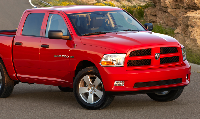
2009 RAM 1500 Hemi...Ow20 vs 5w20 synthetic oil...


Thread Starter
|
Professional
Joined: Sep 2011
Posts: 163
Likes: 0
 2009 RAM 1500 Hemi...Ow20 vs 5w20 synthetic oil...
I have a 2009 Ram 1500 4 x 4 with the Hemi, and I'm interested in opinions or experience with Ow20 as opposed to 5w20 oil. For years now, I've only used synthetic oil in all my vehicles (all my engines in fact including outboard motors). I'm sold on the benefits, so I don't want to debate synthetic vs convention oil...but the recommended oil in my Ram is 5w20 which is what I'm using but I've thought about switching to Ow20. At operating temperatures, viscosity is the same so it would seem Ow20 gives the added benefit of better flow at lower temperatures (I live north of Toronto so we deal with some pretty cold winters). Still, the engineers at Dodge specify 5w20. I believe you can only get Ow20 oil as a synthetic so maybe that contributes to Dodge spec'ing 5w20. Not a big deal, just curious...

Administrator
Joined: Jul 2007
Posts: 24,686
Likes: 21
From: South Georgia/East Florida
I don't see any negative to running a 0w-20 myself. I know 5w-30 is a NO-NO with MDS, but the 0w-20 shouldn't physically make any difference. That said, however, I know for a fact that they'll deny a warranty claim on an engine failure on an MDS Hemi if 5w-30 is in there and I could see them holding to the "letter of the law" if anything other than the recommended 5w-20 was in the crankcase if there was a problem.
If warranty is an issue, I'd prolly stick to the recommended viscosity, unless you have it in writing from the dealer or Dodge that 0w-20 is an acceptable oil...
If warranty is an issue, I'd prolly stick to the recommended viscosity, unless you have it in writing from the dealer or Dodge that 0w-20 is an acceptable oil...

Veteran
Joined: Dec 2010
Posts: 422
Likes: 0
From: North Aurora, Il - 40 miles west of Chicago
0W cold, is still thicker than 20W hot. 20W hot, is still thinner than 0W cold.
Food for thought.......
I have frequently used lower winter weights, in many different vehicles, with nothing but GOOD results --- it's the warm weights you have to be concerned with IMHO.
Better lubricity when cold is always a good thing , better lubrication, better starting, easier on the starter, easier on parts, faster flow --- not a bad thing in the bunch
Food for thought.......
I have frequently used lower winter weights, in many different vehicles, with nothing but GOOD results --- it's the warm weights you have to be concerned with IMHO.
Better lubricity when cold is always a good thing , better lubrication, better starting, easier on the starter, easier on parts, faster flow --- not a bad thing in the bunch

Thread Starter
|
Professional
Joined: Sep 2011
Posts: 163
Likes: 0
Warranty coverage.....
I don't see any negative to running a 0w-20 myself. I know 5w-30 is a NO-NO with MDS, but the 0w-20 shouldn't physically make any difference. That said, however, I know for a fact that they'll deny a warranty claim on an engine failure on an MDS Hemi if 5w-30 is in there and I could see them holding to the "letter of the law" if anything other than the recommended 5w-20 was in the crankcase if there was a problem.
If warranty is an issue, I'd prolly stick to the recommended viscosity, unless you have it in writing from the dealer or Dodge that 0w-20 is an acceptable oil...
If warranty is an issue, I'd prolly stick to the recommended viscosity, unless you have it in writing from the dealer or Dodge that 0w-20 is an acceptable oil...

Site Moderator


Joined: May 2008
Posts: 9,656
Likes: 24
From: Louisville, Ky
They can and will test the oil if an oil related problem occurs under warranty. The pcm will actually throw a dealer readable code that will not turn on the CEL if anything thicker than 5w20 is used in a MDS equipped truck.
The owners manual will tell you what oil is recommended and has been tested in all temp. extremes. If you bought the truck new and have a lifetime powertrain warranty, I would use what is recommended. I do. My dealer does all of my oil changes cheaper than I can do them myself and I have all of the records if a warranty issue was to show up.
0w20 is a German thing that BMW and Mercedes started using a couple of years ago.
But, to answer your question, it won't hurt anything.
All oil starts out as the lower number and has additives that thicken it up as it heats up, contrary to popular belief.
The owners manual will tell you what oil is recommended and has been tested in all temp. extremes. If you bought the truck new and have a lifetime powertrain warranty, I would use what is recommended. I do. My dealer does all of my oil changes cheaper than I can do them myself and I have all of the records if a warranty issue was to show up.
0w20 is a German thing that BMW and Mercedes started using a couple of years ago.
But, to answer your question, it won't hurt anything.
All oil starts out as the lower number and has additives that thicken it up as it heats up, contrary to popular belief.
Administrator
Joined: Jul 2007
Posts: 24,686
Likes: 21
From: South Georgia/East Florida
My believe it's a common misconception that a car manufacturer can deny warranty coverage because you used the "wrong" oil. My understanding is that they have to prove beyond a reasonable doubt, that the damage was due to the oil used. (Magnuson Moss Warranty Act). IF I use an oil other than specified, and it does result in damage, then I wouldn't expect the manufacturer to provide warranty coverage. The key point though is that they have to prove the damage was due to the oil...they can't simply deny coverage because you used a different oil.
I know the Magnuson/Moss Act quite well, have used it myself against a Furd dealership and have advised people to use it. But I doubt Magnuson/Moss is gonna cover your a$$ if you are using a lubricant outside of the manufacturer's guidelines and you suffer from an internal engine failure. The manufacturer is very specific as to what viscosity is necessary for proper MDS operation.
The essence of Magnuson/Moss for example is for a dealer to not deny warranty claim for a front end suspension issue because you installed a cat back exhaust. You dick around with a component of your vehicle outside the manufacturer's specs and a part that is directly related to the part you installed fails, you are the one who's going to have a hard time proving your case.
Contrary to belief, the burden of proof is on them to show that it is likely the "modification" can cause the condition for which the customer seeks warranty service, not prove it beyond reasonable doubt. This isn't a murder case here, LOL. The term "reasonable doubt" only pertains to criminal cases, there is no such thing in contracts or civil cases. This would be civil and the verdict is awarded to the side that displays a preponderance of the evidence. Meaning they only need to be 51% right to win.
Besides, is it worth it just to use one grade different oil??? As I stated, the 0w-20 isn't going to cause an MDS issue, I don't even know that 5w-30 would (although Dodge sure seems to think so). But it's just not worth the hassle if you did have an engine failure, IMO.
Have you read the Magnuson/Moss Act? I have, in it's entirety. Google it and read it, you'll be shocked to see how little vehicles or vehicle warranty is mentioned in it.
Oh and yeah, I worked in the court system for 12 years...
Last edited by HammerZ71; Sep 24, 2011 at 09:27 PM.
Trending Topics
Thread Starter
|
Professional
Joined: Sep 2011
Posts: 163
Likes: 0
I know the Magnuson/Moss Act quite well, have used it myself against a Furd dealership and have advised people to use it. But I doubt Magnuson/Moss is gonna cover your a$$ if you are using a lubricant outside of the manufacturer's guidelines and you suffer from an internal engine failure. The manufacturer is very specific as to what viscosity is necessary for proper MDS operation.
The essence of Magnuson/Moss for example is for a dealer to not deny warranty claim for a front end suspension issue because you installed a cat back exhaust. You dick around with a component of your vehicle outside the manufacturer's specs and a part that is directly related to the part you installed fails, you are the one who's going to have a hard time proving your case.
Contrary to belief, the burden of proof is on them to show that it is likely the "modification" can cause the condition for which the customer seeks warranty service, not prove it beyond reasonable doubt. This isn't a murder case here, LOL. The term "reasonable doubt" only pertains to criminal cases, there is no such thing in contracts or civil cases. This would be civil and the verdict is awarded to the side that displays a preponderance of the evidence. Meaning they only need to be 51% right to win.
Besides, is it worth it just to use one grade different oil??? As I stated, the 0w-20 isn't going to cause an MDS issue, I don't even know that 5w-30 would (although Dodge sure seems to think so). But it's just not worth the hassle if you did have an engine failure, IMO.
Have you read the Magnuson/Moss Act? I have, in it's entirety. Google it and read it, you'll be shocked to see how little vehicles or vehicle warranty is mentioned in it.
Oh and yeah, I worked in the court system for 12 years...
The essence of Magnuson/Moss for example is for a dealer to not deny warranty claim for a front end suspension issue because you installed a cat back exhaust. You dick around with a component of your vehicle outside the manufacturer's specs and a part that is directly related to the part you installed fails, you are the one who's going to have a hard time proving your case.
Contrary to belief, the burden of proof is on them to show that it is likely the "modification" can cause the condition for which the customer seeks warranty service, not prove it beyond reasonable doubt. This isn't a murder case here, LOL. The term "reasonable doubt" only pertains to criminal cases, there is no such thing in contracts or civil cases. This would be civil and the verdict is awarded to the side that displays a preponderance of the evidence. Meaning they only need to be 51% right to win.
Besides, is it worth it just to use one grade different oil??? As I stated, the 0w-20 isn't going to cause an MDS issue, I don't even know that 5w-30 would (although Dodge sure seems to think so). But it's just not worth the hassle if you did have an engine failure, IMO.
Have you read the Magnuson/Moss Act? I have, in it's entirety. Google it and read it, you'll be shocked to see how little vehicles or vehicle warranty is mentioned in it.
Oh and yeah, I worked in the court system for 12 years...
I agree that there is very little difference between Ow20 and 5w20, and I simply thought that perhaps the Ow20 would be superior to 5w20 in a cold weather climate especially during the winter months. I believe the only Ow20 oils that are available are synthetic (I only use synthetic anyway) while 5w20 is available in conventional and synthetic formulation.
I'm not concerned with warranty coverage--I just wanted feedback regarding Ow20 and 5w20 oil to see if anybody had direct experience, and if I was overlooking something in my belief that Ow20 would be equal to or better than 5w20.

Captain
Joined: Mar 2009
Posts: 716
Likes: 1
From: Nashua, NH
Fronm the AMSOIL site.
Let's compare the kinematic viscosity of the three AMSOIL lubricants
AMSOIL 0W30 is 57.3 cST @ 40 °C, & 11.3 cST @ 100 °C
AMSOIL 5W30 is 59.5 cST @ 40 °C, & 11.7 cST @ 100 °C
AMSOIL 10W30 is 66.1 cST @ 40 °C, & 11.7 cST @ 100 °C
As you can see from the data above the kinematic viscosities are extremely close. Therefore, whether you use the 0W-30, 5W-30 or the 10W-30 is strictly a matter of choice. With the small differences in kinematic viscosity you would be hard-pressed to detect these differences on initial engine start-up without specialized engine test equipment.
As mentioned you would be hard pressed to notice any difference at start up between a 0W and a 5W Now if I lived in Northern Alaska.....
Let's compare the kinematic viscosity of the three AMSOIL lubricants
AMSOIL 0W30 is 57.3 cST @ 40 °C, & 11.3 cST @ 100 °C
AMSOIL 5W30 is 59.5 cST @ 40 °C, & 11.7 cST @ 100 °C
AMSOIL 10W30 is 66.1 cST @ 40 °C, & 11.7 cST @ 100 °C
As you can see from the data above the kinematic viscosities are extremely close. Therefore, whether you use the 0W-30, 5W-30 or the 10W-30 is strictly a matter of choice. With the small differences in kinematic viscosity you would be hard-pressed to detect these differences on initial engine start-up without specialized engine test equipment.
As mentioned you would be hard pressed to notice any difference at start up between a 0W and a 5W Now if I lived in Northern Alaska.....