


1989 5.2 starting problems


Record Breaker
Joined: May 2008
Posts: 1,174
Likes: 1
From: North TX

Wasn't the ballast resistor just for the ignition system? My parents 76 Plymouth Fury 318 had one and with it broke there was no spark though the engine would turn over when trying to start it.
1987 was the last production year for the ballast resistor on the ignition system (Haynes Repair manual #30065).
1987 was the last production year for the ballast resistor on the ignition system (Haynes Repair manual #30065).
Last edited by Mobile Auto Repair; Jan 17, 2010 at 10:00 PM.

Van & CUV Section Moderator


Joined: Nov 2006
Posts: 5,381
Likes: 117

Naturally I'm joking, you or anyone can ask all the questions you want. Well anyone except that homophobe from the other day.

The ballast resistor was strictly for the ignition system. Fusible links were replaced with a power distribution box (fuse box under the hood) in the early 90s.
I couldn't remember when chrysler last used the ballast resistor, but i knew it was the 1980's. So any time a car came in for a no spark, we would plug a new resistor in and see if the engine would start and run. Anyway like alloro had ask on a early post. Has the dist been removed? Or has the dist pick up been replaced?

Thread Starter
|
Registered User
Joined: Jan 2010
Posts: 19
Likes: 0
I couldn't remember when chrysler last used the ballast resistor, but i knew it was the 1980's. So any time a car came in for a no spark, we would plug a new resistor in and see if the engine would start and run. Anyway like alloro had ask on a early post. Has the dist been removed? Or has the dist pick up been replaced?
However, having consistent spark throughout my testing yesterday, it still wasn't starting, but was showing run-on / after-run when I release the key as the video shows.
The damn battery doesn't crank for very long now either, even though I had it tested by kragen and it seemed ok. I guess I have to invest in a optima yellowtop as those crank forever. how slowly can the starter turn and the van still start?
I do agree that the ECU seems the likely candidate for the moment, however it's nearly $300 for a reconditioning of my OWN unit, with an 80% chance of being able to fix it (as told by rock auto). If dropping that much cash make the van start, I still can't assume total confidence that they "fixed" anything and I'm back where I am with a big hole in my wallet

I will try next:
The fuel test landyacht suggested
Switch the plug order back to what I think it was before i replace the cap & wires (which doesn't match the manual)
unfortunately I only get to spend time once a week or two so it could be a long story!
Thanks everyone!


Record Breaker
Joined: Aug 2007
Posts: 1,146
Likes: 1
A little battery lesson.
Optima batteries excel in high vibration, high physical stress enviornments. They are an AGM(absorbed glass mat) and not a gell cell battery as some commonly call them. AGM batteries have much lower internal resistance, basically meaning they can be discharged and charged at higher amperage rates than flooded wet cell batteries.
At 75 degrees f, a flooded battery will self discharge at 14% a month
at 75 degrees f, an AGM battery will self discharge at 2 to 3% per month.
The ability of a battery to crank the engine over repeated non starts, is not so much rated by the cold cranking amps, but the capacity, rated in amp hours.
While Optima have very high CCA ratings, their amp hour capacity is about 25 % less than a flooded battery of the same size footprint.
Also a yellow top Optima is a deep cycle battery and will have less CCA than a red top Optima. But the same A/h rating.
Also, the best way to kill any lead acid battery is to discharge them below 80% full, and leave them like that. It is called sulfation, and the lower the battery is discharged and the longer it stays that way, the faster the sulphates build on the plates and the harder they get, reducing the battery's ability to flow and store electricity. Much Hyped about battery desulphators have proponents with strong views on both sides of the fence as to their efficacy. I think it's better, and easier, to attempt to keep the sulphates from building in the first place.
So my advice is to not go out and spend 200 dollars on an new AGM Battery that actually cannot crank the engine as long as a new 60 dollar battery from Walmart can. Also fully recharge any battery after every cranking session.
Also, A vehicle that needs a jump start due to a dead battery will need at least 6 six hours or more of continuous driving before it approaches being fully charged. AGM batteries will charge faster, but most alternators are not designed to deliver this kind of high continuous amperage, and can overheat and fail.
This is why even newish batteries fail shortly after their first jumpstart. They never get full recharged, and also cause your alternator to work harder, and reduce your fuel economy.
My Haynes Manual certainly lists the correct firing order, but I have made mistakes in doing so, but it would still start and run poorly on 4 cylinders.
Optima batteries excel in high vibration, high physical stress enviornments. They are an AGM(absorbed glass mat) and not a gell cell battery as some commonly call them. AGM batteries have much lower internal resistance, basically meaning they can be discharged and charged at higher amperage rates than flooded wet cell batteries.
At 75 degrees f, a flooded battery will self discharge at 14% a month
at 75 degrees f, an AGM battery will self discharge at 2 to 3% per month.
The ability of a battery to crank the engine over repeated non starts, is not so much rated by the cold cranking amps, but the capacity, rated in amp hours.
While Optima have very high CCA ratings, their amp hour capacity is about 25 % less than a flooded battery of the same size footprint.
Also a yellow top Optima is a deep cycle battery and will have less CCA than a red top Optima. But the same A/h rating.
Also, the best way to kill any lead acid battery is to discharge them below 80% full, and leave them like that. It is called sulfation, and the lower the battery is discharged and the longer it stays that way, the faster the sulphates build on the plates and the harder they get, reducing the battery's ability to flow and store electricity. Much Hyped about battery desulphators have proponents with strong views on both sides of the fence as to their efficacy. I think it's better, and easier, to attempt to keep the sulphates from building in the first place.
So my advice is to not go out and spend 200 dollars on an new AGM Battery that actually cannot crank the engine as long as a new 60 dollar battery from Walmart can. Also fully recharge any battery after every cranking session.
Also, A vehicle that needs a jump start due to a dead battery will need at least 6 six hours or more of continuous driving before it approaches being fully charged. AGM batteries will charge faster, but most alternators are not designed to deliver this kind of high continuous amperage, and can overheat and fail.
This is why even newish batteries fail shortly after their first jumpstart. They never get full recharged, and also cause your alternator to work harder, and reduce your fuel economy.
My Haynes Manual certainly lists the correct firing order, but I have made mistakes in doing so, but it would still start and run poorly on 4 cylinders.
Thread Starter
|
Registered User
Joined: Jan 2010
Posts: 19
Likes: 0
 that's how she goes boys
She runs!
I bought a new battery which was fortunate as this one was completely dead when I got to the van this week (I'll have to test for a drain so my new battery doesn't follow suit!) and had been performing poorly anyway.
I was super po'd to find my can of easy-start wasn't were I thought it was and thought I was SOL to be able to perform that test this week.
However, new battery in and spark test still performing well, van still didn't start properly. I gapped the spark plugs as I didn't the right size gapper before and noticed they were soaked with fuel, so I assumed the fuel was getting delivered.
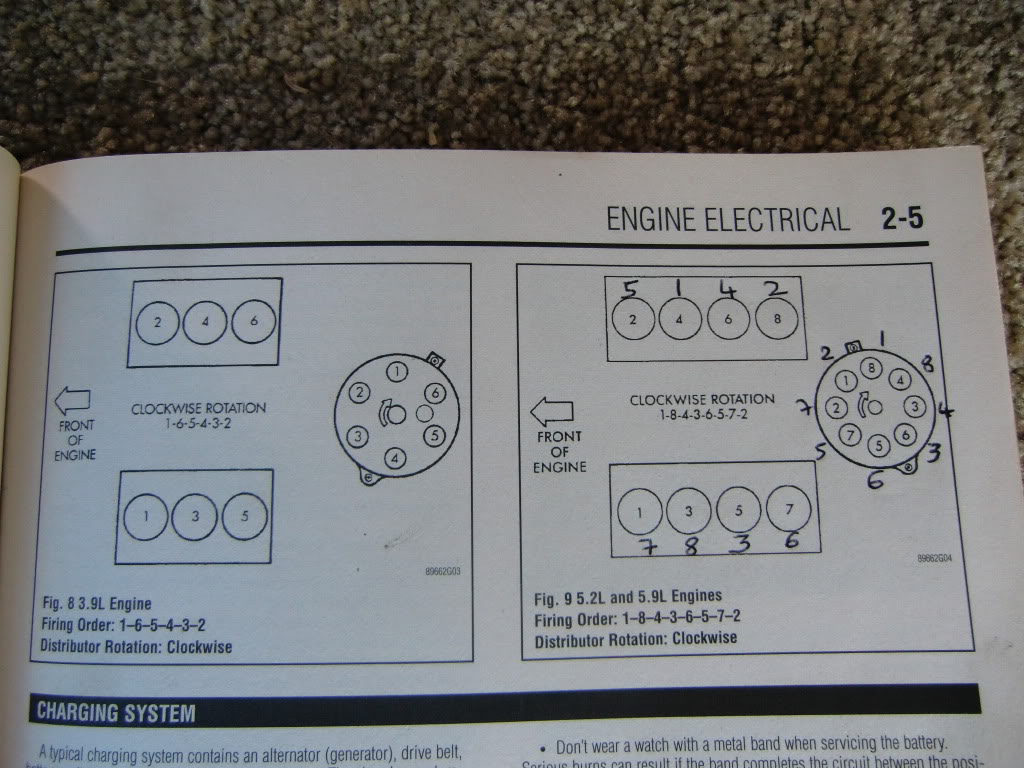
This led me to think about the firing order which we noted was different that the manual stated. I tried the order I had marked down and it would then fire a little, but kind of seize and stall the starter motor.
After checking more carefully and changing the order again, she started right up! See the video for proof The video was taken before I tried to move the van and under load started getting huge backfires, including one through the air filter which was a bit freaky.
http://www.youtube.com/watch?v=9tWll...=youtube_gdata
A THIRD careful check and I had two of the wires switched, and now she runs great on all 8.
Lessons learnt:
As it turns out the manual was completely wrong, or someone had changed the firing order of this van. At first I thought the distributor or cap was off by one position (or the manual markings) but I can't figure out how it would ever match what the books says. My working order is written in ink:
Now I think I have a clear picture of the timeline:
yay! we have our camper van back
I bought a new battery which was fortunate as this one was completely dead when I got to the van this week (I'll have to test for a drain so my new battery doesn't follow suit!) and had been performing poorly anyway.
I was super po'd to find my can of easy-start wasn't were I thought it was and thought I was SOL to be able to perform that test this week.
However, new battery in and spark test still performing well, van still didn't start properly. I gapped the spark plugs as I didn't the right size gapper before and noticed they were soaked with fuel, so I assumed the fuel was getting delivered.
This led me to think about the firing order which we noted was different that the manual stated. I tried the order I had marked down and it would then fire a little, but kind of seize and stall the starter motor.
After checking more carefully and changing the order again, she started right up! See the video for proof
The video was taken before I tried to move the van and under load started getting huge backfires, including one through the air filter which was a bit freaky. http://www.youtube.com/watch?v=9tWll...=youtube_gdata
A THIRD careful check and I had two of the wires switched, and now she runs great on all 8.
Lessons learnt:
- The helpfulness of forum members is incredible, thank you all!
- Always mark your plug wires!!!!
- Don't trust that previous owners / mechanics haven't changed things
- The manual isn't always right
As it turns out the manual was completely wrong, or someone had changed the firing order of this van. At first I thought the distributor or cap was off by one position (or the manual markings) but I can't figure out how it would ever match what the books says. My working order is written in ink:
Now I think I have a clear picture of the timeline:
- Hall effect sensor started going bad. Would work intermittently causing no spark at times.
- Replacing coil was a red herring
- Replaced wires/plugs/cap to protect new coil
- Used manual to adjust plug order / firing order (mistake)
- Replaced hall effect sensor to get consistent spark
- Restored original firing order
yay! we have our camper van back
