


diagnosing voltage issues - b250 '93


Van & CUV Section Moderator


Joined: Nov 2006
Posts: 5,373
Likes: 115

The voltage regulator is built into the ECU and it's an all or nothing replacement.
Try contacting this seller on eBay and see if he'll ship to the UK. Current price is $75.00 US.
http://cgi.ebay.com/ebaymotors/1993-...mZ110479156959

Record Breaker
Joined: Aug 2007
Posts: 1,146
Likes: 1
I have read on this forum, or another, that the external voltage regulator, must be hooked up with the battery disconnected. It must be grounded to the firewall and fully connected before reattaching the battery cables, or it will fry and cause an overvoltage situation.
In your photo, that does look like a voltage regulator, and the case is not grounded, as far as I can see.
In your photo, that does look like a voltage regulator, and the case is not grounded, as far as I can see.

Thread Starter
|
Rookie
Joined: Jan 2010
Posts: 73
Likes: 0
From: UK
I have read on this forum, or another, that the external voltage regulator, must be hooked up with the battery disconnected. It must be grounded to the firewall and fully connected before reattaching the battery cables, or it will fry and cause an overvoltage situation.
In your photo, that does look like a voltage regulator, and the case is not grounded, as far as I can see.
In your photo, that does look like a voltage regulator, and the case is not grounded, as far as I can see.
 as the original location was directly in a 'drip-zone'
  (see first photo!). It's got open sides, direct to circuitry, which you cant see in the photo. It was screwed into the panel under the hood - you can see the screw hole in the first photo, to the left of the rusty screw at top. It probably was a poor ground as the paint was mostly intact...
I'll disconnect it tomorrow and see if the voltage changes at all.
Alloro, I'll also get in touch with ebay guy - thanks!!!
Wilbo
Thread Starter
|
Rookie
Joined: Jan 2010
Posts: 73
Likes: 0
From: UK
ok, curiosity got the better of me, I've taken off the VR and here's the inside of it.
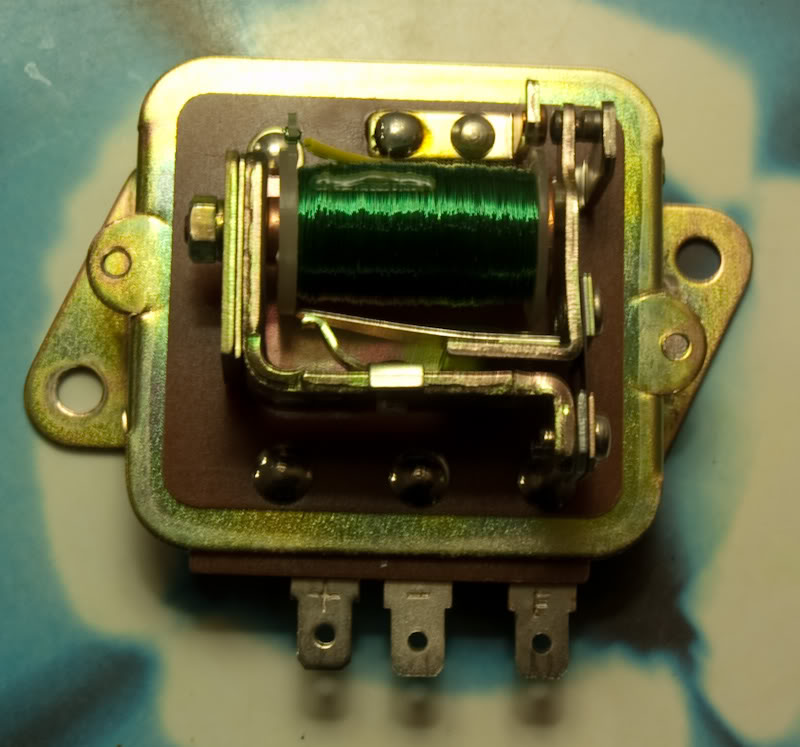
There's no evidence of frying, I've tested resistance across the + and - and it's about 90 ohms. It's the same resistance between + and F (field?) and when the arm is pulled in towards the coil this connects + to F.
So if this is working, I should see that little arm flicking back and forth when the engine is running?
Should the original field connection (from the PCM) on the alternator be disconnected when using this thing?
oh, and it doesn't look like the case needs grounding as it doesn't connect to anything inside? but should I do this anyway!?
There's no evidence of frying, I've tested resistance across the + and - and it's about 90 ohms. It's the same resistance between + and F (field?) and when the arm is pulled in towards the coil this connects + to F.
So if this is working, I should see that little arm flicking back and forth when the engine is running?
Should the original field connection (from the PCM) on the alternator be disconnected when using this thing?
oh, and it doesn't look like the case needs grounding as it doesn't connect to anything inside? but should I do this anyway!?
Last edited by wilbo; Jan 15, 2010 at 05:55 PM.
Van & CUV Section Moderator
Joined: Nov 2006
Posts: 5,373
Likes: 115
Yes sir! 
Some mechanical regulators are 3-wire and some are 4-wire, with the 4th wire being the case. The easiest way to know is to check for continuity from the case to various points within the (disconnected) regulator. This being a non-factory regulator, I would also be hard pressed to come up with information beyond the basis.
Some mechanical regulators are 3-wire and some are 4-wire, with the 4th wire being the case. The easiest way to know is to check for continuity from the case to various points within the (disconnected) regulator. This being a non-factory regulator, I would also be hard pressed to come up with information beyond the basis.
Thread Starter
|
Rookie
Joined: Jan 2010
Posts: 73
Likes: 0
From: UK
I'll keep you posted guys, but I'm going to try to get a new PCM asap.
thanks
