


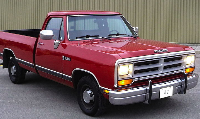
Where is the oil pressure sender?


Thread Starter
|
Captain
Joined: Sep 2012
Posts: 611
Likes: 0
 Where is the oil pressure sender?
1991 318, Power Ram 150 4 speed. ALL STOCK. OK, long question to a short answer I hope! I have heard the 318 has an oil pressure sender that when old, gives low or false readings. My truck has 127k original ,miles on it and has great oil pressure when I start it and even when hot except every once in a while, if I have to stop right after leaving the freeway or something similar, the oil light comes on and the gauge goes lower than the center reading "good" scale. I would like to replace the oil pressure sender to prove my pressure is good. For peace of mind and such. Second part tot he question, does the oil pump in these get weak? I remember my FAL's truck, a 2001 Dodge with the 318 in it had a problem where he would be driving along and the oil pressure would just go to ZERO then after he stopped and shut it down, it would be fine again. Once he was driving home from the lake pulling a boat and the pressure went to zero and he didn't catch it and he blew the motor! I googled it and those trucks had "that problem" with some sort of defective oil pump thing mentioned a lot on the web. Would it do me any good or is it necessary to replace my oil pump or do the sender first and see what I get?
The truck doesn't smoke, nor use an inordinate amount of oil. I think it might use a half quart in 3000 miles.
The truck doesn't smoke, nor use an inordinate amount of oil. I think it might use a half quart in 3000 miles.

Registered User
Joined: Sep 2012
Posts: 23
Likes: 0
the small, bell shaped sensor can be found on the back of the engine, on the top, next to/around the distributor.
These sending units do tend to "go out of tolerance" on higher mileage cars and give false readings...of all makes, not limited to 318 mopar engines.
I bought a high mileage mitsubish/dodge mighty max truck that the owner wanted to sell quickly, for next to nothing, because the oil pressure light came on at idle. The engine was very quiet, the owner had records of regular oil changes.
I suggested that he change the oil pressure light sensor, quite easy to do on that 4 cylinder engine, before he gave up on the truck. He wanted nothing more to do with the truck. I bought it quite cheaply, changed the sensor, no more oil pressure light warning at idle!! I drove it for 2 years and then sold it to a co-worker who drove and drove it for quite some time also.
These sending units do tend to "go out of tolerance" on higher mileage cars and give false readings...of all makes, not limited to 318 mopar engines.
I bought a high mileage mitsubish/dodge mighty max truck that the owner wanted to sell quickly, for next to nothing, because the oil pressure light came on at idle. The engine was very quiet, the owner had records of regular oil changes.
I suggested that he change the oil pressure light sensor, quite easy to do on that 4 cylinder engine, before he gave up on the truck. He wanted nothing more to do with the truck. I bought it quite cheaply, changed the sensor, no more oil pressure light warning at idle!! I drove it for 2 years and then sold it to a co-worker who drove and drove it for quite some time also.

Thread Starter
|
Captain
Joined: Sep 2012
Posts: 611
Likes: 0
I'd love to do that but it would be easier to stick a new sender on it and see if I still have problems. Like MCH stated, the motor is very quiet, smooth and doesn't tick or make noise when the oil pressure lamp comes on so I think it is the sender. I had the same problem on one of my Blazers and after I swapped in a new sender the problem stopped.

Champion
Joined: Mar 2009
Posts: 2,639
Likes: 4
From: Bent Mountain Va
If you replace the sender and the gauge starts to work and sits at the halfway position or any other position you still have no idea what the gauge is saying in actual pressure. Depending on how well or poor the resistance of the gauge and the sender match will effect where the needle of the gauge sits more than the actual pressure does.
I can match a gauge with a non matching sender (resistance wise) and make the gauge read either high or low. Remember senders and gauges of the same part number can have different resistance readings.
I speak of gauges because personally I would never trust my engines life blood monitoring to an idiot light. By the time the light comes on the damage is already done, but it is your engine.
I can match a gauge with a non matching sender (resistance wise) and make the gauge read either high or low. Remember senders and gauges of the same part number can have different resistance readings.
I speak of gauges because personally I would never trust my engines life blood monitoring to an idiot light. By the time the light comes on the damage is already done, but it is your engine.

Legend


Joined: Jun 2009
Posts: 8,025
Likes: 72
From: orangeville ontario
i would have to agree with SEAL. you can even buy a mechanical gauge with all the stuff needed to install it for cheaper then you can buy the sending unit.
Trending Topics
Registered User
Joined: Sep 2012
Posts: 23
Likes: 0

ahhh, gotcha. I'm showing my age with my response; haven't had a mopar v8 since 1977.
That will be changing soon!

Thread Starter
|
Captain
Joined: Sep 2012
Posts: 611
Likes: 0
Well, a mechanical gauge with everything to install it is going to cost more than 15 dollars. However, even though I am a big fan of mechanical gauges, Maybe what I'll do is use a T and ALSO run a mechanical gauge. I don't like having something on the truck that doesn't work, and want the stock gauge and idiot light to work. But I do want to see what the pressure is really doing.
Champion
Joined: Mar 2009
Posts: 2,639
Likes: 4
From: Bent Mountain Va
Go to the hardware store and get a cheap 1/4" 0-100 PSI gauge and screw it in where the sender goes and see what the pressure is. Then you can put the new sender in it and look at the gauge. This will tell you what position on the gauge is equal to the pressure you know you have. This is what I did. You may need a coupler and a pipe nipple.