


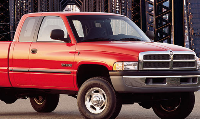
Stock Air intake


Professional
Joined: Nov 2011
Posts: 189
Likes: 0
From: Canada

With a V-8 there isn't usually much problem with the "cold" part of a CAI ... transverse engines and 4-bangers in general sometimes have problems there, since they're routed tight to begin with, and especially if there's a turbo involved.
A pleated filter (like a K&N) can improve airflow even over no filter at all; also the filter housing plays a role ... you will get poorer flow with an open carb than with a housing attached, especially the base.
You really just need a good low pressure area to draw from; low pressure area via a small hole is better than high pressure area via a big hole.
I don't see any glaring issues with the stock setup on the magnum engines on the GenII Rams. A K&N-type filter pretty much always helps but the fenderwell is generally a good low pressure area to draw from; which is all you really need if there's no heat soak issues.
The only other consideration is nice and high if you can get it, in case you ford any water.
A pleated filter (like a K&N) can improve airflow even over no filter at all; also the filter housing plays a role ... you will get poorer flow with an open carb than with a housing attached, especially the base.
You really just need a good low pressure area to draw from; low pressure area via a small hole is better than high pressure area via a big hole.
I don't see any glaring issues with the stock setup on the magnum engines on the GenII Rams. A K&N-type filter pretty much always helps but the fenderwell is generally a good low pressure area to draw from; which is all you really need if there's no heat soak issues.
The only other consideration is nice and high if you can get it, in case you ford any water.

Administrator


Joined: Apr 2010
Posts: 87,562
Likes: 4,231
From: Clayton MI
Erm, why would you want to draw air from a LOW pressure area? Seems to me that drawing from a high pressure area, (like the base of the windshield on cowl induction systems......) would make the air want to flow into the engine a bit more willingly. More air flow equals more power....... If you make the engine work harder to draw in that air, that's power you AREN'T putting to the ground.
I think dodge grabs air out of the fender thinking it is cooler than under-hood air, (barely....) Aside from that, I really can't think of a good reason for the stock intake system. Especially on a 4x4........
I think dodge grabs air out of the fender thinking it is cooler than under-hood air, (barely....) Aside from that, I really can't think of a good reason for the stock intake system. Especially on a 4x4........
Professional
Joined: Nov 2011
Posts: 189
Likes: 0
From: Canada
You can use high pressure for ram effect, but it only works at speeds these trucks will never see.
In an airplane the top of the wing is curved so air travels a longer distance in the same time, the bottom is straight. The top has the least pressure. But the front of the wing is always turbulent so it can't create lift (no pressure differential top to bottom) but it's still a low pressure area. Back a bit they're both laminar flow but there is still a pressure differential (lower on top, even though it's faster air). Without that pressure differential, it wouldn't fly.
The entire top of the vehicle ... hood to windshield to roofline ... is a low pressure area.
In an airplane the top of the wing is curved so air travels a longer distance in the same time, the bottom is straight. The top has the least pressure. But the front of the wing is always turbulent so it can't create lift (no pressure differential top to bottom) but it's still a low pressure area. Back a bit they're both laminar flow but there is still a pressure differential (lower on top, even though it's faster air). Without that pressure differential, it wouldn't fly.
The entire top of the vehicle ... hood to windshield to roofline ... is a low pressure area.
Last edited by Johnny2Bad; Jan 2, 2012 at 11:42 PM.
Administrator
Joined: Apr 2010
Posts: 87,562
Likes: 4,231
From: Clayton MI
 )
) The biggest gains in our particular case though, are it is a "true" cold air induction system, with very little restriction from plumbing. It's up higher than the openings in the fender, so, if you like to play in the mud/water, you are less likely to ingest 'bad stuff' into the engine. I REALLY don't know what they were thinking when they put the intake in the fender on a four wheel drive truck....... that has 'bad plan' written all over it.

Champion
Joined: Aug 2010
Posts: 2,697
Likes: 3
From: Cape Carteret NC
Low pressure is a vacuum.. high pressure blows.. I'd rather find a place with high pressure, because a vacuum would make my engine fight for air.. fighting against a vacuum for air is a bad thing..
High pressure is what you want.. forward facing such as a scoop, or cowl facing for the high pressure air bouncing off the windshield..
High pressure is what you want.. forward facing such as a scoop, or cowl facing for the high pressure air bouncing off the windshield..
Professional
Joined: Nov 2011
Posts: 189
Likes: 0
From: Canada
The hood, the windshield, the roofline are all low pressure areas. The high pressure area is below the front bumper and above the rear bumper.
Look, it's all relative. You want 14,7 psi which you can get inside an airbox of sufficient size. How you fill the airbox only matters insofar as whether you can replenish it with enough air within the time required to support the engine's needs, or not.
The only likely high pressure area (ie above 14.7) directly on the body is directly below the front bumper.
The rest of the top of the body is a low pressure area; you have to be pulling well away from the body (hood, windshield, roofline) to find high pressure.
If there are other areas of higher pressure relative to the normal low pressure flow over the bodywork of a particular vehicle (every body is different) you need to use a manometer to find them, and typically when you do measure and find some, they are not where you think they should have been.
If you can fill the airbox/CAI/etc with enough air, regardless of where it's from, it's as good as you will get without resorting to the fancy bodywork.
On some cars when people have tested them with a manometer the cowl is one of the worst spots (lowest pressure, ie Lexus LS 400) on others it's fine (Miatas, RX7s). The fenderwell is definitely a low pressure area on nearly any vehicle, while the lower part of the grille below the headlight/signal light is almost always good on most vehicles. But you need to test to find out; guessing doesn't work, and you might find that the best you can do is come closest to 14.7, not above it.
Look, it's all relative. You want 14,7 psi which you can get inside an airbox of sufficient size. How you fill the airbox only matters insofar as whether you can replenish it with enough air within the time required to support the engine's needs, or not.
The only likely high pressure area (ie above 14.7) directly on the body is directly below the front bumper.
The rest of the top of the body is a low pressure area; you have to be pulling well away from the body (hood, windshield, roofline) to find high pressure.
If there are other areas of higher pressure relative to the normal low pressure flow over the bodywork of a particular vehicle (every body is different) you need to use a manometer to find them, and typically when you do measure and find some, they are not where you think they should have been.
If you can fill the airbox/CAI/etc with enough air, regardless of where it's from, it's as good as you will get without resorting to the fancy bodywork.
On some cars when people have tested them with a manometer the cowl is one of the worst spots (lowest pressure, ie Lexus LS 400) on others it's fine (Miatas, RX7s). The fenderwell is definitely a low pressure area on nearly any vehicle, while the lower part of the grille below the headlight/signal light is almost always good on most vehicles. But you need to test to find out; guessing doesn't work, and you might find that the best you can do is come closest to 14.7, not above it.
Last edited by Johnny2Bad; Jan 3, 2012 at 01:17 AM.

Champion
Joined: Aug 2009
Posts: 3,015
Likes: 8
From: Western NY,
I would think if the base of the windshield was a high pressure area a lot of turbulence would be created down there hurting mpg as well as pushing rain /snow and bugs down into the engine at speed instead of up and away... even snow thats already on my hood gets pulled away and blown out of this area as long as it hasnt turned to heavy wet slush first.
Isnt this how a bug deflector works to help create even more of a low pressure area on the windshield?
Also the bed area is low pressure too this is why mythbusters found its false that leaving your tailgate down or removing it will help with MPG.... it actually hurt it... they found the best airflow and MPG was when the tailgate was open half way at about a 45 degree angle...
Perhaps a false exhaust stack behind the cab with the scoop facing forward would work well as an intake... then you could use the other as an exhaust facing the opposite way?
Isnt this how a bug deflector works to help create even more of a low pressure area on the windshield?
Also the bed area is low pressure too this is why mythbusters found its false that leaving your tailgate down or removing it will help with MPG.... it actually hurt it... they found the best airflow and MPG was when the tailgate was open half way at about a 45 degree angle...
Perhaps a false exhaust stack behind the cab with the scoop facing forward would work well as an intake... then you could use the other as an exhaust facing the opposite way?
Last edited by Augiedoggy; Jan 3, 2012 at 09:35 AM.