


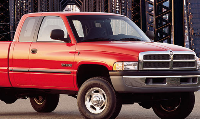
5.2 to 5.9, with an auto to manual Swap to boot.


Record Breaker


Joined: Sep 2012
Posts: 2,438
Likes: 73
From: S. Florida

The torque and power that you're going to develop (whatever that ends up being) you want to be at least in the mid range, since your driving style is not going to put you in the high rpm range.
If you're not in the higher rpm range, you're not flowing big cfm's, so you don't need big cfm components.
The other point about not having big valves is the velocity of the charge entering the cylinder... a larger valve will mean a lower gas velocity entering the cylinder, and give less scavenge... the smaller valve for the cfm's you're actually flowing will give better scavenge and make the most of what you end up squeeze in the cylinder.
This also goes to the reasoning for longer runner length... the longer runner has a bigger volume/mass of air moving towards the valve, and the inertia of that column of air will help squeeze more into the cylinder... if it's moving faster, it will have more inertia.
Just like the concept of "tuned exhaust", there is "tuned intake"... that's why the stock keg has long runners, to get power at lower rpm.
Last edited by Spillage; Jan 26, 2015 at 08:57 PM.

Essentially correct, you would have a bit less bottom end torque, but, better mid to high rpm power.
Also, it appears that both the M1, and Air Gap, will flow more than you really need.... Air Gap will have a larger plenum area, and is also a dual plane manifold, both of which lend themselves to building low-end torque.
)
Also, it appears that both the M1, and Air Gap, will flow more than you really need.... Air Gap will have a larger plenum area, and is also a dual plane manifold, both of which lend themselves to building low-end torque.
)
Both of the features of the AirGap will produce more torque, or both intake manifolds?
Yeah I was reading that, I like that chart, but from what I'm learning, that doesn't even matter that they can flow more, as the cylnders can't even take what is being throw at them.
From your responses to the other replies you've gotten, I see you're getting the idea.
The torque and power that you're going to develop (whatever that ends up being) you want to be at least in the mid range, since your driving style is not going to put you in the high rpm range.
If you're not in the higher rpm range, you're not flowing big cfm's, so you don't need big cfm components.
The other point about not having big valves is the velocity of the charge entering the cylinder... a larger valve will mean a lower gas velocity entering the cylinder, and give less scavenge... the smaller valve for the cfm's you're actually flowing will give better scavenge and make the most of what you end up squeeze in the cylinder.
This also goes to the reasoning for longer runner length... the longer runner has a bigger volume/mass of air moving towards the valve, and the inertia of that column of air will help squeeze more into the cylinder... if it's moving faster, it will have more inertia.
Just like the concept of "tuned exhaust", there is "tuned intake"... that's why the stock keg has long runners, to get power at lower rpm.
The torque and power that you're going to develop (whatever that ends up being) you want to be at least in the mid range, since your driving style is not going to put you in the high rpm range.
If you're not in the higher rpm range, you're not flowing big cfm's, so you don't need big cfm components.
The other point about not having big valves is the velocity of the charge entering the cylinder... a larger valve will mean a lower gas velocity entering the cylinder, and give less scavenge... the smaller valve for the cfm's you're actually flowing will give better scavenge and make the most of what you end up squeeze in the cylinder.
This also goes to the reasoning for longer runner length... the longer runner has a bigger volume/mass of air moving towards the valve, and the inertia of that column of air will help squeeze more into the cylinder... if it's moving faster, it will have more inertia.
Just like the concept of "tuned exhaust", there is "tuned intake"... that's why the stock keg has long runners, to get power at lower rpm.
Will I really have a substantial amount of low-end torque lost with the 2.02 valves? I guess what I'm asking is, what will the difference in RPM level I'm courious about. I'm sure thats a difficult question, but hey, it's worth a shot.

Administrator


Joined: Apr 2010
Posts: 87,478
Likes: 4,223
From: Clayton MI
The Air Gap manifold will lend itself to building bottom end more so than the M1.
Going with the 2.02 valves, my guess is you will still have quite a bit more bottom end, than you do right now.... which is what you are looking for. You will gain in the mid-upper RPM ranges, but consider, where does your engine spend most of its time? Mine RARELY sees 3000 RPM.......
Going with the 2.02 valves, my guess is you will still have quite a bit more bottom end, than you do right now.... which is what you are looking for.
You will gain in the mid-upper RPM ranges, but consider, where does your engine spend most of its time? Mine RARELY sees 3000 RPM.......
Just re-reading this forum to go over some stuff and was thinking... you said at 4500rpm and I still haven't met the maximum flow rate of 1.92 valves, is that in a PERFECT senario without any other interferences? I'm just relating this to what you said before about perfect scenarios and such how that'll most likely never happen (which I understand).
Administrator
Joined: Apr 2010
Posts: 87,478
Likes: 4,223
From: Clayton MI
Even at 100% volumetric efficiency, (which discounts loss of flow because of turbulence, various restrictions in the intake tract, and the fact that air doesn't instantly accelerate to max speed when an opening occurs.....) you would be good to over 5K RPM with 1.92 valves. In reality....... if you hit 80% volumetric efficiency, you would be doing REALLY well. Which pushes your max rpm before the heads start being the restriction even higher.
The stock kegger becomes the restriction (runs out of breath) at around 4K RPM...... that's why power falls off so bad in the upper RPM range with everything stock.
The stock kegger becomes the restriction (runs out of breath) at around 4K RPM...... that's why power falls off so bad in the upper RPM range with everything stock.
The Air Gap manifold will lend itself to building bottom end more so than the M1.
Going with the 2.02 valves, my guess is you will still have quite a bit more bottom end, than you do right now.... which is what you are looking for. You will gain in the mid-upper RPM ranges, but consider, where does your engine spend most of its time? Mine RARELY sees 3000 RPM.......
Going with the 2.02 valves, my guess is you will still have quite a bit more bottom end, than you do right now.... which is what you are looking for.
You will gain in the mid-upper RPM ranges, but consider, where does your engine spend most of its time? Mine RARELY sees 3000 RPM.......Oh yea, I'm sure torque will be there, I'm hopeing for, especially if I change the gear ratio, that'll wake this baby up. Mine rarely sees 3000 RPM as well, but it would be nice on that occassion that it does, to really have that edge on friends and such (the 20 year old in me coming out here).
If only it was easy enough to get the best of both worlds, I need a diesel, but something bout' a gas V8 and this being m first truck I love.
Administrator
Joined: Apr 2010
Posts: 87,478
Likes: 4,223
From: Clayton MI
For your purposes, go with the air gap. It will still flow enough that your engine will build decent power if you get on it. (I think you will be more traction-limited, than power-limited....) Even with the better heads, you won't max out on flow till much higher in the RPM band than you probably really wanna push it. Doing a bit of gasket matching on the intake and heads will make a nice difference as well.
Doing a bit of gasket matching on the intake and heads will make a nice difference as well.

