


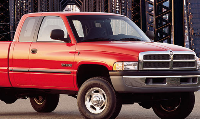
5.2 to 5.9, with an auto to manual Swap to boot.


Administrator


Joined: Apr 2010
Posts: 87,478
Likes: 4,223
From: Clayton MI

Longer runners move your torque/HP peaks down. The cam you selected states it is good for idle, to 5500 RPM, the intake is meant more for mid- to high-rpm usage, heads are for mid- to high RPM.
If my math is right.... your cylinder volume is .026 cubic feet. So, even the stock heads (190 cfm intake runners), you are good to 7300 RPM......
Now, supposedly the EQ fellers flow in the neighborhood of 230 cfm..... That puts you good to well over 8000 RPM....
Of course, that assumes 100% volumetric efficiency, which hardly ever happens on a naturally aspirated engine.... realistically, it's more like 70 to 80%.
So even worst case, you are still good to 5100 RPM with stock heads......
Smaller valves, and runners, will promote low-end torque.
In all reality, you don't really need the big valve heads. The stock replacements they offer will do ya just fine for what you have in mind. Of course, when you get into it, (toenails in the radiator) the big valve heads will give you MUCH better performance in the mid- to high-rpm areas.
So, thoroughly confused yet?
Keep in mind, this is all "in theory", in actual practice....... this serves as a good guideline, but, not a hard and fast rule.
If my math is right.... your cylinder volume is .026 cubic feet. So, even the stock heads (190 cfm intake runners), you are good to 7300 RPM......
Now, supposedly the EQ fellers flow in the neighborhood of 230 cfm..... That puts you good to well over 8000 RPM....
Of course, that assumes 100% volumetric efficiency, which hardly ever happens on a naturally aspirated engine.... realistically, it's more like 70 to 80%.
So even worst case, you are still good to 5100 RPM with stock heads......
Smaller valves, and runners, will promote low-end torque.
In all reality, you don't really need the big valve heads. The stock replacements they offer will do ya just fine for what you have in mind. Of course, when you get into it, (toenails in the radiator) the big valve heads will give you MUCH better performance in the mid- to high-rpm areas.
So, thoroughly confused yet?
Keep in mind, this is all "in theory", in actual practice....... this serves as a good guideline, but, not a hard and fast rule.


Okay, the head bolts I'm using have less than 5,000 miles on them.

Record Breaker
Joined: Mar 2013
Posts: 1,130
Likes: 15
From: Somewhere in Kentucky
Yeah, the head bolts are Torque-To-Yield, and when they are installed and torqued, they actually stretch a little. Re-using these bolts won't give you an accurate torque reading. Buying new bolts is worth it.
It's not that you're getting "more" at the top end, just that what you do get is at the top end, rather than in the middle where you're likely to use it.
Longer runners will give better torque (needed for acceleration) and put your peek HP at a lower RPM than a short runner.
This goes to my point... in your other reply you say you plan on being in the 2000-2200rpm range at 70mph... you say that you drive slower and like to baby your motor, but you're selecting parts and building something that has it's performance at 5000rpm and above.
This is why your shop guy is telling you wont notice the difference in having bigger valves... even at 4500rpm, you haven't reached the maximum flow rate of the 1.92" valves... that's almost twice as hard as you on plan driving.
When I get into mine with hard acceleration, I'm lucky to make it to 3500rpm... on 265/75/16's with 3.55 axle I'm in the vicinity of 2000rpm at 65mph and 2200rpm at 75mph.
Longer runners will give better torque (needed for acceleration) and put your peek HP at a lower RPM than a short runner.
This goes to my point... in your other reply you say you plan on being in the 2000-2200rpm range at 70mph... you say that you drive slower and like to baby your motor, but you're selecting parts and building something that has it's performance at 5000rpm and above.
This is why your shop guy is telling you wont notice the difference in having bigger valves... even at 4500rpm, you haven't reached the maximum flow rate of the 1.92" valves... that's almost twice as hard as you on plan driving.
When I get into mine with hard acceleration, I'm lucky to make it to 3500rpm... on 265/75/16's with 3.55 axle I'm in the vicinity of 2000rpm at 65mph and 2200rpm at 75mph.
Okay I understand now. I was under the impression, better is more, but in this case it isn't.
I guess it's almost pretty much pointless to go with the bigger valves. I was just going with something my cam will be useful for.
I read that the stock heads stop flowing at 199cfm, no matter what size of the cam. Then there are the EQ 2.02 heads that flow something like 257cfm at my .506 of lift cam.
I don't want to be dumb, but just want to clarify with what you're saying. In the direction I'm going, my power won't be made until I'm really hitting those higher rpm levels, correct? As well as not using the full potential of the 2.02 valves?
Longer runners move your torque/HP peaks down. The cam you selected states it is good for idle, to 5500 RPM, the intake is meant more for mid- to high-rpm usage, heads are for mid- to high RPM.
If my math is right.... your cylinder volume is .026 cubic feet. So, even the stock heads (190 cfm intake runners), you are good to 7300 RPM......
Now, supposedly the EQ fellers flow in the neighborhood of 230 cfm..... That puts you good to well over 8000 RPM....
Of course, that assumes 100% volumetric efficiency, which hardly ever happens on a naturally aspirated engine.... realistically, it's more like 70 to 80%.
So even worst case, you are still good to 5100 RPM with stock heads......
Smaller valves, and runners, will promote low-end torque.
In all reality, you don't really need the big valve heads. The stock replacements they offer will do ya just fine for what you have in mind. Of course, when you get into it, (toenails in the radiator) the big valve heads will give you MUCH better performance in the mid- to high-rpm areas.
So, thoroughly confused yet?
Keep in mind, this is all "in theory", in actual practice....... this serves as a good guideline, but, not a hard and fast rule.
If my math is right.... your cylinder volume is .026 cubic feet. So, even the stock heads (190 cfm intake runners), you are good to 7300 RPM......
Now, supposedly the EQ fellers flow in the neighborhood of 230 cfm..... That puts you good to well over 8000 RPM....
Of course, that assumes 100% volumetric efficiency, which hardly ever happens on a naturally aspirated engine.... realistically, it's more like 70 to 80%.
So even worst case, you are still good to 5100 RPM with stock heads......
Smaller valves, and runners, will promote low-end torque.
In all reality, you don't really need the big valve heads. The stock replacements they offer will do ya just fine for what you have in mind. Of course, when you get into it, (toenails in the radiator) the big valve heads will give you MUCH better performance in the mid- to high-rpm areas.
So, thoroughly confused yet?
Keep in mind, this is all "in theory", in actual practice....... this serves as a good guideline, but, not a hard and fast rule.
In laymen's terms, I'm basically not using the full potential of these 2.02 heads. The only real reason I was drawn to them as I just stated above, I wanted to get the most out of my camshaft as possible, as I read the stock heads stopped flowing at about 199cfm, but with what you're saying, the engine can't even handle what will be being throw at it.
Now hypothetically speaking, if I did go with the 2.02 valves, vs 1.92 valves, I would make about the same power, but just at different RPM levels? Correct me if I'm wrong.
Ohhhh good to know, thank you. I didn't know that.
One last thing I forgot to add, HeyYou, How did you find out that cylinder volume? I do infact have pistons that are bored .030 in the engine, I actually found out as I took the heads off. Now I can't imagine that make much of a difference as it only brings me to 365.320 c.i.
I'm also reading up that the stock cylinder volume is 44.988.
And my new cylinder volume is 45.665.
I got this info from the book "How to Rebuild the Small-Block Mopar" By Willian Burt.
The guy I bought the engine from gave it to me.
This book to be exact:
I'm also reading up that the stock cylinder volume is 44.988.
And my new cylinder volume is 45.665.
I got this info from the book "How to Rebuild the Small-Block Mopar" By Willian Burt.
The guy I bought the engine from gave it to me.
This book to be exact:

Administrator
Joined: Apr 2010
Posts: 87,478
Likes: 4,223
From: Clayton MI
Sorry Sir, I will try and refrain from that in the future.
Essentially correct, you would have a bit less bottom end torque, but, better mid to high rpm power.
Also, it appears that both the M1, and Air Gap, will flow more than you really need.... Air Gap will have a larger plenum area, and is also a dual plane manifold, both of which lend themselves to building low-end torque.
I calculate cylinder volume backwards.
Engine displacement / number of cylinders / 12 /12 /12 equals volume in cubic feet. (engine is measured in cubic inches, so, dividing by twelve three times, is the the equivalent of dividing by 12 cubed. which is what you need to do to convert from cubic inches, to cubic feet.)
Not going to lie, I understand where you are coming from. I kind of have to, I'm going to school for Mechanical Engineering and double majoring in a 3 Assistant Engineer's license as a Merchant Marine.
In laymen's terms, I'm basically not using the full potential of these 2.02 heads. The only real reason I was drawn to them as I just stated above, I wanted to get the most out of my camshaft as possible, as I read the stock heads stopped flowing at about 199cfm, but with what you're saying, the engine can't even handle what will be being throw at it.
Now hypothetically speaking, if I did go with the 2.02 valves, vs 1.92 valves, I would make about the same power, but just at different RPM levels? Correct me if I'm wrong.
In laymen's terms, I'm basically not using the full potential of these 2.02 heads. The only real reason I was drawn to them as I just stated above, I wanted to get the most out of my camshaft as possible, as I read the stock heads stopped flowing at about 199cfm, but with what you're saying, the engine can't even handle what will be being throw at it.
Now hypothetically speaking, if I did go with the 2.02 valves, vs 1.92 valves, I would make about the same power, but just at different RPM levels? Correct me if I'm wrong.
Also, it appears that both the M1, and Air Gap, will flow more than you really need.... Air Gap will have a larger plenum area, and is also a dual plane manifold, both of which lend themselves to building low-end torque.
One last thing I forgot to add, HeyYou, How did you find out that cylinder volume? I do infact have pistons that are bored .030 in the engine, I actually found out as I took the heads off. Now I can't imagine that make much of a difference as it only brings me to 365.320 c.i.
I'm also reading up that the stock cylinder volume is 44.988.
And my new cylinder volume is 45.665.
I got this info from the book "How to Rebuild the Small-Block Mopar" By Willian Burt.
The guy I bought the engine from gave it to me.
This book to be exact: How to Rebuild the Small-Block Mopar: William Burt: 9781613250587: Amazon.com: Books
I'm also reading up that the stock cylinder volume is 44.988.
And my new cylinder volume is 45.665.
I got this info from the book "How to Rebuild the Small-Block Mopar" By Willian Burt.
The guy I bought the engine from gave it to me.
This book to be exact: How to Rebuild the Small-Block Mopar: William Burt: 9781613250587: Amazon.com: Books
Engine displacement / number of cylinders / 12 /12 /12 equals volume in cubic feet. (engine is measured in cubic inches, so, dividing by twelve three times, is the the equivalent of dividing by 12 cubed. which is what you need to do to convert from cubic inches, to cubic feet.)
