


How far on reserve


Registered User
Joined: Jun 2007
Posts: 16
Likes: 0
 RE: How far on reserve
I put in 21.8 gallons one time, and the DTE overhead display said 1 mile. So, that's pretty accurate, though don't know how a hill would affect it. Didn't mean to drive it that low, but the first group of stations I went by had no power so couldn't pump any gas. The next station was 5 miles away in stop and go traffic.
On the issue of gas mileage (this is with the 4.7l V8). This past weekend, I tried an informal experiment with the truck. We went on a 450 mile round trip to our vacation place in the mountains of West Virginia. 80% of the drive was interstate, with the last 25 miles or so being state highways. I decided to keep the speed at 65 mph, at the most, rather than my usual 75 mph. I averaged 19.3 mpg on the way up and 21.2 on the way back. This compares to the 17-18 mpg I had gotten at the higher speed in the past.
So yes, at least in this case, 65 mph vs 75 mph provided around 25% better gas mileage.
On the issue of gas mileage (this is with the 4.7l V8). This past weekend, I tried an informal experiment with the truck. We went on a 450 mile round trip to our vacation place in the mountains of West Virginia. 80% of the drive was interstate, with the last 25 miles or so being state highways. I decided to keep the speed at 65 mph, at the most, rather than my usual 75 mph. I averaged 19.3 mpg on the way up and 21.2 on the way back. This compares to the 17-18 mpg I had gotten at the higher speed in the past.
So yes, at least in this case, 65 mph vs 75 mph provided around 25% better gas mileage.

Professional
Joined: Jan 2007
Posts: 172
Likes: 0
From:
RE: How far on reserve
For us Canadians....
My light usually comes on around 550 kms, and when I fill up, its usually between 65-70 litres, which leaves between 12-17 litres in the tank. When I actually hit the reserve, I fill it up, and it was bang on 72 litres.
My light usually comes on around 550 kms, and when I fill up, its usually between 65-70 litres, which leaves between 12-17 litres in the tank. When I actually hit the reserve, I fill it up, and it was bang on 72 litres.

Professional
Joined: Jul 2007
Posts: 119
Likes: 1
From:
RE: How far on reserve
ORIGINAL: srs_49
I put in 21.8 gallons one time, and the DTE overhead display said 1 mile. So, that's pretty accurate, though don't know how a hill would affect it. Didn't mean to drive it that low, but the first group of stations I went by had no power so couldn't pump any gas. The next station was 5 miles away in stop and go traffic.
On the issue of gas mileage (this is with the 4.7l V8). This past weekend, I tried an informal experiment with the truck. We went on a 450 mile round trip to our vacation place in the mountains of West Virginia. 80% of the drive was interstate, with the last 25 miles or so being state highways. I decided to keep the speed at 65 mph, at the most, rather than my usual 75 mph. I averaged 19.3 mpg on the way up and 21.2 on the way back. This compares to the 17-18 mpg I had gotten at the higher speed in the past.
So yes, at least in this case, 65 mph vs 75 mph provided around 25% better gas mileage.
I put in 21.8 gallons one time, and the DTE overhead display said 1 mile. So, that's pretty accurate, though don't know how a hill would affect it. Didn't mean to drive it that low, but the first group of stations I went by had no power so couldn't pump any gas. The next station was 5 miles away in stop and go traffic.
On the issue of gas mileage (this is with the 4.7l V8). This past weekend, I tried an informal experiment with the truck. We went on a 450 mile round trip to our vacation place in the mountains of West Virginia. 80% of the drive was interstate, with the last 25 miles or so being state highways. I decided to keep the speed at 65 mph, at the most, rather than my usual 75 mph. I averaged 19.3 mpg on the way up and 21.2 on the way back. This compares to the 17-18 mpg I had gotten at the higher speed in the past.
So yes, at least in this case, 65 mph vs 75 mph provided around 25% better gas mileage.
There is a basic equation for the force it takes to push something through air:
Aerodynamic drag = 1/2 D x A x Vsquared
In this equation, D is the density of the air, A is the frontal area of the moving shape, and V is its velocity relative to the air.
For real body shapes, air at standard conditions, V in mph, and drag in pounds of force, this equation becomes:
Drag = 1/391 x Cd x A x Vsquared

Which shape represents the nose of a Dodge truck? Why, it's the one with the highest coefficient. I did see something that said the Hummer H2 had a higher number than Dodge. That's something I guess.
Professional
Joined: Jul 2007
Posts: 119
Likes: 1
From:
RE: How far on reserve
This is totally geek but cool none the less. Looks like we will need a few engine upgrades to hit 400mph.
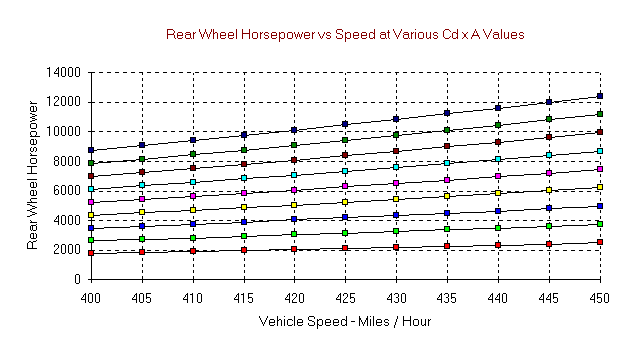
I'm guessing the hp on a stock engine is somewhere near 225hp. The graph isn't labeled with which co-efficient is which but I'm guessing our top speed is right around 125~130mph.
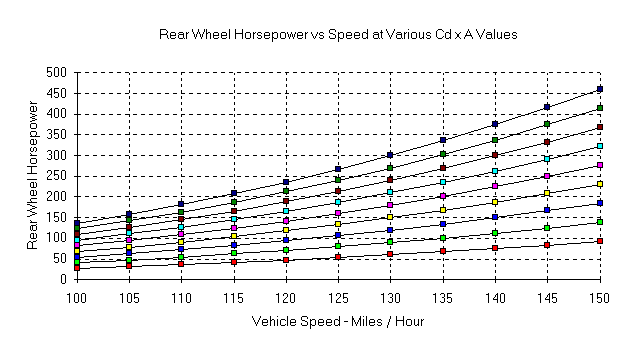
I'm guessing the hp on a stock engine is somewhere near 225hp. The graph isn't labeled with which co-efficient is which but I'm guessing our top speed is right around 125~130mph.