


rpms high. running rich.


Banned Goober Smoocher
Joined: Jun 2010
Posts: 8,916
Likes: 1

Make sure your IAT is on the intake manifold where Dodge put it. Putting it in the air cleaner housing will make the PCM think it's really cold and will dump fuel to compensate and try to warm the engine up.

Site Moderator


Joined: May 2008
Posts: 9,657
Likes: 24
From: Louisville, Ky
The IAT on the Ram is in the air inlet tubing. The MAP is in the intake manifold.
Unfortunately, Dodge is still in the stone age and doesn't use a MAF system which would make these engines run so much better, especially with mods.
IAT is next to bottom bolt on the Hemi hat :
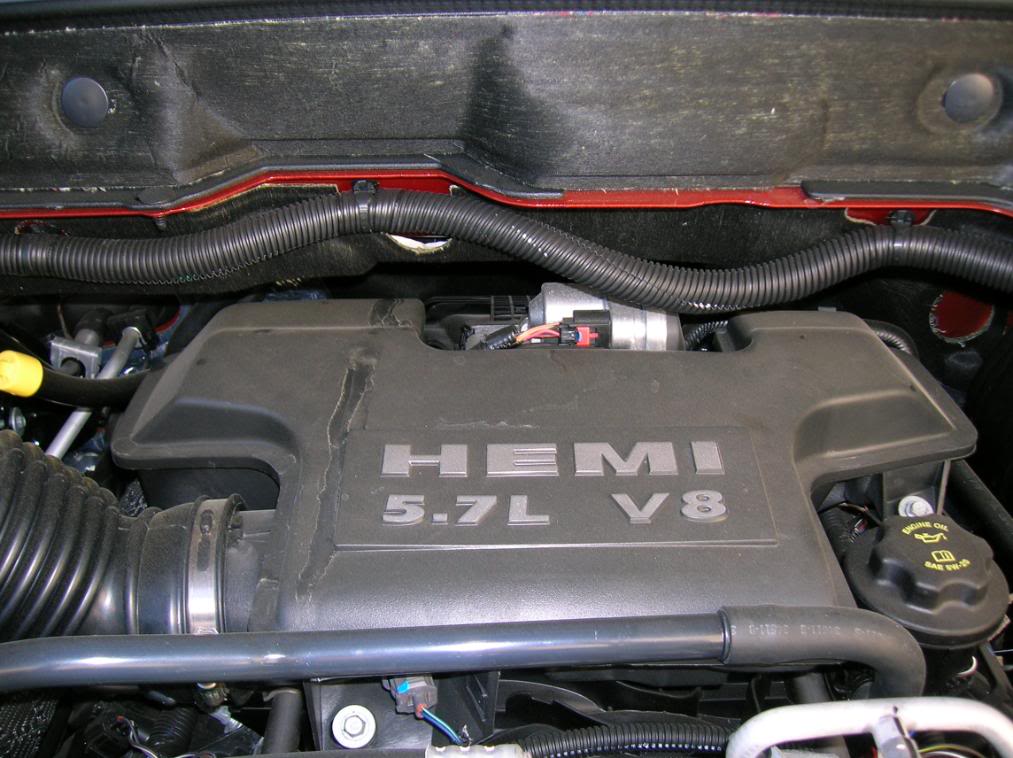
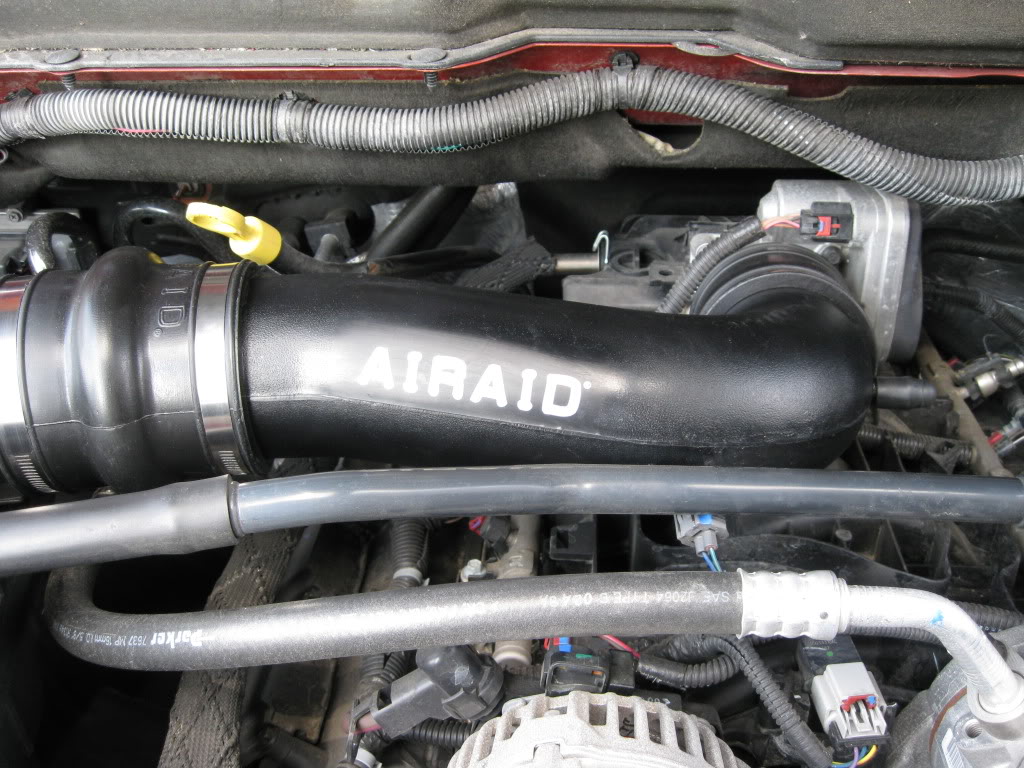
Same basic location on the aftermarket air intake:
Unfortunately, Dodge is still in the stone age and doesn't use a MAF system which would make these engines run so much better, especially with mods.
IAT is next to bottom bolt on the Hemi hat :

Same basic location on the aftermarket air intake:

Last edited by lxman1; May 18, 2013 at 12:42 AM.


Champion
Joined: Aug 2006
Posts: 4,489
Likes: 4
From: New Jersey
Actually the MAP sensor is generally a better way to tune engines for performance, as it uses engine load to determine fuel mixture and spark timing, so generally it is more versatile when tuning for performance. Where-as a MAF sensor uses "air flow" to determine timing and fuel, so it is subject to much more variation, although it is a touch more accurate in the sense that it can get a spot on 14.7 "Stoich" A/F mixture, it doesn't do too well under high performance conditions, especially when dealing with forced induction.
This is why most high performance vehicles use Speed Density tuning methods versus Mass Air Flow (MAF) methods.
I'm not going to hi-jack and derail the thread, so I'll just summarize and let you guys do the research.
MAF:
Great for Stock Applications, where there are no heavy duty or high performance needs, allows for more accurate "closed loop" A/F mixtures to be obtained.
MAP:
Great for high performance and heavy duty uses, allows for more accurate A/F mixtures when under load which is where A/F accuracy is much more sensitive.
So, Dodge definitely isn't in the "stone age" when it comes to using a Speed Density system, they are actually reducing the risk that their engines will "grenade" when pushed to the limit, which is definitely what the Hemi's were designed to handle.
That's my .02, back on track now...
@ TraceCornell
There is definitely something wrong there, are you sure that you have the correct MAP sensor?
What I would do is run the engine without the intake tube on, so that you can see the throttle plate.
If the throttle plate is opening more than 2-7% then you may have a bad TPS (Throttle Position Sensor), which is telling your truck to open the throttle more than it needs in order to idle properly.
The only other thing that I've seen cause a high idle problem is if there is a MASSIVE (and I mean MASSIVE) vacuum leak in the system somewhere. So I would be following all of the vacuum lines and pinching them off in various places to see if the engine idle goes to normal, that will tell you that there is a vacuum leak somewhere.
You can also use my brake cleaner spray method to find a vacuum leak, just be careful not to spray it on electrical connectors and sensors.
Basically all you need to do is spray the brake cleaner on the vacuum lines and connection points and if the engine idle drops or the truck stalls then you've found your leak.
I hope that helps.
This is why most high performance vehicles use Speed Density tuning methods versus Mass Air Flow (MAF) methods.
I'm not going to hi-jack and derail the thread, so I'll just summarize and let you guys do the research.
MAF:
Great for Stock Applications, where there are no heavy duty or high performance needs, allows for more accurate "closed loop" A/F mixtures to be obtained.
MAP:
Great for high performance and heavy duty uses, allows for more accurate A/F mixtures when under load which is where A/F accuracy is much more sensitive.
So, Dodge definitely isn't in the "stone age" when it comes to using a Speed Density system, they are actually reducing the risk that their engines will "grenade" when pushed to the limit, which is definitely what the Hemi's were designed to handle.
That's my .02, back on track now...
@ TraceCornell
There is definitely something wrong there, are you sure that you have the correct MAP sensor?
What I would do is run the engine without the intake tube on, so that you can see the throttle plate.
If the throttle plate is opening more than 2-7% then you may have a bad TPS (Throttle Position Sensor), which is telling your truck to open the throttle more than it needs in order to idle properly.
The only other thing that I've seen cause a high idle problem is if there is a MASSIVE (and I mean MASSIVE) vacuum leak in the system somewhere. So I would be following all of the vacuum lines and pinching them off in various places to see if the engine idle goes to normal, that will tell you that there is a vacuum leak somewhere.
You can also use my brake cleaner spray method to find a vacuum leak, just be careful not to spray it on electrical connectors and sensors.
Basically all you need to do is spray the brake cleaner on the vacuum lines and connection points and if the engine idle drops or the truck stalls then you've found your leak.
I hope that helps.