


Stock Brake Performance Question


Registered User
Joined: May 2013
Posts: 1
Likes: 0

Baer makes an upgrade rotor/caliper system for the Ram, but it's over $3k. I saw it on Stacey David's "Gearz" show, where he modded an '11 Express.
http://staceydavid.com/projects/drag-n-wagon
http://staceydavid.com/projects/drag-n-wagon

Veteran
Joined: Dec 2011
Posts: 318
Likes: 1
From: Rochester, New York
The RAMs ABS has the typical pulsation that you are describing when activated. I hear it all the time on slippery MN winter roads. :-) Especially when I had the stock Goodyear tires on it.
Frankly, I think the ABS system sucks on the RAMs. When I'm on an icy road and I can modulate the pedal without activating ABS the truck decelerates noticeably faster then it does once ABS engages. It seems like the 'off' cycle time is way too high when engaged. I find that if I back off enough to disengage it and then modulate it myself I can again get back to a reasonable deceleration rate. When ABS is activated on an icy road the rate of decel is startlingly slow.
Rob
Frankly, I think the ABS system sucks on the RAMs. When I'm on an icy road and I can modulate the pedal without activating ABS the truck decelerates noticeably faster then it does once ABS engages. It seems like the 'off' cycle time is way too high when engaged. I find that if I back off enough to disengage it and then modulate it myself I can again get back to a reasonable deceleration rate. When ABS is activated on an icy road the rate of decel is startlingly slow.
Rob
With regard to the Goodyear Wrangler HPs, at 83,000 miles I'm on my second set and I'm experiencing the same problems of scalloping and uneven tire wear as i did on the factory set. If you go to the Tire Rack website you can see that this tire gets a relatively poor rating for traction and stopping.
I will be replacing the front brakes for the first time on my 2010 in the very near future. I ordered the original factory supplied pads (5143350-AC) from Chrysler and compared them to the somewhat cheaper V-line pads that Chrysler sells. They are different. The V-line appears to be a semi-metallic and the factory pads I believe are ceramic. They are also have steeper and shorter beveled areas on the ends. Metallic's might provide better stopping, but I'm sure at the expense of increased rotor wear.
Regards,
Dusty
2010 Ram Big Horn 1500 Quad Cab 2WD, 5.7 Hemi, 545RFE, 3.92 LSD, factory dual exhaust, 20” wheels. Now at: 83,000 miles.
Last edited by Dusty48; Jun 11, 2013 at 08:50 PM.

Thread Starter
|
Rookie
Joined: Aug 2010
Posts: 54
Likes: 0
Dusty, I've been testing and researching the issues I have had with OEM brake performance. I now have quantitative data to show the OEM brake pads are the problem and they do not create enough friction when they are cold. You are correct that, with the OEM brake pads, its unlikely the ABS will come on in a straight-line stop on dry pavement. I just installed EBC Yellows before I made the decision to spend the bucks for a big brake kit. Yellows provide the most friction in the EBC line-up when they are cold and have a wide temp range. The difference is amazing and I have a g-meter to prove it. ABS comes on the instant you slam on the brake pedal! Send/Take your OEM brake pads back, they aren't worth it. If you really want to stay with OEM, I'll send you my almost new pads for free (3500 easy miles). As much as that sounds like I'm being nice, it is likely the opposite. I wouldn't give these pads to a friend. It will take me another week or so to write up the report and format the data. I will tell you again, don't put the OEM brake pads back on.
Last edited by menarefrommars; Jun 11, 2013 at 11:57 PM.
Veteran
Joined: Dec 2011
Posts: 318
Likes: 1
From: Rochester, New York
Dusty, I've been testing and researching the issues I have had with OEM brake performance. I now have quantitative data to show the OEM brake pads are the problem and they do not create enough friction when they are cold. You are correct that, with the OEM brake pads, its unlikely the ABS will come on in a straight-line stop on dry pavement. I just installed EBC Yellows before I made the decision to spend the bucks for a big brake kit. Yellows provide the most friction in the EBC line-up when they are cold and have a wide temp range. The difference is amazing and I have a g-meter to prove it. ABS comes on the instant you slam on the brake pedal! Send/Take your OEM brake pads back, they aren't worth it. If you really want to stay with OEM, I'll send you my almost new pads for free (3500 easy miles). As much as that sounds like I'm being nice, it is likely the opposite. I wouldn't give these pads to a friend. It will take me another week or so to write up the report and format the data. I will tell you again, don't put the OEM brake pads back on.
I'm hearing the same complaints from owners of other trucks. Honestly, I don't perceive the brakes on my Ram to be a problem, most certainly no worse than any other factory ABS system. I went through this with my wife's Toyota Avalon. ABS brakes in general don't stop as quickly as the same vehicle without ABS. I've installed aftermarket "better" brake pads on numerous ABS cars and cannot say with empirical confidence that they stop any better. The downside has always been super aggressive, premature rotor wear and noisy brakes.
I've got 83,000 miles on this truck and I still have better than 4mm of pad left. I'm only replacing them now because of rotor hard spots and I don't want to be doing this in the winter months.
Best regards,
Dusty
Thread Starter
|
Rookie
Joined: Aug 2010
Posts: 54
Likes: 0
I didn't just test my truck. I tested three 4th gen RAMs; my son's 2010, my neighbor's 2012, and mine. I couldn't believe how consistent they were with the OEM pads. All three would only generate 0.75 Gs on initial brake application and then the force would progressively increase until the ABS came on near the end of the stop. I always did 2 panic stops in a session and all three had slightly better braking on the 2nd run. You don't get a second chance to miss the car or ambulance, in my case, that pulls out in front of you. The graph below shows a summary of the testing and tells me that the OEM brake pads have to warm up before they generate sufficient friction. To improve my braking I had to find a set of pads or bigger brake kit that generated more friction on initial pedal application which is represented by the shaded area. Since this is when your vehicle is the fastest, improvements in this area provide the most benefit in shortening your stopping distance.
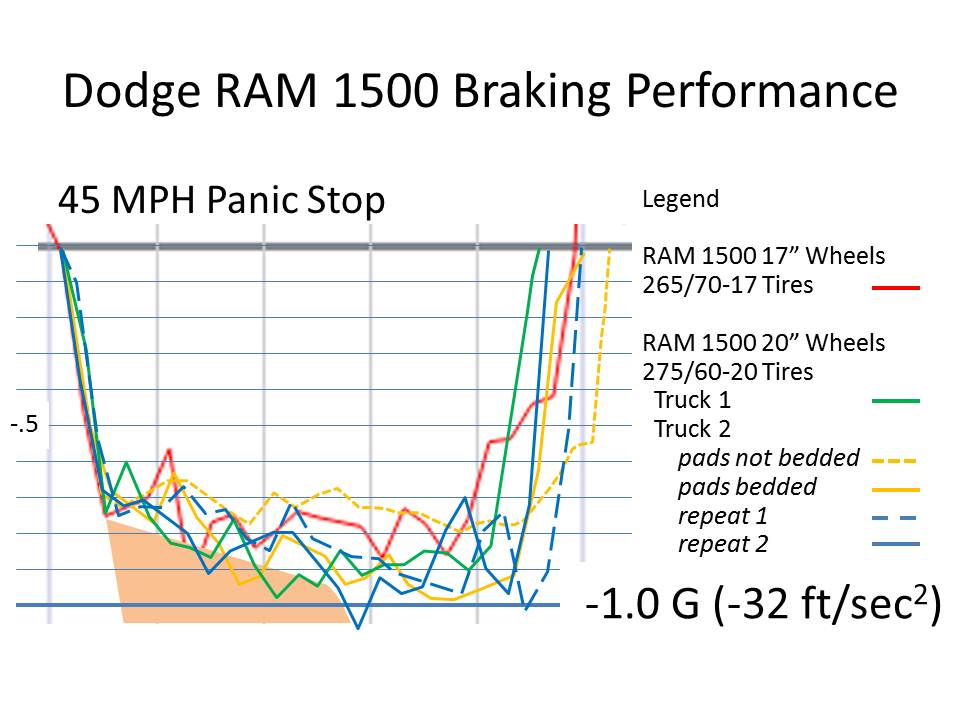
The EBC Yellow pads I installed provided more braking force and engaged the anti-skid on initial pedal application on my first try after 3 days of driving with them. The initial braking force was 0.9 Gs and it quickly increase to just over 1.0 Gs. The vehicle stopped a 1/2 second quicker! Brake components are consumables. It doesn't bother me to have to replace my rotors a few miles sooner or wash some brake dust off my wheels every now and then. It is much less expensive than having an accident with the associated body work or worse.


The EBC Yellow pads I installed provided more braking force and engaged the anti-skid on initial pedal application on my first try after 3 days of driving with them. The initial braking force was 0.9 Gs and it quickly increase to just over 1.0 Gs. The vehicle stopped a 1/2 second quicker! Brake components are consumables. It doesn't bother me to have to replace my rotors a few miles sooner or wash some brake dust off my wheels every now and then. It is much less expensive than having an accident with the associated body work or worse.

Last edited by menarefrommars; Jun 12, 2013 at 09:29 AM.
Veteran
Joined: Dec 2011
Posts: 318
Likes: 1
From: Rochester, New York
The EBC Yellow pads I installed provided more braking force and engaged the anti-skid on initial pedal application on my first try after 3 days of driving with them. The initial braking force was 0.9 Gs and it quickly increase to just over 1.0 Gs. The vehicle stopped a 1/2 second quicker! Brake components are consumables. It doesn't bother me to have to replace my rotors a few miles sooner or wash some brake dust off my wheels every now and then. It is much less expensive than having an accident with the associated body work or worse.
Of the two times I've had to panic stop I've been satisfied with my brakes performance. I wonder how much effect of your findings is related to tire selection.
Frankly, I'm not that concerned because I drive relatively sanely and rather cautiously. If I do bump into something it'll probably be a deer...at least that's what caused all my panic stops in the last twenty years...and since they are so unpredictable it would be doubtful if a half-second would've made a difference in any given instance.
In any event I finished replacing the front pads and rotors yesterday and found an amazing increase in stopping ability. This is probably due to the fact the rotors were heavily glazed.
Best regards,
Dusty
Thread Starter
|
Rookie
Joined: Aug 2010
Posts: 54
Likes: 0
Thanks, Dusty. I'm glad your brakes are now working better. The tires are a constant here. The only independent variable is the brake pads. Better tires would provide more grip and require higher G forces before anti-skid would engage. Tires with less traction would have the anti-skid engaging sooner and, if they were poor enough, mask any improvement in braking performance from the brake pad change. In this situation, everything was the same from the tires, speed, even the patch of asphalt used for the testing. The only change was the brake pads.
I drive my truck so passively, my brake pads hadn't bedded after 3500 miles of driving. I coast down to reduce speed and save gas before turns and stops. I drive like an "old man" and typically only apply brakes below 30 mph and then with light pressure - that's why my brakes never bedded. My panic stop was at a relaxed 45 mph when an ambulance ran a red light (my green light) and I didn't have a view of him coming up to the intersection. Though I don't have the equipment to measure stopping distance accurate, I calculate that the 1/2 second saved with the EBC Yellow brake pads compared to OEM is over 1 truck length at 45 mph. That to me is more than significant.
Find a vacant road and apply maximum braking force at 45 mph. If your anti-skid doesn't come on right away, your stopping distance would benefit from better brake pads.
Drive Safe. Mars
I drive my truck so passively, my brake pads hadn't bedded after 3500 miles of driving. I coast down to reduce speed and save gas before turns and stops. I drive like an "old man" and typically only apply brakes below 30 mph and then with light pressure - that's why my brakes never bedded. My panic stop was at a relaxed 45 mph when an ambulance ran a red light (my green light) and I didn't have a view of him coming up to the intersection. Though I don't have the equipment to measure stopping distance accurate, I calculate that the 1/2 second saved with the EBC Yellow brake pads compared to OEM is over 1 truck length at 45 mph. That to me is more than significant.
Find a vacant road and apply maximum braking force at 45 mph. If your anti-skid doesn't come on right away, your stopping distance would benefit from better brake pads.
Drive Safe. Mars
Last edited by menarefrommars; Jun 26, 2013 at 08:30 AM.