When you click on links to various merchants on this site and make a purchase, this can result in this site earning a commission. Affiliate programs and affiliations include, but are not limited to, the eBay Partner Network.
4th Gen Ram Tech2009 - 2018 Rams and the 2019 Ram Classic: This section is for TECHNICAL discussions only, that involve the 2009 - 2018 Rams and the 2019 Ram Classic. For any non-tech discussions, please direct your attention to the "General discussion/NON-tech" sub sections.
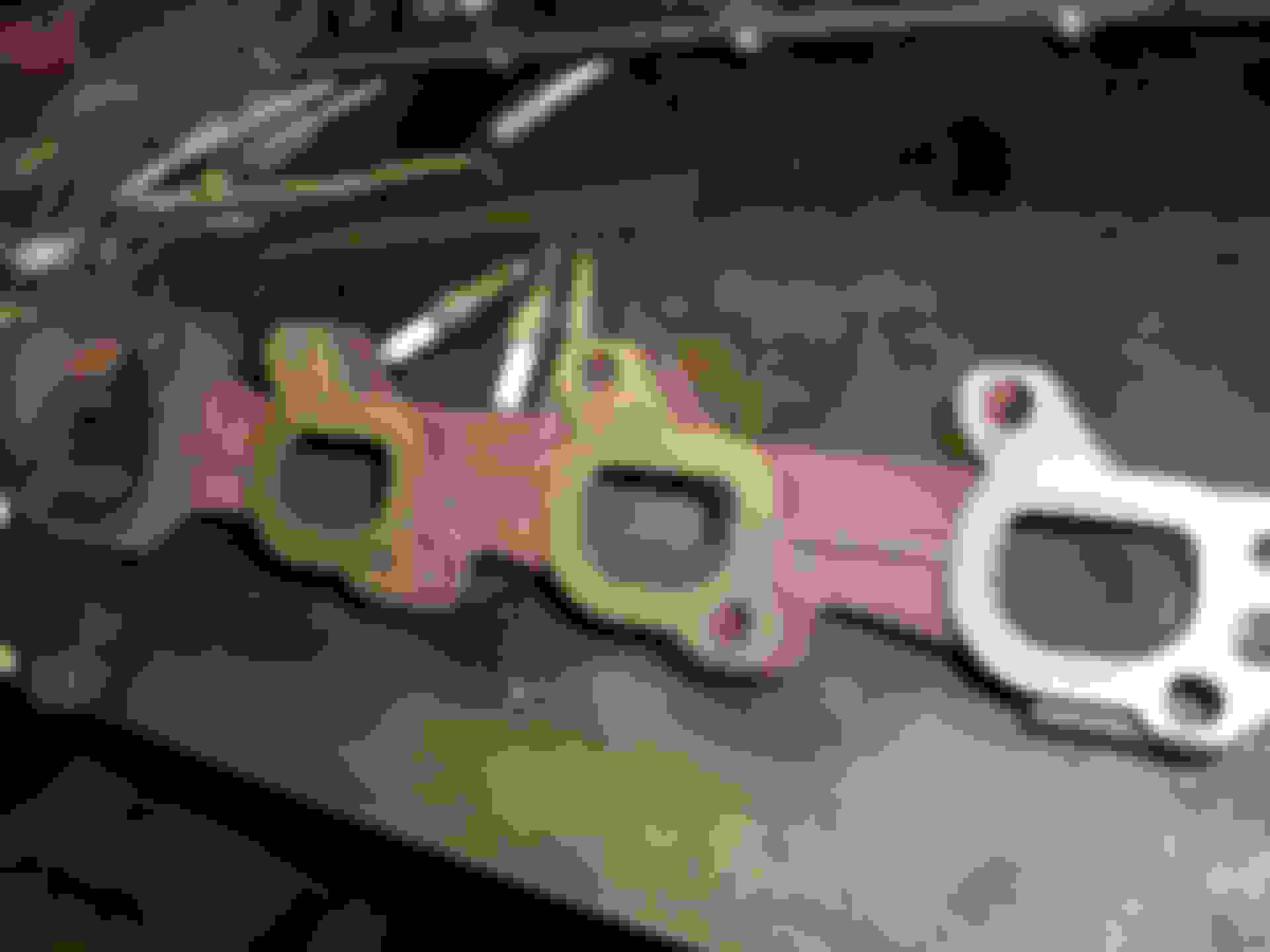
When I got the right side manifold off the head (2 rear bolts were broken) & cleaned up, a flatness check revealed almost a millimeter of warpage on the rear port. Some say that's what causes the bolts to break, but my opinion is the warpage is a result after the bolts break (technically, I should use the term "screws"....not bolts).
A little time on the big belt sander table & we are good to go. Now if my back would just heal up enough so I could finish the job.....
it would take alot of force to stretch those bolts 1mm, but it would be plenty of force to break them, idk if the manifolds are strong enough to exert that kind of force.
if you want to see the math on the bolt, ill be happy to share it, but it boils down to 51265 lbs of force exerted on the bolt to stretch it .1 mm, when the bolt (assuming the torque spec vs class matches up with the table i have and chrysler didnt do something special) has a strength of 4800 lbs . . .
Well, the bolts DO break........ I suspect it is due to heat cycling, and it is most often the bolts at the rear of the manifold, where things get hottest.......
Well, the bolts DO break........ I suspect it is due to heat cycling, and it is most often the bolts at the rear of the manifold, where things get hottest.......
heat effects metal in some seemingly weird ways, one of which is to increase the apparent strength of the bolts, but in the process and over time they become brittle from the heat treat process, idk as the underhood environment gets hot enough to create this kind of effect on the bolts, but i wont rule it out as a possibility.
what are the manifolds made out of? it would take alot less than 1mm of movement to break those bolts, if the thermal expansion coefficients are different enough it could definitely be caused by the heat.
assuming 4800lbs of force is correct, the manifold would have to warp (expand?) .000175 in to break the bolt . . . i havent done any analysis on this except running some quick stress calculations on paper, but its definitely within the realm of possibility.
Cast iron I do believe. Not sure on nickel content.... if any.
Also, bear in mind, that the design of the manifold passes ALL the exhaust from that bank thru the same passage at the rear. So, I would also suspect uneven heating of the manifold to be a contributor as well. Exhaust gases are north of 1200 degrees coming out of the heads...... could be as high as 1800 degrees. I wouldn't be surprised if that weren't enough to cause the cast iron to expand enough to pop the rear bolts.
So what SHOULD have been done to prevent this in the first place? Why didn't we have this problem on cars for the last 50 years? Aluminum heads have been around a long time and lots of cars have them.
Agree.....exhaust manifolds have been made of cast iron since the invention of the IC engine. Aluminum heads have been used since the 1930s....in larger volumes since the 50's. Broken bolts have become "normal" instead of rare....I think bad engineering is to blame.
So what SHOULD have been done to prevent this in the first place? Why didn't we have this problem on cars for the last 50 years? Aluminum heads have been around a long time and lots of cars have them.
Shorty headers (with individual tubes for each exhaust port, going to a common collector) should, theoretically, completely solve the problem.
Cast iron I do believe. Not sure on nickel content.... if any.
Also, bear in mind, that the design of the manifold passes ALL the exhaust from that bank thru the same passage at the rear. So, I would also suspect uneven heating of the manifold to be a contributor as well. Exhaust gases are north of 1200 degrees coming out of the heads...... could be as high as 1800 degrees. I wouldn't be surprised if that weren't enough to cause the cast iron to expand enough to pop the rear bolts.
1200-1800 is definitely hot enough to alter the metal, and the cooling rate is going to be rather low which affects the equation too, the cast iron may not care as much from a strength perspective, but the bolts will definitely be affected.
for reference heat treating of steel takes place between 800 and 1600 deg C (1472-2900 deg F).
Had time to clean up the drivers side head tonight & found one broken bolt on the manifold (upper one at the back). It also had about the same amount of warpage. I wonder if the 2nd bolt was stretched & ready to pop? I might clamp it up & do some testing on it. Another trip to the belt sander flattened the manifold back out.
Mike S





 Hemi Exhaust Manifold