


Ride along with me...


Thread Starter
|
Captain

Joined: Oct 2005
Posts: 568
Likes: 8
From: The Summit, Queensland, Australia

It occurs to me that I haven’t posted very much about the beautiful place in which I lived at this time. The town of Dalveen once boasted a railway station – complete with station-master’s cottage – a police station and sundry other things you find in small country towns. The New England Highway, one of two main highways between Sydney and Brisbane, was also the main street.
Today that highway has been upgraded and shifted a couple of hundred metres to the West, the old road runs more or less parallel to it for about twelve miles as a local access road and there’s not much activity in the main street of Dalveen…
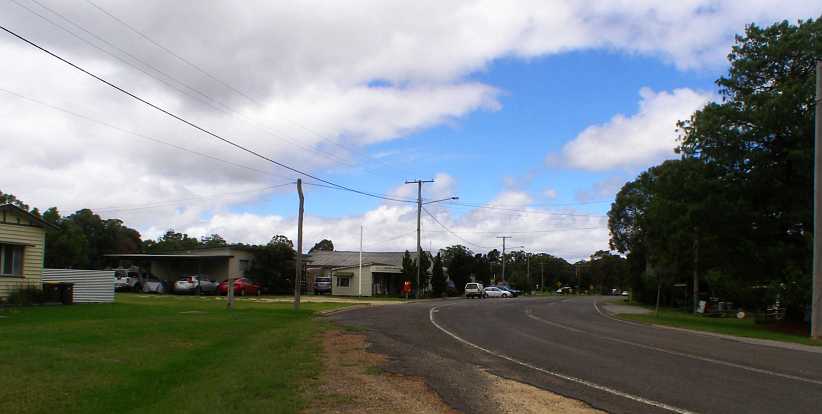
Dalveen main street. What you see here (beyond the house on the left) is a factory, office and shopfront for the one business now operating in Dalveen. In the distance is the Rest Area of which I’ve posted a number of pictures.
…apart from the people coming and going to the Post Office, located in that shopfront.
The office and factory are a business called “Action Graphics” who publish travel magazines, produce promotional materials for businesses and wholesale promotional and screen printed clothing, some of that being school uniform items. They have so much mail of their own that they have taken on the Post Office licence to keep that in town. Which is, of course, advantageous to the few hundred local residents.
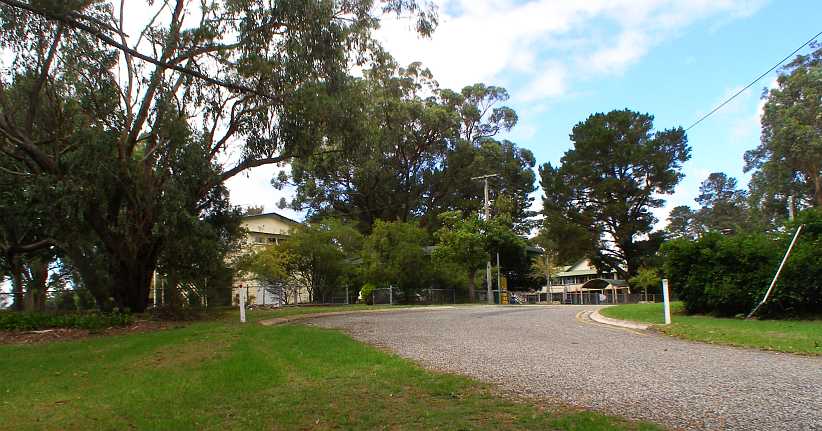
Dalveen State School. Primary schooling (5 to 11 year olds) is available here for the local children. High schoolers catch a bus to Stanthorpe.
The school becomes the centre of a lot of local activity and the school produces a news-sheet which has effectively become a community communication medium.
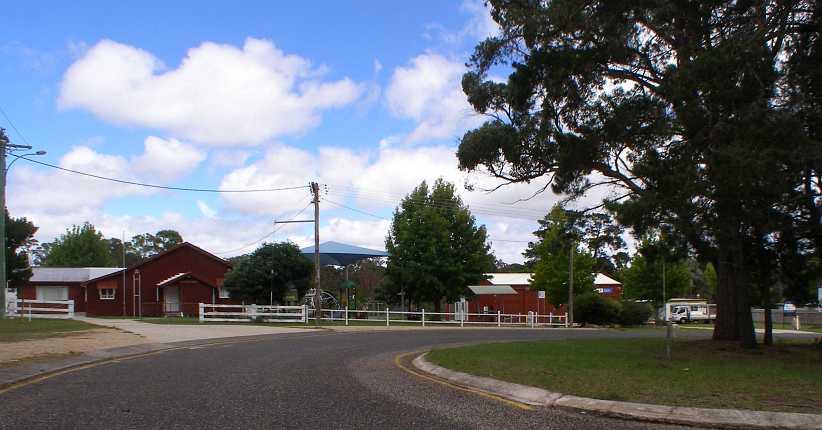
Community Hall and Fire Station. Right next to the school, these serve local needs well. The fire brigade is a volunteer service.
Periodically there are training days for the volunteer firemen and there’s a very community-minded social aspect to it as well. All notifications are handed to people when they pick up their mail. Equipment is supplied through insurance companies and the State Government. There are around twenty homes in the immediate area, a few more not too far away, most locals are on rural properties.
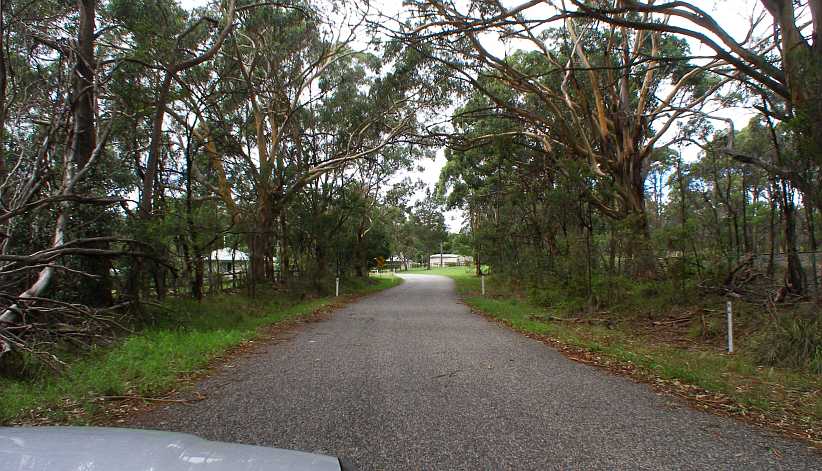
The road home. Leaving the village the road to my home is flanked by two homes, the last dwellings to be seen for almost two miles.
This road descends through a bushy area with a couple of dips and some slight bends, then it sweeps through a climbing right hand bend into more open ground…
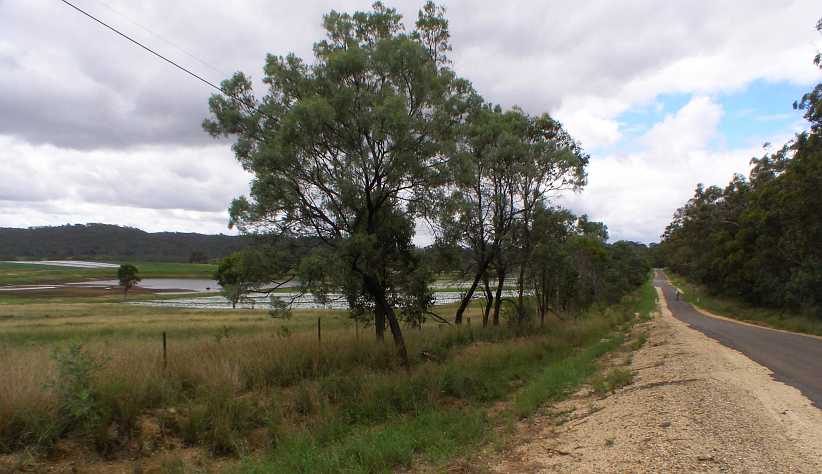
Dam and cyclist. Coming around that bend exposes the dam, seen on the left here, and it normally dominates the sight with its glistening waters. There is a lot of plastic covering here for the vegetable crop being grown, while further down the road a cyclist pedals along.
…with the pretty dam coming into view. This road was itself the highway many years ago, it was unsealed in those days and I doubt it saw as much traffic then as it sees local traffic today.
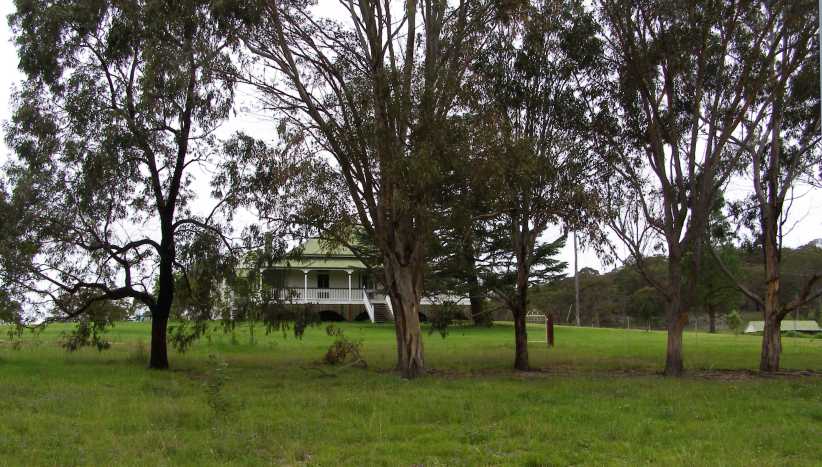
Home. The main farmhouse at a property named ‘Mountain Park,’ this beautiful old place was my home for ten years.
The house is built about 400 yards back from the road, with a good solid row of trees beside the road as well as those nearer the house as shown in the picture. Janet and I were very fortunate to come along looking for a place to rent just as the owners decided they needed to rent it out.
When we moved in there was no farming activity on the 860 acres on which the house sits, but there were two groups of cattle on agistment on the 1,900 acres belonging to the property on the other side of the road. That meant that from time to time cattle were brought over to the yards below the house for drenching or separating calves from cows, even some loaded to go to market.
Those yards are visible here…
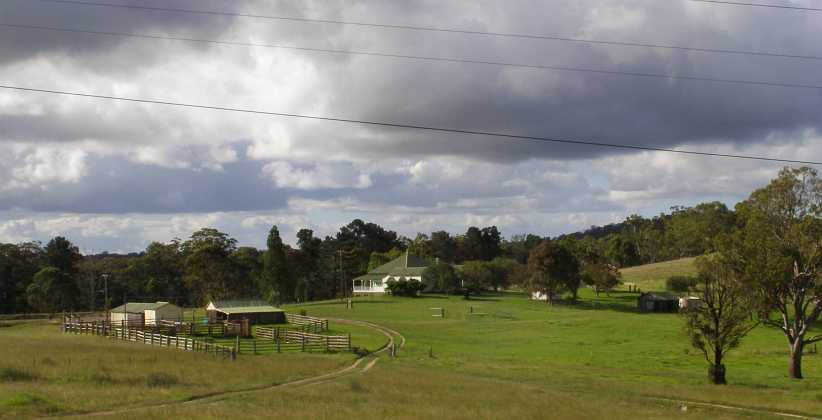
Rear view. Taken from up near the second house on the property, this gives a good appreciation of the layout of the place.
…while other things I’ve mentioned previously show too. The water tank which receives rainwater from the house is white, right next to the dark shed to the lower right of the picture, while the gravity-feed tank is not visible but is up the cleared hill to the right. My workshop and storage was in a couple of the sheds adjacent to the cattle yards.
I trust nobody questions why I fell in love with living here...
Today that highway has been upgraded and shifted a couple of hundred metres to the West, the old road runs more or less parallel to it for about twelve miles as a local access road and there’s not much activity in the main street of Dalveen…
Dalveen main street. What you see here (beyond the house on the left) is a factory, office and shopfront for the one business now operating in Dalveen. In the distance is the Rest Area of which I’ve posted a number of pictures.
…apart from the people coming and going to the Post Office, located in that shopfront.
The office and factory are a business called “Action Graphics” who publish travel magazines, produce promotional materials for businesses and wholesale promotional and screen printed clothing, some of that being school uniform items. They have so much mail of their own that they have taken on the Post Office licence to keep that in town. Which is, of course, advantageous to the few hundred local residents.
Dalveen State School. Primary schooling (5 to 11 year olds) is available here for the local children. High schoolers catch a bus to Stanthorpe.
The school becomes the centre of a lot of local activity and the school produces a news-sheet which has effectively become a community communication medium.
Community Hall and Fire Station. Right next to the school, these serve local needs well. The fire brigade is a volunteer service.
Periodically there are training days for the volunteer firemen and there’s a very community-minded social aspect to it as well. All notifications are handed to people when they pick up their mail. Equipment is supplied through insurance companies and the State Government. There are around twenty homes in the immediate area, a few more not too far away, most locals are on rural properties.
The road home. Leaving the village the road to my home is flanked by two homes, the last dwellings to be seen for almost two miles.
This road descends through a bushy area with a couple of dips and some slight bends, then it sweeps through a climbing right hand bend into more open ground…
Dam and cyclist. Coming around that bend exposes the dam, seen on the left here, and it normally dominates the sight with its glistening waters. There is a lot of plastic covering here for the vegetable crop being grown, while further down the road a cyclist pedals along.
…with the pretty dam coming into view. This road was itself the highway many years ago, it was unsealed in those days and I doubt it saw as much traffic then as it sees local traffic today.
Home. The main farmhouse at a property named ‘Mountain Park,’ this beautiful old place was my home for ten years.
The house is built about 400 yards back from the road, with a good solid row of trees beside the road as well as those nearer the house as shown in the picture. Janet and I were very fortunate to come along looking for a place to rent just as the owners decided they needed to rent it out.
When we moved in there was no farming activity on the 860 acres on which the house sits, but there were two groups of cattle on agistment on the 1,900 acres belonging to the property on the other side of the road. That meant that from time to time cattle were brought over to the yards below the house for drenching or separating calves from cows, even some loaded to go to market.
Those yards are visible here…
Rear view. Taken from up near the second house on the property, this gives a good appreciation of the layout of the place.
…while other things I’ve mentioned previously show too. The water tank which receives rainwater from the house is white, right next to the dark shed to the lower right of the picture, while the gravity-feed tank is not visible but is up the cleared hill to the right. My workshop and storage was in a couple of the sheds adjacent to the cattle yards.
I trust nobody questions why I fell in love with living here...

Thread Starter
|
Captain
Joined: Oct 2005
Posts: 568
Likes: 8
From: The Summit, Queensland, Australia
Indeed...
The day Janet and I went to see the place she knew, from the moment I first saw it, that our search for somewhere nice to live was over. That was, of course, if the owners approved of us.
We sweated through the next week awaiting advice through the agents, but it came and we moved in about three weeks later. It was nice, too, I think, that Janet was able to spend her final five years in a place so nice.
I posted some pics earlier this month from when I took the van home and started doing a few small things to it. The background to those photos show some of the more remote parts of the property.
The day Janet and I went to see the place she knew, from the moment I first saw it, that our search for somewhere nice to live was over. That was, of course, if the owners approved of us.
We sweated through the next week awaiting advice through the agents, but it came and we moved in about three weeks later. It was nice, too, I think, that Janet was able to spend her final five years in a place so nice.
I posted some pics earlier this month from when I took the van home and started doing a few small things to it. The background to those photos show some of the more remote parts of the property.
Thread Starter
|
Captain
Joined: Oct 2005
Posts: 568
Likes: 8
From: The Summit, Queensland, Australia
Of course, it’s my work which gives me the pleasurable life driving around the countryside. There are some flexibilities with it, but principally I have to work Saturdays and Sundays and because of where I live I get to drive to locations over a fairly wide area. And yes, it’s one of the reasons I chose to live in the Stanthorpe area.
One ‘flexibility’ is when I leave home and return. The company give me two nights in a motel, generally, when I’m working at least 60 miles from home, it’s my choice to head off on Friday and be there ready to work on Saturday morning, then drive home Sunday evening – or to get up very early Saturday and have a more relaxed Sunday evening staying over ready for a quiet drive home Monday. This particular week I headed off on Friday afternoon:
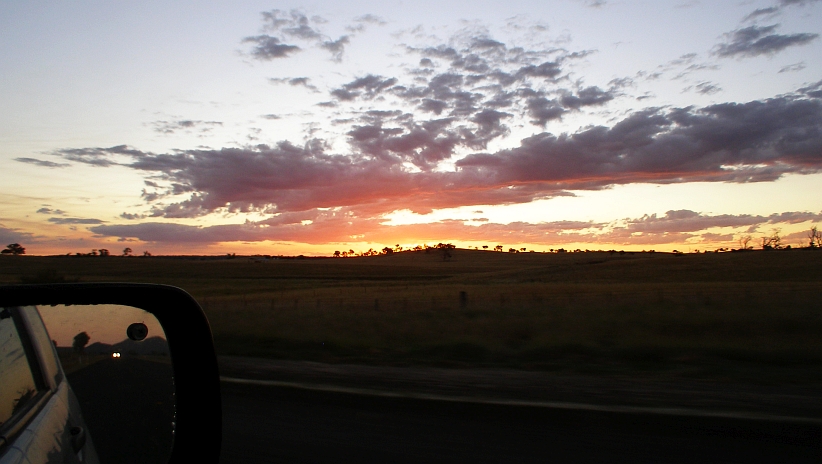
Driving to Armidale. This is a sunset I watched as I got close to Deepwater on a Friday evening.
One reason for the choice to go on Friday is that Queensland doesn’t have daylight saving and New South Wales does. This means you lose that hour going South and you leave it until Saturday morning to leave, well, it’s a three-hour drive and I’m supposed to be working at 9:30 and I get breakfast before I start. Simply, it means setting the alarm for about 4:00am rather than just driving there Friday evening and then having an extra hour available for the drive home on Sunday.
And at Armidale this weekend there was a little car show in the park, Nissan Z-cars were prominent, but there were other cars as well:
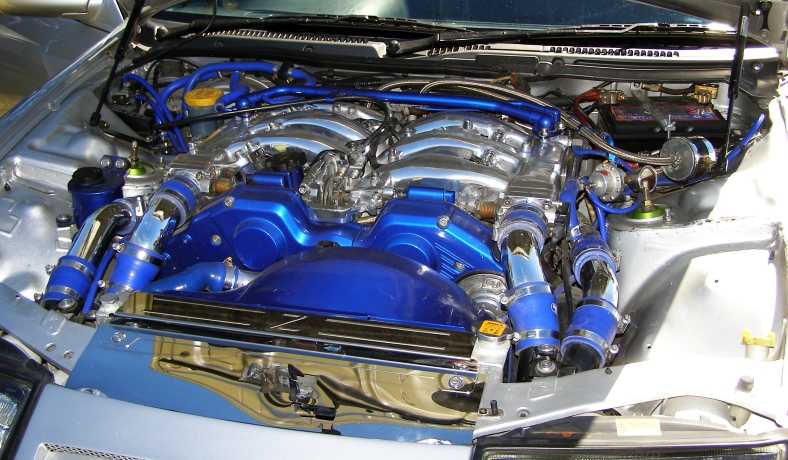
Z-car chrome. There’s extra chrome under the bonnet of this 300Z, with the aluminium intake manifold also highly polished on the twin-turbo engine.
Rather more sedentary were these old Fords:
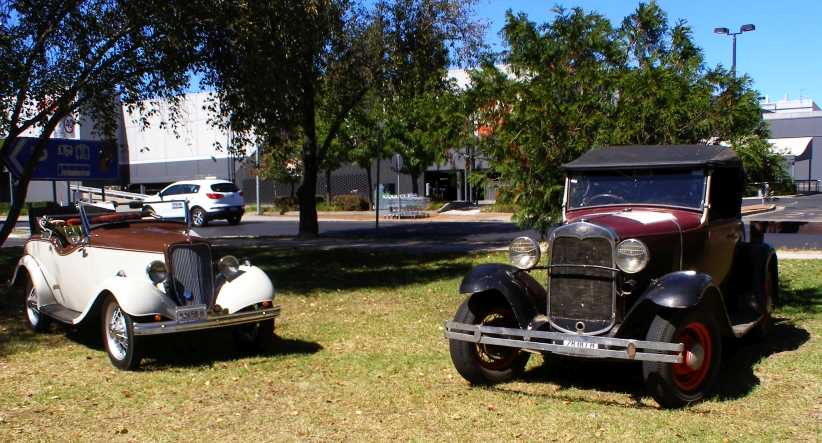
Pair of Fords. The A-model will be familiar to all, but the Y-model to the left is basically a British model.
Ford Australia was assembling cars and making some of them from the mid-twenties. The Y-model here was a ‘Made in Australia’ version of the British car which sported a 4-cylinder side-valve engine of just over a litre. There was a large number of makes and models assembled in Australia, including three of this four:
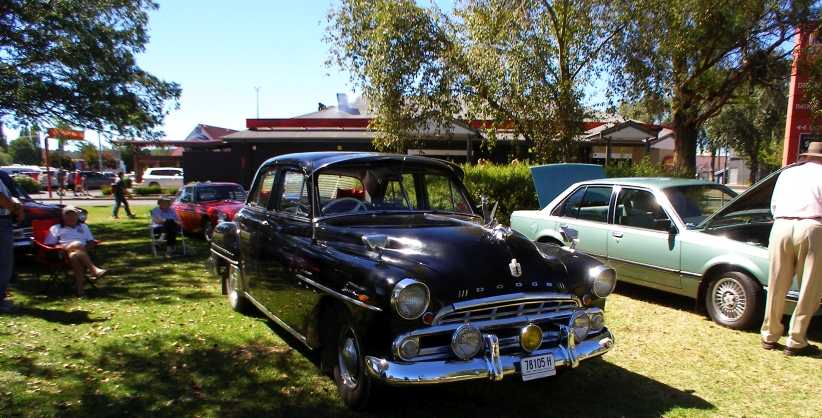
1951 Dodge. This Dodge would have been assembled locally from a CKD pack from Canada, the (mostly obscured) Hillman on the left and the MG B behind the Dodge were too, but the Holden Commodore on the right was fully made in Australia.
Actually, there are bits on this Dodge which were locally made and not a part of the car when built. There are some ‘Special’ badges just back from the headlights, they’re from a ’63 Holden and I some aftermarket indicator, driving and fog lights. I don’t know what the little chrome tabs are at each end of the ‘Dodge’ lettering.
This particular weekend they had me working in two areas and the second area was at Warwick, so after going home Sunday I was off to this area on the Monday, which was a public holiday. I took the time to replace a wheel on the car with a totally-unused spare before I started out that day, I wish I hadn’t…
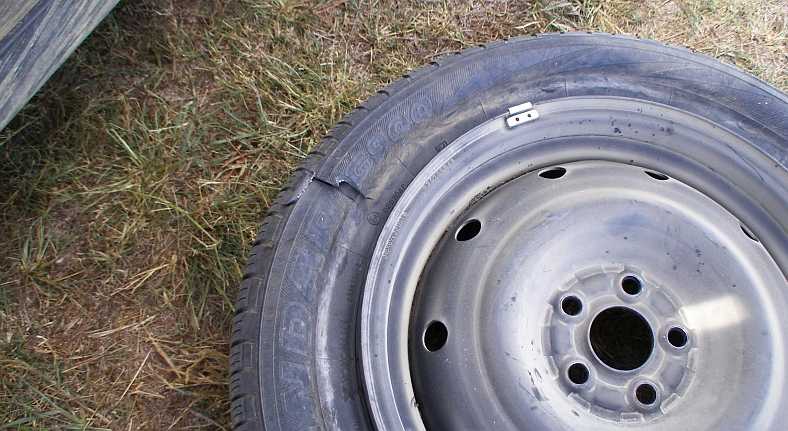
Cut tyre. Late in the morning I had to turn around in a rural driveway and found that the grass hid something which quickly destroyed the brand new tyre.
And then I was back home for a day or two. By this time the grazing rights to the 860 acres surrounding the house were leased to a nice young farmer who lives about 15 miles away. His heifers were grazing in the area near the sheds:
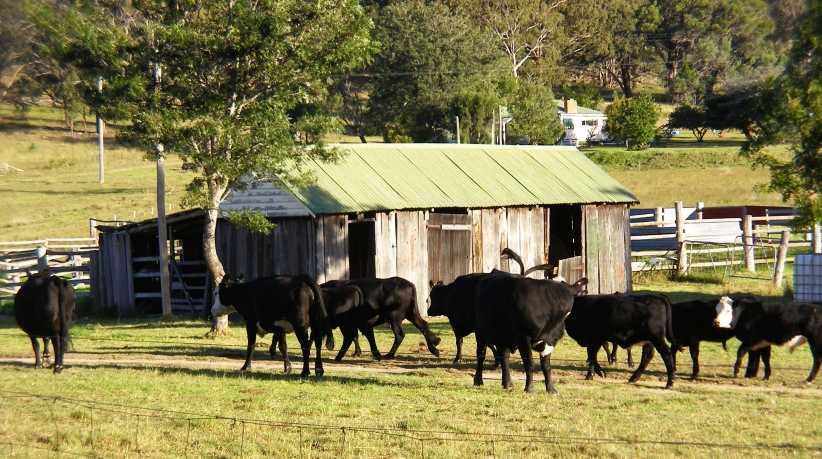
Heifers. There was generally about 60 cows and calves roaming the property at this time, with the owner coming by every few days to move them from one paddock to another or give them some supplements.
When I work at the Gold Coast or Tweed I drive towards Brisbane via Warwick and Cunningham’s Gap…
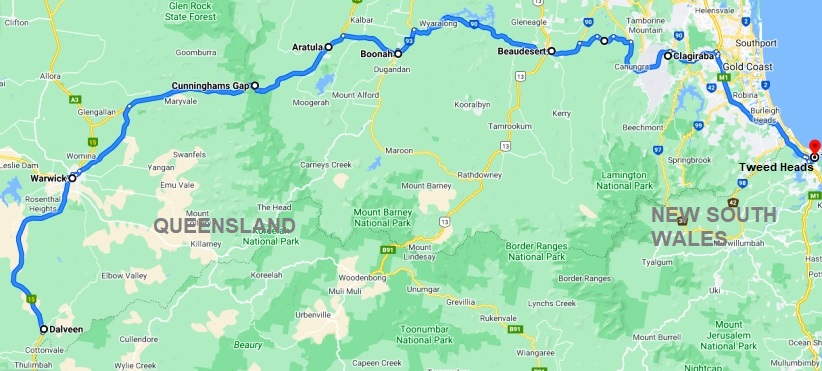
…and turn off the Cunningham Highway after Aratula, go through Boonah and Beaudesert and then backroads to the lower part of the Gold Coast before joining the Pacific Highway for the balance of the trip.
This trip, however, I noticed as I got near the summit of Cunningham’s Gap – the point where we cross the Great Dividing Range on this road – that some interesting cars were heading in the opposite direction. I pulled into the parking area at the summit and got some pics:
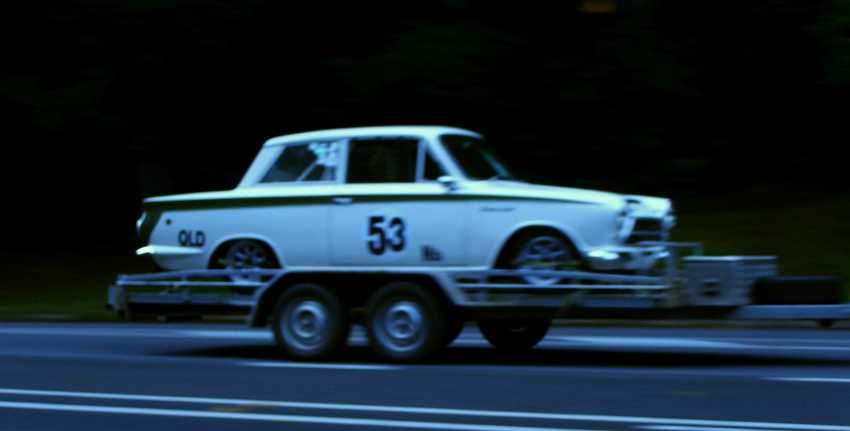
Lotus Cortina. These cars electrified circuit racing in the early to mid-sixties. They were light, had a twin-cam engine and suspension improvements. This one was clearly going to Morgan Park.
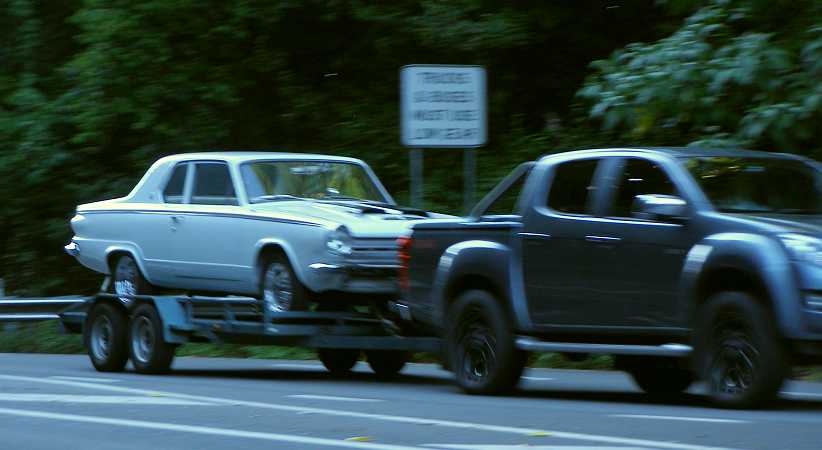
1964 Dart. Once again, a model not seen here as we only had our Valiants. This one looks like it’s not one which have been marketed here anyway.
Morgan Park also has drag racing, much more likely to be the destination for the Dart and quite likely the place to which these Valiants were going:
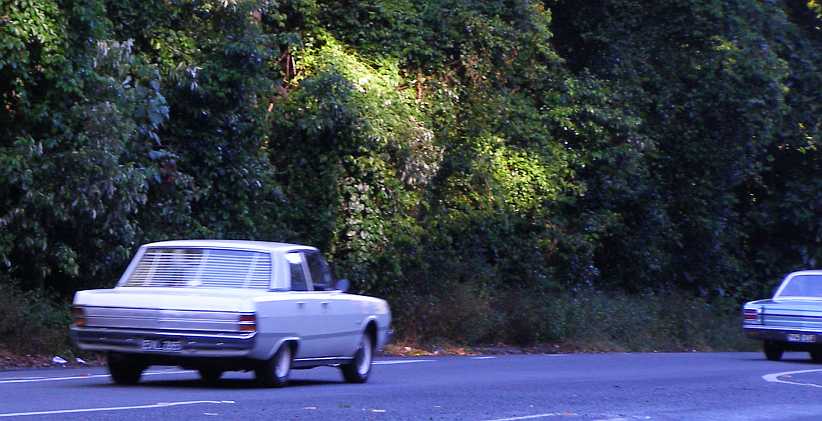
VG Valiant and VF Valiant 2-door. Scampering along effectively, I almost missed this shot of a VG Regal and the tail end of a VF coupe apparently travelling together.
Finally, a very different kind of power for a hot-rod:
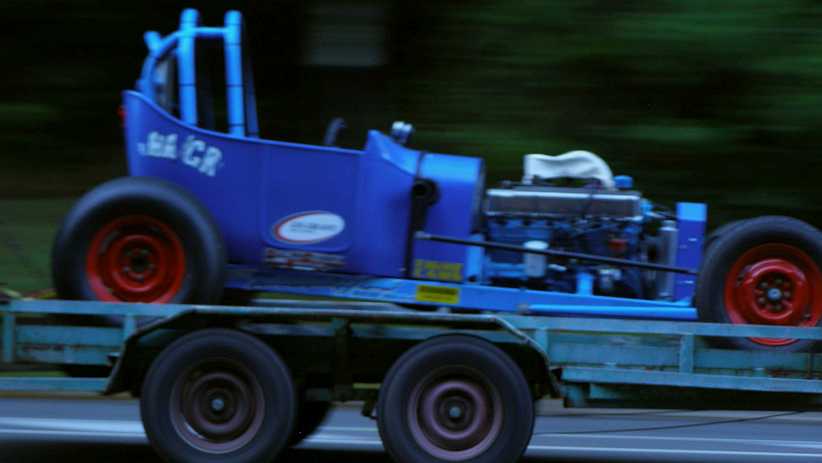
Slant in hot-rod. The slant 6 made this hot-rod different to the majority, which are mostly V8-powered.
As usual I called in at Ben’s after completing my work, this week taking the Saturday and Sunday night accommodation option so I was there on Monday morning. He had a comprehensive 265 Hemi 6 build almost complete:
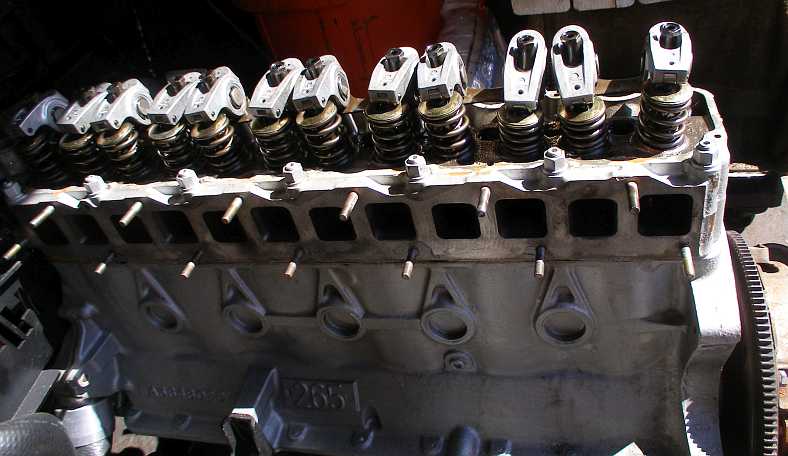
Hemi 6 build. With roller rockers, double valve springs and studs replacing head bolts, it’s obvious that there’s been some modifications made inside this engine.
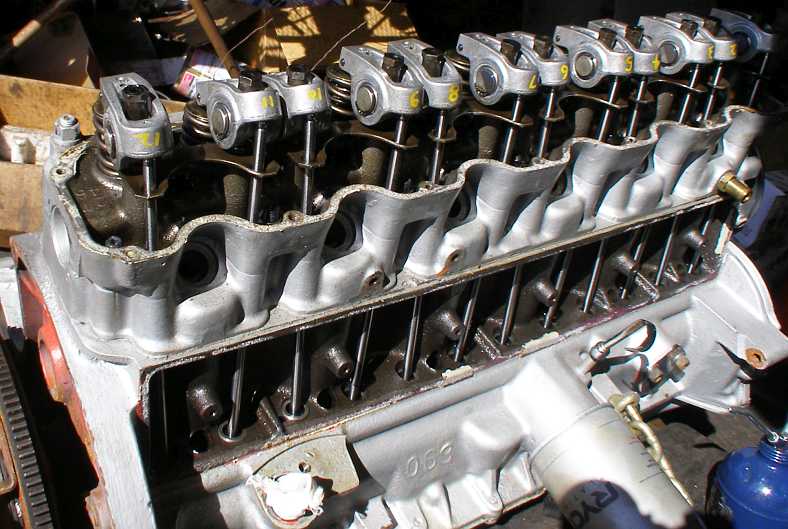
Camshaft side. The other side of the engine, with inlet valve No 5 and exhaust valve No 6 open. There’s a story about that combination.
Note that the port order is the same the whole way along the engine, from the front being exhaust-inlet-exhaust-inlet and so on. This differs from almost every other engine built, with most having exhaust-inlet-inlet-exhaust-exhaust-inlet-inlet and so on. The result of this is that there’s a double-loading on the cam with the two valves shown open above.
The camshaft, like virtually all cams in a 6-cylinder engine, has four bearings. This means that the cam lobes which work at the same time are located halfway between the third and fourth bearings. And so, despite a large diameter cam being involved, the cam flexes slightly in engines modified like this one – with big lifts and heavy valve springs.
And then came another trip to Armidale. This shot is one end of the main shopping area, which has had cars banished from it:
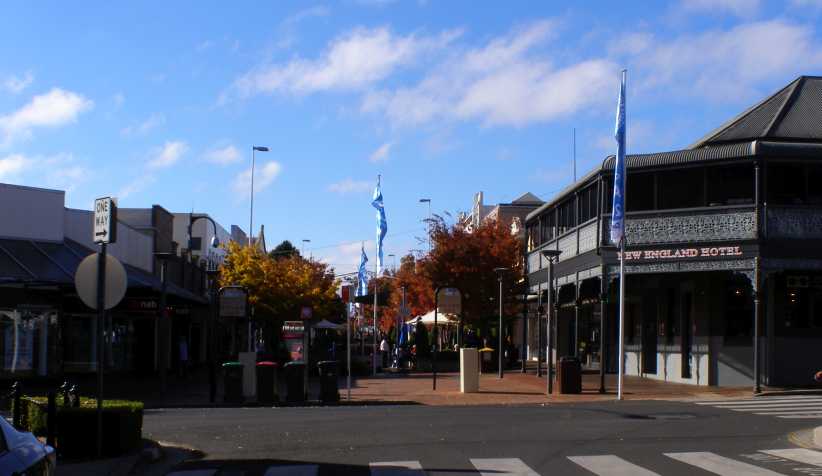
Old Armidale. The trees along the plaza show strong signs that Winter’s on its way. A large malls a few hundred yards from here sees a lot of the business activity.
This time of year it’s a town which really does show some colour. Homes are generally very neat and streets very much like this one are plentiful…
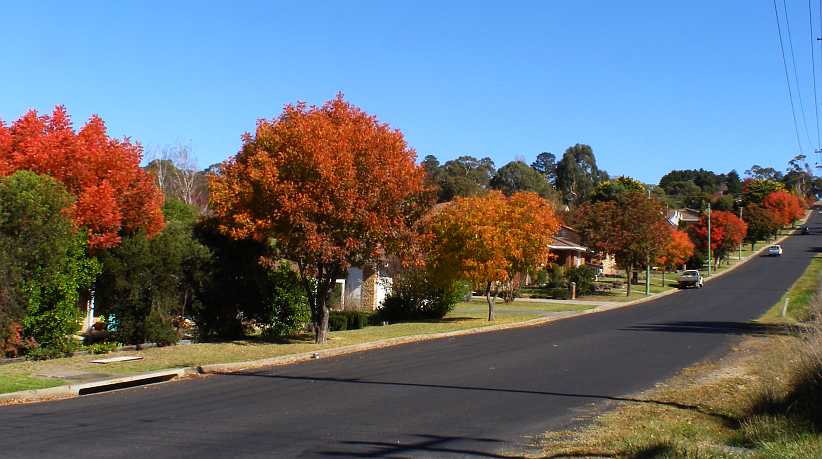
Colourful streets. Not many of the native trees are deciduous so the towns like Armidale which have been heavily planted with trees which are stand out in the autumn.
…in a town which is home to many people with above-average income.
Back at home there’d been a storm and this tree…
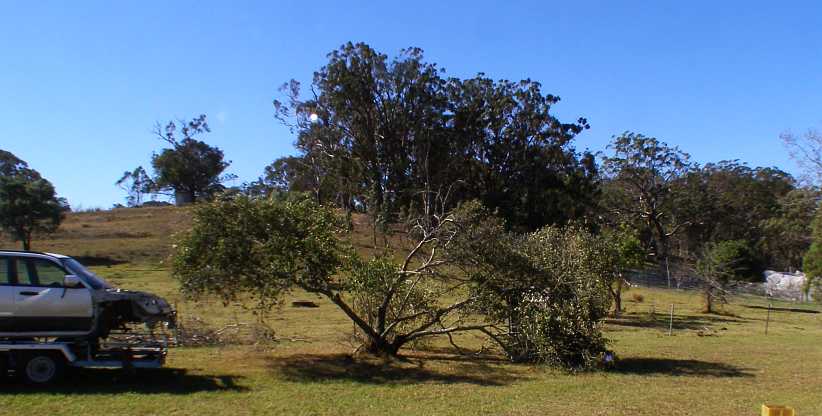
Tree down. With branches which became a bit too heavy for their own strength, a good wind was all that was necessary to cause much of the tree to collapse.
…needed to have large pieces cut off and thrown over the fence. Henceforth the mowing around this tree got a lot easier. Note that the white Forester is still hanging around, though missing everything mechanical.
The presence of the cattle in the paddocks around the house yard meant I had to make sure the gate was shut. They would trample things and leave a lot of mess around if they got into the house yard, but even outside they could cause consternation:
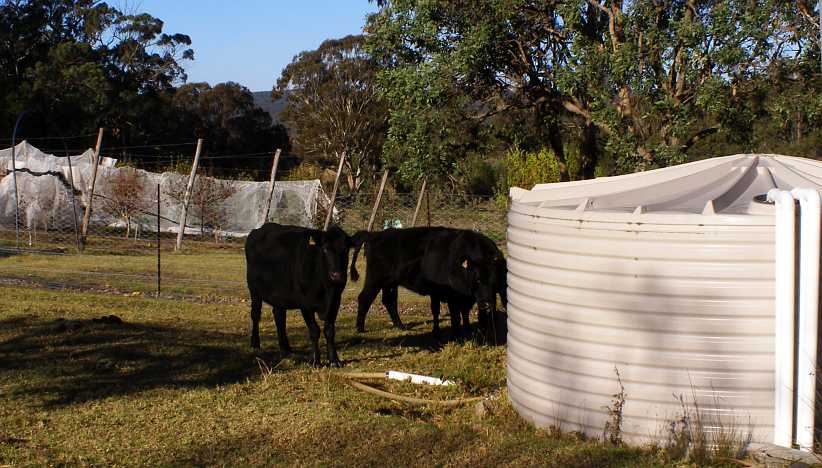
Cattle at the tank. Picking at the green growth around the tank’s outlet, they’d nuzzled against the ball **** and I was losing precious water!
Rocks around the ball-**** fixed the problem, but it showed one had to keep an eye on things or they could get out of control. And, of course, there was the fact that I was so often absent, either at Sandra’s place or away for the weekend working.
There was often something different to see as I went away. Another trip to the Tweed took me past this molten mess:
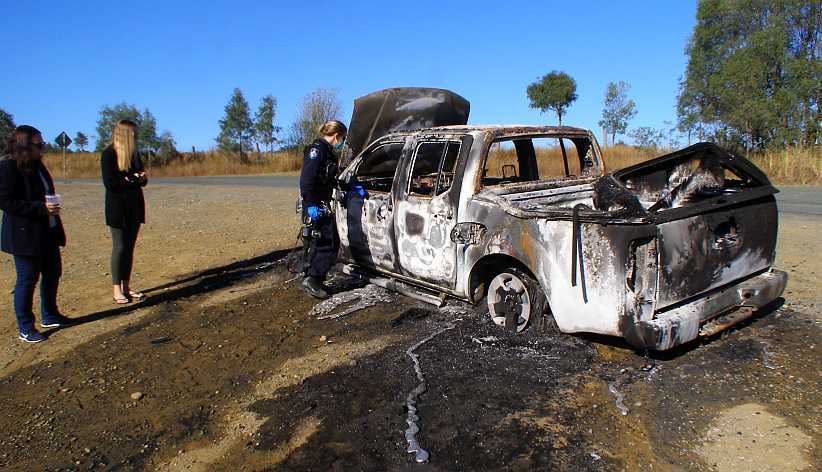
Molten utility. I happened along just as the police and the owner’s family arrived. The fire had occurred the night before.
The family’s story was that the young owner had run out of fuel and got a lift home. It seems to me that there was no shortage of fuel around the vehicle when the fire began, however, and I’ve never seen such rivers of molten alloy anywhere.
And another week on it was cars which were on show again that caught the attention of my lens:
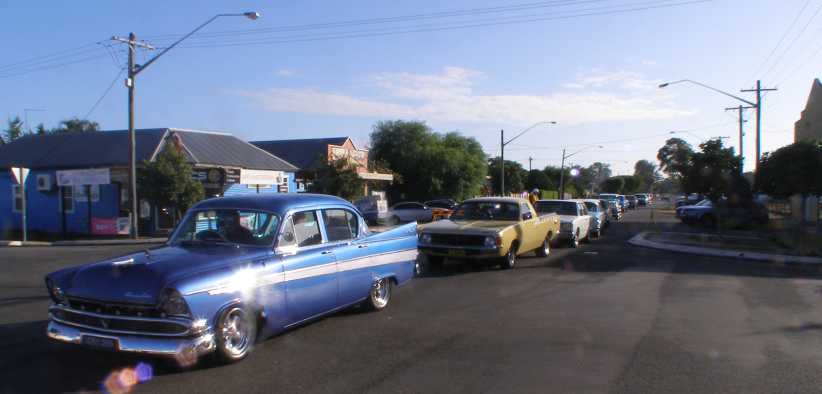
Casino parade. A Chrysler Royal heads a Valiant utility in this line of cars parading through the main street of Casino.
I arrived in Casino and found that it was the scene of a gathering of ‘classic’ cars. My friends, the Veness family, were there with their Mopars, but they were by no means on their own. The parade was quite long.
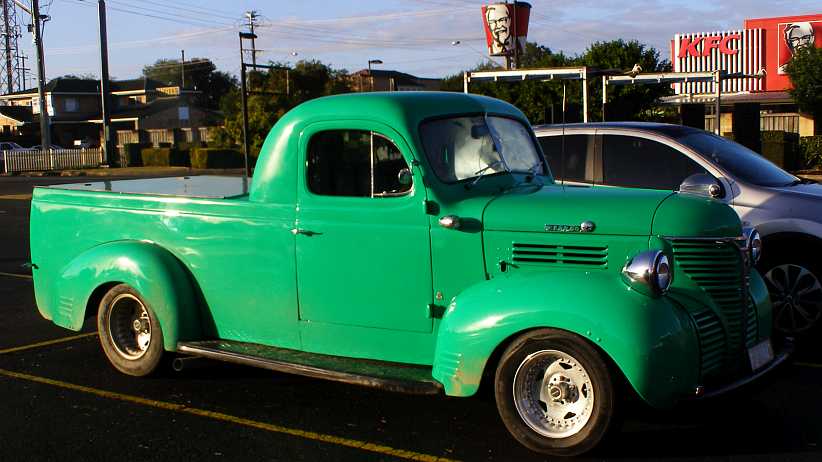
Fargo utility. A very early post-war example, assembled in Australia with body stampings by Holden. ‘Fargo’ was an export name for Chrysler commercial vehicles, equivalent to Plymouth in the passenger cars.
The Fargo symbol, seen as a mascot and on the badge on the side, is a globe of the world while the Holden badge is the little chrome item low on the body just ahead of the door.
This day I was working out in a rural area South of Casino and one of my respondents was this lady:
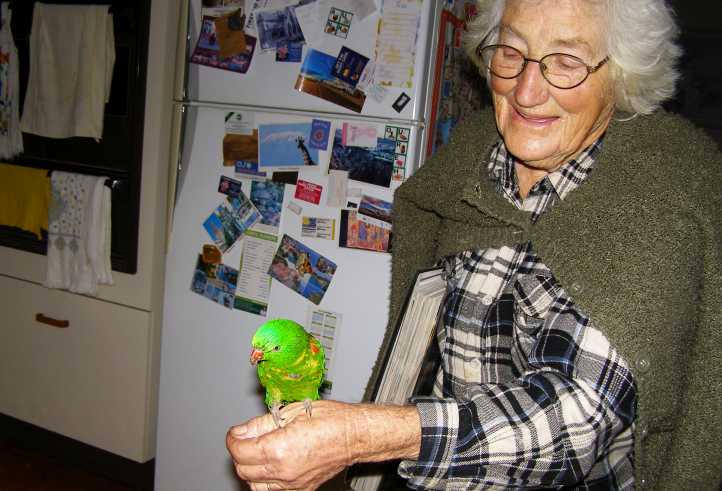
Lady with a bird. The bird was rescued when it was just a chick and has lived in her house for over twenty years. It didn’t seem interested in escaping, either.
It’s not unusual for me to find people who are a little bit different to usual, whether it be because they have a bird living in their home with them or if they’ve decided to live in a railway station and train carriage…
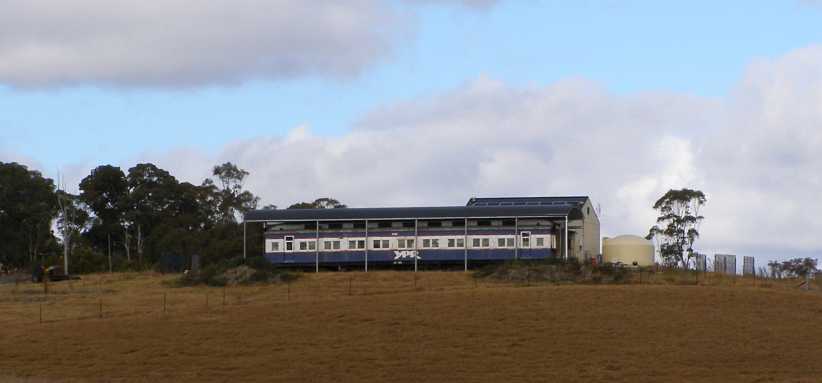
Station and carriage. This scene is on the top of a hill not far from Tenterfield, where a rail carriage is being converted to become part of a home in conjunction with a building emulating a railway station.
…with a bit of a difference. They’ve selected a Victorian carriage because of its size. The Victorian railways use a broader gauge than the standard gauge of 4 ' 8½", theirs being 5’ 3”. This means the carriages can be larger and this one was formerly used on a once-popular service between Melbourne and Adelaide.
Back at home with yet another assignment completed, I finally got serious and did something towards getting the van ready for the road.
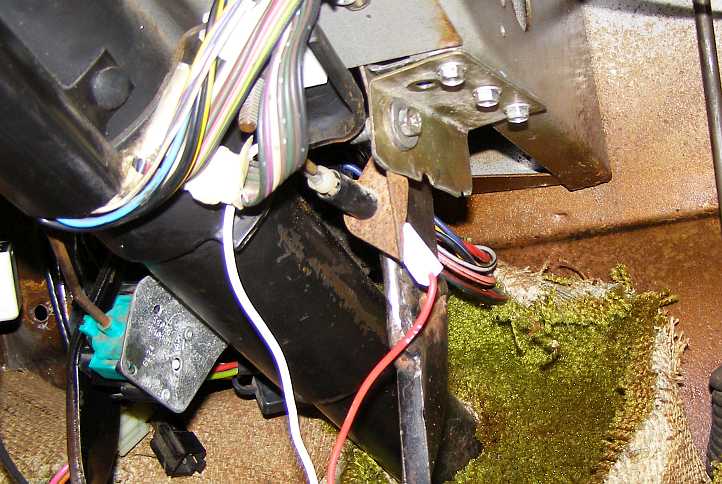
Brake pedal and brake light switch. I had previously simply cut away part of the brake pedal from when the van was automatic, now I did a ‘cut and shut’ on the pedal to put the proper small pad onto it. And I fitted up a Valiant brake light switch as I had to bypass the original switch.
A small step, but at least I was making a start. The next weekend I had two jobs to do at Armidale, on the way I came across this car which had suffered a suspension collapse going onto this bridge. I think the poor lady was suffering shock.
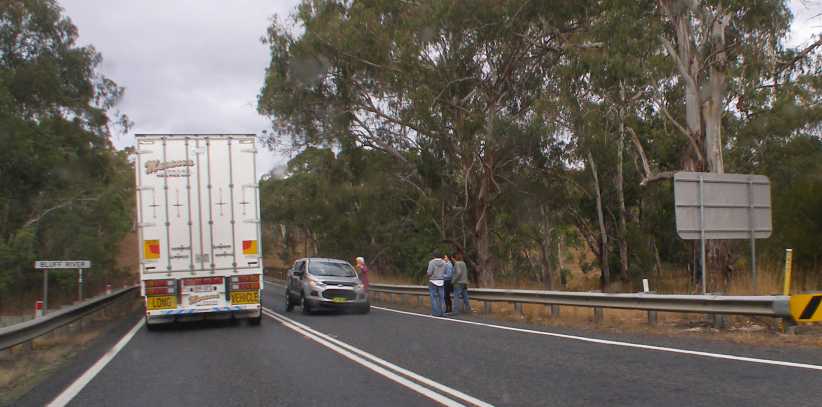
Suspension collapse. At the Bluff River bridge the little Ford SUV had a suspension collapse and came to a stop blocking its lane.
About this time the company offered me two assignments every weekend, which was a handy increase in pay, but I decided to do that every second weekend as it would otherwise take up just too much of my time. Sandra was all in favour, “Take it while you can get it!” she said.
Back at home I got a bit further with the van, fitting a second light mount into the section of the tail lamp cluster base which had the reversing light in it. The reason was that I needed to have an amber indicator light and so I fitted an amber globe to this mount:
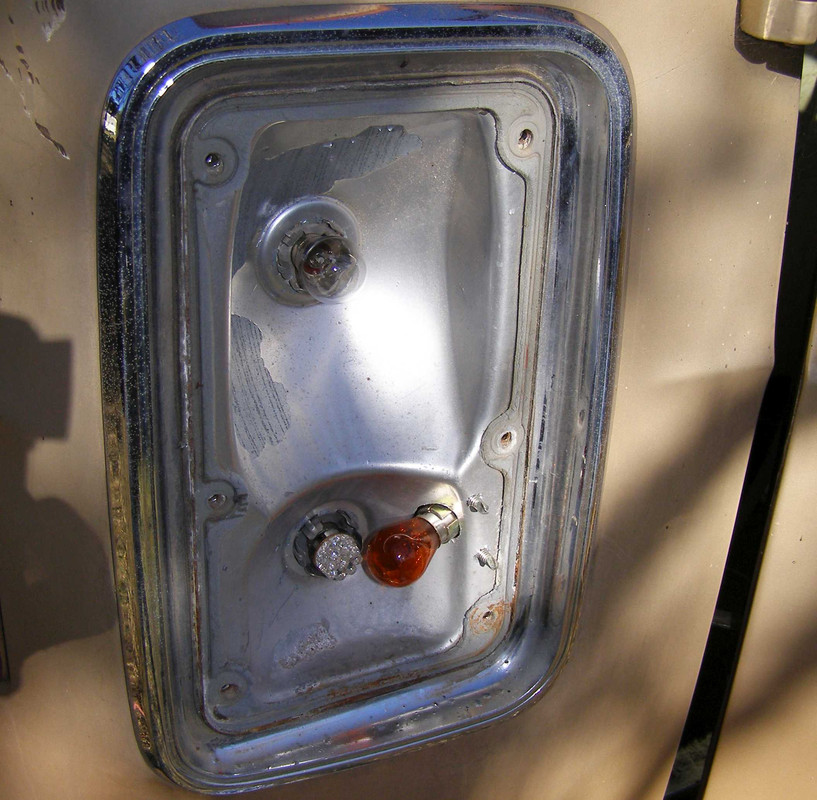
Amber globe fitted. By fitting an amber globe in this section I would get an indicator light in amber without fitting extra lights to the van.
I also fitted an LED light to the reversing light mount to give a bit more space for the amber globe. And when I assembled the tail light and tried the indicator it showed up just fine:
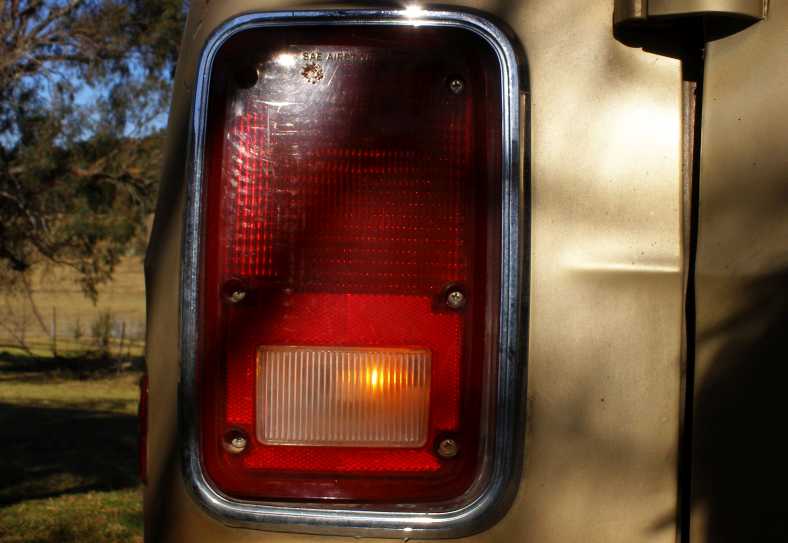
Amber indicator. A bit more progress as the indicator itself was now working in a matter as required for the Australian rules. But there was still work to be done.
Winter had now arrived. But apart from cold nights and mornings, the days were dry and good for getting jobs such as this done. Soon I would make a lot more progress…
One ‘flexibility’ is when I leave home and return. The company give me two nights in a motel, generally, when I’m working at least 60 miles from home, it’s my choice to head off on Friday and be there ready to work on Saturday morning, then drive home Sunday evening – or to get up very early Saturday and have a more relaxed Sunday evening staying over ready for a quiet drive home Monday. This particular week I headed off on Friday afternoon:
Driving to Armidale. This is a sunset I watched as I got close to Deepwater on a Friday evening.
One reason for the choice to go on Friday is that Queensland doesn’t have daylight saving and New South Wales does. This means you lose that hour going South and you leave it until Saturday morning to leave, well, it’s a three-hour drive and I’m supposed to be working at 9:30 and I get breakfast before I start. Simply, it means setting the alarm for about 4:00am rather than just driving there Friday evening and then having an extra hour available for the drive home on Sunday.
And at Armidale this weekend there was a little car show in the park, Nissan Z-cars were prominent, but there were other cars as well:
Z-car chrome. There’s extra chrome under the bonnet of this 300Z, with the aluminium intake manifold also highly polished on the twin-turbo engine.
Rather more sedentary were these old Fords:
Pair of Fords. The A-model will be familiar to all, but the Y-model to the left is basically a British model.
Ford Australia was assembling cars and making some of them from the mid-twenties. The Y-model here was a ‘Made in Australia’ version of the British car which sported a 4-cylinder side-valve engine of just over a litre. There was a large number of makes and models assembled in Australia, including three of this four:
1951 Dodge. This Dodge would have been assembled locally from a CKD pack from Canada, the (mostly obscured) Hillman on the left and the MG B behind the Dodge were too, but the Holden Commodore on the right was fully made in Australia.
Actually, there are bits on this Dodge which were locally made and not a part of the car when built. There are some ‘Special’ badges just back from the headlights, they’re from a ’63 Holden and I some aftermarket indicator, driving and fog lights. I don’t know what the little chrome tabs are at each end of the ‘Dodge’ lettering.
This particular weekend they had me working in two areas and the second area was at Warwick, so after going home Sunday I was off to this area on the Monday, which was a public holiday. I took the time to replace a wheel on the car with a totally-unused spare before I started out that day, I wish I hadn’t…
Cut tyre. Late in the morning I had to turn around in a rural driveway and found that the grass hid something which quickly destroyed the brand new tyre.
And then I was back home for a day or two. By this time the grazing rights to the 860 acres surrounding the house were leased to a nice young farmer who lives about 15 miles away. His heifers were grazing in the area near the sheds:
Heifers. There was generally about 60 cows and calves roaming the property at this time, with the owner coming by every few days to move them from one paddock to another or give them some supplements.
When I work at the Gold Coast or Tweed I drive towards Brisbane via Warwick and Cunningham’s Gap…
…and turn off the Cunningham Highway after Aratula, go through Boonah and Beaudesert and then backroads to the lower part of the Gold Coast before joining the Pacific Highway for the balance of the trip.
This trip, however, I noticed as I got near the summit of Cunningham’s Gap – the point where we cross the Great Dividing Range on this road – that some interesting cars were heading in the opposite direction. I pulled into the parking area at the summit and got some pics:
Lotus Cortina. These cars electrified circuit racing in the early to mid-sixties. They were light, had a twin-cam engine and suspension improvements. This one was clearly going to Morgan Park.
1964 Dart. Once again, a model not seen here as we only had our Valiants. This one looks like it’s not one which have been marketed here anyway.
Morgan Park also has drag racing, much more likely to be the destination for the Dart and quite likely the place to which these Valiants were going:
VG Valiant and VF Valiant 2-door. Scampering along effectively, I almost missed this shot of a VG Regal and the tail end of a VF coupe apparently travelling together.
Finally, a very different kind of power for a hot-rod:
Slant in hot-rod. The slant 6 made this hot-rod different to the majority, which are mostly V8-powered.
As usual I called in at Ben’s after completing my work, this week taking the Saturday and Sunday night accommodation option so I was there on Monday morning. He had a comprehensive 265 Hemi 6 build almost complete:
Hemi 6 build. With roller rockers, double valve springs and studs replacing head bolts, it’s obvious that there’s been some modifications made inside this engine.
Camshaft side. The other side of the engine, with inlet valve No 5 and exhaust valve No 6 open. There’s a story about that combination.
Note that the port order is the same the whole way along the engine, from the front being exhaust-inlet-exhaust-inlet and so on. This differs from almost every other engine built, with most having exhaust-inlet-inlet-exhaust-exhaust-inlet-inlet and so on. The result of this is that there’s a double-loading on the cam with the two valves shown open above.
The camshaft, like virtually all cams in a 6-cylinder engine, has four bearings. This means that the cam lobes which work at the same time are located halfway between the third and fourth bearings. And so, despite a large diameter cam being involved, the cam flexes slightly in engines modified like this one – with big lifts and heavy valve springs.
And then came another trip to Armidale. This shot is one end of the main shopping area, which has had cars banished from it:
Old Armidale. The trees along the plaza show strong signs that Winter’s on its way. A large malls a few hundred yards from here sees a lot of the business activity.
This time of year it’s a town which really does show some colour. Homes are generally very neat and streets very much like this one are plentiful…
Colourful streets. Not many of the native trees are deciduous so the towns like Armidale which have been heavily planted with trees which are stand out in the autumn.
…in a town which is home to many people with above-average income.
Back at home there’d been a storm and this tree…
Tree down. With branches which became a bit too heavy for their own strength, a good wind was all that was necessary to cause much of the tree to collapse.
…needed to have large pieces cut off and thrown over the fence. Henceforth the mowing around this tree got a lot easier. Note that the white Forester is still hanging around, though missing everything mechanical.
The presence of the cattle in the paddocks around the house yard meant I had to make sure the gate was shut. They would trample things and leave a lot of mess around if they got into the house yard, but even outside they could cause consternation:
Cattle at the tank. Picking at the green growth around the tank’s outlet, they’d nuzzled against the ball **** and I was losing precious water!
Rocks around the ball-**** fixed the problem, but it showed one had to keep an eye on things or they could get out of control. And, of course, there was the fact that I was so often absent, either at Sandra’s place or away for the weekend working.
There was often something different to see as I went away. Another trip to the Tweed took me past this molten mess:
Molten utility. I happened along just as the police and the owner’s family arrived. The fire had occurred the night before.
The family’s story was that the young owner had run out of fuel and got a lift home. It seems to me that there was no shortage of fuel around the vehicle when the fire began, however, and I’ve never seen such rivers of molten alloy anywhere.
And another week on it was cars which were on show again that caught the attention of my lens:
Casino parade. A Chrysler Royal heads a Valiant utility in this line of cars parading through the main street of Casino.
I arrived in Casino and found that it was the scene of a gathering of ‘classic’ cars. My friends, the Veness family, were there with their Mopars, but they were by no means on their own. The parade was quite long.
Fargo utility. A very early post-war example, assembled in Australia with body stampings by Holden. ‘Fargo’ was an export name for Chrysler commercial vehicles, equivalent to Plymouth in the passenger cars.
The Fargo symbol, seen as a mascot and on the badge on the side, is a globe of the world while the Holden badge is the little chrome item low on the body just ahead of the door.
This day I was working out in a rural area South of Casino and one of my respondents was this lady:
Lady with a bird. The bird was rescued when it was just a chick and has lived in her house for over twenty years. It didn’t seem interested in escaping, either.
It’s not unusual for me to find people who are a little bit different to usual, whether it be because they have a bird living in their home with them or if they’ve decided to live in a railway station and train carriage…
Station and carriage. This scene is on the top of a hill not far from Tenterfield, where a rail carriage is being converted to become part of a home in conjunction with a building emulating a railway station.
…with a bit of a difference. They’ve selected a Victorian carriage because of its size. The Victorian railways use a broader gauge than the standard gauge of 4 ' 8½", theirs being 5’ 3”. This means the carriages can be larger and this one was formerly used on a once-popular service between Melbourne and Adelaide.
Back at home with yet another assignment completed, I finally got serious and did something towards getting the van ready for the road.
Brake pedal and brake light switch. I had previously simply cut away part of the brake pedal from when the van was automatic, now I did a ‘cut and shut’ on the pedal to put the proper small pad onto it. And I fitted up a Valiant brake light switch as I had to bypass the original switch.
A small step, but at least I was making a start. The next weekend I had two jobs to do at Armidale, on the way I came across this car which had suffered a suspension collapse going onto this bridge. I think the poor lady was suffering shock.
Suspension collapse. At the Bluff River bridge the little Ford SUV had a suspension collapse and came to a stop blocking its lane.
About this time the company offered me two assignments every weekend, which was a handy increase in pay, but I decided to do that every second weekend as it would otherwise take up just too much of my time. Sandra was all in favour, “Take it while you can get it!” she said.
Back at home I got a bit further with the van, fitting a second light mount into the section of the tail lamp cluster base which had the reversing light in it. The reason was that I needed to have an amber indicator light and so I fitted an amber globe to this mount:
Amber globe fitted. By fitting an amber globe in this section I would get an indicator light in amber without fitting extra lights to the van.
I also fitted an LED light to the reversing light mount to give a bit more space for the amber globe. And when I assembled the tail light and tried the indicator it showed up just fine:
Amber indicator. A bit more progress as the indicator itself was now working in a matter as required for the Australian rules. But there was still work to be done.
Winter had now arrived. But apart from cold nights and mornings, the days were dry and good for getting jobs such as this done. Soon I would make a lot more progress…
Thread Starter
|
Captain
Joined: Oct 2005
Posts: 568
Likes: 8
From: The Summit, Queensland, Australia
As the Winter of 2018 got going properly, I started to hear mutterings that I would have to leave my beautiful home. That the owner wanted to retire, leave the city and settle his family into this splendour they normally only enjoyed of weekends when they came to the property to work on their orchard or pull weeds from the grazing country.
Apparently the agents had been told to advise me of this in January, but even in June I was only hearing second-hand reports and I remained optimistic that it wasn’t true. All the same, it concerned me that I’d be leaving things like this behind:
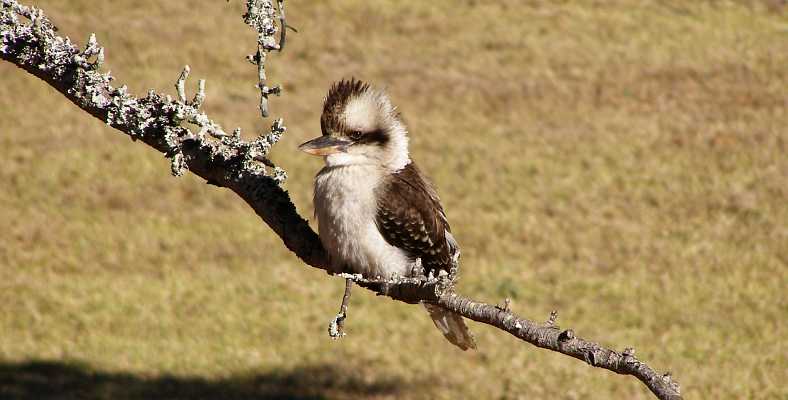
Baby kookaburra. Sitting on a branch of the tall pine near my front verandah, this young fellow allowed me to photograph him.
The years I had lived there had been nothing but enjoyment. Peace and quiet, the daily drive to pick up the mail, the animals around us, not too far from the towns of Stanthorpe and Warwick. But also the scope it gave me for my work, it placed me perfectly to enable me to travel in many directions each weekend, to see sights of all kinds as I did so.
I used to tell people, “One day I decided to count the cars going by, but I gave up at three.” In response to their quizzical looks I would explain, “It was lunchtime!” And it is true that Janet and I used to get up each morning and check the wind direction. That would determine which verandah we’d sit on to have our breakfast. And we had a toaster on each verandah.
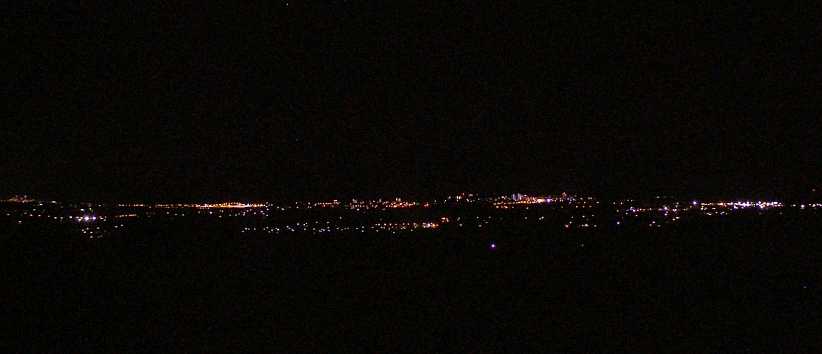
Lights of the Gold Coast. One evening coming away from the Gold Coast I managed to get this picture of the lights of this ever-growing city.
Winter is always the dry season in the broader area where I lived. Known as the ‘Granite Belt’, 2018’s Winter was going to be harder than usual because we were in drought and really starting to feel it. Nowhere was it better shown than across the road at the farm where they’d developed a lot of land for vegetable growing and watered it extensively from that dam seen coming down the road from Dalveen to my place. But now…
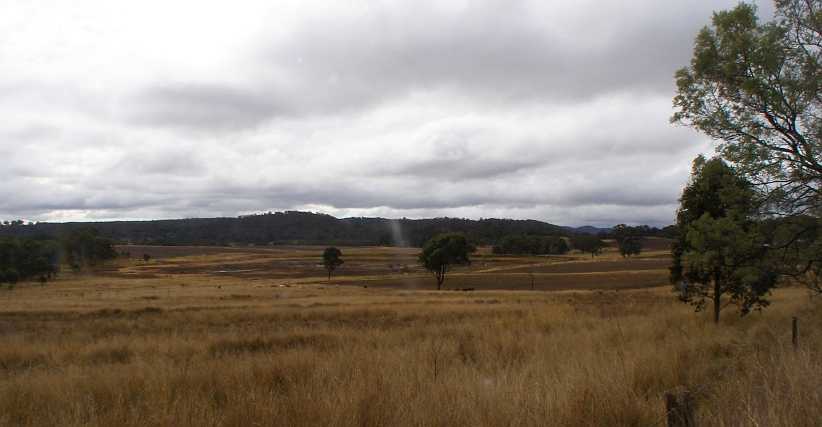
Onset of drought. What was normally an attractive body of water surrounded by green turned into varying shades of brown as the rains stayed away in early to mid-2018.
…the vegetable beds were all dry and their cattle were eating only dried out grass stalks and drinking from small ponds which contained all the water left in the dam.
My work, of course, continued. And to show further my flexibility, this photo is of the sunrise as I’d got an early start on Saturday and was well-advanced on my way to Armidale when the glow came in the Eastern sky:
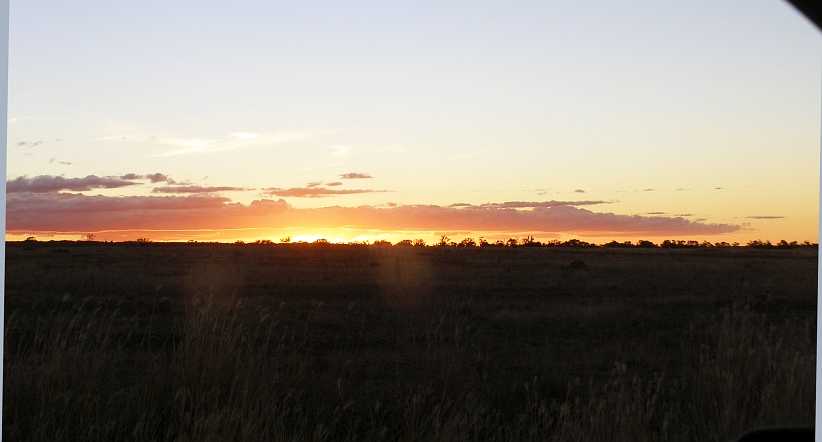
Sunrise on the way to Armidale. This time the glow in the sky is to my left, and it’s clear here that the weather had not been very co-operative with farmers.
Now we were advancing into July and the colourful leaves of autumn were a memory. The days were bright and clear, of course, but the nights and mornings were very brisk. It reminds me of when my son was planning on going to the university there, the brochure told him that Winters were ‘invigorating.’
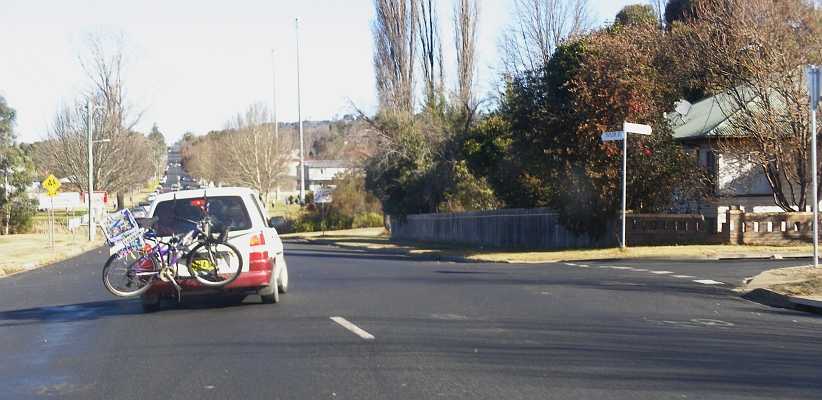
Signs of Winter. Trees which were once full of leaves and full of colour were now dead sticks and quite unattractive.
As I headed home on the Monday I dropped in to the hot-rod shop at Glen Innes. I was still chasing more of those 1940-47 Ford wheels and hoped they’d give me a lead on some. They couldn’t, but I managed to have a look around anyway and found some old Mopars of interest:
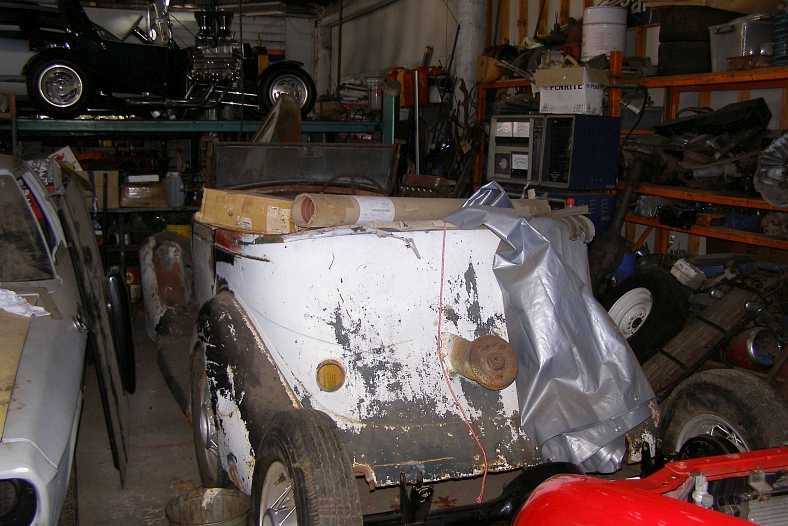
Plymouth phaeton. While there’s a neat hot-rod on the hoist in the background, tucked away in the shop was this Plymouth from the mid-thirties. As most sold here were sedans, this was a rare car.
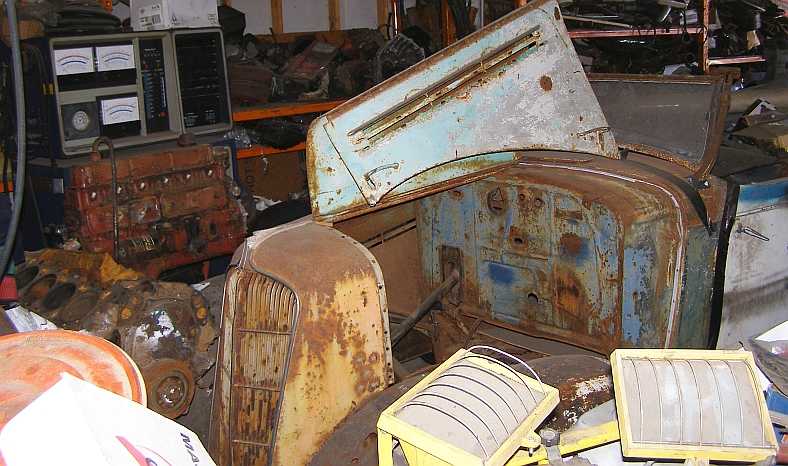
Up front. The grille identifies it as a 1935 model while the engines off to the side are other than Mopar. The Holden six is from 1963 to 1983 while the V8 block is a Chevy.
Out in the yard was a Dodge of similar vintage – or a couple of years newer – which is road-ready as a classy old pickup:
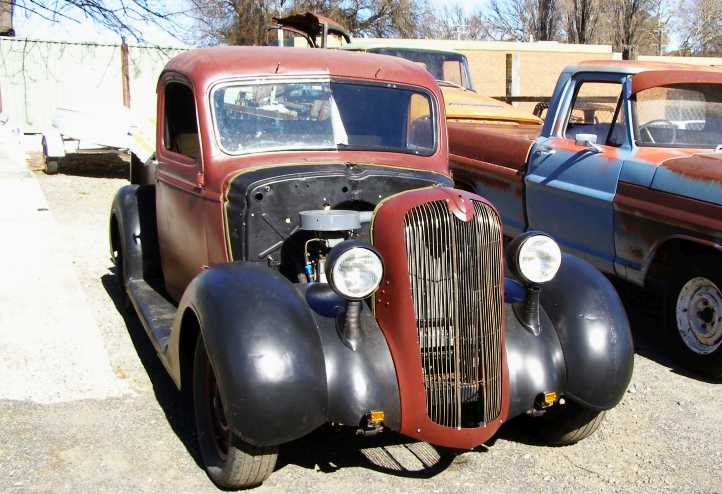
Dodge pickup hot-rod. Some features look a bit different to standard, but it seems the old flathead 6 was considered good enough to work with.
Home and Sandra’s place, just keeping pace with doing my washing and topping up the engine oil gave little time for much else apart from shopping. One day, however, I captured this nice sunset in the Western sky. The clouds brought nothing in the way of rain, by the way…
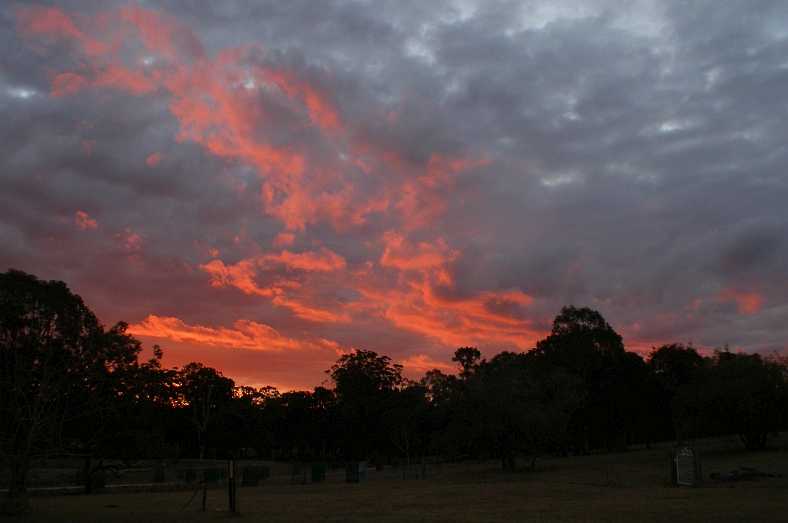
Dalveen sunset. Another day which had promised rain but didn’t deliver ended with a colourful display at sunset.
The following weekend I was off to the Tweed Heads area again. I remember well the problem I had this weekend with the motel, the Blue Pelican, where smokers again spoiled my stay. But out on the road I spotted this nice De Soto and the driver was good enough to pull up and let me have a good look:
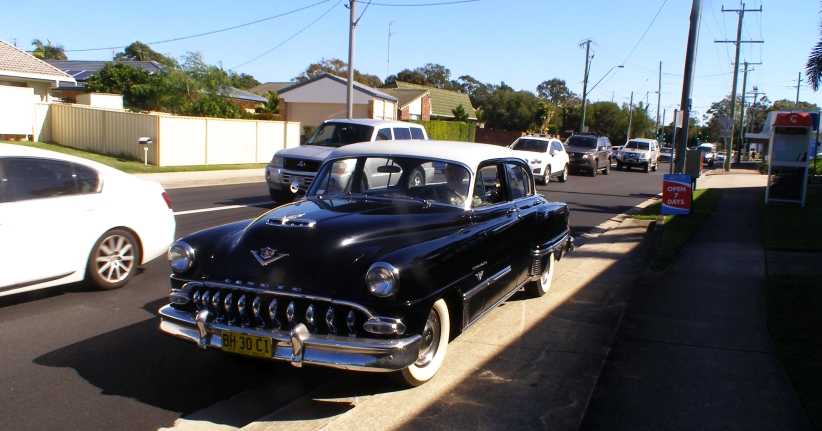
1953 De Soto. Another model never sold in Australia. Until 1957 we only got ‘badge engineered’ cars, Plymouth, Dodge and De Soto shared the Plymouth body and the last of these was the 1954 model. This car is a Firedome V8 model and remains left hand drive.
Towards the end of Sunday I got to meet another Mopar fancier. There were three homes on the one property and at the one occupied by one of the sons this Dart was garaged…
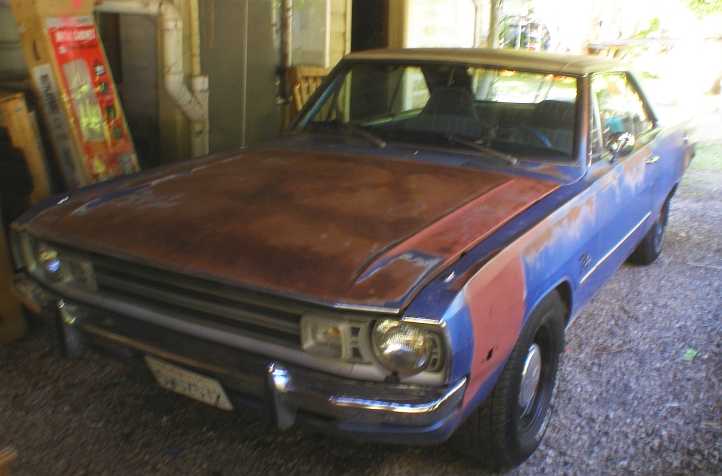
Dodge Dart. Yet another import, this Dart was about to be prepared for painting and other restoration.
…along with a few other Mopars but I couldn’t get pics of them.
This led into a two-week stay at home, as I was to work at Tenterfield the following weekend. Of course, I did trek up to see Sandra for a few days, but Tenterfield is just an hour down the road and I spent the nights at home while working there. It was at this point that the railway teams reached Dalveen with their sleeper-replacement gear, and wasn’t there some gear!
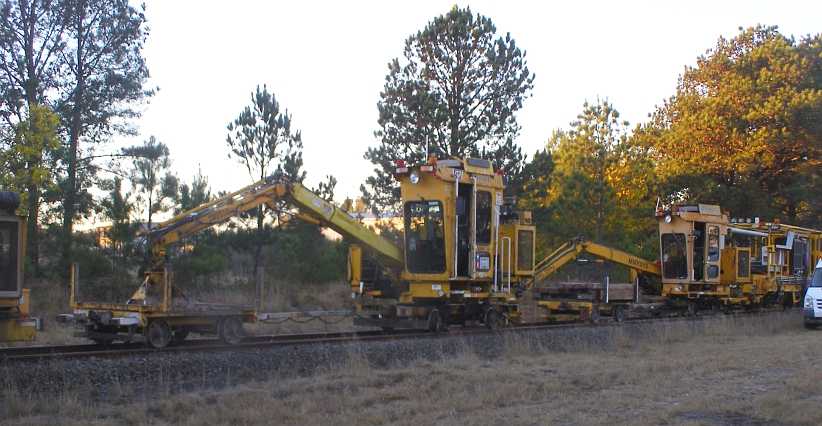
Lots of equipment. The team working on the line had plenty of hydraulics to help them, this is just a part of it.
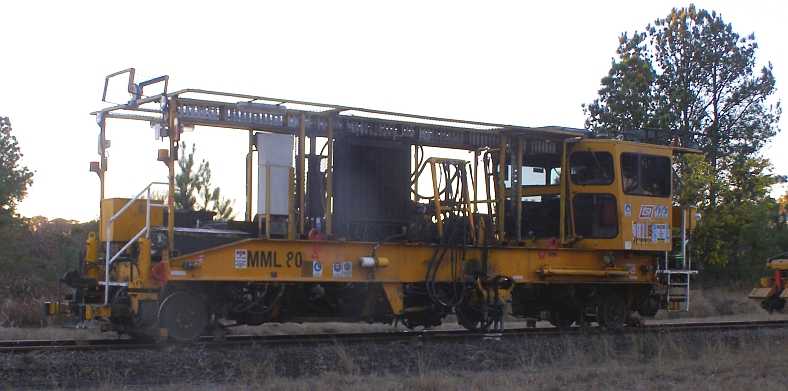
Labour saver. This machine is the one which ejects the old sleepers from beneath the rails, fascinating to watch.
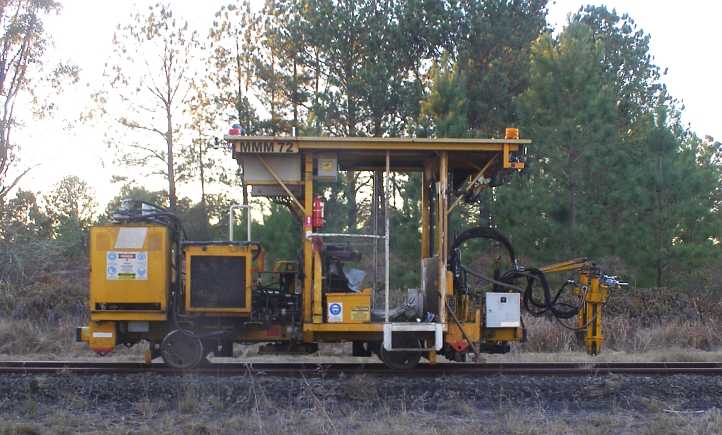
Removals specialist. Pulling the spikes out of the sleepers so they can be cast aside falls to this one.
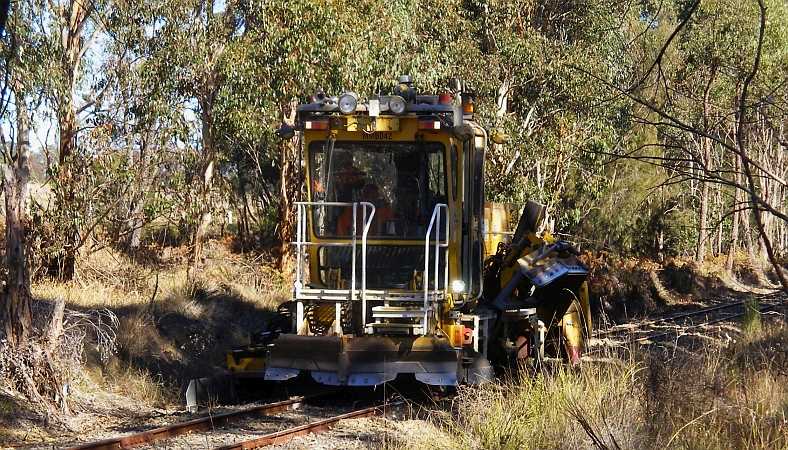
More hydraulics. I’m not sure what this one did but it sure looks important with all those guards around it.
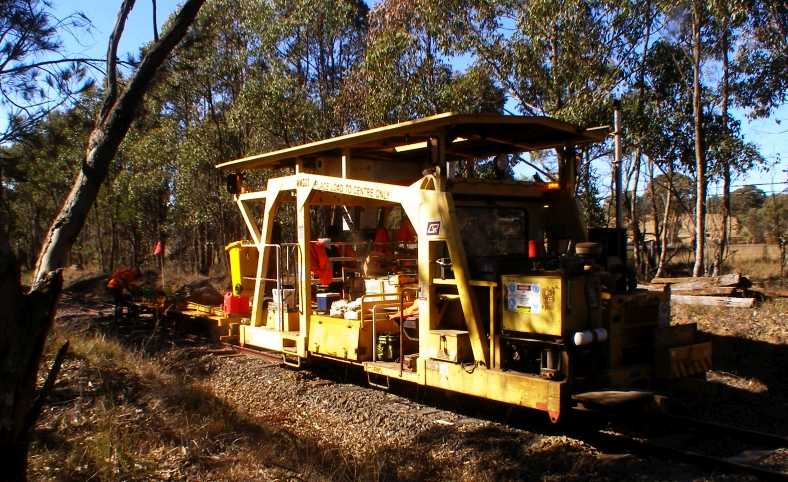
More specialised gear. Another one I can’t identify the purpose, but imposing so it must have been important.
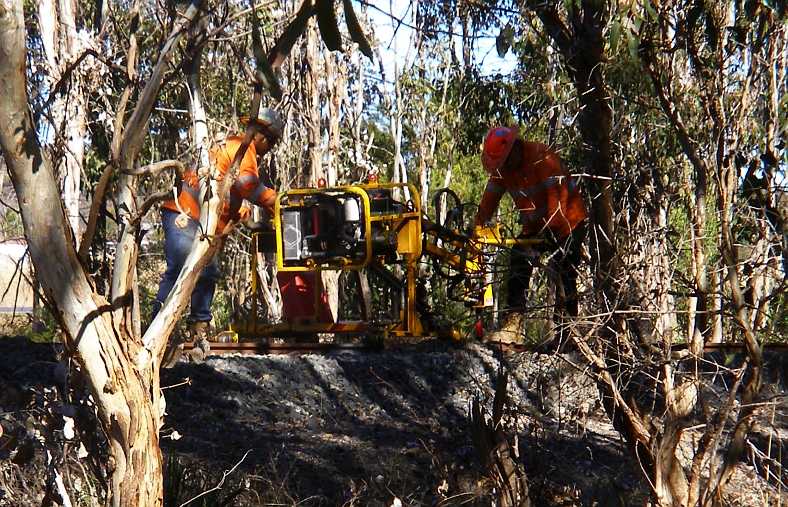
Drilling. Only a small machine here which operators used to drill holes for the new spikes in the new sleepers.
It was most impressive to see these at work, slinging sleepers (old and new) back and forth at great speed:
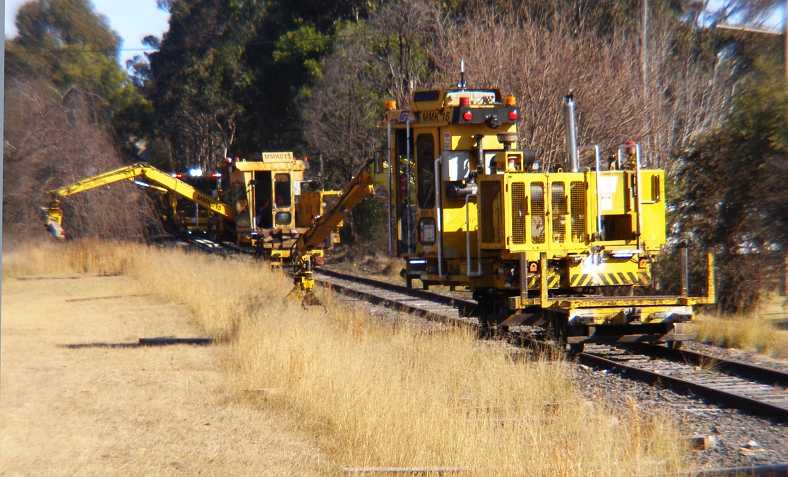
Swinging times. These machines were really quick in operation and that operation was effected by some very-experienced men if the way I saw them moving things around was anything to go by.
I did manage to get hold of a number of the old sleepers for use due to meeting the head ganger on the job after hours. He said we could take what we wanted as long as they’d cleared that area as a worksite, so another friend and I picked up a couple of dozen of them.
And then I got stuck into getting the wiring for the rear lights fixed up in the van. What I had to do was bypass the whole brake light/rear indicator setup and run fresh wires the length of the van. It looked like it was too hard to make any sense of doing this over top of the doors so I decided to go underneath. But first, let’s explain what I was doing:
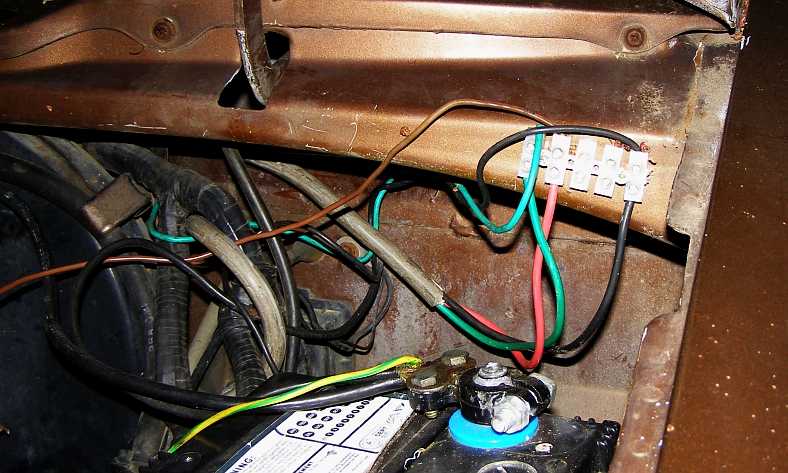
Wiring joiner. I did tidy this up a bit later, but what I did here was bring a wire from the right front indicator (green) and the left front indicator (black) to this junction point. A wire which tapped into the power supply wire to the reversing light switch (brown) is there too.
From this junction point it all went into an old household extension cord that I used to run the length of the van. But just inside the cabin I broke into that for the purpose of hooking up the brake light switch I showed a couple of posts ago.
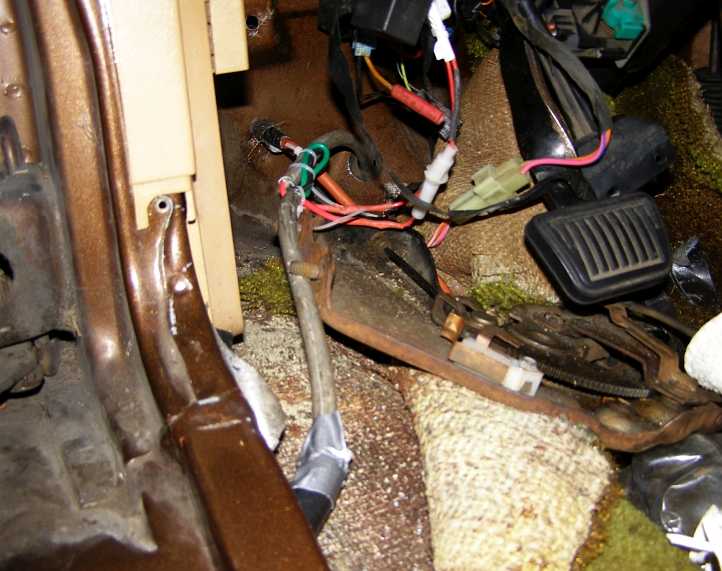
Wiring into box section. I drilled into the box section inboard of the door here and fed the complete wiring ‘loom’ through that so it ran down into the box section under the driver’s step.
I know, it was all overkill, but I was determined that it should be impervious to problems. Down below the step…
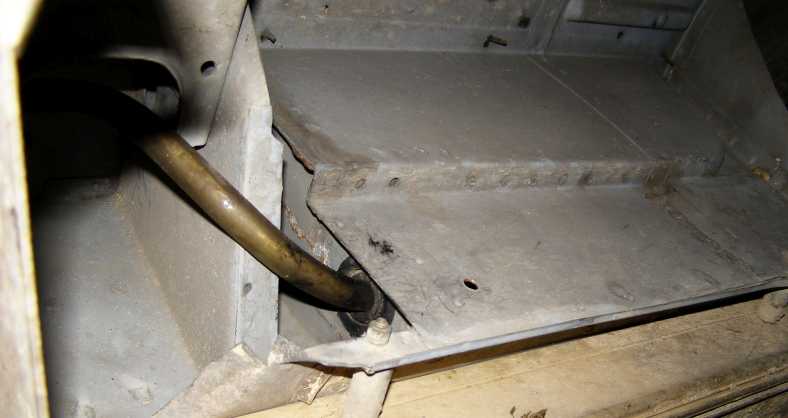
Through the step. All of this was to get the wiring safely past the door. I found a nice grommet which did the job of keeping the wires safe and preventing water getting into the step, while I also put a bit of heavy plastic tube around the wiring for good measure.
It feeds from there up through the square hole you can see, then there’s another round hole into which I put a piece of stainless steel tube from an old hospital couch someone had lying around:
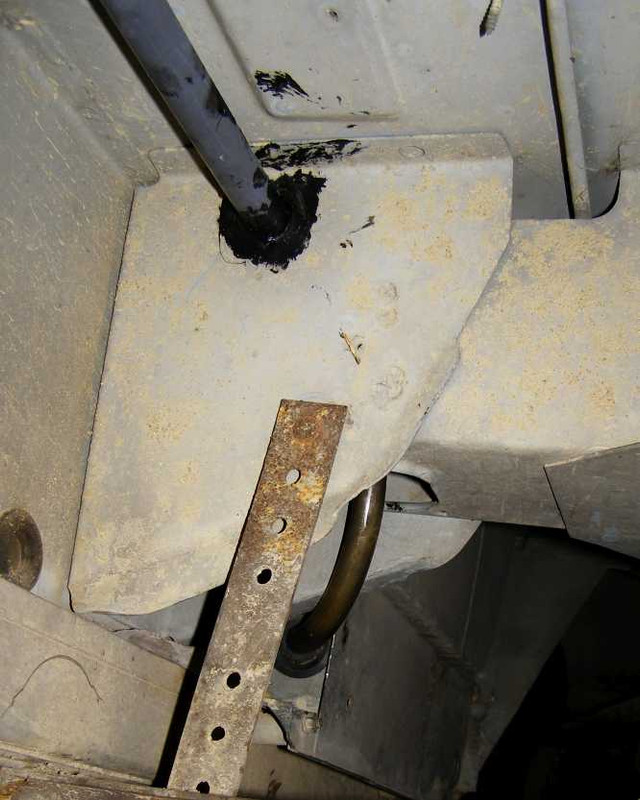
Stainless steel. Nothing but the best! The 3-core flex line headed towards the rear safe as houses in this tube.
There was actually a join required in the tube, but another piece fitted neatly over this one and everywhere there was a chance of moisture getting in I lavished Sikaflex on it.
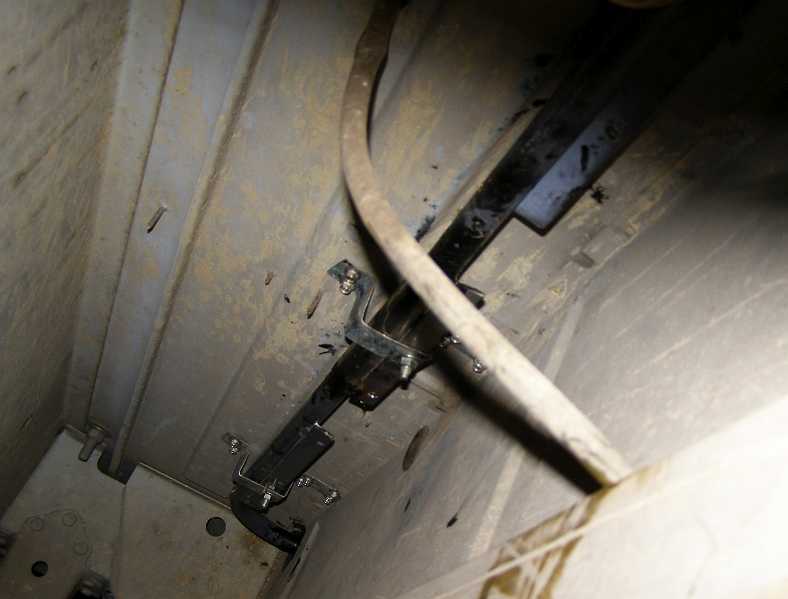
Into the sill. Again using an existing hole in the body I put the bend in the tube into the sill and the wiring ran free inside the wall of the van from that point.
And during that week I was notified that I was needed to do a survey of tenants of Aboriginal Housing. I would have to be in Sydney for a briefing and I’d be going to even more remote areas than those in which I normally worked. Place names like Mungindi, Brewarrina, Lightning Ridge and Bourke were mentioned.
So when I bade Sandra goodbye and headed off to Lismore to work that weekend I was going to be away for a week, and in the coming weeks I’d be working during the week as well as weekends.
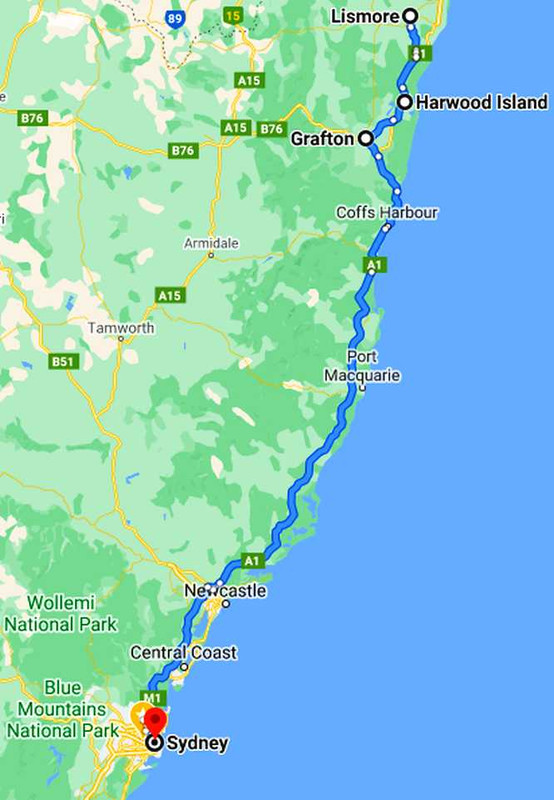
After completing the Lismore assignment I headed off down back-roads to get to the Pacific Highway…
This was on Monday morning. I couldn’t resist taking this photo of a tree growing inside what was either a tank or a silo…
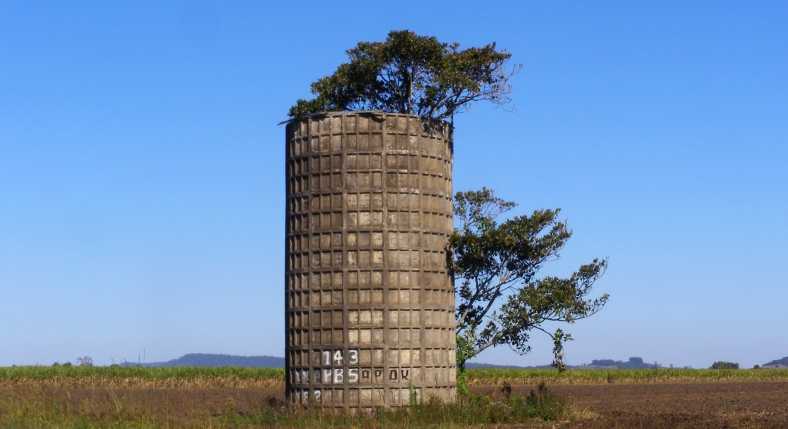
Tree in tank. This tree has made its home here, growing in the sediment at the bottom of the tank. Or was it a silo?
…and I made a stop at an Op Shop (‘Thrift Store’ in American) to add a couple of shirts to my travelling wardrobe. After all, I’d be away from home a lot more and washing opportunities might be reduced.
It was the first time I’d been along this stretch of the Pacific Highway in a long time and it had changed a lot. To put that in perspective, over the past thirty years the upgrading of the highway to freeway standard between the Gold Coast and just North of Newcastle has been in progress. About two years before this the Queensland end had been completed as far as Ballina (on the coast at the same level as Lismore) while from the Sydney end it was done to about twenty miles North of Coffs Harbour. Except for Coffs Harbour itself, which still required a bypass.
So there was about 90 miles apart from the Coffs Harbour bypass to be done and it was all being done at once. Some of it was a long way removed from the existing highway, but some was to be a duplication of the old road or right alongside of it. It was one of these stretches which gave me the biggest surprise:
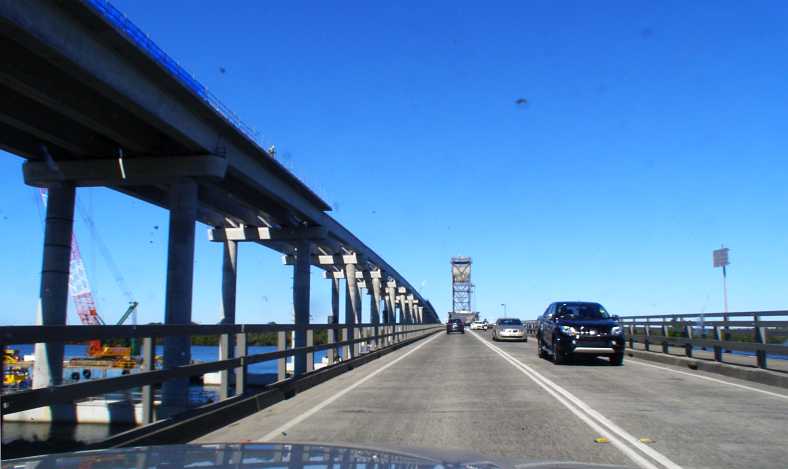
Surprise bridge. What a huge bridge this is! The Harwood Island bridge over which I’m driving here has a span which is elevated to allow shipping through but the new bridge goes right up to that height without such a span.
Of course, such a tall bridge requires long approaches and it’s all a part of the massive roadworks being done to complete the 90-mile link.
And while I was being surprised by one new bridge, I diverted into Grafton to get a look at how their replacement bridge was getting along…
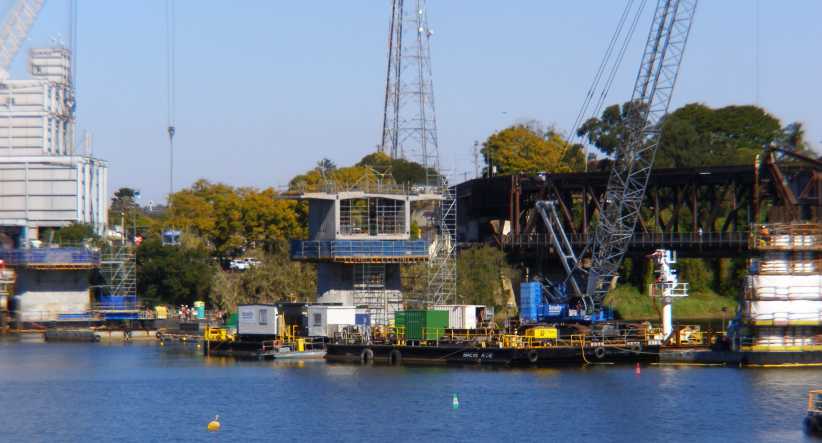
Grafton bridge progress. Now the alignment of the bridge could be seen as one pier was carrying the section with the road decking. The next pier was also emerging from the river.
I got into Sydney in the evening and went to see a former employer of mine at Kingsford…
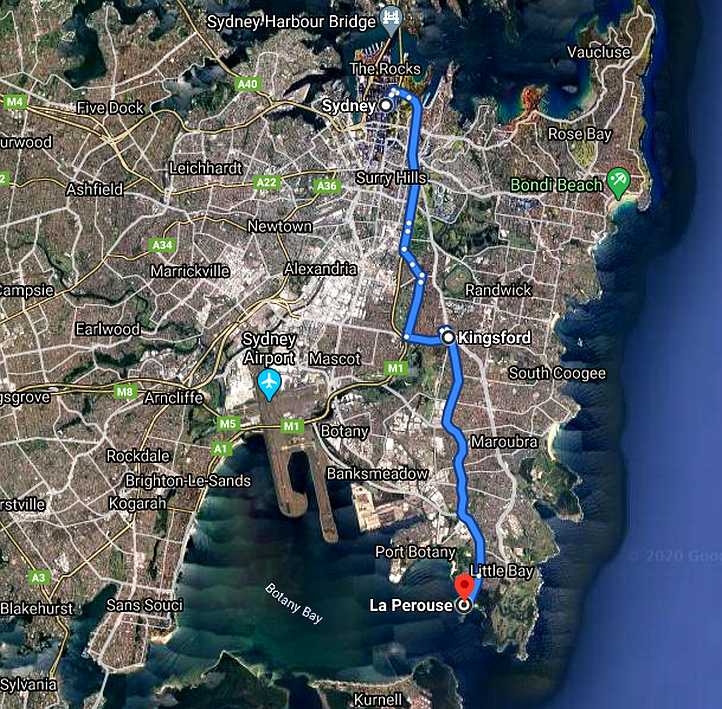
Sam is from Lebanon and I used to enjoy working for him as a courier driver. After that I had to find somewhere to camp for the night. I decided not to travel too far and went all the way to La Perouse before I found a nice quiet and safe spot to lay the seat back. Of course I woke early…
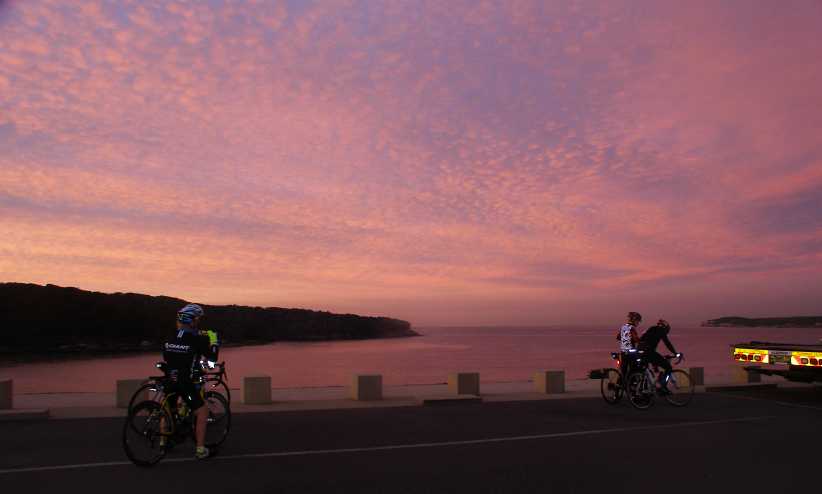
Botany Bay sunrise. Waking early has its compensations at times. I was surprised at the number of people out cycling for exercise, too.
…and looked out across the heads of Botany Bay. This was originally the place where the First Fleet was supposed to sail in and set up the colony under Arthur Phillip, but they soon found that Port Jackson (Sydney Harbour) was better suited to their needs.
La Perouse is named after the Count de La Perouse, who was on a voyage of exploration at the same time the First Fleet were sailing. His crew was attacked by natives on a Pacific Island and they lost 30 men and their longboats, so they decided to head to the only known safe place anywhere around – Botany Bay, so they could get the bones of new longboats out of their hiding places in their ships and put them together.
They arrived at Botany Bay the same hour that the First Fleet started to sail in, coming from the North while Phillip was coming from the South. When they sailed away six weeks later it was the last time Europeans saw them.
But I still had to get to my briefing in the city so I grabbed an early breakfast and drove in close so I’d get a parking spot before the crowds arrived...
Apparently the agents had been told to advise me of this in January, but even in June I was only hearing second-hand reports and I remained optimistic that it wasn’t true. All the same, it concerned me that I’d be leaving things like this behind:
Baby kookaburra. Sitting on a branch of the tall pine near my front verandah, this young fellow allowed me to photograph him.
The years I had lived there had been nothing but enjoyment. Peace and quiet, the daily drive to pick up the mail, the animals around us, not too far from the towns of Stanthorpe and Warwick. But also the scope it gave me for my work, it placed me perfectly to enable me to travel in many directions each weekend, to see sights of all kinds as I did so.
I used to tell people, “One day I decided to count the cars going by, but I gave up at three.” In response to their quizzical looks I would explain, “It was lunchtime!” And it is true that Janet and I used to get up each morning and check the wind direction. That would determine which verandah we’d sit on to have our breakfast. And we had a toaster on each verandah.
Lights of the Gold Coast. One evening coming away from the Gold Coast I managed to get this picture of the lights of this ever-growing city.
Winter is always the dry season in the broader area where I lived. Known as the ‘Granite Belt’, 2018’s Winter was going to be harder than usual because we were in drought and really starting to feel it. Nowhere was it better shown than across the road at the farm where they’d developed a lot of land for vegetable growing and watered it extensively from that dam seen coming down the road from Dalveen to my place. But now…
Onset of drought. What was normally an attractive body of water surrounded by green turned into varying shades of brown as the rains stayed away in early to mid-2018.
…the vegetable beds were all dry and their cattle were eating only dried out grass stalks and drinking from small ponds which contained all the water left in the dam.
My work, of course, continued. And to show further my flexibility, this photo is of the sunrise as I’d got an early start on Saturday and was well-advanced on my way to Armidale when the glow came in the Eastern sky:
Sunrise on the way to Armidale. This time the glow in the sky is to my left, and it’s clear here that the weather had not been very co-operative with farmers.
Now we were advancing into July and the colourful leaves of autumn were a memory. The days were bright and clear, of course, but the nights and mornings were very brisk. It reminds me of when my son was planning on going to the university there, the brochure told him that Winters were ‘invigorating.’
Signs of Winter. Trees which were once full of leaves and full of colour were now dead sticks and quite unattractive.
As I headed home on the Monday I dropped in to the hot-rod shop at Glen Innes. I was still chasing more of those 1940-47 Ford wheels and hoped they’d give me a lead on some. They couldn’t, but I managed to have a look around anyway and found some old Mopars of interest:
Plymouth phaeton. While there’s a neat hot-rod on the hoist in the background, tucked away in the shop was this Plymouth from the mid-thirties. As most sold here were sedans, this was a rare car.
Up front. The grille identifies it as a 1935 model while the engines off to the side are other than Mopar. The Holden six is from 1963 to 1983 while the V8 block is a Chevy.
Out in the yard was a Dodge of similar vintage – or a couple of years newer – which is road-ready as a classy old pickup:
Dodge pickup hot-rod. Some features look a bit different to standard, but it seems the old flathead 6 was considered good enough to work with.
Home and Sandra’s place, just keeping pace with doing my washing and topping up the engine oil gave little time for much else apart from shopping. One day, however, I captured this nice sunset in the Western sky. The clouds brought nothing in the way of rain, by the way…
Dalveen sunset. Another day which had promised rain but didn’t deliver ended with a colourful display at sunset.
The following weekend I was off to the Tweed Heads area again. I remember well the problem I had this weekend with the motel, the Blue Pelican, where smokers again spoiled my stay. But out on the road I spotted this nice De Soto and the driver was good enough to pull up and let me have a good look:
1953 De Soto. Another model never sold in Australia. Until 1957 we only got ‘badge engineered’ cars, Plymouth, Dodge and De Soto shared the Plymouth body and the last of these was the 1954 model. This car is a Firedome V8 model and remains left hand drive.
Towards the end of Sunday I got to meet another Mopar fancier. There were three homes on the one property and at the one occupied by one of the sons this Dart was garaged…
Dodge Dart. Yet another import, this Dart was about to be prepared for painting and other restoration.
…along with a few other Mopars but I couldn’t get pics of them.
This led into a two-week stay at home, as I was to work at Tenterfield the following weekend. Of course, I did trek up to see Sandra for a few days, but Tenterfield is just an hour down the road and I spent the nights at home while working there. It was at this point that the railway teams reached Dalveen with their sleeper-replacement gear, and wasn’t there some gear!
Lots of equipment. The team working on the line had plenty of hydraulics to help them, this is just a part of it.
Labour saver. This machine is the one which ejects the old sleepers from beneath the rails, fascinating to watch.
Removals specialist. Pulling the spikes out of the sleepers so they can be cast aside falls to this one.
More hydraulics. I’m not sure what this one did but it sure looks important with all those guards around it.
More specialised gear. Another one I can’t identify the purpose, but imposing so it must have been important.
Drilling. Only a small machine here which operators used to drill holes for the new spikes in the new sleepers.
It was most impressive to see these at work, slinging sleepers (old and new) back and forth at great speed:
Swinging times. These machines were really quick in operation and that operation was effected by some very-experienced men if the way I saw them moving things around was anything to go by.
I did manage to get hold of a number of the old sleepers for use due to meeting the head ganger on the job after hours. He said we could take what we wanted as long as they’d cleared that area as a worksite, so another friend and I picked up a couple of dozen of them.
And then I got stuck into getting the wiring for the rear lights fixed up in the van. What I had to do was bypass the whole brake light/rear indicator setup and run fresh wires the length of the van. It looked like it was too hard to make any sense of doing this over top of the doors so I decided to go underneath. But first, let’s explain what I was doing:
Wiring joiner. I did tidy this up a bit later, but what I did here was bring a wire from the right front indicator (green) and the left front indicator (black) to this junction point. A wire which tapped into the power supply wire to the reversing light switch (brown) is there too.
From this junction point it all went into an old household extension cord that I used to run the length of the van. But just inside the cabin I broke into that for the purpose of hooking up the brake light switch I showed a couple of posts ago.
Wiring into box section. I drilled into the box section inboard of the door here and fed the complete wiring ‘loom’ through that so it ran down into the box section under the driver’s step.
I know, it was all overkill, but I was determined that it should be impervious to problems. Down below the step…
Through the step. All of this was to get the wiring safely past the door. I found a nice grommet which did the job of keeping the wires safe and preventing water getting into the step, while I also put a bit of heavy plastic tube around the wiring for good measure.
It feeds from there up through the square hole you can see, then there’s another round hole into which I put a piece of stainless steel tube from an old hospital couch someone had lying around:
Stainless steel. Nothing but the best! The 3-core flex line headed towards the rear safe as houses in this tube.
There was actually a join required in the tube, but another piece fitted neatly over this one and everywhere there was a chance of moisture getting in I lavished Sikaflex on it.
Into the sill. Again using an existing hole in the body I put the bend in the tube into the sill and the wiring ran free inside the wall of the van from that point.
And during that week I was notified that I was needed to do a survey of tenants of Aboriginal Housing. I would have to be in Sydney for a briefing and I’d be going to even more remote areas than those in which I normally worked. Place names like Mungindi, Brewarrina, Lightning Ridge and Bourke were mentioned.
So when I bade Sandra goodbye and headed off to Lismore to work that weekend I was going to be away for a week, and in the coming weeks I’d be working during the week as well as weekends.
After completing the Lismore assignment I headed off down back-roads to get to the Pacific Highway…
This was on Monday morning. I couldn’t resist taking this photo of a tree growing inside what was either a tank or a silo…
Tree in tank. This tree has made its home here, growing in the sediment at the bottom of the tank. Or was it a silo?
…and I made a stop at an Op Shop (‘Thrift Store’ in American) to add a couple of shirts to my travelling wardrobe. After all, I’d be away from home a lot more and washing opportunities might be reduced.
It was the first time I’d been along this stretch of the Pacific Highway in a long time and it had changed a lot. To put that in perspective, over the past thirty years the upgrading of the highway to freeway standard between the Gold Coast and just North of Newcastle has been in progress. About two years before this the Queensland end had been completed as far as Ballina (on the coast at the same level as Lismore) while from the Sydney end it was done to about twenty miles North of Coffs Harbour. Except for Coffs Harbour itself, which still required a bypass.
So there was about 90 miles apart from the Coffs Harbour bypass to be done and it was all being done at once. Some of it was a long way removed from the existing highway, but some was to be a duplication of the old road or right alongside of it. It was one of these stretches which gave me the biggest surprise:
Surprise bridge. What a huge bridge this is! The Harwood Island bridge over which I’m driving here has a span which is elevated to allow shipping through but the new bridge goes right up to that height without such a span.
Of course, such a tall bridge requires long approaches and it’s all a part of the massive roadworks being done to complete the 90-mile link.
And while I was being surprised by one new bridge, I diverted into Grafton to get a look at how their replacement bridge was getting along…
Grafton bridge progress. Now the alignment of the bridge could be seen as one pier was carrying the section with the road decking. The next pier was also emerging from the river.
I got into Sydney in the evening and went to see a former employer of mine at Kingsford…
Sam is from Lebanon and I used to enjoy working for him as a courier driver. After that I had to find somewhere to camp for the night. I decided not to travel too far and went all the way to La Perouse before I found a nice quiet and safe spot to lay the seat back. Of course I woke early…
Botany Bay sunrise. Waking early has its compensations at times. I was surprised at the number of people out cycling for exercise, too.
…and looked out across the heads of Botany Bay. This was originally the place where the First Fleet was supposed to sail in and set up the colony under Arthur Phillip, but they soon found that Port Jackson (Sydney Harbour) was better suited to their needs.
La Perouse is named after the Count de La Perouse, who was on a voyage of exploration at the same time the First Fleet were sailing. His crew was attacked by natives on a Pacific Island and they lost 30 men and their longboats, so they decided to head to the only known safe place anywhere around – Botany Bay, so they could get the bones of new longboats out of their hiding places in their ships and put them together.
They arrived at Botany Bay the same hour that the First Fleet started to sail in, coming from the North while Phillip was coming from the South. When they sailed away six weeks later it was the last time Europeans saw them.
But I still had to get to my briefing in the city so I grabbed an early breakfast and drove in close so I’d get a parking spot before the crowds arrived...
Last edited by Ray Bell; Oct 31, 2020 at 05:49 AM.

Thread Starter
|
Captain
Joined: Oct 2005
Posts: 568
Likes: 8
From: The Summit, Queensland, Australia
Once I heard of this extra work I was looking forward to it. Mileage allowances are a fair bit of my income while on jobs like this the distances and brief working times once there mean they comprise even more. Looking at it from this point of view it was going to be a bit of a ‘money in the bank’ job, though I was in a bit of need at the time.
But the first task was to do the training briefing in Sydney. That only took a couple of hours and then I was free to spend a bit of time, and as I’d arranged to stay a couple of nights at Bob Britton’s place that was where I headed, though I did stop in to see Malcolm Smith on the way.
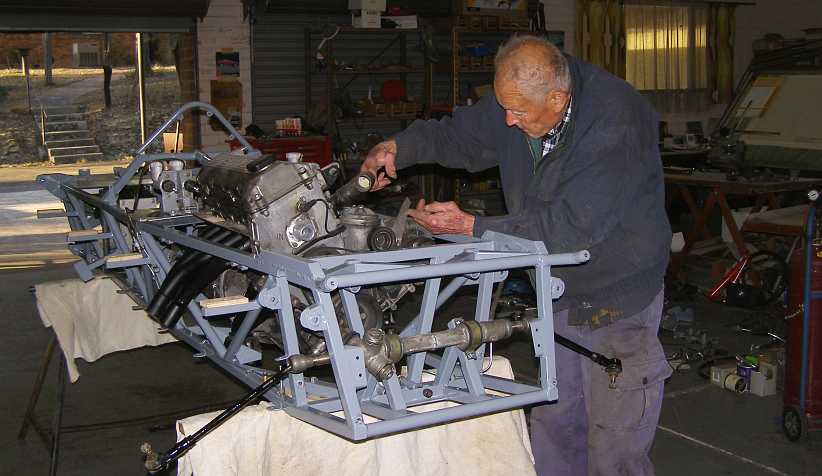
Chassis blasted and painted. The chassis of the open-wheeler had been stripped, sand-blasted and painted, now some final jobs were being done to fit everything in.
Here Bob is working out where the water hose can go if he raises the alternator in an area where things were getting tight. And the fitment of exhaust extractors (headers) had been got off to a good start…
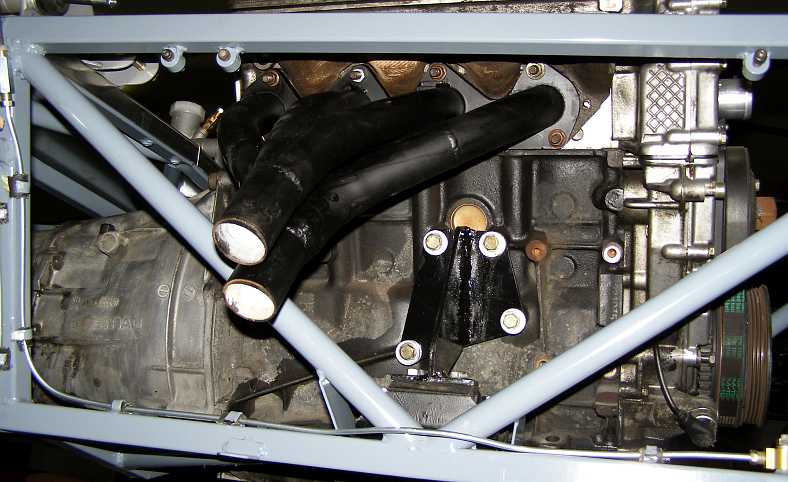
Neat pipes. Tony Zammit helped Bob out by bending and welding up some neat exhaust pipes to suit.
…while the really tricky bit, drop gears at the front of the final drive, were all Bob’s making. He machined up the blanks and had the gears cut almost fifty years ago for a driver who was killed in an accident before he got them, the order was cancelled by the widow. Now he machined up a case from aluminium plate and bolted it together, then bolted it to the front of the BMW housing:
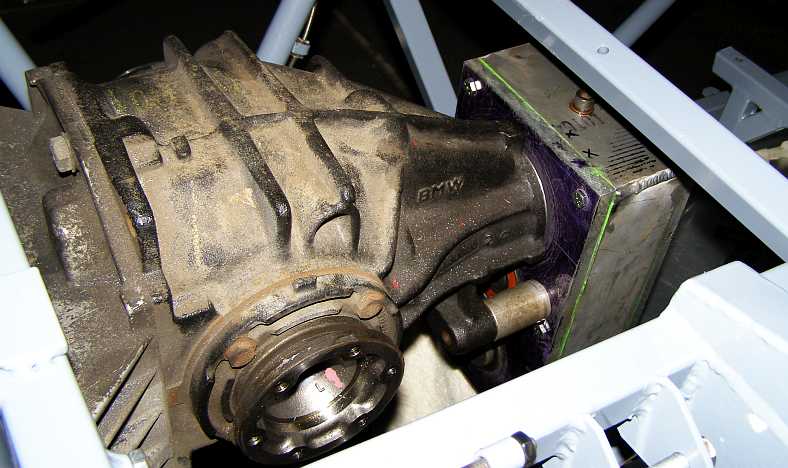
Drop gear case. The purpose of this is to lower the driveshaft so that the driver can sit down lower, three gears inside the case keep the shafts turning in the right direction.
Lots of machining of the plates and the shafts brought it all together…
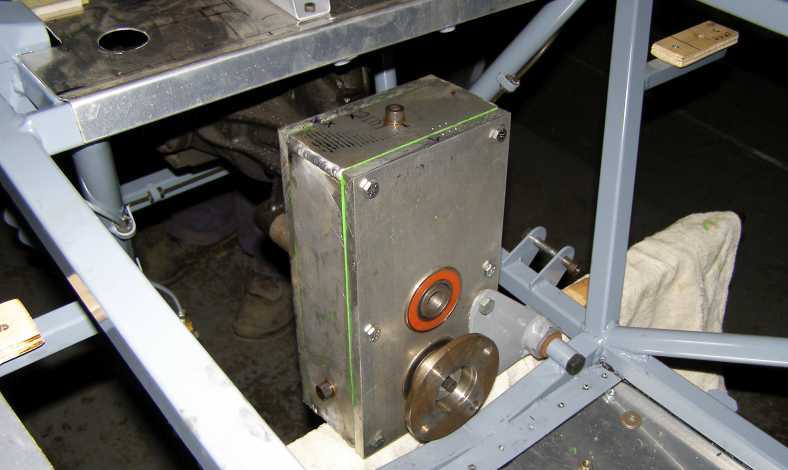
From the front… The driveshaft couldn’t be any lower than this, while sealed bearings are used on the intermediate shaft to keep the oil in.
…and the original BMW rear cover is bolted to the frame using the original flexible mounts:
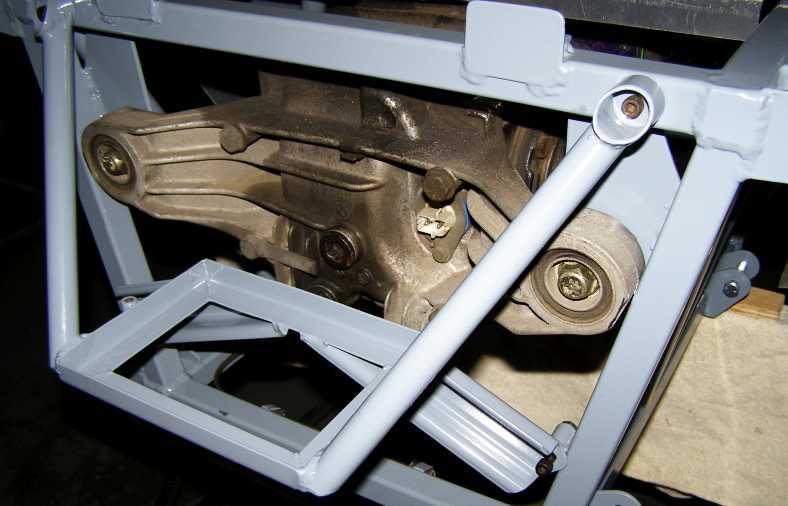
Handling the torque. The ‘ears’ on the rear bolt up to the frame to keep the final drive from turning with the torque reaction of the drive.
Another bit of fabrication is the fuel tank, along with its hold-down strap:
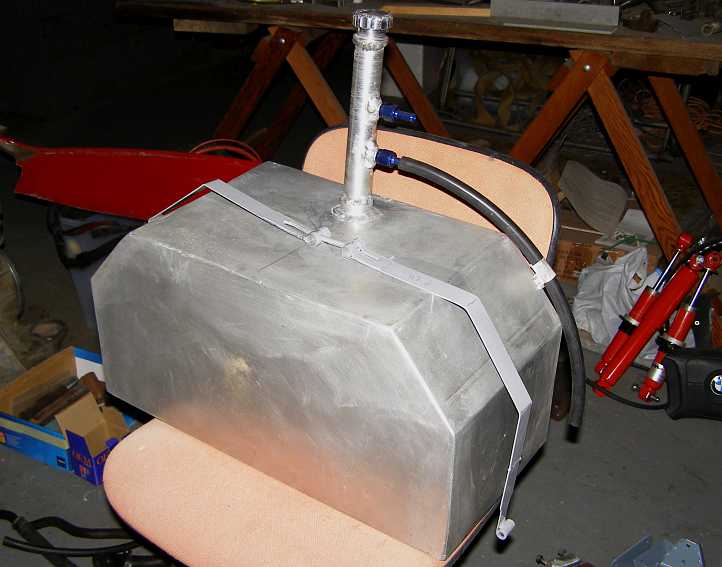
Fuel tank. Not a huge tank, but designed to fit into the tail of the car over top of the final drive.
And while all of this was coming together for Bob over the past few months, another car was given to him to provide bits for another project. Ray Eldershaw’s nephew had done the wrong thing with a Commodore and it was no longer suitable for road use, so it landed at Bob’s place.
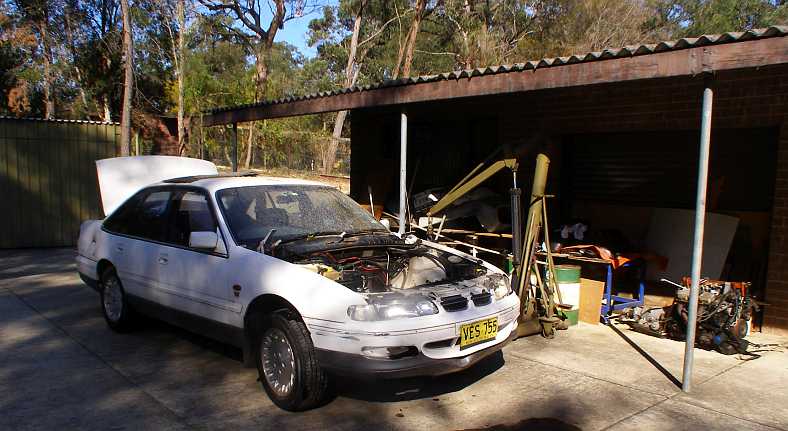
Commodore engine out. The V6 in this car is similar to the one in the earlier car Bob built, again sporting an automatic transmission.
Bob was happy to let me loose with the spanners dismantling this thing. First of all on his ramps, which go from the end of the drive out over a 6’ drop in the terrain, in this comfortable position I undid everything necessary underneath. Driveshaft, gearbox mount, engine mounts, exhausts, linkages and wires.
Then, with the barest minimum of bolts still holding the gearbox in place, we moved the car to this position and I got to work on everything on the top side. Then Bob wheeled out his big hydraulic crane (seen here the other side of the car) and using his adjustable lifter the whole lot came out and found a place on the concrete.
This was all an aside at the moment, of course, though Bob did have plans about what he might use it for. Those plans, however, included mounting it with a 5-speed manual transmission (which he had bought previously) while the automatic off this one would go in the earlier car which had a problem in that department. I learned that Bob had bought that 5-speed without getting the flywheel and clutch, and that they were difficult to find, so I promised I’d keep my eyes peeled for one.
Of more immediate import, however, was the completion of the BMW-powered open-wheeler. The bodywork fitted up well:
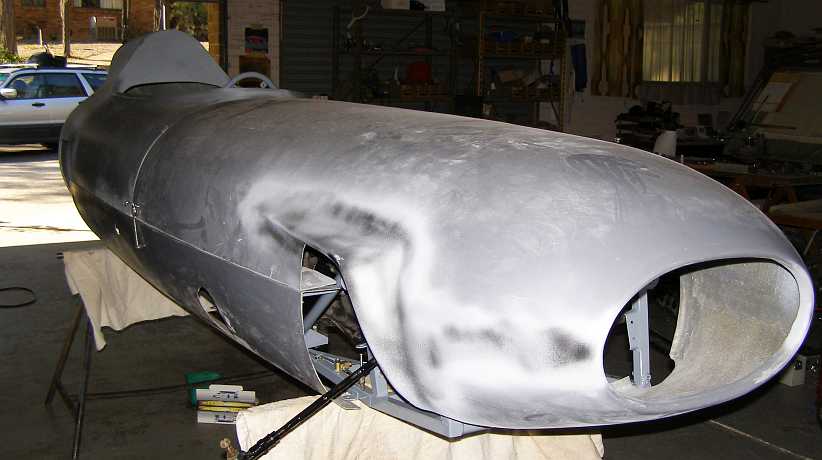
Body fit. Les Puklowski had done a good job of creating the body panels from Bob’s buck, they sat well on the chassis and the car was starting to look really good. Note the ‘egg cup’ locater just inside the body ensuring the upper and lower sections lined up.
I was satisfied at being able to help Bob get a few jobs done. Another task I had was to remove the end wall on the shed in the background, Bob had got a machine in to level a bit more ground and was extending his ‘museum’ shed by two bays to enable him to store all his cars.
And so I headed off to Tamworth and Bob Abberfield’s place, where I stayed over the weekend while working just the other side of the mountain from the city. This was an area where people built homes on elevated larger blocks of land, frequently people with hobbies akin to things I like. One bloke had this 1940s Dodge truck front in his yard…
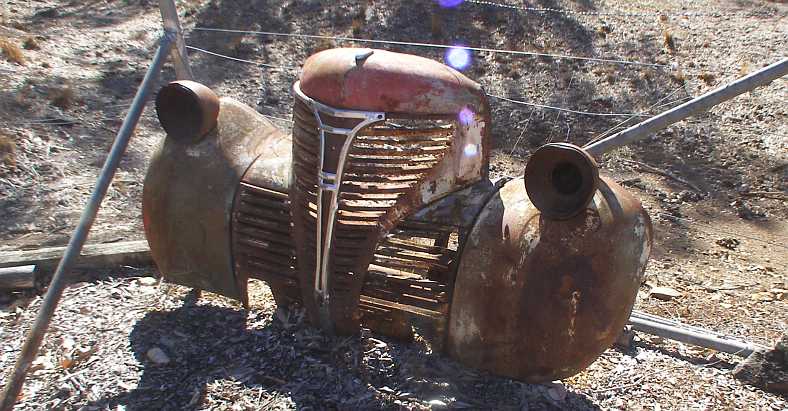
Dodge truck grille. No plans were expressed for what might be happening to this in the future, it was just an ornament in a drought-parched corner.
…while his workshop had two hoists, one of them containing what we know as a Dodge Phoenix:
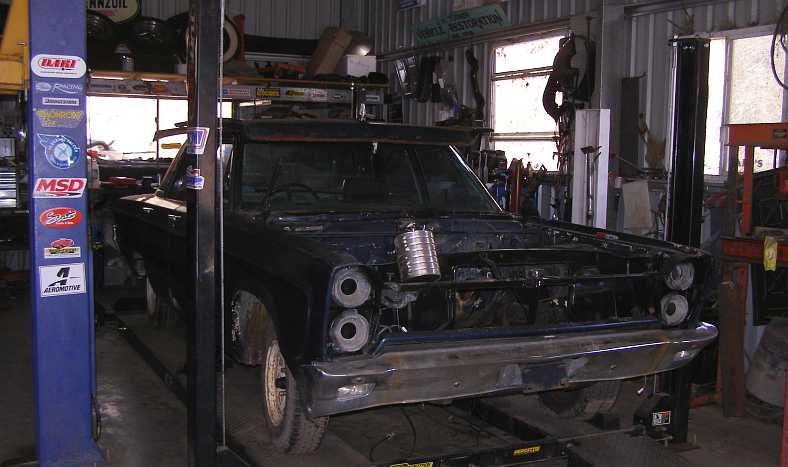
Dodge Phoenix. From the mid-sixties, when the current Plymouth sold here as a Dodge with a 318 Poly and 727.
It was, as mentioned, an elevated area, so from a lot of the homes there were good views over the Peel River valley.
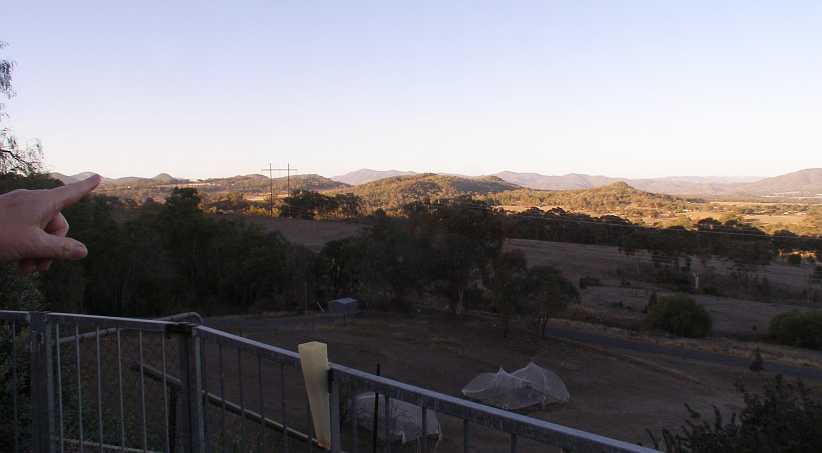
Distant views. One of my respondents points out a distant landmark from her expansive patio area. Nets over fruit trees are a sign of frosty Winter mornings.
Then I drove home. Just imagine my relief when this happened right at home the next day:
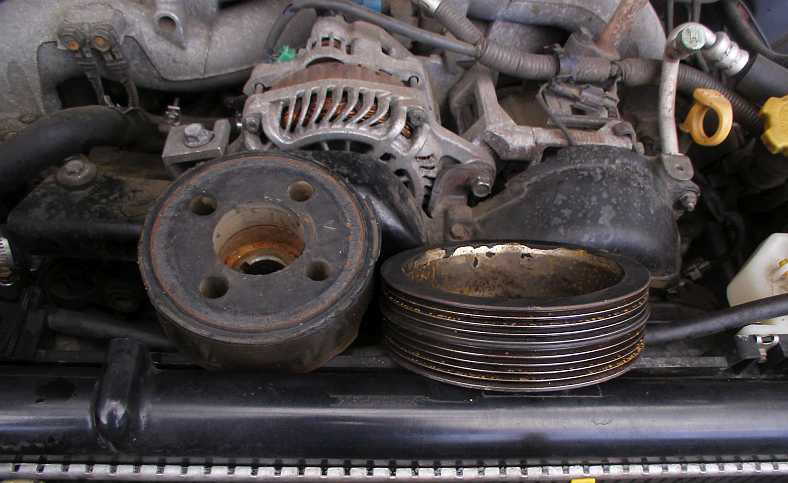
Harmonic balancer separated. Shades of what happened to Sandra’s Falcon a few months earlier, this one came completely apart.
If that had happened when I was hundreds of kilometres from home, as I had been for a week and a half, it would have been a real problem. But at home there was a spare quite handy on one of the other engines.
I mentioned earlier that I had a need to earn some extra funds. This was because in the previous year I’d paid out quite a bit of money to help Sandra’s youngest son get a Partner Visa to bring his wife and children to Australia to live. In Cambodia, where they live, the amount required increased quite a bit because of graft and corruption to do with the authorities there who had to prepare paperwork for him too. Birth certificates, Police checks, Passports, it was all over the top but I managed to find enough to get most of it happening.
And Sandra was now talking about getting a denture as she’d broken a front tooth and others were missing.
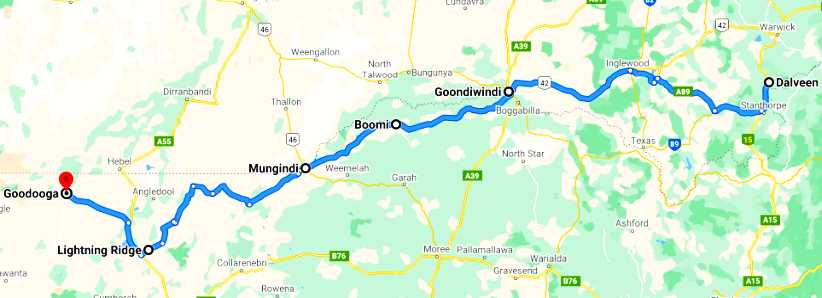
It was over 600kms just driving out there, that’s without the kilometres I’d do running around towns chasing up addresses and going back when people weren’t at home.
We must keep in mind here that there was a need to look out for some car parts. I needed a Commodore V6 flywheel for Bob and Glendon asked me to look for a ‘33 Dodge chassis (he has a fully-restored body to go on that) and I was looking for a chassis suitable for another project I have in mind for the future.
I saw a likely-looking place at the little hamlet of Boomi:
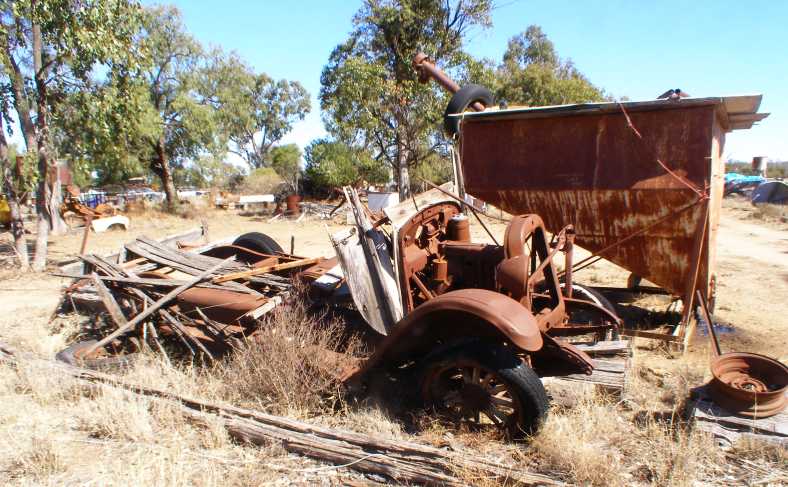
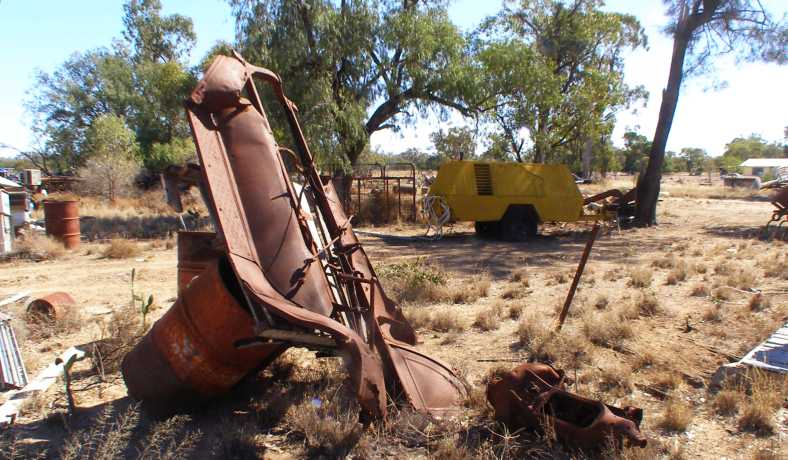
Chev 4 relic. A 4-cylinder Chev from the twenties didn’t meet any of the qualifications I was looking for.
On the same property there was the remains of a Ford T-model, again, not suiting any of the immediate needs but worth reporting to Bob Trevan…
T-model Ford. The engine and gearbox are partially stripped and lying in the dust, the chassis looks to have been almost picked clean.
I’d been making calls to do the quick interviews at a couple of places along the way, next I had to see some people at Mungindi. This is a town right on the border of Queensland and NSW and where a bridge crosses the river to link the two halves of the town. Oddly, the NSW police station is at one end of the bridge in full view of the Queensland police station.
Some years ago I’d become acquainted with Ross Seymour, who was something of a collector of Dodge trucks he bought, generally, from clearance sales when people were selling properties.
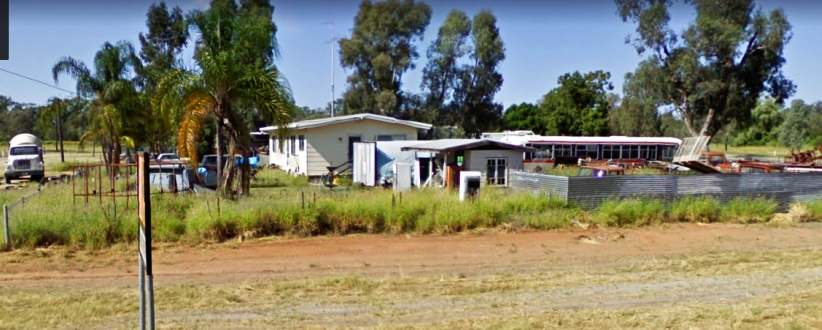
Ross Seymour’s home. Some of his Dodge trucks can be seen in the backyard of his home, right on the edge of town.
The road from there to my next destination, Lightning Ridge, was sealed for almost twenty miles. Then it was a reasonable gravel road (in good weather) from there to Collarenebri. But I wasn’t to stay on that road, I was going via some other less-likely roads to ‘The Ridge.’
This was a place where I had a large list of people to call on, so I had two nights accommodation there. But on the way, and only just after that sealed road ended, I spotted something of interest:
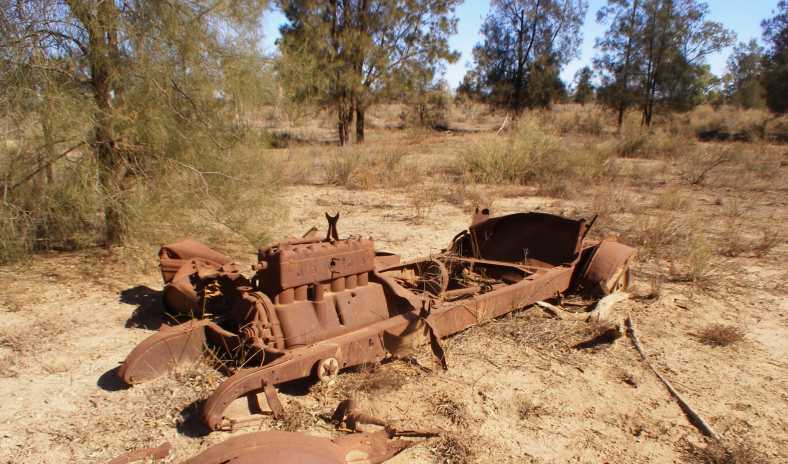
Jewett remains. This was a chassis I could work with for my project! It had a couple of attributes I was looking for, but it would have to be retrieved from this location using my Forester.
Driving on I pondered how I could accomplish this. But my thinking was distracted by the need to avoid turning one of these emus…
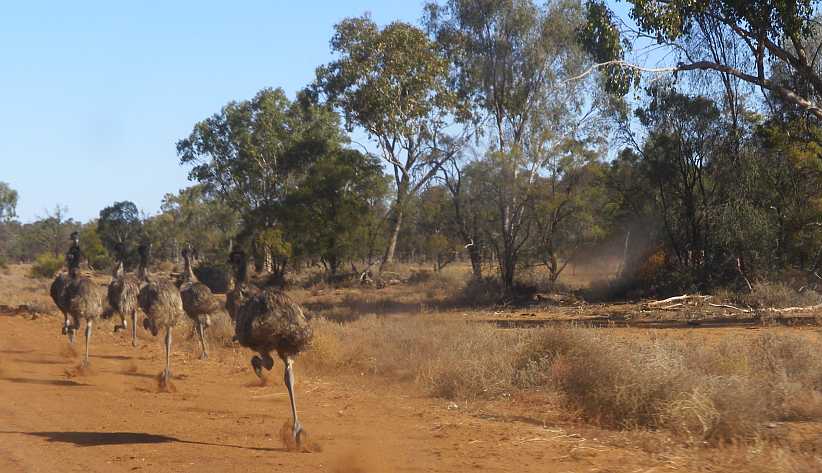
Emus on the run. This kind of country is home to wildlife not seen nearer populations centres, I frightened these emus and they were trying to get away from me.
…into barbecue material. They quickly got to running and I tried to get a better pic of them, not succeeding terribly well:
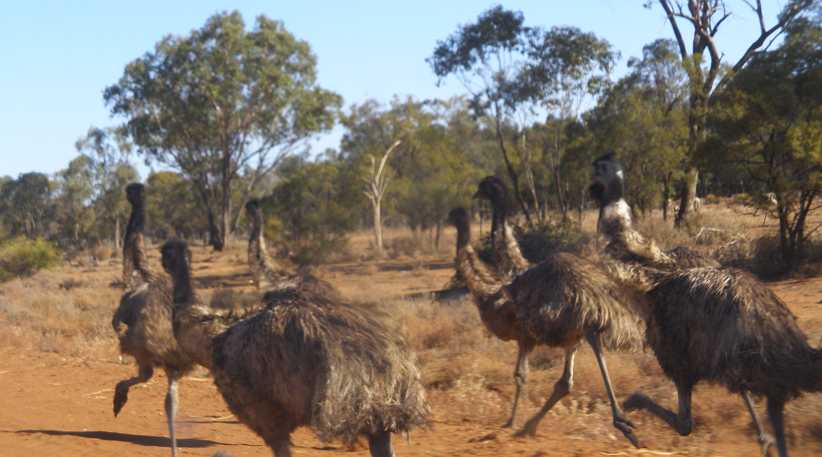
Close-up. While I was driving alongside they were already looking for an escape route…
They turned and headed for the fence, behind which a few sheep were eking out an existence in the dry paddock:
Into the fence. Too blurry to see much here, but as they got to the fence and tried to get over or through it, the threat – me – was going away. Several of them fell over at this point.
There were many properties through which I was to drive on this road. The system allows landowners to not fence their property from little-used roads like this provided they put a grid and gate at their boundaries. Here’s a grid with a grim warning, the gate’s on the other side…
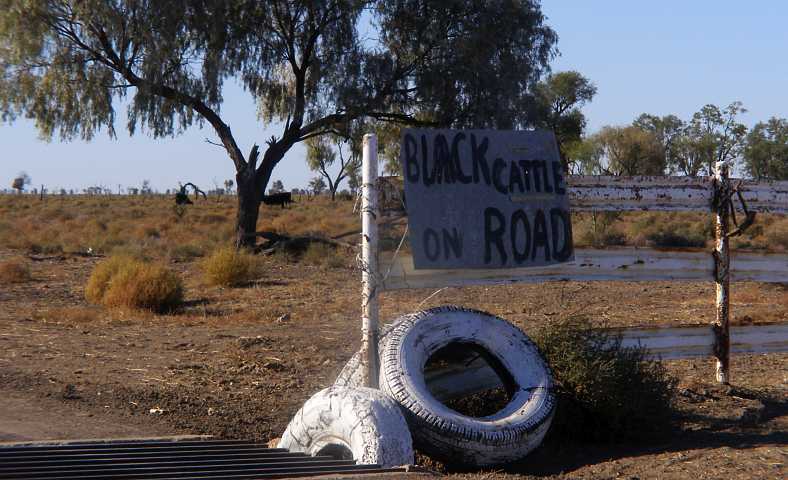
Black cattle. I’d several years ago learned how black the North end of a Southbound black Angus was at night, a sign not to be ignored.
Once in Lightning Ridge I got stuck into doing my interviews. Lightning Ridge is an opal-mining town with claims all over the place and people often living and working in very rudimentary situations. There is a solid nucleus to the town, however, with neat streets and houses, and this is where I was to find most of my respondents.
The purpose of this job, which we did for the NSW Aboriginal Housing people, was to find out how well (or otherwise) the service providers employed by the government to look after the properties were doing their job. It included questions about delays to do repairs, accessibility for information, whether or not they kept lessees informed of things and so on.
There was a wide range of responses, generally relating to the different providers. One seemed to be doing a particularly good job, another less so, yet another just frustratingly hopeless. Of course, through all of this you had to keep in mind that personality clashes might have an effect on their responses.
One bloke I met doing this had an inventive bent…
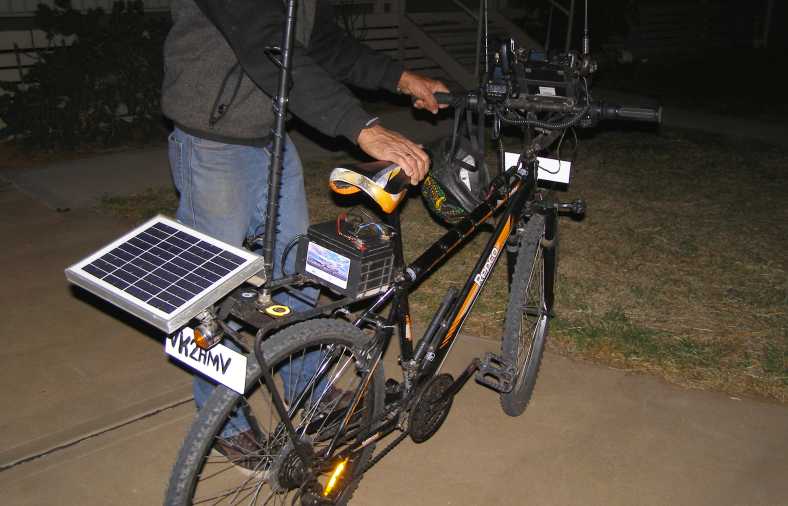
Bike with solar. A solar panel to drive the Ham Radios on his bicycle, something you don’t expect to see.
…and seemed to be making the most of things.
I ate at the dining room of the Bowling Club, which provided good meals at a reasonable price (though the company’s meal allowance wasn’t stingy) and got an all-day breakfast at a cafe in the main street. Looking around the town as I sought out the addresses on my list, I snapped a pic of the golf course:
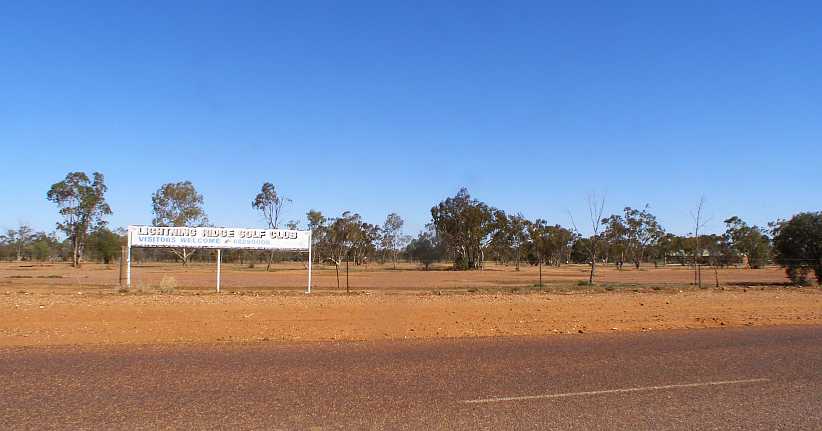
Lightning Ridge Golf Club. Finding a ‘green’ here might be a challenge, especially in droughts like the one being experienced in 2018.
In my motel room I logged into the AACA forum to see if I could get the Jewett identified. It didn’t take long for someone to come back with an answer for me.
On the Friday I moved on, hoping to complete some interviews in nearby (only 50 miles away) Goodooga. Then I’d be in a position to drive home via Hebel and Thallon, somewhere between six and seven hours for the drive. Plus a stop to eat.
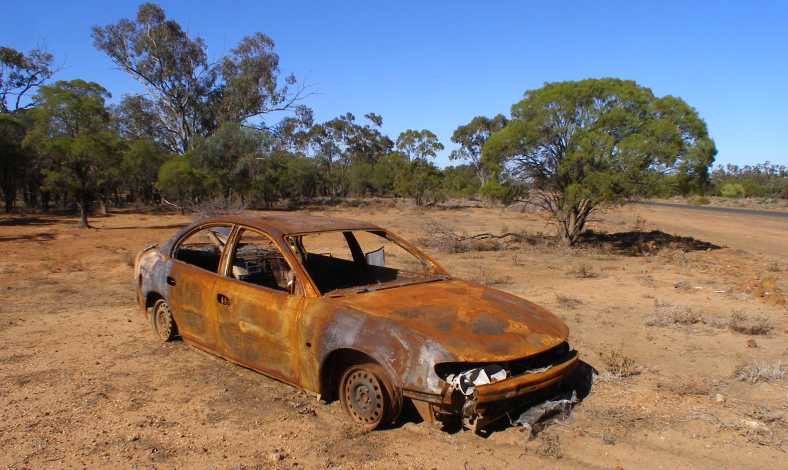
Goodooga Commodore. This one was an automatic too. I don’t know if it was stolen, broken down or what, but it certainly had plenty of fuel tipped on it to get it burned up like this.
Goodooga itself was a very small town and I had to find people both in the town proper and also in the Aboriginal settlement the government had set up to the North West, that’s in the semi-circle close to the river in this Google Earth view:
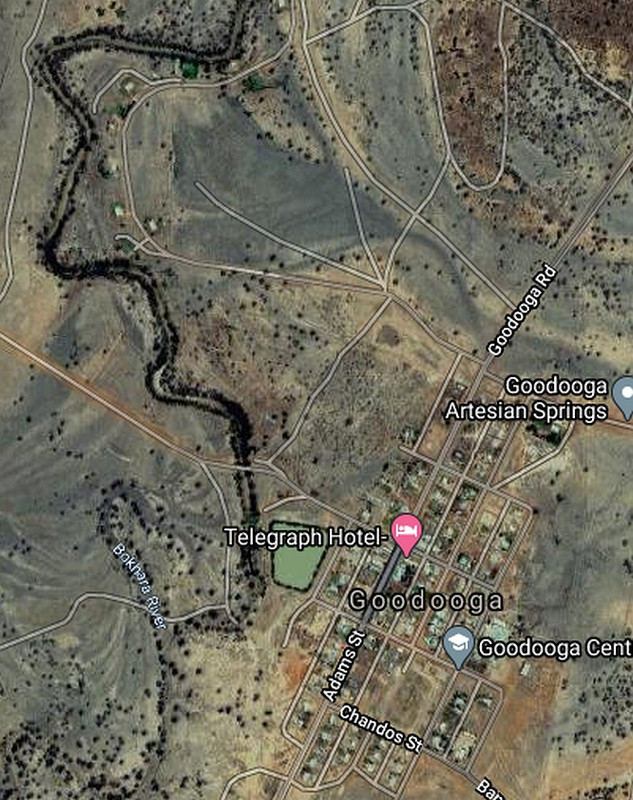
Goodooga. No doubt this was once a bustling settlement, but now it’s almost deserted. One store and one hotel is all that you’ll find operating here.
Google Maps won’t allow me to show my path directly from Goodooga to Hebel, but the road is there and visible, and I found it to be a decent gravel road for that distance. I was rushing a bit to get off it before darkness came, then I’d be on better roads all the way home. Eyes constantly straining, of course, to watch out for kangaroos.
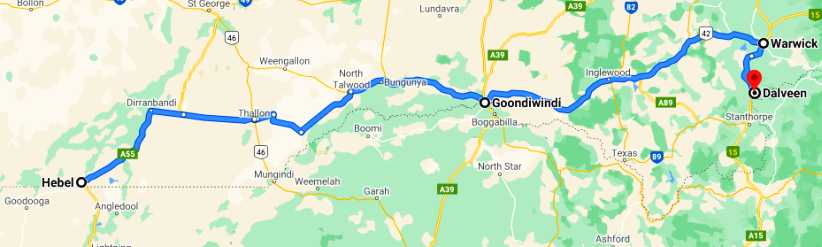
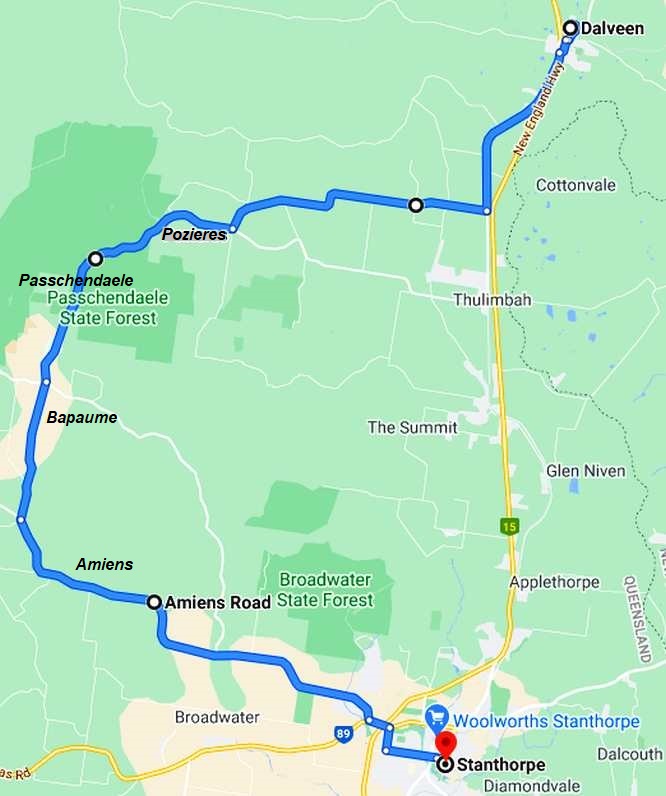
And this drive, from Goodooga to Dalveen was helping the mileage allowances to build up. It would be a late night after my first week on this job and I’d need to be up early to get away to do my regular weekend work at a local area called Bapaume along the road called Armistice Way, an area dedicated to remembering that blood-soaked part of the world and the horrors of the Great War…
But the first task was to do the training briefing in Sydney. That only took a couple of hours and then I was free to spend a bit of time, and as I’d arranged to stay a couple of nights at Bob Britton’s place that was where I headed, though I did stop in to see Malcolm Smith on the way.
Chassis blasted and painted. The chassis of the open-wheeler had been stripped, sand-blasted and painted, now some final jobs were being done to fit everything in.
Here Bob is working out where the water hose can go if he raises the alternator in an area where things were getting tight. And the fitment of exhaust extractors (headers) had been got off to a good start…
Neat pipes. Tony Zammit helped Bob out by bending and welding up some neat exhaust pipes to suit.
…while the really tricky bit, drop gears at the front of the final drive, were all Bob’s making. He machined up the blanks and had the gears cut almost fifty years ago for a driver who was killed in an accident before he got them, the order was cancelled by the widow. Now he machined up a case from aluminium plate and bolted it together, then bolted it to the front of the BMW housing:
Drop gear case. The purpose of this is to lower the driveshaft so that the driver can sit down lower, three gears inside the case keep the shafts turning in the right direction.
Lots of machining of the plates and the shafts brought it all together…
From the front… The driveshaft couldn’t be any lower than this, while sealed bearings are used on the intermediate shaft to keep the oil in.
…and the original BMW rear cover is bolted to the frame using the original flexible mounts:
Handling the torque. The ‘ears’ on the rear bolt up to the frame to keep the final drive from turning with the torque reaction of the drive.
Another bit of fabrication is the fuel tank, along with its hold-down strap:
Fuel tank. Not a huge tank, but designed to fit into the tail of the car over top of the final drive.
And while all of this was coming together for Bob over the past few months, another car was given to him to provide bits for another project. Ray Eldershaw’s nephew had done the wrong thing with a Commodore and it was no longer suitable for road use, so it landed at Bob’s place.
Commodore engine out. The V6 in this car is similar to the one in the earlier car Bob built, again sporting an automatic transmission.
Bob was happy to let me loose with the spanners dismantling this thing. First of all on his ramps, which go from the end of the drive out over a 6’ drop in the terrain, in this comfortable position I undid everything necessary underneath. Driveshaft, gearbox mount, engine mounts, exhausts, linkages and wires.
Then, with the barest minimum of bolts still holding the gearbox in place, we moved the car to this position and I got to work on everything on the top side. Then Bob wheeled out his big hydraulic crane (seen here the other side of the car) and using his adjustable lifter the whole lot came out and found a place on the concrete.
This was all an aside at the moment, of course, though Bob did have plans about what he might use it for. Those plans, however, included mounting it with a 5-speed manual transmission (which he had bought previously) while the automatic off this one would go in the earlier car which had a problem in that department. I learned that Bob had bought that 5-speed without getting the flywheel and clutch, and that they were difficult to find, so I promised I’d keep my eyes peeled for one.
Of more immediate import, however, was the completion of the BMW-powered open-wheeler. The bodywork fitted up well:
Body fit. Les Puklowski had done a good job of creating the body panels from Bob’s buck, they sat well on the chassis and the car was starting to look really good. Note the ‘egg cup’ locater just inside the body ensuring the upper and lower sections lined up.
I was satisfied at being able to help Bob get a few jobs done. Another task I had was to remove the end wall on the shed in the background, Bob had got a machine in to level a bit more ground and was extending his ‘museum’ shed by two bays to enable him to store all his cars.
And so I headed off to Tamworth and Bob Abberfield’s place, where I stayed over the weekend while working just the other side of the mountain from the city. This was an area where people built homes on elevated larger blocks of land, frequently people with hobbies akin to things I like. One bloke had this 1940s Dodge truck front in his yard…
Dodge truck grille. No plans were expressed for what might be happening to this in the future, it was just an ornament in a drought-parched corner.
…while his workshop had two hoists, one of them containing what we know as a Dodge Phoenix:
Dodge Phoenix. From the mid-sixties, when the current Plymouth sold here as a Dodge with a 318 Poly and 727.
It was, as mentioned, an elevated area, so from a lot of the homes there were good views over the Peel River valley.
Distant views. One of my respondents points out a distant landmark from her expansive patio area. Nets over fruit trees are a sign of frosty Winter mornings.
Then I drove home. Just imagine my relief when this happened right at home the next day:
Harmonic balancer separated. Shades of what happened to Sandra’s Falcon a few months earlier, this one came completely apart.
If that had happened when I was hundreds of kilometres from home, as I had been for a week and a half, it would have been a real problem. But at home there was a spare quite handy on one of the other engines.
I mentioned earlier that I had a need to earn some extra funds. This was because in the previous year I’d paid out quite a bit of money to help Sandra’s youngest son get a Partner Visa to bring his wife and children to Australia to live. In Cambodia, where they live, the amount required increased quite a bit because of graft and corruption to do with the authorities there who had to prepare paperwork for him too. Birth certificates, Police checks, Passports, it was all over the top but I managed to find enough to get most of it happening.
And Sandra was now talking about getting a denture as she’d broken a front tooth and others were missing.
It was over 600kms just driving out there, that’s without the kilometres I’d do running around towns chasing up addresses and going back when people weren’t at home.
We must keep in mind here that there was a need to look out for some car parts. I needed a Commodore V6 flywheel for Bob and Glendon asked me to look for a ‘33 Dodge chassis (he has a fully-restored body to go on that) and I was looking for a chassis suitable for another project I have in mind for the future.
I saw a likely-looking place at the little hamlet of Boomi:
Chev 4 relic. A 4-cylinder Chev from the twenties didn’t meet any of the qualifications I was looking for.
On the same property there was the remains of a Ford T-model, again, not suiting any of the immediate needs but worth reporting to Bob Trevan…
T-model Ford. The engine and gearbox are partially stripped and lying in the dust, the chassis looks to have been almost picked clean.
I’d been making calls to do the quick interviews at a couple of places along the way, next I had to see some people at Mungindi. This is a town right on the border of Queensland and NSW and where a bridge crosses the river to link the two halves of the town. Oddly, the NSW police station is at one end of the bridge in full view of the Queensland police station.
Some years ago I’d become acquainted with Ross Seymour, who was something of a collector of Dodge trucks he bought, generally, from clearance sales when people were selling properties.
Ross Seymour’s home. Some of his Dodge trucks can be seen in the backyard of his home, right on the edge of town.
The road from there to my next destination, Lightning Ridge, was sealed for almost twenty miles. Then it was a reasonable gravel road (in good weather) from there to Collarenebri. But I wasn’t to stay on that road, I was going via some other less-likely roads to ‘The Ridge.’
This was a place where I had a large list of people to call on, so I had two nights accommodation there. But on the way, and only just after that sealed road ended, I spotted something of interest:
Jewett remains. This was a chassis I could work with for my project! It had a couple of attributes I was looking for, but it would have to be retrieved from this location using my Forester.
Driving on I pondered how I could accomplish this. But my thinking was distracted by the need to avoid turning one of these emus…
Emus on the run. This kind of country is home to wildlife not seen nearer populations centres, I frightened these emus and they were trying to get away from me.
…into barbecue material. They quickly got to running and I tried to get a better pic of them, not succeeding terribly well:
Close-up. While I was driving alongside they were already looking for an escape route…
They turned and headed for the fence, behind which a few sheep were eking out an existence in the dry paddock:
Into the fence. Too blurry to see much here, but as they got to the fence and tried to get over or through it, the threat – me – was going away. Several of them fell over at this point.
There were many properties through which I was to drive on this road. The system allows landowners to not fence their property from little-used roads like this provided they put a grid and gate at their boundaries. Here’s a grid with a grim warning, the gate’s on the other side…
Black cattle. I’d several years ago learned how black the North end of a Southbound black Angus was at night, a sign not to be ignored.
Once in Lightning Ridge I got stuck into doing my interviews. Lightning Ridge is an opal-mining town with claims all over the place and people often living and working in very rudimentary situations. There is a solid nucleus to the town, however, with neat streets and houses, and this is where I was to find most of my respondents.
The purpose of this job, which we did for the NSW Aboriginal Housing people, was to find out how well (or otherwise) the service providers employed by the government to look after the properties were doing their job. It included questions about delays to do repairs, accessibility for information, whether or not they kept lessees informed of things and so on.
There was a wide range of responses, generally relating to the different providers. One seemed to be doing a particularly good job, another less so, yet another just frustratingly hopeless. Of course, through all of this you had to keep in mind that personality clashes might have an effect on their responses.
One bloke I met doing this had an inventive bent…
Bike with solar. A solar panel to drive the Ham Radios on his bicycle, something you don’t expect to see.
…and seemed to be making the most of things.
I ate at the dining room of the Bowling Club, which provided good meals at a reasonable price (though the company’s meal allowance wasn’t stingy) and got an all-day breakfast at a cafe in the main street. Looking around the town as I sought out the addresses on my list, I snapped a pic of the golf course:
Lightning Ridge Golf Club. Finding a ‘green’ here might be a challenge, especially in droughts like the one being experienced in 2018.
In my motel room I logged into the AACA forum to see if I could get the Jewett identified. It didn’t take long for someone to come back with an answer for me.
On the Friday I moved on, hoping to complete some interviews in nearby (only 50 miles away) Goodooga. Then I’d be in a position to drive home via Hebel and Thallon, somewhere between six and seven hours for the drive. Plus a stop to eat.
Goodooga Commodore. This one was an automatic too. I don’t know if it was stolen, broken down or what, but it certainly had plenty of fuel tipped on it to get it burned up like this.
Goodooga itself was a very small town and I had to find people both in the town proper and also in the Aboriginal settlement the government had set up to the North West, that’s in the semi-circle close to the river in this Google Earth view:
Goodooga. No doubt this was once a bustling settlement, but now it’s almost deserted. One store and one hotel is all that you’ll find operating here.
Google Maps won’t allow me to show my path directly from Goodooga to Hebel, but the road is there and visible, and I found it to be a decent gravel road for that distance. I was rushing a bit to get off it before darkness came, then I’d be on better roads all the way home. Eyes constantly straining, of course, to watch out for kangaroos.
And this drive, from Goodooga to Dalveen was helping the mileage allowances to build up. It would be a late night after my first week on this job and I’d need to be up early to get away to do my regular weekend work at a local area called Bapaume along the road called Armistice Way, an area dedicated to remembering that blood-soaked part of the world and the horrors of the Great War…
Last edited by Ray Bell; Nov 2, 2020 at 05:57 PM.
Thread Starter
|
Captain
Joined: Oct 2005
Posts: 568
Likes: 8
From: The Summit, Queensland, Australia
After completing the job at Bapaume I headed for Sandra’s and spent Monday with her. That put me on a different path to the work area, with Toomelah and Boggabilla being the first two areas I’d reach and look once more to find if people were home.
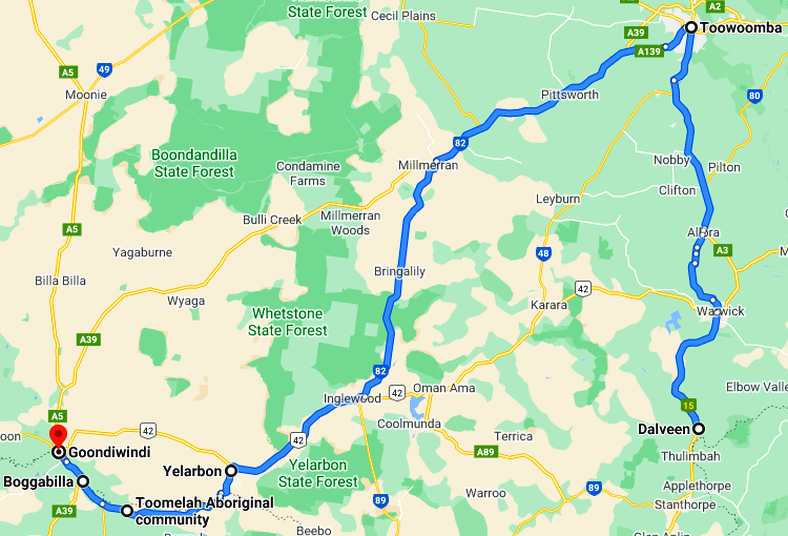
Toomelah was built by the New South Wales state government to house Aboriginals living in the area, principally in Boggabilla. There are about fifty houses, a school, a community centre and other amenities with sealed roads, water and sewerage etc. The town was built right on the banks of the river which forms the border with Queensland, as can be seen in this Google Earth view:
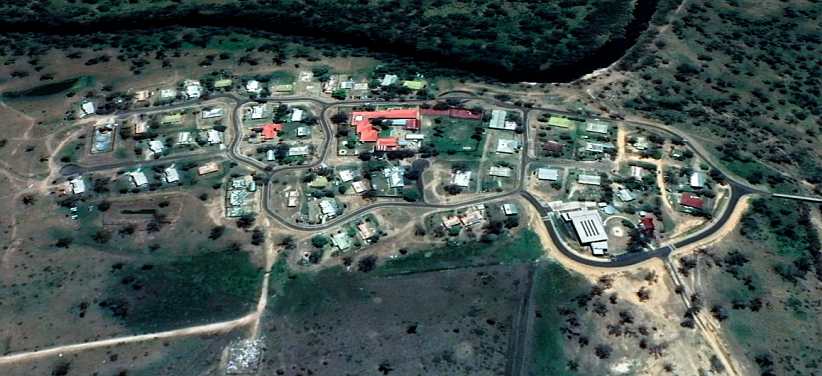
Settlement by the Dumaresq. The river at this point is named the Dumaresq and the town has everything but shops. Shopping is generally done at Boggabilla and Goondiwindi. Major centres are the school, with its large red roof, and the Community Centre with its white roof with what appears to be stripes created by rows of solar panels.
Catching people at home can be difficult in places like this. Often whole families would go off shopping for the day and I needed to speak to either the lessee of the home or someone who knew what was happening about the home. At one very nice point this morning I was invited to a communal breakfast where bacon and eggs on toast were handed to me as I waited for one of these people to turn up. That was at a sporting club’s building next to the school.
Then I was off to Boggabilla, putting me back on sealed roads after seeing a lot of dust on the way from Yelarbon. The housing authority has both purchased existing homes and built new ones for Aboriginals in this town, which has also seen many problems over the years. Family conflicts have seen cars and houses torched and vandalised.
The homes built for them have been quite acceptable…
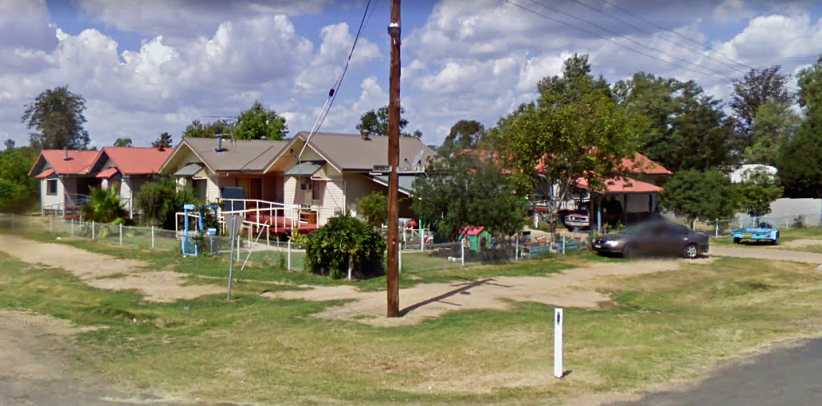
Boggabilla flats. Built principally to house older people, some of these dwellings have been outfitted with amenities to help tenants with disabilities.
…and are dotted around the town in small clusters.
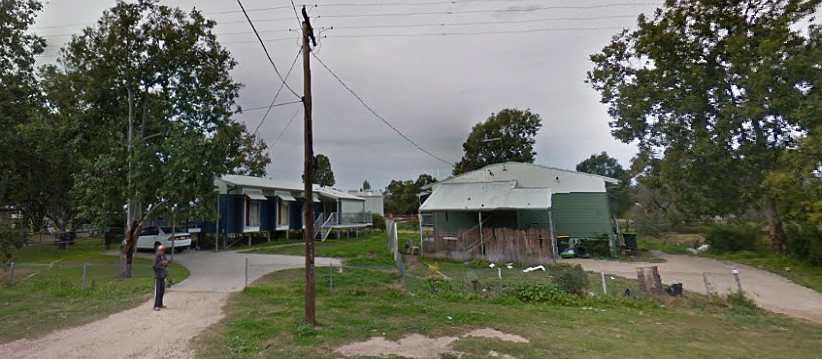
Bigger houses. Because of the tendency for families to have relatives come and go, some staying for long periods, multi-bedroom homes have been provided.
It’s a far cry from the Boggabilla I visited with my family in 1950. My father’s oldest brother lived on the edge of town and it was a peaceful place, this was the furthest we reached from our home in suburban Sydney on what was an adventurous 2-week trip sightseeing and visiting various family members travelling in dad’s 1930 A-model ‘New Beauty’ Ford.
Between Boggabilla and Goondiwindi there’s a bend in the river which has formed a little beach, this is named ‘Little Bondi’ by the locals and I recall going paddling in the water there on that first trip. My cousins, older than us, were on the high bank further around doing a little fishing and after a while we all went around there to see how they were doing.
Floods had just been through and there were lots of little minnows for them to throw back in, to our disappointment. But while we were around there a herd of wild horses came running down to the ‘beach’ to get a drink and, remembering that mum had put my baby brother down on the beach in his basket the cry went up, “What about Robbie?” But mum assured us that she’d put him back in the car and so he was safe.
Though I’ve worked at Boggabilla a number of times in the past decade or so, and I must have met at least 60% of the small population there, and I’ve asked anyone old enough, only one person I’ve struck could recall either my uncle and aunt or my cousins. Later in this story, however, we’ll encounter another who had vivid memories of the time he met Uncle Ron.
That night I spent at Goondiwindi and the following day I was on the road to Mungindi again. Some of he people I had to find in that town were the occupants of these houses:
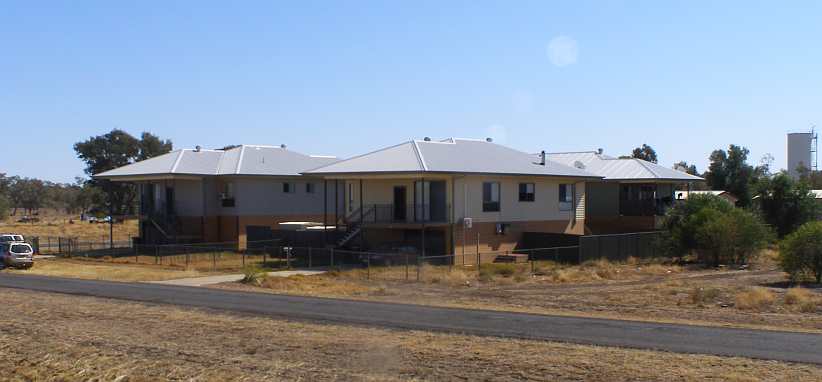
Mungindi houses. Again we have quite large houses, three of them clustered here on the Southern edge of the town.
There’s a levee bank around the town and it was from that bank, about 16’ high, I took the photo of the houses as I awaited the return of one of the people. This is looking along the levee to the East, as can be seen the local teenagers use it as a motorcycle track…
Levee bank. Floods in this country can be bad and levee banks like this surround many towns.
Also at Mungindi I dropped in on Ross Seymour to ask him about that old derelict car out on the road to Collarenebri. His explanation was interesting:
“I started working for the nursery when I was eight,” he began. “And when I was ten I got a job at the bakery, where they had that car doing deliveries. But a universal joint failed and they put another car on the delivery job and this one sat in the shed.”
“Someone from Collarenebri came along and wanted to buy it, but the baker didn’t want to sell it as it was, a deal was struck and I had to job of replacing the universal joint. When that was done the man came and drove off, but only got twenty miles up the road and something else broke down. He got a lift back to town and wanted his money back.”
Of course, the baker wasn’t going to give him a refund and the car was simply left there. Over the ensuing sixty-five and more years many bits have been taken from it. On that basis, Ross told me it was his as much as it was anyone else’s so I could have what I wanted from it.
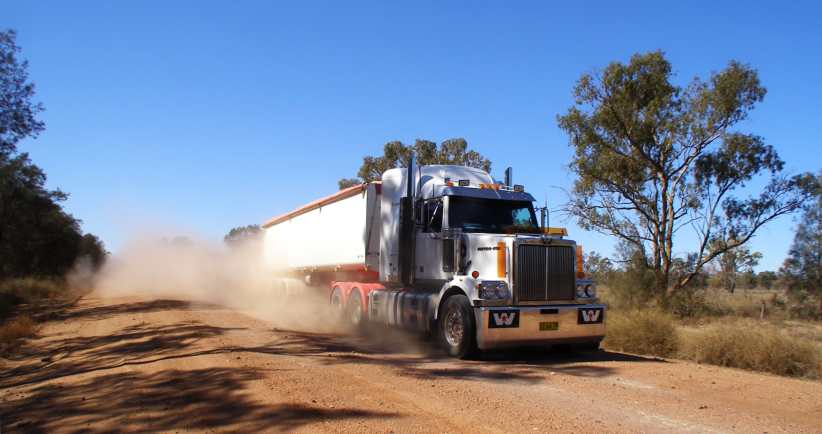
Collarenebri Road. This pic of a passing truck was taken at the point along the road where the remains of the old car had been left.
The AACA forum had established for me that the car was a 1924 Jewett. Also, an Australia Jewett owner assured me nobody would want the chassis, so I’d charge up all three batteries for my cordless angle grinder and took a packet of cutting discs with me, the plan being to recharge the batteries before my return trip to finish cutting off the front section of the chassis to load on the roof of the Forester for the trip home.
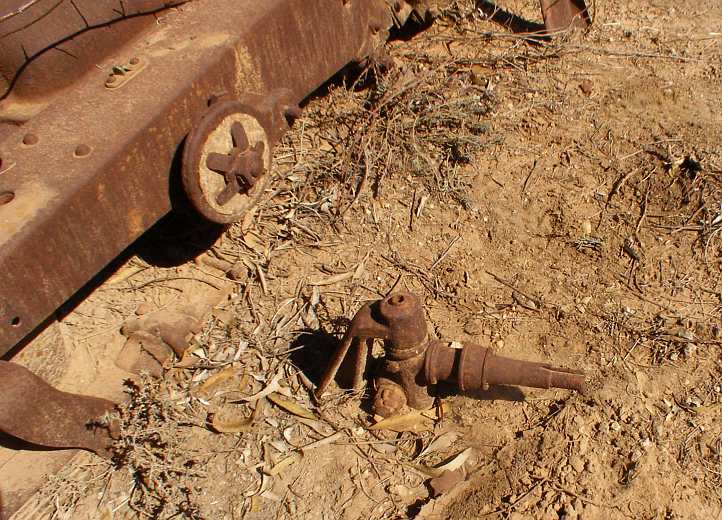
Buried axle. Yes, it’s certainly been here a long time! It has also been pushed back from the edge of the road by a machine at some time, which has bent the left side chassis rail.
Having accomplished all I could for the moment there I drove on, but not far down the road I stopped to have a look at this Falcon…
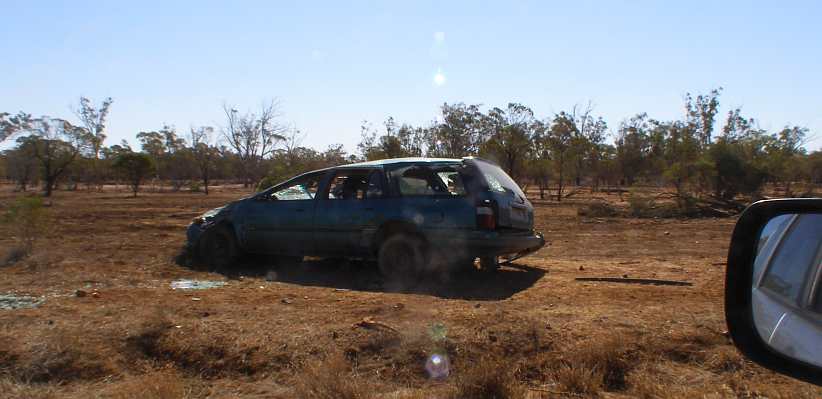
Crashed Falcon. A look around this car established that it had been on a grocery-shopping trip before the driver has lost control on the gravel road and flipped it into a farm’s fence.
…before rejoining the road. Another truck came by, this one a livestock transport undoubtedly engaged in either taking cattle to market or moving them hundreds of miles in search of pasture not devastated by the terrible drought:
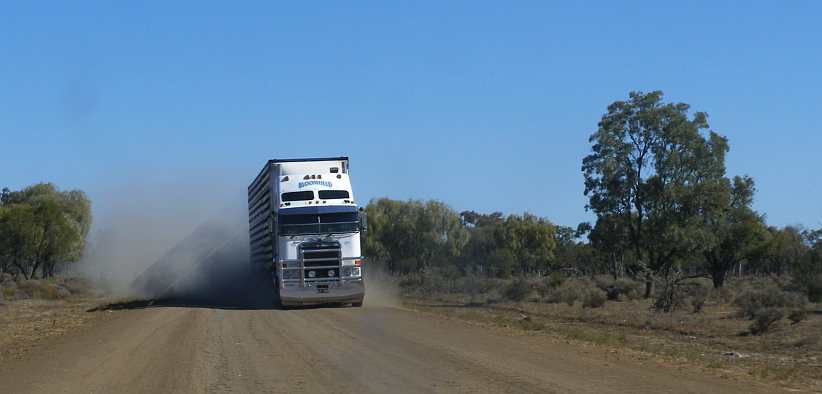
Stock crate Kenworth. The state of the nation is shown in that this back-blocks road is seeing a truck from nearly 1,000 miles away.
Just a little further along this road I had to turn right and the lesser roads through to Lightning Ridge had hardly any traffic, as seen in the previous post. On reaching ‘The Ridge’ I started calling on addresses from my list, some of the homes looking much like these:
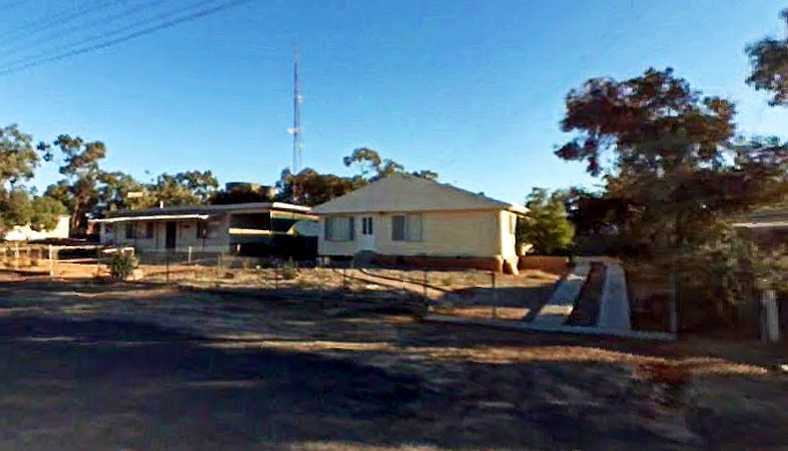
Typical houses. These are the kinds of houses I was visiting in Lightning Ridge. Usually the lawns were being watered with sprinklers which seemed to be going day and night.
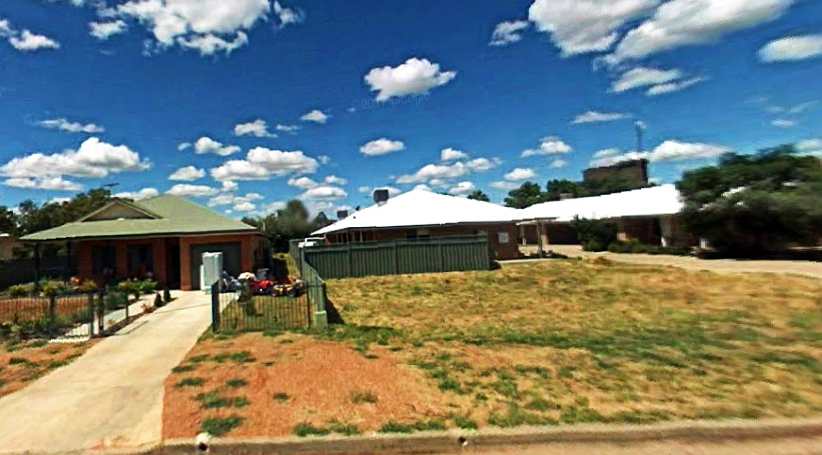
More modern. Newer areas of the town had many brick homes. The one on the left is an Aboriginal Housing property, the flats to the right are privately owned.
Again I ate at the Bowling Club and I spent a night at this little motel in the main street:
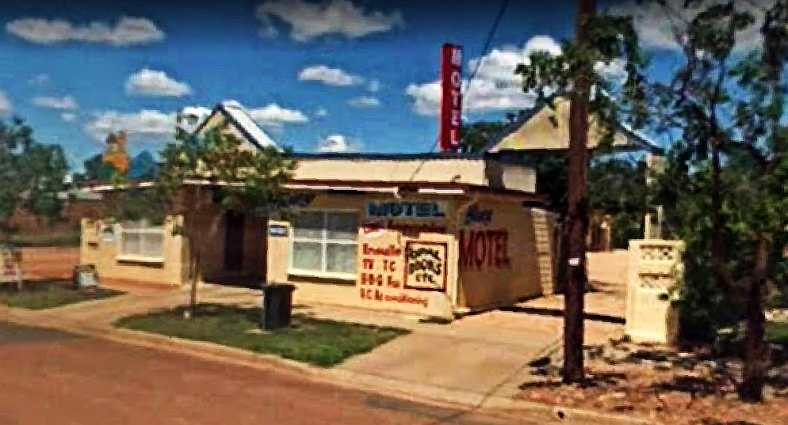
Bluey Motel. Not the classiest, but a clean room, a shower, power points to charge my angle grinder batteries and wi-fi so I could go on the net – what more could I ask?
After a little more work here the next day, I got mobile again. I wanted to finish up what I had to do in Goodooga and then go to Weilmoringle and Enngonia. I booked accommodation at Enngonia so I could run the work over into the next day if needed. And I expected it to be needed.
This forest of signs at Goodooga showed the way to Weilmoringle, and only 84 kilometres too. But that would be gravel, of course…
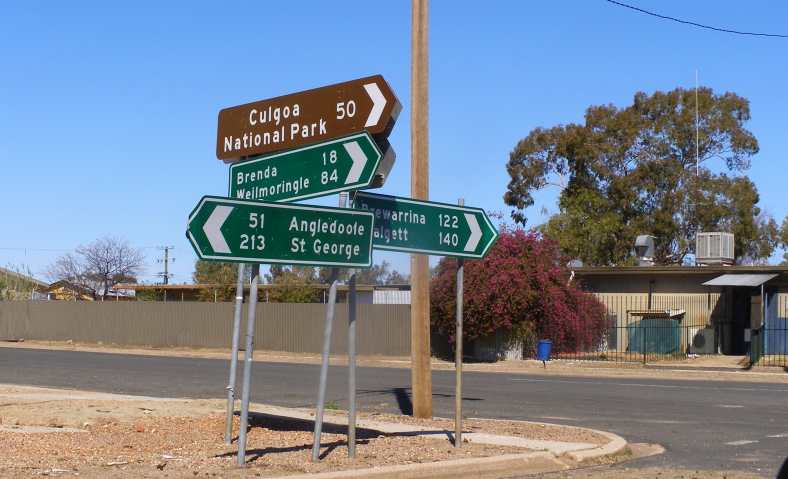
Sign forest. putting that information to a map is awkward, but it did help point the way to far-flung destinations.
…and so the planned route for the afternoon, and much of the next day, was thus:
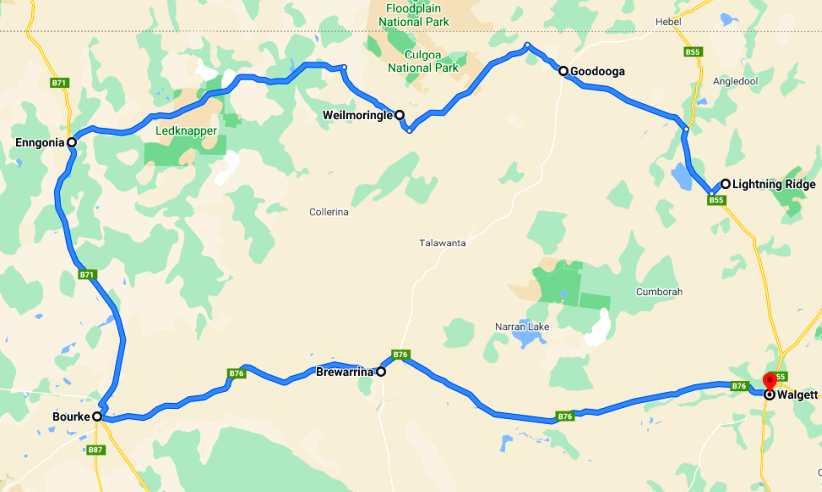
That looks straightforward enough, but this roadmap shows that road conditions – and possibly signage – might well be a bit more difficult:
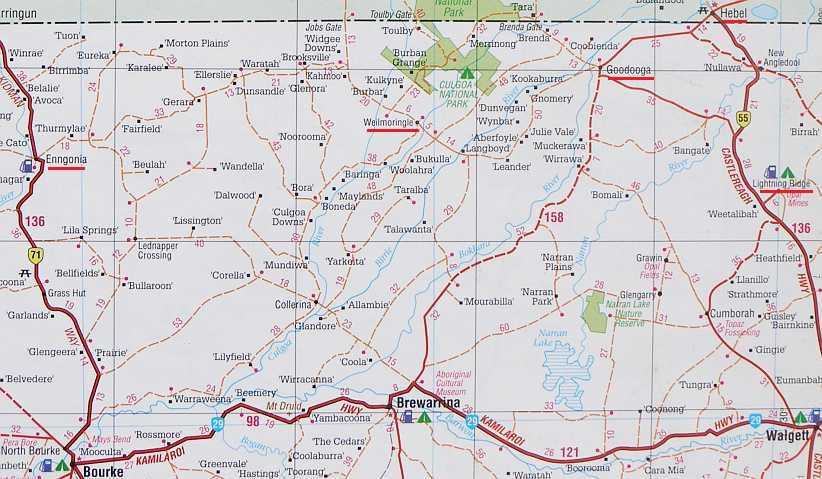
Dotted lines only. The roads I was to take from Goodooga to Enngonia didn’t rank highly with the mapmaker here. I’ve underlined each relevant place-name in red.
I was throughout this period travelling just South of the Queensland-New South Wales border and – officially – I had been in the ‘Outback’ since Lightning Ridge. It was all new to me and I didn’t really know what to expect.
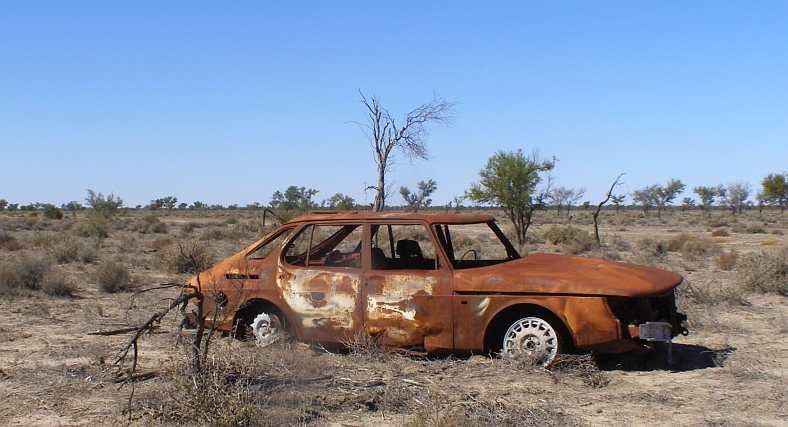
Sad SAAB. Setting fire to cars is a bit of a game in this part of the world. This Saab might have struck trouble, it might have been stolen or simply reached the end of its life.
The bleakness and featureless nature of the country was the same for many miles. This Holden utility from the fifties appears to me to have been deliberately left there to provide a landmark, probably for a local to help people find his property…
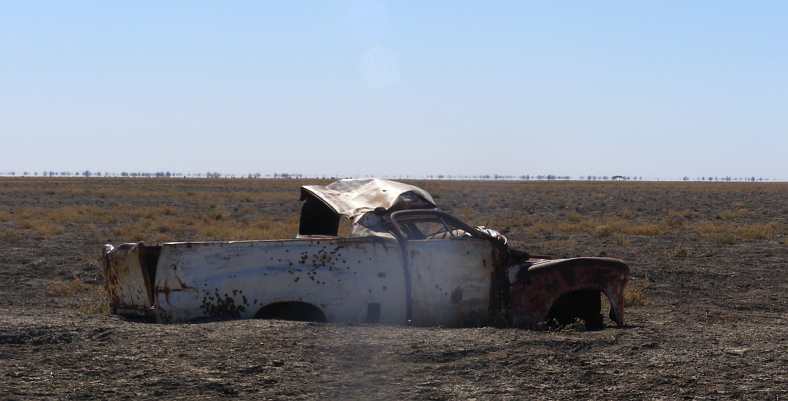
Bleak resting place. The slim line of trees on the horizon is the only company for this poor old Holden utility.
This flat and straight road and the country through which it makes a path are no different, there was miles of this:
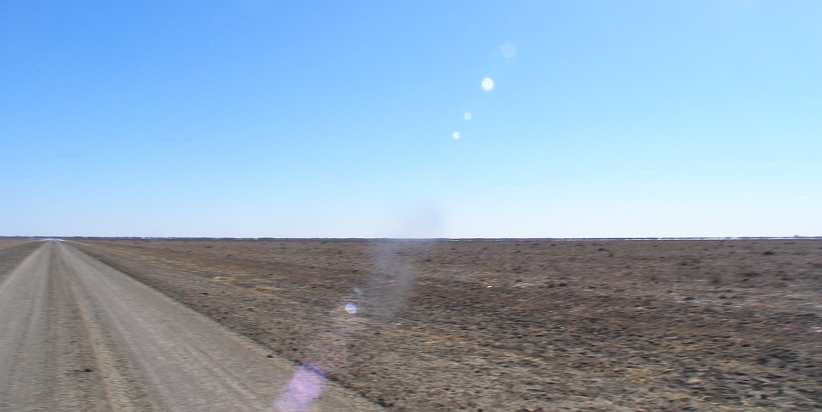
Flat and featureless. There’s no telling how far away those trees are, probably lining a watercourse as dry as the paddocks.
This utility was at a road junction not far before I got to Weilmoringle. This is one reason I feel a property owner might have put them out to guide visitors. At least this one has company of some power lines:
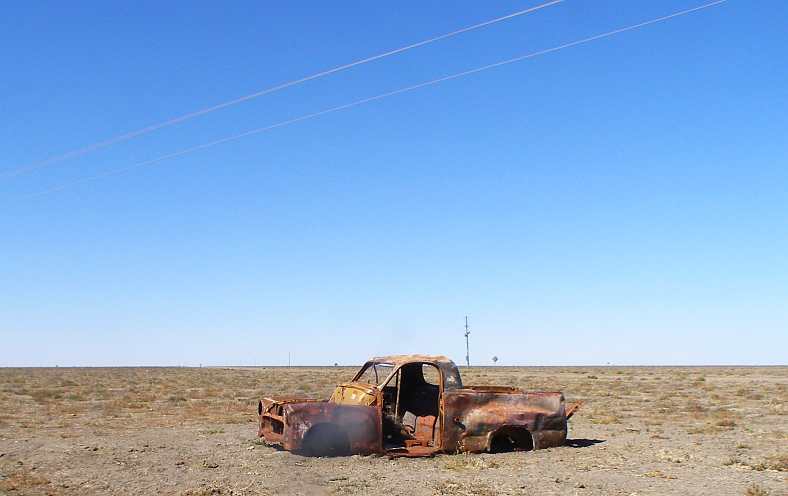
Landmark? You can see the road I’ve just come along behind this utility, then I’ve turned to the right at a junction out of this picture’s frame.
I reached Weilmoringle and saw that this sign pointed down yet another road going to Goodooga, and that it was the same distance. Looking at the map you can see that there are roads each side of the ‘river’ and the National Park:
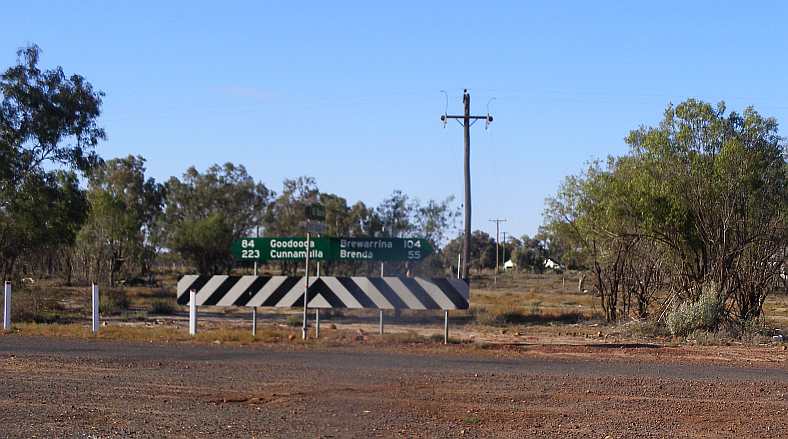
Another road. It confused me at first, but a look at the map put it in place. Now I had to go into the small settlement of modern houses which had been built for the Aboriginals of the area.
There would only be 15 to 20 homes in the settlement. I managed to get enough interviews to keep the bosses happy and was ready to move on. The most interesting conversation was with a woman aged about 70 who kept repeating, “We were always better off when we lived in humpies down by the creek. Everyone was happy and we all looked after each other!”
The road I needed to take was Jobs Gate Road, which would go on to cross the border into Queensland. But my turning point came before that about 12 miles out of Weilmoringle. There was another car coming out of the road I was entering as I got there and when I turned I had to come to a stop:
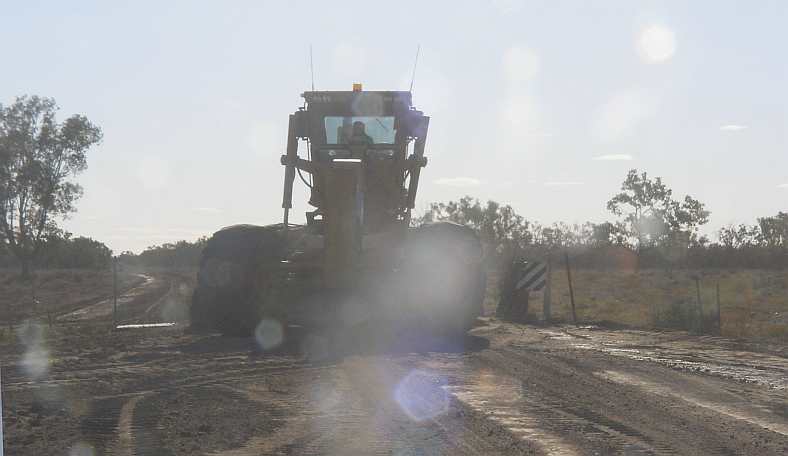
Big grader! This grader, with huge wide tyres, only just fitted between the posts each side of the grid. Unfortunately I had to snap the pic in a big hurry and the quality has suffered.
Yes, another grid, which meant there might be livestock along this road. Which was now freshly graded for at least some distance. I was now in scrub country and naturally enough on the lookout for animals intruding on my projected path.
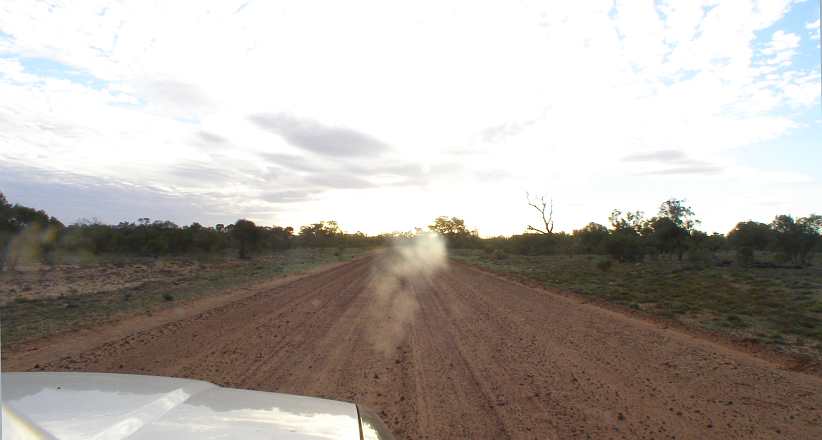
Enngonia road. The road was good enough to enable me to travel fairly quickly, but always with a weather-eye out for animals crossing.
The scrub would provide most of the food for grazing animals in this drought. I saw a number of goats and was amused by one family crossing in front of me with a little one only rushing out at the last second to keep up.
There had been a shower of rain through very recently and so one area had a lot of water lying along each side of the road:
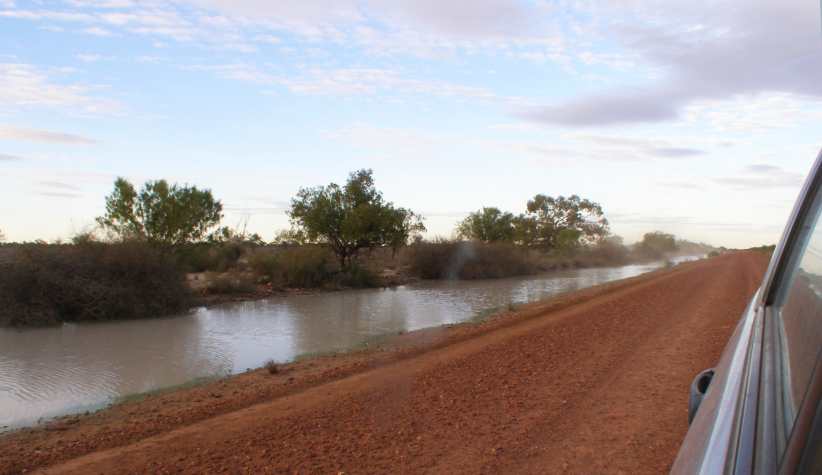
Water in gutters. It must have been a substantial shower which came through and left this little legacy.
Eventually Enngonia came into view and I saw on my left, half a mile or so before the road junction, a cluster of houses which were obviously among those I must visit:
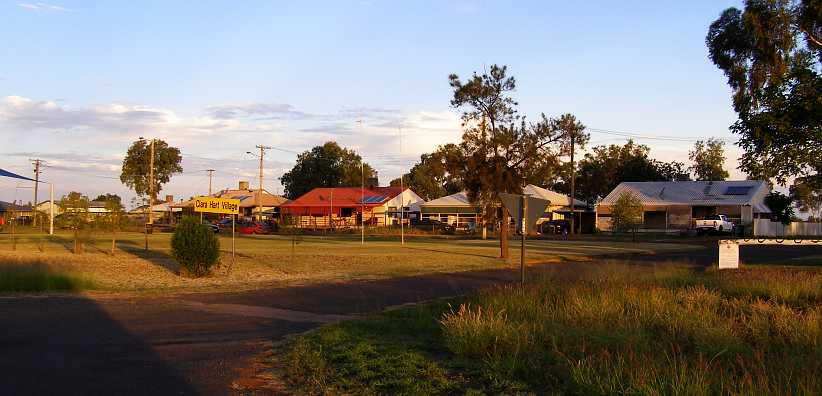
Enngonia homes. Another cluster of homes built to house the local Aboriginals. It was here that I started working on getting interviews.
First, however, I sorted out my accommodation at the only hotel in town. Another Google Earth Street View picture shows that it wasn’t a large hotel:
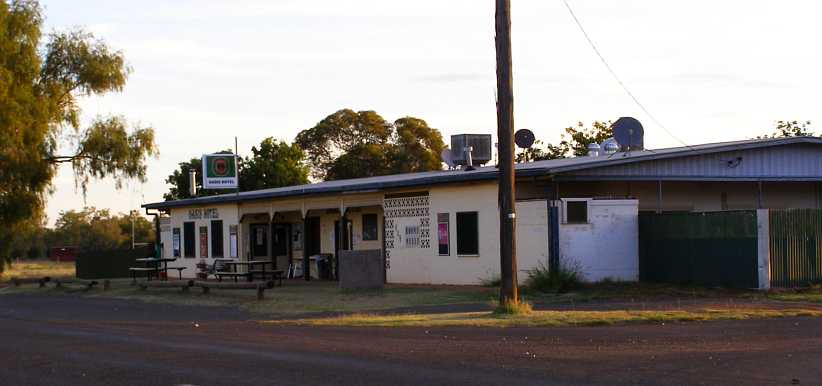
Oasis Hotel. I was to be the only customer taking a room and having a meal here that night. The owners don’t live on the premises and I had to park my car inside the yard and be locked in until morning.
I did go out and try to make contact with some of the people I had to find, only getting a little bit of interviewing done before I gave up and left it till morning.
The lady at the hotel told me of some unusual ways exhibited by the Aboriginals. “They like to eat emu,” she told me, “and so they kill them by running them down with their cars. Then, because they don’t fit into the oven they drape them across the top of the stove to cook.”
Getting a mental image of all the emu fat running down the sides, front and back of the stoves, I tried to put all that out of mind when I spoke to these people…
Toomelah was built by the New South Wales state government to house Aboriginals living in the area, principally in Boggabilla. There are about fifty houses, a school, a community centre and other amenities with sealed roads, water and sewerage etc. The town was built right on the banks of the river which forms the border with Queensland, as can be seen in this Google Earth view:
Settlement by the Dumaresq. The river at this point is named the Dumaresq and the town has everything but shops. Shopping is generally done at Boggabilla and Goondiwindi. Major centres are the school, with its large red roof, and the Community Centre with its white roof with what appears to be stripes created by rows of solar panels.
Catching people at home can be difficult in places like this. Often whole families would go off shopping for the day and I needed to speak to either the lessee of the home or someone who knew what was happening about the home. At one very nice point this morning I was invited to a communal breakfast where bacon and eggs on toast were handed to me as I waited for one of these people to turn up. That was at a sporting club’s building next to the school.
Then I was off to Boggabilla, putting me back on sealed roads after seeing a lot of dust on the way from Yelarbon. The housing authority has both purchased existing homes and built new ones for Aboriginals in this town, which has also seen many problems over the years. Family conflicts have seen cars and houses torched and vandalised.
The homes built for them have been quite acceptable…
Boggabilla flats. Built principally to house older people, some of these dwellings have been outfitted with amenities to help tenants with disabilities.
…and are dotted around the town in small clusters.
Bigger houses. Because of the tendency for families to have relatives come and go, some staying for long periods, multi-bedroom homes have been provided.
It’s a far cry from the Boggabilla I visited with my family in 1950. My father’s oldest brother lived on the edge of town and it was a peaceful place, this was the furthest we reached from our home in suburban Sydney on what was an adventurous 2-week trip sightseeing and visiting various family members travelling in dad’s 1930 A-model ‘New Beauty’ Ford.
Between Boggabilla and Goondiwindi there’s a bend in the river which has formed a little beach, this is named ‘Little Bondi’ by the locals and I recall going paddling in the water there on that first trip. My cousins, older than us, were on the high bank further around doing a little fishing and after a while we all went around there to see how they were doing.
Floods had just been through and there were lots of little minnows for them to throw back in, to our disappointment. But while we were around there a herd of wild horses came running down to the ‘beach’ to get a drink and, remembering that mum had put my baby brother down on the beach in his basket the cry went up, “What about Robbie?” But mum assured us that she’d put him back in the car and so he was safe.
Though I’ve worked at Boggabilla a number of times in the past decade or so, and I must have met at least 60% of the small population there, and I’ve asked anyone old enough, only one person I’ve struck could recall either my uncle and aunt or my cousins. Later in this story, however, we’ll encounter another who had vivid memories of the time he met Uncle Ron.
That night I spent at Goondiwindi and the following day I was on the road to Mungindi again. Some of he people I had to find in that town were the occupants of these houses:
Mungindi houses. Again we have quite large houses, three of them clustered here on the Southern edge of the town.
There’s a levee bank around the town and it was from that bank, about 16’ high, I took the photo of the houses as I awaited the return of one of the people. This is looking along the levee to the East, as can be seen the local teenagers use it as a motorcycle track…
Levee bank. Floods in this country can be bad and levee banks like this surround many towns.
Also at Mungindi I dropped in on Ross Seymour to ask him about that old derelict car out on the road to Collarenebri. His explanation was interesting:
“I started working for the nursery when I was eight,” he began. “And when I was ten I got a job at the bakery, where they had that car doing deliveries. But a universal joint failed and they put another car on the delivery job and this one sat in the shed.”
“Someone from Collarenebri came along and wanted to buy it, but the baker didn’t want to sell it as it was, a deal was struck and I had to job of replacing the universal joint. When that was done the man came and drove off, but only got twenty miles up the road and something else broke down. He got a lift back to town and wanted his money back.”
Of course, the baker wasn’t going to give him a refund and the car was simply left there. Over the ensuing sixty-five and more years many bits have been taken from it. On that basis, Ross told me it was his as much as it was anyone else’s so I could have what I wanted from it.
Collarenebri Road. This pic of a passing truck was taken at the point along the road where the remains of the old car had been left.
The AACA forum had established for me that the car was a 1924 Jewett. Also, an Australia Jewett owner assured me nobody would want the chassis, so I’d charge up all three batteries for my cordless angle grinder and took a packet of cutting discs with me, the plan being to recharge the batteries before my return trip to finish cutting off the front section of the chassis to load on the roof of the Forester for the trip home.
Buried axle. Yes, it’s certainly been here a long time! It has also been pushed back from the edge of the road by a machine at some time, which has bent the left side chassis rail.
Having accomplished all I could for the moment there I drove on, but not far down the road I stopped to have a look at this Falcon…
Crashed Falcon. A look around this car established that it had been on a grocery-shopping trip before the driver has lost control on the gravel road and flipped it into a farm’s fence.
…before rejoining the road. Another truck came by, this one a livestock transport undoubtedly engaged in either taking cattle to market or moving them hundreds of miles in search of pasture not devastated by the terrible drought:
Stock crate Kenworth. The state of the nation is shown in that this back-blocks road is seeing a truck from nearly 1,000 miles away.
Just a little further along this road I had to turn right and the lesser roads through to Lightning Ridge had hardly any traffic, as seen in the previous post. On reaching ‘The Ridge’ I started calling on addresses from my list, some of the homes looking much like these:
Typical houses. These are the kinds of houses I was visiting in Lightning Ridge. Usually the lawns were being watered with sprinklers which seemed to be going day and night.
More modern. Newer areas of the town had many brick homes. The one on the left is an Aboriginal Housing property, the flats to the right are privately owned.
Again I ate at the Bowling Club and I spent a night at this little motel in the main street:
Bluey Motel. Not the classiest, but a clean room, a shower, power points to charge my angle grinder batteries and wi-fi so I could go on the net – what more could I ask?
After a little more work here the next day, I got mobile again. I wanted to finish up what I had to do in Goodooga and then go to Weilmoringle and Enngonia. I booked accommodation at Enngonia so I could run the work over into the next day if needed. And I expected it to be needed.
This forest of signs at Goodooga showed the way to Weilmoringle, and only 84 kilometres too. But that would be gravel, of course…
Sign forest. putting that information to a map is awkward, but it did help point the way to far-flung destinations.
…and so the planned route for the afternoon, and much of the next day, was thus:
That looks straightforward enough, but this roadmap shows that road conditions – and possibly signage – might well be a bit more difficult:
Dotted lines only. The roads I was to take from Goodooga to Enngonia didn’t rank highly with the mapmaker here. I’ve underlined each relevant place-name in red.
I was throughout this period travelling just South of the Queensland-New South Wales border and – officially – I had been in the ‘Outback’ since Lightning Ridge. It was all new to me and I didn’t really know what to expect.
Sad SAAB. Setting fire to cars is a bit of a game in this part of the world. This Saab might have struck trouble, it might have been stolen or simply reached the end of its life.
The bleakness and featureless nature of the country was the same for many miles. This Holden utility from the fifties appears to me to have been deliberately left there to provide a landmark, probably for a local to help people find his property…
Bleak resting place. The slim line of trees on the horizon is the only company for this poor old Holden utility.
This flat and straight road and the country through which it makes a path are no different, there was miles of this:
Flat and featureless. There’s no telling how far away those trees are, probably lining a watercourse as dry as the paddocks.
This utility was at a road junction not far before I got to Weilmoringle. This is one reason I feel a property owner might have put them out to guide visitors. At least this one has company of some power lines:
Landmark? You can see the road I’ve just come along behind this utility, then I’ve turned to the right at a junction out of this picture’s frame.
I reached Weilmoringle and saw that this sign pointed down yet another road going to Goodooga, and that it was the same distance. Looking at the map you can see that there are roads each side of the ‘river’ and the National Park:
Another road. It confused me at first, but a look at the map put it in place. Now I had to go into the small settlement of modern houses which had been built for the Aboriginals of the area.
There would only be 15 to 20 homes in the settlement. I managed to get enough interviews to keep the bosses happy and was ready to move on. The most interesting conversation was with a woman aged about 70 who kept repeating, “We were always better off when we lived in humpies down by the creek. Everyone was happy and we all looked after each other!”
The road I needed to take was Jobs Gate Road, which would go on to cross the border into Queensland. But my turning point came before that about 12 miles out of Weilmoringle. There was another car coming out of the road I was entering as I got there and when I turned I had to come to a stop:
Big grader! This grader, with huge wide tyres, only just fitted between the posts each side of the grid. Unfortunately I had to snap the pic in a big hurry and the quality has suffered.
Yes, another grid, which meant there might be livestock along this road. Which was now freshly graded for at least some distance. I was now in scrub country and naturally enough on the lookout for animals intruding on my projected path.
Enngonia road. The road was good enough to enable me to travel fairly quickly, but always with a weather-eye out for animals crossing.
The scrub would provide most of the food for grazing animals in this drought. I saw a number of goats and was amused by one family crossing in front of me with a little one only rushing out at the last second to keep up.
There had been a shower of rain through very recently and so one area had a lot of water lying along each side of the road:
Water in gutters. It must have been a substantial shower which came through and left this little legacy.
Eventually Enngonia came into view and I saw on my left, half a mile or so before the road junction, a cluster of houses which were obviously among those I must visit:
Enngonia homes. Another cluster of homes built to house the local Aboriginals. It was here that I started working on getting interviews.
First, however, I sorted out my accommodation at the only hotel in town. Another Google Earth Street View picture shows that it wasn’t a large hotel:
Oasis Hotel. I was to be the only customer taking a room and having a meal here that night. The owners don’t live on the premises and I had to park my car inside the yard and be locked in until morning.
I did go out and try to make contact with some of the people I had to find, only getting a little bit of interviewing done before I gave up and left it till morning.
The lady at the hotel told me of some unusual ways exhibited by the Aboriginals. “They like to eat emu,” she told me, “and so they kill them by running them down with their cars. Then, because they don’t fit into the oven they drape them across the top of the stove to cook.”
Getting a mental image of all the emu fat running down the sides, front and back of the stoves, I tried to put all that out of mind when I spoke to these people…
Last edited by Ray Bell; May 2, 2021 at 07:59 AM.
Thread Starter
|
Captain
Joined: Oct 2005
Posts: 568
Likes: 8
From: The Summit, Queensland, Australia
Morning came and I found my way around. Breakfast done, I set out to get the necessary interviews done so I could leave Enngonia behind me. I would be working in Tenterfield the next day – Saturday – and that was a long way away.
The list of addresses I was given for this job was never going to be completed. I may have had, for instance, six addresses in a town. But the quota for interviews might be two or three. All the same, I had to push to get those because of the vagaries of the way the people live and just who might be available. It was supposed to be the actual lessee if possible, but someone who claimed to know about the family relationship with the service providers would suffice.
Just around the corner from the hotel I found a couple of the addresses, one sporting the remains of a Chrysler Charger in the yard:
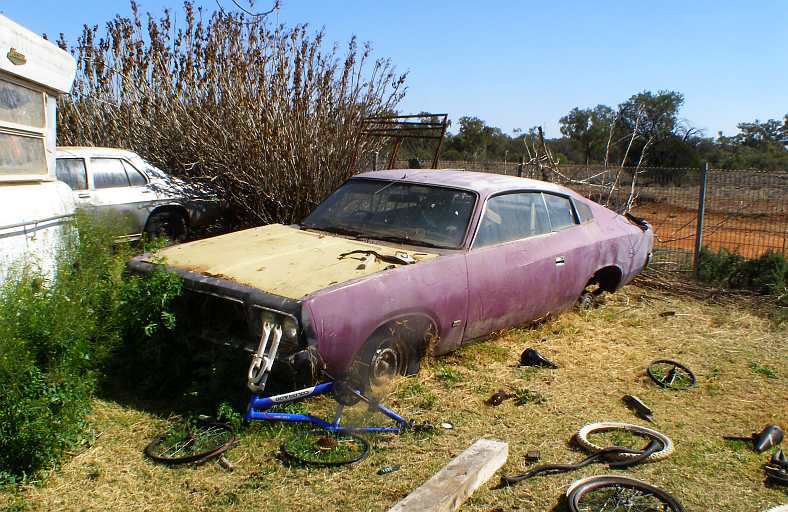
Charger. Like many other things in this yard, the Charger has seen better days. This is one of the last models of the Charger built by Chrysler Australia.
I stumbled around the back block from there and found another tenant to talk to, the most important thing to notice in this little scene…
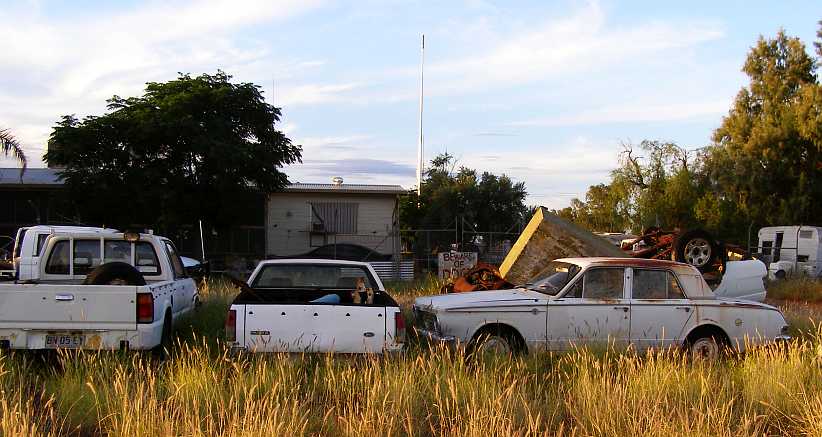
Obstacles. Though I found the occupant here co-operative, it was a job to get past all the relics and the vicious dogs.
…being the ‘Beware of the Dog’ sign. I then went back to see what I could find out of the several addresses I had in the area in the picture of the houses seen coming into town. A young girl was ‘in charge’ at one of them so I got my third interview and was able to get on the road.
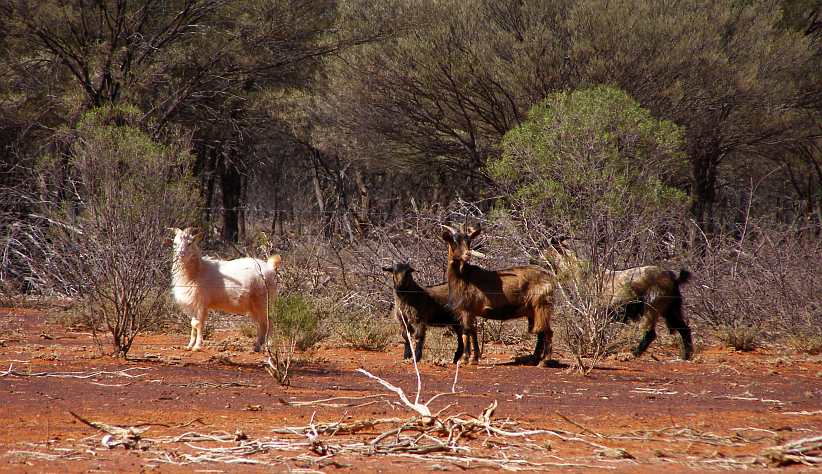
Goats. Feral goats were prolific in the area, able to live on the rough scrub growing in the area and not confined by any fences farmers chose to build.
The main road took me to North Bourke first, where a new bridge has replaced this old lift-span bridge built in days when paddle-wheelers took care of a lot of the transport of goods…
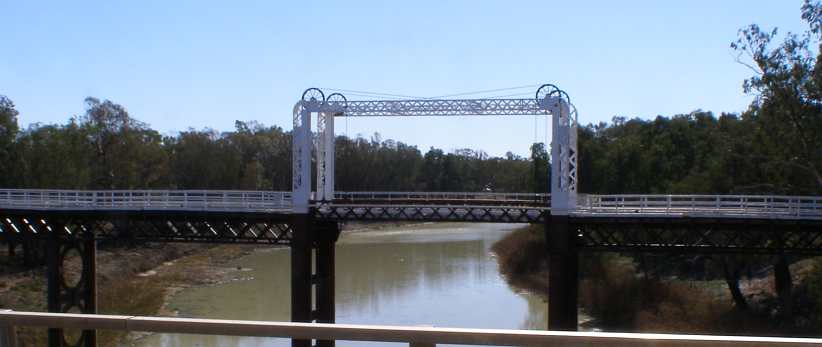
Bridge at North Bourke. There was a time when this waterway provided transport solutions for settlers along the river and the bridge had to give clearance for the boats.
Then came Bourke. There were listings of addresses for interviews in this town too, but I wasn’t required to chase them up. I turned left to head towards Brewarrina, but soon pulled up as I briefly had phone signal here and needed to finalise some things by phone. I also went to the local library to go online for a short time.
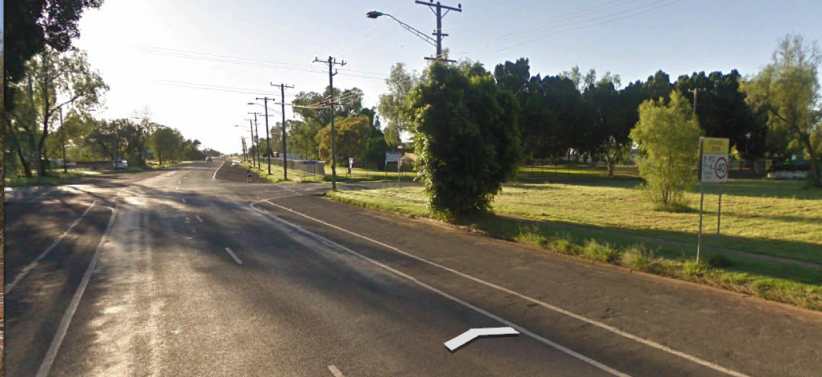
Bourke when green. This Google Earth Street View picture was taken after the drought broke. I pulled up here and made some necessary phone calls.
It was about 60 miles from Bourke to Brewarrina, with not much to see. One thing which stood out was the remains of somebody’s trailer. Probably starting from a wheel bearing fire – as we saw in an earlier post – nothing was salvageable here:
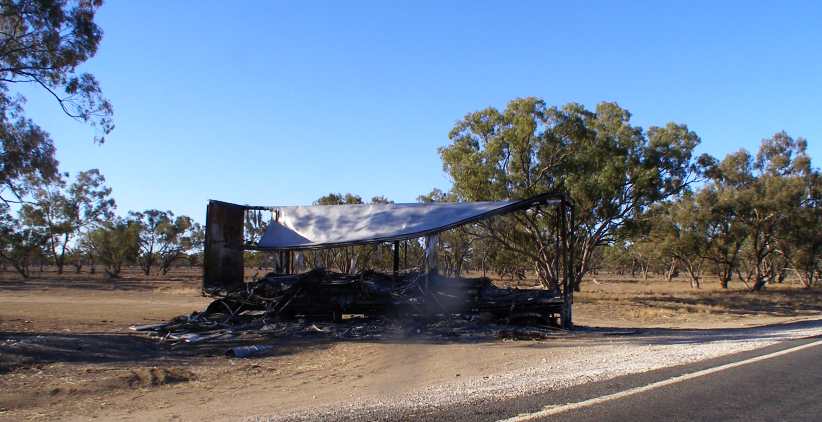
Total loss. Out there in this scrubby and lightly populated country, a fire in a semi-trailer is very likely to result on a loss of the trailer and its load. Hence this one has simply been unhooked and left behind between Bourke an Brewarrina.
The long drive continued along these roads:
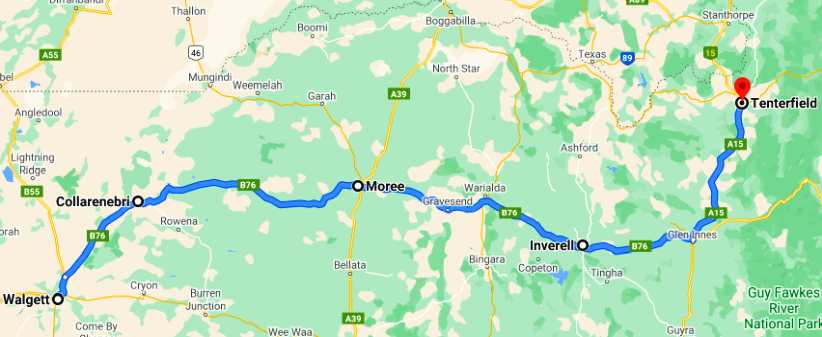
I got to Moree in the dark and had my dinner there, then drove on to Inverell where I spent the night at the Twin Swans Motel. The Saturday and Sunday were spent working at Tenterfield and then I went to Sandra’s. But not for long, Monday afternoon saw me on the way towards Lightning Ridge again…
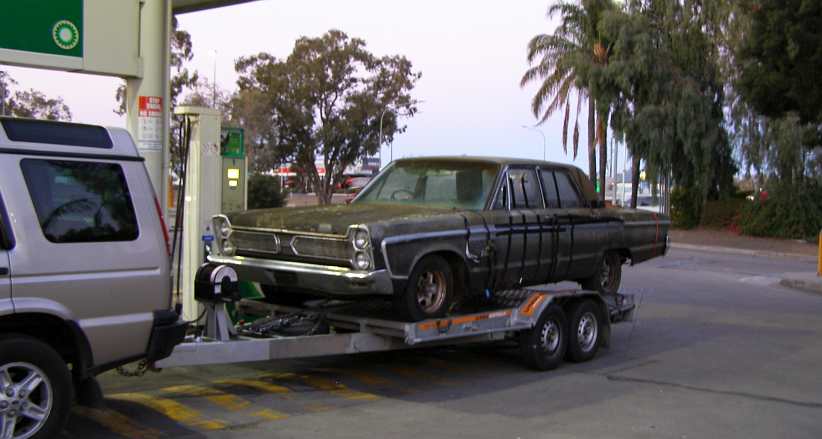
Phoenix on trailer. The owner of this rig had travelled over 700 miles so far retrieving this Dodge Phoenix – and still had a distance to go.
…and caught sight of this newly-purchased Phoenix ‘restorer’ on its way to Brisbane at the Goondiwindi truckstop. The next day, after using up the batteries of my cordless angle grinder on the chassis near Mungindi, I arrived in Lightning Ridge in time to see a straggler from a group of Frenchmen crossing Australia in their old Citroens:
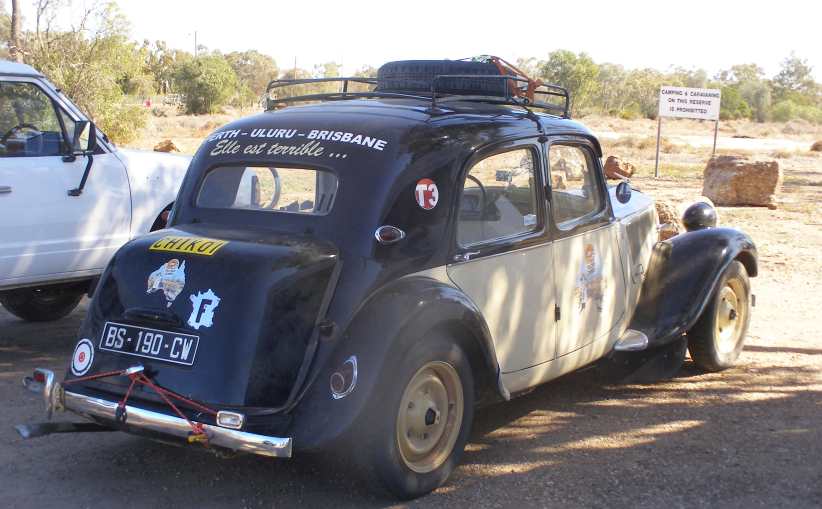
Citroen Light 15. About a 1954 model, this is the same as one I owned in 1966. I didn’t have it long…
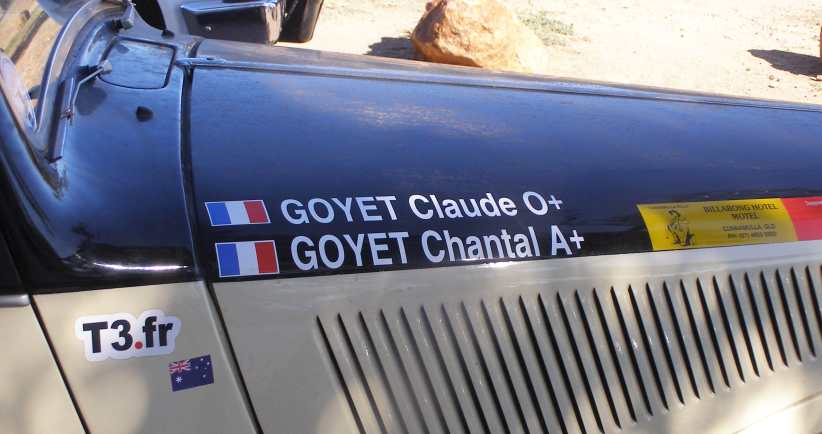
A long way from home. Clearly French names to match the origin of the car, I didn’t see the owners.
Tracbar Dundee. A clear indication that they weren’t alone, though I didn’t see any of their companions.
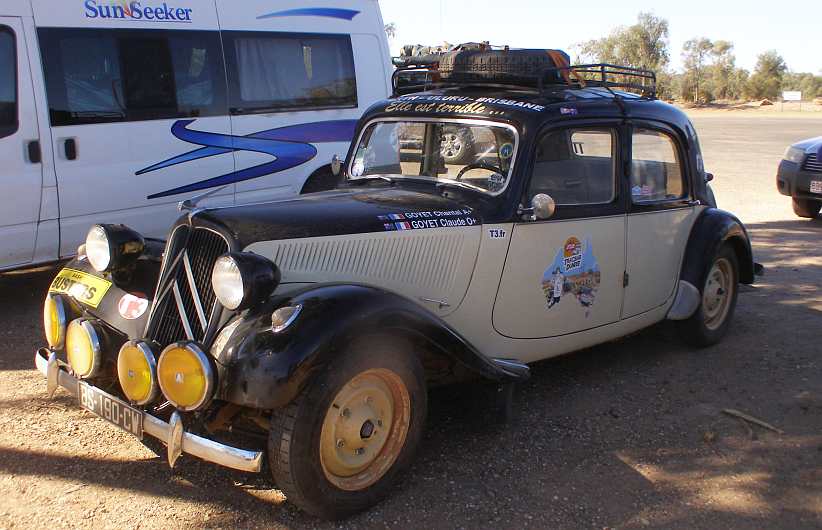
Well equipped. Foglights, extra spare wheels, they were ready for anything they might encounter.
These pics were taken outside the hot springs pool, so I guess the owners were enjoying a refreshing dip in that pool.
In addition to looking over the Citroen, I decide to take other photos around town to show the character of the place:
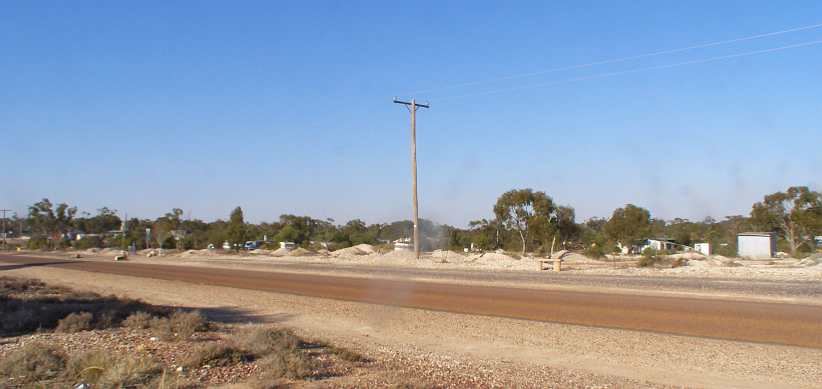
Diggings. Mullock heaps and lean-tos dot the scenery just over the hill from the layout of streets and houses which make up most of the town.
I learned that many people who ‘migrated’ to Lightning Ridge in the seventies bought an old truck to carry their gear along with them for the move and knew they’d have further use for it at their diggings. Lots of them are still hanging around, used and unused:
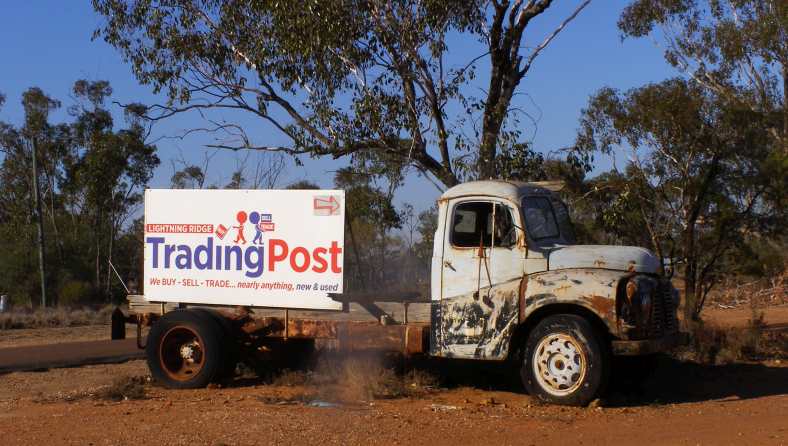
Austin truck. From the mid-fifties, this Austin featured a 4-litre 6-cylinder engine which was undoubtedly quite uneconomical. It’s obviously become an advertising hoarding.
Some places served to accumulate a number of these vehicles – as well as other machinery items and assorted scrap:
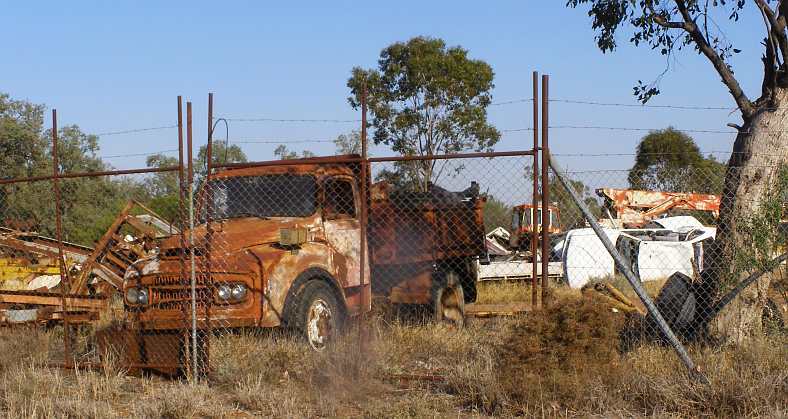
Yard full. Another Austin of similar vintage, this one with a tipper body. In the background there’s a large crane truck and lots of steel fabrications lie about the yard.
More advertising was more common…
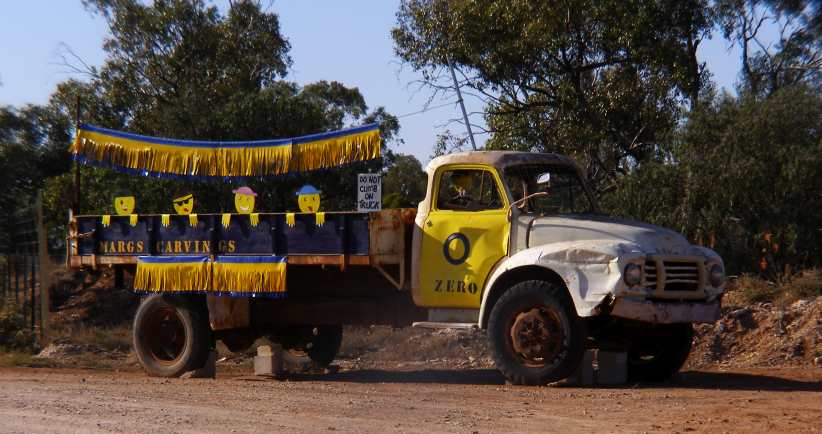
Bedford. GM was represented by the Bedfords seen around the area, this one being another advertising hoarding as it seems to have driven its last mile.
…but some just decorated driveways in the town:
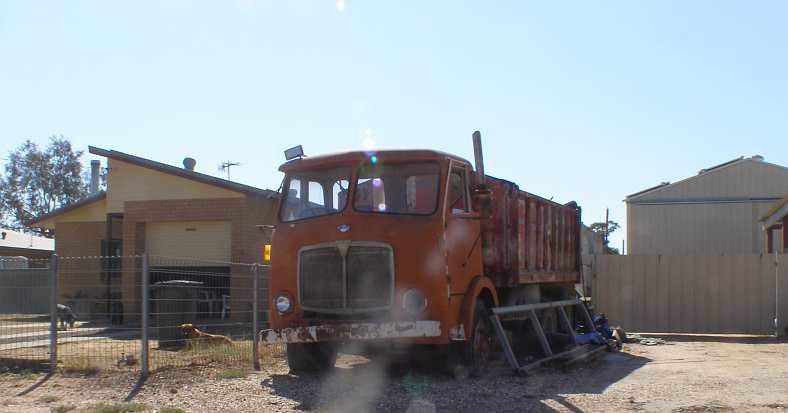
Diesel in the driveway. An AEC tipper from the same era fills out a driveway not far from the main street.
And even railway carriages have been transported from Sydney:
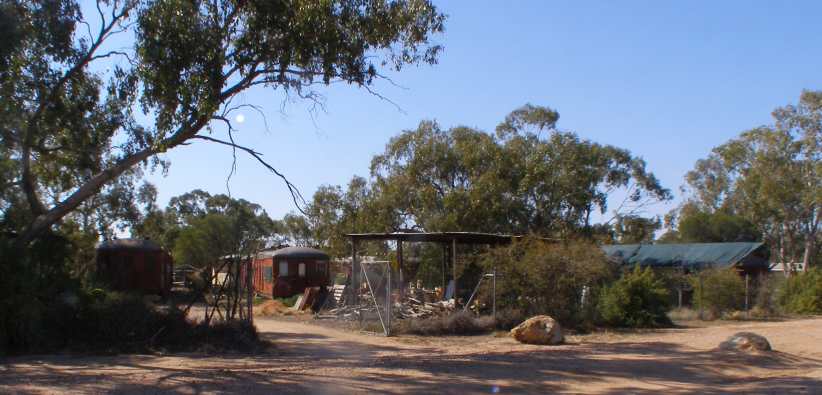
Suburban rail carriages. In use now as a part of a museum, these were built in the fifties too, and they carried millions of commuters before being retired in the eighties.
Some ‘stashes’ of this old machinery look more commercial, like they wheel and deal in the various items.
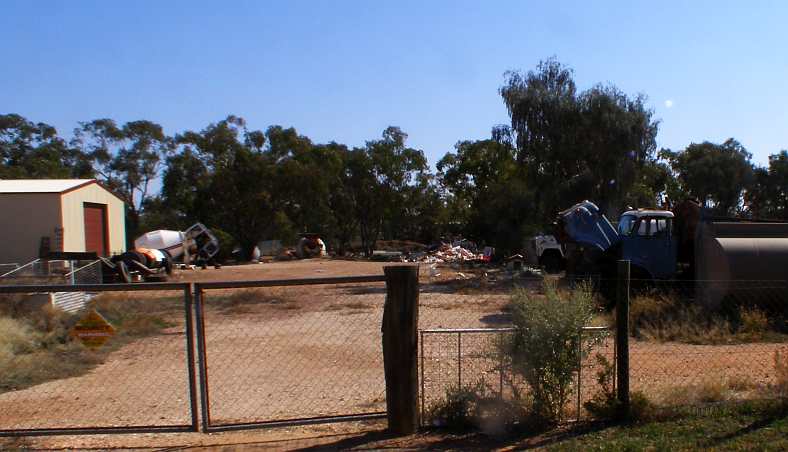
Cement mixers. A German MAN truck is on the right here while there are a couple of cement-mixing bowls in the yard too.
The cement mixers are used for ‘tumbling’ the winnings from the diggings to reveal the opals.
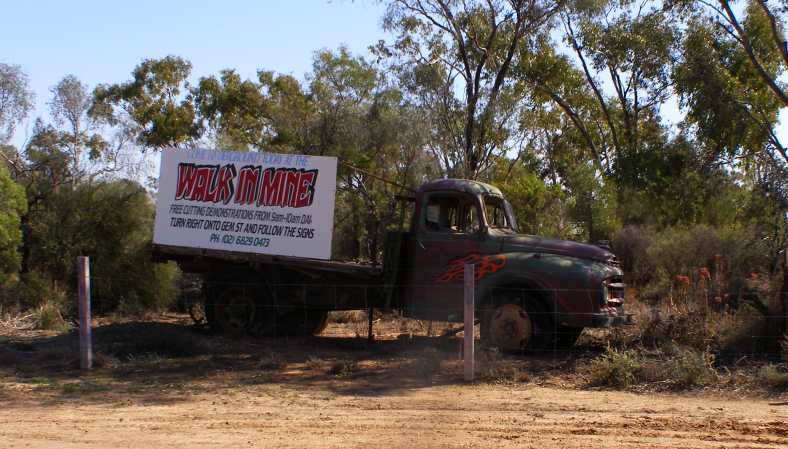
Another Austin. Yet another of the Austins, long since consigned to supporting a sign advertising an ‘opal mining experience.’
The job now completed at Lightning Ridge, and my batteries for the angle grinder nicely recharged at the motel, I headed for home on the Friday with a stop along the road to get the front half of the Jewett chassis. I tied it onto the racks on the roof of the Forester and headed off home so I could go to work down the Tweed coast again. By now the drought was biting in hard, even at Dalveen:
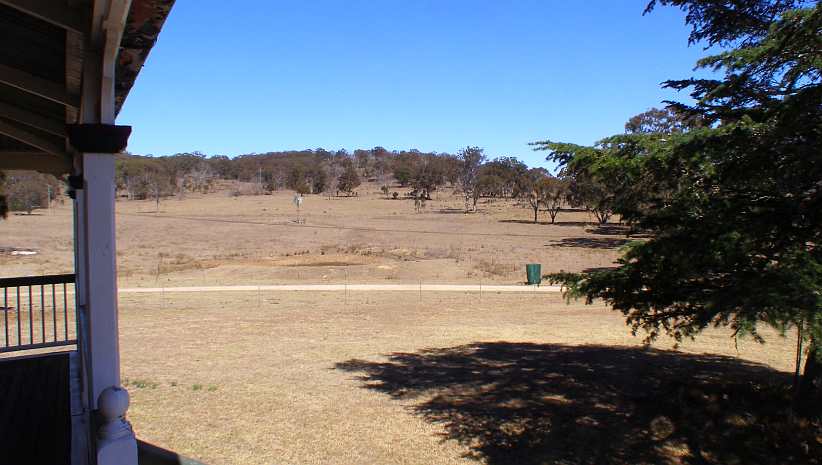
Drought at Dalveen. Looking across a paddock which was usually green and supporting a number of cattle, now the drought had seriously reduced the level of the dam and left little grass alive.
At this time Sandra had convinced her mother to live with her in Toowoomba and I was unclear about where I had to work for the week so made a trip to Brisbane with her to get mum and her gear transported up. There was also a problem with a major fuel leak in the Falcon which showed up while we were there, causing consternation.
Then I had to prepare for the best part of two weeks away. The Aboriginal Housing job was coming to an end and decisions made by the office meant I was allocated with work a bit further South. The trip began with a weekend at Walcha…
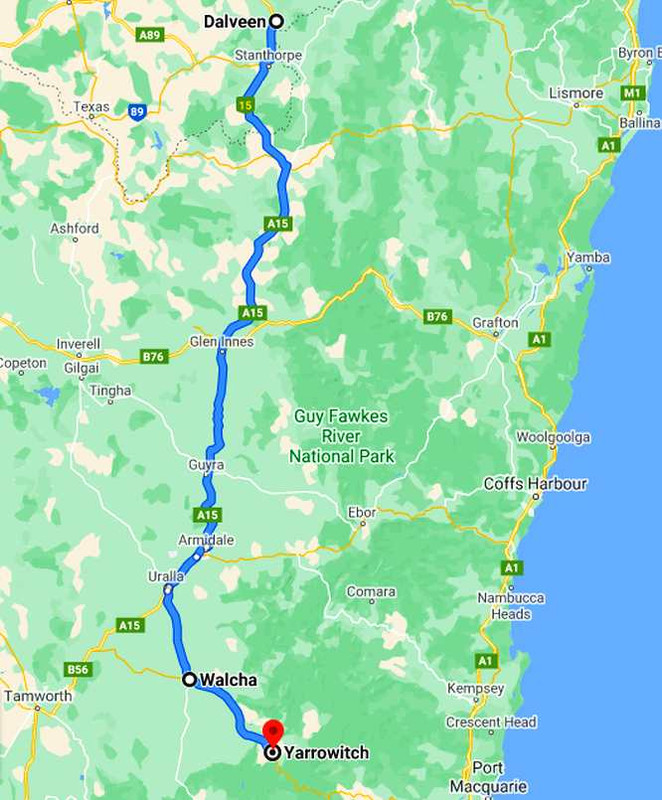
…where I did the regular weekend work and also tried to flush out a couple of the Aboriginal housing tenants. While there I arranged to stay with Phil, father of a friend of min in Inverell. Phil was recently divorced and having a bit of a hard time and lived out at Yarrowitch:
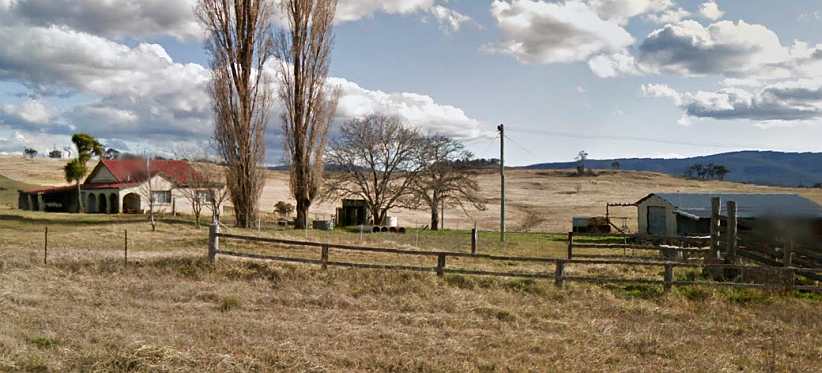
Phil’s house. Well away from town, Phil’s house is comfortable and has some good shed space for his motorcycle.
I had a look at the old bus Phil is converting into a travelling home, but he’s been a bit slow at getting it done as other things keep cropping up. Also while there I had a go at fixing a problem which had developed with the Forester.
When I first fitted the new engine there was a bit of a misfire which I traced to the number 2 plug lead. I changed the lead. Now there was a bad miss, its hill-climbing abilities had declined badly and it was using about 20% more fuel than it should. While I was doing all these miles for work!
I changed the coil pack, but it didn’t make any difference, I just had to go on the longest leg of all these trips without resolving the problem. And satisfy myself that my curiosity over a car spotted in a front yard in Walcha had educated me some more when I had the blokes at the AACA forum identify it (the owner had no idea at all)…
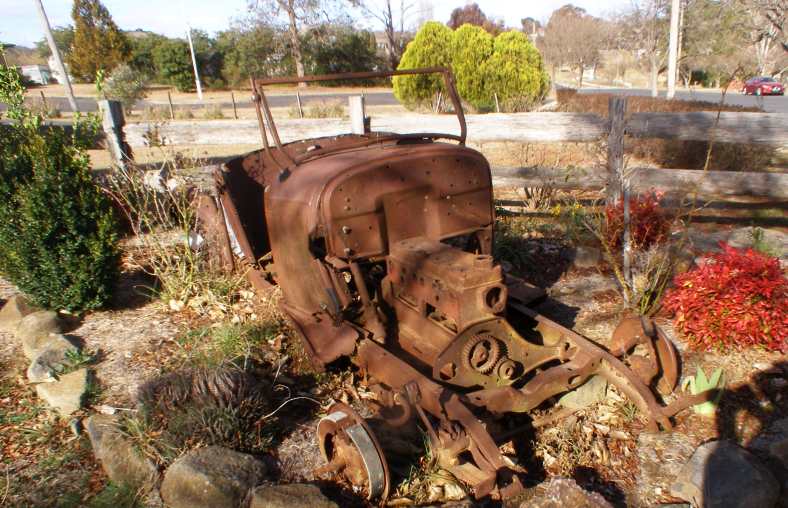
Dodge Six. The Dodge Brothers company made this 6-cylinder car alongside the 4-cylinder models for which they were better-known in the late twenties before the Chrysler takeover.
Walcha is, for Australia, a cold place, but it’s a neat town with well-kept homes and yards fronting the streets which form a grid pattern over the hills:
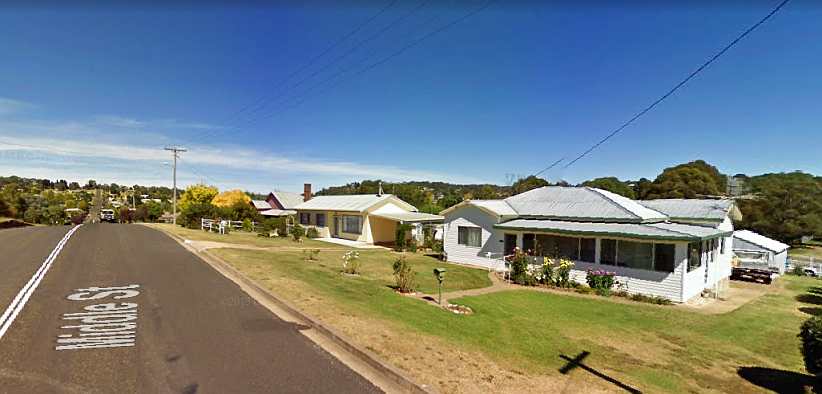
Middle Street. A Street View pic of the area where I worked this weekend, around the corner from where I spotted the old Dodge.
Not having found any of the Aboriginal Housing tenants at home over the weekend I tried again on Monday after another night at Phil’s. My success was very limited, so I set off for the next destinations they’d given me at Quirindi and Werris Creek, stopping at Bob and Elaine’s place at Timbumburi Monday night:
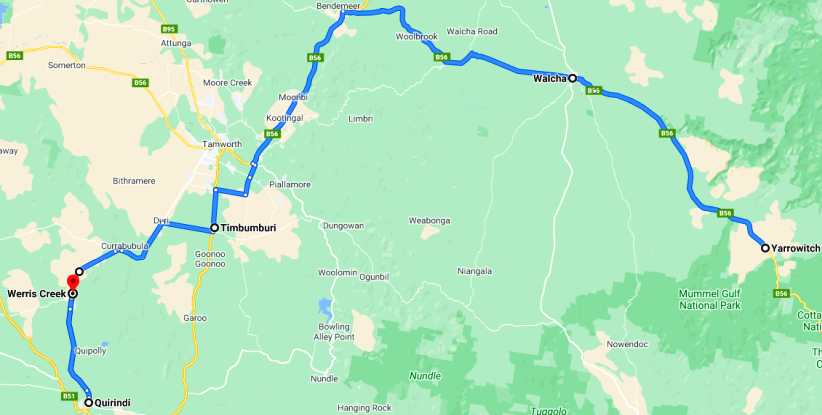
Tuesday would see me tackling some long mileages, the Forester still drinking fuel, which would set the scene for the whole week. We had reached the situation with this job where there were just a few interviews to get in some quite disparate areas to satisfy the government department and I was on a clean-up operation...
The list of addresses I was given for this job was never going to be completed. I may have had, for instance, six addresses in a town. But the quota for interviews might be two or three. All the same, I had to push to get those because of the vagaries of the way the people live and just who might be available. It was supposed to be the actual lessee if possible, but someone who claimed to know about the family relationship with the service providers would suffice.
Just around the corner from the hotel I found a couple of the addresses, one sporting the remains of a Chrysler Charger in the yard:
Charger. Like many other things in this yard, the Charger has seen better days. This is one of the last models of the Charger built by Chrysler Australia.
I stumbled around the back block from there and found another tenant to talk to, the most important thing to notice in this little scene…
Obstacles. Though I found the occupant here co-operative, it was a job to get past all the relics and the vicious dogs.
…being the ‘Beware of the Dog’ sign. I then went back to see what I could find out of the several addresses I had in the area in the picture of the houses seen coming into town. A young girl was ‘in charge’ at one of them so I got my third interview and was able to get on the road.
Goats. Feral goats were prolific in the area, able to live on the rough scrub growing in the area and not confined by any fences farmers chose to build.
The main road took me to North Bourke first, where a new bridge has replaced this old lift-span bridge built in days when paddle-wheelers took care of a lot of the transport of goods…
Bridge at North Bourke. There was a time when this waterway provided transport solutions for settlers along the river and the bridge had to give clearance for the boats.
Then came Bourke. There were listings of addresses for interviews in this town too, but I wasn’t required to chase them up. I turned left to head towards Brewarrina, but soon pulled up as I briefly had phone signal here and needed to finalise some things by phone. I also went to the local library to go online for a short time.
Bourke when green. This Google Earth Street View picture was taken after the drought broke. I pulled up here and made some necessary phone calls.
It was about 60 miles from Bourke to Brewarrina, with not much to see. One thing which stood out was the remains of somebody’s trailer. Probably starting from a wheel bearing fire – as we saw in an earlier post – nothing was salvageable here:
Total loss. Out there in this scrubby and lightly populated country, a fire in a semi-trailer is very likely to result on a loss of the trailer and its load. Hence this one has simply been unhooked and left behind between Bourke an Brewarrina.
The long drive continued along these roads:
I got to Moree in the dark and had my dinner there, then drove on to Inverell where I spent the night at the Twin Swans Motel. The Saturday and Sunday were spent working at Tenterfield and then I went to Sandra’s. But not for long, Monday afternoon saw me on the way towards Lightning Ridge again…
Phoenix on trailer. The owner of this rig had travelled over 700 miles so far retrieving this Dodge Phoenix – and still had a distance to go.
…and caught sight of this newly-purchased Phoenix ‘restorer’ on its way to Brisbane at the Goondiwindi truckstop. The next day, after using up the batteries of my cordless angle grinder on the chassis near Mungindi, I arrived in Lightning Ridge in time to see a straggler from a group of Frenchmen crossing Australia in their old Citroens:
Citroen Light 15. About a 1954 model, this is the same as one I owned in 1966. I didn’t have it long…
A long way from home. Clearly French names to match the origin of the car, I didn’t see the owners.
Tracbar Dundee. A clear indication that they weren’t alone, though I didn’t see any of their companions.
Well equipped. Foglights, extra spare wheels, they were ready for anything they might encounter.
These pics were taken outside the hot springs pool, so I guess the owners were enjoying a refreshing dip in that pool.
In addition to looking over the Citroen, I decide to take other photos around town to show the character of the place:
Diggings. Mullock heaps and lean-tos dot the scenery just over the hill from the layout of streets and houses which make up most of the town.
I learned that many people who ‘migrated’ to Lightning Ridge in the seventies bought an old truck to carry their gear along with them for the move and knew they’d have further use for it at their diggings. Lots of them are still hanging around, used and unused:
Austin truck. From the mid-fifties, this Austin featured a 4-litre 6-cylinder engine which was undoubtedly quite uneconomical. It’s obviously become an advertising hoarding.
Some places served to accumulate a number of these vehicles – as well as other machinery items and assorted scrap:
Yard full. Another Austin of similar vintage, this one with a tipper body. In the background there’s a large crane truck and lots of steel fabrications lie about the yard.
More advertising was more common…
Bedford. GM was represented by the Bedfords seen around the area, this one being another advertising hoarding as it seems to have driven its last mile.
…but some just decorated driveways in the town:
Diesel in the driveway. An AEC tipper from the same era fills out a driveway not far from the main street.
And even railway carriages have been transported from Sydney:
Suburban rail carriages. In use now as a part of a museum, these were built in the fifties too, and they carried millions of commuters before being retired in the eighties.
Some ‘stashes’ of this old machinery look more commercial, like they wheel and deal in the various items.
Cement mixers. A German MAN truck is on the right here while there are a couple of cement-mixing bowls in the yard too.
The cement mixers are used for ‘tumbling’ the winnings from the diggings to reveal the opals.
Another Austin. Yet another of the Austins, long since consigned to supporting a sign advertising an ‘opal mining experience.’
The job now completed at Lightning Ridge, and my batteries for the angle grinder nicely recharged at the motel, I headed for home on the Friday with a stop along the road to get the front half of the Jewett chassis. I tied it onto the racks on the roof of the Forester and headed off home so I could go to work down the Tweed coast again. By now the drought was biting in hard, even at Dalveen:
Drought at Dalveen. Looking across a paddock which was usually green and supporting a number of cattle, now the drought had seriously reduced the level of the dam and left little grass alive.
At this time Sandra had convinced her mother to live with her in Toowoomba and I was unclear about where I had to work for the week so made a trip to Brisbane with her to get mum and her gear transported up. There was also a problem with a major fuel leak in the Falcon which showed up while we were there, causing consternation.
Then I had to prepare for the best part of two weeks away. The Aboriginal Housing job was coming to an end and decisions made by the office meant I was allocated with work a bit further South. The trip began with a weekend at Walcha…
…where I did the regular weekend work and also tried to flush out a couple of the Aboriginal housing tenants. While there I arranged to stay with Phil, father of a friend of min in Inverell. Phil was recently divorced and having a bit of a hard time and lived out at Yarrowitch:
Phil’s house. Well away from town, Phil’s house is comfortable and has some good shed space for his motorcycle.
I had a look at the old bus Phil is converting into a travelling home, but he’s been a bit slow at getting it done as other things keep cropping up. Also while there I had a go at fixing a problem which had developed with the Forester.
When I first fitted the new engine there was a bit of a misfire which I traced to the number 2 plug lead. I changed the lead. Now there was a bad miss, its hill-climbing abilities had declined badly and it was using about 20% more fuel than it should. While I was doing all these miles for work!
I changed the coil pack, but it didn’t make any difference, I just had to go on the longest leg of all these trips without resolving the problem. And satisfy myself that my curiosity over a car spotted in a front yard in Walcha had educated me some more when I had the blokes at the AACA forum identify it (the owner had no idea at all)…
Dodge Six. The Dodge Brothers company made this 6-cylinder car alongside the 4-cylinder models for which they were better-known in the late twenties before the Chrysler takeover.
Walcha is, for Australia, a cold place, but it’s a neat town with well-kept homes and yards fronting the streets which form a grid pattern over the hills:
Middle Street. A Street View pic of the area where I worked this weekend, around the corner from where I spotted the old Dodge.
Not having found any of the Aboriginal Housing tenants at home over the weekend I tried again on Monday after another night at Phil’s. My success was very limited, so I set off for the next destinations they’d given me at Quirindi and Werris Creek, stopping at Bob and Elaine’s place at Timbumburi Monday night:
Tuesday would see me tackling some long mileages, the Forester still drinking fuel, which would set the scene for the whole week. We had reached the situation with this job where there were just a few interviews to get in some quite disparate areas to satisfy the government department and I was on a clean-up operation...
Last edited by Ray Bell; May 2, 2021 at 08:14 AM.