


Ride along with me...


Thread Starter
|
Captain

Joined: Oct 2005
Posts: 570
Likes: 8
From: The Summit, Queensland, Australia

I was looking at the fuel cost, of course, but the mileage allowance I was being paid easily covered it. I was also careful about ensuring I didn’t buy fuel where it was expensive, carrying a couple of jerry cans with me to extend my range. But a car which had been getting around 650kms from a tankful (completely full to dead empty – drums are useful to allow you to do that) was now turning in tankfuls which only yielded about 470kms. And this loop ahead of me was over 1,000kms.
Did I, perhaps, have a crook injector? But there was no real time to sort it out, all my spares were at home anyway, and there was work to be done. And I also needed a new tyre, so I called ahead to Bob Abberfield and asked his advice on where to get one. “Leicht’s at Taminda,” came the reply, so I went there on the way. I was quoted $110 for a single tyre – which was all I needed at the moment – and asked if they could make it $100. “Buy two,” the lady told me, “And I’ll give you that price.” I got the one fitted up and arranged to return within a few weeks to pick up the second one.
That taken care of I had to look at the options of where I had to go. Remembering that I had to do a few in each area to satisfy the clients, it was really a matter of working out how to efficiently get to each area. It was now Tuesday morning and I was due back in the Tamworth area to do my regular work there on Saturday.
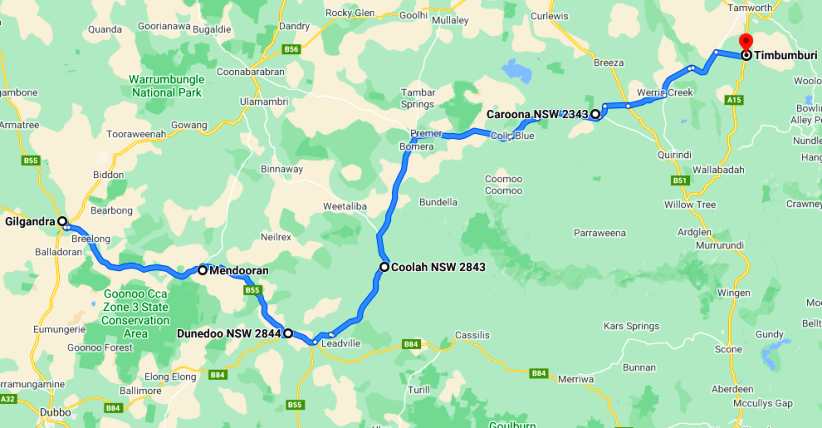
This was the way I decided to go:
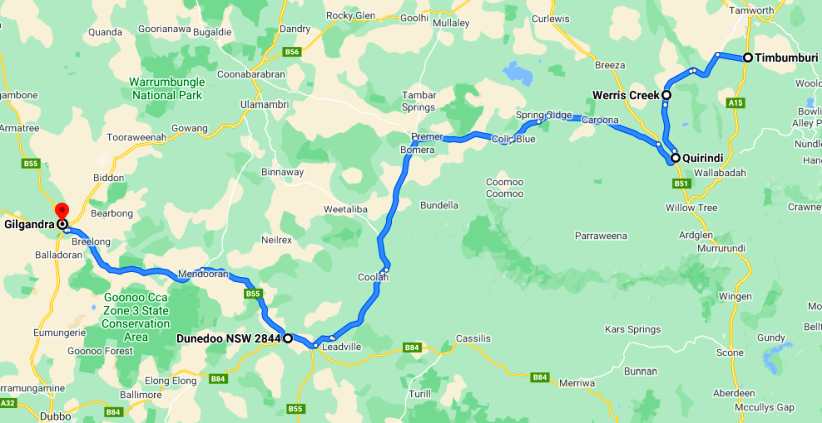
Werris Creek and Quirindi are both old railway towns. In recent years, however, the growth of open-cut coal mining in the area has seen a resurgence in both. Werris Creek is the smaller of the two and I went there first.
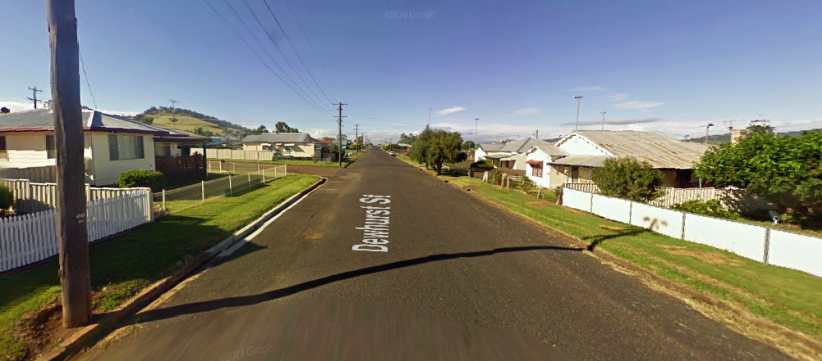
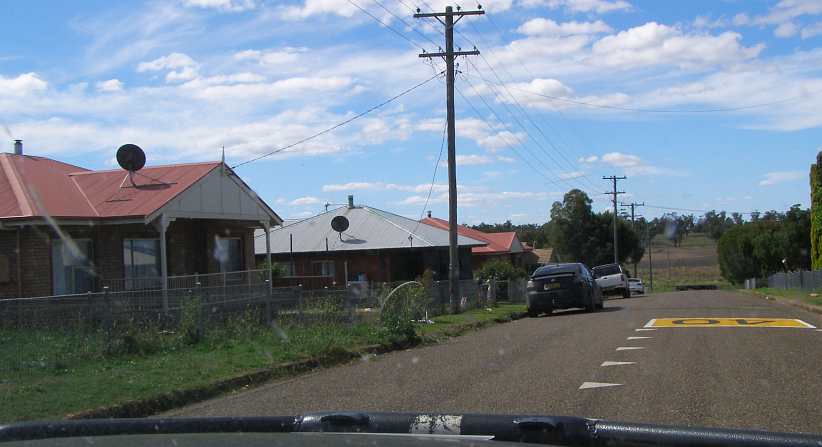
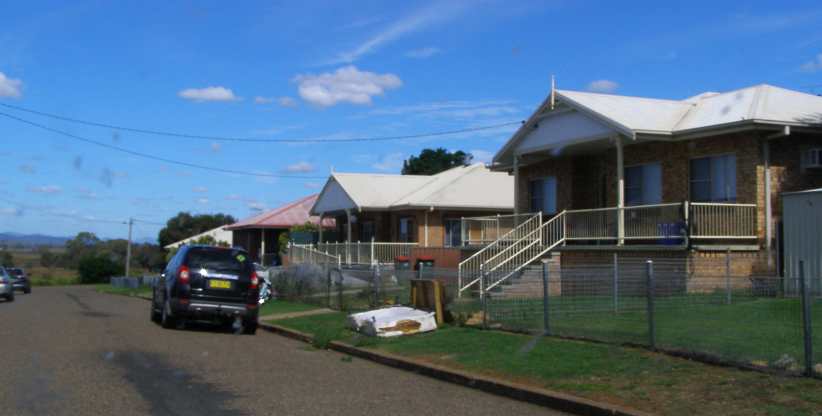
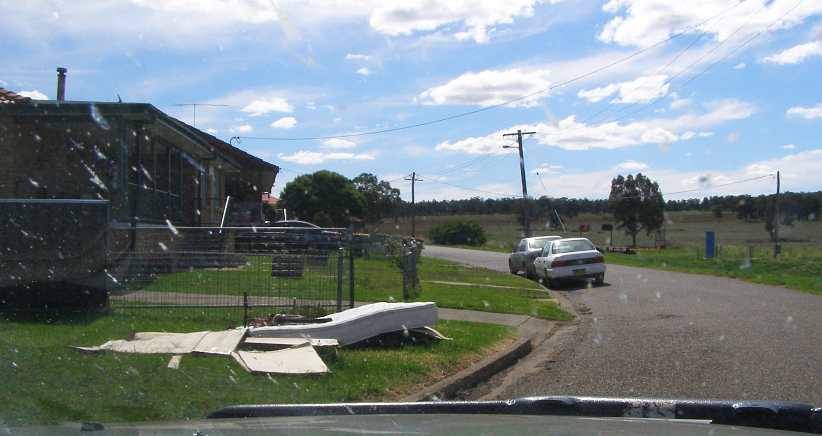
Typical Werris Creek street. Homes on a hillside with most of them between fifty and a hundred years old, most locals keep them neat and lawns well-watered.
A couple of hours saw me get the interviews I needed there and I headed West. It was going to take me three hours to get to Gilgandra and I’d go via the flatter of the two logical routes to avoid being slowed by the big hills on that stretch of the Newell Highway.
There was some light rain in the distance, which would have made someone happy…
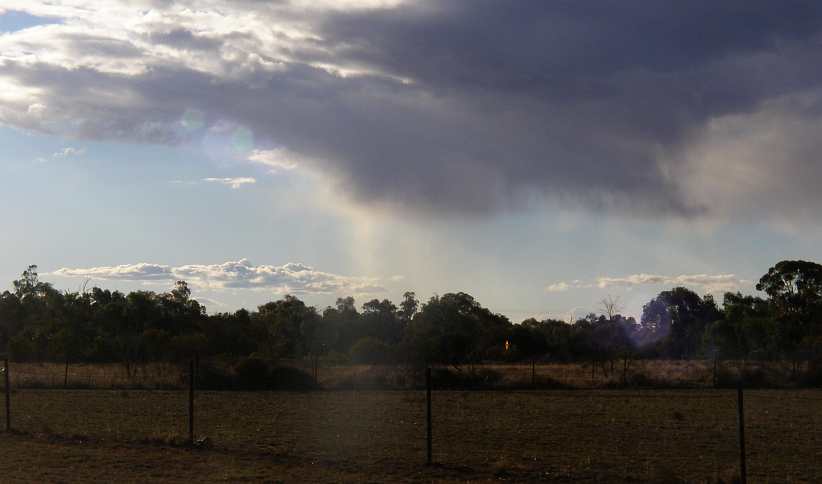
Rain in the distance. A welcome sight at any time during a drought. There wasn’t much in this lot but around Gilgandra had seen some recent falls.
…while I had plenty of ‘thinking time’ as I drove. I didn’t use it to take photos, however, which explains why there are so many Google Earth Street View pics in this post. Caroona, Spring Ridge and Colly Blue are very small places, Premer’s township is actually off the road, Coolah was the next town of substance and I got something to eat there. But without wasting time.
Dunedoo was a place we visited as a family back in 1956 travelling in dad’s brand new FJ Holden. It was easter time and mum’s brother was a panel beater there, I recall that we drove along dirt roads to get from there to Dubbo to see an air show that weekend, but many things have changed since then.
I have had cause over the past fifteen years, however, to drive through the place quite often. The main street is one-sided with a long park and Rest Area opposite the shops:
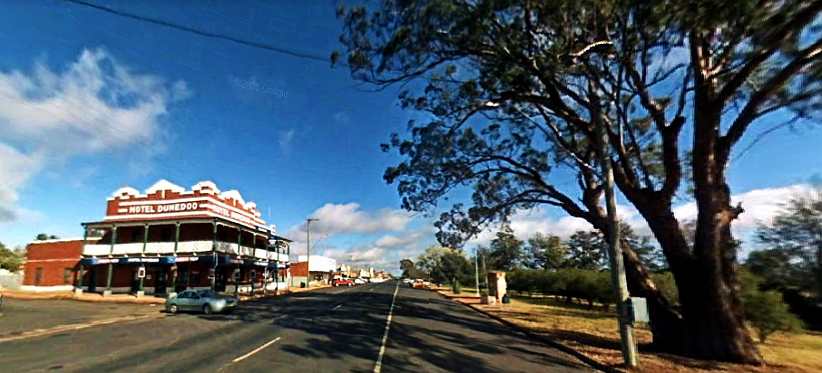
Dunedoo main street. To the right is the park with the Rest Area (and overnight truck parking) on a lower level, the hotel and shops to the left and seemingly prospering.
To Mendooran, then to Gilgandra, the miles ticked away easily enough, with the entry to Gilgandra being this bridge over the Castlereagh River:
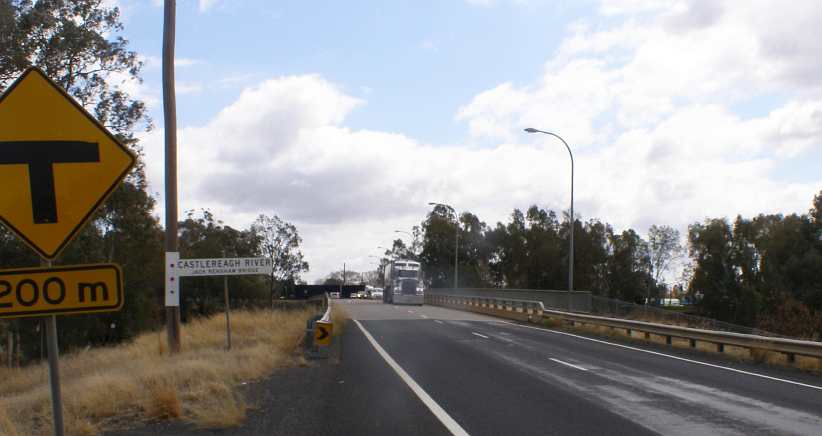
Bridge to Gilgandra. The T-intersection after this bridge makes for noisy truck braking, gearchanges and acceleration. To the right is the centre of town, to the left the traffic stays on the Newell Highway, the main road between Queensland and Victoria.
I booked into the motel for Tuesday night and quickly got started on getting some interviews down. It was after dark by the time I finished, but that didn’t worry me. What did was the lady in her thirties who seemed very keen for me to stay and keep on talking. Her daughter went out for the evening with a friend, I figured it was a good idea to cut the conversation short.
A couple more interviews the next morning and it was time to head to the much more remote town of Nyngan:
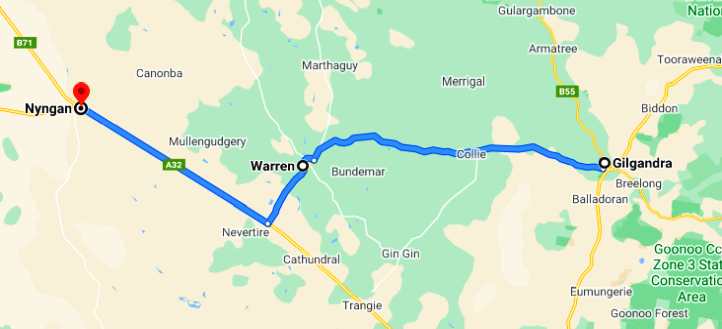
I needed to get six interviews in Nyngan so that meant I’d spend Wednesday in a motel in Nyngan. It was all flat country going out there, flood country at times, and blacksoil which makes roadbuilding a regular exercise…
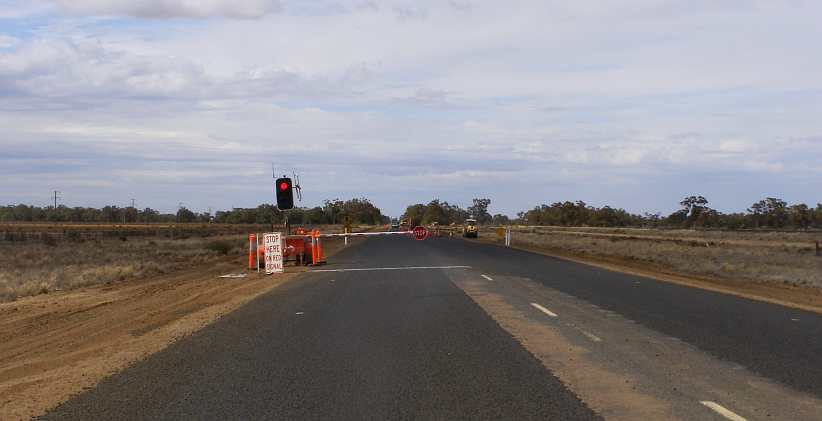
Road to Nyngan. Traffic lights for the roadworks, a regular feature in places like this mid-week.
…as they struggle to keep the roads in acceptable condition.
Once there I started looking to find the people I needed to interview. There was one of the homes I required to visit in this street on the edge of town…
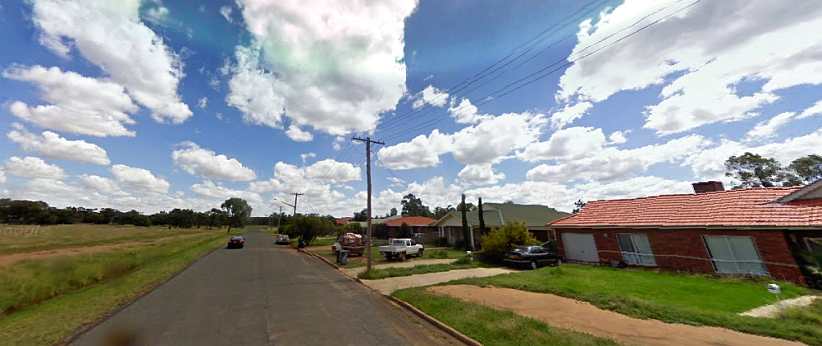
Edge of town. Another Google Earth picture which shows the kind of homes I was visiting. Though some were older and more run-down.
…while others were dotted across the many streets. Some people were home, others I had to call back later. Of course, I also had to see to my creature comforts…
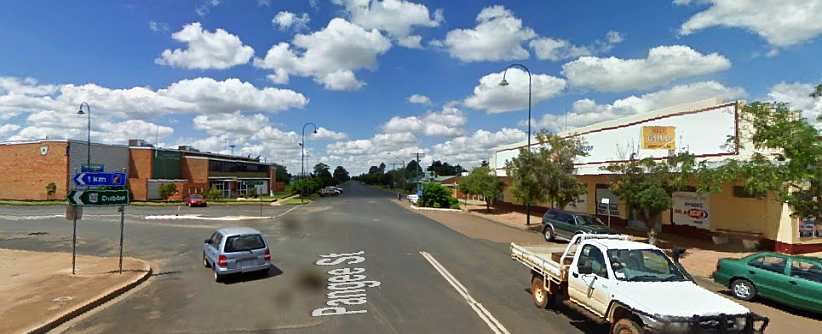
RSL and IGA. I was to go to both of these, the RSL to get my dinner and IGA for a couple of items to carry me through.
These two places would have the greatest floor traffic of any in Nyngan. The RSL (Returned Soldiers League) is an institution in Australia, formed in virtually every large town to provide club amenities for returned soldiers. With most wars now well and truly in the past they admit members from all of the community but they still observe many traditions from their past.
The next day I got the remaining interviews I needed and drove back to Gilgandra. Along the way I stopped off at Warren to get lunch.
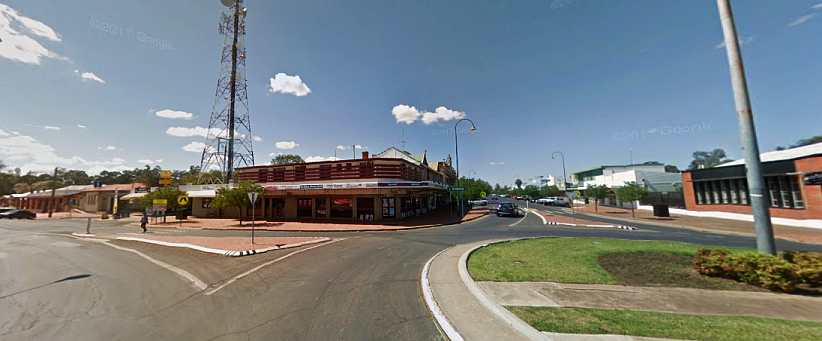
Warren. The busiest intersection in Warren, where I branched off the main road to find something to eat. The tower to the left is at the rear of the Post Office and provides communications for the area.
Back in Gilgandra I quickly set about doing some more work before retiring to my motel:
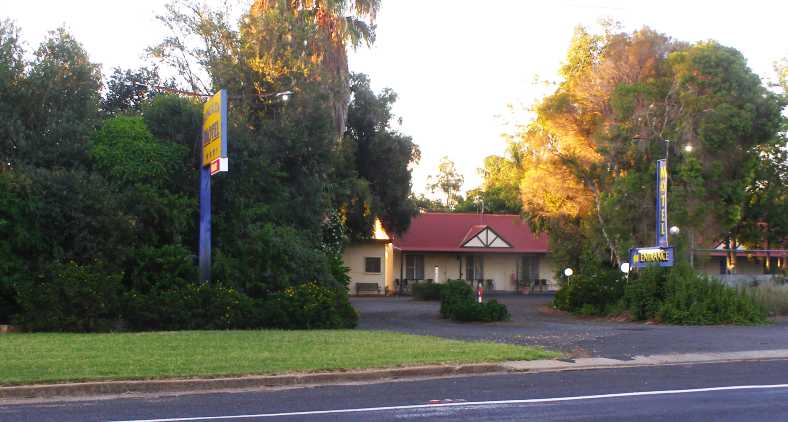
Bungalow Motel. My room was in this drive and down to the right behind the vacant land. It’s a pleasant place to stay, though no longer run by the family I’d known there ten years earlier.
We’d arranged that they didn’t have to make up my room between my stays as it was a quiet time and occupancy levels were low. While in the town I’d also been to the Visitor’s Centre in the large riverside Rest Area, but I didn’t have time to go to the Rural Museum just up the road.
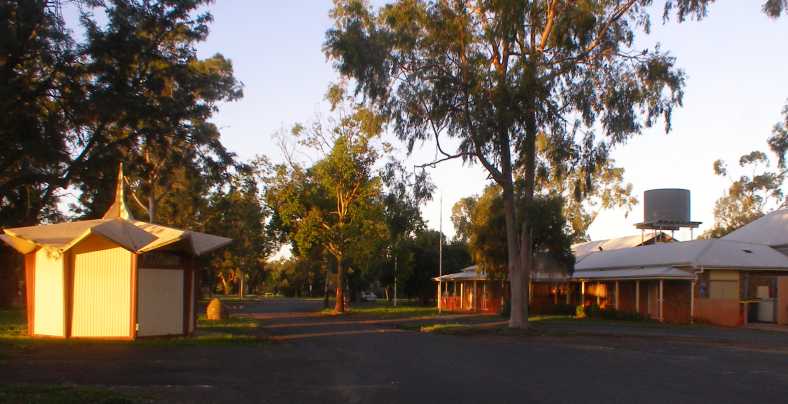
Visitor’s Centre and park. Between the highway and the river is a pleasant and well-treed area which is used by locals and passing traffic alike.
Friday morning saw me quickly wrap up the work I had to do. Though at one stage I thought I’d locked myself out of the car and called the NRMA to rescue me again. No sooner had I completed that call than I realised the window on the passenger’s side was open and I had to call and tell them I was okay.
Before leaving town I took a few photos at the Bridge, mainly because there was no flow in the river below. But I also wanted some pics of the traffic making use of it, like this truck…
]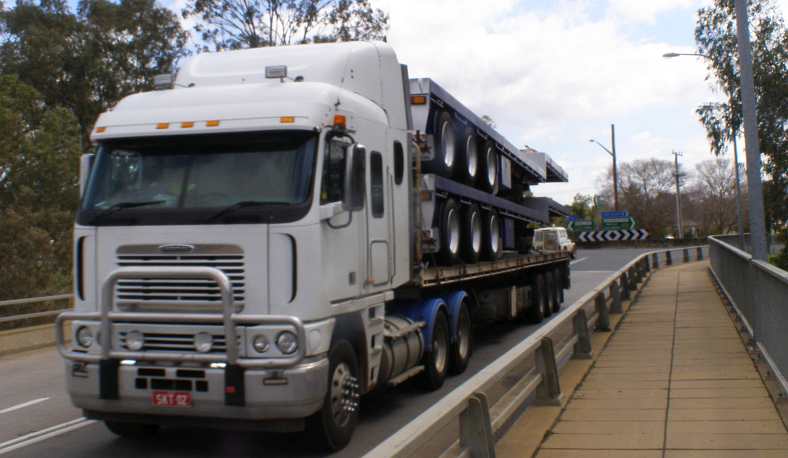
Northbound. This load looks like new B-double type trailers heading North for use. Most Australian manufacture of this kind of thing is done in Melbourne.
…and caravans going the other way:
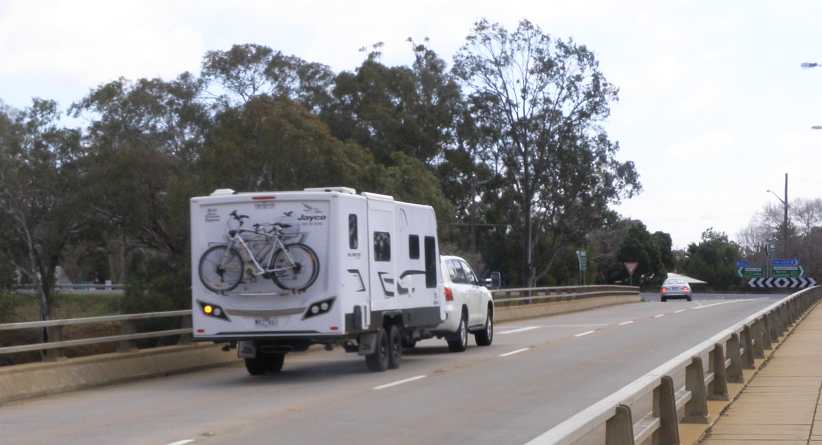
Return trip. Winter sees many from Melbourne head North, but now Winter was ending the caravans were all going South again.
And below us the river was showing that droughts can leave it near-dry:
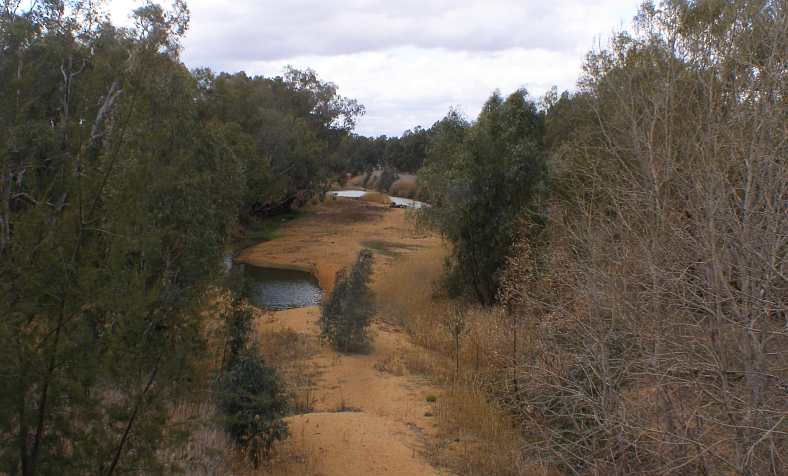
Not much river. Pockets of water lie in the riverbed, probably with a little flow happening through the sands.
Now I was heading back to Bob’s with just some calls at Caroona to make to complete my task for the week:
Once again through Mendooran. I stopped there this time to get a photo of this old store:
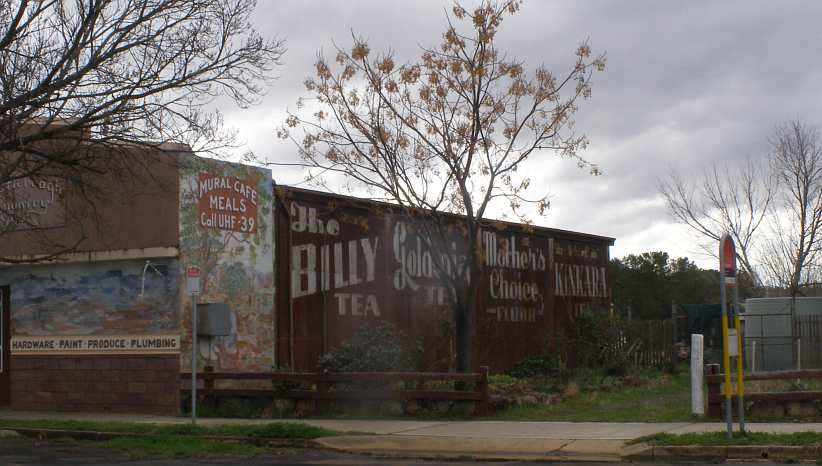
Tea signs. Before coffee took over, tea was a huge seller in Australia and justified lots of advertising. Three brands feature here.
Billy Tea, Goldenia Tea and Kinkara Tea feature here, with the Mother’s Choice Flour being associated with the Kinkara brand. We hear little of any of these today, though Billy Tea, Kinkara and Mother’s Choice still exist. Note that the wall isn’t all history, however, the small cafe sign in the mural section at the front reminds passers-by that they can order over their CB radios.
Between Dunedoo and Coolah there had been some fires, so along with the drought this meant that what was normally long grass was almost non-existent. Which allowed me to see the old railway line I’d never noticed before:
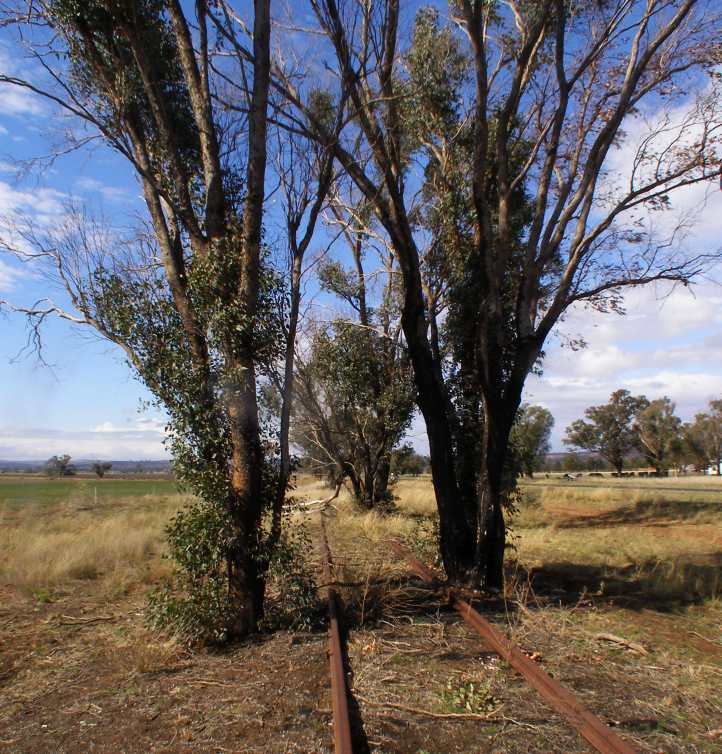
Rails and trees. Trees have been at work confirming that the railway can’t be used again. In places the trees have lifted the lines clear of the ground, growing close to and sometimes between the rails.
Note the growth on the trees, by the way. Gum trees don’t normally have leaves like that, they’re usually confined to upper branches. But after a fire, the trees’ means of restoring growth is to send out shoots right up the trunk to absorb the carbon dioxide in the air and expel oxygen.
Old and abandoned homes, however, have no mechanism to preserve themselves. This one was no doubt once a nice farmhouse surrounded by shady trees:
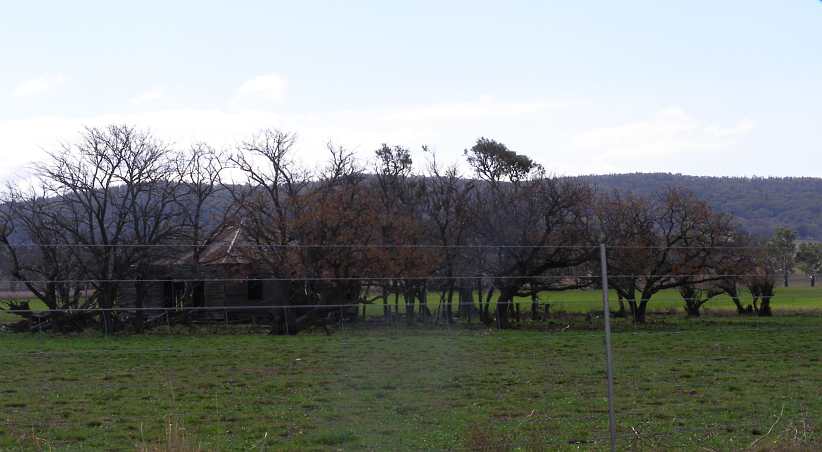
Abandoned. Time’s up for this place now, but at one time it was home and hearth for families making a living on the land.
The flat roads after Coolah allowed me to make good time and I turned into the road leading to the Caroona Mission Aboriginal settlement. I had never seen this before, but I was to learn that the owner of a large property gifted the hill to the local Aboriginals who were camping by the creeks on his land. I could see it as I drove up:
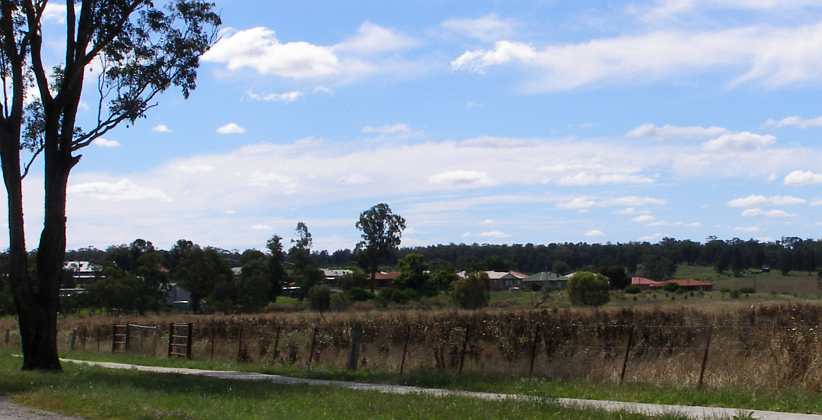
From a distance. The rooftops of near-new homes came into view as I approached from the main road.
I took these photos much later, but they serve to convey what the settlement looks like. Relatively new homes built by the New South Wales Government under their Aboriginal Housing scheme, sealed streets, all amenities.
A town in the bush. This is along Caroona Mission Road, which loops around the whole ‘Mission’ area.
Provision for handicapped. The second house on the right here has a ramp for wheelchairs, this is a street which links across the loop.
Skirting round the edge. Coming back around the loop, open space to the right gives children places to play.
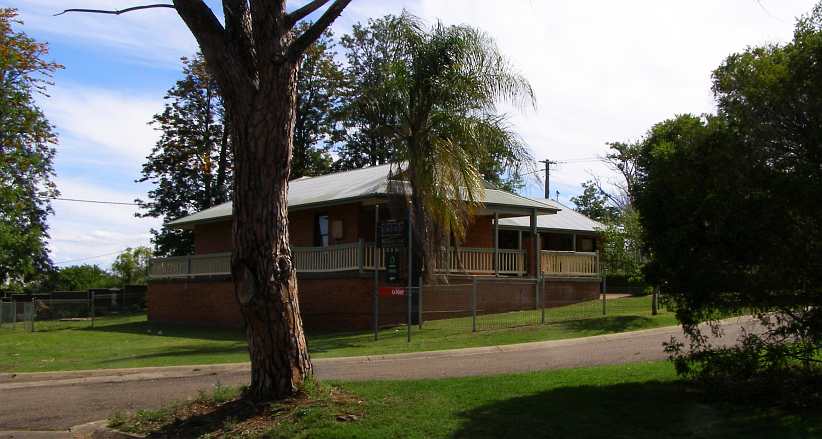
Caroona Community Centre. A place for meeting together, with their Post Office included in this building near the entry to the village area.
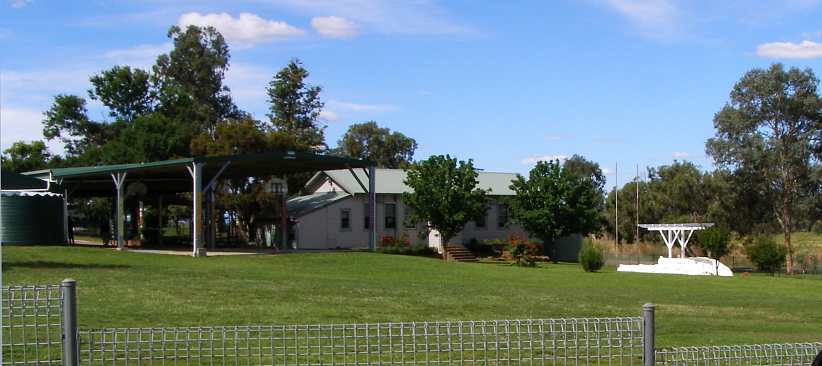
School. An older building serves for the school, which would be for children up to about 11 years, High School would require a bus ride to Quirindi.
After I’d finished I headed back to Bob and Elaine’s where I would be staying the next few nights. As mentioned, I was working in Tamworth that weekend and that was only six or seven miles away. In the week I’d been gone, Elaine had rescued this little bloke:
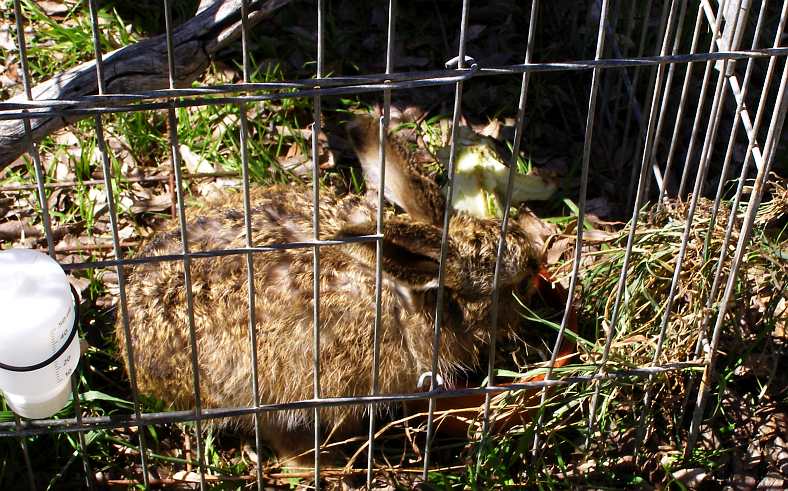
Rescued rabbit. Found cowering and shaking, possibly having been chased by their dogs, this rabbit was caged and cared for until it was ready to be taken somewhere for release.
Each night I’d stay up late with Bob, who’s a bit of a night owl like me. We’d frequently discuss overseas trips, with his preference being to go to Europe while I’d extol the wonders to be found in the USA.
I don’t know if he’ll ever cross the Pacific to see those…
Did I, perhaps, have a crook injector? But there was no real time to sort it out, all my spares were at home anyway, and there was work to be done. And I also needed a new tyre, so I called ahead to Bob Abberfield and asked his advice on where to get one. “Leicht’s at Taminda,” came the reply, so I went there on the way. I was quoted $110 for a single tyre – which was all I needed at the moment – and asked if they could make it $100. “Buy two,” the lady told me, “And I’ll give you that price.” I got the one fitted up and arranged to return within a few weeks to pick up the second one.
That taken care of I had to look at the options of where I had to go. Remembering that I had to do a few in each area to satisfy the clients, it was really a matter of working out how to efficiently get to each area. It was now Tuesday morning and I was due back in the Tamworth area to do my regular work there on Saturday.
This was the way I decided to go:
Werris Creek and Quirindi are both old railway towns. In recent years, however, the growth of open-cut coal mining in the area has seen a resurgence in both. Werris Creek is the smaller of the two and I went there first.
Typical Werris Creek street. Homes on a hillside with most of them between fifty and a hundred years old, most locals keep them neat and lawns well-watered.
A couple of hours saw me get the interviews I needed there and I headed West. It was going to take me three hours to get to Gilgandra and I’d go via the flatter of the two logical routes to avoid being slowed by the big hills on that stretch of the Newell Highway.
There was some light rain in the distance, which would have made someone happy…
Rain in the distance. A welcome sight at any time during a drought. There wasn’t much in this lot but around Gilgandra had seen some recent falls.
…while I had plenty of ‘thinking time’ as I drove. I didn’t use it to take photos, however, which explains why there are so many Google Earth Street View pics in this post. Caroona, Spring Ridge and Colly Blue are very small places, Premer’s township is actually off the road, Coolah was the next town of substance and I got something to eat there. But without wasting time.
Dunedoo was a place we visited as a family back in 1956 travelling in dad’s brand new FJ Holden. It was easter time and mum’s brother was a panel beater there, I recall that we drove along dirt roads to get from there to Dubbo to see an air show that weekend, but many things have changed since then.
I have had cause over the past fifteen years, however, to drive through the place quite often. The main street is one-sided with a long park and Rest Area opposite the shops:
Dunedoo main street. To the right is the park with the Rest Area (and overnight truck parking) on a lower level, the hotel and shops to the left and seemingly prospering.
To Mendooran, then to Gilgandra, the miles ticked away easily enough, with the entry to Gilgandra being this bridge over the Castlereagh River:
Bridge to Gilgandra. The T-intersection after this bridge makes for noisy truck braking, gearchanges and acceleration. To the right is the centre of town, to the left the traffic stays on the Newell Highway, the main road between Queensland and Victoria.
I booked into the motel for Tuesday night and quickly got started on getting some interviews down. It was after dark by the time I finished, but that didn’t worry me. What did was the lady in her thirties who seemed very keen for me to stay and keep on talking. Her daughter went out for the evening with a friend, I figured it was a good idea to cut the conversation short.
A couple more interviews the next morning and it was time to head to the much more remote town of Nyngan:
I needed to get six interviews in Nyngan so that meant I’d spend Wednesday in a motel in Nyngan. It was all flat country going out there, flood country at times, and blacksoil which makes roadbuilding a regular exercise…
Road to Nyngan. Traffic lights for the roadworks, a regular feature in places like this mid-week.
…as they struggle to keep the roads in acceptable condition.
Once there I started looking to find the people I needed to interview. There was one of the homes I required to visit in this street on the edge of town…
Edge of town. Another Google Earth picture which shows the kind of homes I was visiting. Though some were older and more run-down.
…while others were dotted across the many streets. Some people were home, others I had to call back later. Of course, I also had to see to my creature comforts…
RSL and IGA. I was to go to both of these, the RSL to get my dinner and IGA for a couple of items to carry me through.
These two places would have the greatest floor traffic of any in Nyngan. The RSL (Returned Soldiers League) is an institution in Australia, formed in virtually every large town to provide club amenities for returned soldiers. With most wars now well and truly in the past they admit members from all of the community but they still observe many traditions from their past.
The next day I got the remaining interviews I needed and drove back to Gilgandra. Along the way I stopped off at Warren to get lunch.
Warren. The busiest intersection in Warren, where I branched off the main road to find something to eat. The tower to the left is at the rear of the Post Office and provides communications for the area.
Back in Gilgandra I quickly set about doing some more work before retiring to my motel:
Bungalow Motel. My room was in this drive and down to the right behind the vacant land. It’s a pleasant place to stay, though no longer run by the family I’d known there ten years earlier.
We’d arranged that they didn’t have to make up my room between my stays as it was a quiet time and occupancy levels were low. While in the town I’d also been to the Visitor’s Centre in the large riverside Rest Area, but I didn’t have time to go to the Rural Museum just up the road.
Visitor’s Centre and park. Between the highway and the river is a pleasant and well-treed area which is used by locals and passing traffic alike.
Friday morning saw me quickly wrap up the work I had to do. Though at one stage I thought I’d locked myself out of the car and called the NRMA to rescue me again. No sooner had I completed that call than I realised the window on the passenger’s side was open and I had to call and tell them I was okay.
Before leaving town I took a few photos at the Bridge, mainly because there was no flow in the river below. But I also wanted some pics of the traffic making use of it, like this truck…
]
Northbound. This load looks like new B-double type trailers heading North for use. Most Australian manufacture of this kind of thing is done in Melbourne.
…and caravans going the other way:
Return trip. Winter sees many from Melbourne head North, but now Winter was ending the caravans were all going South again.
And below us the river was showing that droughts can leave it near-dry:
Not much river. Pockets of water lie in the riverbed, probably with a little flow happening through the sands.
Now I was heading back to Bob’s with just some calls at Caroona to make to complete my task for the week:
Once again through Mendooran. I stopped there this time to get a photo of this old store:
Tea signs. Before coffee took over, tea was a huge seller in Australia and justified lots of advertising. Three brands feature here.
Billy Tea, Goldenia Tea and Kinkara Tea feature here, with the Mother’s Choice Flour being associated with the Kinkara brand. We hear little of any of these today, though Billy Tea, Kinkara and Mother’s Choice still exist. Note that the wall isn’t all history, however, the small cafe sign in the mural section at the front reminds passers-by that they can order over their CB radios.
Between Dunedoo and Coolah there had been some fires, so along with the drought this meant that what was normally long grass was almost non-existent. Which allowed me to see the old railway line I’d never noticed before:
Rails and trees. Trees have been at work confirming that the railway can’t be used again. In places the trees have lifted the lines clear of the ground, growing close to and sometimes between the rails.
Note the growth on the trees, by the way. Gum trees don’t normally have leaves like that, they’re usually confined to upper branches. But after a fire, the trees’ means of restoring growth is to send out shoots right up the trunk to absorb the carbon dioxide in the air and expel oxygen.
Old and abandoned homes, however, have no mechanism to preserve themselves. This one was no doubt once a nice farmhouse surrounded by shady trees:
Abandoned. Time’s up for this place now, but at one time it was home and hearth for families making a living on the land.
The flat roads after Coolah allowed me to make good time and I turned into the road leading to the Caroona Mission Aboriginal settlement. I had never seen this before, but I was to learn that the owner of a large property gifted the hill to the local Aboriginals who were camping by the creeks on his land. I could see it as I drove up:
From a distance. The rooftops of near-new homes came into view as I approached from the main road.
I took these photos much later, but they serve to convey what the settlement looks like. Relatively new homes built by the New South Wales Government under their Aboriginal Housing scheme, sealed streets, all amenities.
A town in the bush. This is along Caroona Mission Road, which loops around the whole ‘Mission’ area.
Provision for handicapped. The second house on the right here has a ramp for wheelchairs, this is a street which links across the loop.
Skirting round the edge. Coming back around the loop, open space to the right gives children places to play.
Caroona Community Centre. A place for meeting together, with their Post Office included in this building near the entry to the village area.
School. An older building serves for the school, which would be for children up to about 11 years, High School would require a bus ride to Quirindi.
After I’d finished I headed back to Bob and Elaine’s where I would be staying the next few nights. As mentioned, I was working in Tamworth that weekend and that was only six or seven miles away. In the week I’d been gone, Elaine had rescued this little bloke:
Rescued rabbit. Found cowering and shaking, possibly having been chased by their dogs, this rabbit was caged and cared for until it was ready to be taken somewhere for release.
Each night I’d stay up late with Bob, who’s a bit of a night owl like me. We’d frequently discuss overseas trips, with his preference being to go to Europe while I’d extol the wonders to be found in the USA.
I don’t know if he’ll ever cross the Pacific to see those…
Last edited by Ray Bell; Feb 20, 2021 at 06:14 AM.
Thread Starter
|
Captain
Joined: Oct 2005
Posts: 570
Likes: 8
From: The Summit, Queensland, Australia
As I drove away from Bob and Elaine’s on the Monday morning I was heading off for my last calls on this survey of Aboriginal Housing tenants. The job had certainly helped me financially and given me some travel I wouldn’t ordinarily have. It also cemented relationships within the company that would ultimately lead to my trip to Central Australia eight months later.
I only had a few calls to make as I drove, and I picked my course so I could complete the task of obtaining the rest of that Jewett chassis near Mungindi…
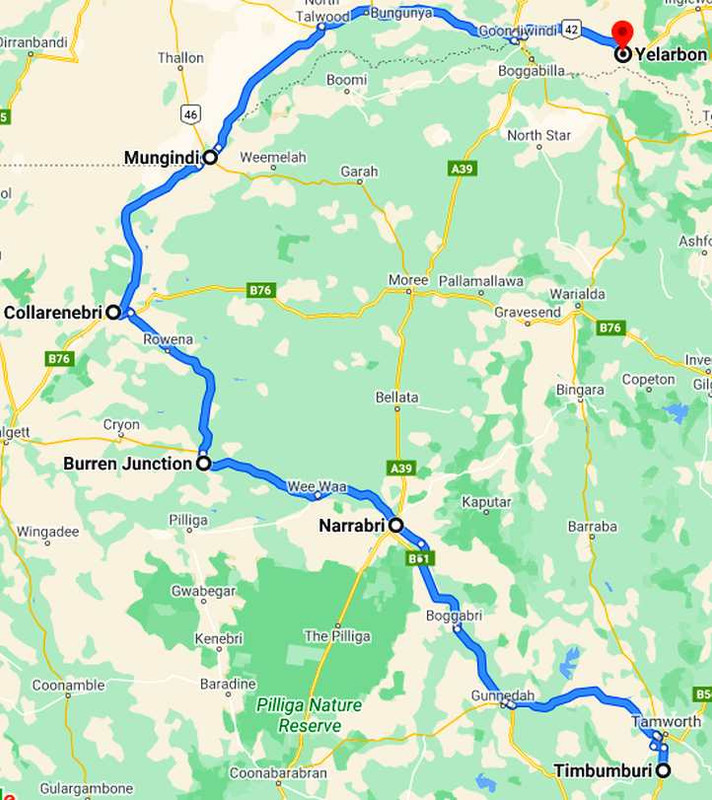
Two calls at Gunnedah completed the quota there, then I needed to get a couple in Narrabri. After Boggabri there’s a little place called Baan Baa and there I spotted a dual cab Dodge truck…
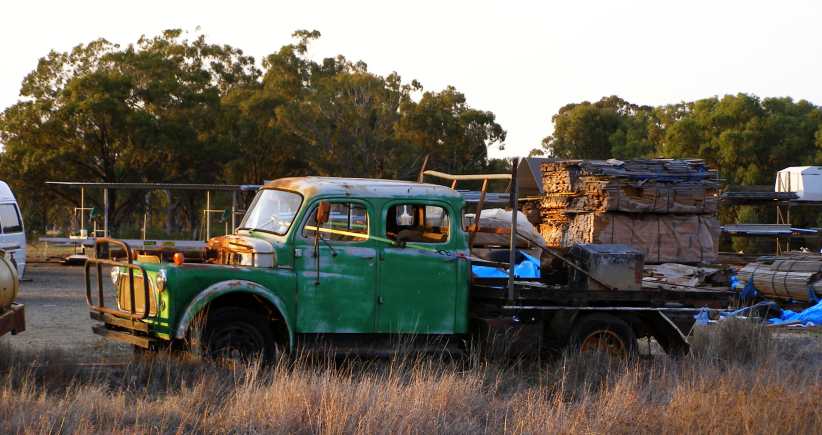
Dual cab at Baan Baa. This truck has been altered around the grille, but the dual cab fitment and the heavy-duty suspension imply that it belonged to the PMG or a local council originally.
The PMG – Post Master General – was responsible for all telephone services until the sixties, when the postal and telecommunications branches were separated. Dual cab trucks were good for getting crews on the job along with their tools, both for the PMG and for councils with roadworkers.
It became even more of a Dodge truck day when I got to Narrabri, calling in for fuel I quickly spotted this AT4 truck:
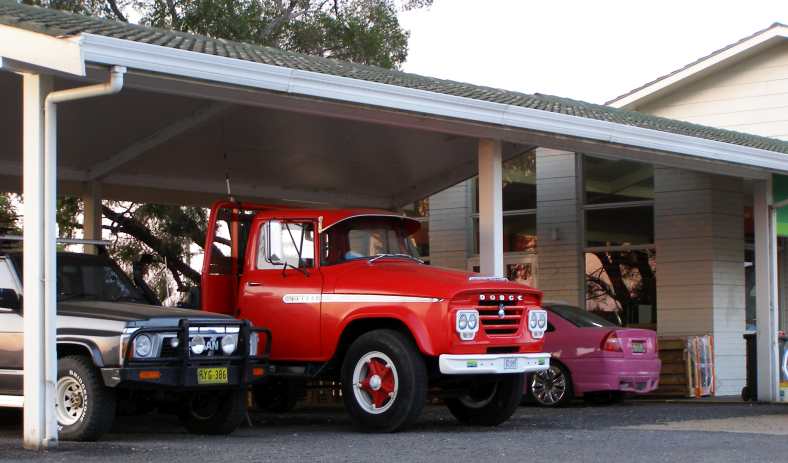
AT4 at Narrabri. The first of the Dodge trucks made in Australia using International Harvester body pressings, this one has spider wheels, so was a hard-worker from the beginning.
Chrysler Australia had been pressing out International Harvester body panels since the forties, I believe, and when the ‘Pilot House’ style Dodge bodies were getting too long in the tooth it was easier to make a few small changes to the International bodywork than to bring in dies for later Dodge trucks from the US.
But something didn’t belong…
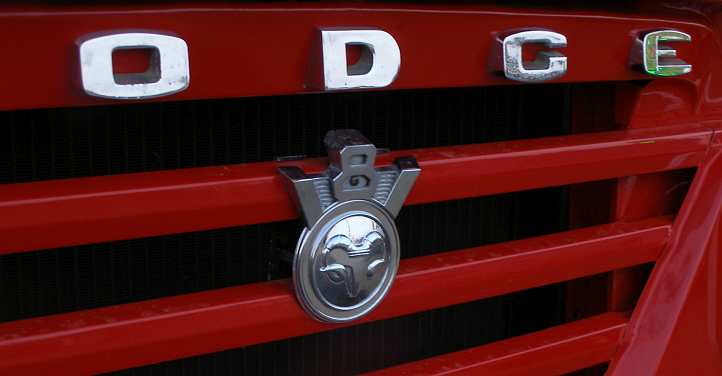
Rare V8 badge. This badge is from the Pilot House series, very few of which were V8-powered in Australia. Most used the venerable flathead six.
To get from Narrabri to Collarenebri, where my last two calls had to be completed, I went past Burren Junction’s hot springs bore. I called in, expecting to see hundreds of campers, but there was just a few. A sure sign that Winter was over and the people from the South were winging it home after free-camping in spots like this.
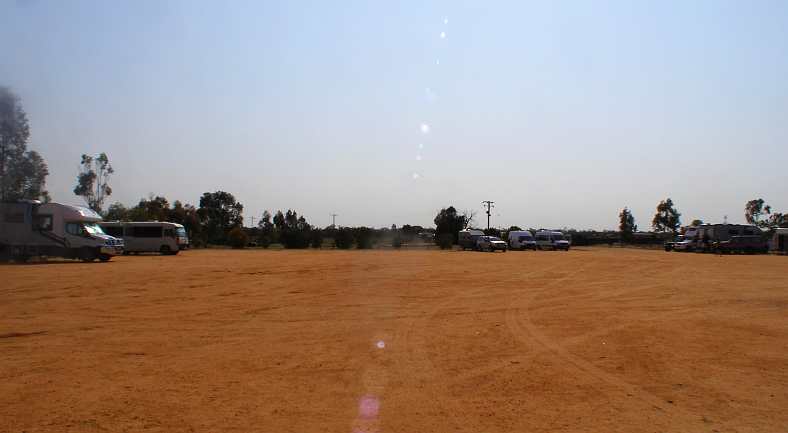
Burren Bore camping. It’s an amazing sight to see this whole area covered in caravans, campervans, motorhomes and even tents in Winter.
The population of the little town swells annually as this popular location attracts people with its warm baths…
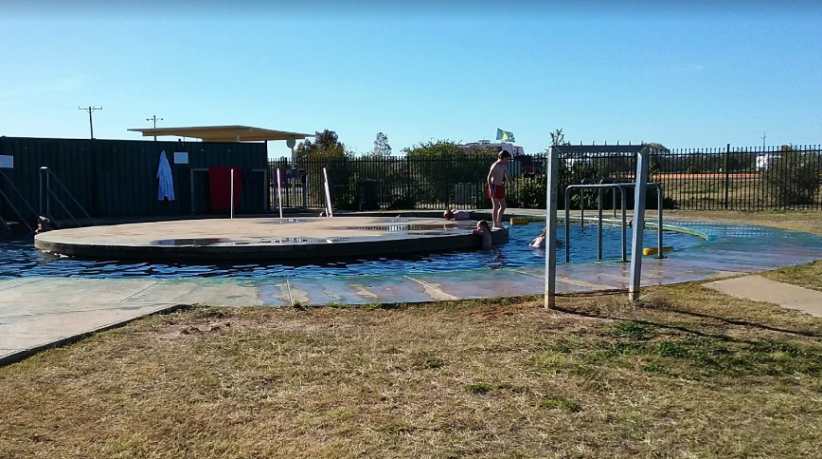
Burren baths. I took this pic from a website, it shows the pool which attracts so many visitors every year.
On through Rowena I went, an area totally devoted to growing cotton out of its black soil plains. The roads around there are very slippery in wet weather, I discovered once in my front-wheel-drive Mazda 626. At Collarenebri I located the people I needed to see, completed the job and then thought about the evening ahead.
It was getting on towards dusk and the next town was Mungindi, but I had to stop before that and take at least a little time cutting the rest of the chassis apart and loading it into the Forester. Once I’d done that, there wouldn’t be anywhere in Mungindi still open for me to get a meal, so I had to do that here. I went into the hotel…
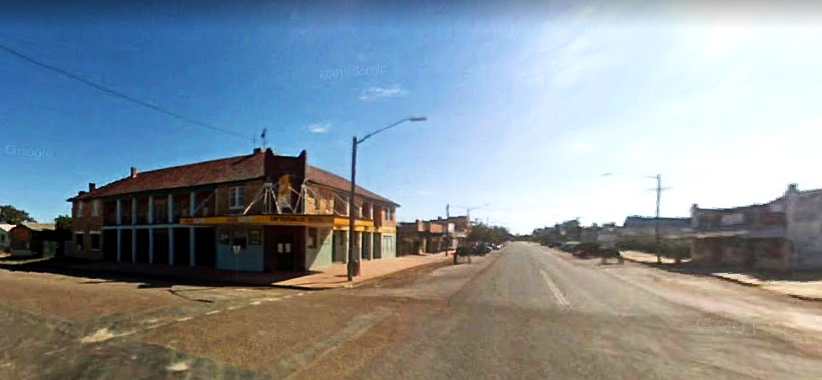
Collarenebri main street. The biggest building in town is the hotel, but I learned it’s not the most prosperous of places.
…where the staff were the new management. The hotelier had decamped after not being able to make a go of the business and the staff were trying to see if they could do better. They certainly did the right thing by me and I had a fine meal.
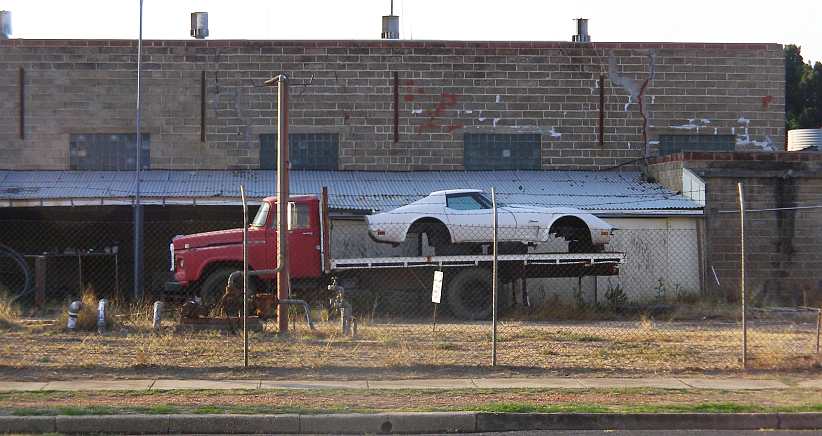
Corvette. There must be a story behind this Corvette, quite apart from the irony that it’s loaded onto the back of a Toyota truck.
Corvettes are not something you see every day in Australia, and even fewer of them are seen in bush towns like Collarenebri. This one has been on the truck for a while here and there surely must be an unusual tale behind its presence.
Of course I was working in the dark when I got to the chassis…
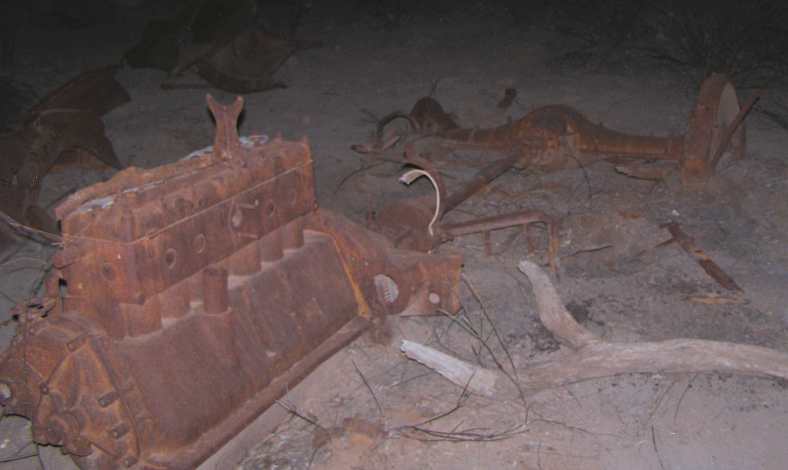
No chassis! My job was done at this stage, the chassis was now all mine and the rear half was cut in two and stashed in the back of the Forester.
…and completed the dismemberment with my trusty cordless angle grinder. Without the rails the mechanical parts sitting in the ground sure looked lonely.
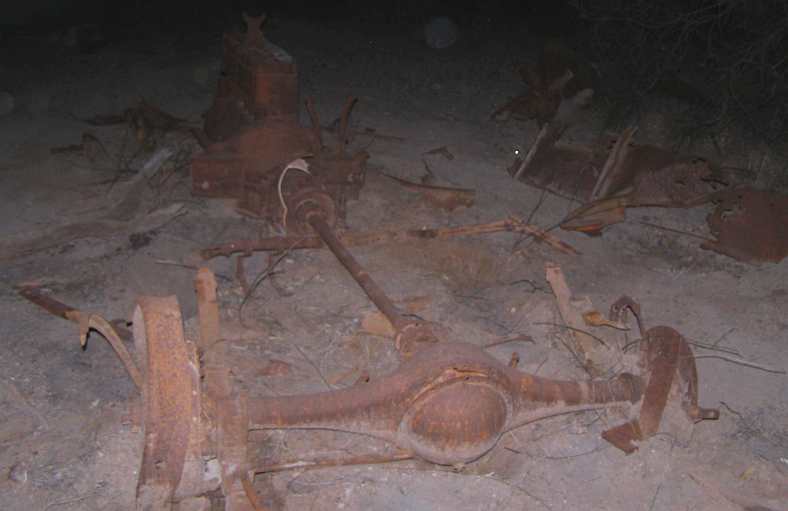
Rear view. Springs and axles, a wheel, that’s pretty much all that was left at the rear of the Jewett.
The following day I propped up the chassis pieces at my storage shed and photographed what I’d claimed for myself. Conversations with Ross Seymour led to him saying he’d be going out there and getting the tail shaft he’d repaired when he was a kid.
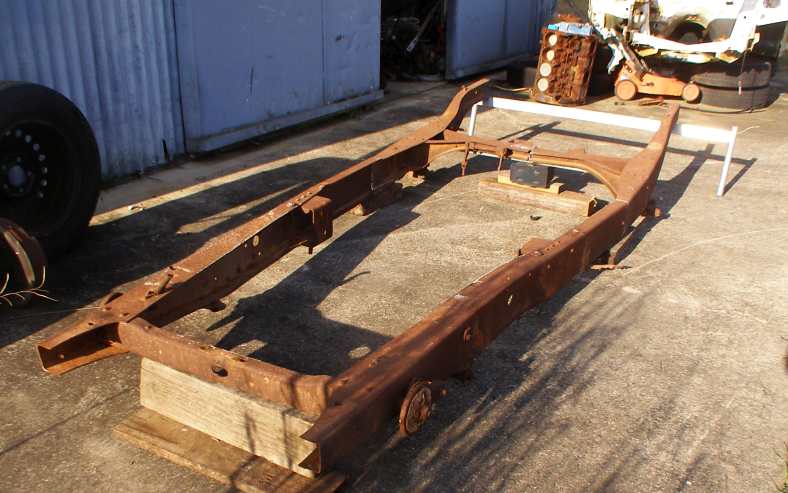
Chassis laid out. This gives a good idea of what I procured, and it helped me to establish that the bits I’d got would do the job I want to do – eventually.
But I wasn’t home yet. It had been a long day, I’d travelled far, done a few hours work and by the time I got to Yelarbon I was tired enough to pull up in the Rest Area…
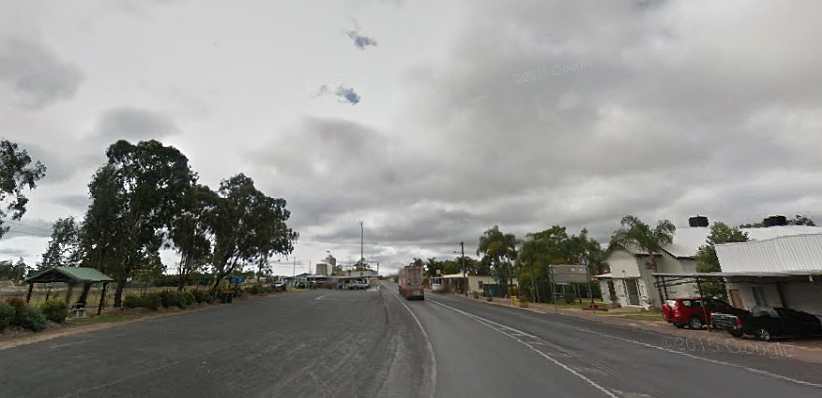
Yelarbon Rest Area. Many trucks pull up here for their rest, this night it was my turn. A public toilet just across the street was useful.
I had been away from home for eleven days straight and it was now time to go see Sandra. I’d barely got there and she told me she had a nice surprise for me and that’s how I finished up here:
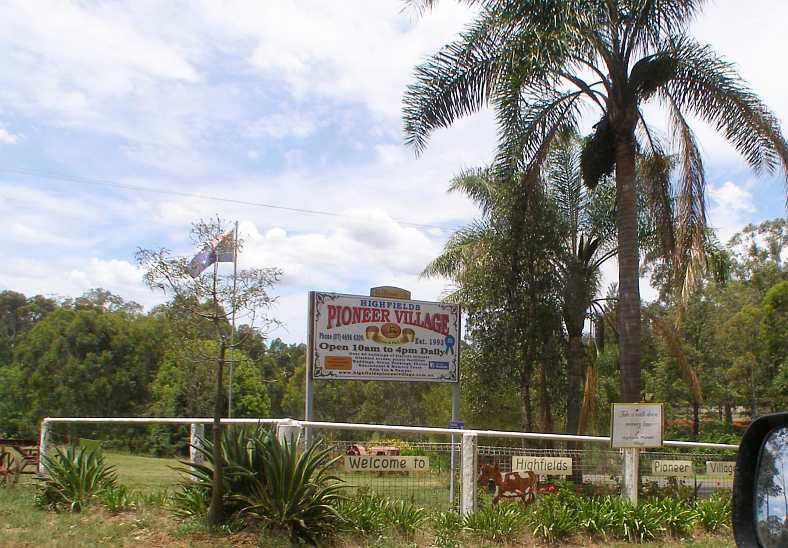
Highfields Pioneer Village I’d heard of this place but didn’t know much about it. Sandra knew I’d enjoy an afternoon there.
Highfields is about six miles from where Sandra was living, the Pioneer Village just a little further. Sandra drove me there in the Falcon and even on the way in we were seeing artifacts from long ago:
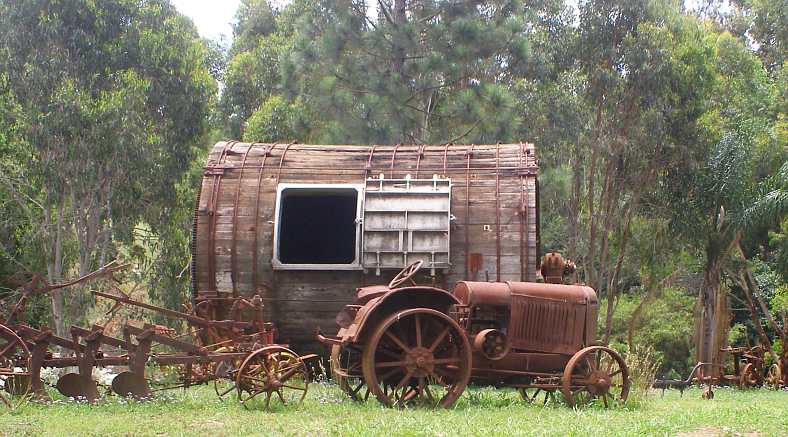
Tanning vat. Plowing in the early Twentieth Century involved mechanised equipment now long superseded. And the big drum? A tanning vat, something very different to see.
The parking area was surrounded by old and old-style buildings, all well-shaded by tall trees which gave a very friendly welcome as Sandra paid our small admission fees.
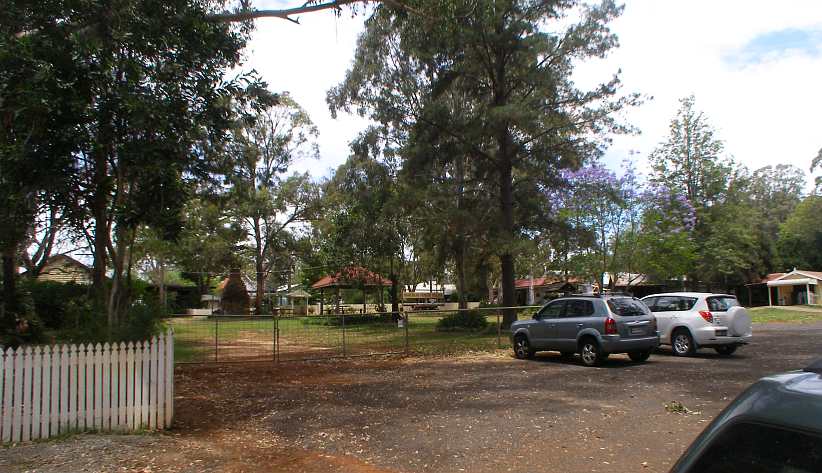
Village front. Nice shade, old buildings, a chimney remnant and covered picnic areas, it was a pleasant place to approach.
Some displays were quite ordinary, some were items on loan from local families, some were strikingly different and some were a total surprise. A very large one was this diesel engine and generating setup which once produced power for thousands of homes:
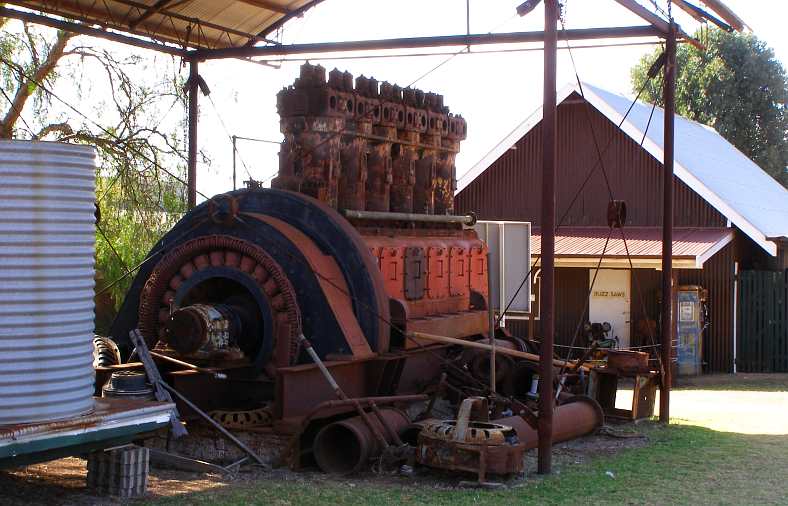
Monster diesel. Kept under a roof to slow further deterioration, this diesel generator was put out of service decades ago. It’s just huge.
Old signage gets a bit of exposure, too…
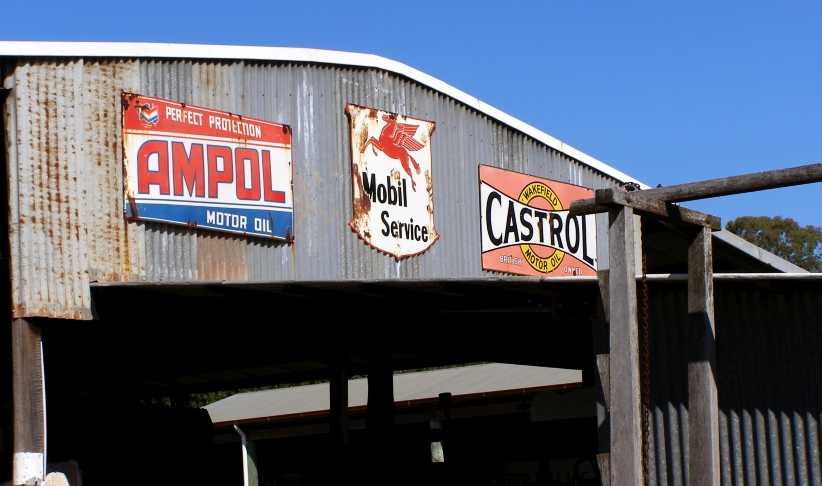
Signs and rust. Rusty corrugated roofing is in vogue in many places these days, here it’s just a part of a backdrop. The signs from Ampol, Mobil and Castrol were commonplace in the fifties.
And, of course, there were many, many vehicles. Way too many to cover in a dozen posts, so just a few highlights:
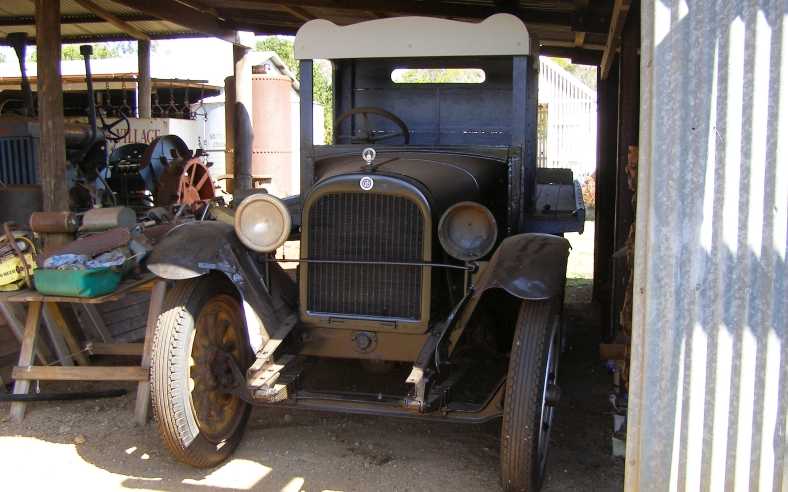
Graham Brothers. Graham Brothers were absorbed by Chrysler in the twenties, this one is neatly restored.
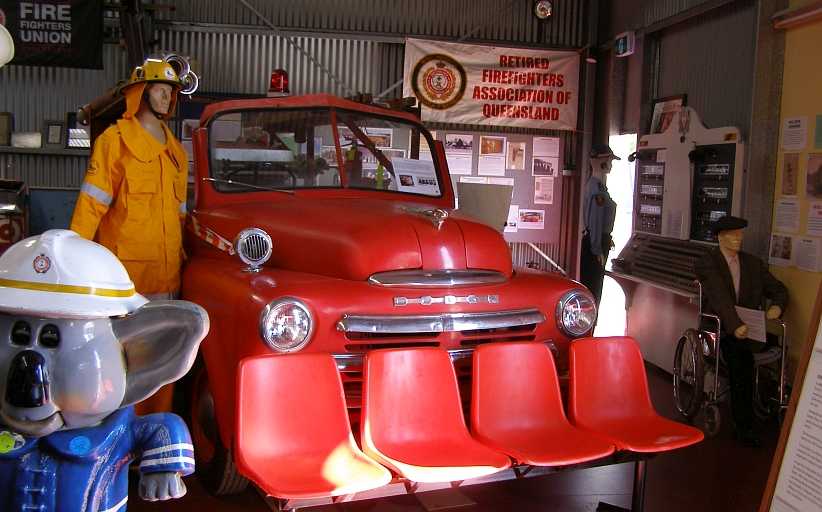
Dodge fire truck. From the mid-fifties, this Dodge was a part of the Retired Firefighters Association display.
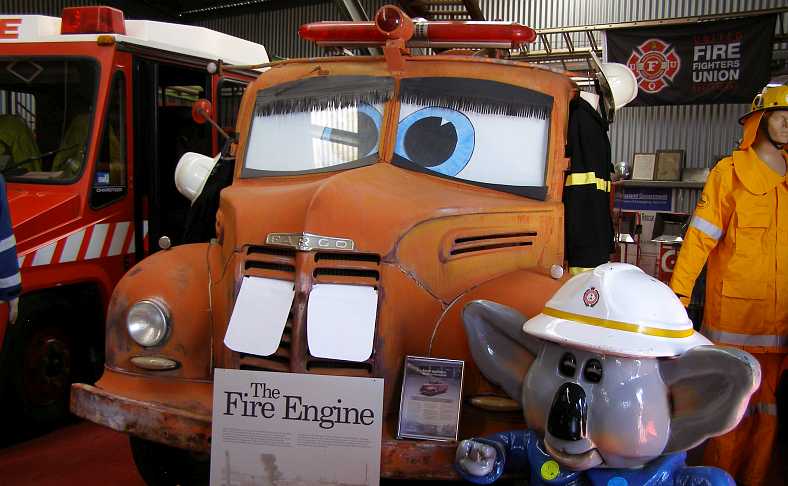
Kew Fargo. More of the Firefighters’ display, this British-built Fargo has the tell-tale ‘KEW’ directly under the ‘FARGO’ in small letters. Kew was the town in England where Chrysler built these trucks, coming as Fargo or Dodge or (possibly) De Soto with the flathead six engines.
The ‘Kew’ name was also stamped on the engines, which gave rise to many Australians who didn’t read them but heard of ‘Kew Dodge’ engines thinking it was ‘Q Dodge’ engines and thinking that all flathead sixes were so named. In fact, like in Canada, only the longer flatheads were produced in Kew, ranging from about 218 to 265 cubic inches. The cylinder head length was 25” whereas the other engines, made only in the USA, had a head length of 23¾”. US plants built both, of course.
I mentioned De Soto, I don’t think these trucks sold as De Sotos in the US:
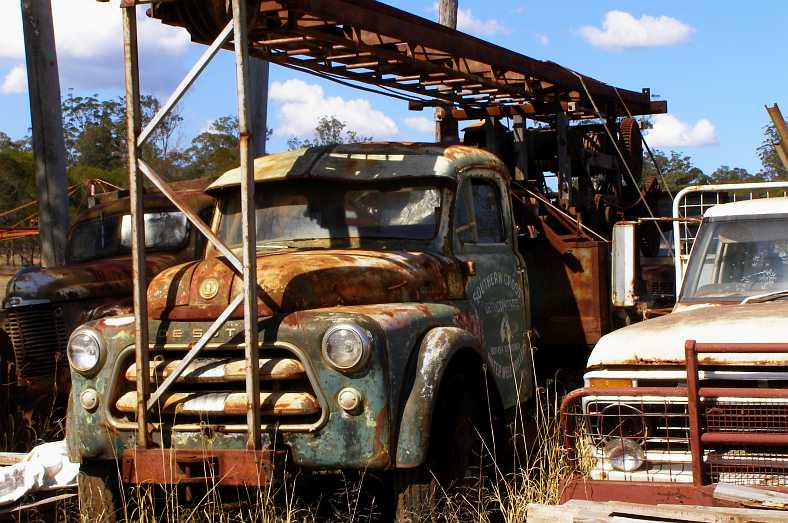
De Soto well driller. This truck spent its life in outback Queensland drilling for water. Flanked by an older International and a newer Ford, it’s a post-1953 model (one piece windscreen) and extensions to the mudguards imply it’s on the heavier chassis. No V8 badges, so it’s a 265 flathead.
I posted from my visit to the museum in Belgium a picture of a shaft-drive FN bicycle, but this one goes a step further:
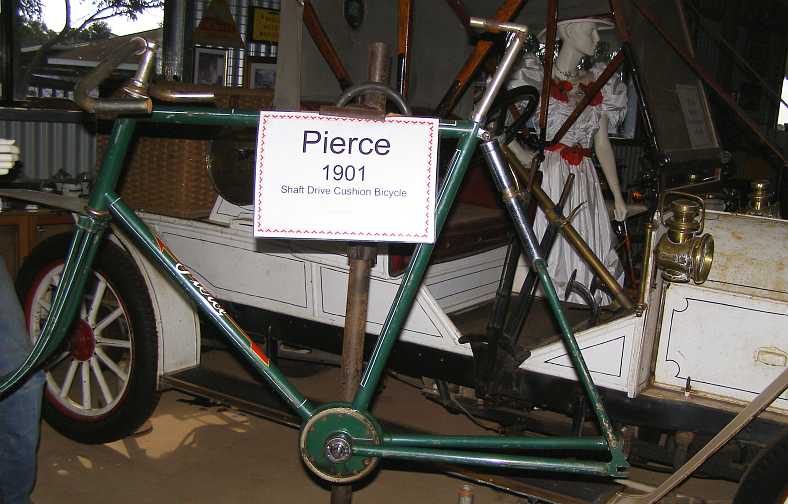
Pierce shaft drive bicycle. Not only shaft drive, but sprung suspension in the rear forks, a real quality model – but no wheels.
A shame it had no wheels, these were made of wood and I’d like to have seen them. Of course it had pneumatic tyres but another surprise – it was made by the Pierce-Arrow car company.
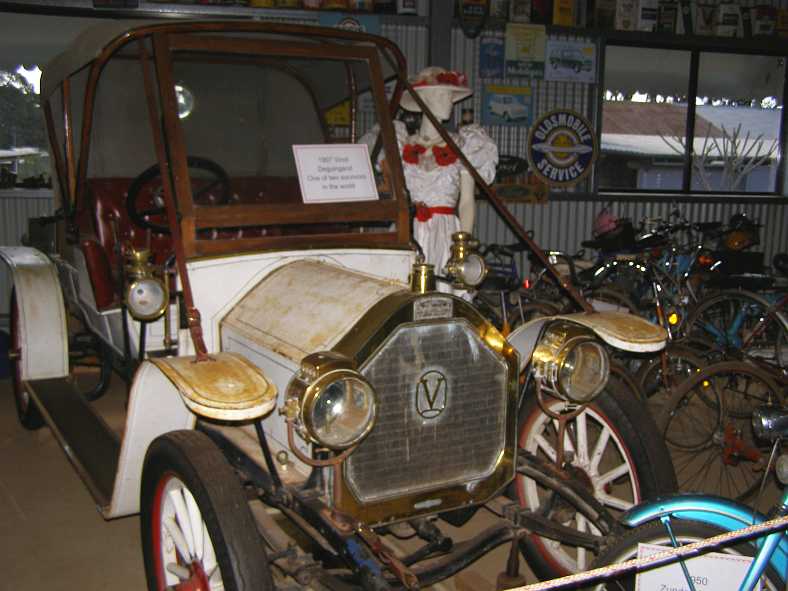
Vinot Deguingand. From one of the many car makers of the earliest times, this is a 1907 model. The brand ceased to exist in 1919.
Some are doing things with their projects at the museum, giving the museum a small level of being a ‘working museum’… this ‘racer’ is T-model based, but it’s not all T-model:
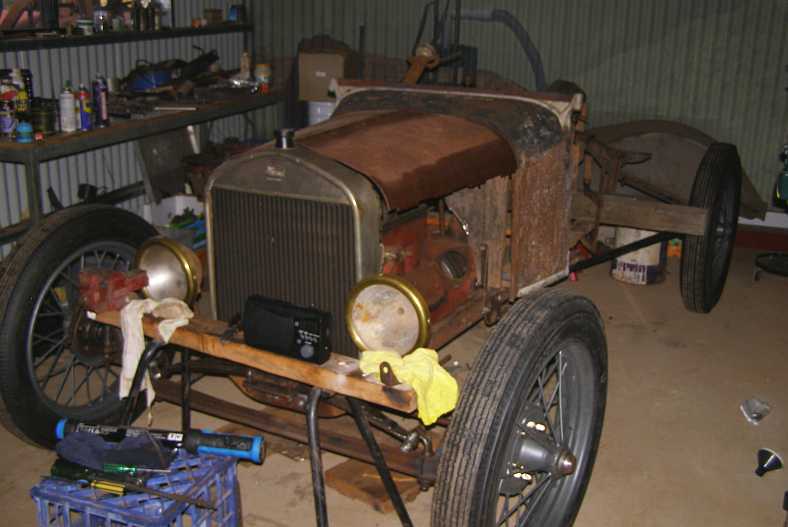
T-Racer lookalike. Wire wheels set it apart in this view, while it seems to be headed to have a lowered cowl too. It’s a project which lives at the museum.
The engine is certainly interesting, too:
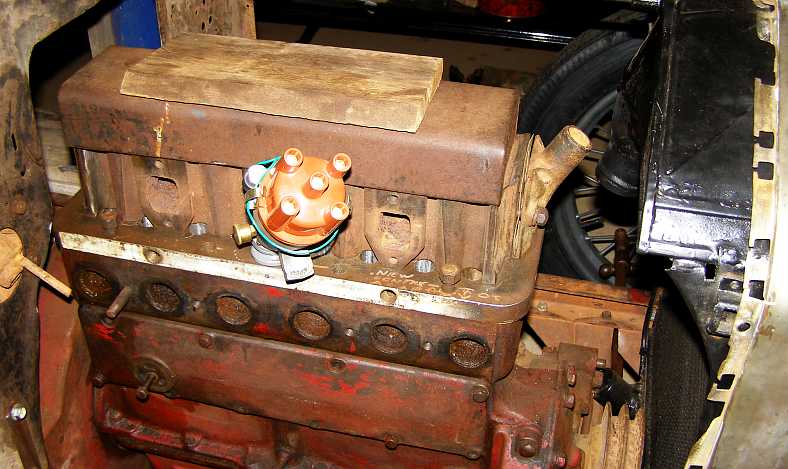
Chev head adapted. It’s an A-model engine and to get a low-cost overhead valve conversion a Chev 4 head has been fitted.
That’s an adaptor plate about an inch thick there to cope with different head bolt patterns, but chasing a high compression might be a bit of a task.
Finally, among all those bicycles on display was this home-made 3-wheeler which shows that people like playing with old stuff, even in more recent times:
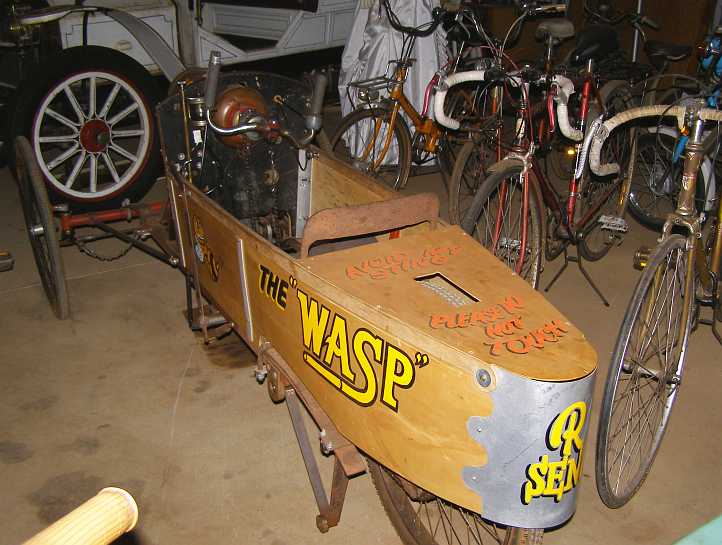
Wasp single-seater. Running bicycle wheels and gaining stability from a fairly wide front axle, the maker hasn't apparently heard of 'king-pin inclination.'
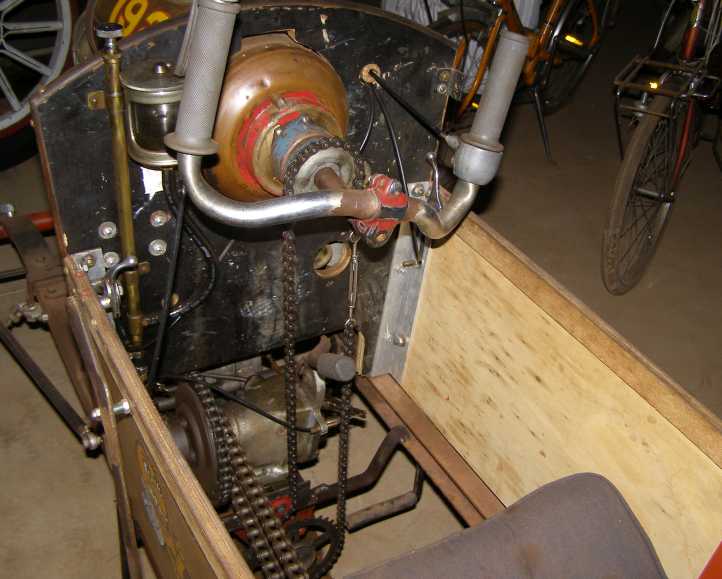
Steering and gears. Chains are everywhere! For the steering, for the drive to the clutch and to the single rear wheel. A bit of complexity here.
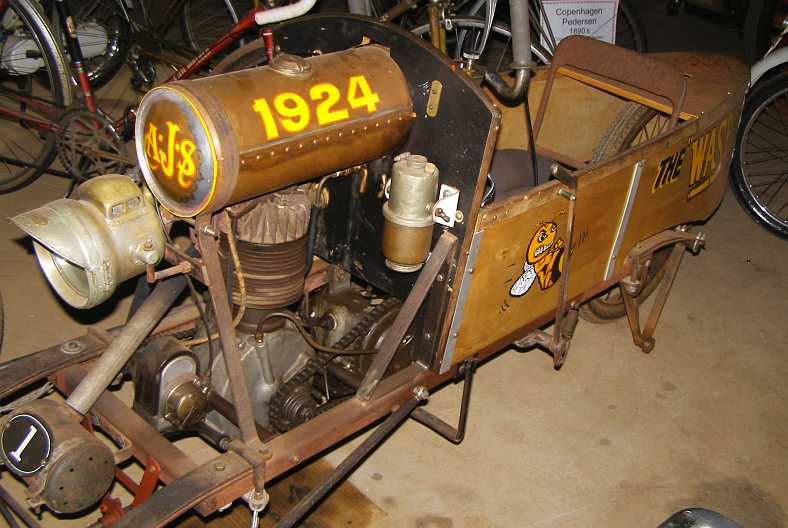
AJS engine. Definite signs here of the age of the design, AJS made motorcycles for several decades. This would have given the Wasp plenty of speed. The number attached to the muffler on the front has me wondering if it's something of a competition machine.
An interesting afternoon, we finished it off at the cafe within the village and had a nice cool drink there. But soon I had to get back to thinking about getting my van ready, it had been neglected over these past many weeks but time was running out.
And with the prospect of that big job coming up, I had to get back to work…
I only had a few calls to make as I drove, and I picked my course so I could complete the task of obtaining the rest of that Jewett chassis near Mungindi…
Two calls at Gunnedah completed the quota there, then I needed to get a couple in Narrabri. After Boggabri there’s a little place called Baan Baa and there I spotted a dual cab Dodge truck…
Dual cab at Baan Baa. This truck has been altered around the grille, but the dual cab fitment and the heavy-duty suspension imply that it belonged to the PMG or a local council originally.
The PMG – Post Master General – was responsible for all telephone services until the sixties, when the postal and telecommunications branches were separated. Dual cab trucks were good for getting crews on the job along with their tools, both for the PMG and for councils with roadworkers.
It became even more of a Dodge truck day when I got to Narrabri, calling in for fuel I quickly spotted this AT4 truck:
AT4 at Narrabri. The first of the Dodge trucks made in Australia using International Harvester body pressings, this one has spider wheels, so was a hard-worker from the beginning.
Chrysler Australia had been pressing out International Harvester body panels since the forties, I believe, and when the ‘Pilot House’ style Dodge bodies were getting too long in the tooth it was easier to make a few small changes to the International bodywork than to bring in dies for later Dodge trucks from the US.
But something didn’t belong…
Rare V8 badge. This badge is from the Pilot House series, very few of which were V8-powered in Australia. Most used the venerable flathead six.
To get from Narrabri to Collarenebri, where my last two calls had to be completed, I went past Burren Junction’s hot springs bore. I called in, expecting to see hundreds of campers, but there was just a few. A sure sign that Winter was over and the people from the South were winging it home after free-camping in spots like this.
Burren Bore camping. It’s an amazing sight to see this whole area covered in caravans, campervans, motorhomes and even tents in Winter.
The population of the little town swells annually as this popular location attracts people with its warm baths…
Burren baths. I took this pic from a website, it shows the pool which attracts so many visitors every year.
On through Rowena I went, an area totally devoted to growing cotton out of its black soil plains. The roads around there are very slippery in wet weather, I discovered once in my front-wheel-drive Mazda 626. At Collarenebri I located the people I needed to see, completed the job and then thought about the evening ahead.
It was getting on towards dusk and the next town was Mungindi, but I had to stop before that and take at least a little time cutting the rest of the chassis apart and loading it into the Forester. Once I’d done that, there wouldn’t be anywhere in Mungindi still open for me to get a meal, so I had to do that here. I went into the hotel…
Collarenebri main street. The biggest building in town is the hotel, but I learned it’s not the most prosperous of places.
…where the staff were the new management. The hotelier had decamped after not being able to make a go of the business and the staff were trying to see if they could do better. They certainly did the right thing by me and I had a fine meal.
Corvette. There must be a story behind this Corvette, quite apart from the irony that it’s loaded onto the back of a Toyota truck.
Corvettes are not something you see every day in Australia, and even fewer of them are seen in bush towns like Collarenebri. This one has been on the truck for a while here and there surely must be an unusual tale behind its presence.
Of course I was working in the dark when I got to the chassis…
No chassis! My job was done at this stage, the chassis was now all mine and the rear half was cut in two and stashed in the back of the Forester.
…and completed the dismemberment with my trusty cordless angle grinder. Without the rails the mechanical parts sitting in the ground sure looked lonely.
Rear view. Springs and axles, a wheel, that’s pretty much all that was left at the rear of the Jewett.
The following day I propped up the chassis pieces at my storage shed and photographed what I’d claimed for myself. Conversations with Ross Seymour led to him saying he’d be going out there and getting the tail shaft he’d repaired when he was a kid.
Chassis laid out. This gives a good idea of what I procured, and it helped me to establish that the bits I’d got would do the job I want to do – eventually.
But I wasn’t home yet. It had been a long day, I’d travelled far, done a few hours work and by the time I got to Yelarbon I was tired enough to pull up in the Rest Area…
Yelarbon Rest Area. Many trucks pull up here for their rest, this night it was my turn. A public toilet just across the street was useful.
I had been away from home for eleven days straight and it was now time to go see Sandra. I’d barely got there and she told me she had a nice surprise for me and that’s how I finished up here:
Highfields Pioneer Village I’d heard of this place but didn’t know much about it. Sandra knew I’d enjoy an afternoon there.
Highfields is about six miles from where Sandra was living, the Pioneer Village just a little further. Sandra drove me there in the Falcon and even on the way in we were seeing artifacts from long ago:
Tanning vat. Plowing in the early Twentieth Century involved mechanised equipment now long superseded. And the big drum? A tanning vat, something very different to see.
The parking area was surrounded by old and old-style buildings, all well-shaded by tall trees which gave a very friendly welcome as Sandra paid our small admission fees.
Village front. Nice shade, old buildings, a chimney remnant and covered picnic areas, it was a pleasant place to approach.
Some displays were quite ordinary, some were items on loan from local families, some were strikingly different and some were a total surprise. A very large one was this diesel engine and generating setup which once produced power for thousands of homes:
Monster diesel. Kept under a roof to slow further deterioration, this diesel generator was put out of service decades ago. It’s just huge.
Old signage gets a bit of exposure, too…
Signs and rust. Rusty corrugated roofing is in vogue in many places these days, here it’s just a part of a backdrop. The signs from Ampol, Mobil and Castrol were commonplace in the fifties.
And, of course, there were many, many vehicles. Way too many to cover in a dozen posts, so just a few highlights:
Graham Brothers. Graham Brothers were absorbed by Chrysler in the twenties, this one is neatly restored.
Dodge fire truck. From the mid-fifties, this Dodge was a part of the Retired Firefighters Association display.
Kew Fargo. More of the Firefighters’ display, this British-built Fargo has the tell-tale ‘KEW’ directly under the ‘FARGO’ in small letters. Kew was the town in England where Chrysler built these trucks, coming as Fargo or Dodge or (possibly) De Soto with the flathead six engines.
The ‘Kew’ name was also stamped on the engines, which gave rise to many Australians who didn’t read them but heard of ‘Kew Dodge’ engines thinking it was ‘Q Dodge’ engines and thinking that all flathead sixes were so named. In fact, like in Canada, only the longer flatheads were produced in Kew, ranging from about 218 to 265 cubic inches. The cylinder head length was 25” whereas the other engines, made only in the USA, had a head length of 23¾”. US plants built both, of course.
I mentioned De Soto, I don’t think these trucks sold as De Sotos in the US:
De Soto well driller. This truck spent its life in outback Queensland drilling for water. Flanked by an older International and a newer Ford, it’s a post-1953 model (one piece windscreen) and extensions to the mudguards imply it’s on the heavier chassis. No V8 badges, so it’s a 265 flathead.
I posted from my visit to the museum in Belgium a picture of a shaft-drive FN bicycle, but this one goes a step further:
Pierce shaft drive bicycle. Not only shaft drive, but sprung suspension in the rear forks, a real quality model – but no wheels.
A shame it had no wheels, these were made of wood and I’d like to have seen them. Of course it had pneumatic tyres but another surprise – it was made by the Pierce-Arrow car company.
Vinot Deguingand. From one of the many car makers of the earliest times, this is a 1907 model. The brand ceased to exist in 1919.
Some are doing things with their projects at the museum, giving the museum a small level of being a ‘working museum’… this ‘racer’ is T-model based, but it’s not all T-model:
T-Racer lookalike. Wire wheels set it apart in this view, while it seems to be headed to have a lowered cowl too. It’s a project which lives at the museum.
The engine is certainly interesting, too:
Chev head adapted. It’s an A-model engine and to get a low-cost overhead valve conversion a Chev 4 head has been fitted.
That’s an adaptor plate about an inch thick there to cope with different head bolt patterns, but chasing a high compression might be a bit of a task.
Finally, among all those bicycles on display was this home-made 3-wheeler which shows that people like playing with old stuff, even in more recent times:
Wasp single-seater. Running bicycle wheels and gaining stability from a fairly wide front axle, the maker hasn't apparently heard of 'king-pin inclination.'
Steering and gears. Chains are everywhere! For the steering, for the drive to the clutch and to the single rear wheel. A bit of complexity here.
AJS engine. Definite signs here of the age of the design, AJS made motorcycles for several decades. This would have given the Wasp plenty of speed. The number attached to the muffler on the front has me wondering if it's something of a competition machine.
An interesting afternoon, we finished it off at the cafe within the village and had a nice cool drink there. But soon I had to get back to thinking about getting my van ready, it had been neglected over these past many weeks but time was running out.
And with the prospect of that big job coming up, I had to get back to work…
Last edited by Ray Bell; Nov 15, 2020 at 11:21 PM.
Thread Starter
|
Captain
Joined: Oct 2005
Posts: 570
Likes: 8
From: The Summit, Queensland, Australia
I must apologise to those who've been thwarted from seeing the pics over the last couple of days...
I use Postimage.org to host my pics and they seem to have taken a holiday for about 24 to 36 hours. Back now, all right, but it must have been as frustrating for readers as it's been for me.
I have to go back and edit the last post because I now realise that the 'Wasp' must be a fairly recent creation, it has rod ends of the type used in the seventies and some aluminium extrusions which weren't available sixty and more years ago.
I use Postimage.org to host my pics and they seem to have taken a holiday for about 24 to 36 hours. Back now, all right, but it must have been as frustrating for readers as it's been for me.
I have to go back and edit the last post because I now realise that the 'Wasp' must be a fairly recent creation, it has rod ends of the type used in the seventies and some aluminium extrusions which weren't available sixty and more years ago.
Thread Starter
|
Captain
Joined: Oct 2005
Posts: 570
Likes: 8
From: The Summit, Queensland, Australia
This post was supposed to have been replaced by the next when its time had come...
But I neglected to do that and now it's just a message to say, "Move right along to the next post!"
But I neglected to do that and now it's just a message to say, "Move right along to the next post!"
Last edited by Ray Bell; Dec 6, 2020 at 07:30 AM.
Thread Starter
|
Captain
Joined: Oct 2005
Posts: 570
Likes: 8
From: The Summit, Queensland, Australia
Day to day I still had the Forester maintenance to do and after all the shenanigans with the poor running I ultimately found No. 1 plug lead was faulty. That’s the lead I’d already replaced!
So the car was going better, but there’d be more to this story. And the house-moving story was becoming more definite. I’d had a chance to speak to the owners and they confirmed they needed me to move out by December – and it was now the end of September. Having the van on the road would be an essential to enable me to move.
I started assessing the things I had to do to the van to make it ready for Australian compliance. A compliance, I might add, that was only able to be signed off by a very small number of engineers, of course they charged a hefty fee as well.
One of the first issues to address, now that I’d done the rewiring and alterations for the indicators, brake lights and parking lights, was the broken right hand manifold:
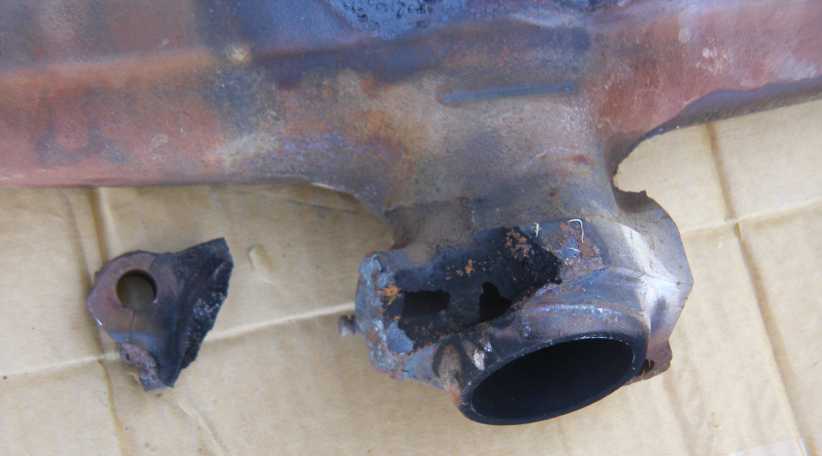
Manifold malady. This had been broken back in 2014 in Florida when I missed a turn into a Rest Area and went in across the grass – and a kerb which grounded the exhaust and broke this casting.
There were also problems with the windscreen washers…
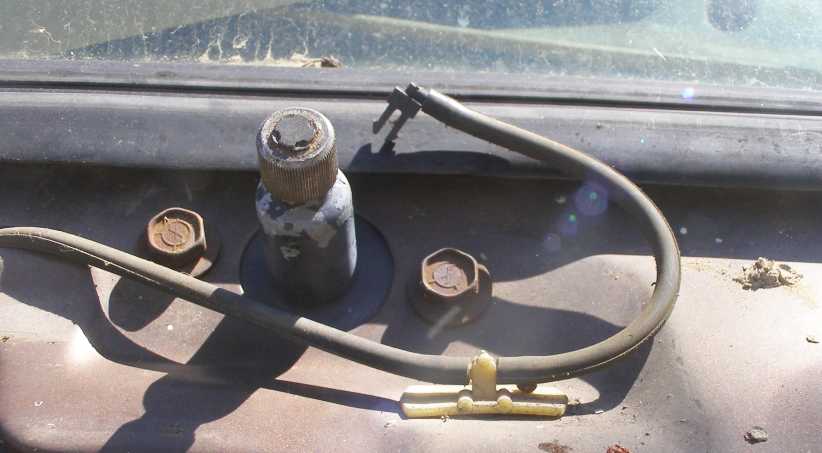
Windscreen washers. Lines and fittings were broken, I realised I’d have to fit something more conventional.
…while I found that mice had been invading the van and I needed to keep them out.
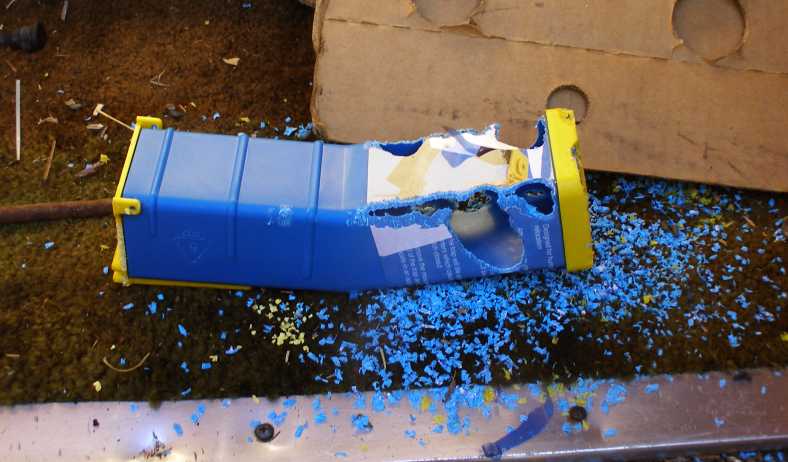
Mousetrap eaten! These are great mousetraps, but when the mouse trapped inside has friends on the outside they don’t last long.
I started mouse-proofing the van, looking at anywhere and everywhere (I thought) that mice could get through. I bought some tough expanded metal to block off the vents beneath the windscreen…
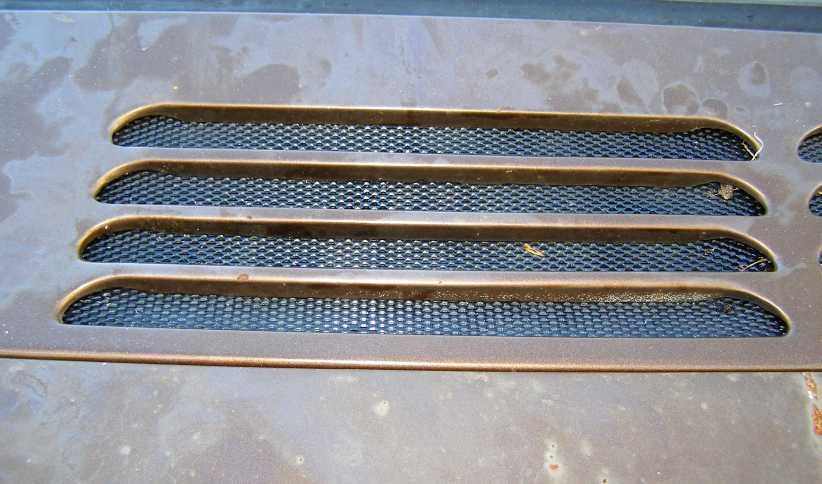
Mice blocking. Strategies such as this cost me time when I should have been getting on with something more important.
…and looked elsewhere until I finally found the main entry point:
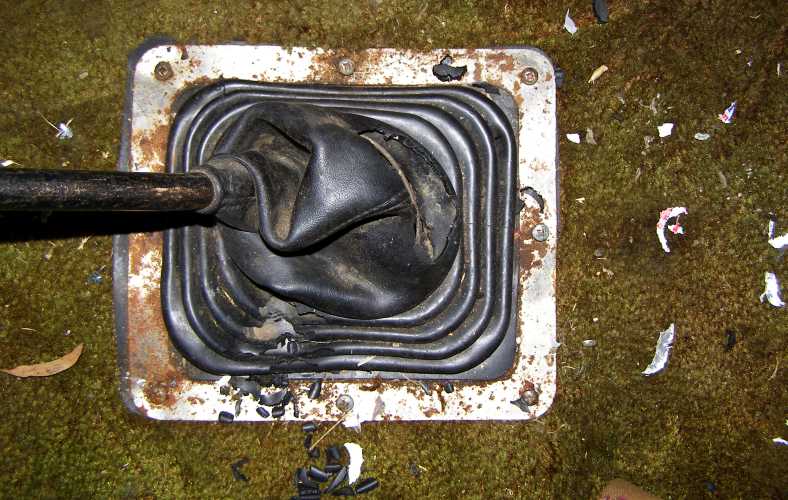
Easy access. Finding these holes put paid to my searching. I thought about devising something to block it from underneath but ran out of time.
One of the problems I’d always had with the van was that the pressure of applying force to the clutch throwout lever tended to push the back of the gearbox sideways. That it could move sideways meant I was losing clutch travel all the time. I decided to put an end to that…
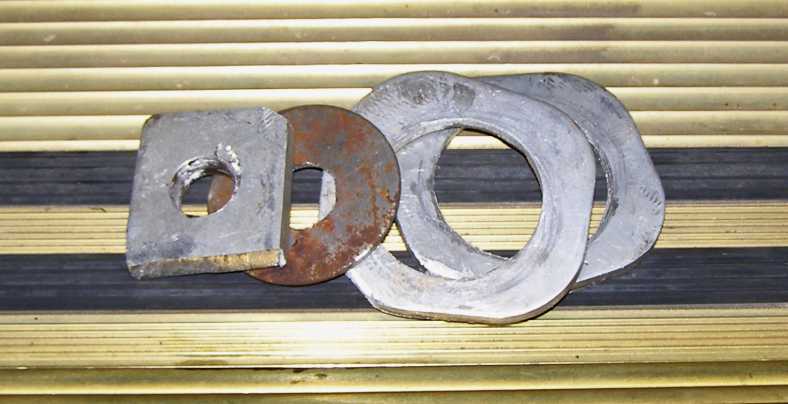
Gearbox mount spacers. These spacers, made from scraps I had lying around, would prevent the gearbox moving sideways.
…with some deft use of a hole saw and large drill and digging into my scrap metal bin. It should do the job:
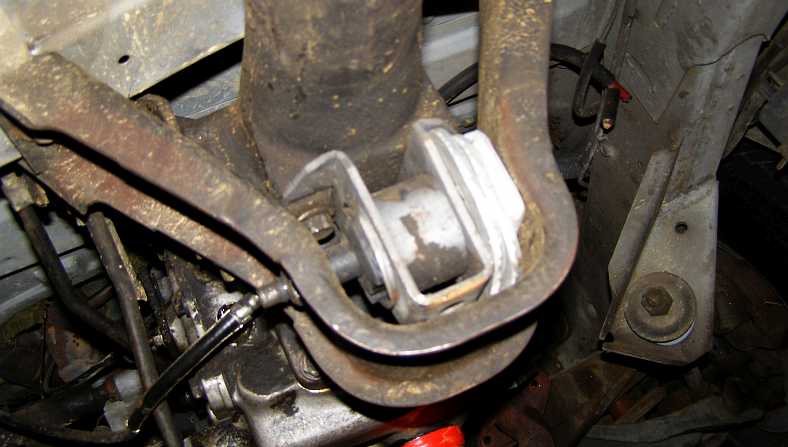
Spacers in place. They allow all the normal movement but prevent the mount being pushed sideways by the pressure on the clutch fork.
I would later learn that this was only a part of a bigger problem, but for now it worked better. And, of course, I didn’t have unlimited time as I was still off to work each weekend. A trip to Tweed Heads afforded me a chance to photograph a seriously heavy recovery truck in action…
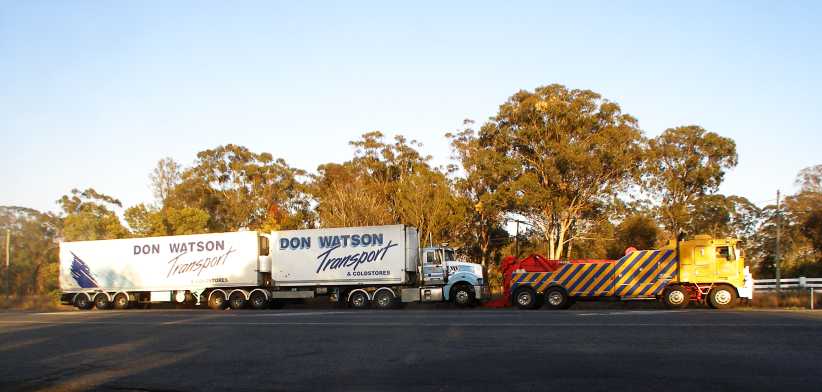
Major recovery job. By the way this recovery vehicle and the B-Double attached to it were travelling, the perishables on board needed to be delivered quickly.
…with the whole rig keeping up a good pace except when slowed by big hills.
There was some rain about this weekend but I got the job done, visited some friends on the Gold Coast and then headed for Brisbane on Monday to check out safety belts for the van. Buying safety belts isn’t hard at all, and not expensive either, but mine had to pass inspection and that was much tougher and more expensive.
I learned that a late European safety rating was acceptable and found a place near Ipswich, a Western suburb of Brisbane, which had them at a reasonable price. So the majority of the next week was spent pulling out seats and rearranging things to suit different belts, one of my problems being that there was a requirement for the seats in the back to be a specific distance from the inside of the van’s walls and this meant they’d be migrating about an inch and a half towards the centre. The lounge/bed at the back didn’t need belts because, as it was movable, it would not be permitted to have passengers riding in it.
Work the next weekend would be 300 miles South, in Tamworth, which took me once again past the place where Janet and I had lived for a bit over a year:
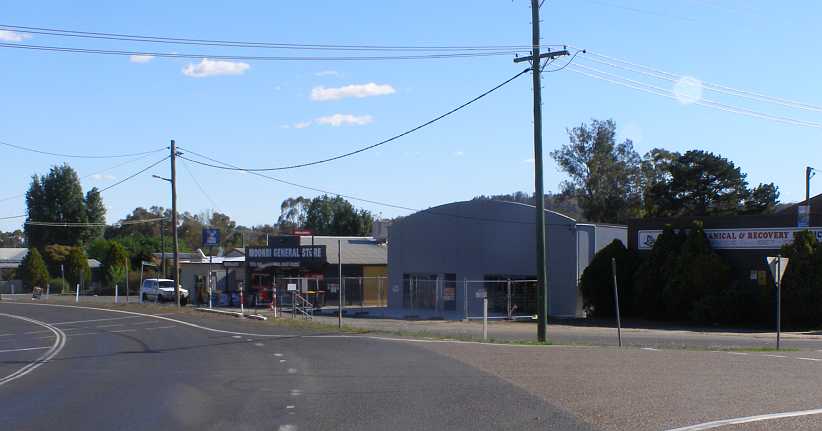
Moonbi reconstruction. The house, apparently, had been demolished because of termite infestation. Now a bottle shop was being built on the site, with a Post Office to one side.
We had enjoyed running the Post Office there before we were forced to move on. This trip to Tamworth had seen me staying in a motel, unusually, as Bob and Elaine were away overseas. On the Saturday night I followed one of the many pickups out the drive, it stopped to let traffic by, then reversed into me! The Forester suffered a towball-size hole in the front numberplate and bumper.
The weekend over and back at Dalveen I chanced to look down one day in the area where I frequently stood and walked as I was doing jobs using the verandah as a workbench. I hadn’t seen one of these in many years…
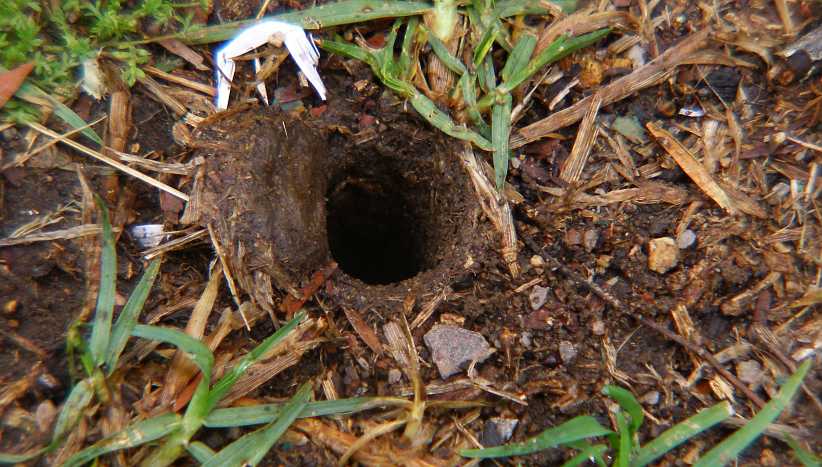
Trapdoor. One of the varieties of spider we have here is called the Trapdoor Spider, you can see why in this shot with its door open, presumably to vent the place after rain.
…looking back at times when my mother would pour methylated spirits down the hole and set fire to it just as the spiders came rushing out.
I’ve mentioned, I’m sure, that I’ve become sensitive to fragrances. Going into motel rooms which have been cleaned and sprayed with deodorants and so on and then locked up is a real drama for me. And I chanced upon this article in a magazine Sandra picked up:
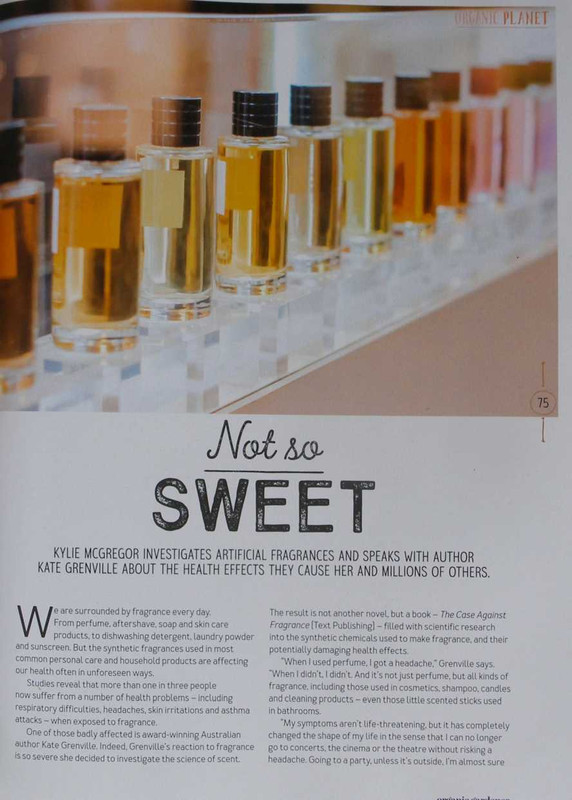
Fragrances. I knew I was not alone in this. My intolerance of these things has been getting worse as I’ve been exposed to more and more of them.
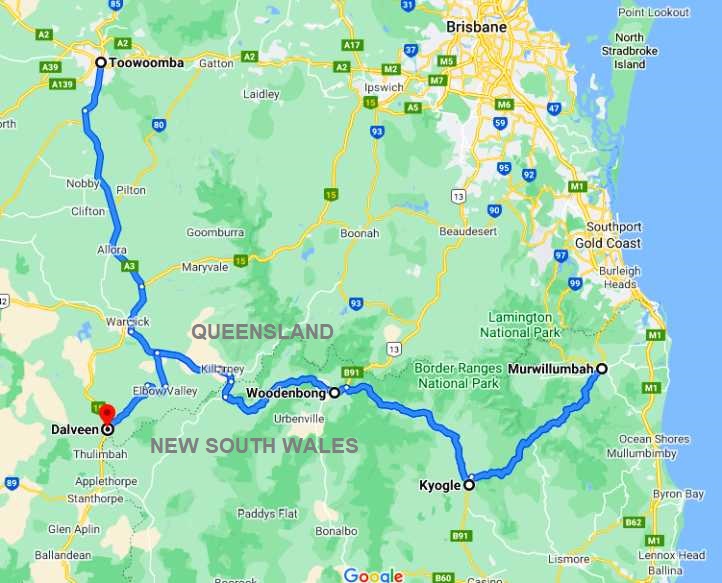
I’d tried to surprise Sandra by turning up there on Thursday after more work on the seats and belts, she had a bit of a nasty sore throat while I’d just shaken a bit of a cold. She had also got herself a little budgerigar which she named 'Terry'. Next I was off to Murwillumbah, with the most direct roads being quite twisty:
And it rained…
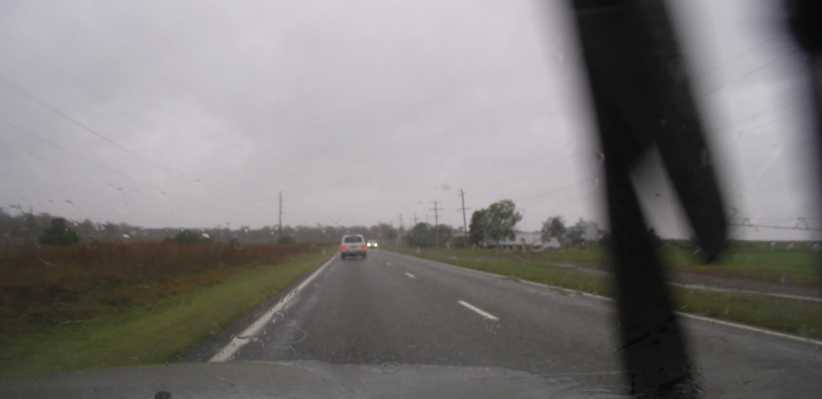
Wet roads to Murwillumbah. One of the less-twisty parts of the trip. Rain persisted all this weekend.
…and the motel was loaded down with the chemicals! Windows and the door were opened for hours trying to clear the air, while I got a bit of a surprise looking at the array of wi-fi links located nearby:
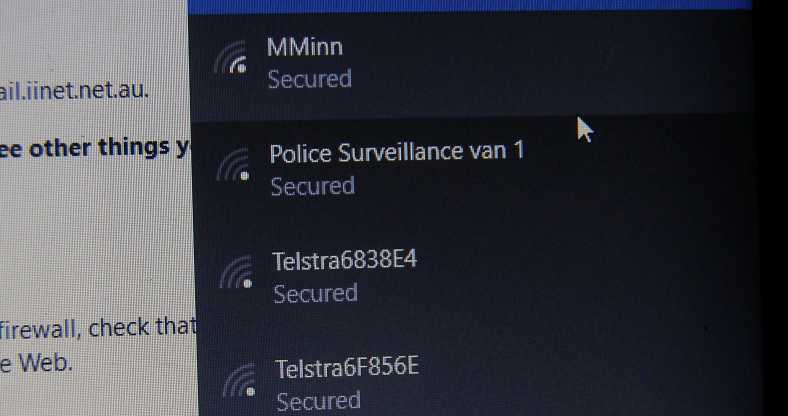
Police surveillance. Not the usual sort of thing you’d find on the wi-fi list when hooking up in the motel.
I really gave the Forester a workout on the way home. The twisty roads were a temptation I didn’t pass up this time and I worked it hard in the lower gears. And got the shortest distance I’d ever seen out of a tankful of fuel – just 438kms!
Or was something else wrong? I had the bluetooth diagnostic plug and tried it, with the message coming back that something was amiss in there. I was too busy at home to do much about it, those belt at seat mountings were still taking up my time, though I got one break in that I didn’t have to go away the next weekend for my work, it was local.
I planned a bit of an attack on it on the way to the following weekend’s job at Yamba, when I’d call in at Norm’s and use his garage, but in the meantime there was more work to be done on the van and sights to be seen locally, too:
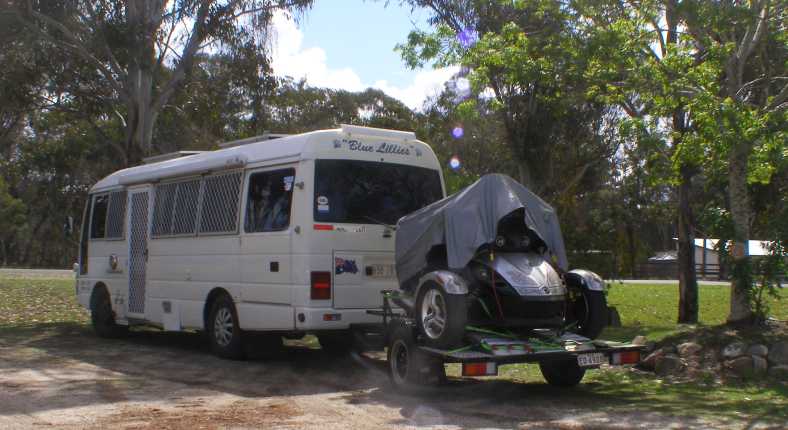
3-wheeler in the Rest Area. Dalveen’s Rest Area often has something different to be seen among campers and passers-by. This kind of rig is commonplace in Australia, though usually it’s a small car on the trailer rather than a 3-wheeler.
I packed a front section of exhaust system for the trip to Norm’s, but the intention was to just swap over the Oxygen sensors in those pipes. They couldn’t be changed without dropping the pipes, but that wasn’t a huge job and I swapped them over. The warning lights went off. For 100kms!
So I went on down the highway to McLean and turned off to Yamba. It was pleasant work that weekend in this retirement and holiday area, but the big surprise was what was happening to the Harwood Island bridge. It’s all a part of the Pacific Highway upgrade, the second last section, in fact, and they’re doing 90 miles of it all at once, duplicating the highway and bypassing towns, with bridges to a new standard being built:
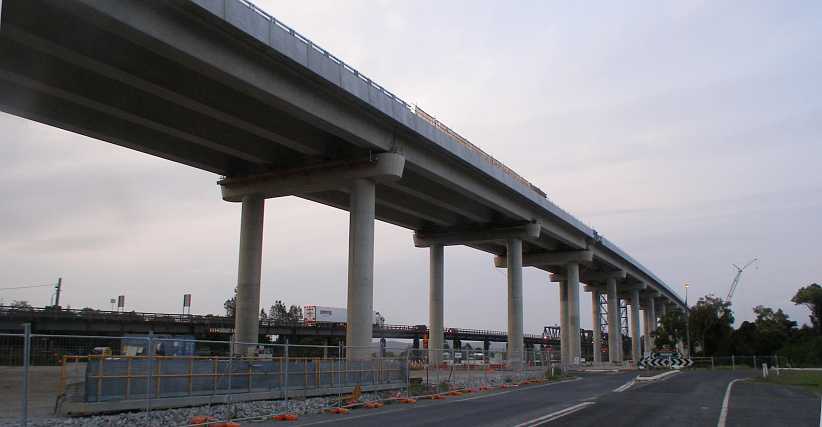
Harwood Island Bridge. Traffic runs across the old 2-lane bridge with its lift-span in the middle while work proceeds on a new long and very tall 4-lane bridge.
Like I said, it was a surprise to me as I hadn’t been in the area for some time. But I didn’t have time to hang around as I had a second job this weekend, at Tingha, 200 miles away:
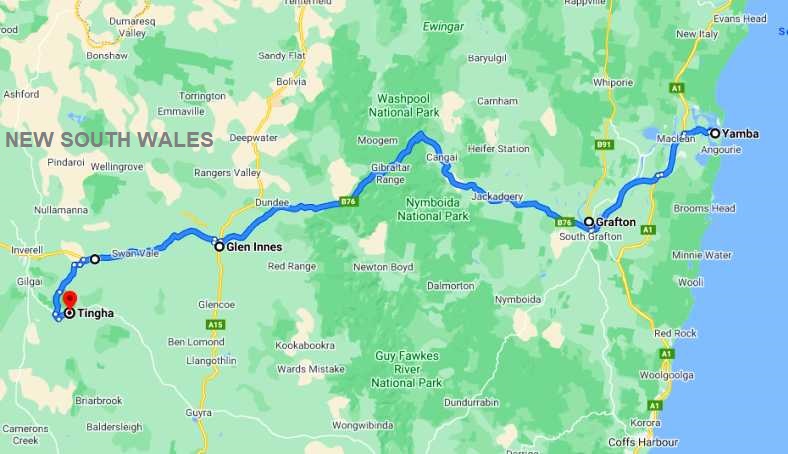
Tingha is a fairly strange place. While there’s a pretty normal core to the town, once out of that immediate central area, houses are dotted around on little fenced-off properties in all sorts of places, seemingly without order at all. On top of that, as you enter the town’s outskirts you cross a cattle grid and a sign warning that cattle are grazing in the town – which is all an old-fashioned common.
On the way out there I got a shot of an old shed, the kind of picture I managed to take many times in America:
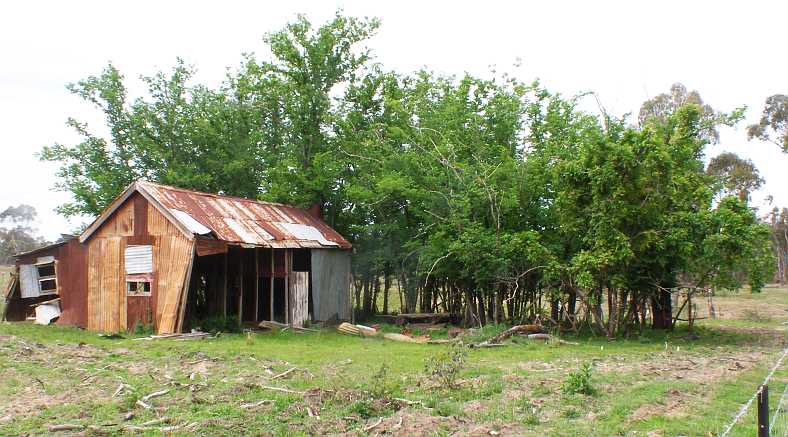
Old shed. On the way to Tingha I snapped this, thinking it was pretty rustic and interesting.
These two photos were taken on a much earlier trip, but illustrate what I want to convey nicely:
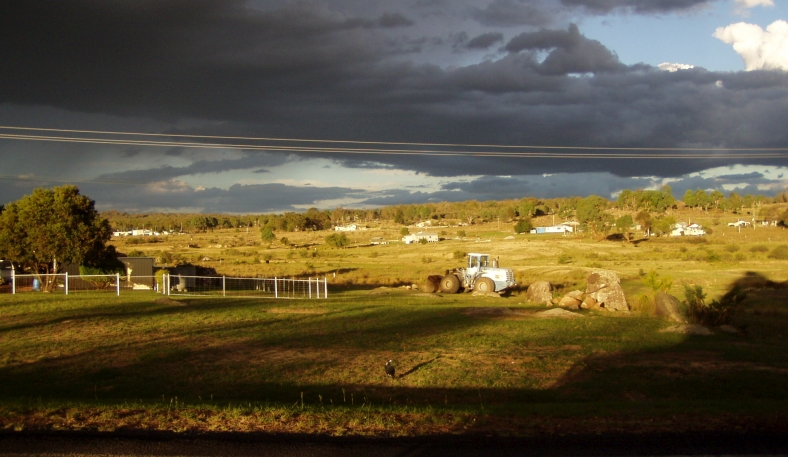
Tingha on mining leases. Outside the centre of the town, homes have been built just anywhere as people have (many years ago) occupied the small plots of land to seek their fortunes.
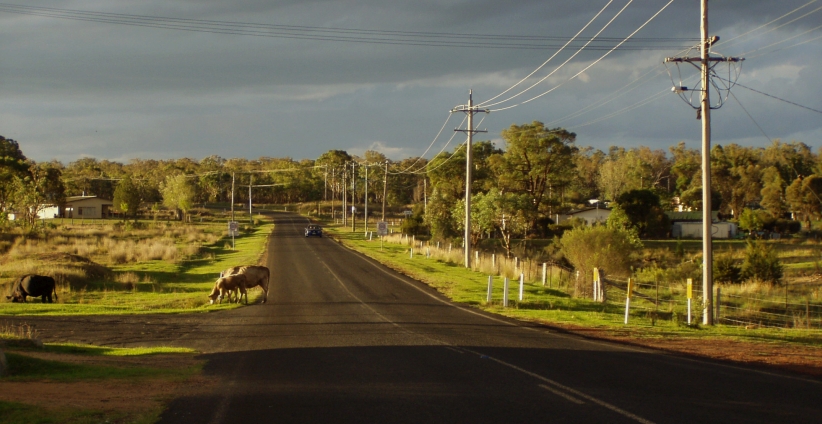
Cattle roaming free. Cattle have total freedom to roam the streets of the town area as it's all a common.
All of that pales alongside this house in Tingha. I should put you in the picture properly, however.
I started photographing this place back in 2014 because I thought it was pretty unusual that the owner was casting his own cement blocks with which he was surrounding his little cottage:
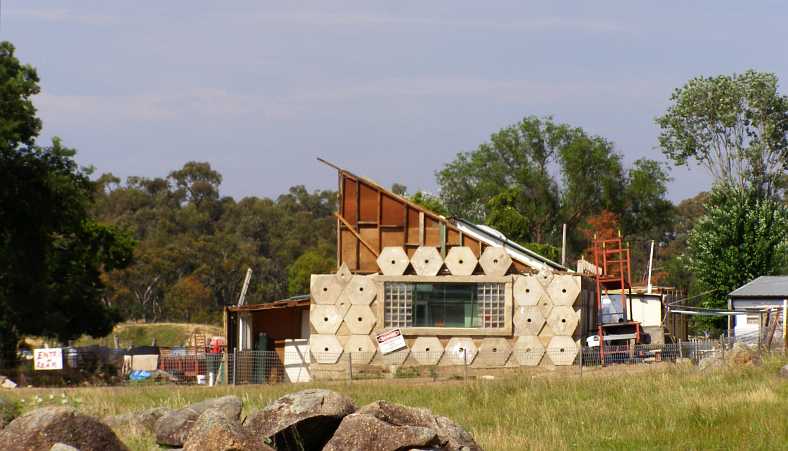
2014 view. The hexagonal blocks had attracted me. The original house is inside there, you can see the roof in this view.
Steadily it grew. I went past here when I visited Dave out on the farm at Bundarra, so I got plenty of opportunities to get more pictures…
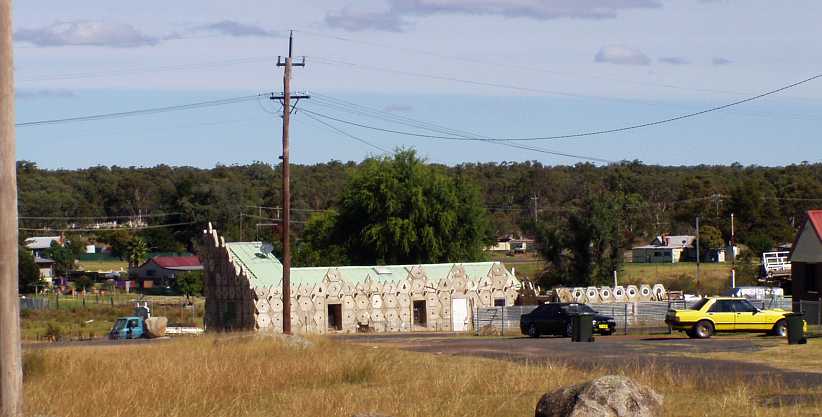
Steady growth. It was getting bigger, the walls spreading further, as time passed.
…and didn’t miss much in the development of it. The next step…
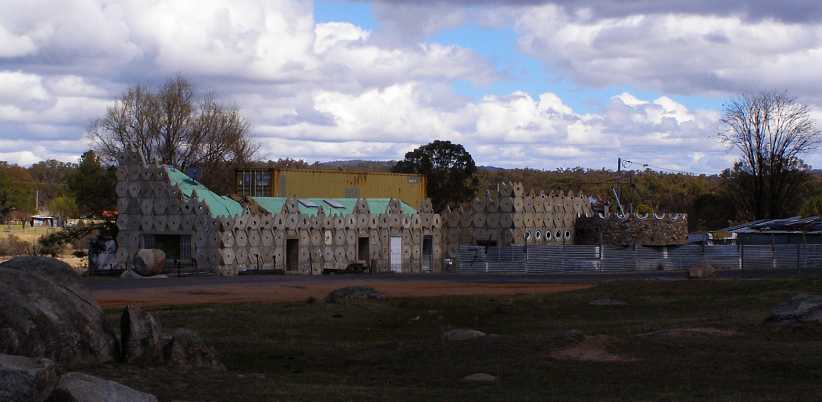
Raising the ante. This time it was clear that it was a very different construction to normal, and that meant more than the hexagonal blocks.
…was the mounting of a 40’ shipping container as the beginnings of a second level:
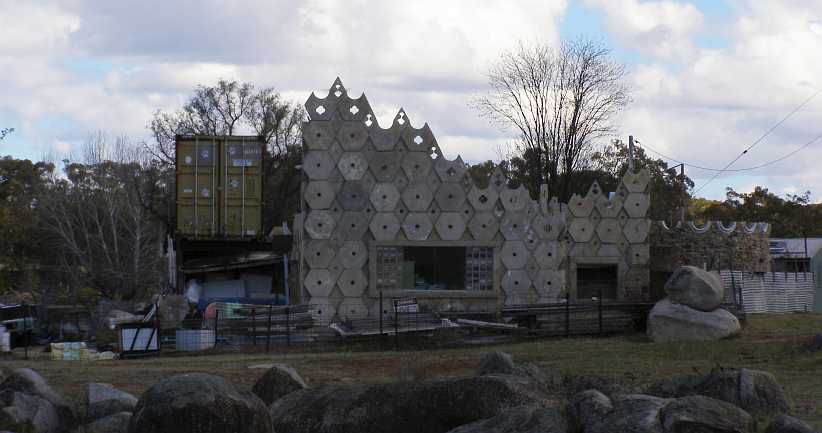
Shipping container! Supported on steel framework, this container was to become a part of the house.
This trip through the work had accelerated. The shipping container was now buried deep within and the blocks were reaching new heights…
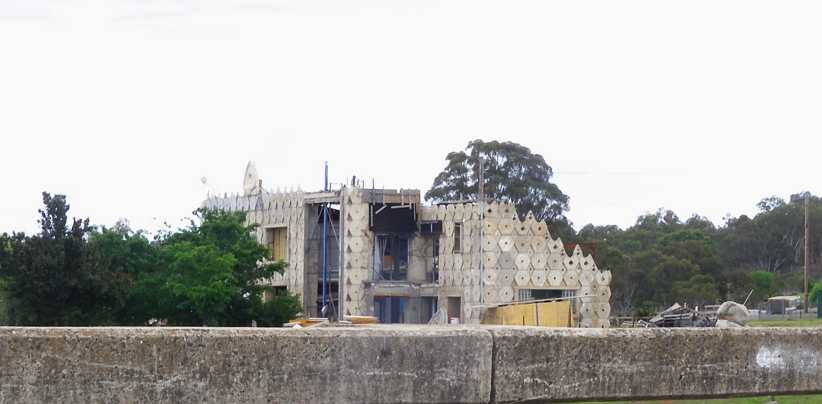
New heights. The structure is really standing out in this tiny town now, and it’s still not finished.
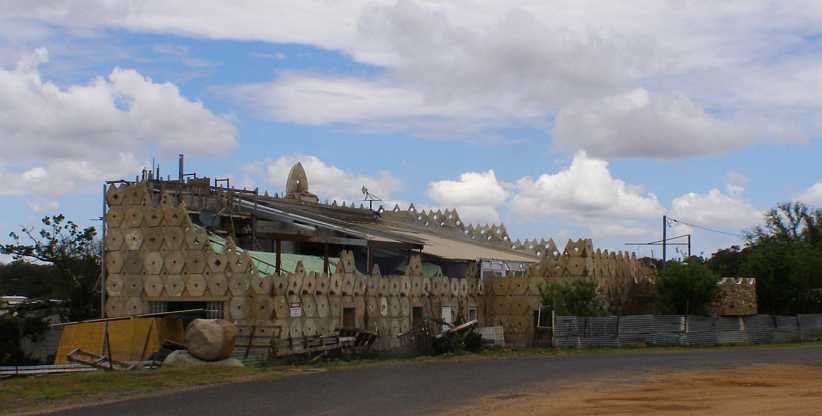
A man’s home… There’s no telling what the neighbours think about this, but I’m sure they’re pretty easy-going with the owner.
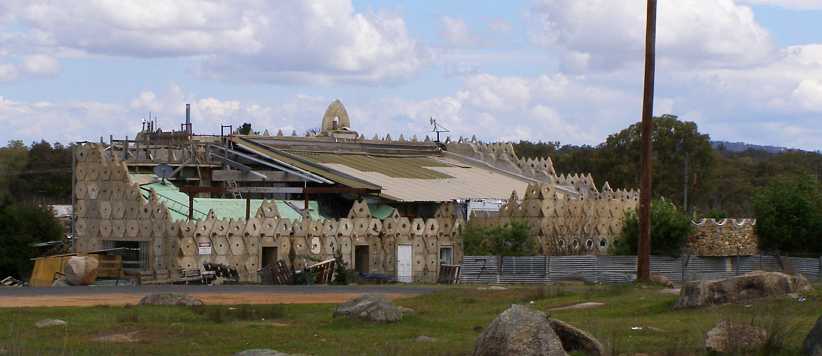
New roof. This angle shows the new roof as well as what appears to be a round raised patio area off to the right.
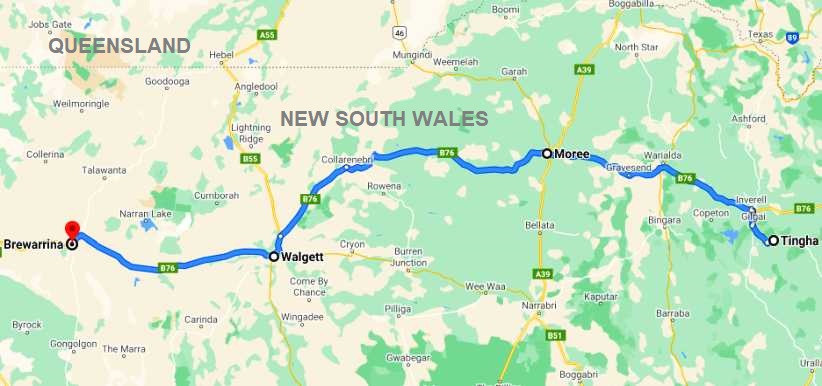
I had to leave Tingha, of course, as there was more to be done elsewhere. In fact, it was a final wrap-up of the Aboriginal Housing survey I’d thought I’d finished with almost a month earlier. A 300-mile drive to Brewarrina saw me working there and in Walgett for a couple of days.
I seem to be perpetually chasing sunsets on long drives, this would be another one…
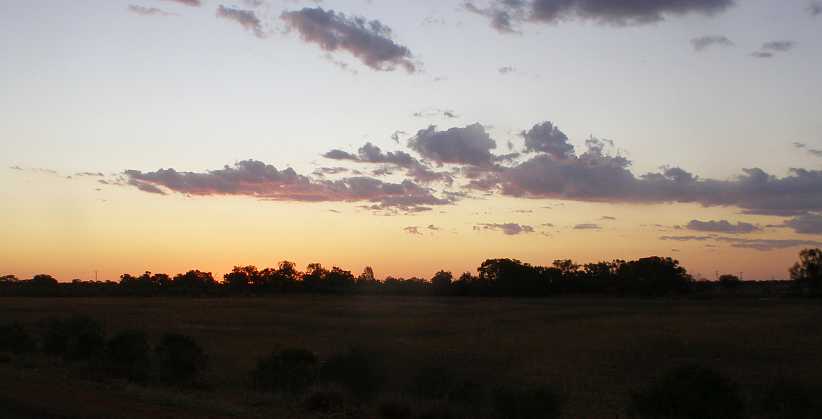
Road to Brewarrina. Walgett is said to be the beginning of the ‘outback’ and Brewarrina is a further 60 or 70 miles. The chances of travelling that way at sunset are significant.
…and it would lead to some interesting moments as I struggled to find enough people to fill the quota I’d been given for Walgett. Fortunately a late discovery that one of my ‘targets’ was a woman who worked at the hospital led to me catching up with her at work and I was able to move on to Brewarrina.
I needed to get that area done in a day so I could get home and work on the van again, with a need to do that exhaust manifold, while the Forester was showing signs of still being in trouble as it lacked hill-climbing ability…
So the car was going better, but there’d be more to this story. And the house-moving story was becoming more definite. I’d had a chance to speak to the owners and they confirmed they needed me to move out by December – and it was now the end of September. Having the van on the road would be an essential to enable me to move.
I started assessing the things I had to do to the van to make it ready for Australian compliance. A compliance, I might add, that was only able to be signed off by a very small number of engineers, of course they charged a hefty fee as well.
One of the first issues to address, now that I’d done the rewiring and alterations for the indicators, brake lights and parking lights, was the broken right hand manifold:
Manifold malady. This had been broken back in 2014 in Florida when I missed a turn into a Rest Area and went in across the grass – and a kerb which grounded the exhaust and broke this casting.
There were also problems with the windscreen washers…
Windscreen washers. Lines and fittings were broken, I realised I’d have to fit something more conventional.
…while I found that mice had been invading the van and I needed to keep them out.
Mousetrap eaten! These are great mousetraps, but when the mouse trapped inside has friends on the outside they don’t last long.
I started mouse-proofing the van, looking at anywhere and everywhere (I thought) that mice could get through. I bought some tough expanded metal to block off the vents beneath the windscreen…
Mice blocking. Strategies such as this cost me time when I should have been getting on with something more important.
…and looked elsewhere until I finally found the main entry point:
Easy access. Finding these holes put paid to my searching. I thought about devising something to block it from underneath but ran out of time.
One of the problems I’d always had with the van was that the pressure of applying force to the clutch throwout lever tended to push the back of the gearbox sideways. That it could move sideways meant I was losing clutch travel all the time. I decided to put an end to that…
Gearbox mount spacers. These spacers, made from scraps I had lying around, would prevent the gearbox moving sideways.
…with some deft use of a hole saw and large drill and digging into my scrap metal bin. It should do the job:
Spacers in place. They allow all the normal movement but prevent the mount being pushed sideways by the pressure on the clutch fork.
I would later learn that this was only a part of a bigger problem, but for now it worked better. And, of course, I didn’t have unlimited time as I was still off to work each weekend. A trip to Tweed Heads afforded me a chance to photograph a seriously heavy recovery truck in action…
Major recovery job. By the way this recovery vehicle and the B-Double attached to it were travelling, the perishables on board needed to be delivered quickly.
…with the whole rig keeping up a good pace except when slowed by big hills.
There was some rain about this weekend but I got the job done, visited some friends on the Gold Coast and then headed for Brisbane on Monday to check out safety belts for the van. Buying safety belts isn’t hard at all, and not expensive either, but mine had to pass inspection and that was much tougher and more expensive.
I learned that a late European safety rating was acceptable and found a place near Ipswich, a Western suburb of Brisbane, which had them at a reasonable price. So the majority of the next week was spent pulling out seats and rearranging things to suit different belts, one of my problems being that there was a requirement for the seats in the back to be a specific distance from the inside of the van’s walls and this meant they’d be migrating about an inch and a half towards the centre. The lounge/bed at the back didn’t need belts because, as it was movable, it would not be permitted to have passengers riding in it.
Work the next weekend would be 300 miles South, in Tamworth, which took me once again past the place where Janet and I had lived for a bit over a year:
Moonbi reconstruction. The house, apparently, had been demolished because of termite infestation. Now a bottle shop was being built on the site, with a Post Office to one side.
We had enjoyed running the Post Office there before we were forced to move on. This trip to Tamworth had seen me staying in a motel, unusually, as Bob and Elaine were away overseas. On the Saturday night I followed one of the many pickups out the drive, it stopped to let traffic by, then reversed into me! The Forester suffered a towball-size hole in the front numberplate and bumper.
The weekend over and back at Dalveen I chanced to look down one day in the area where I frequently stood and walked as I was doing jobs using the verandah as a workbench. I hadn’t seen one of these in many years…
Trapdoor. One of the varieties of spider we have here is called the Trapdoor Spider, you can see why in this shot with its door open, presumably to vent the place after rain.
…looking back at times when my mother would pour methylated spirits down the hole and set fire to it just as the spiders came rushing out.
I’ve mentioned, I’m sure, that I’ve become sensitive to fragrances. Going into motel rooms which have been cleaned and sprayed with deodorants and so on and then locked up is a real drama for me. And I chanced upon this article in a magazine Sandra picked up:
Fragrances. I knew I was not alone in this. My intolerance of these things has been getting worse as I’ve been exposed to more and more of them.
I’d tried to surprise Sandra by turning up there on Thursday after more work on the seats and belts, she had a bit of a nasty sore throat while I’d just shaken a bit of a cold. She had also got herself a little budgerigar which she named 'Terry'. Next I was off to Murwillumbah, with the most direct roads being quite twisty:
And it rained…
Wet roads to Murwillumbah. One of the less-twisty parts of the trip. Rain persisted all this weekend.
…and the motel was loaded down with the chemicals! Windows and the door were opened for hours trying to clear the air, while I got a bit of a surprise looking at the array of wi-fi links located nearby:
Police surveillance. Not the usual sort of thing you’d find on the wi-fi list when hooking up in the motel.
I really gave the Forester a workout on the way home. The twisty roads were a temptation I didn’t pass up this time and I worked it hard in the lower gears. And got the shortest distance I’d ever seen out of a tankful of fuel – just 438kms!
Or was something else wrong? I had the bluetooth diagnostic plug and tried it, with the message coming back that something was amiss in there. I was too busy at home to do much about it, those belt at seat mountings were still taking up my time, though I got one break in that I didn’t have to go away the next weekend for my work, it was local.
I planned a bit of an attack on it on the way to the following weekend’s job at Yamba, when I’d call in at Norm’s and use his garage, but in the meantime there was more work to be done on the van and sights to be seen locally, too:
3-wheeler in the Rest Area. Dalveen’s Rest Area often has something different to be seen among campers and passers-by. This kind of rig is commonplace in Australia, though usually it’s a small car on the trailer rather than a 3-wheeler.
I packed a front section of exhaust system for the trip to Norm’s, but the intention was to just swap over the Oxygen sensors in those pipes. They couldn’t be changed without dropping the pipes, but that wasn’t a huge job and I swapped them over. The warning lights went off. For 100kms!
So I went on down the highway to McLean and turned off to Yamba. It was pleasant work that weekend in this retirement and holiday area, but the big surprise was what was happening to the Harwood Island bridge. It’s all a part of the Pacific Highway upgrade, the second last section, in fact, and they’re doing 90 miles of it all at once, duplicating the highway and bypassing towns, with bridges to a new standard being built:
Harwood Island Bridge. Traffic runs across the old 2-lane bridge with its lift-span in the middle while work proceeds on a new long and very tall 4-lane bridge.
Like I said, it was a surprise to me as I hadn’t been in the area for some time. But I didn’t have time to hang around as I had a second job this weekend, at Tingha, 200 miles away:
Tingha is a fairly strange place. While there’s a pretty normal core to the town, once out of that immediate central area, houses are dotted around on little fenced-off properties in all sorts of places, seemingly without order at all. On top of that, as you enter the town’s outskirts you cross a cattle grid and a sign warning that cattle are grazing in the town – which is all an old-fashioned common.
On the way out there I got a shot of an old shed, the kind of picture I managed to take many times in America:
Old shed. On the way to Tingha I snapped this, thinking it was pretty rustic and interesting.
These two photos were taken on a much earlier trip, but illustrate what I want to convey nicely:
Tingha on mining leases. Outside the centre of the town, homes have been built just anywhere as people have (many years ago) occupied the small plots of land to seek their fortunes.
Cattle roaming free. Cattle have total freedom to roam the streets of the town area as it's all a common.
All of that pales alongside this house in Tingha. I should put you in the picture properly, however.
I started photographing this place back in 2014 because I thought it was pretty unusual that the owner was casting his own cement blocks with which he was surrounding his little cottage:
2014 view. The hexagonal blocks had attracted me. The original house is inside there, you can see the roof in this view.
Steadily it grew. I went past here when I visited Dave out on the farm at Bundarra, so I got plenty of opportunities to get more pictures…
Steady growth. It was getting bigger, the walls spreading further, as time passed.
…and didn’t miss much in the development of it. The next step…
Raising the ante. This time it was clear that it was a very different construction to normal, and that meant more than the hexagonal blocks.
…was the mounting of a 40’ shipping container as the beginnings of a second level:
Shipping container! Supported on steel framework, this container was to become a part of the house.
This trip through the work had accelerated. The shipping container was now buried deep within and the blocks were reaching new heights…
New heights. The structure is really standing out in this tiny town now, and it’s still not finished.
A man’s home… There’s no telling what the neighbours think about this, but I’m sure they’re pretty easy-going with the owner.
New roof. This angle shows the new roof as well as what appears to be a round raised patio area off to the right.
I had to leave Tingha, of course, as there was more to be done elsewhere. In fact, it was a final wrap-up of the Aboriginal Housing survey I’d thought I’d finished with almost a month earlier. A 300-mile drive to Brewarrina saw me working there and in Walgett for a couple of days.
I seem to be perpetually chasing sunsets on long drives, this would be another one…
Road to Brewarrina. Walgett is said to be the beginning of the ‘outback’ and Brewarrina is a further 60 or 70 miles. The chances of travelling that way at sunset are significant.
…and it would lead to some interesting moments as I struggled to find enough people to fill the quota I’d been given for Walgett. Fortunately a late discovery that one of my ‘targets’ was a woman who worked at the hospital led to me catching up with her at work and I was able to move on to Brewarrina.
I needed to get that area done in a day so I could get home and work on the van again, with a need to do that exhaust manifold, while the Forester was showing signs of still being in trouble as it lacked hill-climbing ability…
Last edited by Ray Bell; Feb 20, 2021 at 06:04 AM.
Thread Starter
|
Captain
Joined: Oct 2005
Posts: 570
Likes: 8
From: The Summit, Queensland, Australia
Brewarrina is a small town on the Barwon River, a major tributary of the Murray River system which drains all of inland New South Wales and Victoria and some of Southern Queensland. It’s mostly flat and sandy country which for many years has been forced to carry sheep to grow wool, wool which used to leave town on paddle steamers.
The paddle steamers didn’t go beyond Brewarrina very often because there usually wasn’t enough water, the river falling significantly over a few miles in this area. Trains came to town in 1901 and took over the transport of goods and people but today the railway is also defunct. Flood damage in 1972 put an end to it.
A significant portion of the local people are Aboriginal, with a section of the town to the North of the river being set aside for many of them while more are dotted around the main section of town. Some of these were the people I was here to see. I also took a couple of pics of the famous fish traps in the river, or what’s left of them…
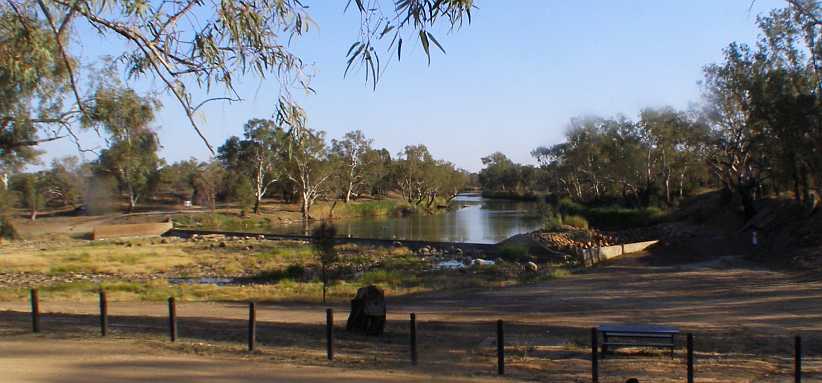
Brewarrina weir. A weir built across the area of the fish traps holds back water for several miles in this flat country.
It’s now being claimed that the fish traps might be the oldest man-made structures on earth. This is based on the supposition that Aboriginals have been in Australia for more than 65,000 years (which totally ignores all the information from the bible) and estimates – without real foundation – that this array of rocks laid out as walls were put there 40,000 years ago.
There’s no doubt that it was clever work creating the walls on the very wide river bed for the river to wash into, carrying the fish, and giving the fish little chance of escape, but it’s neither fish farming or permanent in nature. It simply worked at the time.
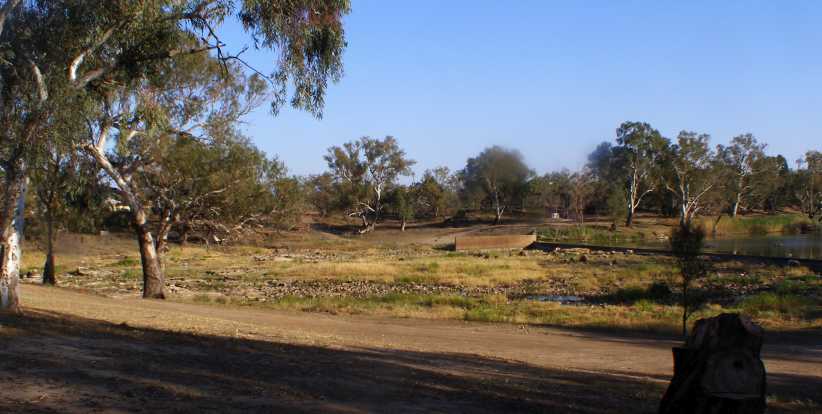
Famous fish traps. A mere remnant of the original traps, there are still rock walls in the riverbed.
As I breezed around looking for the people I had to find, and there were several of them, I got over to the North side of town and got a pic of the old lift-span bridge which used to let the paddle-steamers through…
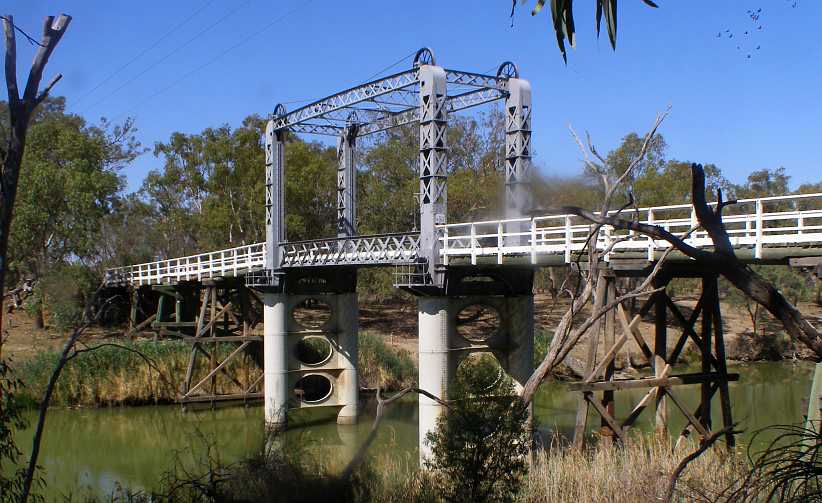
Lift-span bridge. It would be a long time since the lift span was operated here, certainly before the weir was built.
…but I also had my mind on getting it all done and getting home. By mid-afternoon I was heading towards Collarenebri and Mungindi, dropping in to see Ross Seymour on the way through, and then on to Dalveen. Even though I still had work to do on the van, I had been in touch with a knowledgeable friend about the Forester’s depleted performance. “All that driving with a duff plug lead,” he said, “would likely have caused the unburned mixture to burn in the catalytic converter. They don’t like that.”
So off came the exhaust again and splitting the sections I had a fistful of bits of converter…
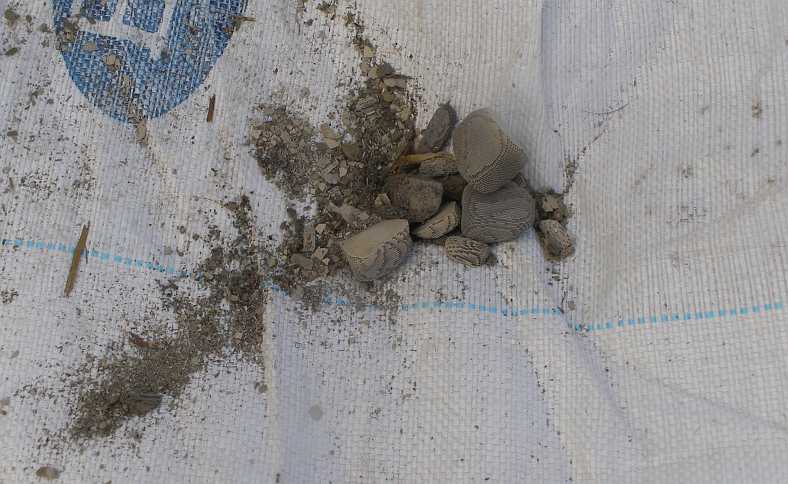
Catalyst. Bits like this floating around within the exhaust system were causing blockages which caused performance problems.
That fixed, and more work done on the van, I had caught up to the next weekend and I was scheduled to go to Grafton. But the annual Jacaranda Festival was on there and all accommodation was booked out. They booked me into a place at McLean, but that was so far away that they changed my work location to Yamba, all of which meant I was able to have more of a look at the new Harwood Island bridge:
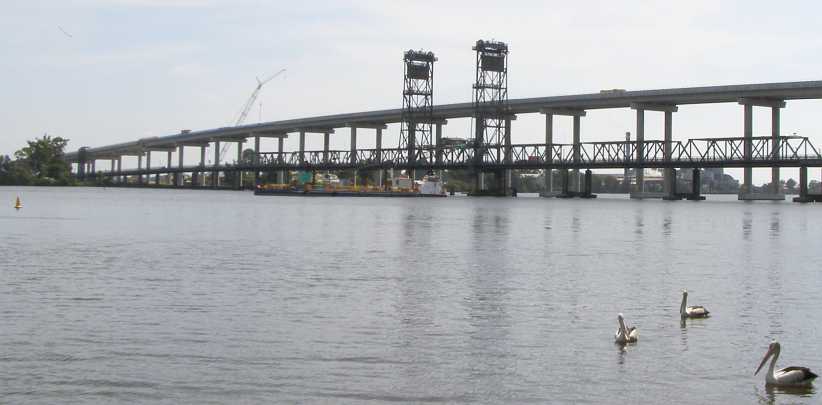
More Harwood Island bridge. This angle of the new bridge shows just how huge it is alongside the old one.
But by this time the need to get the van on the road so I could move was really pressing on me. I was living with some long days trying to get things done, and as proof of that I got a nice sunrise pic at home:
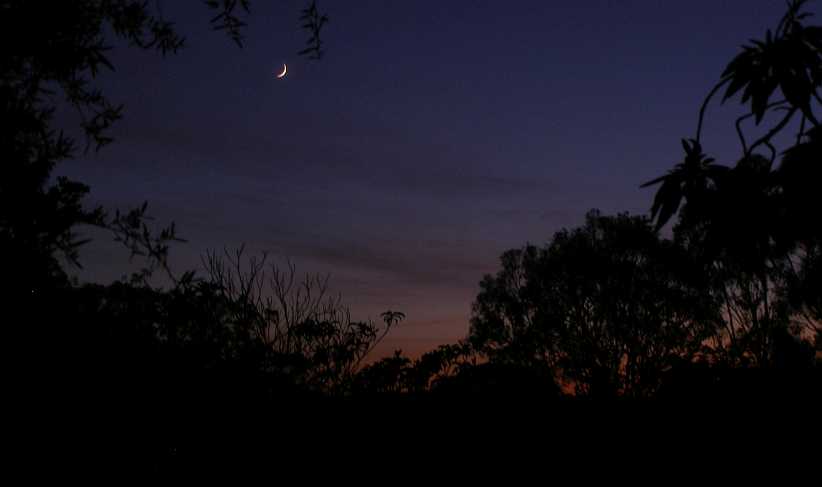
Dalveen sunrise. Sunrise was hard to catch at Dalveen, usually blanked out by clouds or something, but this time it looked pretty good to me and the camera caught it nicely.
I worked out how to do the manifold, first of all putting a drill smaller than the square through the plug, then filing the hole larger, then butchering a bigger drill to get it nice and round, finally finding a larger drill to get out to the required size. A smaller drilling and tapping job got the fixing bolt hole done too…
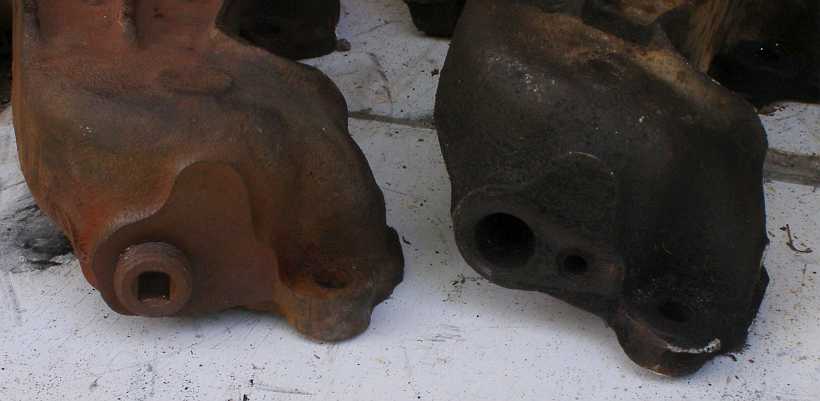
How it should be. The opposite ends of the manifolds show what I had to do…
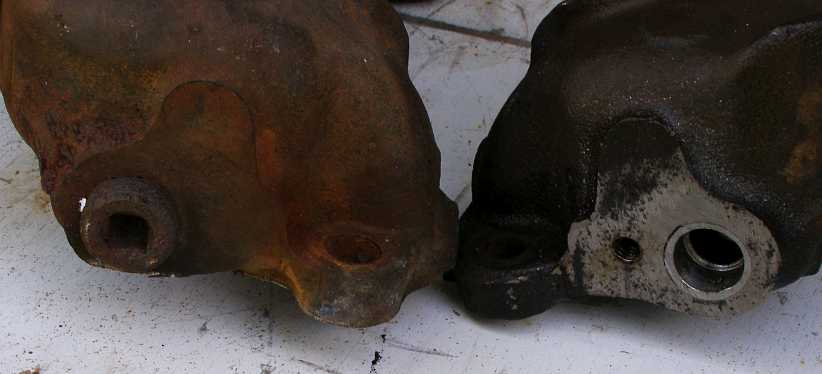
The desired result. A fair bit of work for me, but I got it sorted and fitted up to the 360’s right bank in the van.
I’d bought a full set of tie rod ends back in New Mexico, I decided to fit them all and dropped the entire steering linkage assembly:
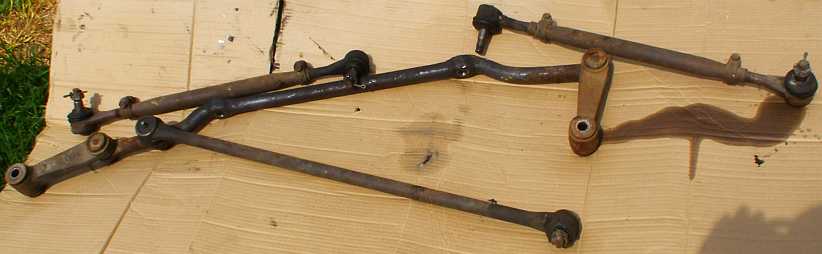
Steering linkages. With it all removed from the van, it was easier to crack tapers and generally better to work on.
I was still finishing off the safety belts and seats, and I was also still looking for somewhere to live. Time rushed by, before long there was another weekend and I had to go to Grafton to work. On the way I saw this for the first time:
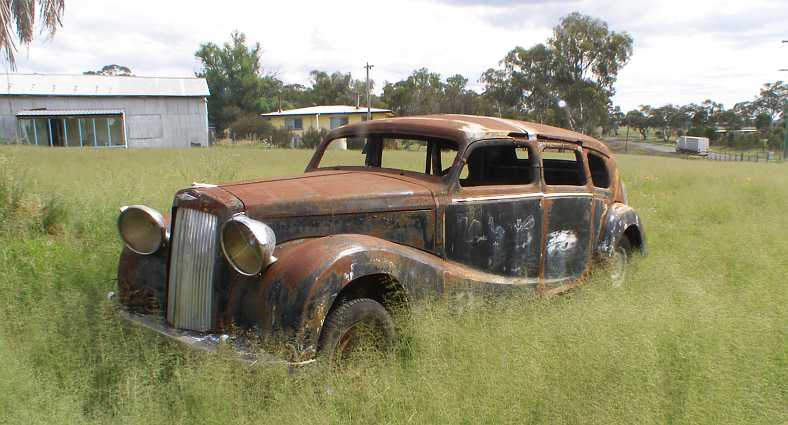
Rusty Shereline. Well, I always called them Sherelines, but they were also known as A125s and some were Princesses.
The cars are a big Austin from the immediate post-war years, fitted with a 4-litre six-cylinder engine based on the Austin truck unit. A 4-speed gearbox was fitted, while this one looks to be a longer-wheelbase model. It also looks like it’s been in a barn deteriorating for many years.
Once again I stopped by the Raspberry lookout for its grandeur…
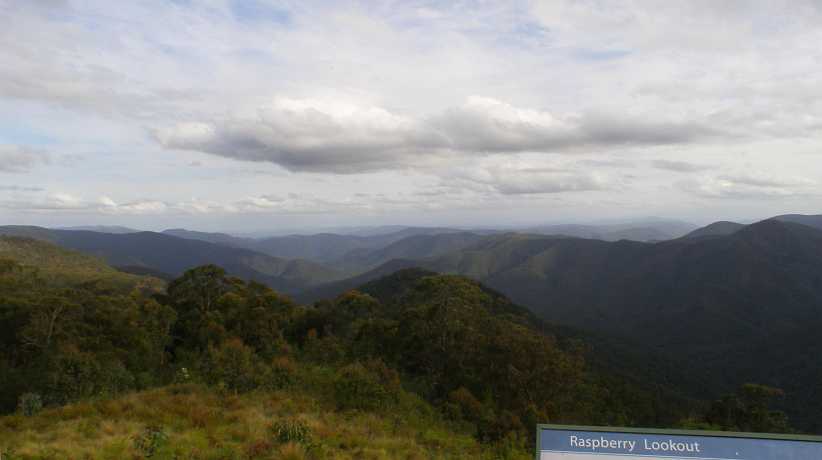
Raspberry grandeur. The sheer unspoiled beauty of the country visible from this lookout makes it worthwhile stopping here. It’s also a decent distance from home to make it a good place to have a coffee.
Still looking at bridges, I was anxious to see if the final pylon of the new Grafton bridge was coming on. The bridge was, in fact, showing progress…
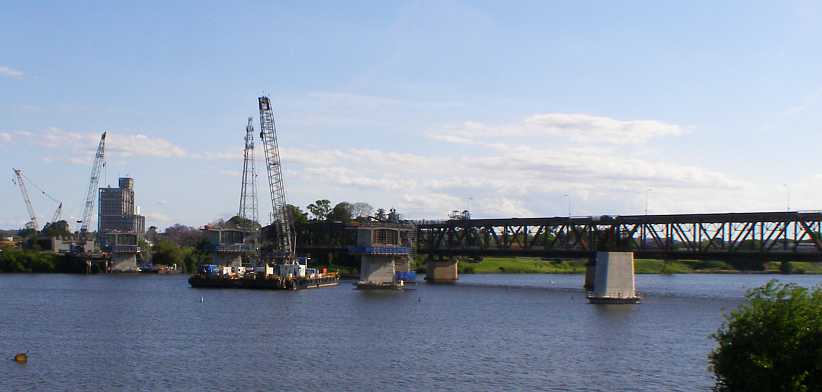
Grafton bridge. Now there were three pylons with the bridge profile casting mounted on them.
…and that last pylon was finally growing:
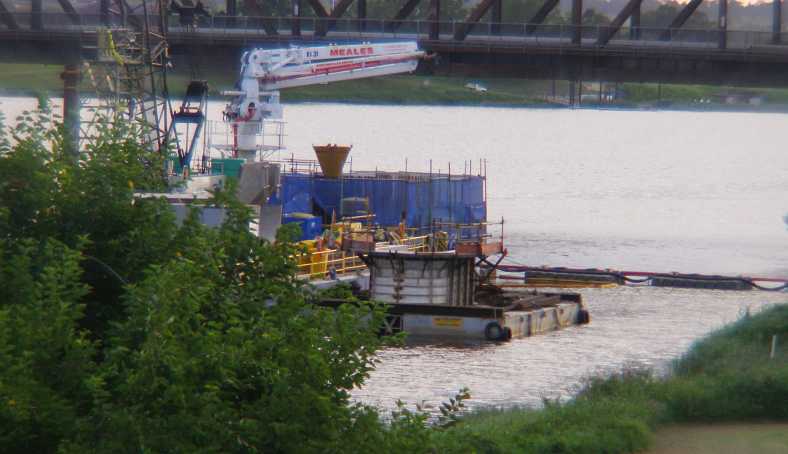
Troubled pylon. I learned that this one had caused the engineers some problems due to its location.
Meanwhile, over the other side the concrete casting area was full of bridge profile sections awaiting transport to their destinations out over the waters of the Clarence River:
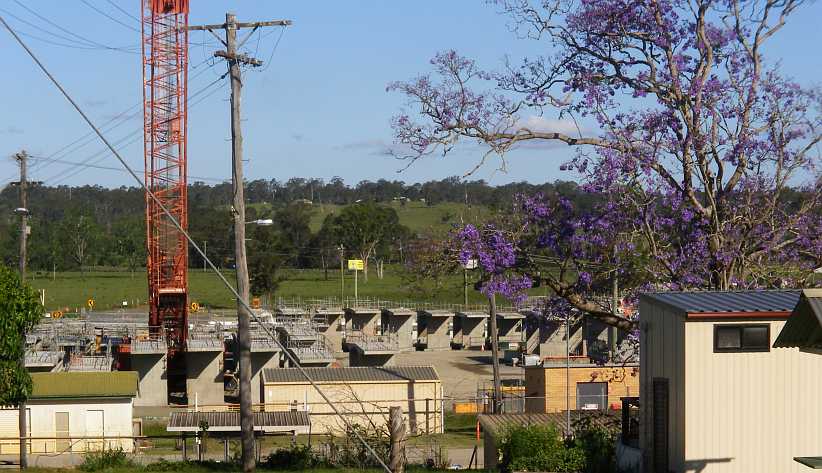
Concrete and jacaranda. This is just one corner of the yard with the pre-cast sections already prepared for assembly. And the jacaranda is still in full bloom.
Climbing into the mountains as I drove home on Sunday afternoon was much more ‘interesting’ than it had been with those exhaust blockages:
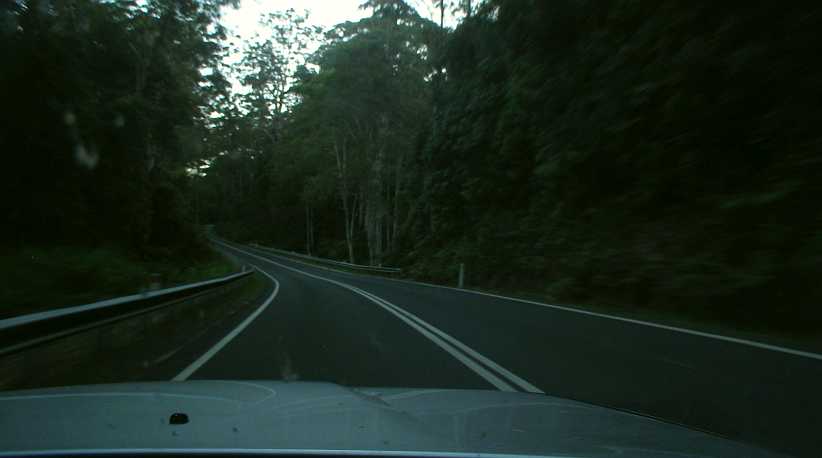
Opening up. I do enjoy the rush up the mountains on the Gwydir Highway as it ascends the Gibraltar Range. With a clear exhaust system it was much better than the previous week.
I was so busy at home I barely thought of getting the camera out, even though now I feel I’d like to have some pics of the work I did getting the van ready. The seat and belt mounts involved a lot of work. And now a friend offered me the use of a small pickup and a large trailer to get my moving done, something I was to really appreciate before too long.
But there was still work every weekend, the next weekend was at Elsmore near Inverell. The ‘highlight’ of this weekend was losing the main keys to the green Forester, which had been in the door pocket of the one I was driving. Which was why I pulled up in front of the Tenterfield Court House to go into the Police Station to see if anyone had handed them in.
I mused with myself that the cannon was there to blow away the ‘No Parking’ sign:
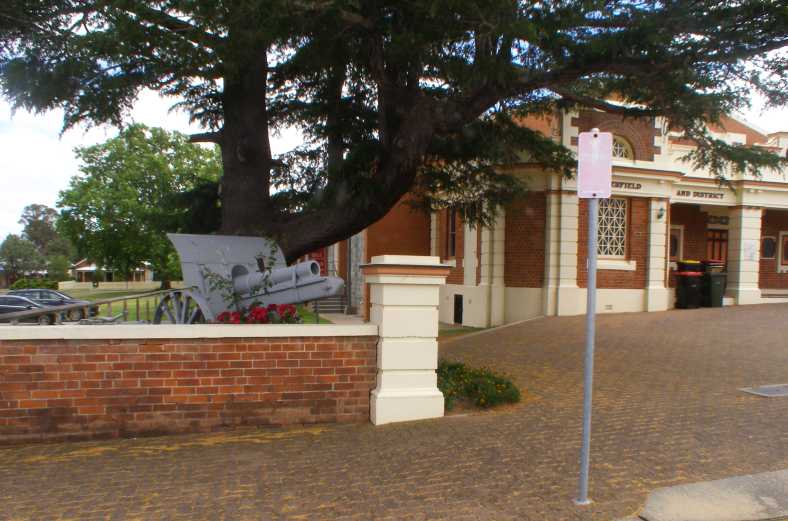
Tenterfield cannon. Tenterfield’s Soldiers’ Memorial building is next door to the Police Station and dates back to the ‘Great War’ - 1914-1918.
Finally the van was ready. I paid for the insurance and drove it to Toowoomba to have the compliance checked. They weren’t happy with the retracting lap/sash belts in the rear captains’ chairs but would accept lap belts, so I drove off to Sandra’s place and performed that change so I could get it finalised the next day.. Once it had been passed and had the compliance plate rivetted in place, I had to go and get a roadworthy inspection. But everyone was busy!
Then someone suggested I see a bloke who was a bit of an American car fancier, I turned up there the next afternoon and he barely looked at the van before he was writing out the paper I needed to complete the registration process,while he took it for a run around the block just for the pleasure of driving it. He had some projects of his own:
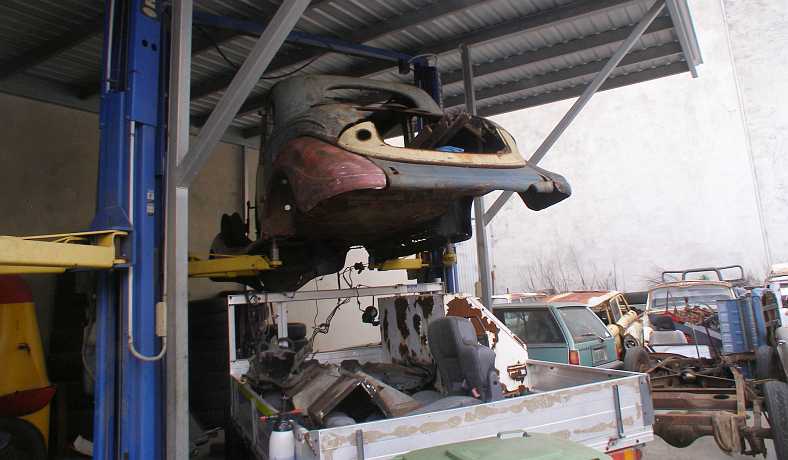
Coupe. This coupe from the thirties was just one of the projects to be seen in the back of the workshop…
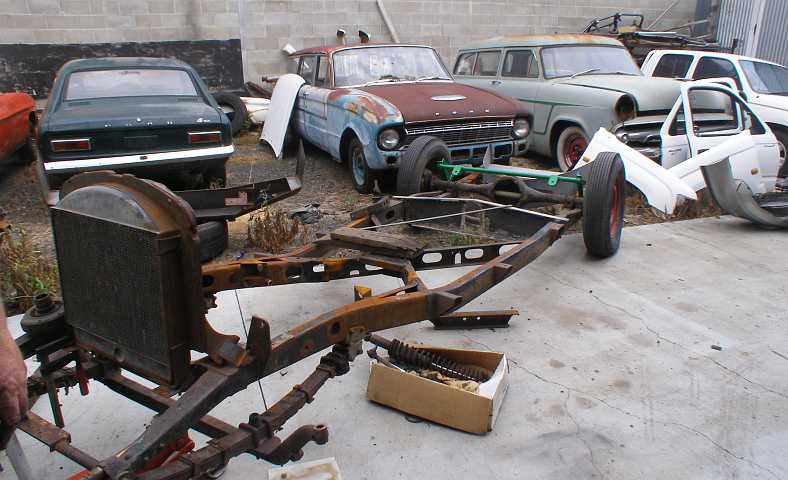
Chassis too. …and a bare chassis flanked by a variety of cars, it’s no wonder he was talking about giving the business away so he could work on his own vehicles.
So off I went to the Motor Transport office and paid out for the privilege of putting number plates on the van. Life was good, the van on the road and the pickup and trailer on loan, now all I needed was somewhere to go!
Of course, work never stopped. A destination just South of Casino came next, where this rather unfriendly sign was to be seen on one place…
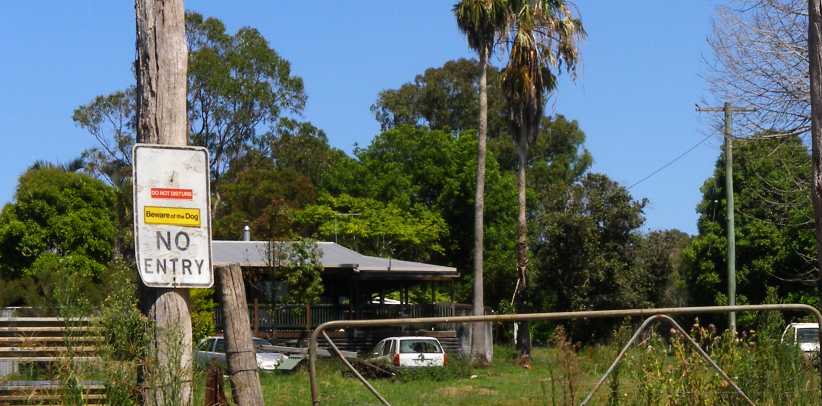
No entry. With ‘Do not disturb’ and ‘Beware of the dog’ added to this (stolen) traffic sign, this wasn’t someone who’d be happy to have me call.
…but it was unlike the attitude of most people in the area. On the way to the location I went by these Valiants looking like they need somewhere better to live:
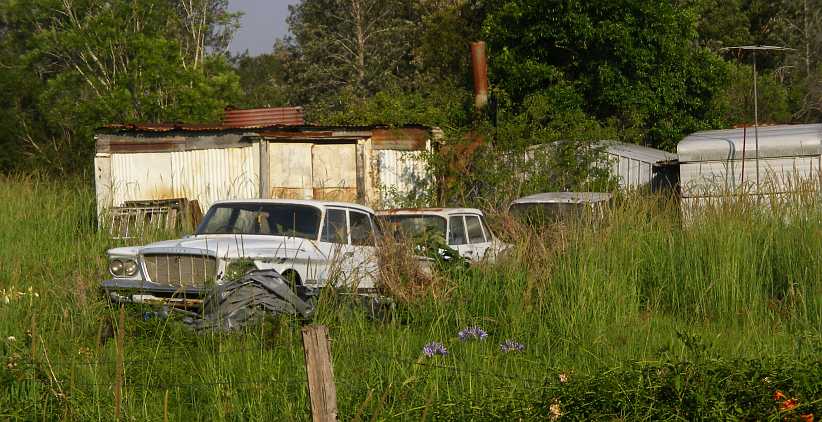
Valiants. Two S-series sedans and a slightly later model wagon (we only had sedans in the S-series) live in rust-inducing conditions here.
During the next week, after a trip to Toowoomba to take some of my furniture to Sandra’s place, the van showed signs of not liking long uphill stretches. Things were starting to get to me, but I had to get to the bottom of all of this. Then I learned exactly what this device, bypassed on my van, was for:
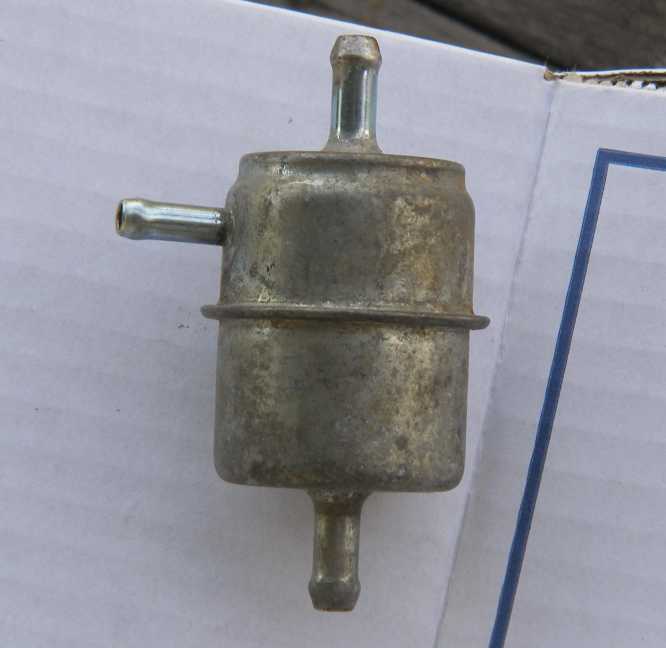
Vapour separator. Not merely a fuel filter, the second ‘outlet’ is placed to send unwanted fuel vapour back to the fuel tank.
I sparked up at the revelation, but I couldn’t buy one anywhere. I cleaned up the old one and fitted it, expecting that my problems would all be over. And it did improve things, but still there were troubles. I phoned Ben, my nephew, and he suggested that I might have a blockage in the little filter where the fuel enters the carby.
This filter is tiny, I doubt that it's an inch long:
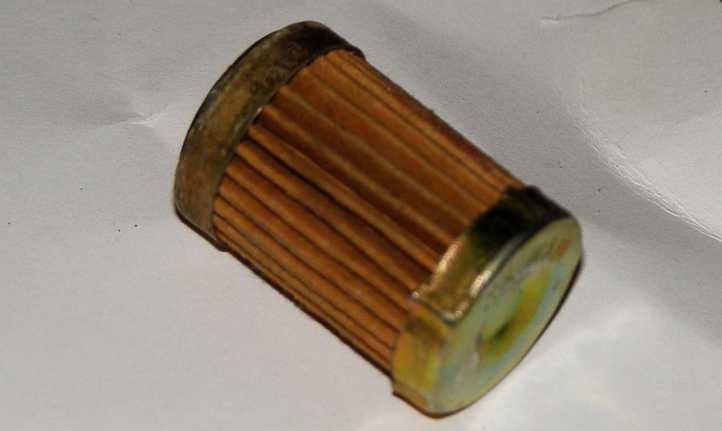
Tiny filter. It was only after I pulled this out that the van's running problems finally disappeared.
I pulled it out and didn’t replace it. And the van ran properly! It was obviously new back in Indiana, but now blocked, and the vaporisation problems I’d been having in Colorado were now explained too. All very positive, but I still had nowhere to live!
I looked at a house but it had problems, I had to resign myself to moving into the house Sandra was renting and finding somewhere to store the vast amount of stuff I had that couldn’t go there.
I was already renting a shed at the back of an old factory which was now being used for storage rentals, one section of the factory had poor access and I came to an arrangement with the owner, who had not been able to find enough tenants for all the space he had available. So now I started using that pickup and trailer to make multiple trips each day.
A friend came along to help for a couple of days, that made things progress well, Sandra also lent a hand with packing. The house was huge and it was still full of Janet’s things as well as mine. Janet had made a point of buying things for the house every time she went to Brisbane and there was also all her hairdressing gear – she worked as a mobile hairdresser – and an excess of wall art and trinkets and cupboards in which they lived.
I started to fill the huge shed, though I was trying to keep to about a quarter of the area so the owner could still rent out some space in there if someone came along.
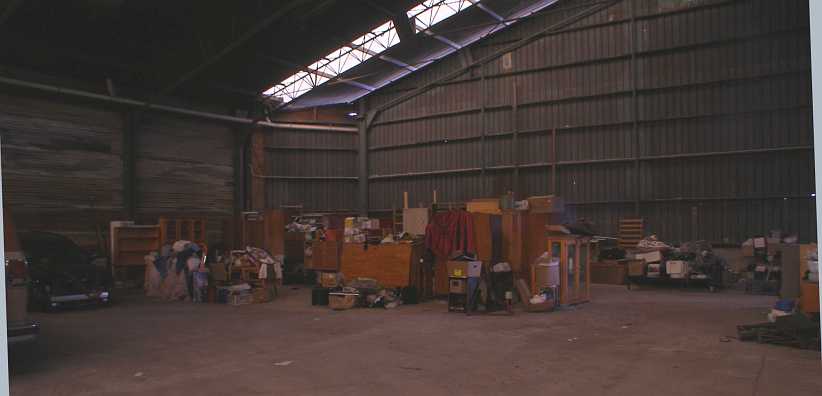
Loading the shed. I tried to arrange things so they were orderly, but there was so much to move and so little time…
I had a couple of cars to get rid of too, so I gave them to a bloke who has a tilt-tray (he deals in scrap metal) in return for him carting the two pickups to the shed:
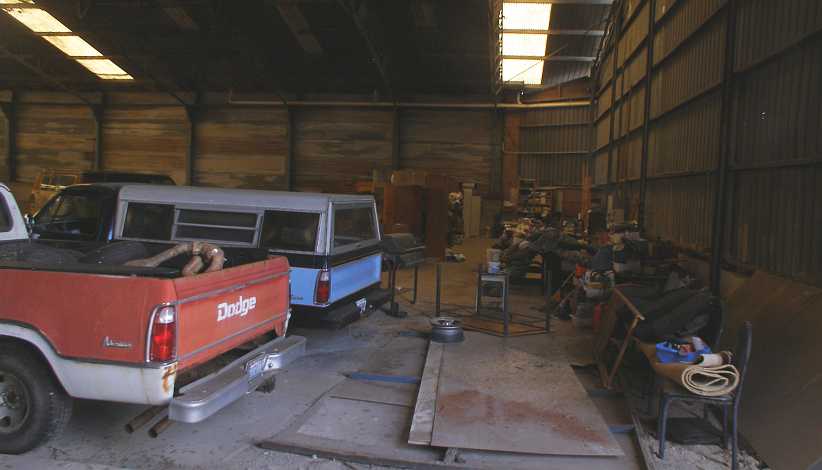
Pickups in place. The two pickups lined up at one end of my storage area while wardrobes, bookshelves and cupboards are formed up and filling with other possessions.
Ordinarily I’d reckon a Coffs Harbour job on a weekend would be a good thing, better mileage than was usual, but I was struggling for time. All the same, I found a moment or two to get a photo of another bridge:
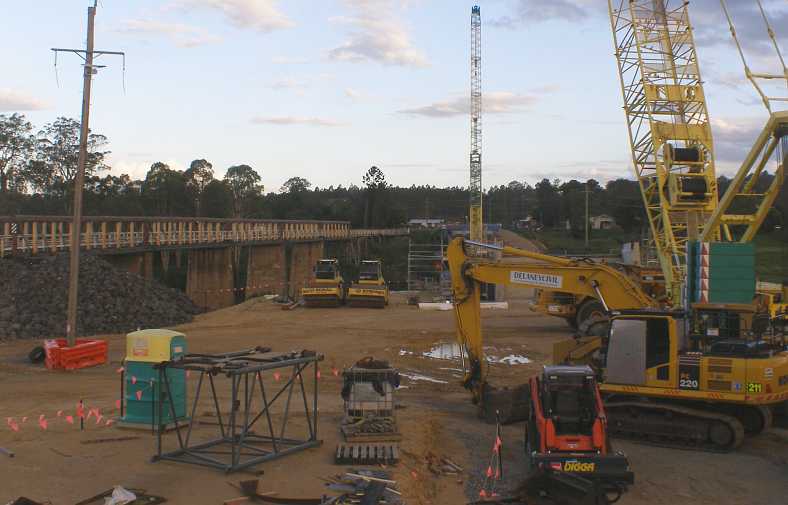
Tabulam bridge. The old single-lane bridge is over 60’ from the river level and the longest-span timber truss bridge in the Southern Hemisphere. But replacement was overdue.
With the lack of photography during this hectic period, this post has covered from the last weekend of October up to late December, 2018. I’d been working all over the place, the Brewarrina job was on the map in the previous post, but this map shows all the places I went to over the two months:
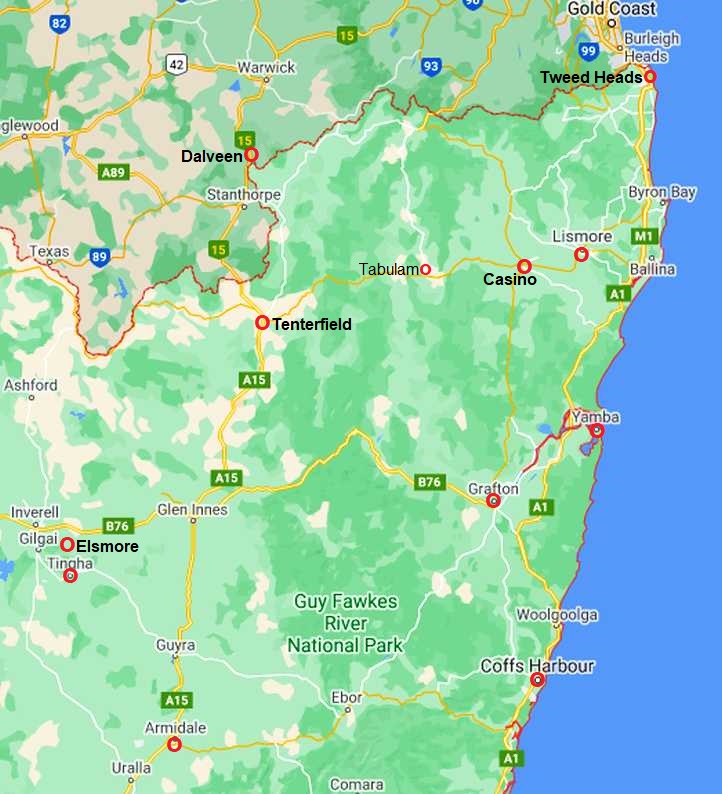
Covering the territory. The bold red circles record the places I’d worked over the two months, with Armidale to be the last one of the year. Of course I didn’t work at Tabulam, but I thought it good to note where it’s located.
So after all the struggle, finishing the move just using the van, which also went into the shed for storage, that last job of the year saw me finish up at Armidale and then drive home to Toowoomba. I left there Sunday evening and camped at Wallangarra that night, did my paperwork the next morning and was there when the driver reviver opened ready for the holiday travellers:
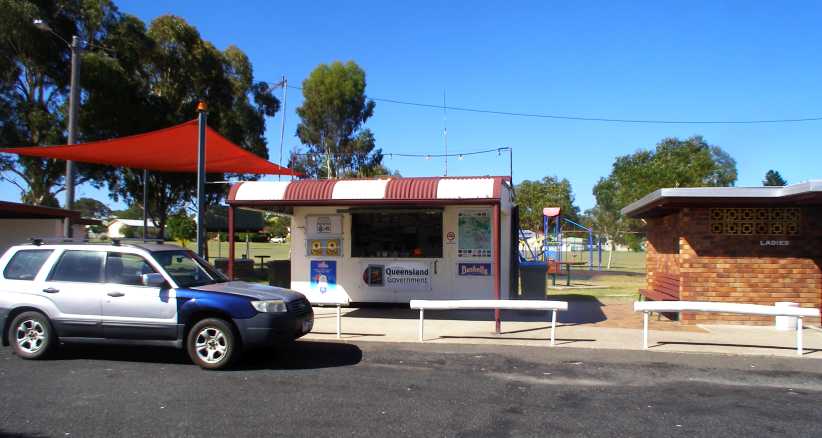
Driver reviver.Wallangarra’s Rest Area, right on the NSW/Queensland border, is well-equipped. Childrens’ playground, toilets, tables and benches and in holiday time the driver reviver dispenses free tea and coffee.
2018 had seen some changes. The sad loss of my ‘country estate’ home, but the pleasure of having my van on the road. But there was still work to be done before I would be able to go away on the big job which would take me to Central Australia…
The paddle steamers didn’t go beyond Brewarrina very often because there usually wasn’t enough water, the river falling significantly over a few miles in this area. Trains came to town in 1901 and took over the transport of goods and people but today the railway is also defunct. Flood damage in 1972 put an end to it.
A significant portion of the local people are Aboriginal, with a section of the town to the North of the river being set aside for many of them while more are dotted around the main section of town. Some of these were the people I was here to see. I also took a couple of pics of the famous fish traps in the river, or what’s left of them…
Brewarrina weir. A weir built across the area of the fish traps holds back water for several miles in this flat country.
It’s now being claimed that the fish traps might be the oldest man-made structures on earth. This is based on the supposition that Aboriginals have been in Australia for more than 65,000 years (which totally ignores all the information from the bible) and estimates – without real foundation – that this array of rocks laid out as walls were put there 40,000 years ago.
There’s no doubt that it was clever work creating the walls on the very wide river bed for the river to wash into, carrying the fish, and giving the fish little chance of escape, but it’s neither fish farming or permanent in nature. It simply worked at the time.
Famous fish traps. A mere remnant of the original traps, there are still rock walls in the riverbed.
As I breezed around looking for the people I had to find, and there were several of them, I got over to the North side of town and got a pic of the old lift-span bridge which used to let the paddle-steamers through…
Lift-span bridge. It would be a long time since the lift span was operated here, certainly before the weir was built.
…but I also had my mind on getting it all done and getting home. By mid-afternoon I was heading towards Collarenebri and Mungindi, dropping in to see Ross Seymour on the way through, and then on to Dalveen. Even though I still had work to do on the van, I had been in touch with a knowledgeable friend about the Forester’s depleted performance. “All that driving with a duff plug lead,” he said, “would likely have caused the unburned mixture to burn in the catalytic converter. They don’t like that.”
So off came the exhaust again and splitting the sections I had a fistful of bits of converter…
Catalyst. Bits like this floating around within the exhaust system were causing blockages which caused performance problems.
That fixed, and more work done on the van, I had caught up to the next weekend and I was scheduled to go to Grafton. But the annual Jacaranda Festival was on there and all accommodation was booked out. They booked me into a place at McLean, but that was so far away that they changed my work location to Yamba, all of which meant I was able to have more of a look at the new Harwood Island bridge:
More Harwood Island bridge. This angle of the new bridge shows just how huge it is alongside the old one.
But by this time the need to get the van on the road so I could move was really pressing on me. I was living with some long days trying to get things done, and as proof of that I got a nice sunrise pic at home:
Dalveen sunrise. Sunrise was hard to catch at Dalveen, usually blanked out by clouds or something, but this time it looked pretty good to me and the camera caught it nicely.
I worked out how to do the manifold, first of all putting a drill smaller than the square through the plug, then filing the hole larger, then butchering a bigger drill to get it nice and round, finally finding a larger drill to get out to the required size. A smaller drilling and tapping job got the fixing bolt hole done too…
How it should be. The opposite ends of the manifolds show what I had to do…
The desired result. A fair bit of work for me, but I got it sorted and fitted up to the 360’s right bank in the van.
I’d bought a full set of tie rod ends back in New Mexico, I decided to fit them all and dropped the entire steering linkage assembly:
Steering linkages. With it all removed from the van, it was easier to crack tapers and generally better to work on.
I was still finishing off the safety belts and seats, and I was also still looking for somewhere to live. Time rushed by, before long there was another weekend and I had to go to Grafton to work. On the way I saw this for the first time:
Rusty Shereline. Well, I always called them Sherelines, but they were also known as A125s and some were Princesses.
The cars are a big Austin from the immediate post-war years, fitted with a 4-litre six-cylinder engine based on the Austin truck unit. A 4-speed gearbox was fitted, while this one looks to be a longer-wheelbase model. It also looks like it’s been in a barn deteriorating for many years.
Once again I stopped by the Raspberry lookout for its grandeur…
Raspberry grandeur. The sheer unspoiled beauty of the country visible from this lookout makes it worthwhile stopping here. It’s also a decent distance from home to make it a good place to have a coffee.
Still looking at bridges, I was anxious to see if the final pylon of the new Grafton bridge was coming on. The bridge was, in fact, showing progress…
Grafton bridge. Now there were three pylons with the bridge profile casting mounted on them.
…and that last pylon was finally growing:
Troubled pylon. I learned that this one had caused the engineers some problems due to its location.
Meanwhile, over the other side the concrete casting area was full of bridge profile sections awaiting transport to their destinations out over the waters of the Clarence River:
Concrete and jacaranda. This is just one corner of the yard with the pre-cast sections already prepared for assembly. And the jacaranda is still in full bloom.
Climbing into the mountains as I drove home on Sunday afternoon was much more ‘interesting’ than it had been with those exhaust blockages:
Opening up. I do enjoy the rush up the mountains on the Gwydir Highway as it ascends the Gibraltar Range. With a clear exhaust system it was much better than the previous week.
I was so busy at home I barely thought of getting the camera out, even though now I feel I’d like to have some pics of the work I did getting the van ready. The seat and belt mounts involved a lot of work. And now a friend offered me the use of a small pickup and a large trailer to get my moving done, something I was to really appreciate before too long.
But there was still work every weekend, the next weekend was at Elsmore near Inverell. The ‘highlight’ of this weekend was losing the main keys to the green Forester, which had been in the door pocket of the one I was driving. Which was why I pulled up in front of the Tenterfield Court House to go into the Police Station to see if anyone had handed them in.
I mused with myself that the cannon was there to blow away the ‘No Parking’ sign:
Tenterfield cannon. Tenterfield’s Soldiers’ Memorial building is next door to the Police Station and dates back to the ‘Great War’ - 1914-1918.
Finally the van was ready. I paid for the insurance and drove it to Toowoomba to have the compliance checked. They weren’t happy with the retracting lap/sash belts in the rear captains’ chairs but would accept lap belts, so I drove off to Sandra’s place and performed that change so I could get it finalised the next day.. Once it had been passed and had the compliance plate rivetted in place, I had to go and get a roadworthy inspection. But everyone was busy!
Then someone suggested I see a bloke who was a bit of an American car fancier, I turned up there the next afternoon and he barely looked at the van before he was writing out the paper I needed to complete the registration process,while he took it for a run around the block just for the pleasure of driving it. He had some projects of his own:
Coupe. This coupe from the thirties was just one of the projects to be seen in the back of the workshop…
Chassis too. …and a bare chassis flanked by a variety of cars, it’s no wonder he was talking about giving the business away so he could work on his own vehicles.
So off I went to the Motor Transport office and paid out for the privilege of putting number plates on the van. Life was good, the van on the road and the pickup and trailer on loan, now all I needed was somewhere to go!
Of course, work never stopped. A destination just South of Casino came next, where this rather unfriendly sign was to be seen on one place…
No entry. With ‘Do not disturb’ and ‘Beware of the dog’ added to this (stolen) traffic sign, this wasn’t someone who’d be happy to have me call.
…but it was unlike the attitude of most people in the area. On the way to the location I went by these Valiants looking like they need somewhere better to live:
Valiants. Two S-series sedans and a slightly later model wagon (we only had sedans in the S-series) live in rust-inducing conditions here.
During the next week, after a trip to Toowoomba to take some of my furniture to Sandra’s place, the van showed signs of not liking long uphill stretches. Things were starting to get to me, but I had to get to the bottom of all of this. Then I learned exactly what this device, bypassed on my van, was for:
Vapour separator. Not merely a fuel filter, the second ‘outlet’ is placed to send unwanted fuel vapour back to the fuel tank.
I sparked up at the revelation, but I couldn’t buy one anywhere. I cleaned up the old one and fitted it, expecting that my problems would all be over. And it did improve things, but still there were troubles. I phoned Ben, my nephew, and he suggested that I might have a blockage in the little filter where the fuel enters the carby.
This filter is tiny, I doubt that it's an inch long:
Tiny filter. It was only after I pulled this out that the van's running problems finally disappeared.
I pulled it out and didn’t replace it. And the van ran properly! It was obviously new back in Indiana, but now blocked, and the vaporisation problems I’d been having in Colorado were now explained too. All very positive, but I still had nowhere to live!
I looked at a house but it had problems, I had to resign myself to moving into the house Sandra was renting and finding somewhere to store the vast amount of stuff I had that couldn’t go there.
I was already renting a shed at the back of an old factory which was now being used for storage rentals, one section of the factory had poor access and I came to an arrangement with the owner, who had not been able to find enough tenants for all the space he had available. So now I started using that pickup and trailer to make multiple trips each day.
A friend came along to help for a couple of days, that made things progress well, Sandra also lent a hand with packing. The house was huge and it was still full of Janet’s things as well as mine. Janet had made a point of buying things for the house every time she went to Brisbane and there was also all her hairdressing gear – she worked as a mobile hairdresser – and an excess of wall art and trinkets and cupboards in which they lived.
I started to fill the huge shed, though I was trying to keep to about a quarter of the area so the owner could still rent out some space in there if someone came along.
Loading the shed. I tried to arrange things so they were orderly, but there was so much to move and so little time…
I had a couple of cars to get rid of too, so I gave them to a bloke who has a tilt-tray (he deals in scrap metal) in return for him carting the two pickups to the shed:
Pickups in place. The two pickups lined up at one end of my storage area while wardrobes, bookshelves and cupboards are formed up and filling with other possessions.
Ordinarily I’d reckon a Coffs Harbour job on a weekend would be a good thing, better mileage than was usual, but I was struggling for time. All the same, I found a moment or two to get a photo of another bridge:
Tabulam bridge. The old single-lane bridge is over 60’ from the river level and the longest-span timber truss bridge in the Southern Hemisphere. But replacement was overdue.
With the lack of photography during this hectic period, this post has covered from the last weekend of October up to late December, 2018. I’d been working all over the place, the Brewarrina job was on the map in the previous post, but this map shows all the places I went to over the two months:
Covering the territory. The bold red circles record the places I’d worked over the two months, with Armidale to be the last one of the year. Of course I didn’t work at Tabulam, but I thought it good to note where it’s located.
So after all the struggle, finishing the move just using the van, which also went into the shed for storage, that last job of the year saw me finish up at Armidale and then drive home to Toowoomba. I left there Sunday evening and camped at Wallangarra that night, did my paperwork the next morning and was there when the driver reviver opened ready for the holiday travellers:
Driver reviver.Wallangarra’s Rest Area, right on the NSW/Queensland border, is well-equipped. Childrens’ playground, toilets, tables and benches and in holiday time the driver reviver dispenses free tea and coffee.
2018 had seen some changes. The sad loss of my ‘country estate’ home, but the pleasure of having my van on the road. But there was still work to be done before I would be able to go away on the big job which would take me to Central Australia…
Last edited by Ray Bell; Dec 30, 2020 at 05:43 AM.
Thread Starter
|
Captain
Joined: Oct 2005
Posts: 570
Likes: 8
From: The Summit, Queensland, Australia
I've had a question sent to me by member Dodge_Van...
I don't know what has happened to the post, but I'm happy to answer the question.
I don't think 75mph over long distances would be good. The rear axle ratio is 3.9:1, and though the tyres are bigger than regular car tyres, they aren't that much bigger. But, to be honest, I really don't know as I never drove this as an automatic, it's had the A833 overdrive transmission in it since the first couple of days after I arrived in Spokane to pick it up.
This is a 0.73:1 overdrive, so any time I'm up at that speed I've had it in overdrive.
And if anyone knows what happened to the post in which I was asked this, I'd be very happy to find out. I received an e.mail notification and that's the only reason I knew about this question.
can you tell me something about the LWB Dodge Van?
3-Speed automatic I think?
Is it possible to travel with 75mph for long distances and the engine/transmissions goes well with it?
Thanks!
3-Speed automatic I think?
Is it possible to travel with 75mph for long distances and the engine/transmissions goes well with it?
Thanks!
I don't think 75mph over long distances would be good. The rear axle ratio is 3.9:1, and though the tyres are bigger than regular car tyres, they aren't that much bigger. But, to be honest, I really don't know as I never drove this as an automatic, it's had the A833 overdrive transmission in it since the first couple of days after I arrived in Spokane to pick it up.
This is a 0.73:1 overdrive, so any time I'm up at that speed I've had it in overdrive.
And if anyone knows what happened to the post in which I was asked this, I'd be very happy to find out. I received an e.mail notification and that's the only reason I knew about this question.
Thread Starter
|
Captain
Joined: Oct 2005
Posts: 570
Likes: 8
From: The Summit, Queensland, Australia
I had one weekend without work as 2018 ended and 2019 was about to begin. Inverell was to be my next work destination and I planned to get back to the shed on Sunday night and change the gearbox in the van on the Monday – a job I expected to take most of the day.
I had prepared a lot of things for the changeover on the Friday on the way down as well as making up a cradle to mount on my floor jack:
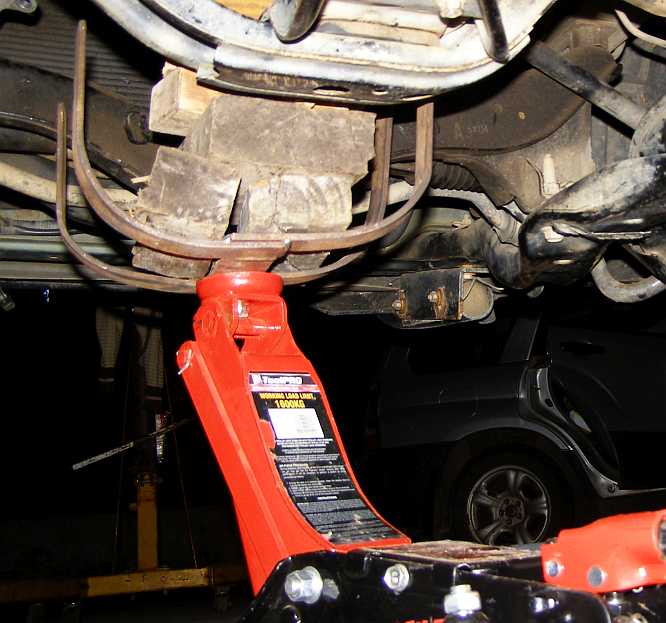
Gearbox cradle. With two gearboxes to change, I decided to make up this cradle to assist me do them on my own. This is on the Forester a few weeks later, but the same applied on the van.
To gain height I stacked short pieces of timber into the cradle underneath the gearbox’s case. The A833 overdrive unit…
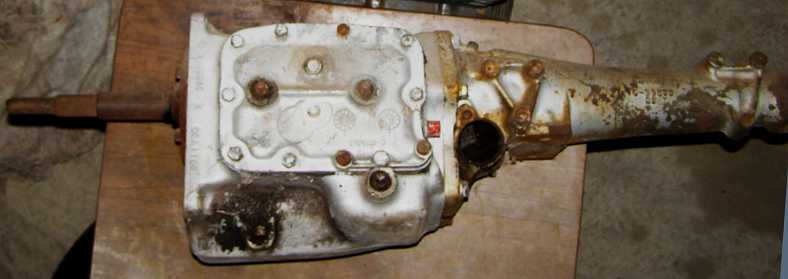
A833 overdrive. Even thought it’s got an alloy main case, the gearbox is still weighty.
…weighs over 140lbs so that’s too much for me to lift by myself under the vehicle. And to juggle while lining up the clutch and getting a bolt or two into the bellhousing.
The actual job took me seven hours. I was able to take it for a run to see how it was and it was very good, quiet in all gears and just what I was looking for. Then I went home in the Forester, which would the following weekend see duty with two assignments, one in Wondai and the other in Kingaroy, Wondai being about 120 miles from Toowooomba:
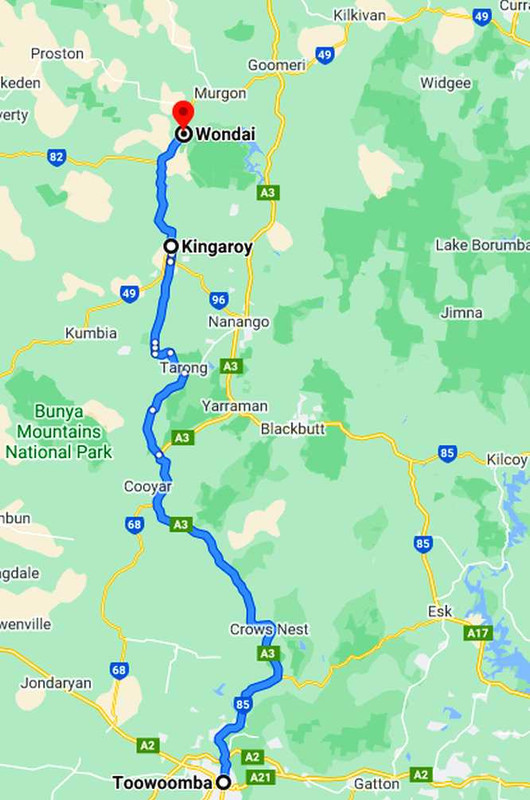
It was a day and a half out in the scrub, basically, only the last two interviews being in town. I was running around on gravel roads out there and a bit surprised to see a bitumen track alongside the road:
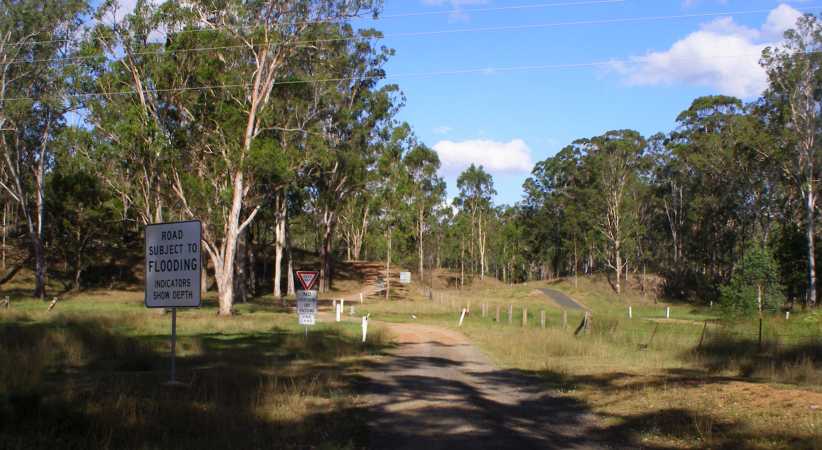
Rail Trail. While I was driving on roads like this, alongside me was a walking/cycling trail which followed the line of a disused railway line.
A development for the tourists and the ones seeking a health kick, the trail actually stretches from Kingaroy to Kilkivan, a distance of 89kms, about 55 miles:
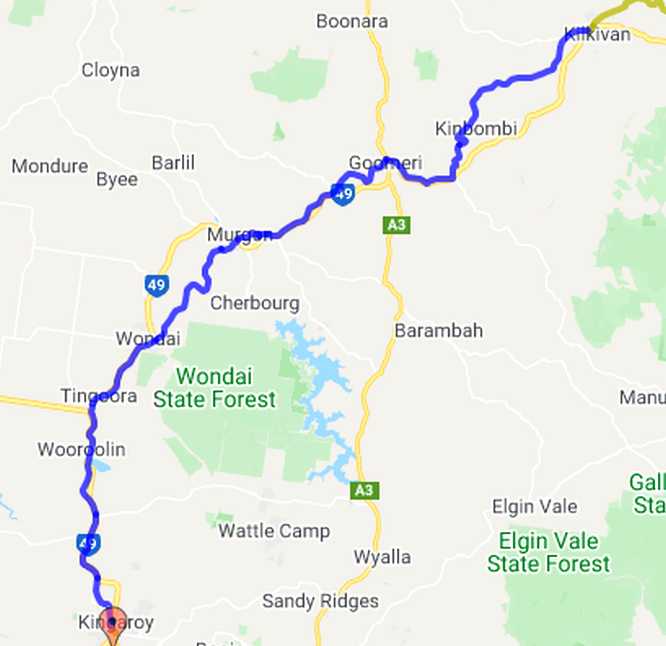
Obviously the railway has to wind around a lot more in the hilly country, but this would also mean that there’d be no steep hills to traverse. But there were some rules, too:
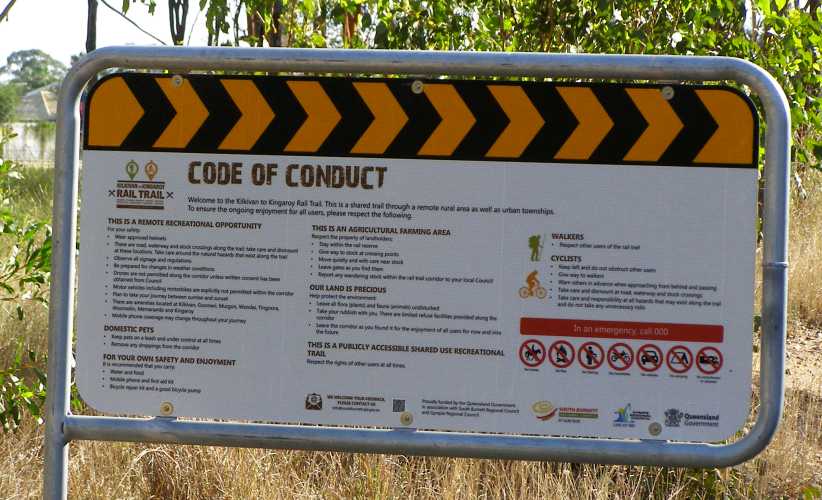
Lots of rules. Some general, some aimed at city folk who might not understand the bush, these rules were posted at various points along the trail.
And there was some country to see out there, too, nice and green and hillside homes got good views over a broad area.
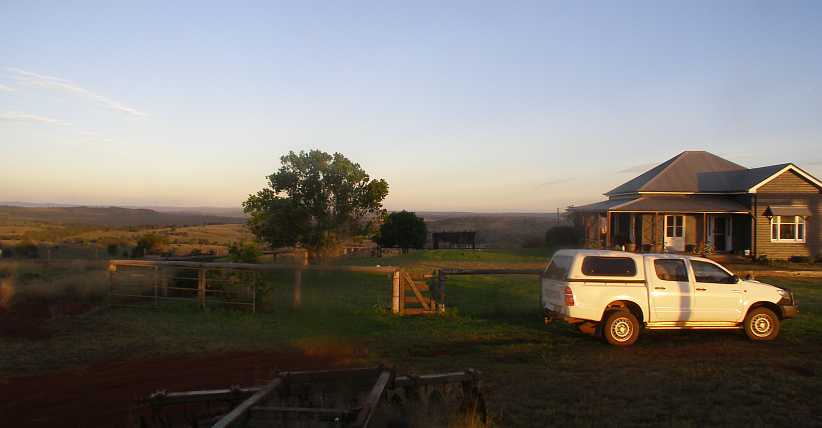
Farmhouse view. An expansive view was to be had from some of the homes I visited in the Wondai area.
And I found some places which have done their dash, too:
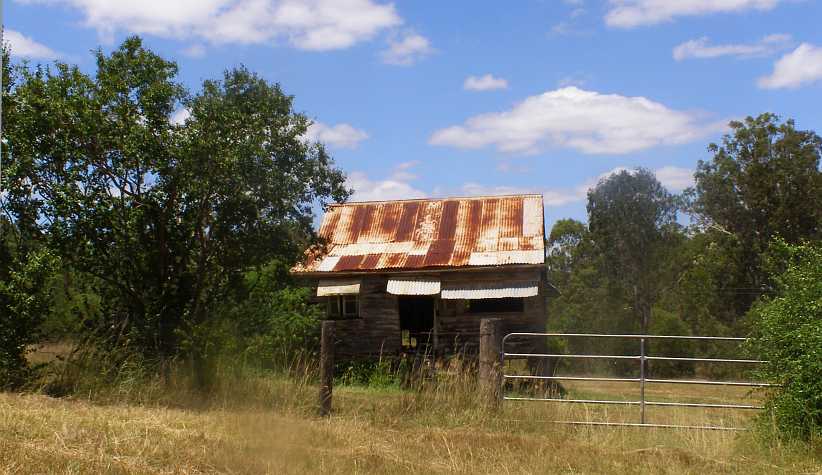
Old house. Usually a place like this is replaced with a new home on the property and becomes a storage shed. While it remains upright.
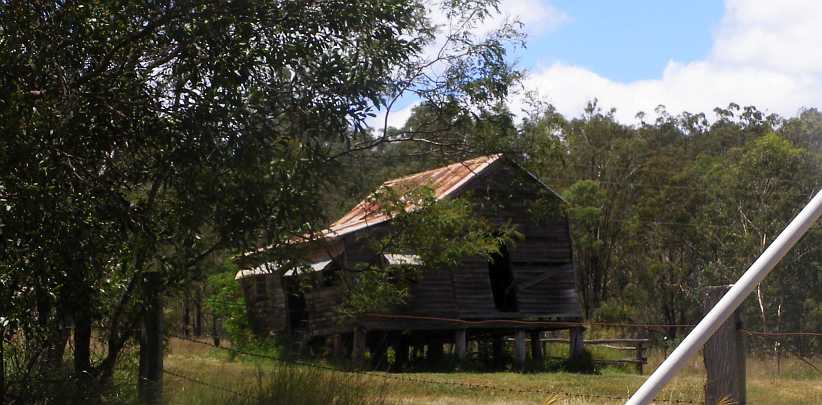
On a lean. This view from down the road just a little shows that its days will soon be numbered.
The Kingaroy job, which I tackled Sunday and Monday morning, brought a surprise. One woman I interviewed told me her husband was an avid collector of old motorcycles. And that he was out in his shed playing with them while I was there. After completing the interview I went to the shed.
Some of the bikes were pre-World War 1 models and one was an Australian bike made in Adelaide in 1913. The brand name of that one was ‘Swastika’, clearly from before that name had any negative connotations. In fact, it reminded me of seeing a swastika on a drag car pictured on the cover of Hot Rod Magazine back in the early sixties, with the explanation in the magazine being that the swastika was always a sort of good luck charm.
The Sunday night I had arranged to stay with Glendon and Linda Perkins, Glendon being a Mopar tragic with a whole shed full of Forward Look cars and a couple of hot-rods. I’d never seen his cars before, so it was a very interesting visit. Another person I visited while in the area was lawrie Poole and his wife Lisa, they being old friends from the Stanthorpe area.
With all of this work happening, and with the prospect of a big trip coming up soon, I decided that the next weekend would be an ideal opportunity for me to take the van to work. A trial run, you might say, for the big trip ahead. I again had a 4-day workload ahead of me and I would be going down into NSW along familiar roads, returning via Tweed Heads to get some new tyres fitted and visiting my nephew, Ben, to see if he could do some fine tuning of the 360.
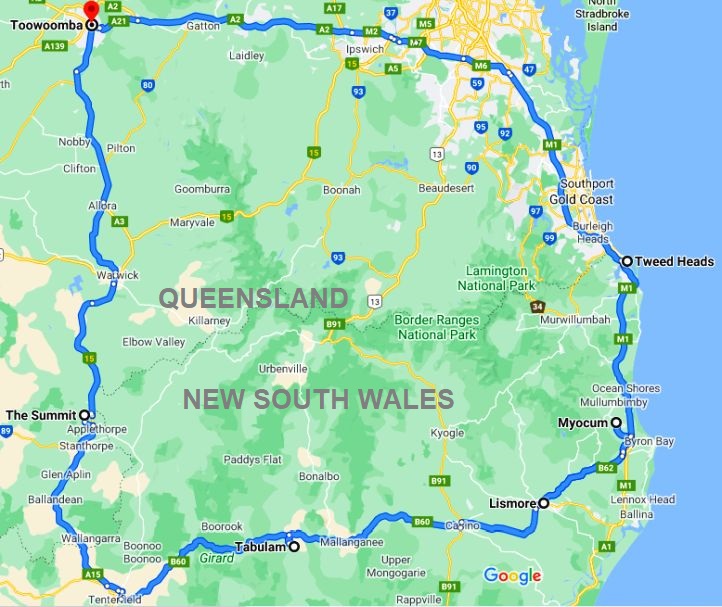
Driving down on the Friday afternoon I got a progress shot of the new Tabulam bridge, which was making progress after (I’m told) the contractors had got into some financial trouble…
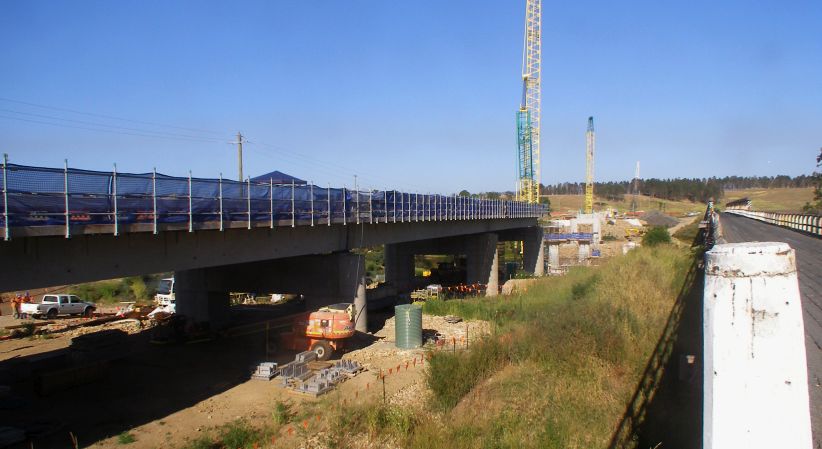
Slow progress. Watching this bridge go up had been slow, but now progress was being made and visible. This view is looking West rather than the Easterly view of the previous picture.
The assignment locations were right in urban Lismore…
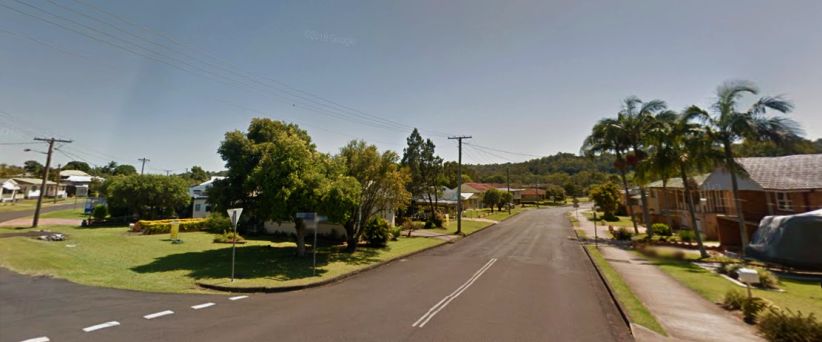
Lismore streets. This quiet area of Lismore (from Google Earth Street View) kept me going Friday afternoon and Saturday, with the meeting of an old bloke who used to hill-climb an Austin Healey being a highlight for me.
… and in very rural Myocum, a bit closer to the coast:
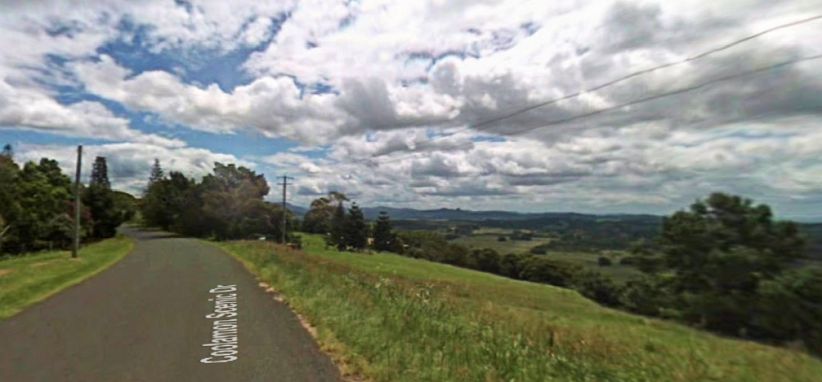
Myocum outlook. Another Google Earth view as I took no pics myself. This part of the country is simply dotted with views like this.
I managed to prove to myself that I needed that Power-Lok in the rear end while on the Myocum job. Driving down a steep farm driveway, the kind where your wheels are at the point of locking up on the loose stony surface, I reached a gate. It was closed, there was no house there and I needed to turn around to get out again.
Foolishly I tried to turn within the confines of the track and got the van into a position where a rear wheel was off the ground. I struggled for some time with this, maybe half an hour, jacking it up higher and piling rocks underneath the tyres to give me some traction. Eventually I made it, then I opened the gate, went in and did a U-turn in the flat paddock beyond, then drove on to the next farm.
Another high point for the weekend was when a lady took a particular interest in the van and wanted me to accelerate past her place, changing up a gear as I went. Of course, I obliged.
With the work done I went to Roadrunner Tyres at Tweed and did a deal on some new rubber, then round to Ben’s where we again came to the conclusion that the timing is just too hard to check with a timing light on this model. I drove home to Toowoomba.
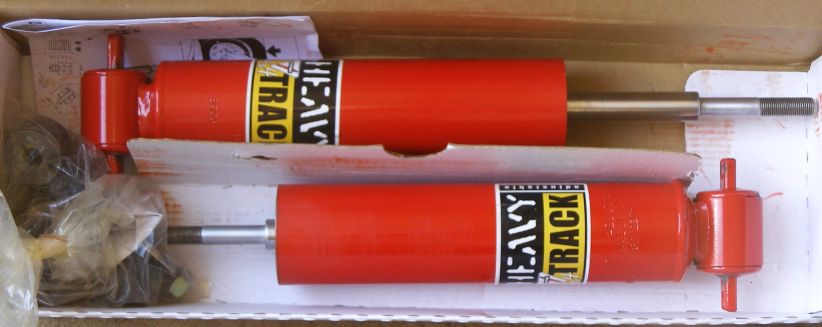
Konis arrive. With the front shocks absolutely shot, I got onto the Koni importers and they found some Chev pickup shocks which I could make fit.
Replacing the shocks certainly gave me some work to do. With Konis it’s vital that they never bottom out as the adjuster nut will strike the foot valve and damage it. These were about a quarter of an inch longer fully closed than the originals so I’d be making spacers to ensure they didn’t get damaged.
My next job was on the Sunshine Coast, which enabled me visit Max and Christine and to drop off some tools that my stepson, Reilly, had arranged for me to get him from Aldi. He was living way up North and too far from any Aldi store to get them himself. I dropped them off at his older brother’s place on the way through, which is how I came to be in a position to get this shot of the Glasshouse Mountains:
Glasshouse Mountains. Captain James Cook named these when he mapped the East Coast of Australia in 1770.
They are long-extinct volcanoes about 40 miles North of Brisbane. It wasn’t far from there to the Sunshine Coast – where I once again took no pics. Back at home Sandra had taken a liking to a family of magpies and kept on supplementing their normal diet.
Magpie with a mouthful. Several pieces of meat were thrown to this brood each day, all were snapped up quickly.
The parents were concentrating on getting plenty of the food into the beak of the young one:
Feeding the young. Plenty of squarking went on if the parents didn’t feed the little one, which is nearly as big as them anyway.
Happy child. The magpie chick works on getting a piece of meat consumed, wanting to grow big and strong.
For me, however, the aim was to get the Konis ready. Apart from the extra quarter inch of stroke to be catered for, there was a greater distance between the bolts in the lower control arm of the Dodge compared to the Chev. I could have done what others would have done and used washers, but I wanted to do it right, so I checked through my ‘stocks’ in the shed to see if I could find a piece of steel of the right diameter to replace the original T-pieces.
And so I found a Peugeot 504 steering column and the hard part began. I had set up a vise and had some power tools in the garage at the house in Toowoomba and started work. Using the angle grinder, the bench grinder, the drill and files I started making the steering column into T-pieces which would fit the Konis perfectly and the Dodge lower control arms as well.
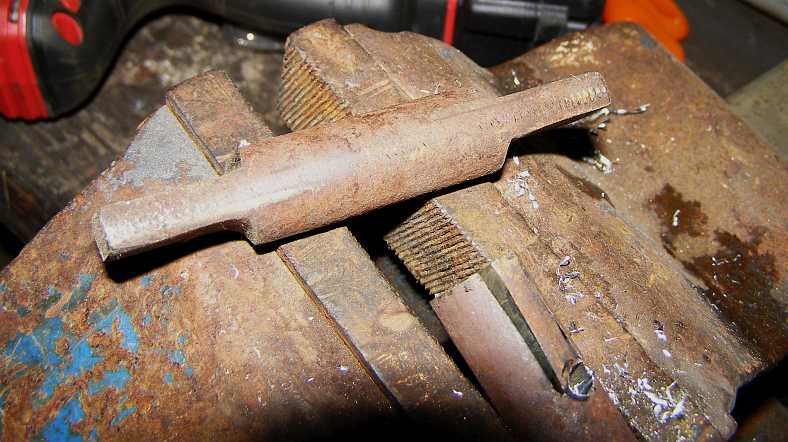
Working on the column. The T-piece is almost completely formed here, while the piece in the vise is becoming the means of getting the T-piece fitted into the rubber bush of the Koni.
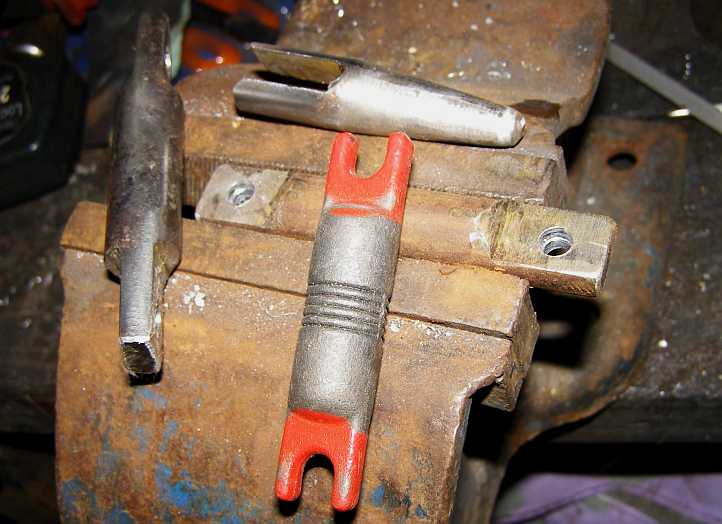
Taking shape. With the original there to show what was needed, the first of the T-pieces is almost finished and the second is taking shape. I drilled the holes rather than simply slotting them.
To put the T-pieces into the rubber bushes, a taper was ground on the end of the piece I’d slotted to fit over the ends of the T-pieces you could call this a fitting tool. I emulated the grooves around the original, which no doubt help prevent the T-piece moving sideways in use, by giving it some light grinds with the cutting wheel of the angle grinder.
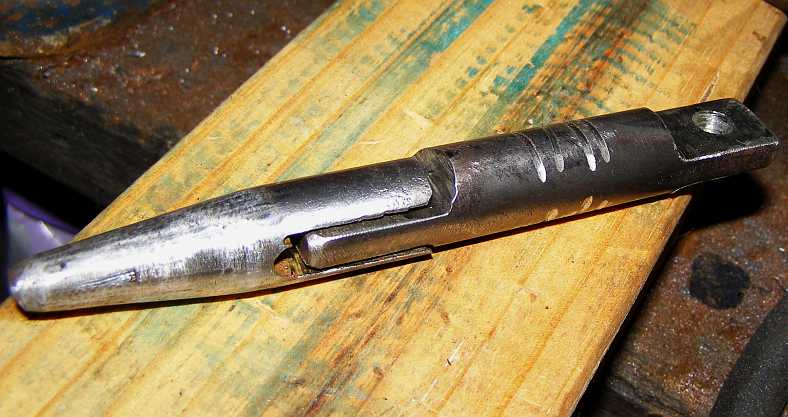
T-piece and taper tool. Fitted together like this it makes it easy to see how the T-piece is slipped into the rubber bush, which is already in the eye at the base of the damper. A little soap makes it even easier.
And so, the finished article:
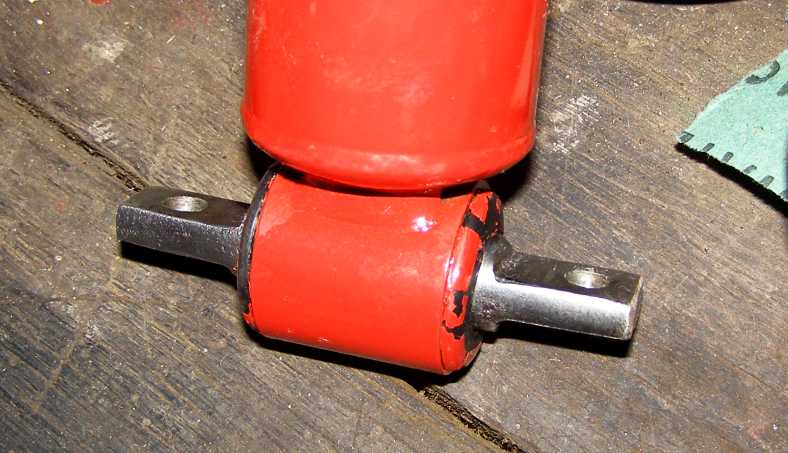
Fitted. And so it went together smoothly, though this was a trial assembly as I wanted to pain the new bits.
And, as if life could get easier somehow, Sandra’s Falcon decided to lose its air conditioning at this point. We checked around and were told of a repairer who was the best in town, I talked to him and he quoted $2,300 to replace the compressor, condenser, drier and some other bits. I asked him about using a second-hand compressor, he wasn’t too pleased with the idea.
I went off to the wreckers and started looking to see if there was a a compressor on the same model which had recently been renewed, finding one which this same repairer had labelled as okay just three months earlier. I bought that for $150 and talked to him about what else I could do to bring the price down. “You take off the bumper and fit the compressor, that will take a lot of time out of my job,” he told me. So I did. The job was now finished, once I replaced the bumper (a terrible job, it surrounds the whole front of the car!) and it had all cost $1,500 or so.
While I was at the wreckers I noticed that a number of cars of that model had separate transmission oil coolers mounted up in front of the radiators. I bought one and fitted it while the bumper was off, but didn’t connect the lines at that time.
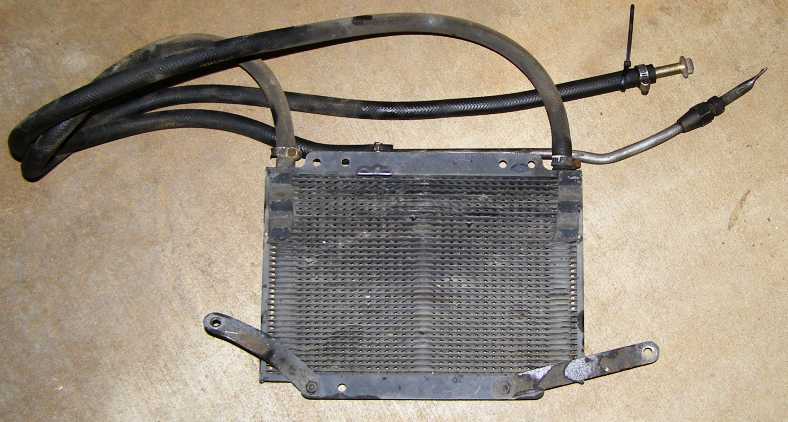
Falcon transmission oil cooler. Fitted up while it was easy to get to, this would not be plumbed in until I had a need to work in that area again.
Back to the Koni fitment, the spacers I needed to go between the lower control arms and the T-pieces were another job. Easy enough cutting up a piece of quarter-inch bar, but I realised that an individual spacer could easily get lost. I roughly curved up some pieces of 3/16” rod and welded them to the spacers so they were in pairs.
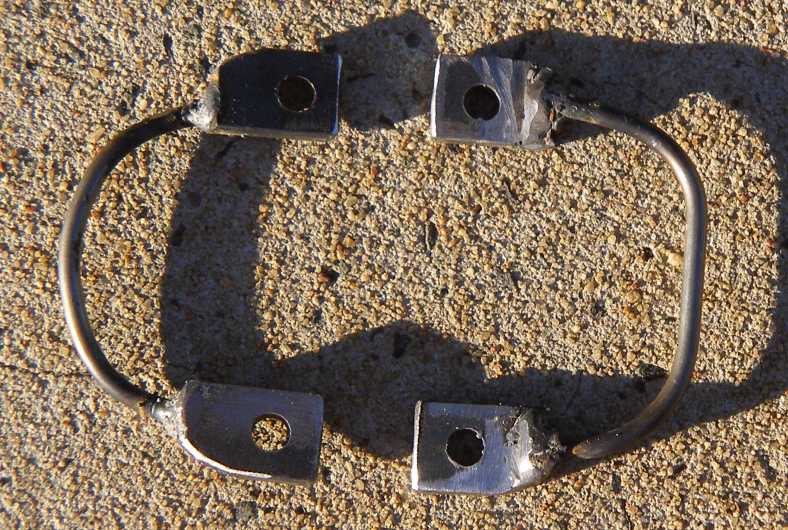
Spacers. I made these up in pairs so they wouldn’t get lost, they gave the necessary extra room for the damper to travel.
While I was haunting wreckers I kept an eye out for that flywheel and pressure plate Bob Britton was needing for his latest Commodore V6-powered car. And I found one for him, which had him delighted.
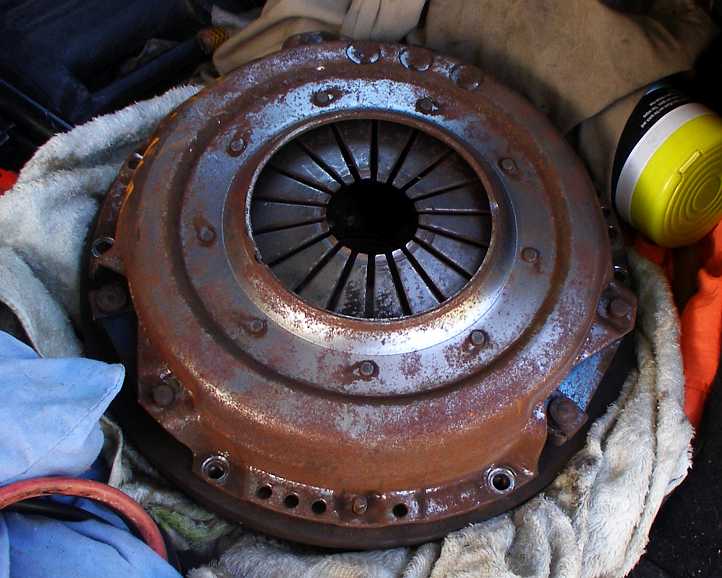
Flywheel and clutch. Hard to get because there are so many automatics sold and people changing to manual transmissions generally get the clutch and flywheel when they buy the gearbox.
The price was okay, too, but Bob was in Sydney and I was in Toowoomba and unlikely to go that way for a while. Eventually I got it as far as Tamworth to Bob Abberfield’s place and then Marc Schagen, who drives his truck all over New South Wales, took it from there. As it turned out, it wasn’t quite the right flywheel, but Bob and Ray Eldershaw looked at it and realised it only needed ten minutes of machining on the lathe to get the needed clearance.
Mind you, while I had it in my possession it caused me some grief:
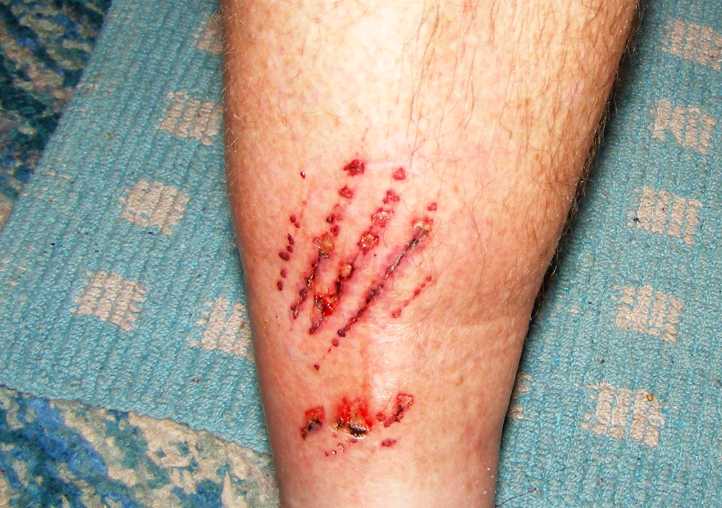
Ouch! The flywheel slipped off the end of the bench and caught my leg on its way to the floor. Mind you, it could have been worse.
So the front shocks were completed, I’d painted all the bits and strung them up in the sun on a bit of wire to dry, which took a couple of days, then it was time to photograph them as a ‘job done’:
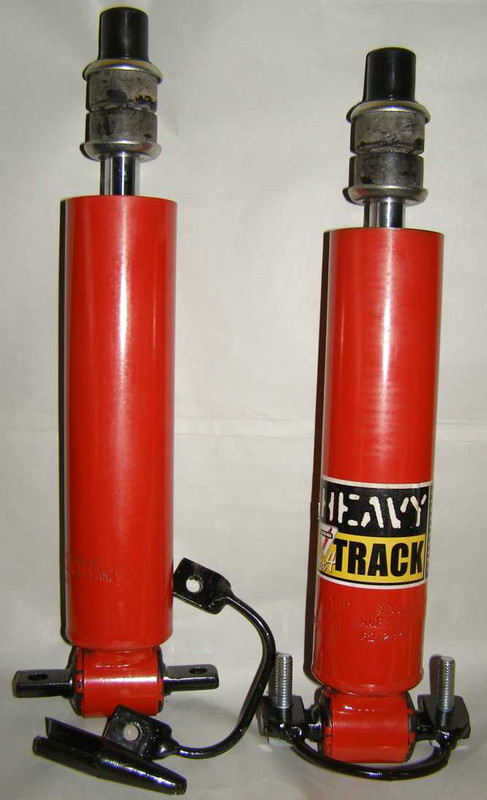
Shocks completed. Ready for installation, new parts all painted. I’d also bought new bolts to attach them to the lower control arms.
So further progress was made towards getting the van ready for the big trip. I still didn’t know how far I’d be going, but I wanted to be ready for anything. And Sandra was happy to once again have air conditioning in her Falcon. It was now mid-February, 2019.
And then we learned that the new owner of the house we were renting had lost his job and wanted us to move out so he could move in. He’d give us until the lease ended in August if he had to, but if we moved out early he’d appreciate it, so we also started (slowly) house-hunting...
I had prepared a lot of things for the changeover on the Friday on the way down as well as making up a cradle to mount on my floor jack:
Gearbox cradle. With two gearboxes to change, I decided to make up this cradle to assist me do them on my own. This is on the Forester a few weeks later, but the same applied on the van.
To gain height I stacked short pieces of timber into the cradle underneath the gearbox’s case. The A833 overdrive unit…
A833 overdrive. Even thought it’s got an alloy main case, the gearbox is still weighty.
…weighs over 140lbs so that’s too much for me to lift by myself under the vehicle. And to juggle while lining up the clutch and getting a bolt or two into the bellhousing.
The actual job took me seven hours. I was able to take it for a run to see how it was and it was very good, quiet in all gears and just what I was looking for. Then I went home in the Forester, which would the following weekend see duty with two assignments, one in Wondai and the other in Kingaroy, Wondai being about 120 miles from Toowooomba:
It was a day and a half out in the scrub, basically, only the last two interviews being in town. I was running around on gravel roads out there and a bit surprised to see a bitumen track alongside the road:
Rail Trail. While I was driving on roads like this, alongside me was a walking/cycling trail which followed the line of a disused railway line.
A development for the tourists and the ones seeking a health kick, the trail actually stretches from Kingaroy to Kilkivan, a distance of 89kms, about 55 miles:
Obviously the railway has to wind around a lot more in the hilly country, but this would also mean that there’d be no steep hills to traverse. But there were some rules, too:
Lots of rules. Some general, some aimed at city folk who might not understand the bush, these rules were posted at various points along the trail.
And there was some country to see out there, too, nice and green and hillside homes got good views over a broad area.
Farmhouse view. An expansive view was to be had from some of the homes I visited in the Wondai area.
And I found some places which have done their dash, too:
Old house. Usually a place like this is replaced with a new home on the property and becomes a storage shed. While it remains upright.
On a lean. This view from down the road just a little shows that its days will soon be numbered.
The Kingaroy job, which I tackled Sunday and Monday morning, brought a surprise. One woman I interviewed told me her husband was an avid collector of old motorcycles. And that he was out in his shed playing with them while I was there. After completing the interview I went to the shed.
Some of the bikes were pre-World War 1 models and one was an Australian bike made in Adelaide in 1913. The brand name of that one was ‘Swastika’, clearly from before that name had any negative connotations. In fact, it reminded me of seeing a swastika on a drag car pictured on the cover of Hot Rod Magazine back in the early sixties, with the explanation in the magazine being that the swastika was always a sort of good luck charm.
The Sunday night I had arranged to stay with Glendon and Linda Perkins, Glendon being a Mopar tragic with a whole shed full of Forward Look cars and a couple of hot-rods. I’d never seen his cars before, so it was a very interesting visit. Another person I visited while in the area was lawrie Poole and his wife Lisa, they being old friends from the Stanthorpe area.
With all of this work happening, and with the prospect of a big trip coming up soon, I decided that the next weekend would be an ideal opportunity for me to take the van to work. A trial run, you might say, for the big trip ahead. I again had a 4-day workload ahead of me and I would be going down into NSW along familiar roads, returning via Tweed Heads to get some new tyres fitted and visiting my nephew, Ben, to see if he could do some fine tuning of the 360.
Driving down on the Friday afternoon I got a progress shot of the new Tabulam bridge, which was making progress after (I’m told) the contractors had got into some financial trouble…
Slow progress. Watching this bridge go up had been slow, but now progress was being made and visible. This view is looking West rather than the Easterly view of the previous picture.
The assignment locations were right in urban Lismore…
Lismore streets. This quiet area of Lismore (from Google Earth Street View) kept me going Friday afternoon and Saturday, with the meeting of an old bloke who used to hill-climb an Austin Healey being a highlight for me.
… and in very rural Myocum, a bit closer to the coast:
Myocum outlook. Another Google Earth view as I took no pics myself. This part of the country is simply dotted with views like this.
I managed to prove to myself that I needed that Power-Lok in the rear end while on the Myocum job. Driving down a steep farm driveway, the kind where your wheels are at the point of locking up on the loose stony surface, I reached a gate. It was closed, there was no house there and I needed to turn around to get out again.
Foolishly I tried to turn within the confines of the track and got the van into a position where a rear wheel was off the ground. I struggled for some time with this, maybe half an hour, jacking it up higher and piling rocks underneath the tyres to give me some traction. Eventually I made it, then I opened the gate, went in and did a U-turn in the flat paddock beyond, then drove on to the next farm.
Another high point for the weekend was when a lady took a particular interest in the van and wanted me to accelerate past her place, changing up a gear as I went. Of course, I obliged.
With the work done I went to Roadrunner Tyres at Tweed and did a deal on some new rubber, then round to Ben’s where we again came to the conclusion that the timing is just too hard to check with a timing light on this model. I drove home to Toowoomba.
Konis arrive. With the front shocks absolutely shot, I got onto the Koni importers and they found some Chev pickup shocks which I could make fit.
Replacing the shocks certainly gave me some work to do. With Konis it’s vital that they never bottom out as the adjuster nut will strike the foot valve and damage it. These were about a quarter of an inch longer fully closed than the originals so I’d be making spacers to ensure they didn’t get damaged.
My next job was on the Sunshine Coast, which enabled me visit Max and Christine and to drop off some tools that my stepson, Reilly, had arranged for me to get him from Aldi. He was living way up North and too far from any Aldi store to get them himself. I dropped them off at his older brother’s place on the way through, which is how I came to be in a position to get this shot of the Glasshouse Mountains:
Glasshouse Mountains. Captain James Cook named these when he mapped the East Coast of Australia in 1770.
They are long-extinct volcanoes about 40 miles North of Brisbane. It wasn’t far from there to the Sunshine Coast – where I once again took no pics. Back at home Sandra had taken a liking to a family of magpies and kept on supplementing their normal diet.
Magpie with a mouthful. Several pieces of meat were thrown to this brood each day, all were snapped up quickly.
The parents were concentrating on getting plenty of the food into the beak of the young one:
Feeding the young. Plenty of squarking went on if the parents didn’t feed the little one, which is nearly as big as them anyway.
Happy child. The magpie chick works on getting a piece of meat consumed, wanting to grow big and strong.
For me, however, the aim was to get the Konis ready. Apart from the extra quarter inch of stroke to be catered for, there was a greater distance between the bolts in the lower control arm of the Dodge compared to the Chev. I could have done what others would have done and used washers, but I wanted to do it right, so I checked through my ‘stocks’ in the shed to see if I could find a piece of steel of the right diameter to replace the original T-pieces.
And so I found a Peugeot 504 steering column and the hard part began. I had set up a vise and had some power tools in the garage at the house in Toowoomba and started work. Using the angle grinder, the bench grinder, the drill and files I started making the steering column into T-pieces which would fit the Konis perfectly and the Dodge lower control arms as well.
Working on the column. The T-piece is almost completely formed here, while the piece in the vise is becoming the means of getting the T-piece fitted into the rubber bush of the Koni.
Taking shape. With the original there to show what was needed, the first of the T-pieces is almost finished and the second is taking shape. I drilled the holes rather than simply slotting them.
To put the T-pieces into the rubber bushes, a taper was ground on the end of the piece I’d slotted to fit over the ends of the T-pieces you could call this a fitting tool. I emulated the grooves around the original, which no doubt help prevent the T-piece moving sideways in use, by giving it some light grinds with the cutting wheel of the angle grinder.
T-piece and taper tool. Fitted together like this it makes it easy to see how the T-piece is slipped into the rubber bush, which is already in the eye at the base of the damper. A little soap makes it even easier.
And so, the finished article:
Fitted. And so it went together smoothly, though this was a trial assembly as I wanted to pain the new bits.
And, as if life could get easier somehow, Sandra’s Falcon decided to lose its air conditioning at this point. We checked around and were told of a repairer who was the best in town, I talked to him and he quoted $2,300 to replace the compressor, condenser, drier and some other bits. I asked him about using a second-hand compressor, he wasn’t too pleased with the idea.
I went off to the wreckers and started looking to see if there was a a compressor on the same model which had recently been renewed, finding one which this same repairer had labelled as okay just three months earlier. I bought that for $150 and talked to him about what else I could do to bring the price down. “You take off the bumper and fit the compressor, that will take a lot of time out of my job,” he told me. So I did. The job was now finished, once I replaced the bumper (a terrible job, it surrounds the whole front of the car!) and it had all cost $1,500 or so.
While I was at the wreckers I noticed that a number of cars of that model had separate transmission oil coolers mounted up in front of the radiators. I bought one and fitted it while the bumper was off, but didn’t connect the lines at that time.
Falcon transmission oil cooler. Fitted up while it was easy to get to, this would not be plumbed in until I had a need to work in that area again.
Back to the Koni fitment, the spacers I needed to go between the lower control arms and the T-pieces were another job. Easy enough cutting up a piece of quarter-inch bar, but I realised that an individual spacer could easily get lost. I roughly curved up some pieces of 3/16” rod and welded them to the spacers so they were in pairs.
Spacers. I made these up in pairs so they wouldn’t get lost, they gave the necessary extra room for the damper to travel.
While I was haunting wreckers I kept an eye out for that flywheel and pressure plate Bob Britton was needing for his latest Commodore V6-powered car. And I found one for him, which had him delighted.
Flywheel and clutch. Hard to get because there are so many automatics sold and people changing to manual transmissions generally get the clutch and flywheel when they buy the gearbox.
The price was okay, too, but Bob was in Sydney and I was in Toowoomba and unlikely to go that way for a while. Eventually I got it as far as Tamworth to Bob Abberfield’s place and then Marc Schagen, who drives his truck all over New South Wales, took it from there. As it turned out, it wasn’t quite the right flywheel, but Bob and Ray Eldershaw looked at it and realised it only needed ten minutes of machining on the lathe to get the needed clearance.
Mind you, while I had it in my possession it caused me some grief:
Ouch! The flywheel slipped off the end of the bench and caught my leg on its way to the floor. Mind you, it could have been worse.
So the front shocks were completed, I’d painted all the bits and strung them up in the sun on a bit of wire to dry, which took a couple of days, then it was time to photograph them as a ‘job done’:
Shocks completed. Ready for installation, new parts all painted. I’d also bought new bolts to attach them to the lower control arms.
So further progress was made towards getting the van ready for the big trip. I still didn’t know how far I’d be going, but I wanted to be ready for anything. And Sandra was happy to once again have air conditioning in her Falcon. It was now mid-February, 2019.
And then we learned that the new owner of the house we were renting had lost his job and wanted us to move out so he could move in. He’d give us until the lease ended in August if he had to, but if we moved out early he’d appreciate it, so we also started (slowly) house-hunting...
Thread Starter
|
Captain
Joined: Oct 2005
Posts: 570
Likes: 8
From: The Summit, Queensland, Australia
At first we didn’t put much effort into house-hunting. Sandra’s daughter was keeping an eye on advertising for likely places, but we did have plenty of time if we needed it. I was involved in further sorting of the stuff from the house I’d been in, also taking lots of things no longer required to the tip, which was a bit awkward as it wasn’t open very often when I was in the area.
The next work area to come up was a place called Sladevale, which was right near Warwick and an area I’d covered before when I’d been doing the Drug Survey five years earlier. So I met up with some people I’d met then during that weekend. It was also an area which showed the devastation of the drought we were suffering:
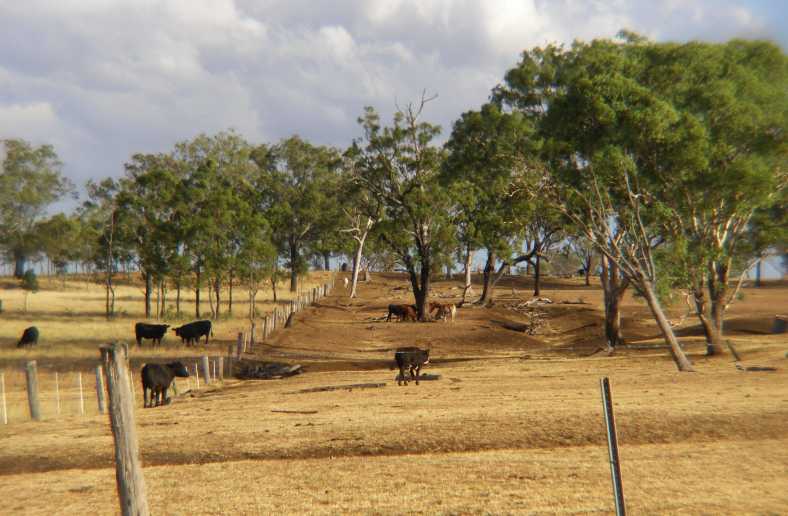
Sladevale drought. Cattle struggling to find feed as the second Summer of the drought bit hard.
The next weekend I was to do two areas, Sandra agreeing with me that I should take any extra work available because it wouldn’t always be there. Milmerran and Nanango were the areas involved:
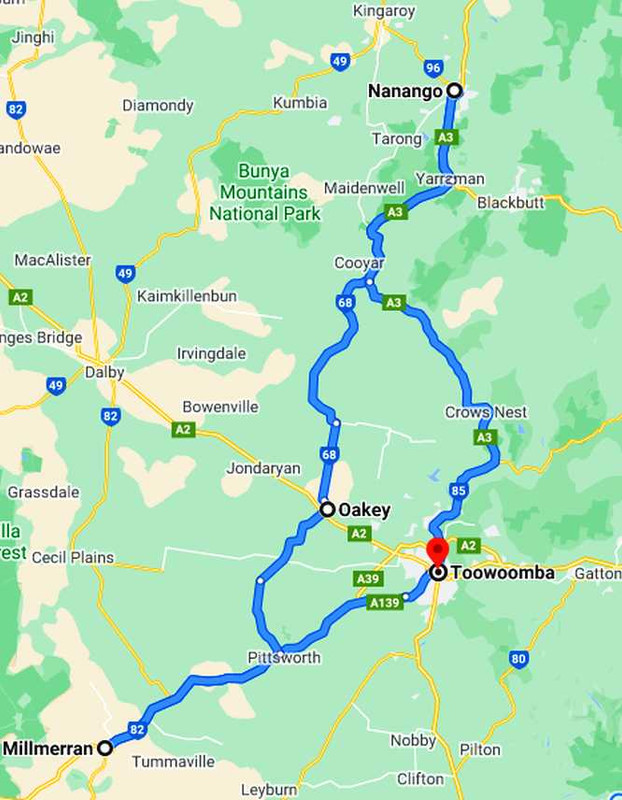
It was hot and dry in Milmerran, while just out of town the locals were up in arms about the plans to put a railway across the flood plain…
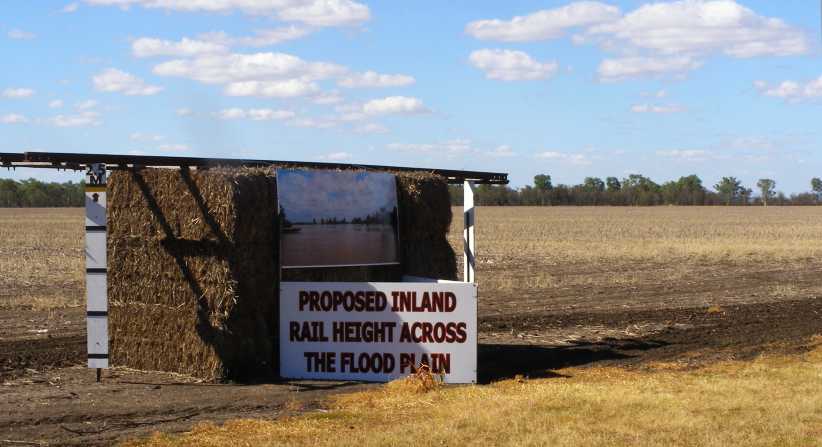
Rail protest. The people of this area are very concerned about the potential for flooding if the railway is built along this line.
…and had suggestions about other paths it could take. This is a new inter-city freight link from Brisbane to Melbourne, with connections to be made half-way across New South Wales at Parkes, where the freight is railed in huge quantities from ships unloading at Darwin and is redistributed in three directions – Sydney, Melbourne and Brisbane, with much of it now carried on trucks.
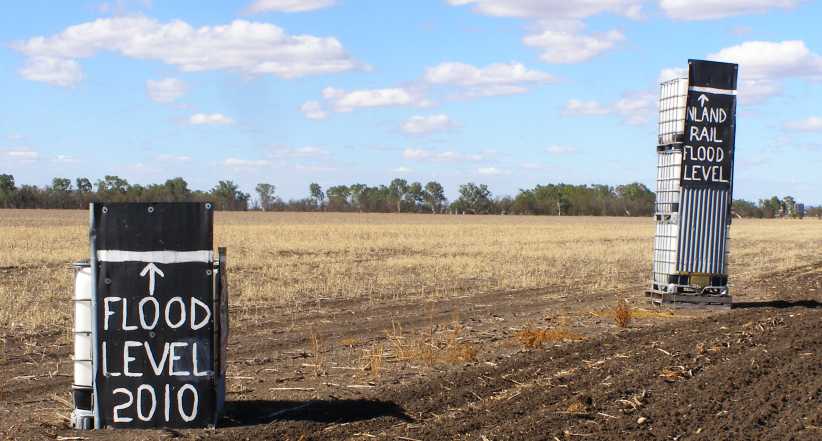
Flood level. This is their contention, that flood levels will increase enormously when heavy rains come. They’ve gone to a lot of trouble to graphically illustrate their point.
Driving to Nanango on Saturday night was fraught with danger, of course. Kangaroos love these roads and it was a matter of keeping the eyes peeled all the way. Getting a feed along the way was difficult too, but I managed and settled in to a day and a half of work in that area.
It was another doubled-up weekend which followed, Goonellabah and Casino this time, and it was all proving a bit much. With very little time between weekends to get other jobs done, I made the decision that the second-job weekends would only be every second weekend. Jobs like…
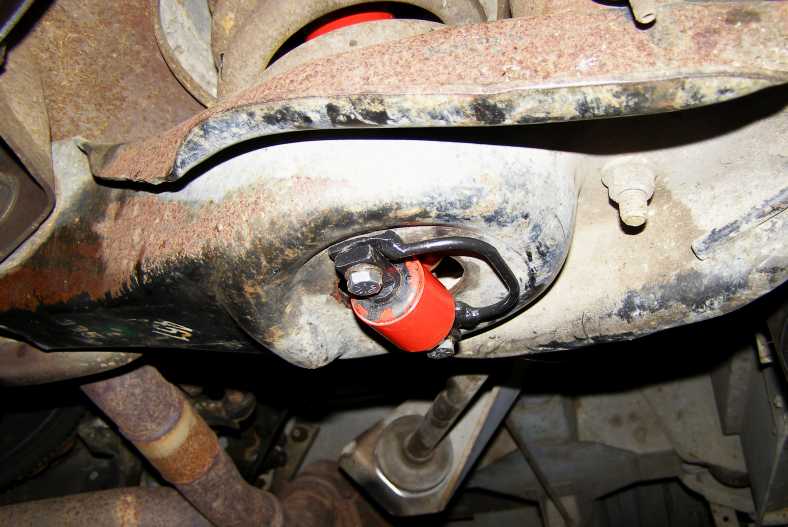
Konis fitted. Fitting the Konis didn’t take a lot of time, but having had to modify the mounts and make up the spacers had made it a fair job. The purpose of the loop joining the spacers is clear in this picture.
I noticed something different in Lismore. Which was between Goonellabah and Casino and is where I stayed for the weekend. This old Austin-based semi-trailer pie ‘cart’ must do a good trade. In fact, I should check them out some time and see if their pies are any good.
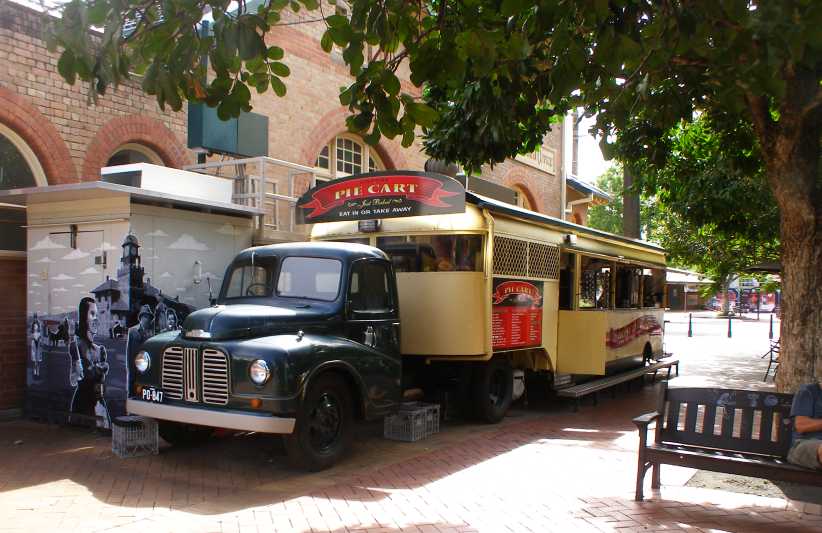
Pie cart. Meat pies are popular lunch-time fare in Australia and this retailer might have a good hold on the local market in Lismore.
During the next week I took the van for an outing. Driving down in the direction of Brisbane I was a bit surprised to see this sight:
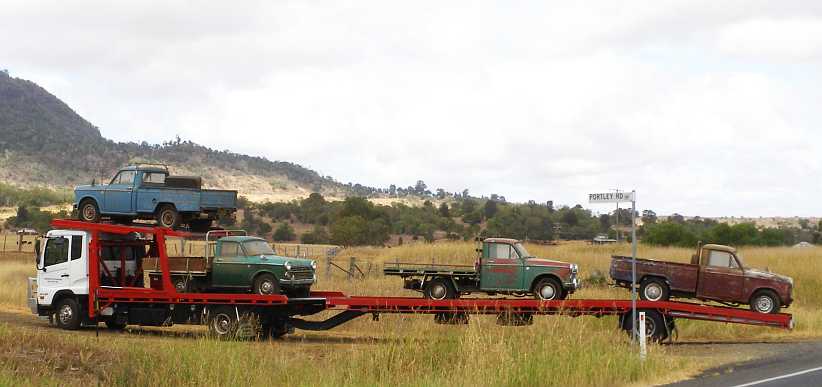
Datsun utes. Nissan had a good market for their various Datsun models in Australia from the early sixties. These utilities (our name for ‘pickups’) are from the mid to late-sixties, powered by 1300 or 1500cc pushrod engines.
My surprise was that someone would be so keen to collect them, but I have to say it’s a good-looking collection.
I was heading towards Brisbane because Sandra’s mother was moving in with us. This had been Sandra’s heartfelt desire for a long time and I supported her wishes. Dulcie was now almost 91 and Sandra was determined that she would take care of her in her final months or years.
We loaded her goods and chattels into the van and transported them home, but it was truly heart-rending when, two days later, Dulcie said she couldn’t stay and other family members arranged to take her back to live with her youngest son again. The devastation of Sandra’s feelings was very real and there was nothing which would console her.
Worse was the fact that it was our third anniversary, so I delayed my departure to spend the time with her. I was working in Tamworth the next weekend, which meant another weekend staying with Bob and Elaine. This little bloke seemed to have flown into a window of my car or something, I picked it up from the ground beside the car on Saturday morning:
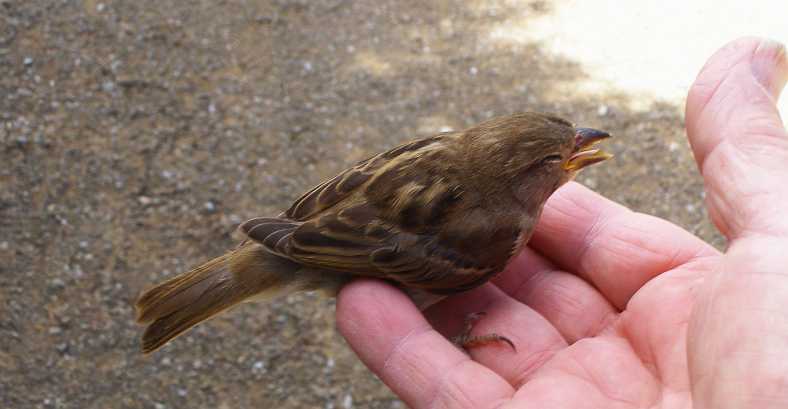
Bird in the hand. No gilded cage for this bird, but after a little time to recuperate it flew away.
After returning to the shed on Monday I was expecting to take the engine and transmission from the green Forester. But I wanted to drain the oil from the gearbox first and found it required a huge Torx socket to undo it, unlike the gearbox which was going in, it had a simple hex-headed plug.
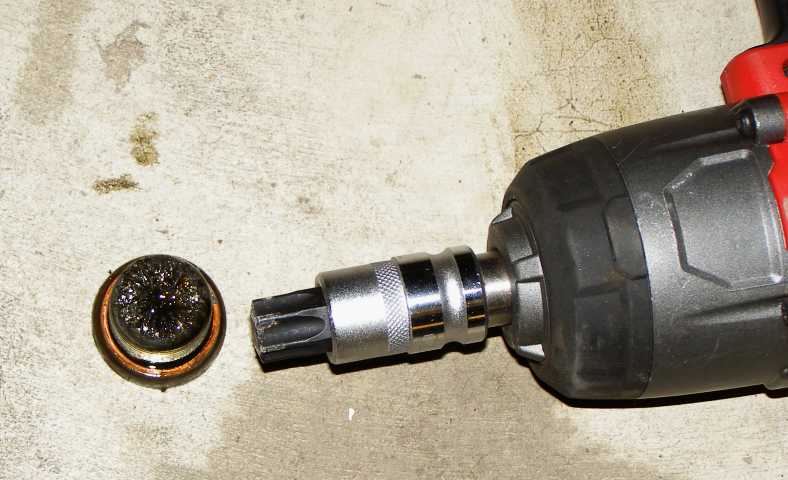
Torx socket. Nobody had one in stock when I went seeking one out, but I found a place which could order on in quickly. There’s plenty of metallic ‘fur’ on the magnetic plug, too.
So this was a job for the next week now, and I ripped it apart on the Friday before heading to Grafton, where I had two areas to cover again. The clutch plate was down to the rivets…
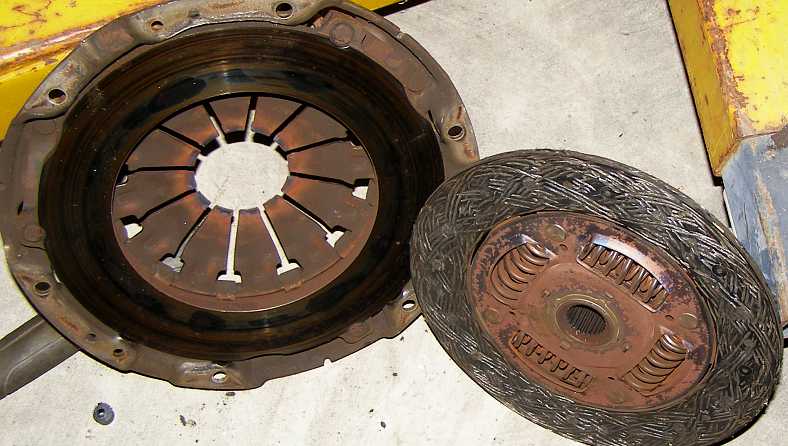
Worn clutch. This was all throwaway stuff as I had the clutch Jim Berry had built and the matching Liberty (Legacy) flywheel to go with it.
…so the efforts of Jim Berry to give me a better unit would soon be appreciated.
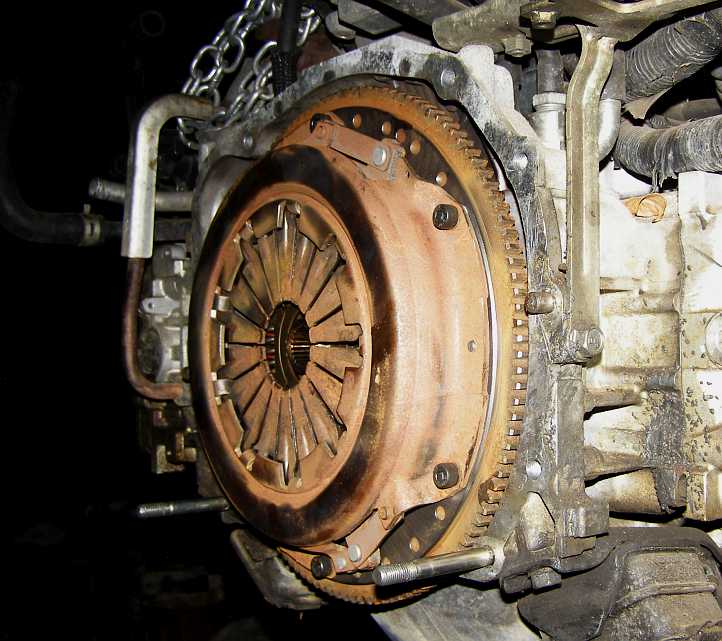
New clutch and flywheel. I cleaned the surface rust off the flywheel and pressure plate face and bolted it all together ready for hundreds of thousands of kilometres in front of the new gearbox.
I wanted everything to be in readiness for a day the following week to be devoted to the installation. I had a lot of reservations about it as there are three driveshafts to be removed and replaced in the transmission during the change operation, I reckoned I could do it if I swung one of the front struts out to give me some ‘wriggle room’ with the front driveshafts.
Soon enough the old box was out:
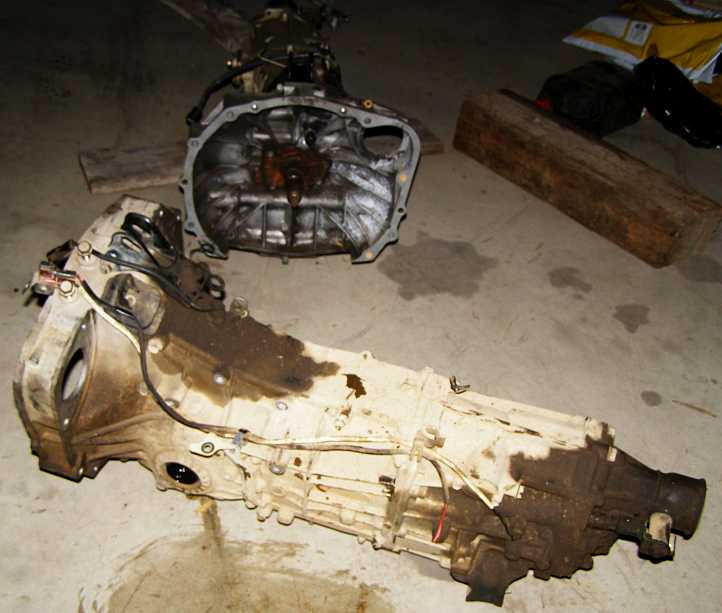
For replacement. The old and the new. The replacement came from the white car I’d bought as a wreck over a year earlier.
And that left a gaping hole in there with a lot of bits intruding:
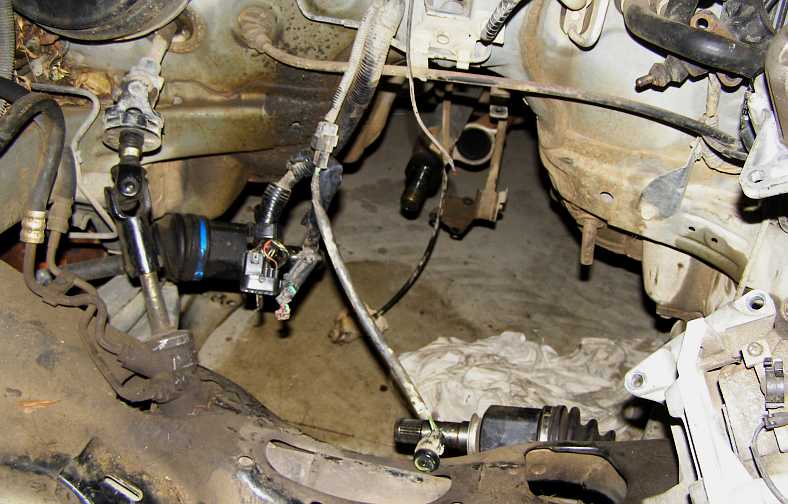
Empty space. With the gearbox and its two crossmembers removed, there’s still the driveshafts (the right hand one being pulled away as the strut is swung out from the body), various wiring looms, the gearchange and low-range cable intruding into it.
I got all of that done before dark and the next morning I was off early for the drive to Grafton. Even in the inclement weather – with fog – I still stopped in at the Raspberry lookout for a cup of coffee. The view, however, was not up to the usual standard:
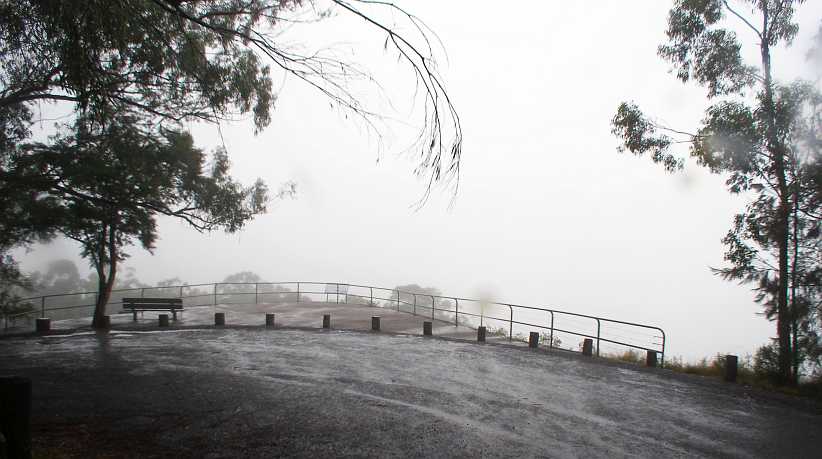
Foggy Raspberry. Not much of a view, but still a nice spot to stop for a break in the drive.
A further 60 or 70 miles along I came upon a crash scene. I’d say it was from the previous evening or afternoon as it was still early when I got there…
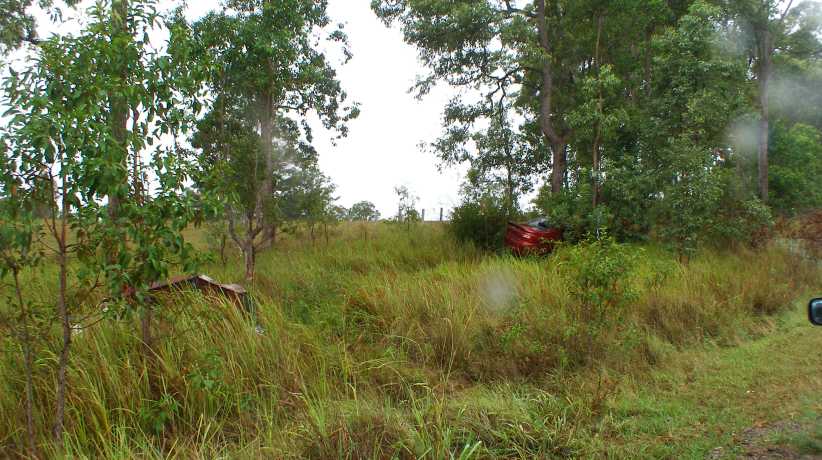
Crash with trailer. It’s a simple climbing right-hand bend, perhaps the trailer got out of control? Anyway, they were separated and the car was buried in the trees.
…and there was no real evidence that anyone had been hurt. And so I continued to Grafton, naturally enough logging progress on the new bridge there…
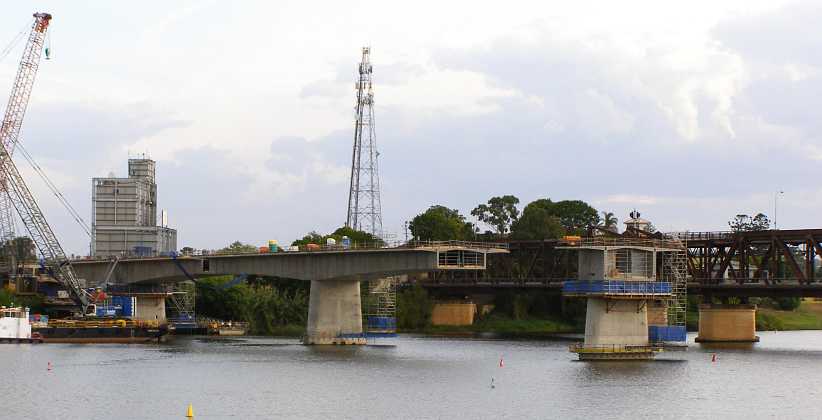
Bridge progress. The bridge was now taking shape with two spans almost completed. The final pylon was also progressing well (out of frame)
…and working a solid three days. Then I drove home and planned out my next week, which would include installing the gearbox and the engine in the green Forester. I decided to head down to the shed on the Thursday just to be sure I’d get it done, which proved to be a wise move.
It was raining outside, which can’t be bad when you’re in a drought-stricken area, but under that big roof I struggled to make sure I’d have it finished before I headed off to work for the weekend. Thursday evening saw the box lowered into place…
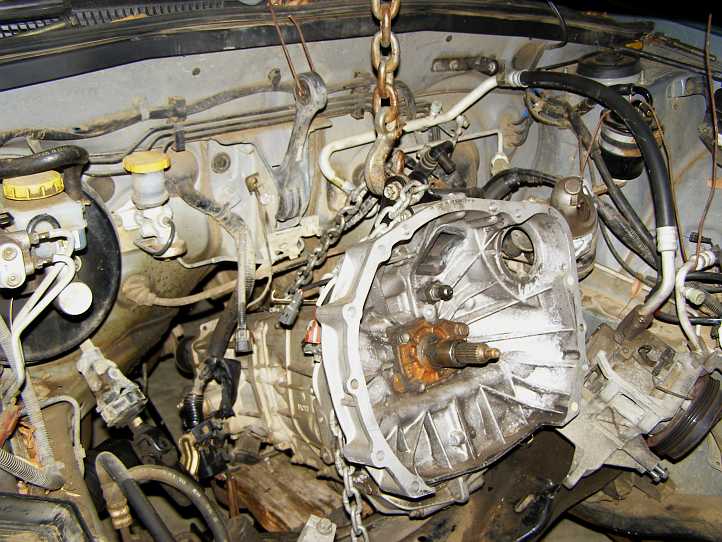
Craned in. My engine hoist does its stuff here as the gearbox is lowered into its space.
…and those crossmembers replaced under it as the gearbox ‘cradle’ on the floor jack holds it in place. Of course, the driveshafts were all guided into their place as I juggled it in. I’d also had to fiddle to get the electronic speedometer drive right along the way as the original had managed to get broken.
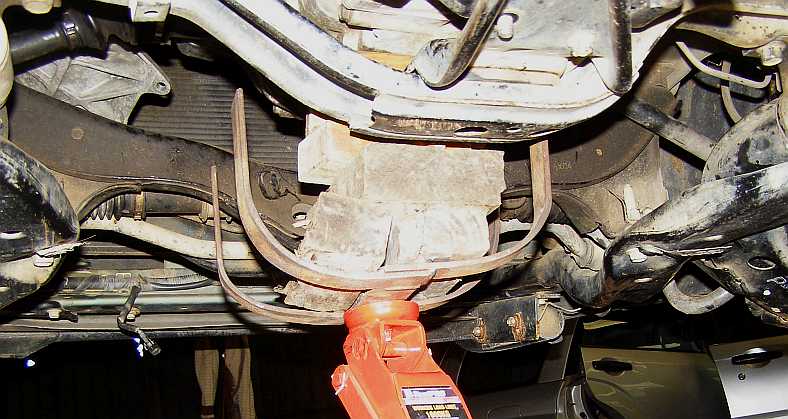
Box lined up. The jack and cradle support the box, the crossmembers are being bolted up after all the driveshafts were threaded into their appropriate places and the gearshift linkages were bolted up.
On Friday I continued the job and in due course I was able to pronounce the gearbox was in and it was time to line up the engine and lower it into place. My support jig held the front of the gearbox up at the right height for the mating, and no, I didn’t forget the clutch fork and throwout:
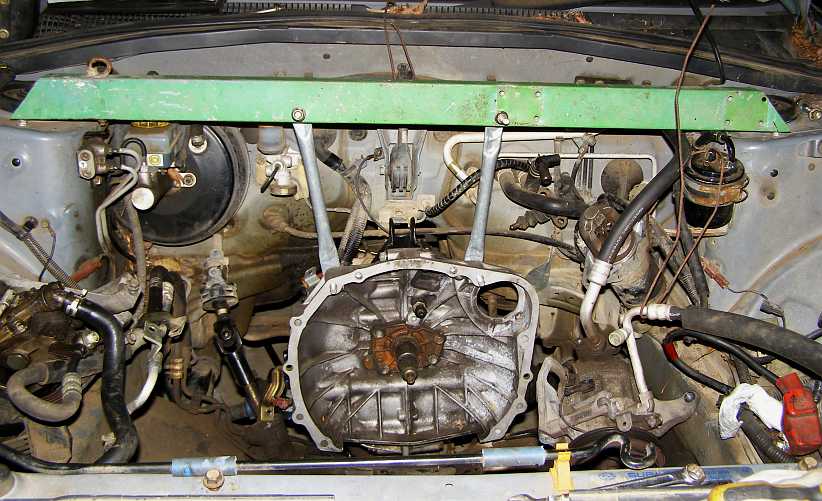
Front supported. Again I was able to put the ‘scrap metal’ gearbox supports to use as the time came to instal the engine.
While it was the first time I’d installed a gearbox in a Forester, it was the third time I’d done an engine and that went fairly smoothly. The job was completed on the Friday afternoon.
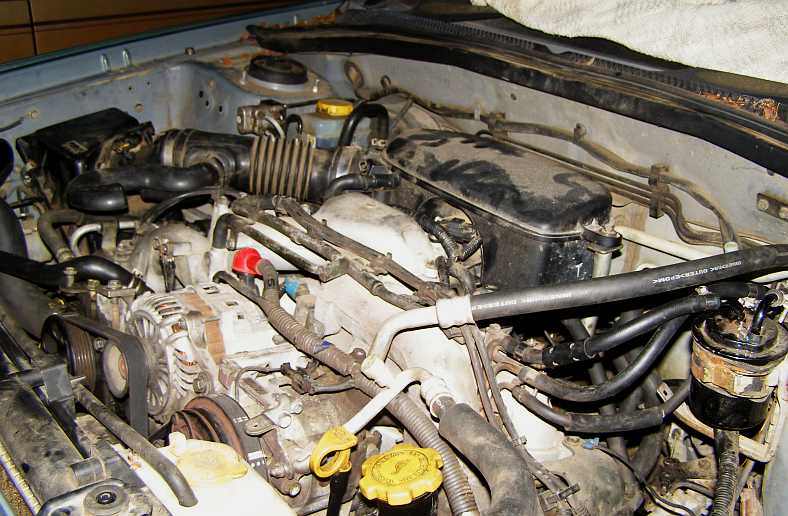
Engine in. The engine certainly fills the hole! All bolted up and ready to go, I was looking forward to quiet gear operation in this one as well.
I got a real surprise when I’d received my work for the weekend this preceded. Torrington, a little town out in the scrub in Northern New South Wales:
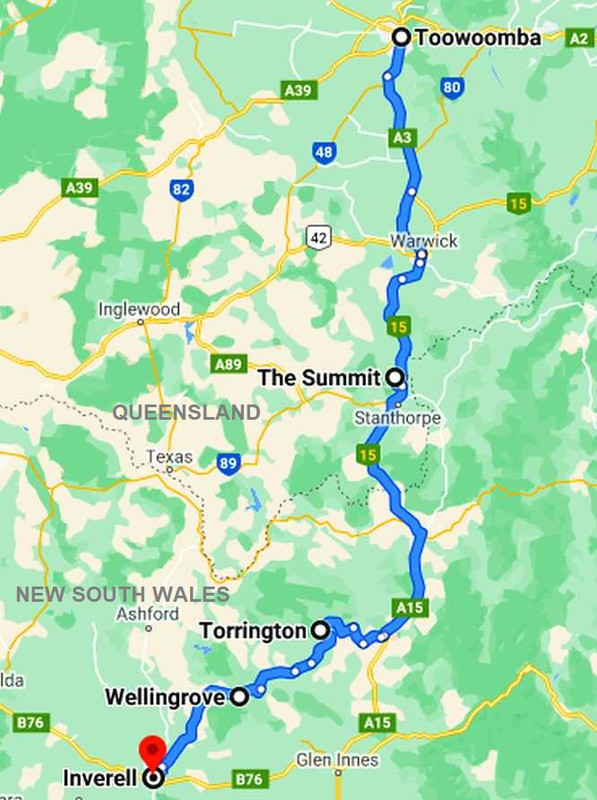
I’d worked there before. Three times. Surely there was nobody in that place I hadn’t called on at some time, I thought?
To top it off, the whole area had been subjected to bushfires in the week or two before I went there, which is why I was able to take these photos:
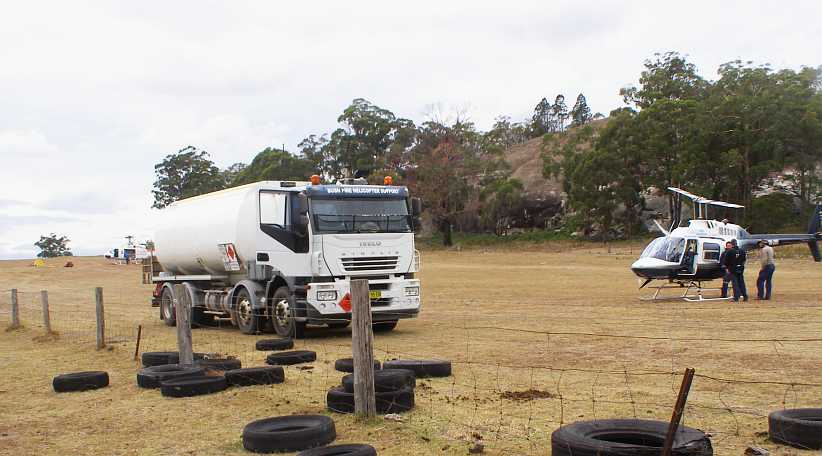
Helicopters. It was almost like an airport at the back of the town. Helicopters had played an important role in beating back the bushfires.
All seemed quiet with them now, they were no doubt on standby in case there was a flare-up requiring their attention.
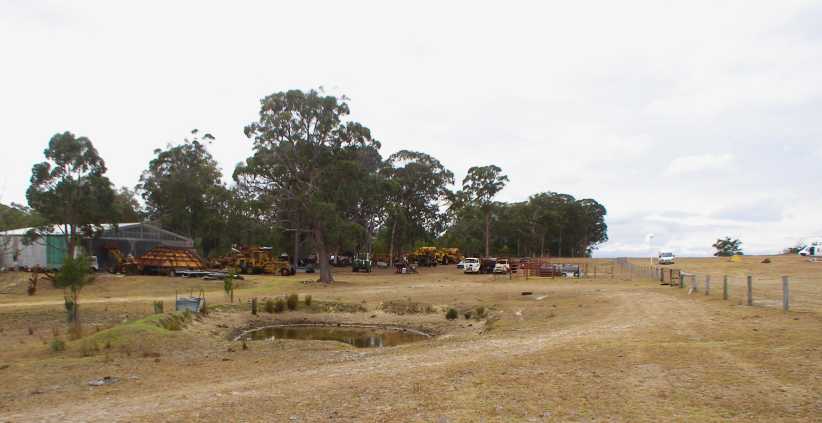
Shed and machinery. The helicopters were based near a huge machinery shed, the low level of the dam in the foreground again indicates the level of drought.
Accommodation was quite a distance away at Inverell. As I drove in that direction I couldn’t help but notice this Holden Commodore:
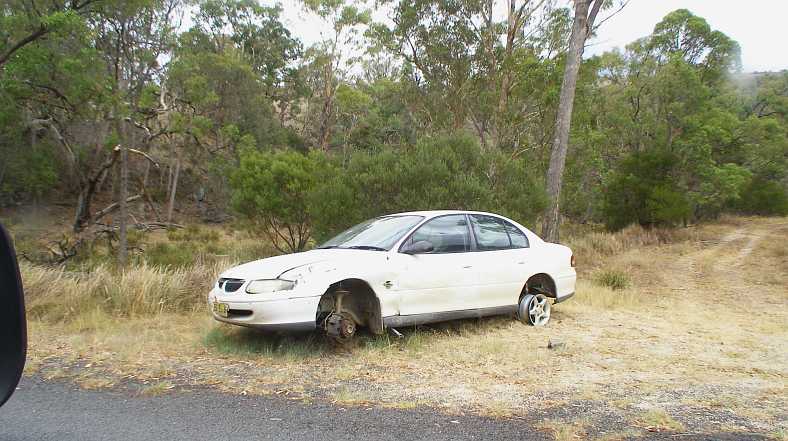
Dumped Holden. With a flimsy jack supporting one side of the car, this Holden was no longer of much value, apparently.
The road also had cattle grazing alongside it. This grazing method is known as using the ‘long paddock’ by stockmen and farmers. Roadside grasses can be a valuable asset in times of drought.
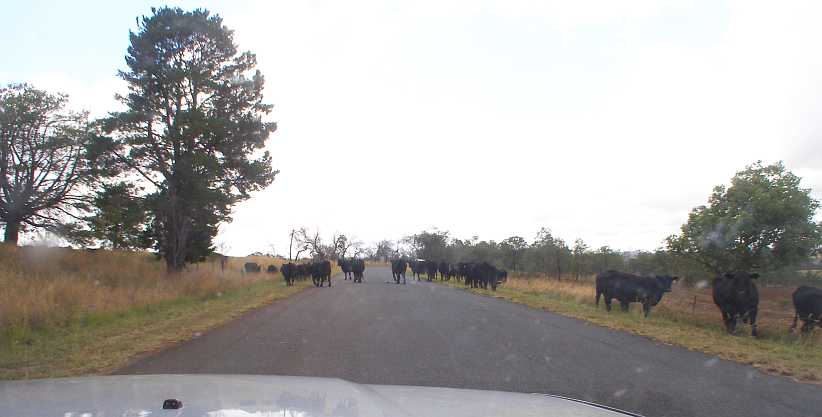
The’Long Paddock’. Cattle on the road, farmers making the most of grass often much longer and much greener than is on their properties.
The road to my accommodation at Inverell winds its way through some rough country and it was getting a bit late by the time I got there. Looking quickly around for somewhere to get some takeaway food I found Hucker’s Tucker:
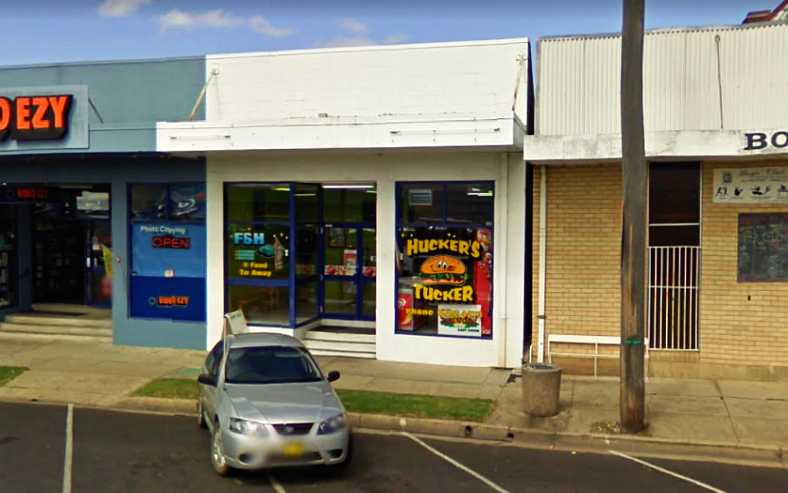
Hucker’s Tucker. This was the first time I bought my dinner at this shop, but it wasn’t the last. Good food made as you want it and good value.
And so we reached mid-March. The importance of getting the green Forester on the road was so that I could run up a decent bit of mileage for work using it before the end of the financial year. This was advantageous tax-wise and now I was almost ready to take advantage of that benefit.
I was also keen to get to a ‘family’ meeting on the New South Wales mid-North coast the next weekend and had arranged my work in that area for the purpose…
The next work area to come up was a place called Sladevale, which was right near Warwick and an area I’d covered before when I’d been doing the Drug Survey five years earlier. So I met up with some people I’d met then during that weekend. It was also an area which showed the devastation of the drought we were suffering:
Sladevale drought. Cattle struggling to find feed as the second Summer of the drought bit hard.
The next weekend I was to do two areas, Sandra agreeing with me that I should take any extra work available because it wouldn’t always be there. Milmerran and Nanango were the areas involved:
It was hot and dry in Milmerran, while just out of town the locals were up in arms about the plans to put a railway across the flood plain…
Rail protest. The people of this area are very concerned about the potential for flooding if the railway is built along this line.
…and had suggestions about other paths it could take. This is a new inter-city freight link from Brisbane to Melbourne, with connections to be made half-way across New South Wales at Parkes, where the freight is railed in huge quantities from ships unloading at Darwin and is redistributed in three directions – Sydney, Melbourne and Brisbane, with much of it now carried on trucks.
Flood level. This is their contention, that flood levels will increase enormously when heavy rains come. They’ve gone to a lot of trouble to graphically illustrate their point.
Driving to Nanango on Saturday night was fraught with danger, of course. Kangaroos love these roads and it was a matter of keeping the eyes peeled all the way. Getting a feed along the way was difficult too, but I managed and settled in to a day and a half of work in that area.
It was another doubled-up weekend which followed, Goonellabah and Casino this time, and it was all proving a bit much. With very little time between weekends to get other jobs done, I made the decision that the second-job weekends would only be every second weekend. Jobs like…
Konis fitted. Fitting the Konis didn’t take a lot of time, but having had to modify the mounts and make up the spacers had made it a fair job. The purpose of the loop joining the spacers is clear in this picture.
I noticed something different in Lismore. Which was between Goonellabah and Casino and is where I stayed for the weekend. This old Austin-based semi-trailer pie ‘cart’ must do a good trade. In fact, I should check them out some time and see if their pies are any good.
Pie cart. Meat pies are popular lunch-time fare in Australia and this retailer might have a good hold on the local market in Lismore.
During the next week I took the van for an outing. Driving down in the direction of Brisbane I was a bit surprised to see this sight:
Datsun utes. Nissan had a good market for their various Datsun models in Australia from the early sixties. These utilities (our name for ‘pickups’) are from the mid to late-sixties, powered by 1300 or 1500cc pushrod engines.
My surprise was that someone would be so keen to collect them, but I have to say it’s a good-looking collection.
I was heading towards Brisbane because Sandra’s mother was moving in with us. This had been Sandra’s heartfelt desire for a long time and I supported her wishes. Dulcie was now almost 91 and Sandra was determined that she would take care of her in her final months or years.
We loaded her goods and chattels into the van and transported them home, but it was truly heart-rending when, two days later, Dulcie said she couldn’t stay and other family members arranged to take her back to live with her youngest son again. The devastation of Sandra’s feelings was very real and there was nothing which would console her.
Worse was the fact that it was our third anniversary, so I delayed my departure to spend the time with her. I was working in Tamworth the next weekend, which meant another weekend staying with Bob and Elaine. This little bloke seemed to have flown into a window of my car or something, I picked it up from the ground beside the car on Saturday morning:
Bird in the hand. No gilded cage for this bird, but after a little time to recuperate it flew away.
After returning to the shed on Monday I was expecting to take the engine and transmission from the green Forester. But I wanted to drain the oil from the gearbox first and found it required a huge Torx socket to undo it, unlike the gearbox which was going in, it had a simple hex-headed plug.
Torx socket. Nobody had one in stock when I went seeking one out, but I found a place which could order on in quickly. There’s plenty of metallic ‘fur’ on the magnetic plug, too.
So this was a job for the next week now, and I ripped it apart on the Friday before heading to Grafton, where I had two areas to cover again. The clutch plate was down to the rivets…
Worn clutch. This was all throwaway stuff as I had the clutch Jim Berry had built and the matching Liberty (Legacy) flywheel to go with it.
…so the efforts of Jim Berry to give me a better unit would soon be appreciated.
New clutch and flywheel. I cleaned the surface rust off the flywheel and pressure plate face and bolted it all together ready for hundreds of thousands of kilometres in front of the new gearbox.
I wanted everything to be in readiness for a day the following week to be devoted to the installation. I had a lot of reservations about it as there are three driveshafts to be removed and replaced in the transmission during the change operation, I reckoned I could do it if I swung one of the front struts out to give me some ‘wriggle room’ with the front driveshafts.
Soon enough the old box was out:
For replacement. The old and the new. The replacement came from the white car I’d bought as a wreck over a year earlier.
And that left a gaping hole in there with a lot of bits intruding:
Empty space. With the gearbox and its two crossmembers removed, there’s still the driveshafts (the right hand one being pulled away as the strut is swung out from the body), various wiring looms, the gearchange and low-range cable intruding into it.
I got all of that done before dark and the next morning I was off early for the drive to Grafton. Even in the inclement weather – with fog – I still stopped in at the Raspberry lookout for a cup of coffee. The view, however, was not up to the usual standard:
Foggy Raspberry. Not much of a view, but still a nice spot to stop for a break in the drive.
A further 60 or 70 miles along I came upon a crash scene. I’d say it was from the previous evening or afternoon as it was still early when I got there…
Crash with trailer. It’s a simple climbing right-hand bend, perhaps the trailer got out of control? Anyway, they were separated and the car was buried in the trees.
…and there was no real evidence that anyone had been hurt. And so I continued to Grafton, naturally enough logging progress on the new bridge there…
Bridge progress. The bridge was now taking shape with two spans almost completed. The final pylon was also progressing well (out of frame)
…and working a solid three days. Then I drove home and planned out my next week, which would include installing the gearbox and the engine in the green Forester. I decided to head down to the shed on the Thursday just to be sure I’d get it done, which proved to be a wise move.
It was raining outside, which can’t be bad when you’re in a drought-stricken area, but under that big roof I struggled to make sure I’d have it finished before I headed off to work for the weekend. Thursday evening saw the box lowered into place…
Craned in. My engine hoist does its stuff here as the gearbox is lowered into its space.
…and those crossmembers replaced under it as the gearbox ‘cradle’ on the floor jack holds it in place. Of course, the driveshafts were all guided into their place as I juggled it in. I’d also had to fiddle to get the electronic speedometer drive right along the way as the original had managed to get broken.
Box lined up. The jack and cradle support the box, the crossmembers are being bolted up after all the driveshafts were threaded into their appropriate places and the gearshift linkages were bolted up.
On Friday I continued the job and in due course I was able to pronounce the gearbox was in and it was time to line up the engine and lower it into place. My support jig held the front of the gearbox up at the right height for the mating, and no, I didn’t forget the clutch fork and throwout:
Front supported. Again I was able to put the ‘scrap metal’ gearbox supports to use as the time came to instal the engine.
While it was the first time I’d installed a gearbox in a Forester, it was the third time I’d done an engine and that went fairly smoothly. The job was completed on the Friday afternoon.
Engine in. The engine certainly fills the hole! All bolted up and ready to go, I was looking forward to quiet gear operation in this one as well.
I got a real surprise when I’d received my work for the weekend this preceded. Torrington, a little town out in the scrub in Northern New South Wales:
I’d worked there before. Three times. Surely there was nobody in that place I hadn’t called on at some time, I thought?
To top it off, the whole area had been subjected to bushfires in the week or two before I went there, which is why I was able to take these photos:
Helicopters. It was almost like an airport at the back of the town. Helicopters had played an important role in beating back the bushfires.
All seemed quiet with them now, they were no doubt on standby in case there was a flare-up requiring their attention.
Shed and machinery. The helicopters were based near a huge machinery shed, the low level of the dam in the foreground again indicates the level of drought.
Accommodation was quite a distance away at Inverell. As I drove in that direction I couldn’t help but notice this Holden Commodore:
Dumped Holden. With a flimsy jack supporting one side of the car, this Holden was no longer of much value, apparently.
The road also had cattle grazing alongside it. This grazing method is known as using the ‘long paddock’ by stockmen and farmers. Roadside grasses can be a valuable asset in times of drought.
The’Long Paddock’. Cattle on the road, farmers making the most of grass often much longer and much greener than is on their properties.
The road to my accommodation at Inverell winds its way through some rough country and it was getting a bit late by the time I got there. Looking quickly around for somewhere to get some takeaway food I found Hucker’s Tucker:
Hucker’s Tucker. This was the first time I bought my dinner at this shop, but it wasn’t the last. Good food made as you want it and good value.
And so we reached mid-March. The importance of getting the green Forester on the road was so that I could run up a decent bit of mileage for work using it before the end of the financial year. This was advantageous tax-wise and now I was almost ready to take advantage of that benefit.
I was also keen to get to a ‘family’ meeting on the New South Wales mid-North coast the next weekend and had arranged my work in that area for the purpose…
Thread Starter
|
Captain
Joined: Oct 2005
Posts: 570
Likes: 8
From: The Summit, Queensland, Australia
There was some importance in me making it to the ‘family’ meeting at Bulahdelah on the mid-coast of New South Wales and so I arranged for two areas as close as I could make them. As it turned out, they weren’t all that close. The actual distance was about 100 miles, so I was risking losing working hours to turn up there for the Sunday morning meeting.
I decided to use a road I’d never been on before, too, travelling down there on the Friday as far as Kempsey…
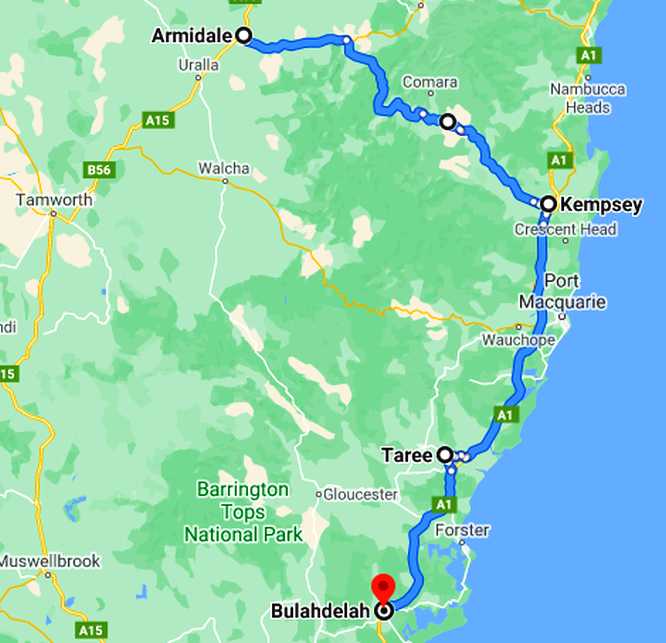
The first stretch, of course, was from Toowoomba to my shed at The Summit, where there was always something to be dropped off or picked up. As I climbed the Braeside hill, about 15 miles before The Summit, I snapped this pic of a car carrier:
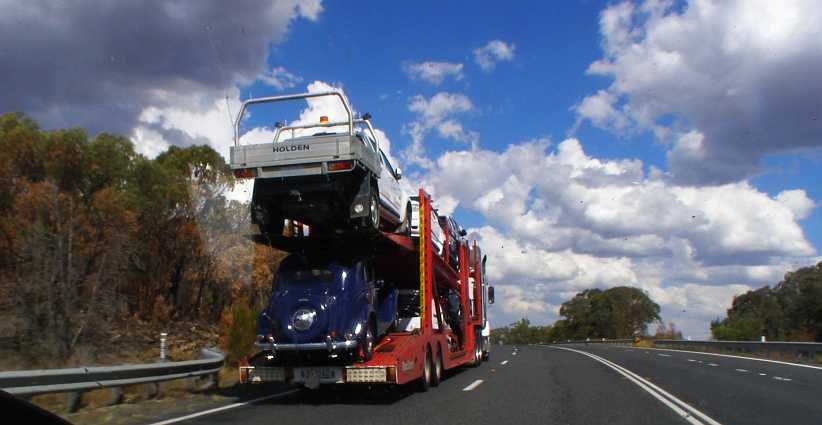
Car carrier. When there’s an old car on a carrier like this you never can be sure what you’ll see. Several years ago I spotted a La Salle on one, the driver saw me taking notice of it and pulled up so I could have a good look!
The car in question, almost looking like it’s ready to fall off the back, was a Ford Pilot. This was a model produced by Ford in England during the early post-war years, largely styled on the ‘36 US Ford but smoothed out a bit and with a different grille up front. They were V8-powered and a fairly classy car in their day on Australian roads.
Pulling up at The Summit allowed the truck to get well ahead of me, but I came across it again going through Deepwater and got a better shot of the Pilot:
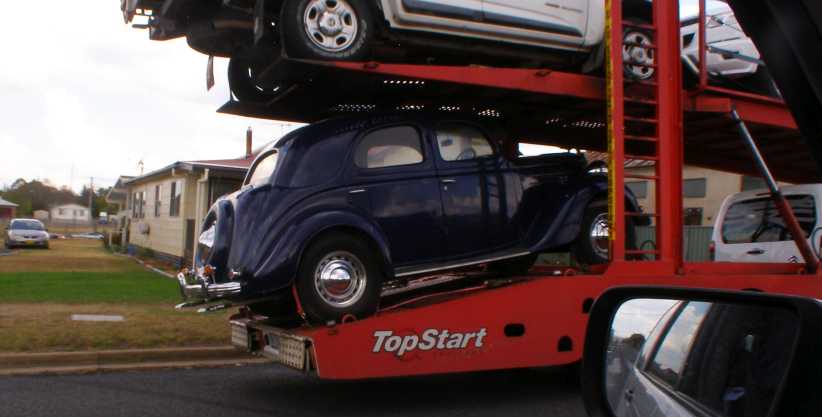
Ford Pilot. A closer look at the Pilot. We knew them well as a neighbour had one in the sixties and my dad’s uncle had one identical to this one from new until he died.
It was to be ironic that I’d be taking photos of the graves of dad’s various family members, including his uncle, before this weekend was over. But that wouldn’t be for hundreds of miles yet, I slipped through Armidale and out onto the Ebor Road and then turned onto the road to Kempsey.
This was the road I’d never driven before. I knew it was very twisty and mostly gravel and I was hoping to get a reasonable distance down it before darkness fell. Time was against me, however, and then, soon after getting onto the road in question, I struck trouble:
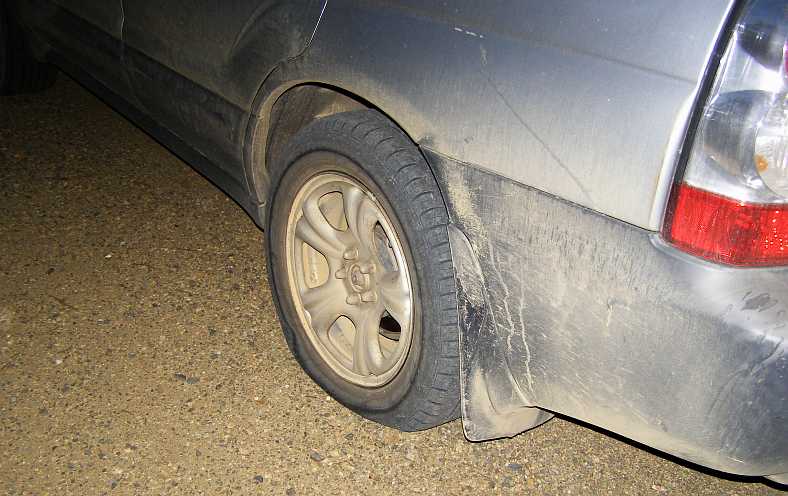
Flat tyre. A sharp edge on a bridge approach with some subsidence caught this tyre out, it took a little while to change.
Now I was on a very lonely road with darkness falling, twisting and turning for endless miles of mostly gravel without a spare tyre!
The road itself was so much of a feature of the journey that I’ve selected a few Google Earth Street View pictures to give a more complete appreciation of the journey…
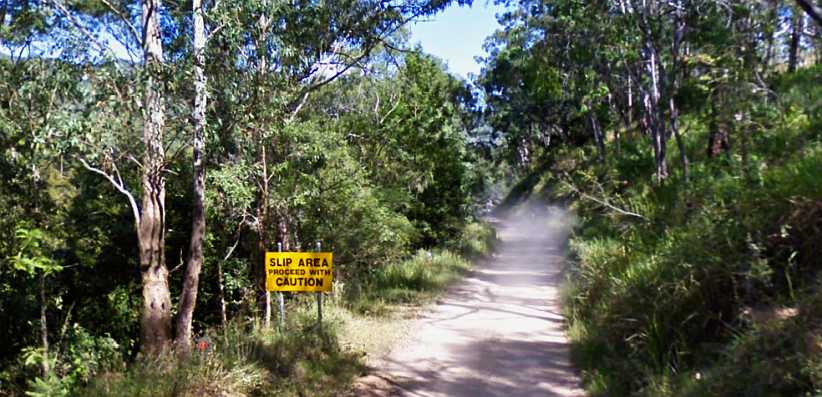
Slip area. A common sign for much of the distance, this warning at times indicated I’d be driving over fallen rubble – because there was insufficient room to go around it.
I had a reason for going this way. Two reasons, I suppose. Twenty-plus years earlier, while doing the Press Liaison job for the Camp Quality Caper I’d ridden with a man who lived just outside of Kempsey and that was the first arousal of my curiosity. He told me that it was interesting every second Thursday morning seeing people rush down the lower part of this road into Kempsey, then an hour or so later seeing them rush back the other way, headed for Armidale.
At that time, unemployed people had to submit a form to the Social Security people to claim their payment for the fortnight. And these were the people who were putting in claims at two different offices to get two payments. So once every two weeks they went over road like this:
Repaired road. Council workers are kept busy repairing ‘slips’ so the road will remain open.
The other interest I held was from the Nostalgia Forum, where discussion of the restoration an old racing car from the pre-1910 period included the claim that the chassis had been found in Australia and that it had at one time been involved in a race from ‘Armidale to the coast’ along this road.
Do you think you’d be driving a 2-wheel braked and very heavy 1910 racer on these roads? All pictures from Google Earth Street View – taken in 2010 but that makes no difference:
Just narrow. A hand-carved road clinging to a mountanside, no place for such a car, is it?
I wrote about it at the time:
Was this sign really necessary?
Traffic Hazard Ahead. A sign which often adorns good, wide, smooth roads when there’s a pothole coming, here it seemed unnecessary.
My description continued – with the explanation that the car of the same era that was really there was much smaller than the Fiat which was said to have been there:
No, I have never seen a sign with the word ‘very’ on it before!
Very narrow sign. Usually signs indicate that the ‘Road Narrows’, but it was already narrow, wasn’t it?
And just around the next bend:
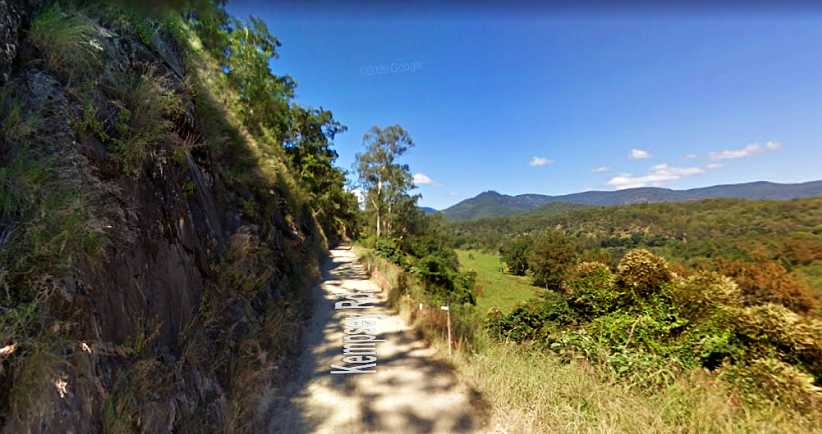
Very narrow road. Nowhere to go, nowhere to pass, it certainly lived up to the sign!
And I still would like to make the drive at a leisurely pace in daylight. Much of it follows the Macleay River, one of the New South Wales North Coast rivers which flood regularly.
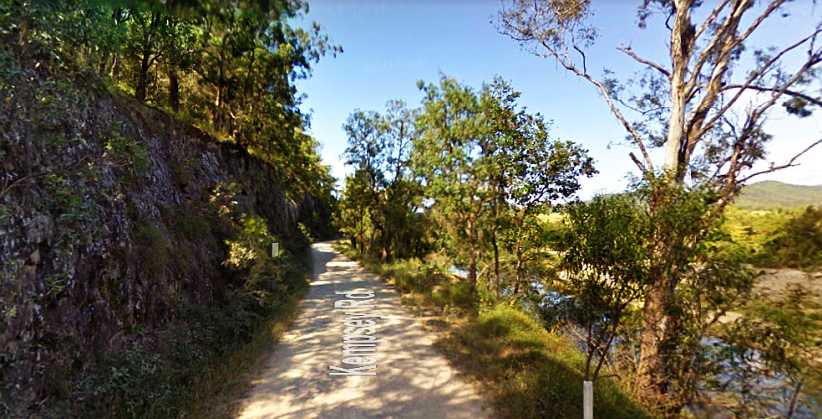
Beside the Macleay. There would be some great scenery to be seen here if one had time to stop occasionally and take it in.
As mentioned, the ‘family’ meeting was important to me. My strategy for the work that weekend was to get as much of the Kempsey job done on Friday as possible, then do the same at Port Macquarie on Saturday, then to drive overnight towards Bulahdelah, complete that drive on Sunday morning to attend the 10am meeting, then in the afternoon head back to Port Macquarie. I’d complete the job in Kempsey on Monday and head for home. But on the way to Bulahdelah I stopped in at the graveyard at Failford and looked over the family headstones again. Including the one for Uncle Roy - dad's uncle who had owned the Ford Pilot like the one on the car carrier.
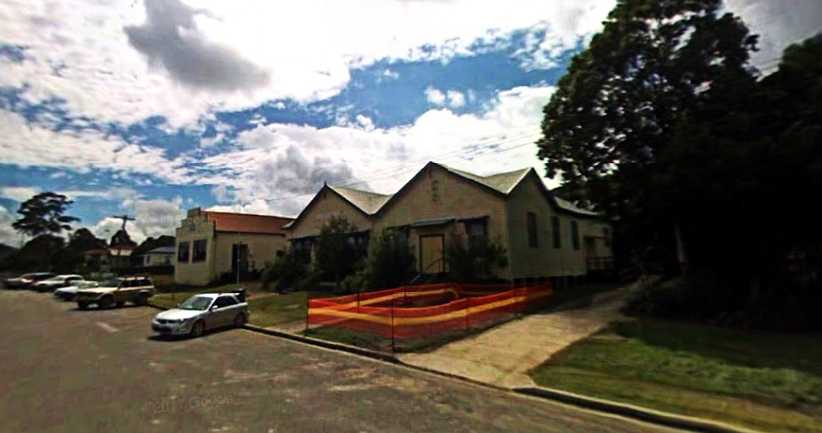
Bulahdelah Community Hall. Our meeting was held here. I had never been able to attend before and it was a treat to be meeting up with family members I’d only seen briefly when I was very young. I was slack with the camera and again counted on Google Earth.
One surprise I had on the Sunday afternoon was, with rain having come in unexpectedly, one of my respondents in Port Macquarie gave me a hi-vis waterproof jacket. His job is observing contractors working on highway construction jobs and with each new job he’s given a new jacket, so he had plenty!
With the work finished on Monday I went straight up the coast to Norm Smith’s place, where I found he was busy working on the bits which convert a Cortina to a Lotus-Cortina. He’d actually acquired these thirty years earlier and copied some other bits when he rebuilt a genuine Lotus-Cortina for a friend of his. All of this with a view to one day putting them together in an ordinary (1200cc pushrod model) shell he’d acquired.
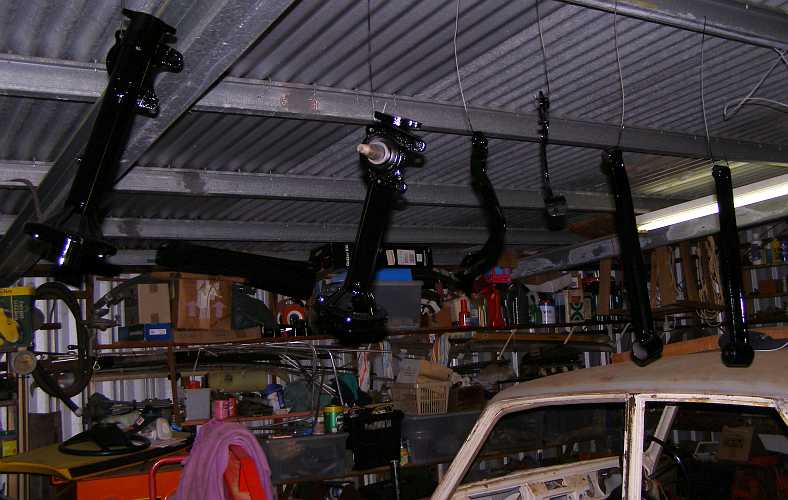
Lotus Cortina parts. Hanging up for the paint to dry, left to right are a pair of struts, brake and clutch pedal and lower rear trailing arms.
Colin Chapman said, famously, when he introduced the Lotus Cortina that he’d done the best he could with a bad job. The struts were an inch shorter and he’d taken out the rear leaf springs and put in coils. The lower trailing arms were aided in keeping the coil spring and damper unit suspension in place by an A-bracket in this lot:
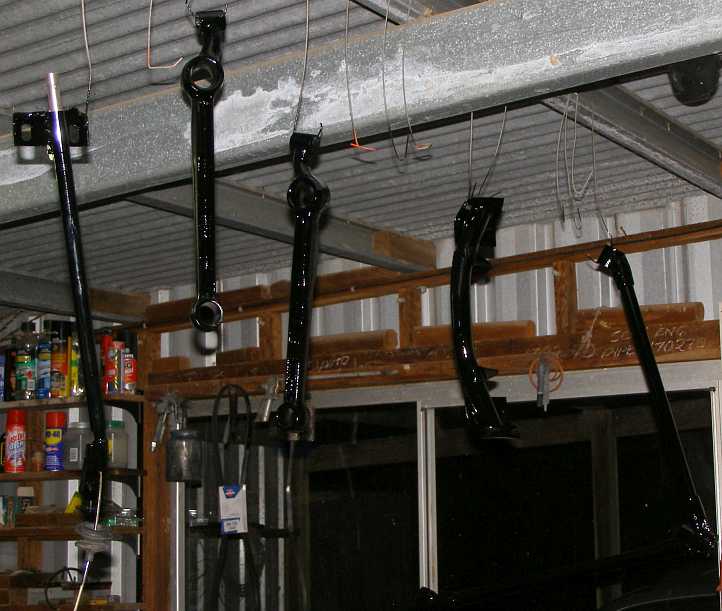
More Lotus Cortina. The A-bracket is to the right, while the lower control arms are joined in this selection by the handbrake lever and the bracket which supports the driveshaft centre-bearing.
Norm doesn’t know what car the handbrake lever is from but doubts that it was especially made for the Lotus Cortina. The lower control arms are slightly longer than the standard ones of the regular sedans and the GT models to give more negative camber, with the angle of the ball joint being altered to suit.
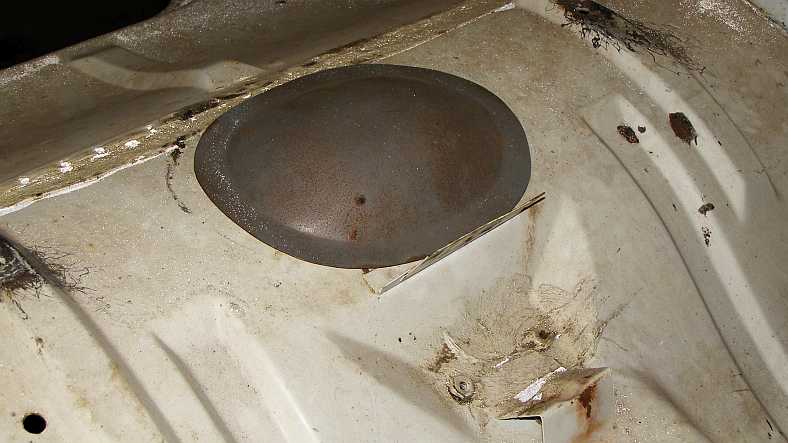
The tin hat. This addition to the boot floor gives clearance for new brackets on top of the rear axle housing for the A-bracket mount.
He also has the bits to build a twin-cam engine for the car. Norm is a Lotus fancier, owning an Elan as well, while he has also had a Cortina GT500 since new. This was a model of which only 115 or so were built to enable them to run in the Armstrong 500 endurance race at Bathurst in 1965. Quite a contrast to the Peugeot 203s he has.
Leaving Norm to his projects, I returned home and thought again about mine. One thing which gave me cause to wonder was the bracket on the back of the van which carries the spare wheel:
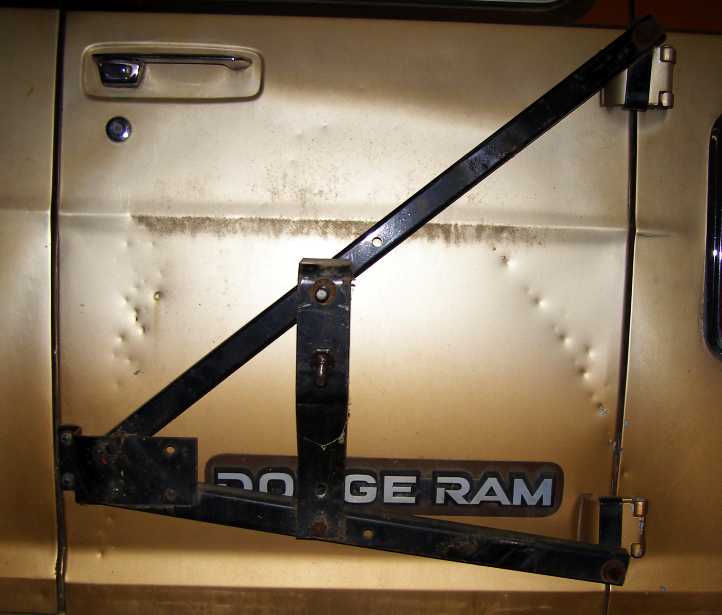
Spare wheel bracket. A couple of things about this didn’t really appeal to me, but though I bought and bent up some steel I ran out of time to do anything about it.
Work at Tenterfield followed the next weekend and again I struck rain:
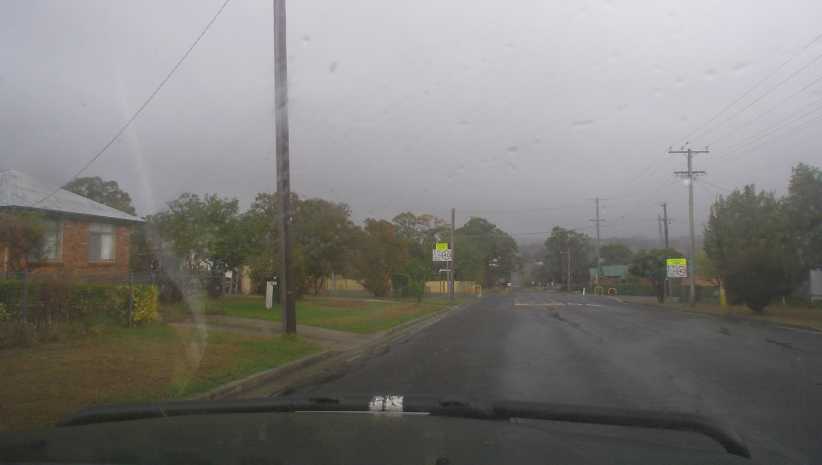
Wet Tenterfield. The back streets of Tenterfield weren’t terribly inviting, especially with some rain. At least it was good for farmers still suffering drought conditions.
The motel at which I stay in Tenterfield is run by a very helpful couple, this note is on the windscreen of every car when people wake up after a night there:
Clean screens. A good service from the proprietors of the Settlers’ Motel in Tenterfield. Other ‘little things’ they do and provide show they want customers to keep coming back.
I was now using the green Forester for work – mostly – but the chance to take the van to Tweed Heads to have another pair of new tyres fitted wasn’t to be missed. An address at Stokers Siding was on one of the jobs I had for the first weekend in April, this being an area near Murwillumbah, while I also had an assignment at Tweed Heads. Areas like Stokers Siding can throw up some characters, hence a couple of pictures worth taking:
Fake VW. Early VW Kombis were popular with the kind of people found in the area, so this Bedford has been given a ‘facelift’ to make it look like an old Kombi.
For some, this is the kind of area they seek out so they can get away from the world, or even hide from it. Little lanes like this abound:
Narrow road. A big Dodge van takes up a lot of room on skinny roads like this!
Another type of character altogether was the couple who’ve gone to extremes to build this rock wall behind their lovely home. Unfortunately my pics of the nice gardens suffered from the sun lighting up the dust on my lens so were unusable…
Stone wall. While this property looked like many others in the area from the front, out the back enormous gardens and this self-built wall added to the attractiveness of the beautiful home.
I was another one working on improving things, with the emphasis on the van. I found a glazing shop which would replace the broken mirrors for the van’s doors and had them done, while I also decided to make the clutch linkage more secure.
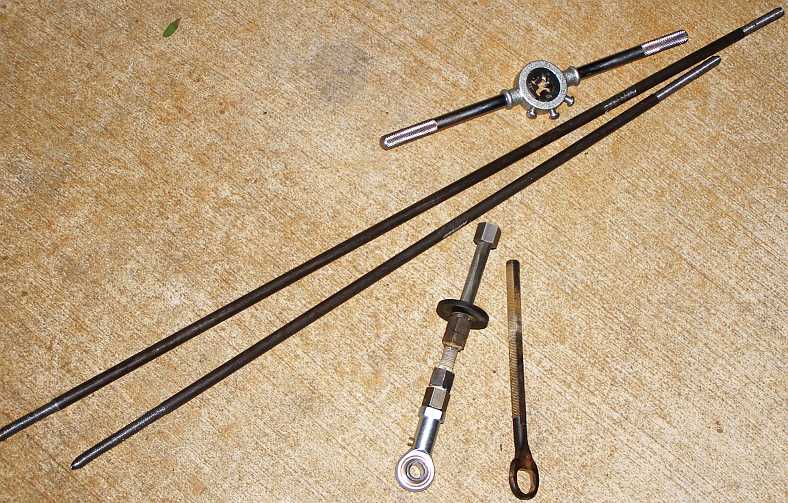
Clutch rods. I decided that rod ends on the two clutch rods would be an improvement and they didn’t cost much, nor take much work.
I was chasing lost motion in the clutch linkage. It had bugged me ever since I got the van, getting the clutch to completely disengage seemed impossible.
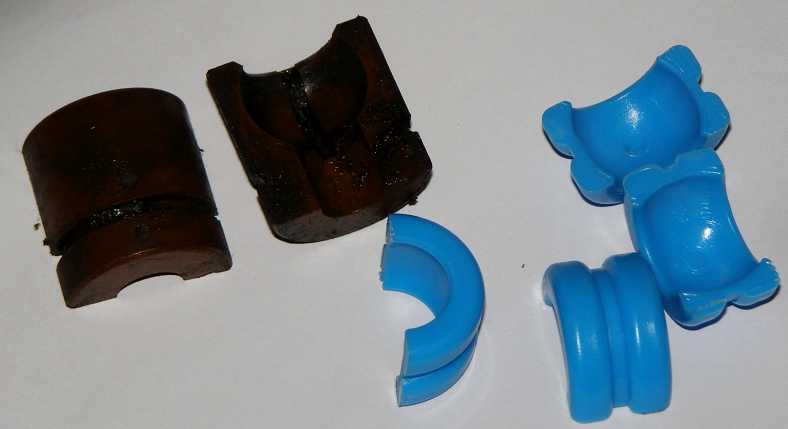
Z-bar bushes. Another area where I was convinced I had a problem, but this wasn’t the cause of the clutch trouble at all.
I bought new bushes, but they were different. Fortunately the originals were in good condition, but they weren’t the cause of my problem at all. That wasn’t to be revealed for a month or two yet…
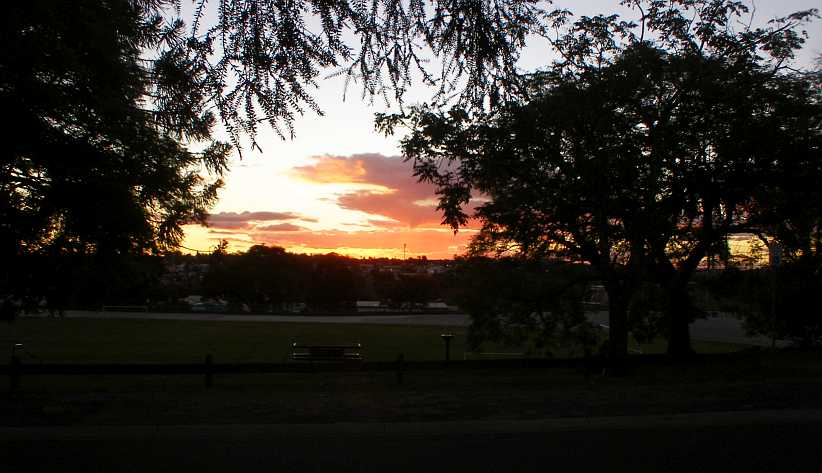
Wattle Street sunset. Despite having seen many a nice sunset from our home in Toowoomba, this was the only time I photographed it.
The real irony here is that it was on the eve of our moving out...
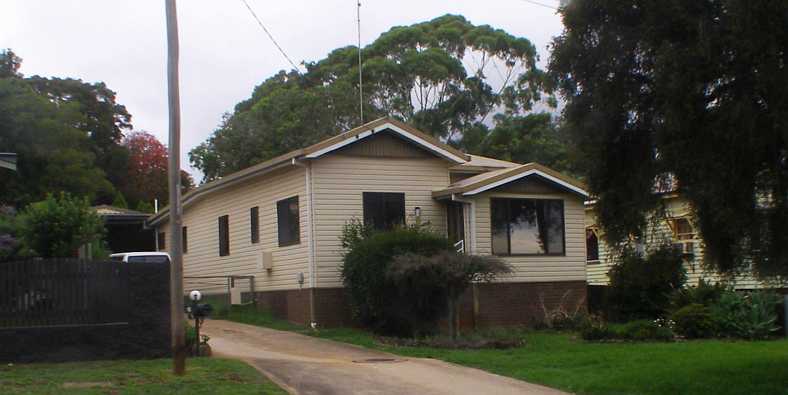
No longer home. It had been almost three years Sandra had lived here when we found the new place, she had been very happy with this one.
Yes, we’d found a house to move into and we were, to a small extent, preparing for that move.
Not that I was happy to have to move house again. Moving out of the farmhouse at Dalveen had really shown me that I was no longer a spring chicken. I lost strength daily, working those long days and moving heavy items. But then, I’d had a few months to recover, hadn’t I?
And as we were now well into April and the move wouldn’t happen for another month, the weather would be cooler too. But there were still hurdles to jump…
I decided to use a road I’d never been on before, too, travelling down there on the Friday as far as Kempsey…
The first stretch, of course, was from Toowoomba to my shed at The Summit, where there was always something to be dropped off or picked up. As I climbed the Braeside hill, about 15 miles before The Summit, I snapped this pic of a car carrier:
Car carrier. When there’s an old car on a carrier like this you never can be sure what you’ll see. Several years ago I spotted a La Salle on one, the driver saw me taking notice of it and pulled up so I could have a good look!
The car in question, almost looking like it’s ready to fall off the back, was a Ford Pilot. This was a model produced by Ford in England during the early post-war years, largely styled on the ‘36 US Ford but smoothed out a bit and with a different grille up front. They were V8-powered and a fairly classy car in their day on Australian roads.
Pulling up at The Summit allowed the truck to get well ahead of me, but I came across it again going through Deepwater and got a better shot of the Pilot:
Ford Pilot. A closer look at the Pilot. We knew them well as a neighbour had one in the sixties and my dad’s uncle had one identical to this one from new until he died.
It was to be ironic that I’d be taking photos of the graves of dad’s various family members, including his uncle, before this weekend was over. But that wouldn’t be for hundreds of miles yet, I slipped through Armidale and out onto the Ebor Road and then turned onto the road to Kempsey.
This was the road I’d never driven before. I knew it was very twisty and mostly gravel and I was hoping to get a reasonable distance down it before darkness fell. Time was against me, however, and then, soon after getting onto the road in question, I struck trouble:
Flat tyre. A sharp edge on a bridge approach with some subsidence caught this tyre out, it took a little while to change.
Now I was on a very lonely road with darkness falling, twisting and turning for endless miles of mostly gravel without a spare tyre!
The road itself was so much of a feature of the journey that I’ve selected a few Google Earth Street View pictures to give a more complete appreciation of the journey…
Slip area. A common sign for much of the distance, this warning at times indicated I’d be driving over fallen rubble – because there was insufficient room to go around it.
I had a reason for going this way. Two reasons, I suppose. Twenty-plus years earlier, while doing the Press Liaison job for the Camp Quality Caper I’d ridden with a man who lived just outside of Kempsey and that was the first arousal of my curiosity. He told me that it was interesting every second Thursday morning seeing people rush down the lower part of this road into Kempsey, then an hour or so later seeing them rush back the other way, headed for Armidale.
At that time, unemployed people had to submit a form to the Social Security people to claim their payment for the fortnight. And these were the people who were putting in claims at two different offices to get two payments. So once every two weeks they went over road like this:
Repaired road. Council workers are kept busy repairing ‘slips’ so the road will remain open.
The other interest I held was from the Nostalgia Forum, where discussion of the restoration an old racing car from the pre-1910 period included the claim that the chassis had been found in Australia and that it had at one time been involved in a race from ‘Armidale to the coast’ along this road.
Do you think you’d be driving a 2-wheel braked and very heavy 1910 racer on these roads? All pictures from Google Earth Street View – taken in 2010 but that makes no difference:
Just narrow. A hand-carved road clinging to a mountanside, no place for such a car, is it?
I wrote about it at the time:
This evening I took that drive from 'Armidale to the coast' in one of my Foresters.
What a road! To be honest, I wouldn't have gone that way had I known fully what I was in for, but now I've done it I'm glad for the education.
The first 40+kms out of Armidale are straightforward, very good country road with very light traffic. Then one turns onto second-class bitumen and immediately swoops and dives over a bridge and onto gravel. In quick succession, bitumen and gravel sections follow, not too outstanding in their makeup (but with a badly sunken bridge approach leaving a sharp concrete edge which dented a rim for me and left me with a flat tyre), but then the gravel was to come in earnest.
Beginning at about 950m altitude, the road climbs to about 1050, then begins a descent which never seems to end. The road is a hand-hewn ledge in the sides of mountains and hills overlooking ravines and creeks, corner following corner, steering winding and unwinding nearly as quickly as is required to wind the other way.
This goes on seemingly endlessly, with about ten kilometres covered before the main descent ends at about 150 metres altitude. Then come some undulations, but the nature of the road, narrow, unfenced for the most part, clinging to hillsides with rock walls to one side and sheer drops to the other, never seems to change. The gravel is not too bad, but it takes a long time to get a short distance in these circumstances.
I drove it as hard as I dared bearing in mind that I no longer had a spare tyre. I travelled 70kms before I encountered an oncoming car. By that time I was finding cattle on the road, it was now dark and the black ones were hard to spot. Once I went between one which was standing there looking at me and another which was lying on the edge of the road chewing its cud, all the while the ABS laughing at my right foot as I delicately steered between the bovines…
What a road! To be honest, I wouldn't have gone that way had I known fully what I was in for, but now I've done it I'm glad for the education.
The first 40+kms out of Armidale are straightforward, very good country road with very light traffic. Then one turns onto second-class bitumen and immediately swoops and dives over a bridge and onto gravel. In quick succession, bitumen and gravel sections follow, not too outstanding in their makeup (but with a badly sunken bridge approach leaving a sharp concrete edge which dented a rim for me and left me with a flat tyre), but then the gravel was to come in earnest.
Beginning at about 950m altitude, the road climbs to about 1050, then begins a descent which never seems to end. The road is a hand-hewn ledge in the sides of mountains and hills overlooking ravines and creeks, corner following corner, steering winding and unwinding nearly as quickly as is required to wind the other way.
This goes on seemingly endlessly, with about ten kilometres covered before the main descent ends at about 150 metres altitude. Then come some undulations, but the nature of the road, narrow, unfenced for the most part, clinging to hillsides with rock walls to one side and sheer drops to the other, never seems to change. The gravel is not too bad, but it takes a long time to get a short distance in these circumstances.
I drove it as hard as I dared bearing in mind that I no longer had a spare tyre. I travelled 70kms before I encountered an oncoming car. By that time I was finding cattle on the road, it was now dark and the black ones were hard to spot. Once I went between one which was standing there looking at me and another which was lying on the edge of the road chewing its cud, all the while the ABS laughing at my right foot as I delicately steered between the bovines…
Traffic Hazard Ahead. A sign which often adorns good, wide, smooth roads when there’s a pothole coming, here it seemed unnecessary.
My description continued – with the explanation that the car of the same era that was really there was much smaller than the Fiat which was said to have been there:
…John says that the car in question came from some 19kms west of Bellbrook, but I have to report that from the first Bellbrook sign to the village itself was probably the best part of 19kms. And in that distance yet more of the hand-carved narrow road etched itself into the hillsides, some parts of it graced with a different sign, "VERY narrow road". Many times drivers were warned not to stop because of the risk of falling rocks, occasionally with the addition of a 'Proceed with caution.'
Very narrow sign. Usually signs indicate that the ‘Road Narrows’, but it was already narrow, wasn’t it?
And just around the next bend:
Very narrow road. Nowhere to go, nowhere to pass, it certainly lived up to the sign!
A shame I made the drive as darkness was falling, I'd like to have seen more of the terrain. But all the while I was thinking just how poorly this little car with 2-wheel brakes must have been equipped for such a road, certainly at any kind of speed.
Beside the Macleay. There would be some great scenery to be seen here if one had time to stop occasionally and take it in.
As mentioned, the ‘family’ meeting was important to me. My strategy for the work that weekend was to get as much of the Kempsey job done on Friday as possible, then do the same at Port Macquarie on Saturday, then to drive overnight towards Bulahdelah, complete that drive on Sunday morning to attend the 10am meeting, then in the afternoon head back to Port Macquarie. I’d complete the job in Kempsey on Monday and head for home. But on the way to Bulahdelah I stopped in at the graveyard at Failford and looked over the family headstones again. Including the one for Uncle Roy - dad's uncle who had owned the Ford Pilot like the one on the car carrier.
Bulahdelah Community Hall. Our meeting was held here. I had never been able to attend before and it was a treat to be meeting up with family members I’d only seen briefly when I was very young. I was slack with the camera and again counted on Google Earth.
One surprise I had on the Sunday afternoon was, with rain having come in unexpectedly, one of my respondents in Port Macquarie gave me a hi-vis waterproof jacket. His job is observing contractors working on highway construction jobs and with each new job he’s given a new jacket, so he had plenty!
With the work finished on Monday I went straight up the coast to Norm Smith’s place, where I found he was busy working on the bits which convert a Cortina to a Lotus-Cortina. He’d actually acquired these thirty years earlier and copied some other bits when he rebuilt a genuine Lotus-Cortina for a friend of his. All of this with a view to one day putting them together in an ordinary (1200cc pushrod model) shell he’d acquired.
Lotus Cortina parts. Hanging up for the paint to dry, left to right are a pair of struts, brake and clutch pedal and lower rear trailing arms.
Colin Chapman said, famously, when he introduced the Lotus Cortina that he’d done the best he could with a bad job. The struts were an inch shorter and he’d taken out the rear leaf springs and put in coils. The lower trailing arms were aided in keeping the coil spring and damper unit suspension in place by an A-bracket in this lot:
More Lotus Cortina. The A-bracket is to the right, while the lower control arms are joined in this selection by the handbrake lever and the bracket which supports the driveshaft centre-bearing.
Norm doesn’t know what car the handbrake lever is from but doubts that it was especially made for the Lotus Cortina. The lower control arms are slightly longer than the standard ones of the regular sedans and the GT models to give more negative camber, with the angle of the ball joint being altered to suit.
The tin hat. This addition to the boot floor gives clearance for new brackets on top of the rear axle housing for the A-bracket mount.
He also has the bits to build a twin-cam engine for the car. Norm is a Lotus fancier, owning an Elan as well, while he has also had a Cortina GT500 since new. This was a model of which only 115 or so were built to enable them to run in the Armstrong 500 endurance race at Bathurst in 1965. Quite a contrast to the Peugeot 203s he has.
Leaving Norm to his projects, I returned home and thought again about mine. One thing which gave me cause to wonder was the bracket on the back of the van which carries the spare wheel:
Spare wheel bracket. A couple of things about this didn’t really appeal to me, but though I bought and bent up some steel I ran out of time to do anything about it.
Work at Tenterfield followed the next weekend and again I struck rain:
Wet Tenterfield. The back streets of Tenterfield weren’t terribly inviting, especially with some rain. At least it was good for farmers still suffering drought conditions.
The motel at which I stay in Tenterfield is run by a very helpful couple, this note is on the windscreen of every car when people wake up after a night there:
Clean screens. A good service from the proprietors of the Settlers’ Motel in Tenterfield. Other ‘little things’ they do and provide show they want customers to keep coming back.
I was now using the green Forester for work – mostly – but the chance to take the van to Tweed Heads to have another pair of new tyres fitted wasn’t to be missed. An address at Stokers Siding was on one of the jobs I had for the first weekend in April, this being an area near Murwillumbah, while I also had an assignment at Tweed Heads. Areas like Stokers Siding can throw up some characters, hence a couple of pictures worth taking:
Fake VW. Early VW Kombis were popular with the kind of people found in the area, so this Bedford has been given a ‘facelift’ to make it look like an old Kombi.
For some, this is the kind of area they seek out so they can get away from the world, or even hide from it. Little lanes like this abound:
Narrow road. A big Dodge van takes up a lot of room on skinny roads like this!
Another type of character altogether was the couple who’ve gone to extremes to build this rock wall behind their lovely home. Unfortunately my pics of the nice gardens suffered from the sun lighting up the dust on my lens so were unusable…
Stone wall. While this property looked like many others in the area from the front, out the back enormous gardens and this self-built wall added to the attractiveness of the beautiful home.
I was another one working on improving things, with the emphasis on the van. I found a glazing shop which would replace the broken mirrors for the van’s doors and had them done, while I also decided to make the clutch linkage more secure.
Clutch rods. I decided that rod ends on the two clutch rods would be an improvement and they didn’t cost much, nor take much work.
I was chasing lost motion in the clutch linkage. It had bugged me ever since I got the van, getting the clutch to completely disengage seemed impossible.
Z-bar bushes. Another area where I was convinced I had a problem, but this wasn’t the cause of the clutch trouble at all.
I bought new bushes, but they were different. Fortunately the originals were in good condition, but they weren’t the cause of my problem at all. That wasn’t to be revealed for a month or two yet…
Wattle Street sunset. Despite having seen many a nice sunset from our home in Toowoomba, this was the only time I photographed it.
The real irony here is that it was on the eve of our moving out...
No longer home. It had been almost three years Sandra had lived here when we found the new place, she had been very happy with this one.
Yes, we’d found a house to move into and we were, to a small extent, preparing for that move.
Not that I was happy to have to move house again. Moving out of the farmhouse at Dalveen had really shown me that I was no longer a spring chicken. I lost strength daily, working those long days and moving heavy items. But then, I’d had a few months to recover, hadn’t I?
And as we were now well into April and the move wouldn’t happen for another month, the weather would be cooler too. But there were still hurdles to jump…
Last edited by Ray Bell; Dec 30, 2020 at 05:24 AM.