


Ride along with me...


Thread Starter
|
Captain

Joined: Oct 2005
Posts: 570
Likes: 8
From: The Summit, Queensland, Australia

I was rushing backwards and forwards between the Boonah area and the areas I had to cover in Tallwood and Bungunyah as time to get the job done was running out. Some people, as you would understand, just had trouble finding time to complete the survey and I had to give them a few chances to have it done before I gave up on them.
And I don’t like giving up on people. Even though there’s an acceptance by the company and by the
Government Department for whom it is done that some questionnaires will never be filled in, it seems to me that it’s my job to make sure the percentage that I get back complete is higher than their average.
So that’s why I was out quite late at times, and able to capture scenes like this one from a driveway near Boonah:
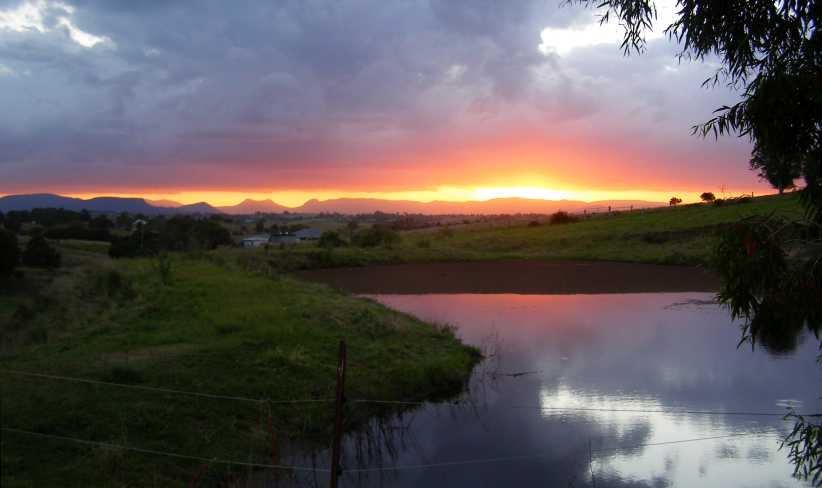
Boonah sunset. Having to pick up a questionnaire late in the afternoon rewarded me with this pleasant sunset view.
Which leads to a funny story. During the period in which we were doing this job, the Australian Government’s periodic Official Census was to be conducted. So, with two major surveys in operation at the same time, the Department in charge of the one we were doing arranged that we wouldn’t work for the two days of the most intensive activity on the Census.
There was one woman in a little town who promised me faithfully she’d get her questionnaire filled out. But I found it increasingly difficult to either catch her at home or get her to answer the door when I knew very well she was at home. Her car in the driveway, her dog yapping inside, the lights on and all. And so I phoned her.
The response was no better, then as I was about to make my final trip to that area I phoned and, in exasperation, said that she should just leave it out on her front step in the envelope provided whether she’d filled it out or not.
And so she did. Not in the envelope, but with her copy of the Census form wrapped up inside our questionnaire. Neither were completed!
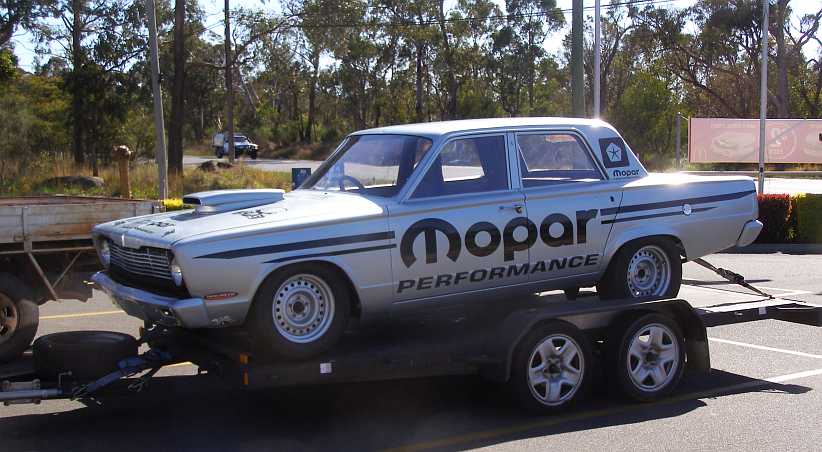
Valiant on steroids. This started life as a VC Valiant, a ‘67 or ‘68 model. I spotted it in a service station as I was flitting from place to place.
Time was passing, I was getting good results but there was always someone who’d force me to make yet another trip to each area. But you get that… and you also get paid to do it, mostly in mileage allowances. The Forester was earning its keep. And covering such mileages you see different things along the way, like this tortoise which was on the road near Inglewood:
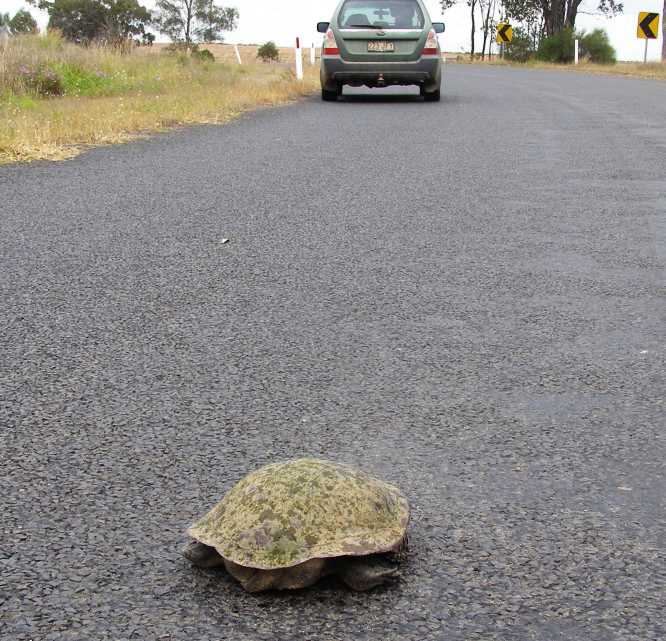
Big tortoise. We don’t see many of these fellows bigger than about eight inches across, but this one was about a foot long. How on earth they think they’ll escape danger by pulling their head and legs in and lying on the road I don’t know, one crack in their shell and they’re doomed.
A sign that the time was passing was seen with the crop at Bungunyah, now well on the way to ripening for the harvest…
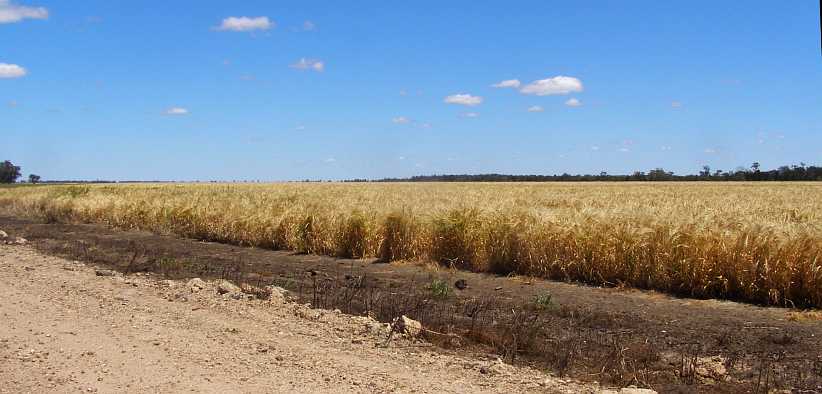
Crop ripening. Warmer weather coming along helped this crop to change colour, soon it would be ready for the harvesters to come through and reap it.
…where the farm’s driveway is heavily covered in a different soil to the one in which the crop grows. That grey soil turns to black when it’s wet and is the perfect trap for the unwary, cars and trucks bog to the axles very quickly.
Another sight you see, but you’re not necessarily happy to see…
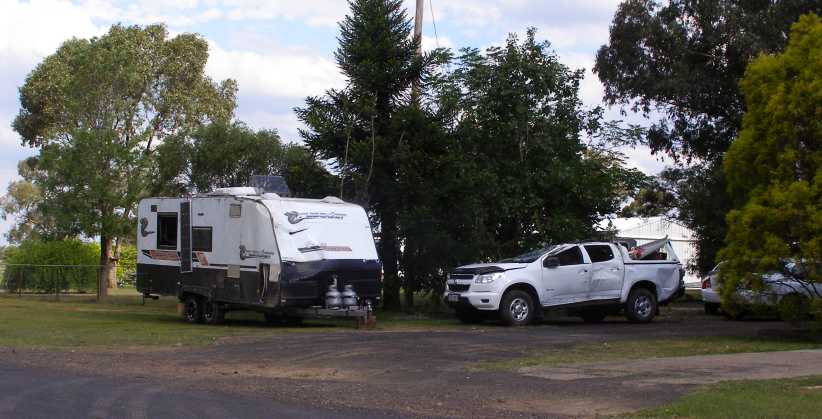
Trip ruined. Another shot at Inglewood, this caravanner has probably returned early after encountering what might be termed, ‘difficulties.’
All in all I was getting about a lot, still enjoying myself, spending odd nights with Sandra, doing odd jobs to keep the Forester going (the driveshafts out of the blue wreck were migrated to my own car at one point) and combining the two jobs. So I was seeing a lot of scenery. And a fair bit of it was from secondary roads where cresting hills revealed an expanse opening up before your eyes…
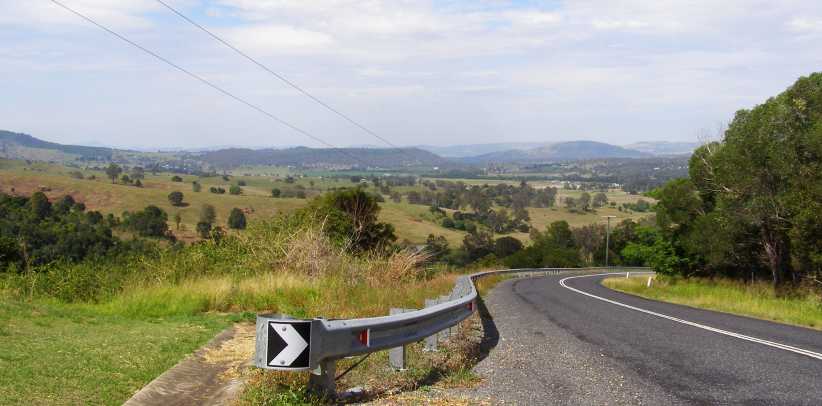
Typical view. I can’t say for sure where this is because there’s a number of places where it could be.
But that wasn’t all that was happening. Paperwork for the passage of the van and it’s load through Customs and other inspections had to be completed. The Van was getting closer to Sydney all the time and these papers had to be there when it arrived. Others necessary for the importation of the van itself had been completed before it ever sailed. Click on the thumbnails if you’re interested…
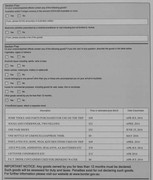
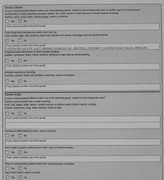
There was regular contact with the shipping agent too, establishing just when it would arrive and final payments I’d have to make. And in the midst of all this I took time to read a local paper, which contained this surprise:
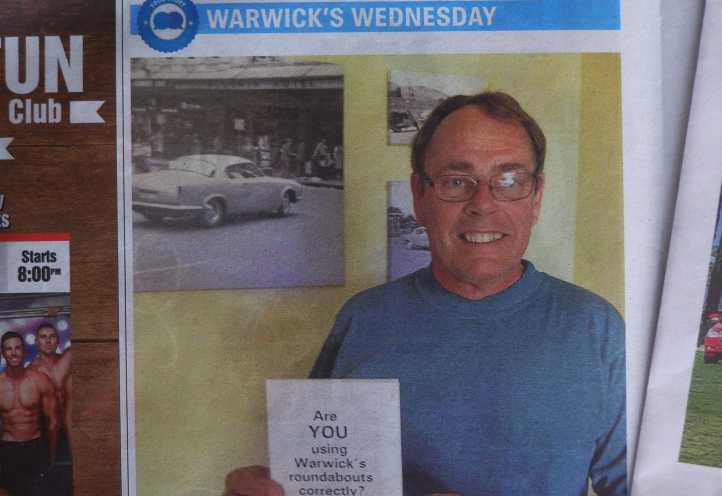
Surprise finding. The story attached to this picture didn’t attract me, but the picture in the background showed a very rare car and I was sure that was deliberately posed.
This led to me phoning the paper to find out how to contact the man in the picture, it then didn’t take long talking to Mark Agnew to establish that it was deliberate and that he owned two of these cars. Only 13 were ever built, so I made arrangements to visit him when my life wasn’t so hectic.
And speaking of hectic, I reached the end of the work on the government job and the company got in touch and asked me if I could go to Sydney, where there were several areas not yet covered and time was running out. So I took another drive to Sydney, where I picked up the materials from the lady with whom I’d done the training. She hadn’t done any of the work assigned to her at all!
Keeping my eye on the job, I spotted this Valiant in Richmond one day when I ducked into town to get some lunch:
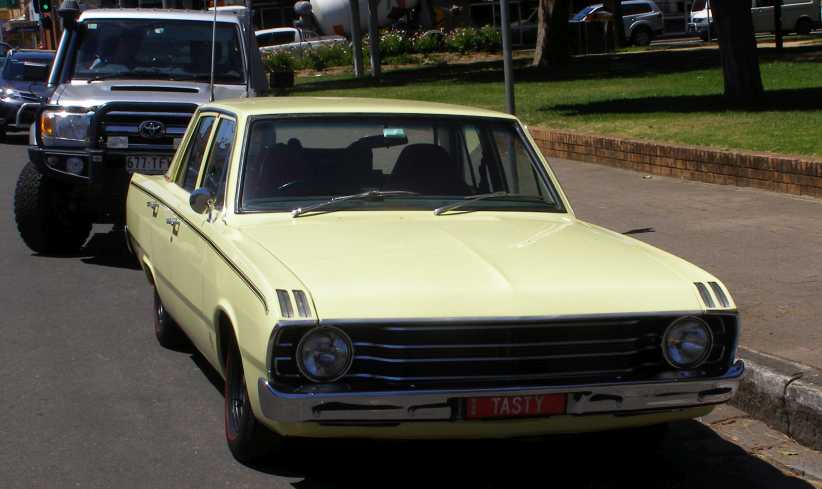
VF Valiant. Two models after the VC, this VF Valiant has different sheet metal front and rear to the VE, which was unchanged from the American Dodge Dart of 1967.
This was a very nicely done restoration, though I never found out anything about it. This model was the last one to be fitted with the 225 Slant 6 engine, but it wouldn’t surprise me to learn it had been ‘upgraded’ with a Hemi 6 of either 245 or 265 cubic inches.
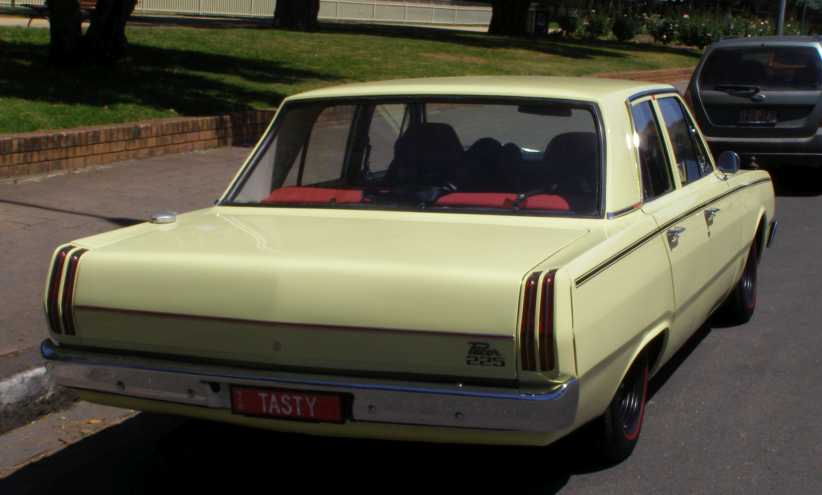
Rear view. I think it’s even neater from the rear and it is a little better looking than the succeeding VG model, which is the one I have.
It just happened that while I was in Sydney the funeral was held for a front-line racing driver of the sixties, Johnny Martin. I took a morning off to go to the ‘wake’ and catch up with some old friends.
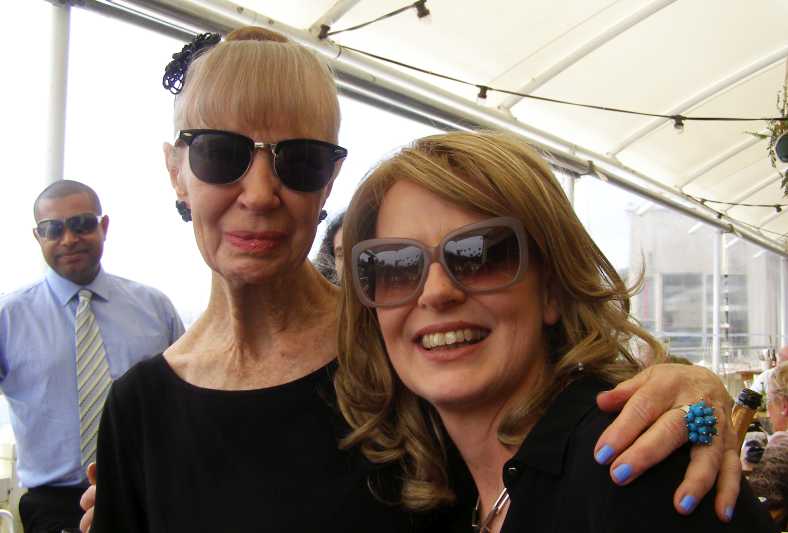
Sad smiles. The widow and one of the daughters of Johnny Martin posed for me. Johnny had the honour of holding a lap record for eight years, and he set it in a Lola that was already five years old.
That was a good chance to have some conversation with people I hadn’t seen in a long time, but I couldn’t forget that there was a limit on the time I had to complete the work in areas roughly shown on this map:
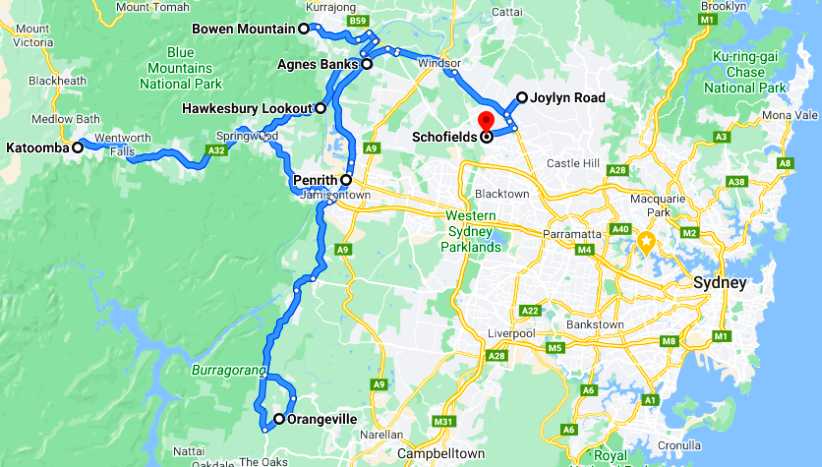
My assignments. Well, not Orangeville, that was to visit a friend, but I had four areas to cover in the Windsor district, including Agnes Banks and Bowen Mountain, and a further three areas to do up the Blue Mountains as far as Katoomba. The company put me into accommodation at Penrith and on the weekend in the middle of my two weeks there I did a regular assignment in Schofields.
In addition, when I had those areas all in check, they sent me to other areas where pickups hadn’t been completed. I was truly a busy boy!
But I still fitted in two visits to Bob Britton (Joylyn Road), where work was proceeding on the car with the big V6 engine:
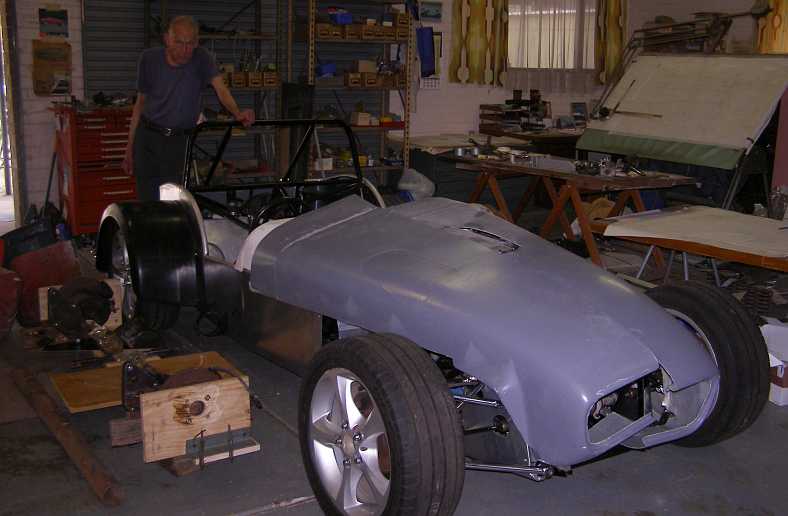
Body widening. Having built the chassis wider to accept the Buick V6 engine, Bob was next faced with widening the nose panel which came from the Lotus 7 mold.
He really had made progress with this car. Mind you, a year earlier he’d told me he’d built his last one already!
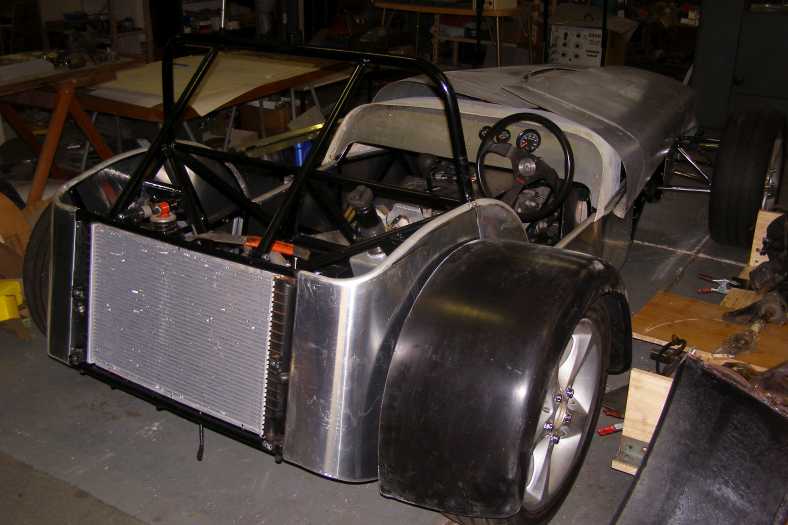
Radiator in rear. An outstanding feature of the car is the radiator being mounted at the rear. All mechanical parts are from the Commodore donor car except the front uprights (spindles).
He’s built this one with a de Dion rear suspension too…
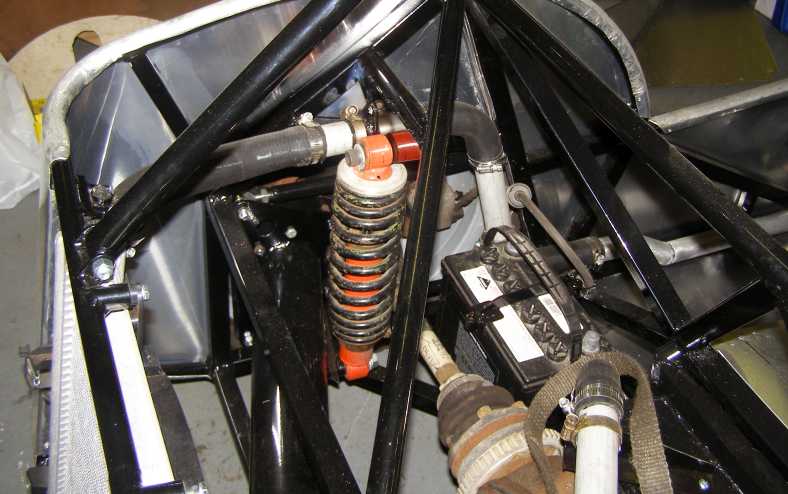
De Dion rear end. As the Commodore has independent rear suspension of a type not suitable for this kind of chassis, a little invention was required.
More Mopar in the streets of South Windsor, not pretty at all, I have no idea of what happened here:
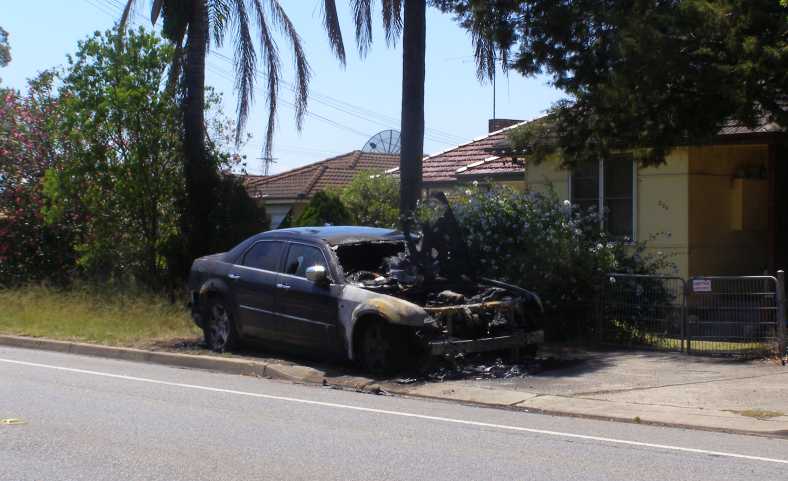
Burned out 300C. I was more than surprised to see this poor 300C as I drove to my work just around the corner.
Rather more picturesque was this scene of the Penrith Lakes…
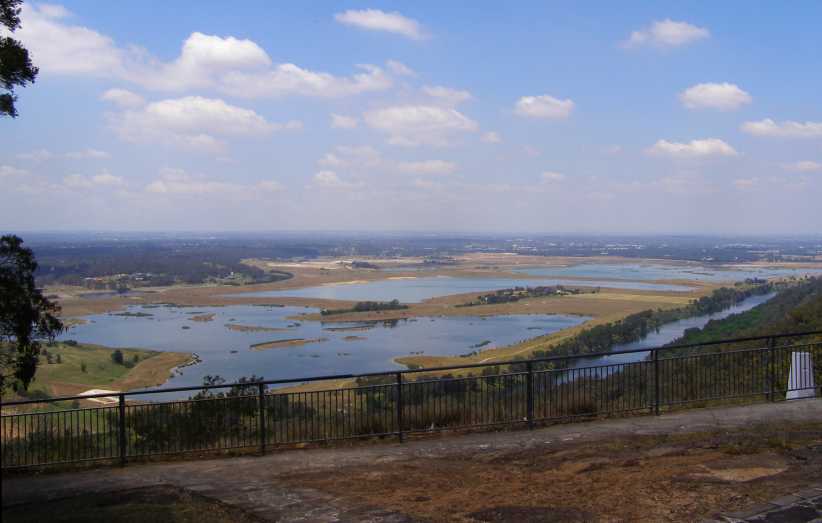
Penrith Lakes. The Hawkesbury Lookout is on a road once used as a hillclimb, the view here is of the Nepean River and the Penrith Lakes.
…which were formed when quarrying of gravel in the area came to an end and flooding the lakes took place. These lakes were used for some of the aquatic events in the 2000 Sydney Olympic Games while the main rowing events were further up the Nepean near Penrith.
While working in Katoomba I was right next to an old racing circuit where I used to go when I was younger. Much younger, it closed for racing in 1971 and, even though it was used for other events for several years, nature is reclaiming it all:
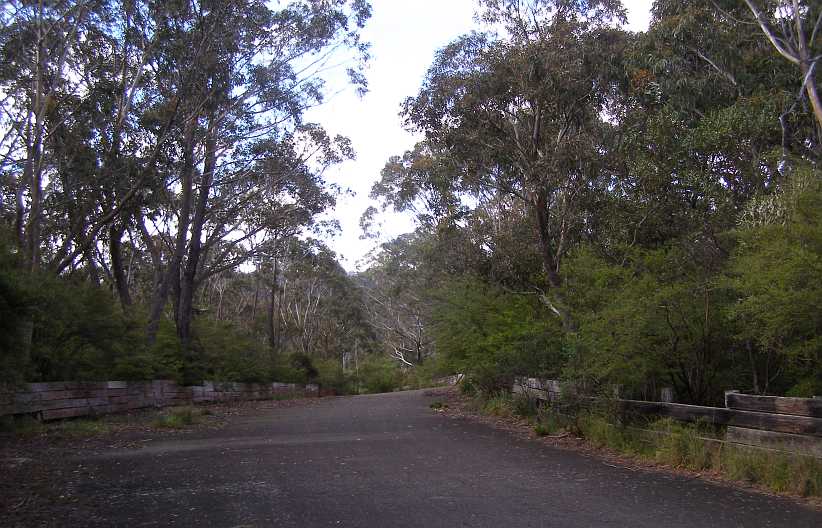
Catalina circuit. This was the run into a corner called ‘The Tunnel of Love’ around the back of the pits, it was a tricky and sometimes dangerous circuit fully fenced as you see here.
I made a final visit to Bob before I left Sydney, he was busily working on creating the shapes necessary to enclose that V6 in the fibreglass body:
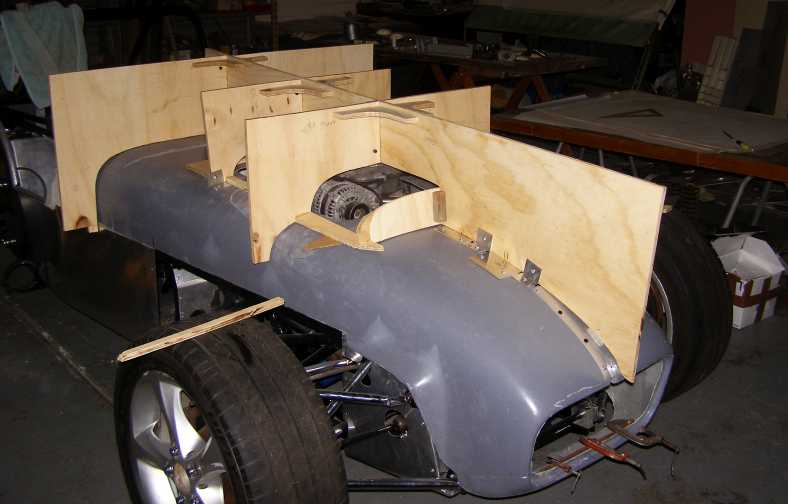
Bob’s formwork. The ‘formwork’ was created to get the shapes right and Bob’s fibreglass man, Les Puklowski, did the rest of the job.
It was a fair drive to Narrabri, where my next weekend’s work was awaiting me. I’d bought some tyres while I’d been in Sydney and now I had some vibrations. Which I was fairly sure was more trouble with the CV joints.
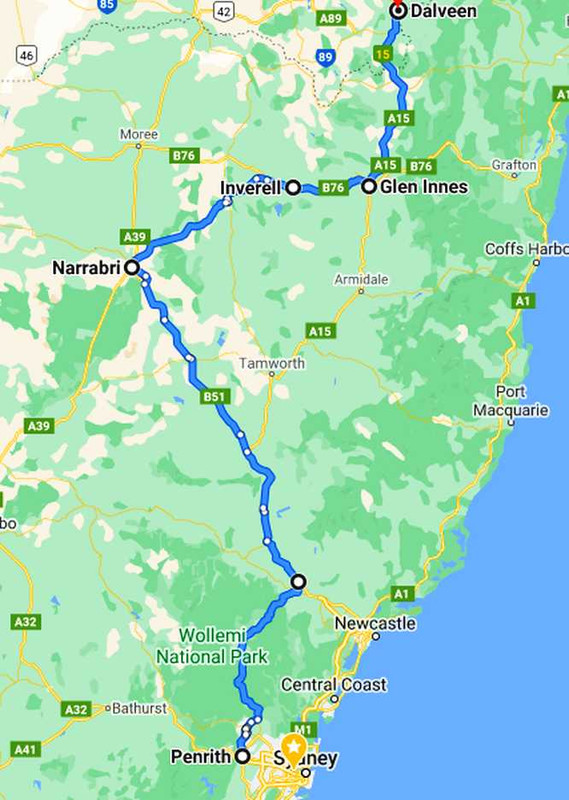
Once you get past the mountainous roads leading the first hundred miles or so out of Sydney you enter flatter country. I could have gone via the freeway, closer to the coast, but I prefer to lighter traffic you find on the Putty Road. Once you get past that it’s all easy running…
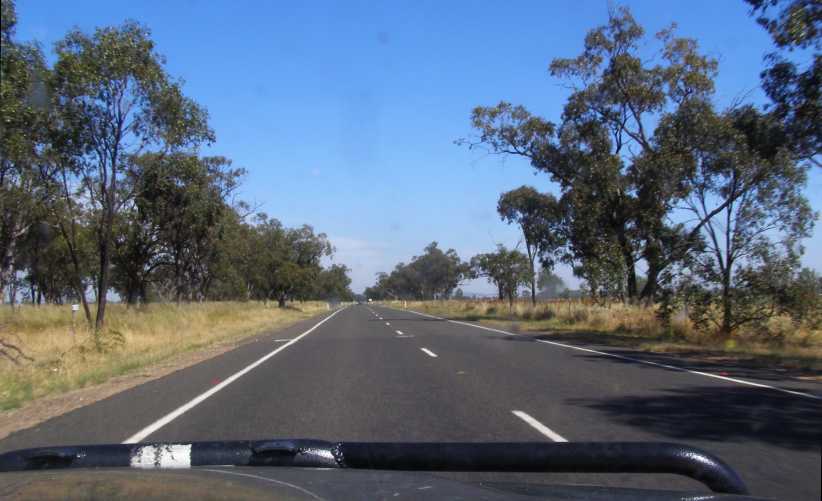
Road to Narrabri. The final stretches of the drive to Narrabri are flat and straight, and the lack of traffic makes for easy travelling.
Then it was off to home. No midweek work, I was able to spend time with Sandra before returning to Glen Innes for the next weekend’s work. On the way home I managed to capture a fairly spectacular sunset over the hills to the West of the highway:
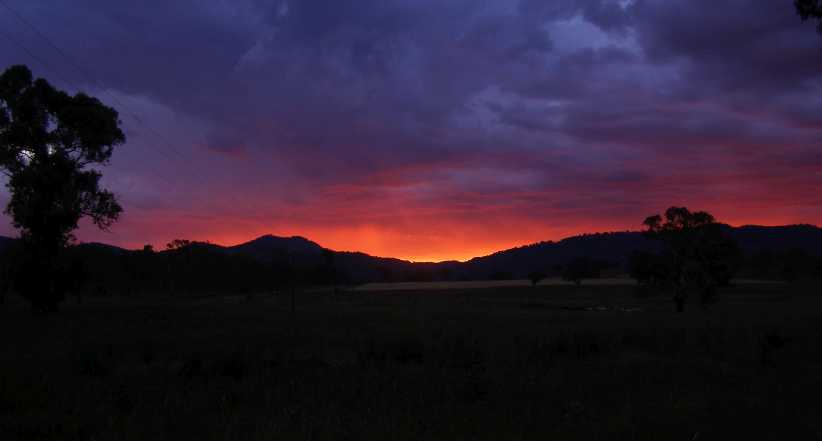
Sunset’s rich colours. Conditions were just right for the colours to come up with this sunset.
Nearing home I found that someone must have needed some wheels from a Holden Astra…
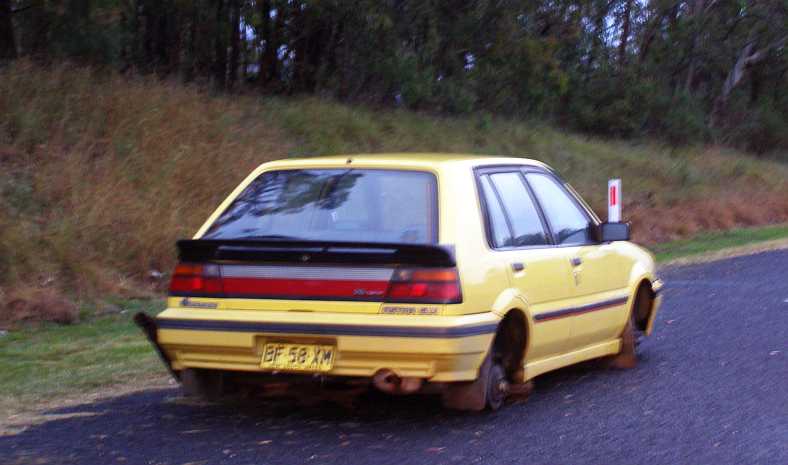
Astra without wheels. There must be a story in this, I’m sure…
…which meant ti sat there flat on the ground just off the road near Bluff River, South of Tenterfield.
During the following week I went to the damaged vehicle auction again and bought another Forester to get a fresh engine for the silver car. And, having bought that (at the right price) I had to arrange to borrow a trailer to get it home. There was very little time for rest as I was also keeping tabs on things with the van, which I hoped to pick up in the two-week break from work that was coming up…
And I don’t like giving up on people. Even though there’s an acceptance by the company and by the
Government Department for whom it is done that some questionnaires will never be filled in, it seems to me that it’s my job to make sure the percentage that I get back complete is higher than their average.
So that’s why I was out quite late at times, and able to capture scenes like this one from a driveway near Boonah:
Boonah sunset. Having to pick up a questionnaire late in the afternoon rewarded me with this pleasant sunset view.
Which leads to a funny story. During the period in which we were doing this job, the Australian Government’s periodic Official Census was to be conducted. So, with two major surveys in operation at the same time, the Department in charge of the one we were doing arranged that we wouldn’t work for the two days of the most intensive activity on the Census.
There was one woman in a little town who promised me faithfully she’d get her questionnaire filled out. But I found it increasingly difficult to either catch her at home or get her to answer the door when I knew very well she was at home. Her car in the driveway, her dog yapping inside, the lights on and all. And so I phoned her.
The response was no better, then as I was about to make my final trip to that area I phoned and, in exasperation, said that she should just leave it out on her front step in the envelope provided whether she’d filled it out or not.
And so she did. Not in the envelope, but with her copy of the Census form wrapped up inside our questionnaire. Neither were completed!
Valiant on steroids. This started life as a VC Valiant, a ‘67 or ‘68 model. I spotted it in a service station as I was flitting from place to place.
Time was passing, I was getting good results but there was always someone who’d force me to make yet another trip to each area. But you get that… and you also get paid to do it, mostly in mileage allowances. The Forester was earning its keep. And covering such mileages you see different things along the way, like this tortoise which was on the road near Inglewood:
Big tortoise. We don’t see many of these fellows bigger than about eight inches across, but this one was about a foot long. How on earth they think they’ll escape danger by pulling their head and legs in and lying on the road I don’t know, one crack in their shell and they’re doomed.
A sign that the time was passing was seen with the crop at Bungunyah, now well on the way to ripening for the harvest…
Crop ripening. Warmer weather coming along helped this crop to change colour, soon it would be ready for the harvesters to come through and reap it.
…where the farm’s driveway is heavily covered in a different soil to the one in which the crop grows. That grey soil turns to black when it’s wet and is the perfect trap for the unwary, cars and trucks bog to the axles very quickly.
Another sight you see, but you’re not necessarily happy to see…
Trip ruined. Another shot at Inglewood, this caravanner has probably returned early after encountering what might be termed, ‘difficulties.’
All in all I was getting about a lot, still enjoying myself, spending odd nights with Sandra, doing odd jobs to keep the Forester going (the driveshafts out of the blue wreck were migrated to my own car at one point) and combining the two jobs. So I was seeing a lot of scenery. And a fair bit of it was from secondary roads where cresting hills revealed an expanse opening up before your eyes…
Typical view. I can’t say for sure where this is because there’s a number of places where it could be.
But that wasn’t all that was happening. Paperwork for the passage of the van and it’s load through Customs and other inspections had to be completed. The Van was getting closer to Sydney all the time and these papers had to be there when it arrived. Others necessary for the importation of the van itself had been completed before it ever sailed. Click on the thumbnails if you’re interested…
There was regular contact with the shipping agent too, establishing just when it would arrive and final payments I’d have to make. And in the midst of all this I took time to read a local paper, which contained this surprise:
Surprise finding. The story attached to this picture didn’t attract me, but the picture in the background showed a very rare car and I was sure that was deliberately posed.
This led to me phoning the paper to find out how to contact the man in the picture, it then didn’t take long talking to Mark Agnew to establish that it was deliberate and that he owned two of these cars. Only 13 were ever built, so I made arrangements to visit him when my life wasn’t so hectic.
And speaking of hectic, I reached the end of the work on the government job and the company got in touch and asked me if I could go to Sydney, where there were several areas not yet covered and time was running out. So I took another drive to Sydney, where I picked up the materials from the lady with whom I’d done the training. She hadn’t done any of the work assigned to her at all!
Keeping my eye on the job, I spotted this Valiant in Richmond one day when I ducked into town to get some lunch:
VF Valiant. Two models after the VC, this VF Valiant has different sheet metal front and rear to the VE, which was unchanged from the American Dodge Dart of 1967.
This was a very nicely done restoration, though I never found out anything about it. This model was the last one to be fitted with the 225 Slant 6 engine, but it wouldn’t surprise me to learn it had been ‘upgraded’ with a Hemi 6 of either 245 or 265 cubic inches.
Rear view. I think it’s even neater from the rear and it is a little better looking than the succeeding VG model, which is the one I have.
It just happened that while I was in Sydney the funeral was held for a front-line racing driver of the sixties, Johnny Martin. I took a morning off to go to the ‘wake’ and catch up with some old friends.
Sad smiles. The widow and one of the daughters of Johnny Martin posed for me. Johnny had the honour of holding a lap record for eight years, and he set it in a Lola that was already five years old.
That was a good chance to have some conversation with people I hadn’t seen in a long time, but I couldn’t forget that there was a limit on the time I had to complete the work in areas roughly shown on this map:
My assignments. Well, not Orangeville, that was to visit a friend, but I had four areas to cover in the Windsor district, including Agnes Banks and Bowen Mountain, and a further three areas to do up the Blue Mountains as far as Katoomba. The company put me into accommodation at Penrith and on the weekend in the middle of my two weeks there I did a regular assignment in Schofields.
In addition, when I had those areas all in check, they sent me to other areas where pickups hadn’t been completed. I was truly a busy boy!
But I still fitted in two visits to Bob Britton (Joylyn Road), where work was proceeding on the car with the big V6 engine:
Body widening. Having built the chassis wider to accept the Buick V6 engine, Bob was next faced with widening the nose panel which came from the Lotus 7 mold.
He really had made progress with this car. Mind you, a year earlier he’d told me he’d built his last one already!
Radiator in rear. An outstanding feature of the car is the radiator being mounted at the rear. All mechanical parts are from the Commodore donor car except the front uprights (spindles).
He’s built this one with a de Dion rear suspension too…
De Dion rear end. As the Commodore has independent rear suspension of a type not suitable for this kind of chassis, a little invention was required.
More Mopar in the streets of South Windsor, not pretty at all, I have no idea of what happened here:
Burned out 300C. I was more than surprised to see this poor 300C as I drove to my work just around the corner.
Rather more picturesque was this scene of the Penrith Lakes…
Penrith Lakes. The Hawkesbury Lookout is on a road once used as a hillclimb, the view here is of the Nepean River and the Penrith Lakes.
…which were formed when quarrying of gravel in the area came to an end and flooding the lakes took place. These lakes were used for some of the aquatic events in the 2000 Sydney Olympic Games while the main rowing events were further up the Nepean near Penrith.
While working in Katoomba I was right next to an old racing circuit where I used to go when I was younger. Much younger, it closed for racing in 1971 and, even though it was used for other events for several years, nature is reclaiming it all:
Catalina circuit. This was the run into a corner called ‘The Tunnel of Love’ around the back of the pits, it was a tricky and sometimes dangerous circuit fully fenced as you see here.
I made a final visit to Bob before I left Sydney, he was busily working on creating the shapes necessary to enclose that V6 in the fibreglass body:
Bob’s formwork. The ‘formwork’ was created to get the shapes right and Bob’s fibreglass man, Les Puklowski, did the rest of the job.
It was a fair drive to Narrabri, where my next weekend’s work was awaiting me. I’d bought some tyres while I’d been in Sydney and now I had some vibrations. Which I was fairly sure was more trouble with the CV joints.
Once you get past the mountainous roads leading the first hundred miles or so out of Sydney you enter flatter country. I could have gone via the freeway, closer to the coast, but I prefer to lighter traffic you find on the Putty Road. Once you get past that it’s all easy running…
Road to Narrabri. The final stretches of the drive to Narrabri are flat and straight, and the lack of traffic makes for easy travelling.
Then it was off to home. No midweek work, I was able to spend time with Sandra before returning to Glen Innes for the next weekend’s work. On the way home I managed to capture a fairly spectacular sunset over the hills to the West of the highway:
Sunset’s rich colours. Conditions were just right for the colours to come up with this sunset.
Nearing home I found that someone must have needed some wheels from a Holden Astra…
Astra without wheels. There must be a story in this, I’m sure…
…which meant ti sat there flat on the ground just off the road near Bluff River, South of Tenterfield.
During the following week I went to the damaged vehicle auction again and bought another Forester to get a fresh engine for the silver car. And, having bought that (at the right price) I had to arrange to borrow a trailer to get it home. There was very little time for rest as I was also keeping tabs on things with the van, which I hoped to pick up in the two-week break from work that was coming up…
Thread Starter
|
Captain
Joined: Oct 2005
Posts: 570
Likes: 8
From: The Summit, Queensland, Australia
Everything was coming to a head with the automotive activity, but I was still working as we went into December, 2016. By now I had worked out that it was an out-of-round tyre which was giving me the vibrations in the front, so that was changed, not a driveshaft. The white Forester I’d bought needed to be trailered from the auction centre in Brisbane and the van was on the ground in Sydney going through final inspections of the van itself and the many contents.
And, of course, I still had a couple of weekends of work to do. On the first weekend of the month I was working at Clifton, between my home in Dalveen and Toowoomba, so I spent each night with Sandra, but the Saturday afternoon in Clifton turned very dark…
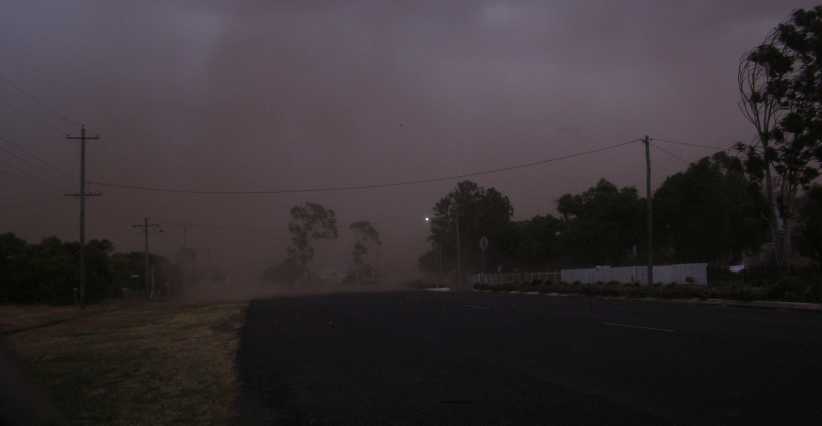
Summer storm. With dark clouds overhead and strong winds whipped up, dust swirled everywhere and power lines whipped about. That’s a spark up there on the right where lines have clashed with each other.
…strong winds came in to bring on a cloud of dust as well. We were on the edge of this storm, so there was no more than a few drops of rain, but it brought down power lines:
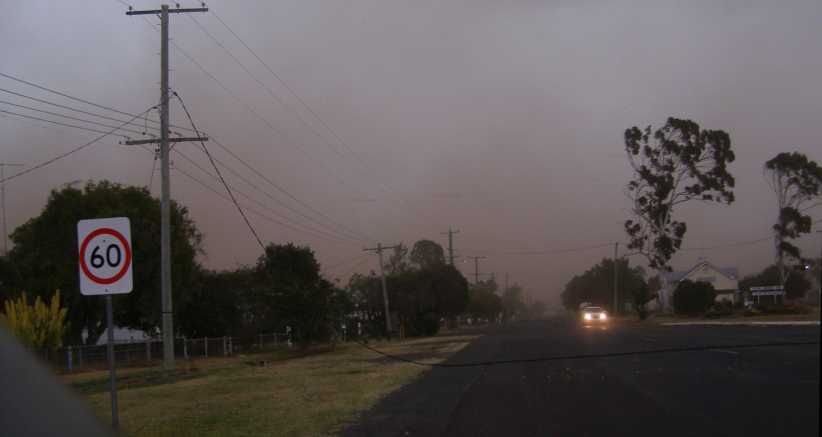
Power lines down. One of the lines brought down by the storm drapes across the main road into the town, the oncoming car’s lights being on due to the storm.
Clifton is only a small town and it’s off the main road. Many businesses have deserted towns such as this, but it still prospers in its own way. Locals go to the bigger towns for major purchases, however, and the old Ford dealership is now a tyre shop:
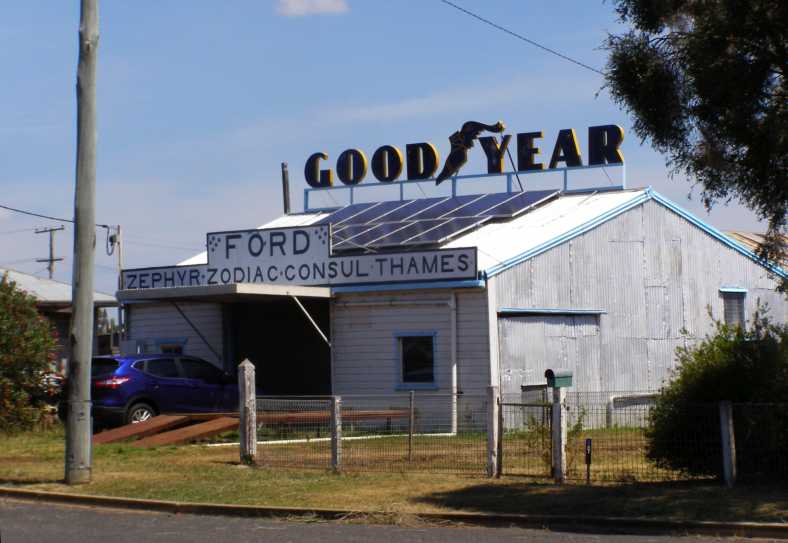
Defunct Ford dealer. While the Goodyear sign and the solar panels on the roof are signs of more modern times, the past glory of this place is retained with the names of the British Ford products formerly sold here still being displayed.
Zephyrs and Zodiacs were 6-cylinder cars of the fifties and sixties, Consuls were the (slightly asthmatic) 4-cylinder version of the same car while Thames were trucks and vans.
Such cars went by the board when the Japanese started marketing here, particularly when they sent us 6-cylinder cars. And it was a Japanese vehicle I was driving and another I was to retrieve a couple of days later with the help of a borrowed trailer:
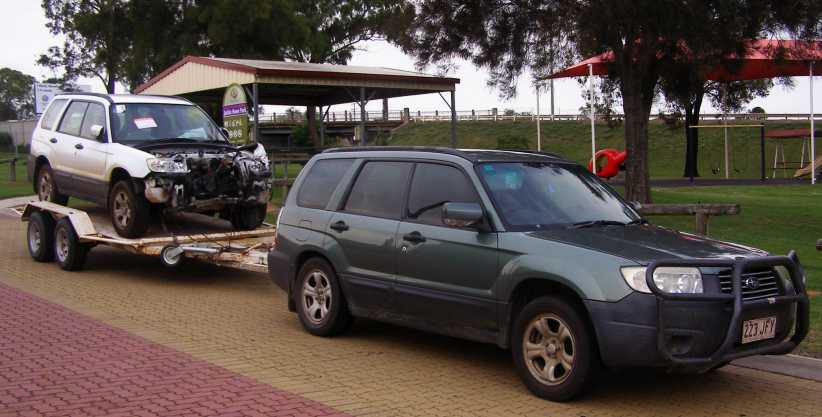
White Forester in transit. After crossing the Great Dividing Range I pulled up at Warwick for a break while towing this home.
Apart from giving me a replacement engine, this would ultimately provide me with many other parts, struts, driveshafts, brakes, all of which my vehicles consume as I cover so many miles. But I really would like to sell the doors and seats to recover some of my outlay!
As I continued my trip home I passed this road train as the highway passes through Warwick…
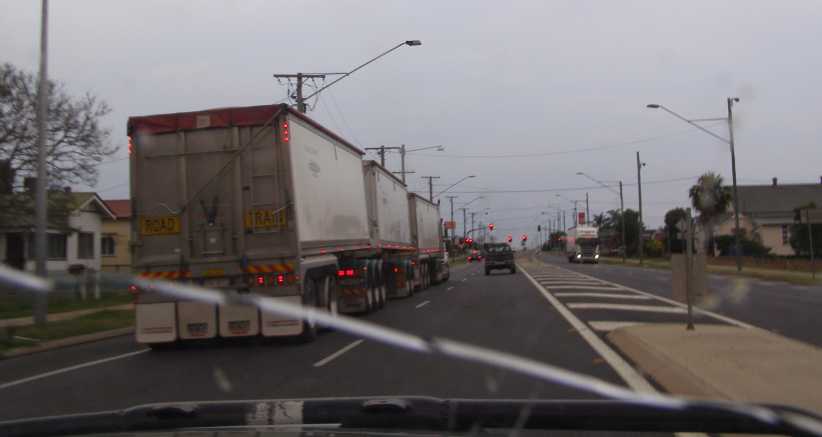
Road train. Road trains are rarely seen this close to the coast, but sometimes they venture this far away from their true home in the bush.
…and the photo makes it clear I could use a new windscreen. I thought I might get one from one of my wrecks but learned that getting them out is likely to break them. They are glued in place.
Of course I started pulling the white car to bits as soon as I got it home, but it would be quite some time before the engine went into the silver car for a variety of reasons. And my mind was very much occupied with getting the van home. I still had one more weekend of work to do before the company shut down for the year, this took me to Boggabilla:
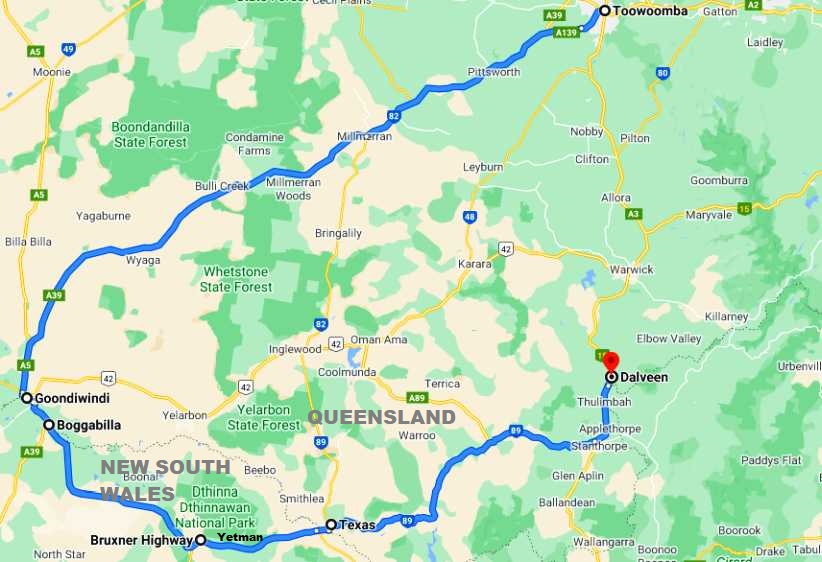
Toowoomba-Boggabilla-Dalveen. This map shows that I was going into or through areas where I’d been otherwise over the past few months, but basically I hadn’t used most of these roads at all in recent times.
I left Sandra in Toowoomba, having spent the rest of the week there, and took the main trucking route to Goondiwindi (that’s pronounced ‘Gundewindi’, by the way), crossed the Dumaresq (****: ‘Dewmerrick’) River, which is the border at that point, and went into the small-and-slowly-dying town of Boggabilla.
Staying in a local motel, I was able to enjoy the Saturday night at a communal barbecue in the motel, but much of the town spends such nights on the watch for children out of control or adults who’ve consumed too much alcohol. We’ll return to Boggabilla in a later post as I spent more time there doing two of the government jobs.
It’s a cause of some sadness to me as Boggabilla is a part of one of my earliest childhood memories – a family holiday from Sydney which culminated in spending a few days with my father’s eldest brother here after we’d leapfrogged up the NSW North Coast visiting other family members from Sydney. But that was 1950 and we were in an A-model Ford. As I drove towards home on the Sunday I was in the comfort of my Forester:
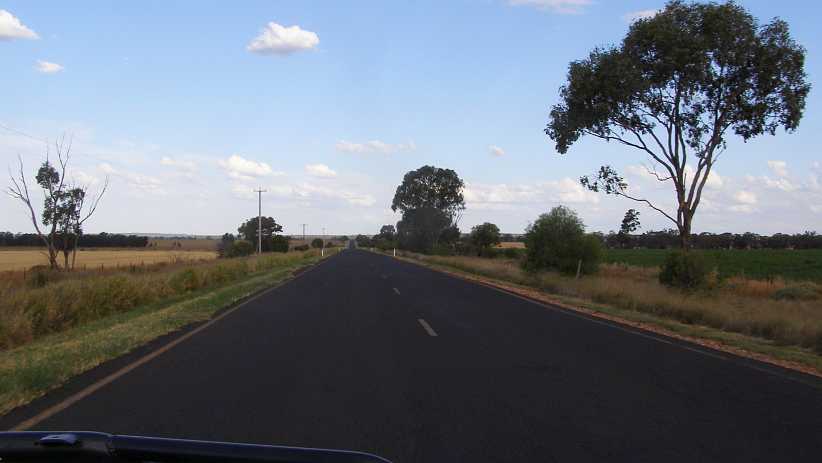
Road from Boggabilla. Long straight roads stretch into the distance, some crops at one side here, but mostly grassland and scrub in the flatter country.
Here I was racing home on the Sunday afternoon. During Saturday I had a phone call from a friend, Graeme, who was taking a break from home and headed up to my place so he could drive me to Sydney to pick up the van. But he was a day early and found my place all locked up. He did find a way in, however, and I told him to make himself at home, there was plenty of food in the fridge and he was waiting for me to return.
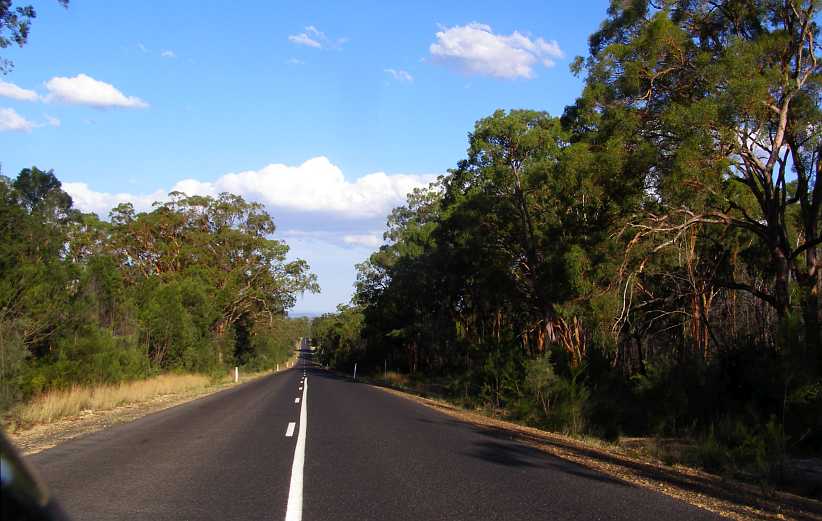
Hills and trees. In the hilly country there tends to be less cleared land and more trees and more of the inevitable scrub. Roads can still be quite straight out here, however.
Another small outpost was to be passed through, this being at Yetman, about 40 miles East of Boggabilla…
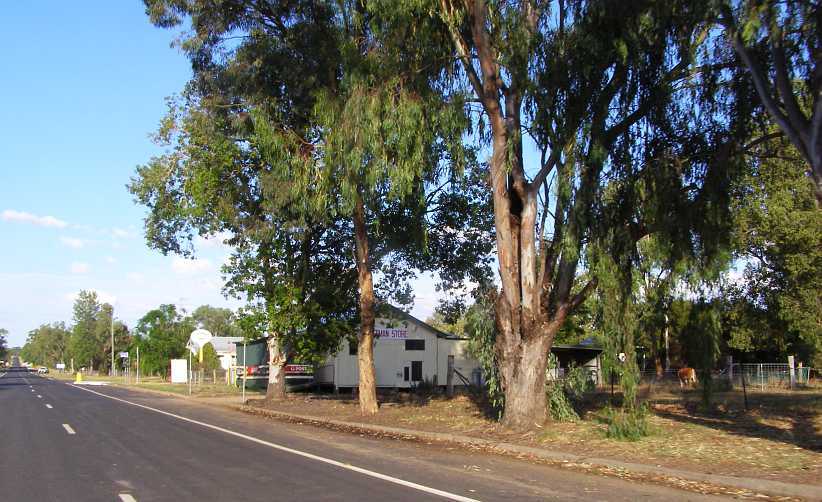
Yetman store and Post Office. Another town feeling the effects of modern transport, which takes locals to larger centres for most of their business.
…with the town of Texas being the next sign of civilisation, a further 30 miles on and off the Bruxner Highway and across the border in Queensland. Texas is much more prosperous than either Boggabilla or Yetman:
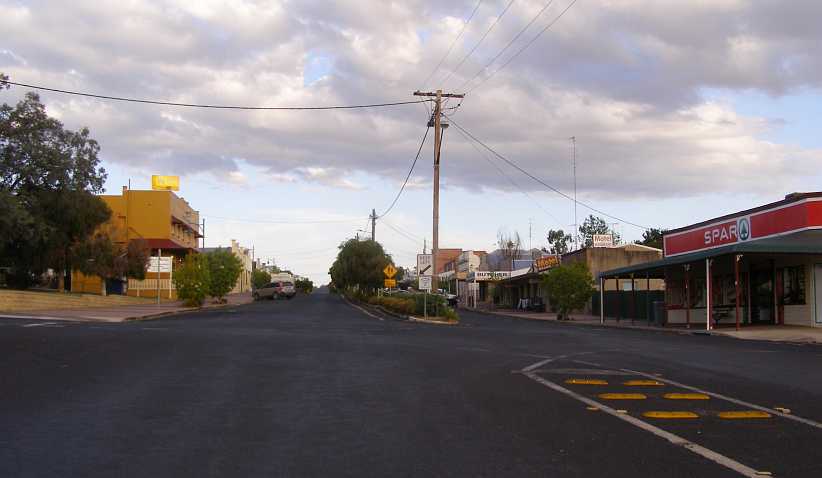
Texas. The main street of Texas, with a hotel on the left, a motel and the supermarket on the right, other businesses stretch up over the hill.
At this point I should explain that NSW has daylight saving and Queensland doesn’t, and we were near the longest day of the year, so it was still well and truly daylight when I got home. Graeme and I enjoyed a fine steak and started talking over things like how I’d deal with the Forester wreck and our trip to Sydney together to pick up the van:
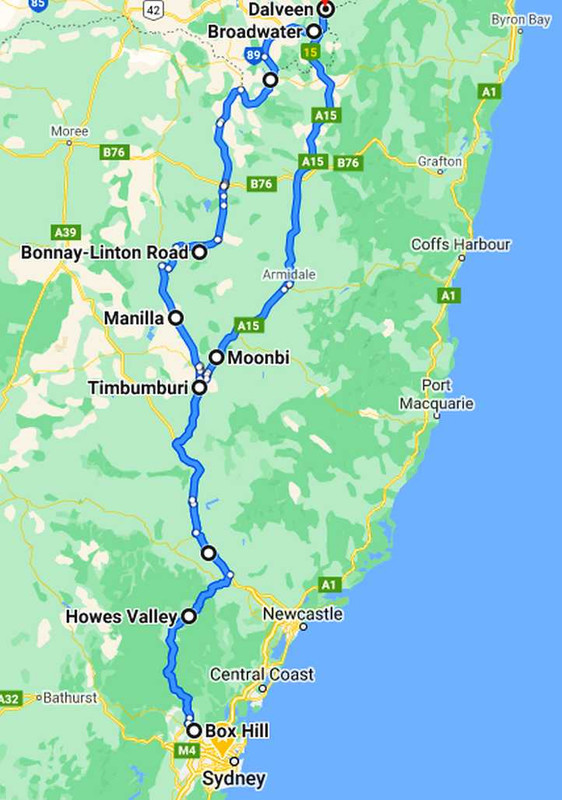
Sydney and return. The drive would be straightforward, down the New England Highway to Singleton, with a stopover at Bob Abberfield’s near Tamworth (Timbumburi on the map), then the Putty Road and on to Bob Britton’s, which was just around the corner from where the van was being held.
Again I kick myself for not taking enough photos. My first is at Moonbi, where Janet and I lived for a short time running the Post Office. But…
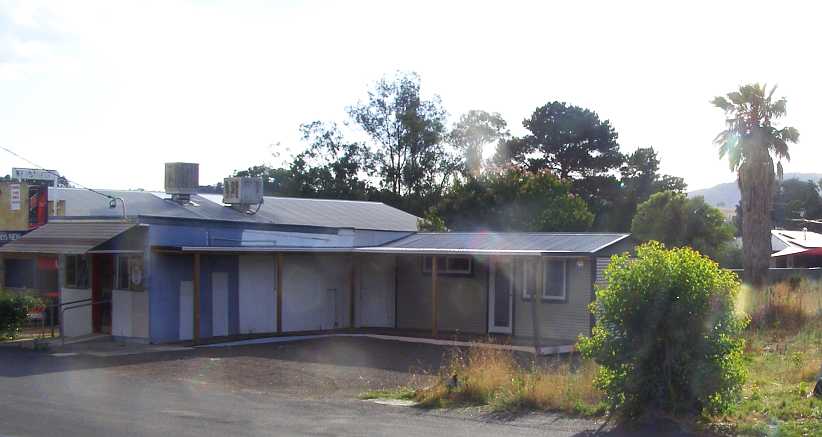
Moonbi memory. The house we lived in is gone, burned down a year or so before. The Post Office was in the structure to the left with the flat roof while the other part is new. The Post Office function has moved to the adjacent shop, the red sign just visible to the left of the window under the awning.
…these days the place isn’t there any more. The Post Office building was just a couple of feet from the house and must have come very close to catching fire too.
Driving on into Tamworth I got Graeme to pull up in a hurry as I saw this car and just had to get pics:
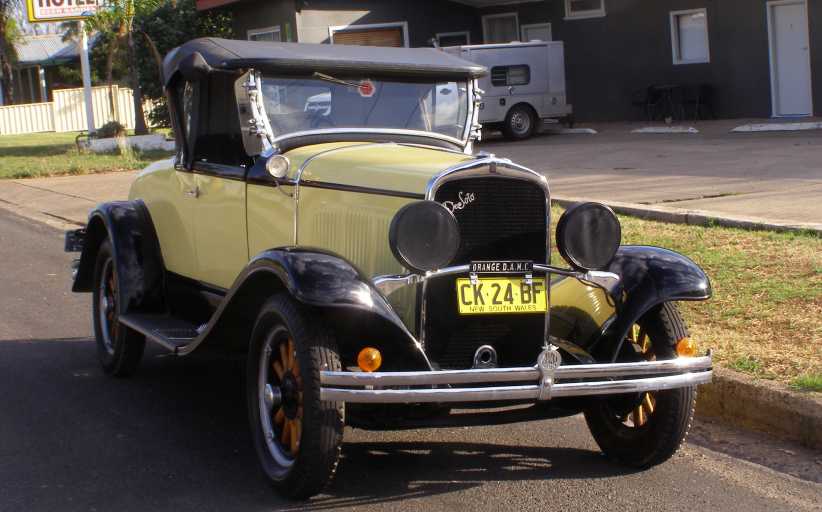
1929 De Soto roadster. A very nice restoration has been done on this car…
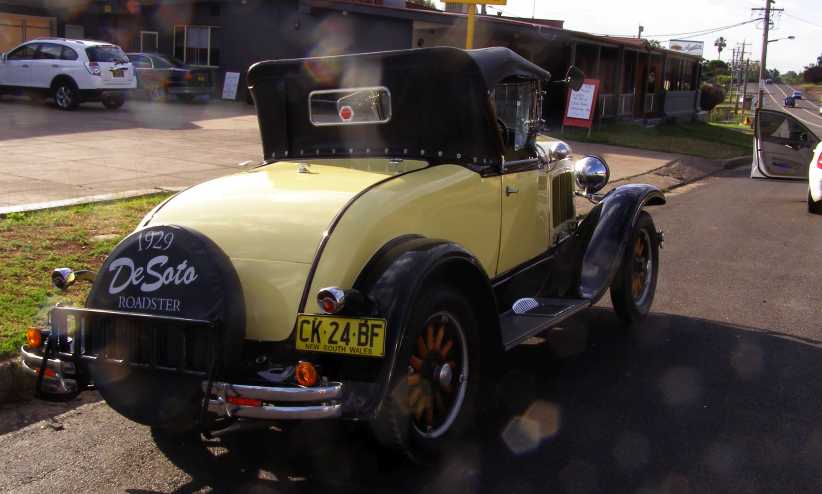
Dicky seat? …which is from the first model year of the De Soto range. Undoubtedly there’s a dicky seat in the rear if passengers want to go along.
Note in the background that I’ve left the passenger’s door of Graeme’s Mercedes open while I’ve snapped these pics!
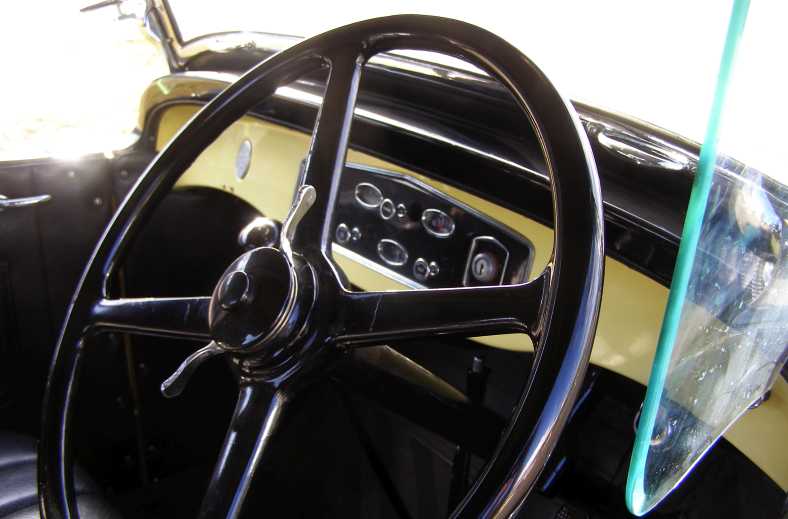
Simpler days. The instrument panel suited both left and right-hand drive while the gearlever came straight out of the top of the gearbox.
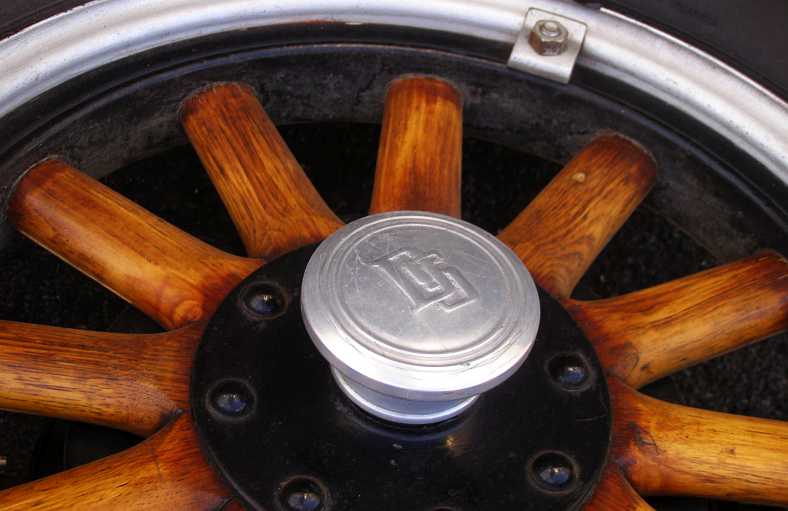
Wooden wheels. A nice job has been done on the wheels and the hubcaps with the ‘DS’ insignia are in good condition.
Our next stop was scheduled. Graeme was among those who joined in the Clubman racing in the seventies and one of our mutual racing friends was Bob Abberfield. It’s he who lives at Timbumburi, only a few miles South of the bustling city of Tamworth.
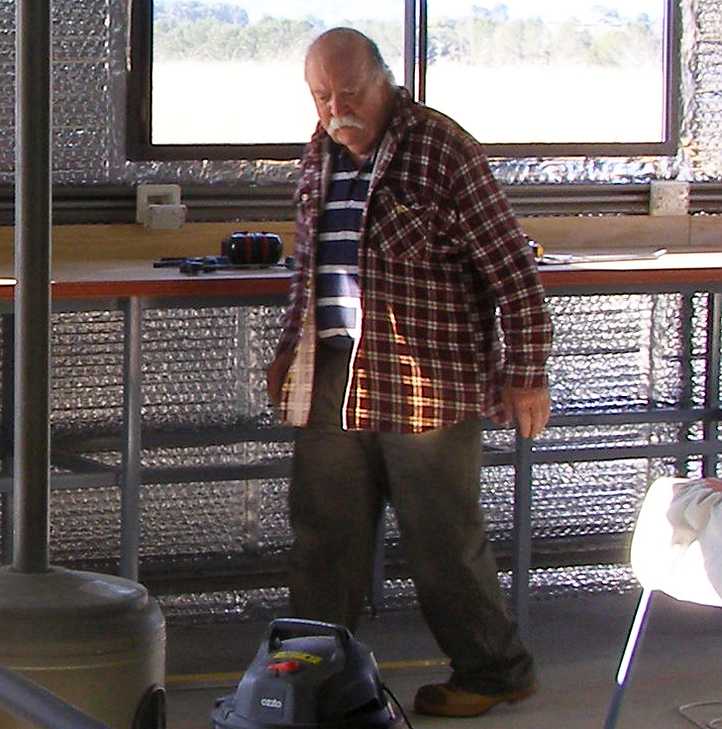
Bob Abberfield. Bob and his wife Elaine put us up for the night. This pic is from a later visit when Bob was building a new home workshop.
The next morning we cruised on, somewhere just South of Scone we passed a wide load going the other way…
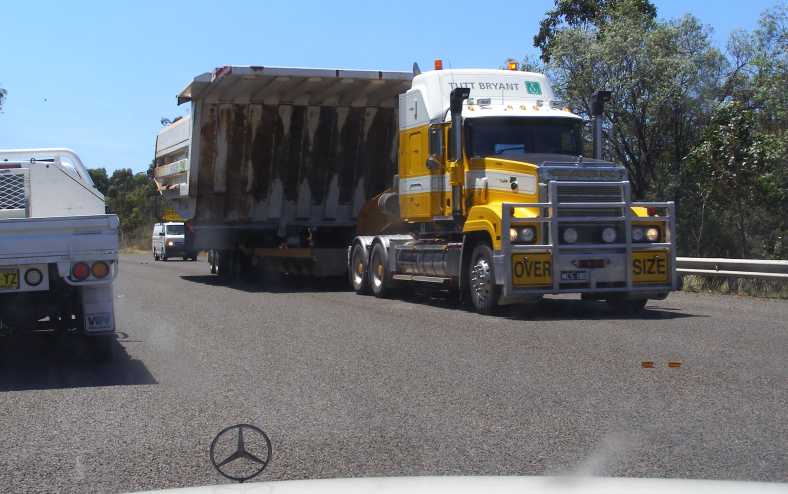
Wide load. A mining dump truck body being transported to the coal mines filled more than its own lane on this highway, which is mostly a 2-lane road.
Leaving the highway we slipped onto the Putty Road. This is a unique stretch of road, starting only forty or so miles from Sydney, it runs through almost uninhabited country for a hundred miles. Sandstone country with scrub and bush everywhere and little profit in attempting to use it for agriculture.
In the sixties it was famous for trucks trying to get a better run out of Sydney to the North, escaping the crowded coastal roads. But today there is a good freeway near the coast and trucks are more efficient on that sort of road. Motorcyclists love the twists and turns intermixed with straight stretches, hence a cafe recently opened at about the half-way mark, a bit South of Howes Valley, does a roaring trade:
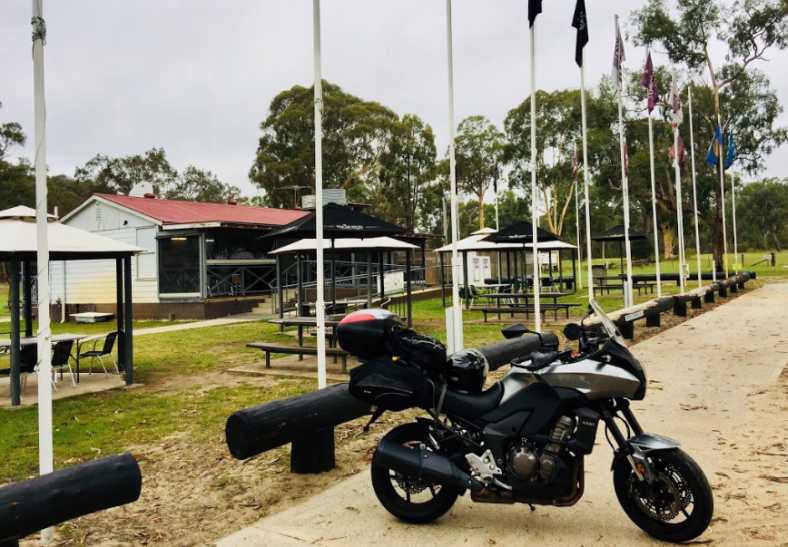
Grey Gums Cafe. Many motorcyclists out for an enjoyable ride stop here for refreshments, it being the only place in a long way to make a stop.
We also stopped in there for lunch. There had been a place called the ‘Halfway Roadhouse’ about eight miles further North which had done a roaring trade in the days when trucks came through in large numbers, but it had burned down some years before this place came into being.
We got to Windsor, at the Southern end of the Putty Road, then headed across to Box Hill and checked out things with the van. This place is really unusual, being basically a stock feeds outlet, but with a Customs Bond Store attached:
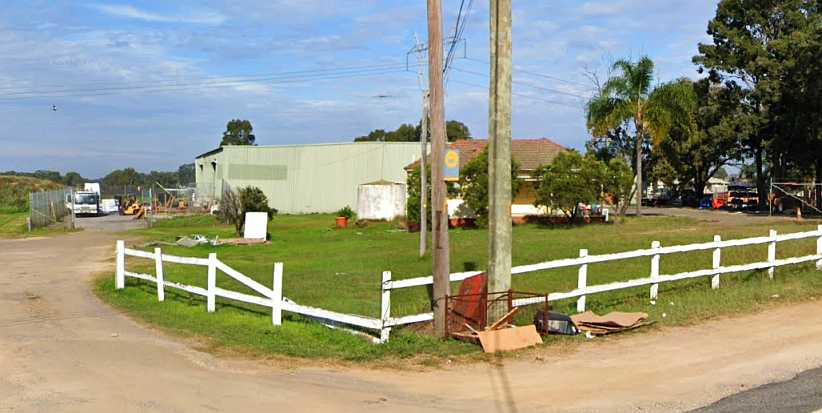
Bond Store. This part of the shed is where containers arrive for unpacking and inspections by Customs and Quarantine people.
I obtained a ‘Permit to Travel’ for the van and that allowed me to drive it around to Bob Britton’s place, about two miles away, and it gave me five days to drive it home by 'a direct route'. Graeme hadn’t met Bob before and was able to look over his ‘museum’ and current projects before he headed off home. I would be staying two nights and doing a bit of work to help Bob with his next project.
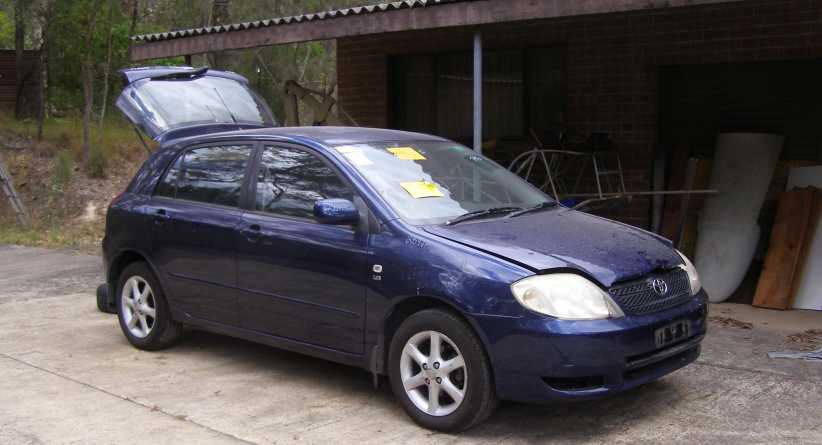
Corolla stripping. This Corolla had been there a few weeks earlier when I was last here, now it was starting to come apart to donate its heart to Bob’s next creation.
The big push was to get the power unit, the wiring harnesses and computer gear out of the car, Bob had basically finished the V6-powered beast and it stood by awaiting having its electronics sorted so he was drawing up a new car to use Corolla power in its rear end.
I had some fun doing that, but eventually I had to drive off and point the van towards its new home in Queensland. Refuelling at Windsor, I headed back to the Putty Road. I took my first pic of the van in Australia out front of that burned down roadhouse along that road:
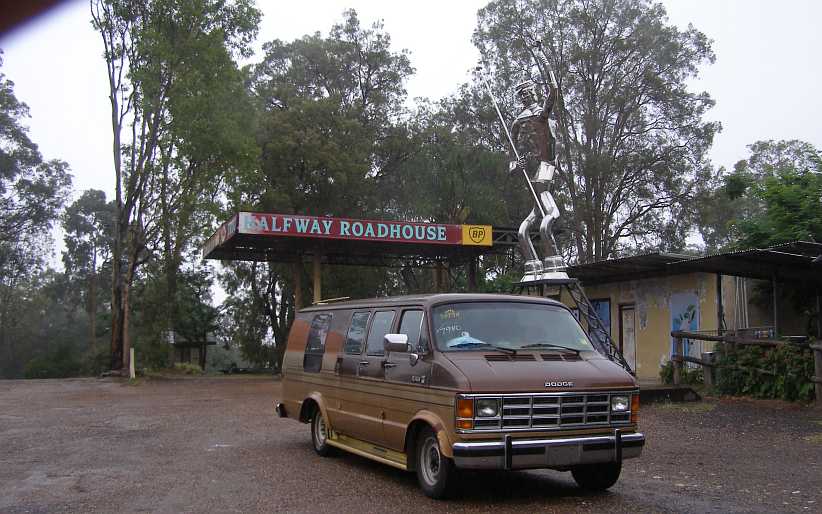
Halfway Roadhouse. In foreign territory, the van poses in front of the burned-out roadhouse, where it’s been raining.
Note, however, that there’s a giant silver statue behind the van. The current occupant of the place creates these things for a living. I drove on from there and again spent a night at Bob’s before heading on further.
I should explain, too, that I use the route chosen for taking these left-hand drive vehicles back home because of the lack of traffic. Both of the pickups went the same route as I reckoned it was safer and only a few miles further.
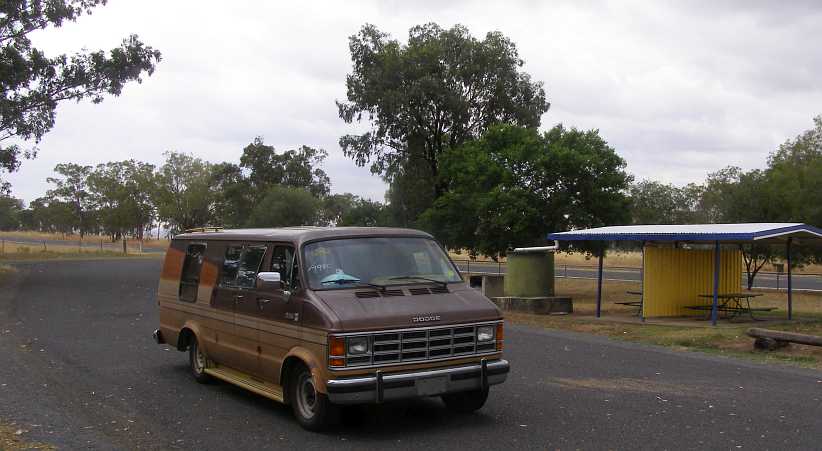
At Manilla. This rest area is a couple of miles South of Manilla, it satisfied my needs for a quick stop on what was still a cloudy day.
The next stop, on the map as ‘Bonnay-Linton Road’, was David Carroll’s farm. A part of the main road between Barraba, the next town North of Manilla, was gravel. And along this section I struck a few spots of rain…
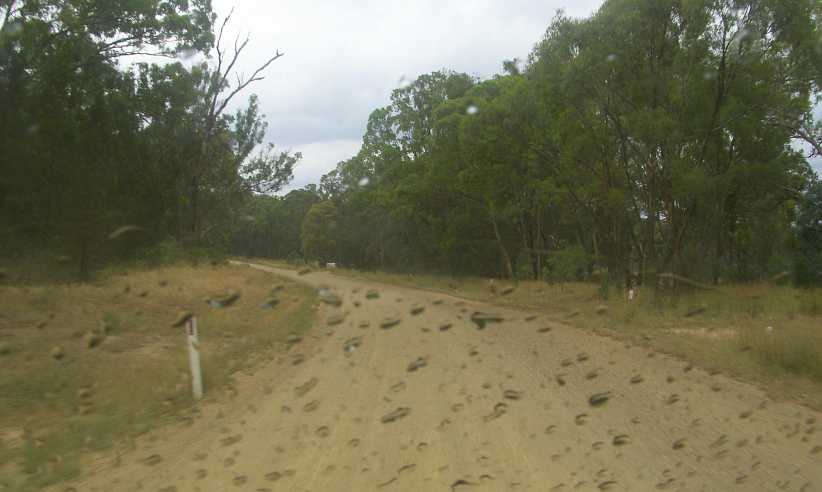
Rain spots on Barraba Road. We’re again in rougher country, but now it’s granite rather than sandstone. The scrub and gum trees remain, however.
After five or six miles of that ‘main’ road’s gravel section, I turned off onto the Bonnay-Linton Road, which isn’t as wide at all…
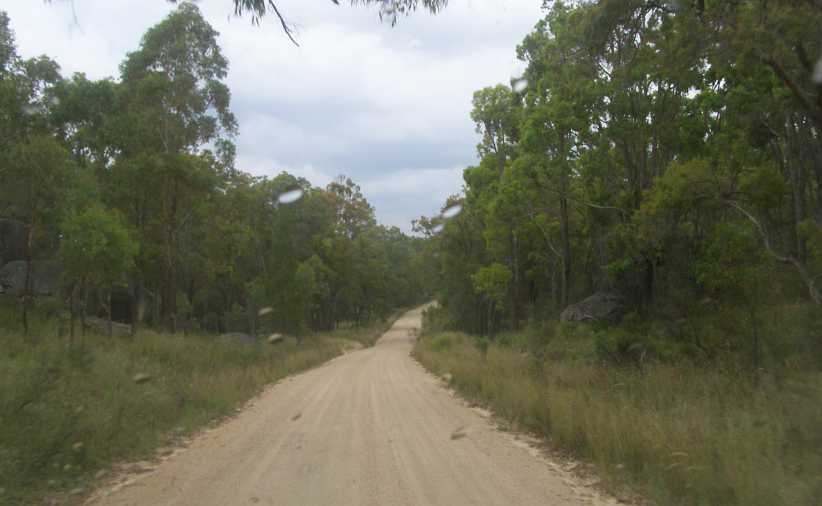
Road to Dave’s. There’s only room for one big van at a time on this road, which has some ‘interesting’ corners in it.
…so it’s a good thing that other traffic is rare. Nearing Dave’s it crosses a creek with this concrete ford:
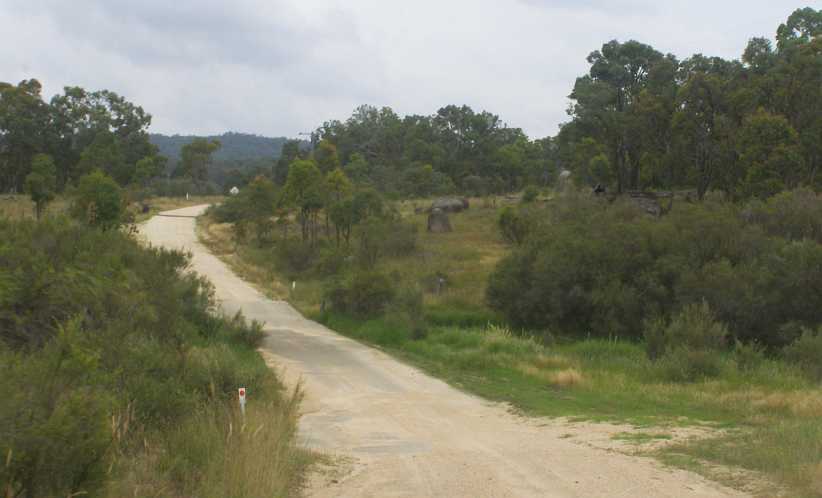
Creek crossing. Dry now, but in heavy rain this one stops traffic completely. Dave’s front gate is just around the next bend.
I was at my destination now. All that remained was to open the gate…
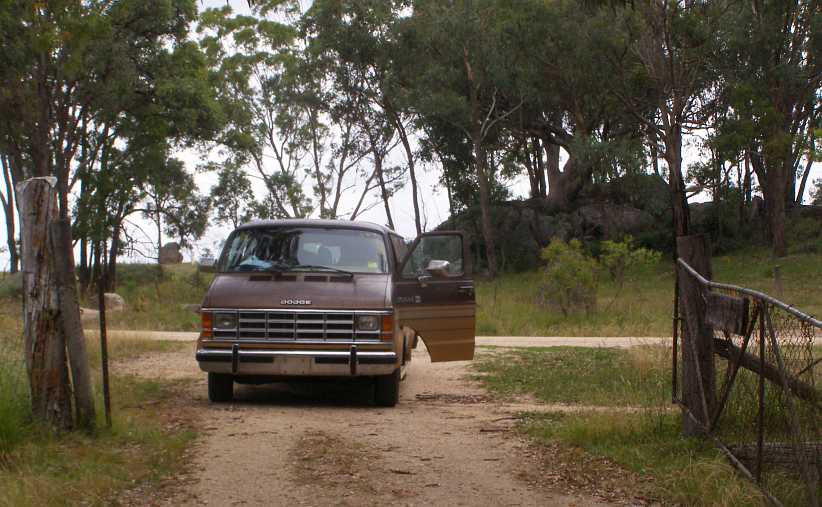
Dave’s gate. This picture gives a good idea of the local outlook, the granite boulders and scrappy trees mix with the old-time fences and the battered gate, it’s all typical of this country.
…which leads to Dave’s own creek crossing:
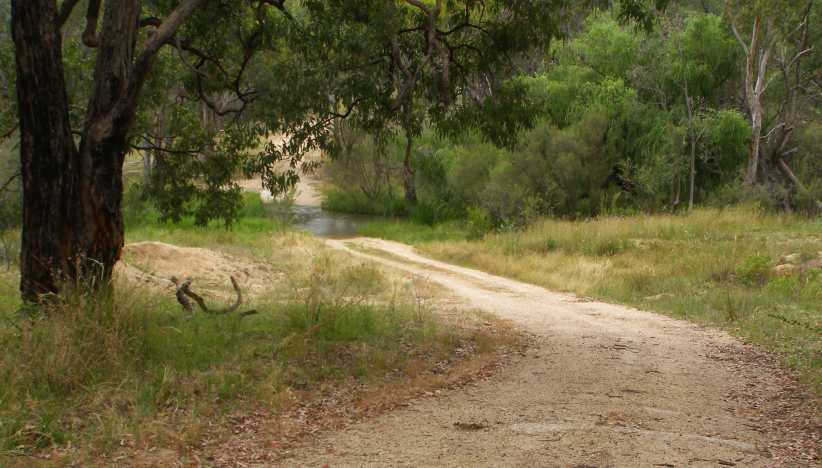
Dave’s ‘moat’. I call it a ‘moat’ but to Dave it was a handy bit of water for visitors’ cars to drive through and hopefully wash off unwanted seeds etc.
Though it meant a pause in my trip, this was going to be a whole new adventure as Dave was preparing to sell up and move out of this place.
The farm is 4,000acres, he bought it full of hopes and saw droughts kill those right off. This week he was totally engrossed in repairing his bulldozer so he could take it away and I was there to give him a hand. Or to learn things from him as I watched him get on with the job.
So delivering the van to Dalveen took a bit of a break, Peggy cooked us a nice dinner and Dave selected a good bottle of wine…
And, of course, I still had a couple of weekends of work to do. On the first weekend of the month I was working at Clifton, between my home in Dalveen and Toowoomba, so I spent each night with Sandra, but the Saturday afternoon in Clifton turned very dark…
Summer storm. With dark clouds overhead and strong winds whipped up, dust swirled everywhere and power lines whipped about. That’s a spark up there on the right where lines have clashed with each other.
…strong winds came in to bring on a cloud of dust as well. We were on the edge of this storm, so there was no more than a few drops of rain, but it brought down power lines:
Power lines down. One of the lines brought down by the storm drapes across the main road into the town, the oncoming car’s lights being on due to the storm.
Clifton is only a small town and it’s off the main road. Many businesses have deserted towns such as this, but it still prospers in its own way. Locals go to the bigger towns for major purchases, however, and the old Ford dealership is now a tyre shop:
Defunct Ford dealer. While the Goodyear sign and the solar panels on the roof are signs of more modern times, the past glory of this place is retained with the names of the British Ford products formerly sold here still being displayed.
Zephyrs and Zodiacs were 6-cylinder cars of the fifties and sixties, Consuls were the (slightly asthmatic) 4-cylinder version of the same car while Thames were trucks and vans.
Such cars went by the board when the Japanese started marketing here, particularly when they sent us 6-cylinder cars. And it was a Japanese vehicle I was driving and another I was to retrieve a couple of days later with the help of a borrowed trailer:
White Forester in transit. After crossing the Great Dividing Range I pulled up at Warwick for a break while towing this home.
Apart from giving me a replacement engine, this would ultimately provide me with many other parts, struts, driveshafts, brakes, all of which my vehicles consume as I cover so many miles. But I really would like to sell the doors and seats to recover some of my outlay!
As I continued my trip home I passed this road train as the highway passes through Warwick…
Road train. Road trains are rarely seen this close to the coast, but sometimes they venture this far away from their true home in the bush.
…and the photo makes it clear I could use a new windscreen. I thought I might get one from one of my wrecks but learned that getting them out is likely to break them. They are glued in place.
Of course I started pulling the white car to bits as soon as I got it home, but it would be quite some time before the engine went into the silver car for a variety of reasons. And my mind was very much occupied with getting the van home. I still had one more weekend of work to do before the company shut down for the year, this took me to Boggabilla:
Toowoomba-Boggabilla-Dalveen. This map shows that I was going into or through areas where I’d been otherwise over the past few months, but basically I hadn’t used most of these roads at all in recent times.
I left Sandra in Toowoomba, having spent the rest of the week there, and took the main trucking route to Goondiwindi (that’s pronounced ‘Gundewindi’, by the way), crossed the Dumaresq (****: ‘Dewmerrick’) River, which is the border at that point, and went into the small-and-slowly-dying town of Boggabilla.
Staying in a local motel, I was able to enjoy the Saturday night at a communal barbecue in the motel, but much of the town spends such nights on the watch for children out of control or adults who’ve consumed too much alcohol. We’ll return to Boggabilla in a later post as I spent more time there doing two of the government jobs.
It’s a cause of some sadness to me as Boggabilla is a part of one of my earliest childhood memories – a family holiday from Sydney which culminated in spending a few days with my father’s eldest brother here after we’d leapfrogged up the NSW North Coast visiting other family members from Sydney. But that was 1950 and we were in an A-model Ford. As I drove towards home on the Sunday I was in the comfort of my Forester:
Road from Boggabilla. Long straight roads stretch into the distance, some crops at one side here, but mostly grassland and scrub in the flatter country.
Here I was racing home on the Sunday afternoon. During Saturday I had a phone call from a friend, Graeme, who was taking a break from home and headed up to my place so he could drive me to Sydney to pick up the van. But he was a day early and found my place all locked up. He did find a way in, however, and I told him to make himself at home, there was plenty of food in the fridge and he was waiting for me to return.
Hills and trees. In the hilly country there tends to be less cleared land and more trees and more of the inevitable scrub. Roads can still be quite straight out here, however.
Another small outpost was to be passed through, this being at Yetman, about 40 miles East of Boggabilla…
Yetman store and Post Office. Another town feeling the effects of modern transport, which takes locals to larger centres for most of their business.
…with the town of Texas being the next sign of civilisation, a further 30 miles on and off the Bruxner Highway and across the border in Queensland. Texas is much more prosperous than either Boggabilla or Yetman:
Texas. The main street of Texas, with a hotel on the left, a motel and the supermarket on the right, other businesses stretch up over the hill.
At this point I should explain that NSW has daylight saving and Queensland doesn’t, and we were near the longest day of the year, so it was still well and truly daylight when I got home. Graeme and I enjoyed a fine steak and started talking over things like how I’d deal with the Forester wreck and our trip to Sydney together to pick up the van:
Sydney and return. The drive would be straightforward, down the New England Highway to Singleton, with a stopover at Bob Abberfield’s near Tamworth (Timbumburi on the map), then the Putty Road and on to Bob Britton’s, which was just around the corner from where the van was being held.
Again I kick myself for not taking enough photos. My first is at Moonbi, where Janet and I lived for a short time running the Post Office. But…
Moonbi memory. The house we lived in is gone, burned down a year or so before. The Post Office was in the structure to the left with the flat roof while the other part is new. The Post Office function has moved to the adjacent shop, the red sign just visible to the left of the window under the awning.
…these days the place isn’t there any more. The Post Office building was just a couple of feet from the house and must have come very close to catching fire too.
Driving on into Tamworth I got Graeme to pull up in a hurry as I saw this car and just had to get pics:
1929 De Soto roadster. A very nice restoration has been done on this car…
Dicky seat? …which is from the first model year of the De Soto range. Undoubtedly there’s a dicky seat in the rear if passengers want to go along.
Note in the background that I’ve left the passenger’s door of Graeme’s Mercedes open while I’ve snapped these pics!
Simpler days. The instrument panel suited both left and right-hand drive while the gearlever came straight out of the top of the gearbox.
Wooden wheels. A nice job has been done on the wheels and the hubcaps with the ‘DS’ insignia are in good condition.
Our next stop was scheduled. Graeme was among those who joined in the Clubman racing in the seventies and one of our mutual racing friends was Bob Abberfield. It’s he who lives at Timbumburi, only a few miles South of the bustling city of Tamworth.
Bob Abberfield. Bob and his wife Elaine put us up for the night. This pic is from a later visit when Bob was building a new home workshop.
The next morning we cruised on, somewhere just South of Scone we passed a wide load going the other way…
Wide load. A mining dump truck body being transported to the coal mines filled more than its own lane on this highway, which is mostly a 2-lane road.
Leaving the highway we slipped onto the Putty Road. This is a unique stretch of road, starting only forty or so miles from Sydney, it runs through almost uninhabited country for a hundred miles. Sandstone country with scrub and bush everywhere and little profit in attempting to use it for agriculture.
In the sixties it was famous for trucks trying to get a better run out of Sydney to the North, escaping the crowded coastal roads. But today there is a good freeway near the coast and trucks are more efficient on that sort of road. Motorcyclists love the twists and turns intermixed with straight stretches, hence a cafe recently opened at about the half-way mark, a bit South of Howes Valley, does a roaring trade:
Grey Gums Cafe. Many motorcyclists out for an enjoyable ride stop here for refreshments, it being the only place in a long way to make a stop.
We also stopped in there for lunch. There had been a place called the ‘Halfway Roadhouse’ about eight miles further North which had done a roaring trade in the days when trucks came through in large numbers, but it had burned down some years before this place came into being.
We got to Windsor, at the Southern end of the Putty Road, then headed across to Box Hill and checked out things with the van. This place is really unusual, being basically a stock feeds outlet, but with a Customs Bond Store attached:
Bond Store. This part of the shed is where containers arrive for unpacking and inspections by Customs and Quarantine people.
I obtained a ‘Permit to Travel’ for the van and that allowed me to drive it around to Bob Britton’s place, about two miles away, and it gave me five days to drive it home by 'a direct route'. Graeme hadn’t met Bob before and was able to look over his ‘museum’ and current projects before he headed off home. I would be staying two nights and doing a bit of work to help Bob with his next project.
Corolla stripping. This Corolla had been there a few weeks earlier when I was last here, now it was starting to come apart to donate its heart to Bob’s next creation.
The big push was to get the power unit, the wiring harnesses and computer gear out of the car, Bob had basically finished the V6-powered beast and it stood by awaiting having its electronics sorted so he was drawing up a new car to use Corolla power in its rear end.
I had some fun doing that, but eventually I had to drive off and point the van towards its new home in Queensland. Refuelling at Windsor, I headed back to the Putty Road. I took my first pic of the van in Australia out front of that burned down roadhouse along that road:
Halfway Roadhouse. In foreign territory, the van poses in front of the burned-out roadhouse, where it’s been raining.
Note, however, that there’s a giant silver statue behind the van. The current occupant of the place creates these things for a living. I drove on from there and again spent a night at Bob’s before heading on further.
I should explain, too, that I use the route chosen for taking these left-hand drive vehicles back home because of the lack of traffic. Both of the pickups went the same route as I reckoned it was safer and only a few miles further.
At Manilla. This rest area is a couple of miles South of Manilla, it satisfied my needs for a quick stop on what was still a cloudy day.
The next stop, on the map as ‘Bonnay-Linton Road’, was David Carroll’s farm. A part of the main road between Barraba, the next town North of Manilla, was gravel. And along this section I struck a few spots of rain…
Rain spots on Barraba Road. We’re again in rougher country, but now it’s granite rather than sandstone. The scrub and gum trees remain, however.
After five or six miles of that ‘main’ road’s gravel section, I turned off onto the Bonnay-Linton Road, which isn’t as wide at all…
Road to Dave’s. There’s only room for one big van at a time on this road, which has some ‘interesting’ corners in it.
…so it’s a good thing that other traffic is rare. Nearing Dave’s it crosses a creek with this concrete ford:
Creek crossing. Dry now, but in heavy rain this one stops traffic completely. Dave’s front gate is just around the next bend.
I was at my destination now. All that remained was to open the gate…
Dave’s gate. This picture gives a good idea of the local outlook, the granite boulders and scrappy trees mix with the old-time fences and the battered gate, it’s all typical of this country.
…which leads to Dave’s own creek crossing:
Dave’s ‘moat’. I call it a ‘moat’ but to Dave it was a handy bit of water for visitors’ cars to drive through and hopefully wash off unwanted seeds etc.
Though it meant a pause in my trip, this was going to be a whole new adventure as Dave was preparing to sell up and move out of this place.
The farm is 4,000acres, he bought it full of hopes and saw droughts kill those right off. This week he was totally engrossed in repairing his bulldozer so he could take it away and I was there to give him a hand. Or to learn things from him as I watched him get on with the job.
So delivering the van to Dalveen took a bit of a break, Peggy cooked us a nice dinner and Dave selected a good bottle of wine…
Last edited by Ray Bell; Oct 3, 2020 at 11:23 PM.
Thread Starter
|
Captain
Joined: Oct 2005
Posts: 570
Likes: 8
From: The Summit, Queensland, Australia
Dave had bought the property from a deceased estate. Apparently the police were closing in on the owner, who was growing drugs, and he killed himself. Hiding such a venture on this property must have been easy, looking at the aerial view from Google Earth:
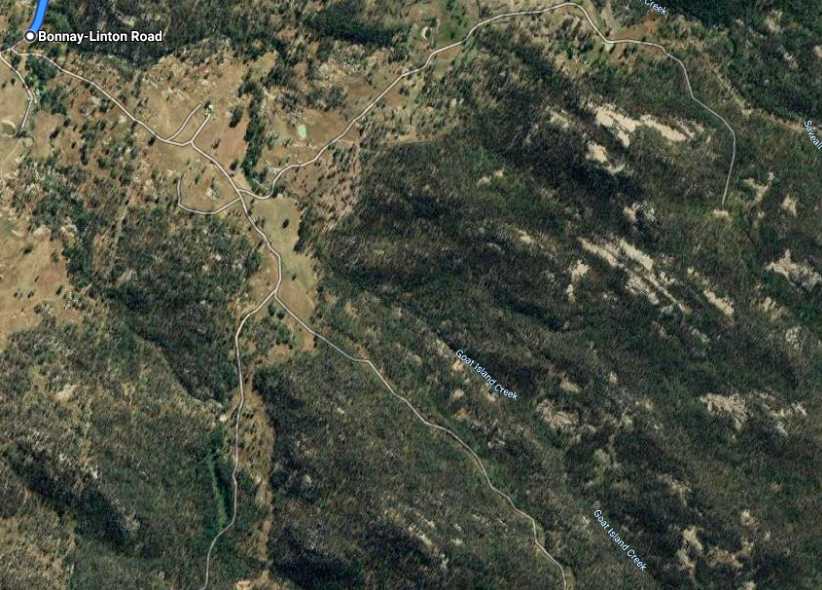
Dave’s rough country. Most of this area is within the boundaries of Dave’s farm, very little is cleared and not much more arable, it’s pretty rough all over. Dave told me he owned it for two years before he discovered where the drugs had been growing.
I had enjoyed a number of overnight stays with Dave and Peggy since rekindling our friendship about five years previously. He was another of our Clubman racing friends but had moved away thirty years earlier and then really disappeared when he went farming.
Breakfast was a social time, but there was work to be done outside as the sun cast its long shadows and promised to bring a warm day. My van was a long way from its original home in Oregon and a total stranger in this bit of Aussie bush. But what could be any more out of place than a beach umbrella sitting up on a bulldozer?
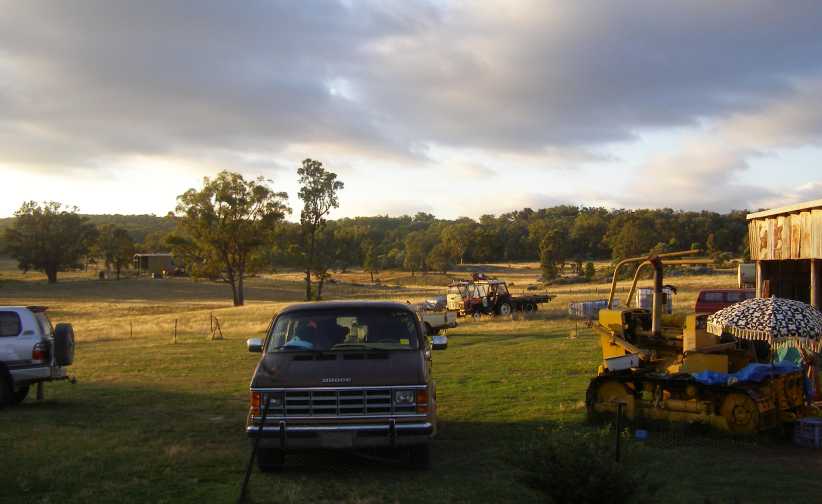
Morning at Dave’s. The morning sun lights up the scene where the work would take place during the day.
Dave had made progress since my previous visit, when the effort was going into fitting up the tracks. An effort which saw the end of one 20-ton jack. Now he was working on the gears and the end of the job was in sight. He’d made a puller to get this gear out so he could replace the ball bearing within it:
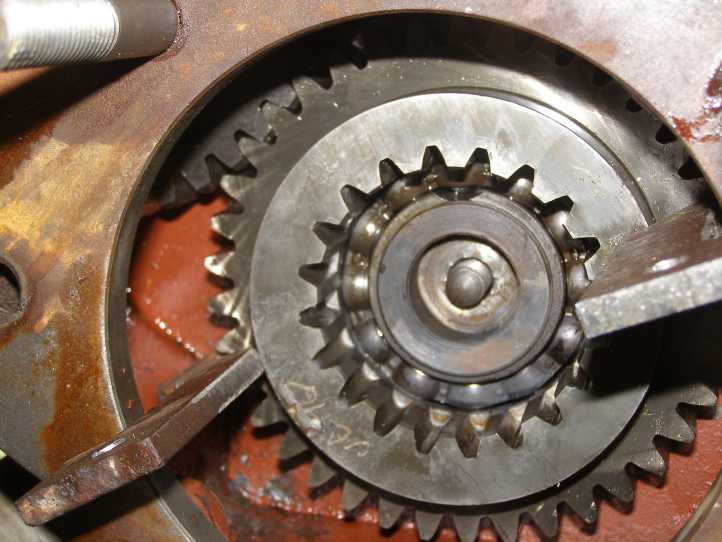
Hard to remove. A special puller had to be made to get this gear out, but that was no impediment and it was just a matter of time.
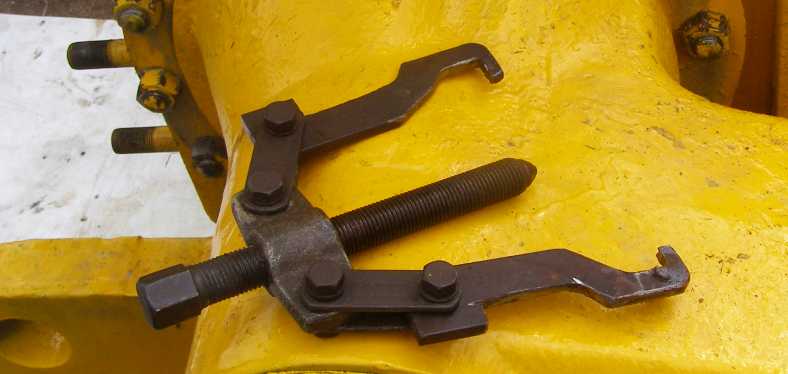
Special puller. This is the puller which has to find its way around the corners to get things moving.
And once out it all looked such an innocent and easy thing to do…
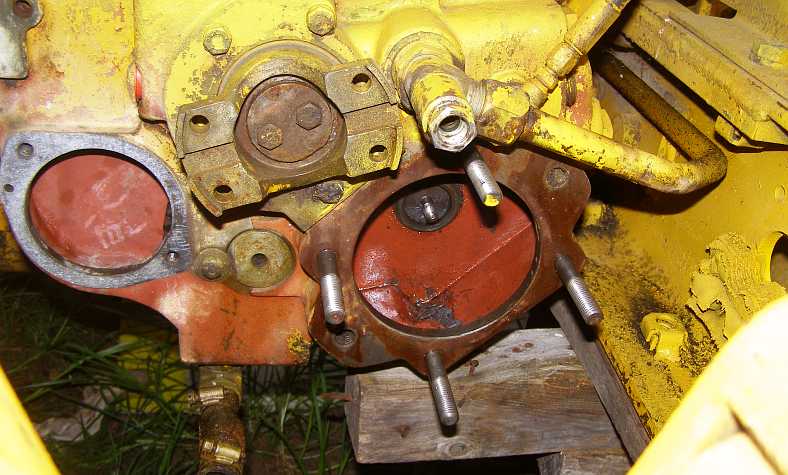
Gear out. An empty section of housing signalled success in this job.
…but nothing like this is all that easy. It reached a point where we had to drive into Bundarra to get something, which revealed that someone had taken up residence in an old double-deck bus. I wanted a closer look, but that would wait until I was on my way home.
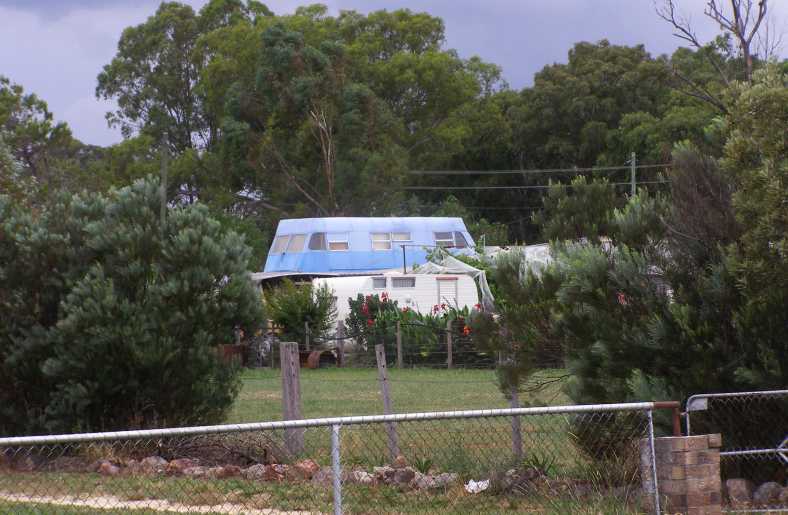
Bus in town. I’d looked around the town plenty of times too, but this converted bus was a newcomer I’d not seen before.
The next step in the job was where I learned something new. Dave had to shrink the bearing into the gear and I thought that would be really tricky. But no, sitting the gear in an old electric frypan and the bearing in the freezer for a short time made it so they just fell together.
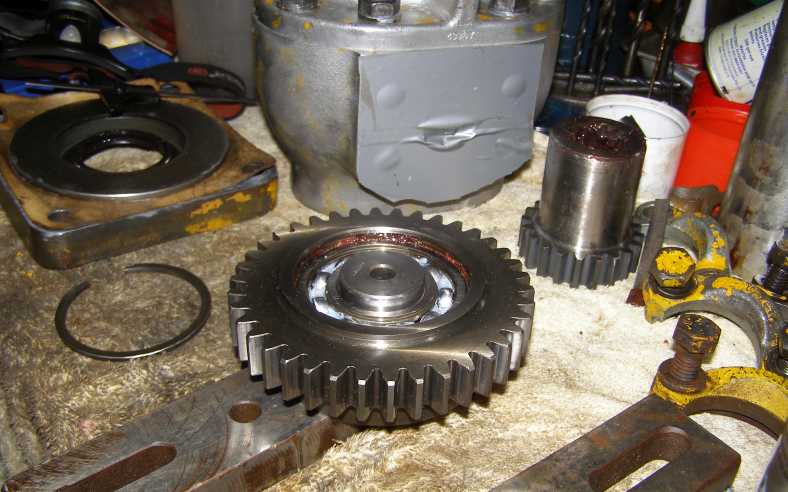
New bearing in. All greased up and ready to go, the bearing had been fitted with the help of kitchen appliances.
And so Dave was able to proceed with the reassembly…
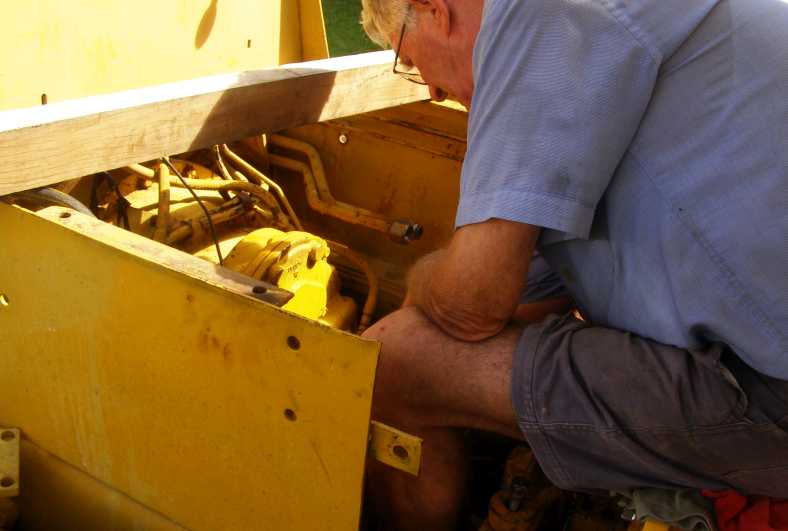
Reassembly position. Dave sits in the shade of the beach umbrella and gets on with the job of screwing it all back together.
It was late afternoon before I left, I did get to Bundarra in time to get a photo of the other side of the bus…
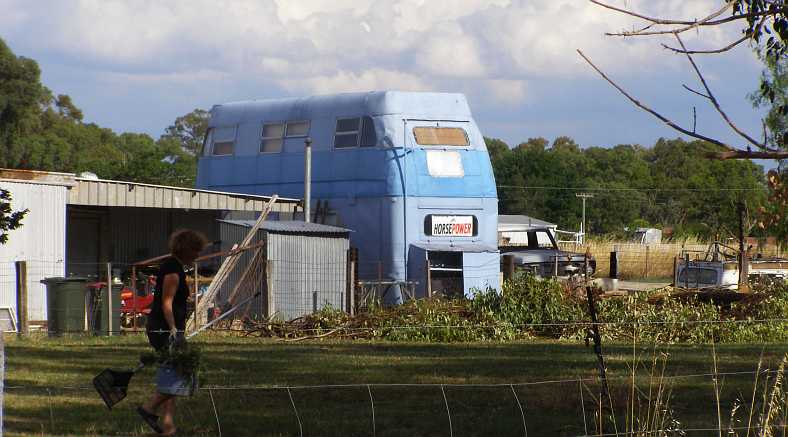
More of the bus. A fuller picture of the old bus. Such things as this aren’t strange in places like this, we’ll see more as we go on.
I dropped in to my cousin’s place between Bundarra and Inverell, a quick stop, and then it was dark for most of the run home. Except that I couldn’t go all the way because I had to drop off a lot of gearboxes and a couple of V8 blocks before I got there. These were mostly to be left in a storage shed I have at The Summit, but one automatic transmission had to go to a friend’s place between there and home.
Ironically, I’d bought this for him about five years previously (the stuff which had been left in the desert at Phoenix, remember?) but he’d died before I delivered it.
A shopping trip to Stanthorpe a day or two later and there I got a shot of this Valiant VC utility:
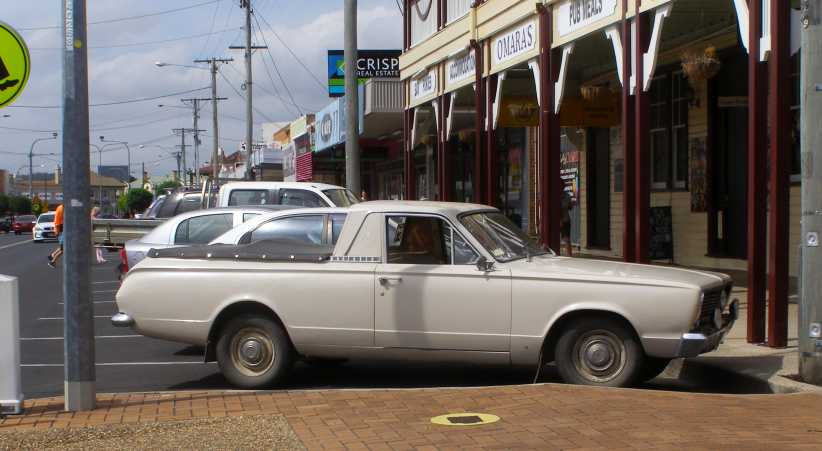
VC Valiant utility. This one sees daily service in the local area and was nearly fifty years old.
But the main purpose of all that had gone before was to get the B350 to my home. And here it was…
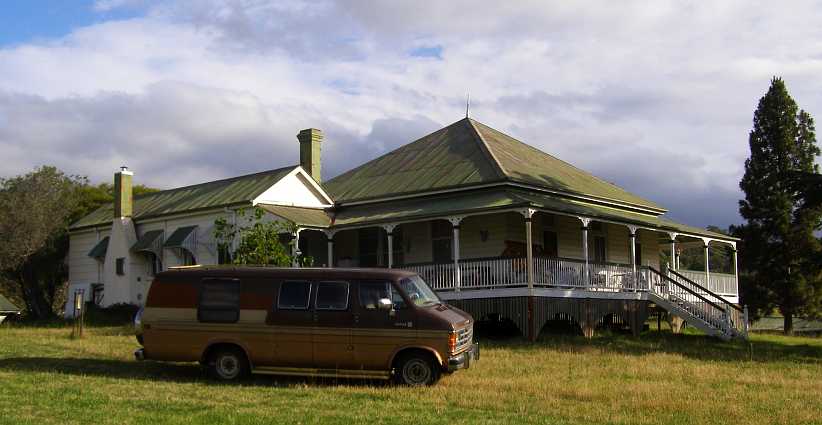
B350 finally at home. Parked in the house yard at the place I’d called home for the past seven years, I’d refitted the spare wheel carrier to the back door.
…and it had lost some of its heavy load. But still more had to come out, while I wondered about those wheel-arch flares:
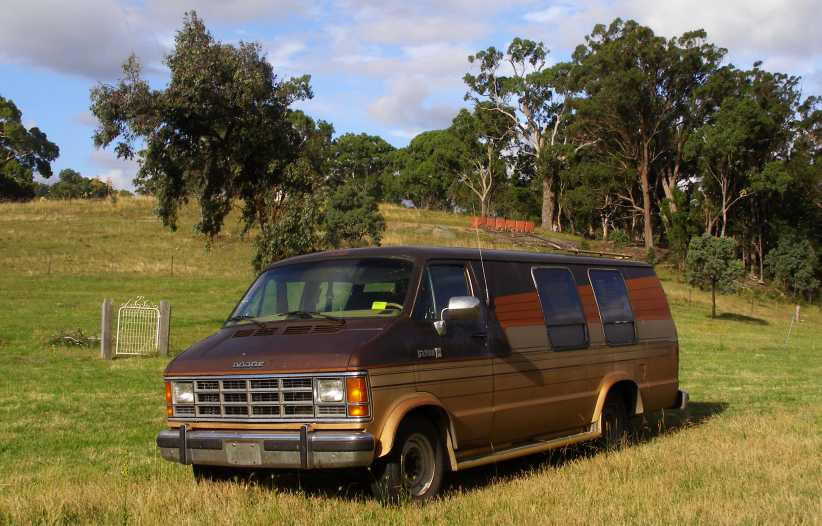
Flares still fitted. Not for much longer. Within a few days of getting home I removed them altogether.
Just why they were there was a mystery, but I’ve theorised that the people who did the conversion fitted wider rims which came out beyond the original bodywork. That makes sense, too, when it’s remembered that 16.5” rims were fitted when I got it. The original owner, seemingly, just got some wheels from somewhere to replace the wide ones he’d been using.
Without the flares it actually looks a lot better:
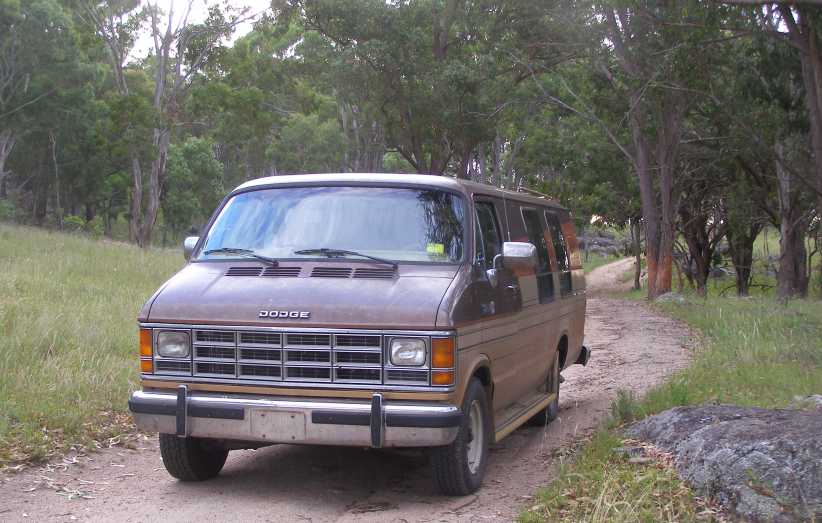
No more flares. Several self-tapping screws held each of the flares on, so some deft turning of a Phillips screwdriver soon took care of them.
With those gone I took a drive around the property. The farm on which I lived was 860 acres and I had the run of the place, so I drove down through the bush on the track shown above and went to the shearing shed:
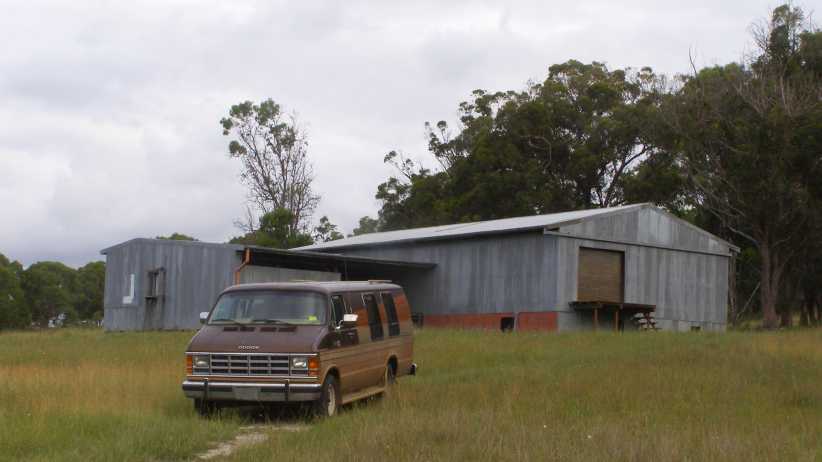
Shearing shed. The shearing shed is used only for storage today, but once it was a busy place at shearing time.
I’ve been told that this property, along with a 1900-acre section on the other side of the road, was sending a semi-trailer of fat lambs away every month when in full production. So there would have been a good number of sheep to shear. Now it carried a small number of cattle, but the owner has plans for expansion.
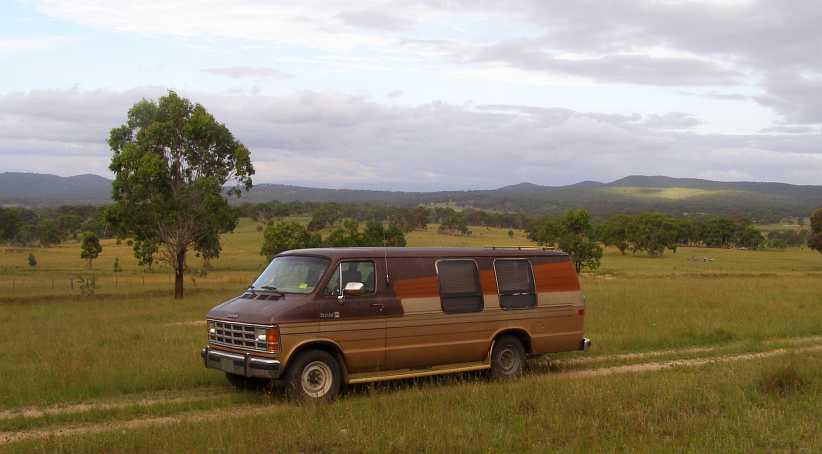
On the track. The open country near the shearing shed provides a nice backdrop for the van at its new home.
But further work on the van would have to wait. I had responsibilities and one of those was to keep Sandra’s Falcon mobile. A leak in a pipe in the heater system was small, but could get worse, so I had to find a better one (near new, in fact) at a wrecking yard and work in the confined space underneath the fuel injection to get it fitted.
The way the Falcon engine has grown like topsy in going from pushrod ohv with carburettor to single overhead cam with fuel injection means that nothing is easy to get to.
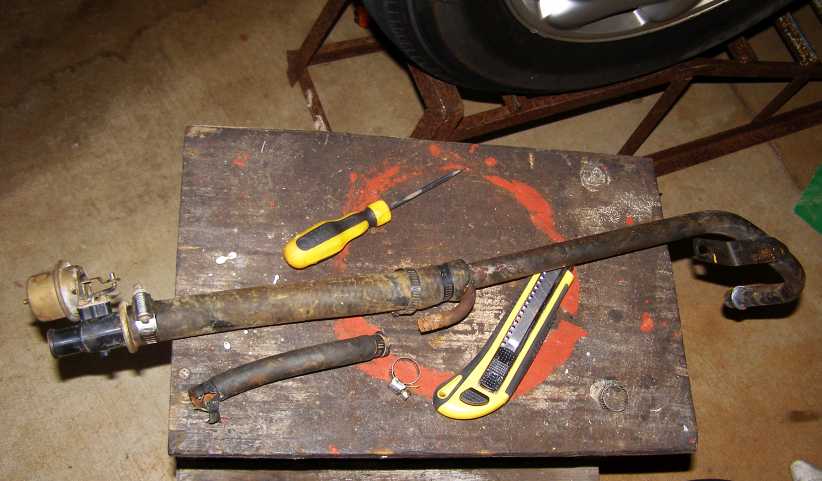
Heater pipe. It was a leak where the small pipe joins in, this one going to the fuel injection.
And there was always something to do to the high-mileage Foresters…
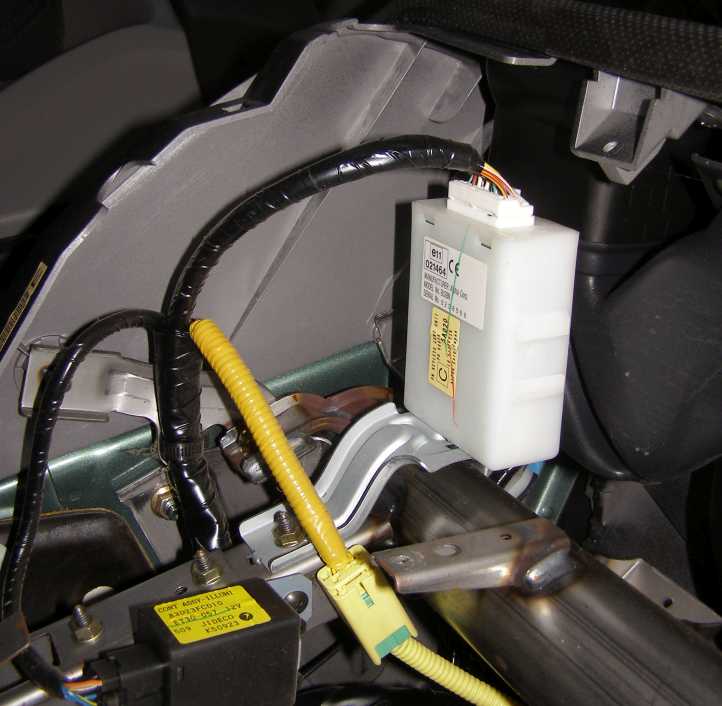
Remote locking receiver. Because the original key had lost its internals I had to fit this from the white wreck and slip its workings into the key. It did mean removing the glove box, to gain access.
My perennial friends at Dalveen were the wallabies. Not that they would come to me or anything, in fact they were quick to run away, but they did spend a lot of time in the house yard because the regular cutting of the lawn meant thee was always green grass for them to nibble on.
This young mother caught my eye and I got a bit closer…
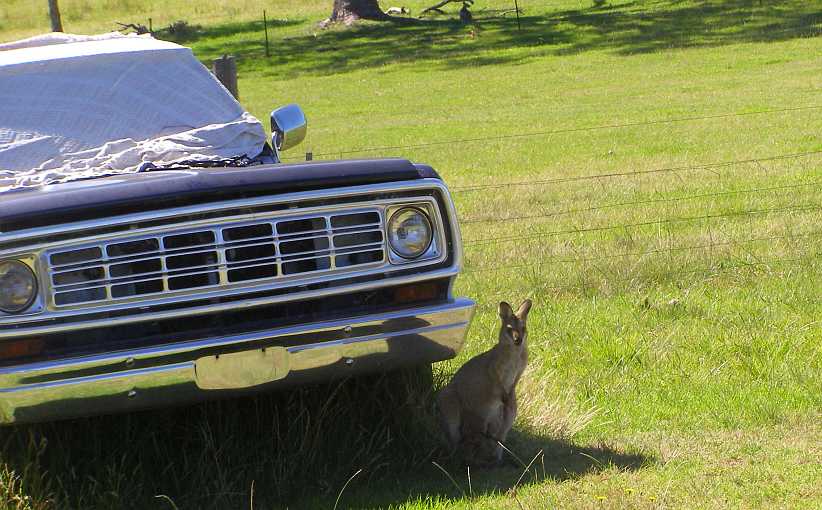
Mother and child. I must have caught her by surprise as she didn’t have time to put the joey back in her pouch before she hopped away.
…and as she hopped away the joey was left behind. I’ve never seen this happen at any other time and this time it revealed that the joey was very immature:
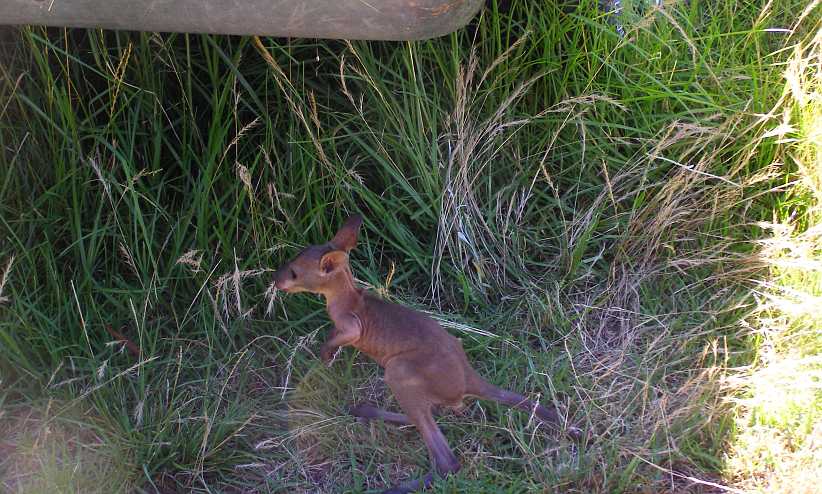
Baby wallaby. This was the poor mite left behind. Its fur was very light, unlike any I’d seen otherwise.
I didn’t stay long as I knew the mother would want to come back as soon as possible, but I did have to get some good pictures…
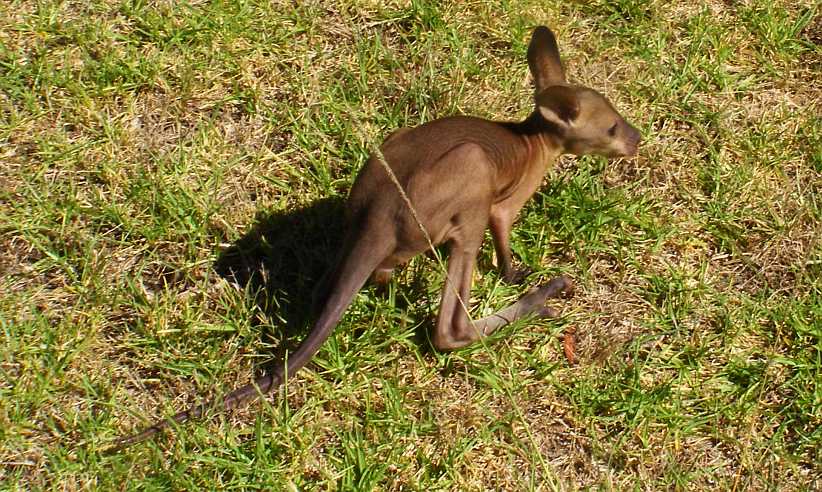
”Where’s my mum?” The poor frightened little joey just wanted to find its mother’s warm pouch.
Something outstanding was catching up with Mark Agnew, I’d been looking forward to seeing him and having a look at his Ascort GT since October. I found the time to call in at his place on the way to Sandra’s a day or two later:
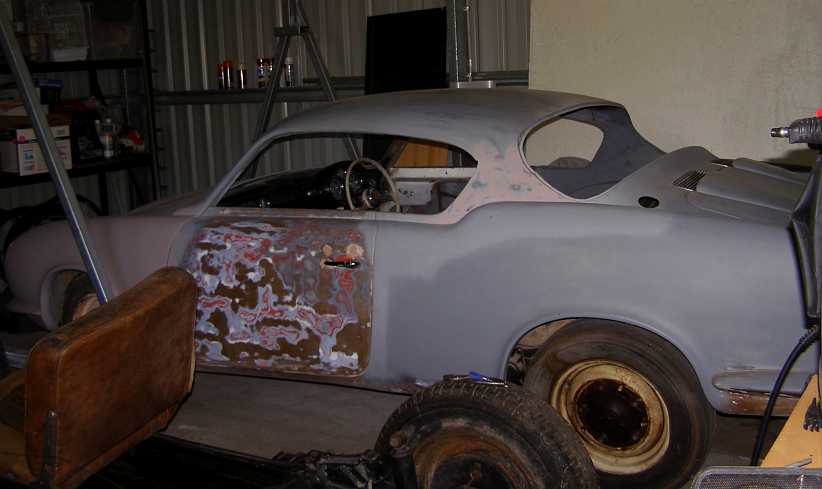
Ascort TSV 1300 GT. Built on a VW platform and using an Okrasa kit that lifted horsepower from 36 to 54, these were big news in 1959 but not big sellers.
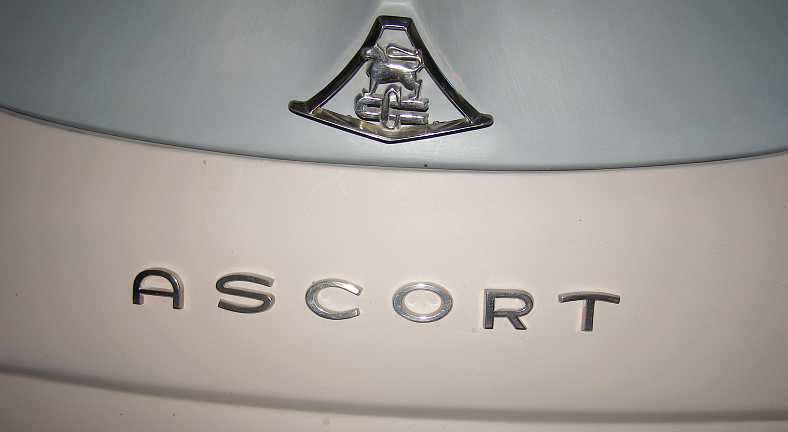
Badges. Mark had to make his own badges, based on photos taken from all angles of these cars when they were new.
This kind of enthusiasm for a particular car is found everywhere, but the meticulous attention to detail is a real mark of character in the enthusiast. He even found a model…
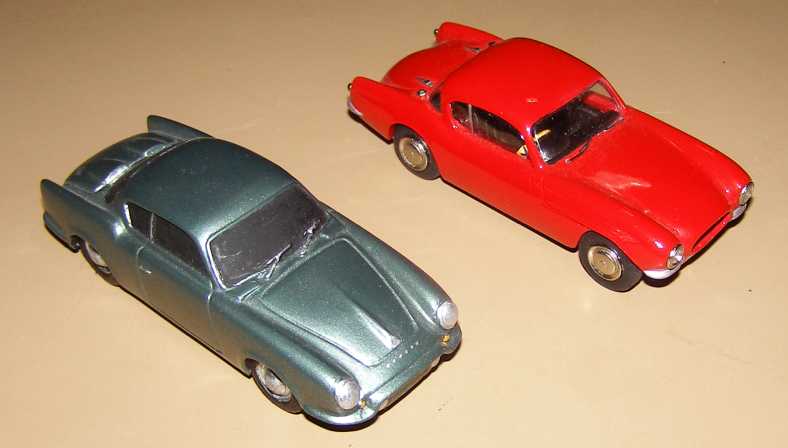
Models too. Amazingly, model makers had seized upon the design even though the car wasn’t a marketing success. The one alongside it was another limited production Australian car too, a Buckle Coupe which featured the Ford Zephyr 2550cc inline six.
I had a lot ahead of me before I could get much work done to put the van on the road, particularly because I had to ration my time between work, vehicle maintenance and spending some time with Sandra. This would continue well into 2018, in fact, but I still have plenty of out-of-the-way trips and visits with interesting people between now and then…
Dave’s rough country. Most of this area is within the boundaries of Dave’s farm, very little is cleared and not much more arable, it’s pretty rough all over. Dave told me he owned it for two years before he discovered where the drugs had been growing.
I had enjoyed a number of overnight stays with Dave and Peggy since rekindling our friendship about five years previously. He was another of our Clubman racing friends but had moved away thirty years earlier and then really disappeared when he went farming.
Breakfast was a social time, but there was work to be done outside as the sun cast its long shadows and promised to bring a warm day. My van was a long way from its original home in Oregon and a total stranger in this bit of Aussie bush. But what could be any more out of place than a beach umbrella sitting up on a bulldozer?
Morning at Dave’s. The morning sun lights up the scene where the work would take place during the day.
Dave had made progress since my previous visit, when the effort was going into fitting up the tracks. An effort which saw the end of one 20-ton jack. Now he was working on the gears and the end of the job was in sight. He’d made a puller to get this gear out so he could replace the ball bearing within it:
Hard to remove. A special puller had to be made to get this gear out, but that was no impediment and it was just a matter of time.
Special puller. This is the puller which has to find its way around the corners to get things moving.
And once out it all looked such an innocent and easy thing to do…
Gear out. An empty section of housing signalled success in this job.
…but nothing like this is all that easy. It reached a point where we had to drive into Bundarra to get something, which revealed that someone had taken up residence in an old double-deck bus. I wanted a closer look, but that would wait until I was on my way home.
Bus in town. I’d looked around the town plenty of times too, but this converted bus was a newcomer I’d not seen before.
The next step in the job was where I learned something new. Dave had to shrink the bearing into the gear and I thought that would be really tricky. But no, sitting the gear in an old electric frypan and the bearing in the freezer for a short time made it so they just fell together.
New bearing in. All greased up and ready to go, the bearing had been fitted with the help of kitchen appliances.
And so Dave was able to proceed with the reassembly…
Reassembly position. Dave sits in the shade of the beach umbrella and gets on with the job of screwing it all back together.
It was late afternoon before I left, I did get to Bundarra in time to get a photo of the other side of the bus…
More of the bus. A fuller picture of the old bus. Such things as this aren’t strange in places like this, we’ll see more as we go on.
I dropped in to my cousin’s place between Bundarra and Inverell, a quick stop, and then it was dark for most of the run home. Except that I couldn’t go all the way because I had to drop off a lot of gearboxes and a couple of V8 blocks before I got there. These were mostly to be left in a storage shed I have at The Summit, but one automatic transmission had to go to a friend’s place between there and home.
Ironically, I’d bought this for him about five years previously (the stuff which had been left in the desert at Phoenix, remember?) but he’d died before I delivered it.
A shopping trip to Stanthorpe a day or two later and there I got a shot of this Valiant VC utility:
VC Valiant utility. This one sees daily service in the local area and was nearly fifty years old.
But the main purpose of all that had gone before was to get the B350 to my home. And here it was…
B350 finally at home. Parked in the house yard at the place I’d called home for the past seven years, I’d refitted the spare wheel carrier to the back door.
…and it had lost some of its heavy load. But still more had to come out, while I wondered about those wheel-arch flares:
Flares still fitted. Not for much longer. Within a few days of getting home I removed them altogether.
Just why they were there was a mystery, but I’ve theorised that the people who did the conversion fitted wider rims which came out beyond the original bodywork. That makes sense, too, when it’s remembered that 16.5” rims were fitted when I got it. The original owner, seemingly, just got some wheels from somewhere to replace the wide ones he’d been using.
Without the flares it actually looks a lot better:
No more flares. Several self-tapping screws held each of the flares on, so some deft turning of a Phillips screwdriver soon took care of them.
With those gone I took a drive around the property. The farm on which I lived was 860 acres and I had the run of the place, so I drove down through the bush on the track shown above and went to the shearing shed:
Shearing shed. The shearing shed is used only for storage today, but once it was a busy place at shearing time.
I’ve been told that this property, along with a 1900-acre section on the other side of the road, was sending a semi-trailer of fat lambs away every month when in full production. So there would have been a good number of sheep to shear. Now it carried a small number of cattle, but the owner has plans for expansion.
On the track. The open country near the shearing shed provides a nice backdrop for the van at its new home.
But further work on the van would have to wait. I had responsibilities and one of those was to keep Sandra’s Falcon mobile. A leak in a pipe in the heater system was small, but could get worse, so I had to find a better one (near new, in fact) at a wrecking yard and work in the confined space underneath the fuel injection to get it fitted.
The way the Falcon engine has grown like topsy in going from pushrod ohv with carburettor to single overhead cam with fuel injection means that nothing is easy to get to.
Heater pipe. It was a leak where the small pipe joins in, this one going to the fuel injection.
And there was always something to do to the high-mileage Foresters…
Remote locking receiver. Because the original key had lost its internals I had to fit this from the white wreck and slip its workings into the key. It did mean removing the glove box, to gain access.
My perennial friends at Dalveen were the wallabies. Not that they would come to me or anything, in fact they were quick to run away, but they did spend a lot of time in the house yard because the regular cutting of the lawn meant thee was always green grass for them to nibble on.
This young mother caught my eye and I got a bit closer…
Mother and child. I must have caught her by surprise as she didn’t have time to put the joey back in her pouch before she hopped away.
…and as she hopped away the joey was left behind. I’ve never seen this happen at any other time and this time it revealed that the joey was very immature:
Baby wallaby. This was the poor mite left behind. Its fur was very light, unlike any I’d seen otherwise.
I didn’t stay long as I knew the mother would want to come back as soon as possible, but I did have to get some good pictures…
”Where’s my mum?” The poor frightened little joey just wanted to find its mother’s warm pouch.
Something outstanding was catching up with Mark Agnew, I’d been looking forward to seeing him and having a look at his Ascort GT since October. I found the time to call in at his place on the way to Sandra’s a day or two later:
Ascort TSV 1300 GT. Built on a VW platform and using an Okrasa kit that lifted horsepower from 36 to 54, these were big news in 1959 but not big sellers.
Badges. Mark had to make his own badges, based on photos taken from all angles of these cars when they were new.
This kind of enthusiasm for a particular car is found everywhere, but the meticulous attention to detail is a real mark of character in the enthusiast. He even found a model…
Models too. Amazingly, model makers had seized upon the design even though the car wasn’t a marketing success. The one alongside it was another limited production Australian car too, a Buckle Coupe which featured the Ford Zephyr 2550cc inline six.
I had a lot ahead of me before I could get much work done to put the van on the road, particularly because I had to ration my time between work, vehicle maintenance and spending some time with Sandra. This would continue well into 2018, in fact, but I still have plenty of out-of-the-way trips and visits with interesting people between now and then…
Thread Starter
|
Captain
Joined: Oct 2005
Posts: 570
Likes: 8
From: The Summit, Queensland, Australia
The end of 2016 ticked over with me having a fair joblist to complete. The van had to be prepared for Australian compliance,;the silver Forester was just sitting waiting for its new engine; Fitting that engine was going to be delayed because I’d found that the lugs where the power steering pump bolts onto the block had been broken off when the whit e car was crashed. At times like this I tend to not know where to start so I don’t start.
No, you always grease the squeakiest wheel, don’t you? So I fixed the broken fan in Sandra’s Falcon.
Work was back on stream after a two-weekend break and it would keep me busy. Of course, it would bring sights to see and even some excitement over the next few months. One person I interviewed in January at Glen Innes had this really nice Charger:
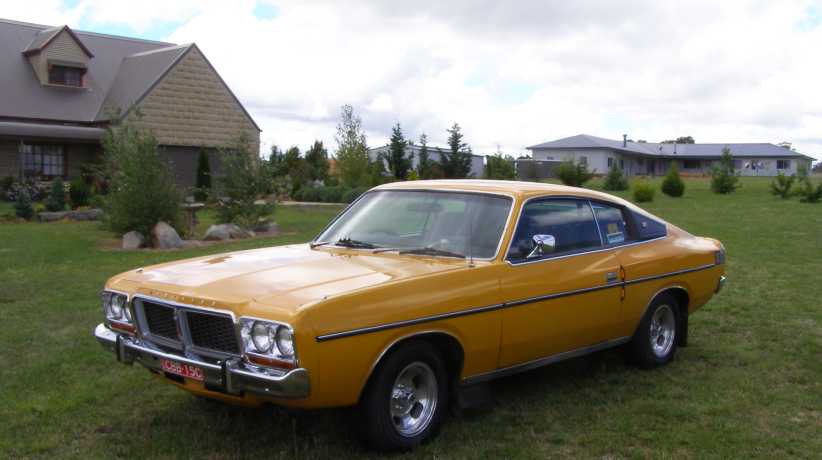
Late Charger. Chrysler Australia carried over the ‘Charger’ name to their sportiest model in the Valiant line-up. This one carries 6-pack decals but has only a 4-bbl on its 265 Hemi 6 engine.
This was on an assignment where I was working out of town a bit, so some places were interesting to visit in themselves. This one, for instance:
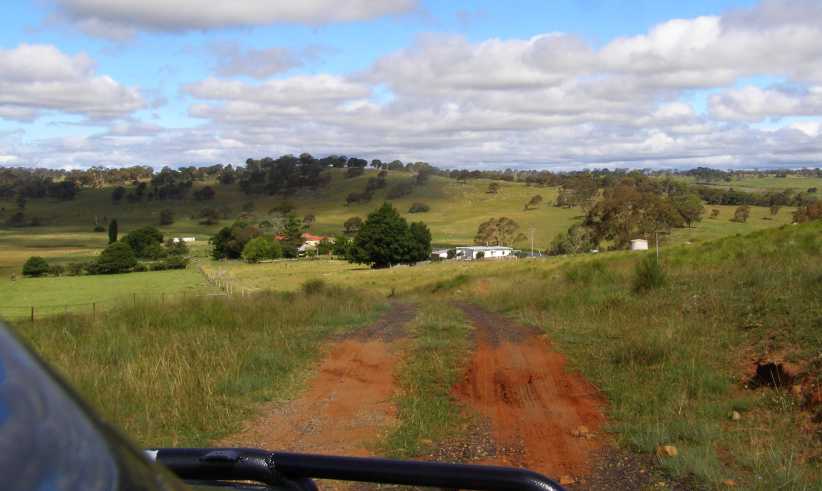
Farm with a view. With the high country background, this farm driveway had a pleasant outlook.
‘High country’ is a comparative term, of course. The Glen Innes to Guyra area is the most highly elevated part of the Great Dividing Range in Northern New South Wales, but it has its peak at about 1,400 metres – or 4,600 feet. It does snow here a couple of times most Winters.
And what they do get is wind! Just a week later I was in the same area and noticed a whole row of trees on a ridge had blown down…
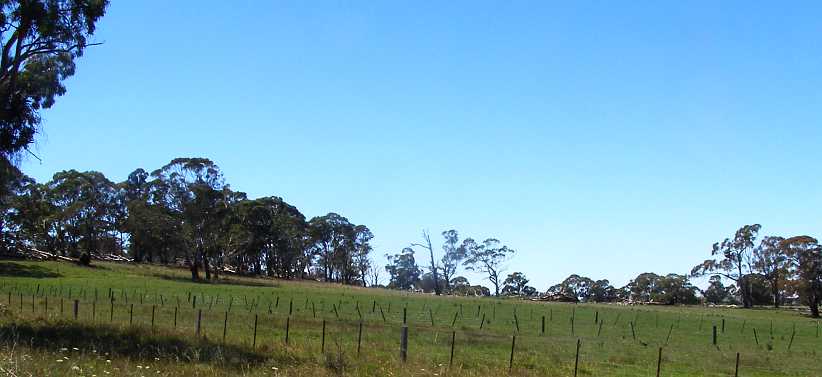
Trees laid flat. Look closely and you’ll see that there are trees lying down right across the ridge in this picture, the result of a huge windstorm.
…and were lying flat across the hillside. I had to get a better look at these on my way home from Armidale:
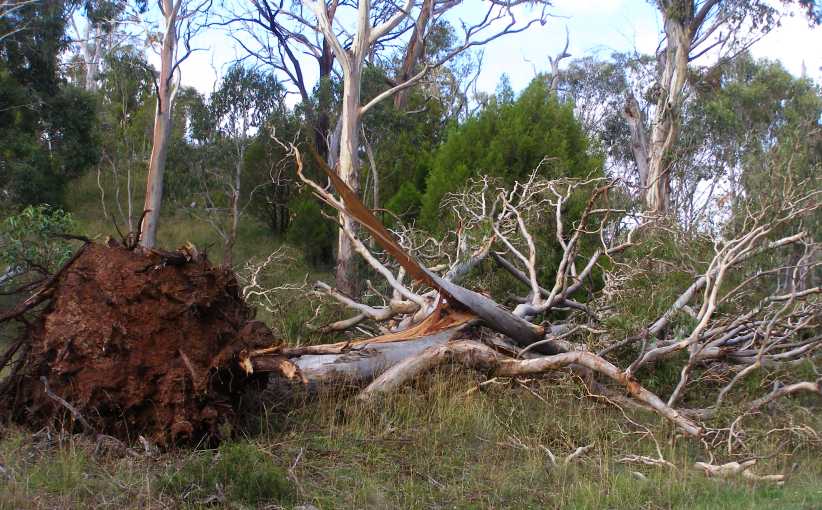
Felled tree. Completely uprooted and sent crashing to the ground, this gum tree would turn into firewood over the next couple of seasons. It’s also broken branches off other trees as it fell.
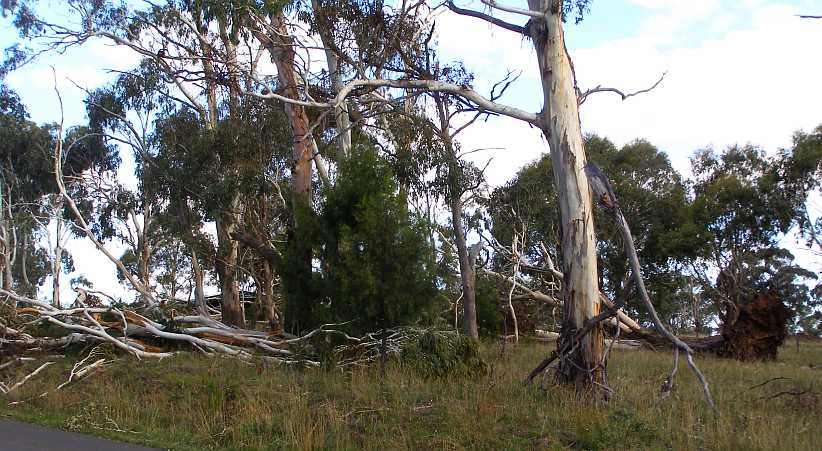
And more… Tons of soil attached to the root system was no match for the wind, recent wet weather had probably made it easier too.
These were near Guyra, and I was working in the Armidale area again two weeks later. From there I headed across country to Dave’s again as he was now moving off the farm and I thought I’d help with some of the work. The Forester was more at home on this road than the van had been, but the afternoon sun was a problem with the dust at times…
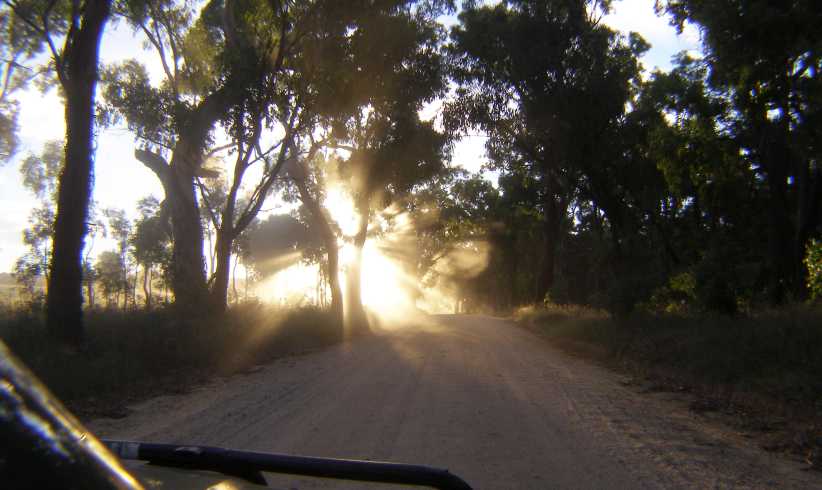
Sun and dust. This is the Bundarra-Barraba Road, wider than the Linton-Bonnay Road into Dave’s farm. But traffic here raises more dust and the road heads to the West, so the sun can be bad.
I got there and several family members were also assisting, there was a lot to do:
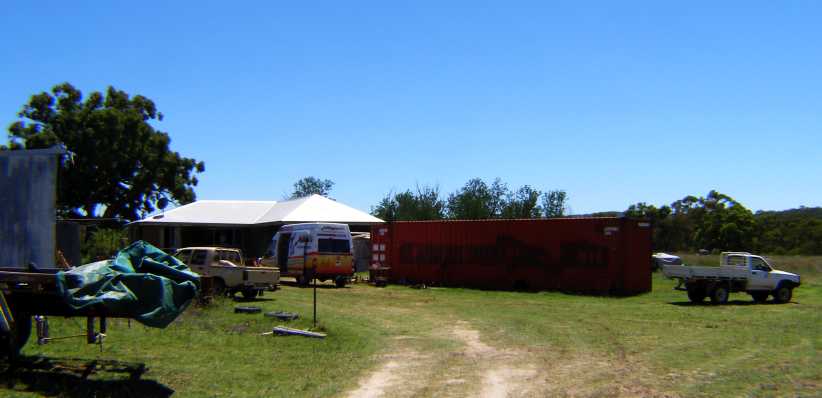
The container. A 40’ container was being used to store a lot of Dave’s gear, while machinery was being moved to a neighbour’s property for storage.
Accumulated over years, the collection of machinery, tools, spare parts and so on had nowhere to go other than into storage as Dave and Peg were going to be living in a caravan for some time as they looked for a new home base. I helped out by taking a few things home, too, Dave said I could have them but I told him they were still his if he ever needed them.
After a day and a half there I headed home, where my joblist was no shorter. By now I had removed the engine from the white Forester but that job languished because of the damage to the power steering mount lugs. It would have been nice to put that engine into the trailer, but…
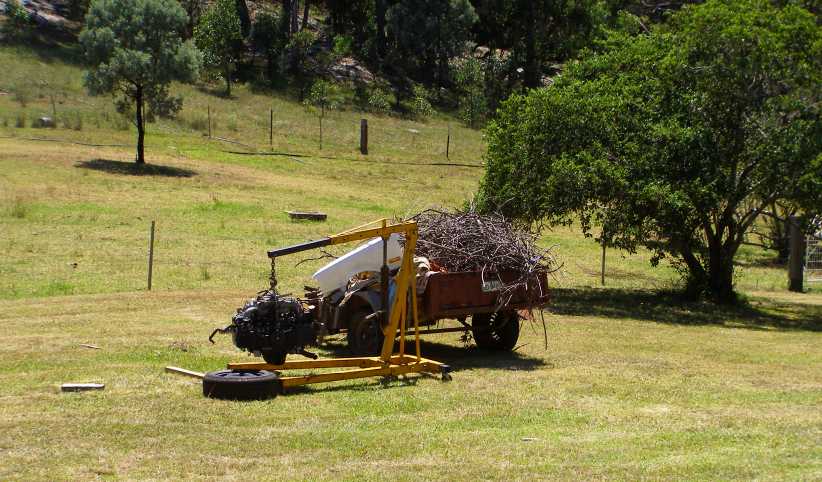
Engine and trailer. Sandra had busied herself on one of her visits cutting out the wisteria bush and loading the rubbish into the trailer.
Until I got rid of the wisteria rubbish I couldn’t do anything else with the trailer. Just move it every time I had to mow the lawn.
Two weeks later I arranged my work to enable me to take another trip to Sydney. I had to have some discussion with a friend about a book we’re co-operating on, and I planned in visits with a few friends. Just opposite where we had the Post Office at Moonbi there’s a place where Mopars are seen in numbers, this day he had two VE Valiants visiting…
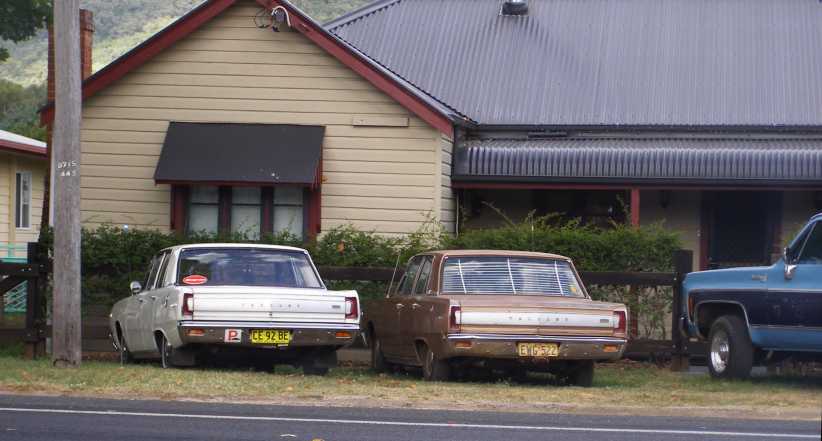
VE Valiants. The VE was pretty much unchanged from the US Dodge Dart of the same year, we could have them with either a 225 slant or a 273 LA V8. Both of these are slant 6-powered but with the 160hp 2-bbl carby option.
Of course I went to Bob Britton’s again. I spent a night or two there and caught up on what he was doing with his latest projects. We also rolled out the coupe so I could get better pics of it:
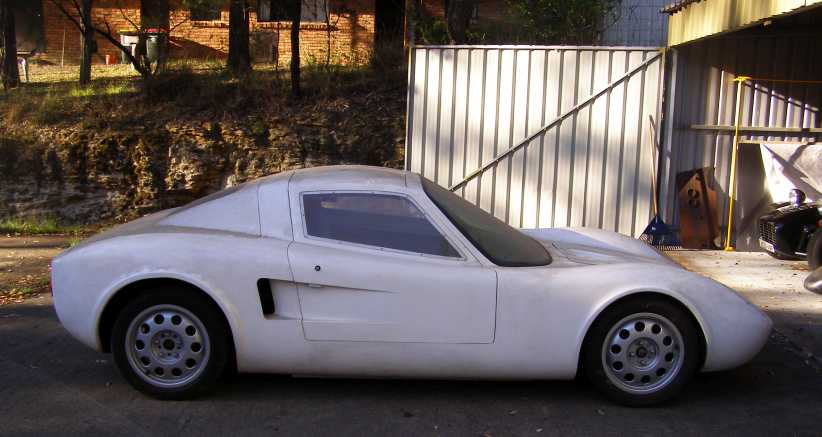
Rennmax coupe. A lot of people comment on what a good looking car this is, but Bob dislikes driving it in its enclosed form.
Another angle of the coupe. Of course I pitched in and helped with a bit more of the stripping of the Corolla that was contributing to the next project, a Lotus 7 type of car with the engine at the rear…
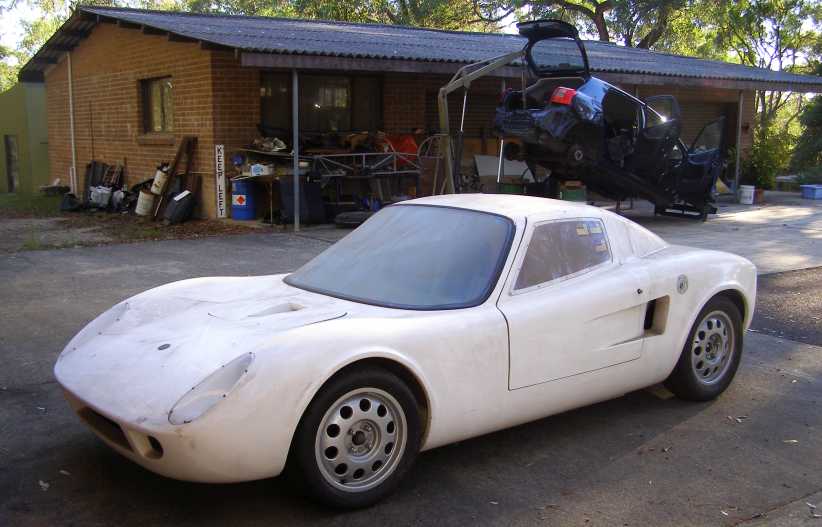
Coupe and Corolla. Dusty but still shapely, the coupe is not quite complete, but the stripping of the Corolla in the background is nearly done.
All modern cars, of course, have highly integrated electronic systems. This is the biggest bugbear Bob strikes with these projects and he has to rely on electronic experts to sort out the changes that have to be made to the wiring. A part of all of this is keeping the original instrumentation, so fitting the dash array into his cars is a part of the build…
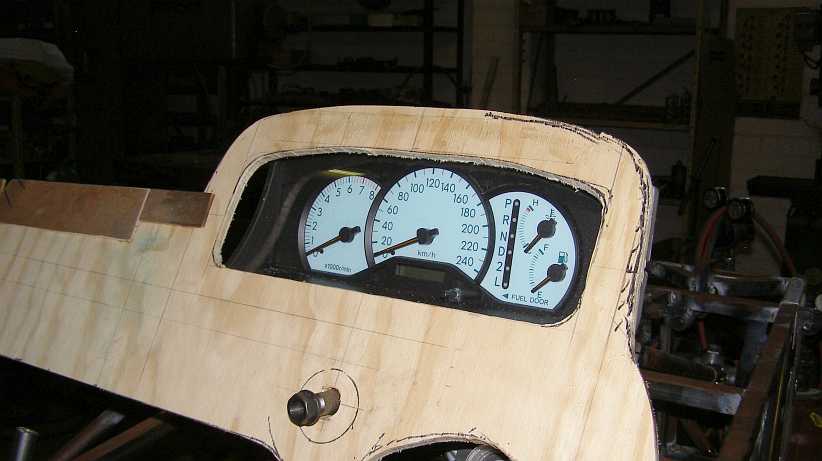
DEash incorporated. Bob’s first steps to putting the original Corolla dash instruments into the newest car.
While I was in Sydney this time I once again paid a visit to Dave Mawer’s workshop, the source of a lot of race car engineering at Orangeville. I was surprised to find another old friend there:
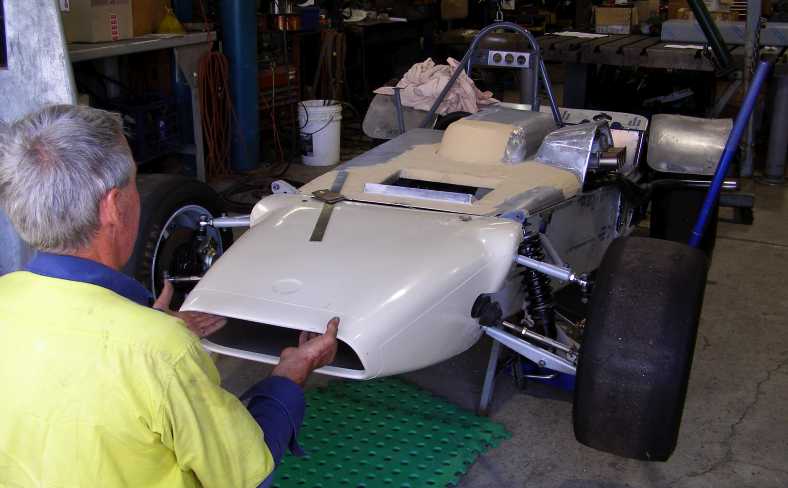
John O’Brien rebuilding. John built and raced this car through the seventies but sold it and moved to Victoria. Now he’s back and has repurchased it so he can put it back to its original glory.
John won the New South Wales Clubman Championship with this car and was always a hot contender. The class those days was limited to 1,300cc pushrod engines and he had the old-style Corolla engine complying with those rules. Much of the bodywork of this car was hand-formed aluminium.
While in that part of the world I also went over the Blue Mountains to catch up with another race-car builder (and Clubman racer) of the sixties and seventies, Brian Rawlings, but I had to be back at work at Tamworth on Saturday morning and time started to slip away. For the second time in a week I drove up the Putty Road…
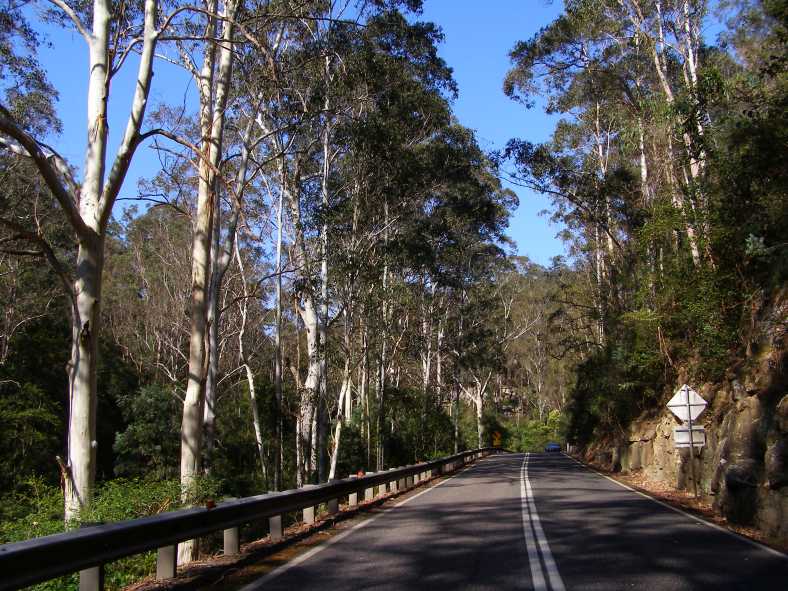
Putty Road. The confines of some stretches of the Putty Road are like this, other places it opens up, the lack of traffic makes it attractive to me.
…past the Grey Gums Cafe again…
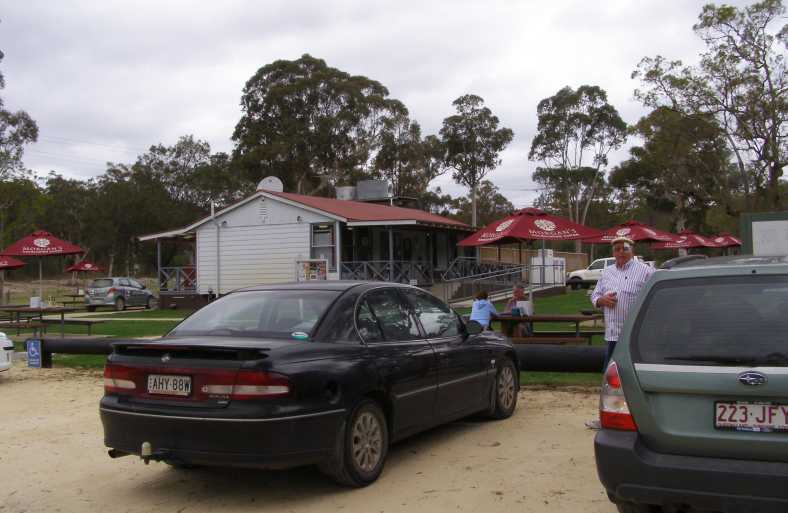
Grey Gums. An earlier trip when I took Max to Sydney in the same car. I was too early for the Grey Gums this morning.
… having grabbed a couple of hours sleep along the road. I had my breakfast at Singleton and pressed on to the work at Tamworth, another night spent at Bob’s place and then home. Summer was coming to an end now and the first throes of autumn were with us. Over the following weeks I spent more time with Sandra and didn’t make much impact on my joblist, One extra job was added to the list, in fact:
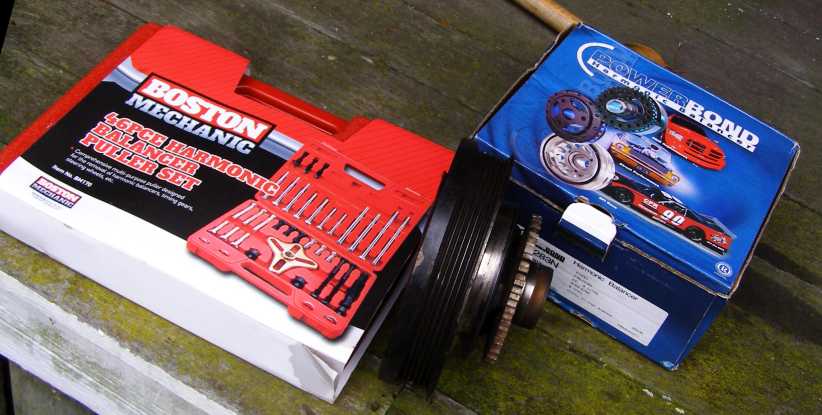
Falcon balancer. Sandra’s Falcon had its harmonic balancer separating, so that was another job to be done. It also meant I had to buy a new puller kit.
An assignment at Glen Elgin, near Glen Innes, in wet weather led to some interesting times.
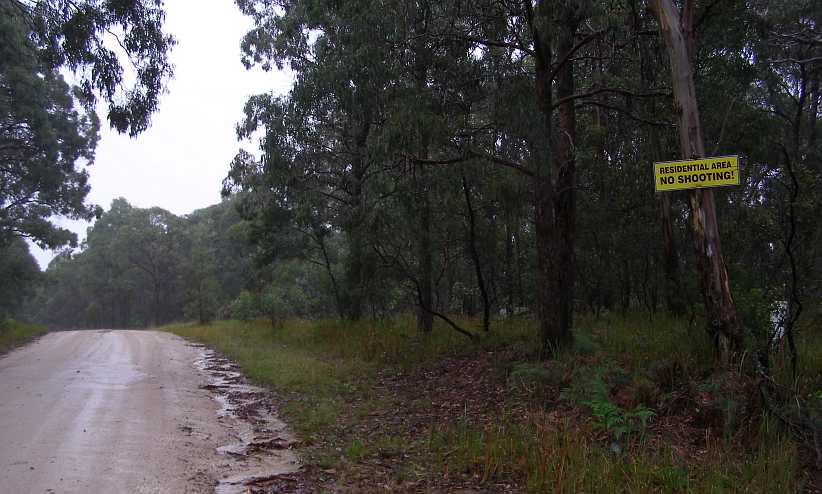
No shooting. It doesn’t look like a ‘residential area’, does it? My job entails finding people wherever I’m sent and there are homes in the strangest of places at times.
The rain had started pelting down in the morning and by mid-afternoon creeks were rising…
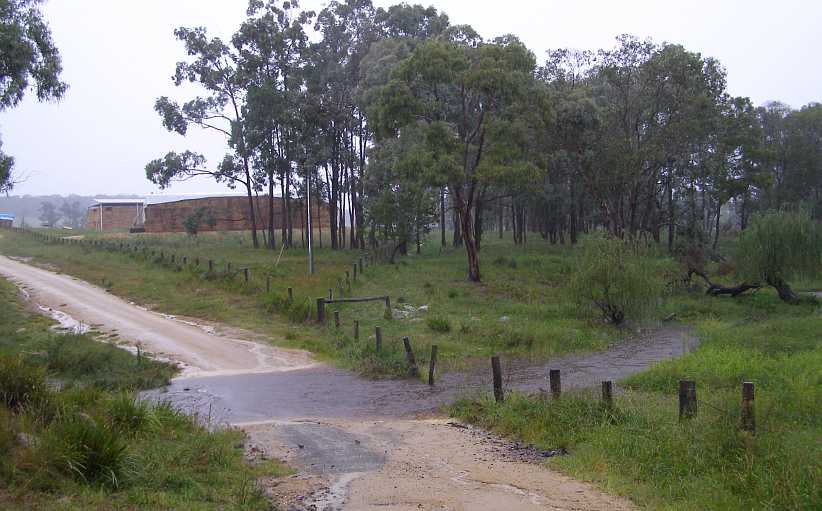
Creeks rising. Persistent rain in a season when there’d been a bit of wet weather and the creeks started to flow at higher than normal levels.
…and I would have to be careful not to get stuck out in this country. This was as far as I was able to get that day:
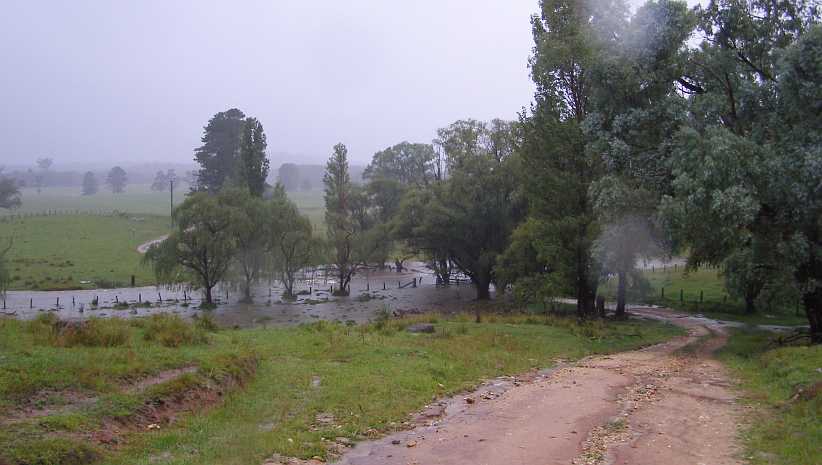
Impassable. I didn’t even try to get through this one, it was time to turn around…
As I got back closer to the highway that would take me back to Glen Innes for the night I was confronted by a tree fallen across the road:
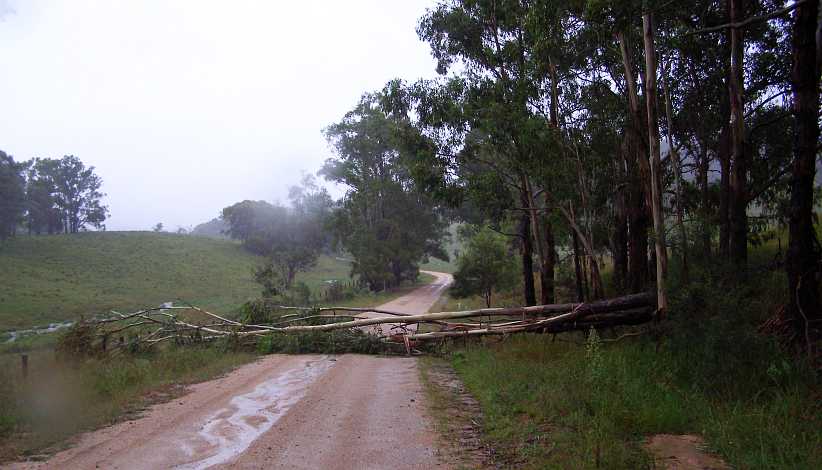
Road blocked. This fallen tree blocked my path only a mile or so from the highway.
I had just made arrangements to come back and see a young bloke the next day a mile or so back from this point so I returned to his place. Like anyone living in this kind of country, he had a chainsaw and cleared the path pretty quickly.
A comparison of this pic…
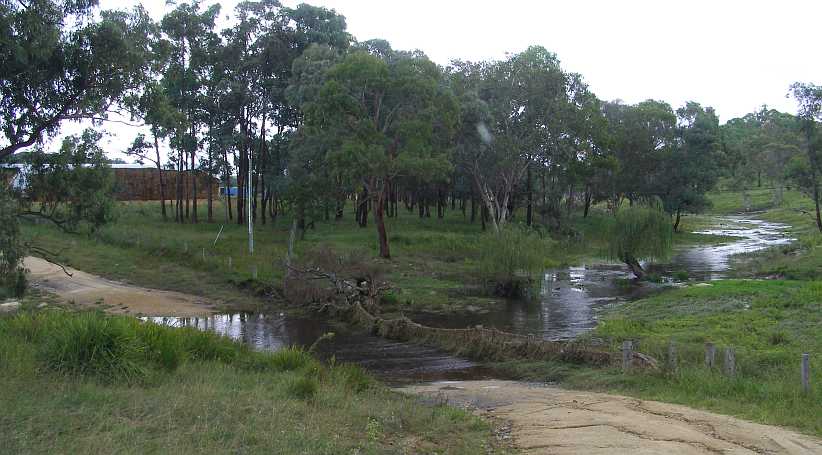
Grass evidence. Overnight the rains kept coming and – judging by the grass clinging to the fences – this crossing had seen at least three feet of water over it since my passage the day before.
…with the first one shows that the rain had certainly poured down and that this road was cut in several places overnight. But now the sun was coming out, the rain had moved on and I could get on and complete the job.
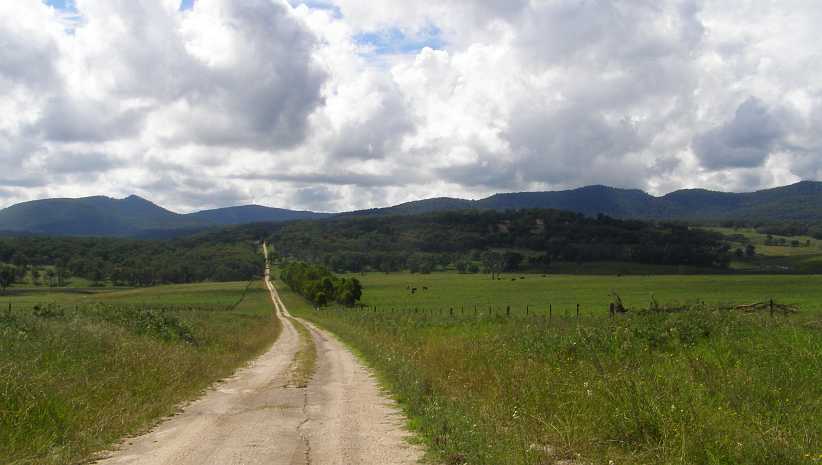
Skies clearing. After rain like that it’s always good to see the clouds breaking up. The road ahead was now clear and the outlook brighter.
I quite enjoy driving through the back-roads in this country, where some unusual sights are sometimes seen and where you meet people who live a different life to those in the towns. You also find some unusual creatures at times:
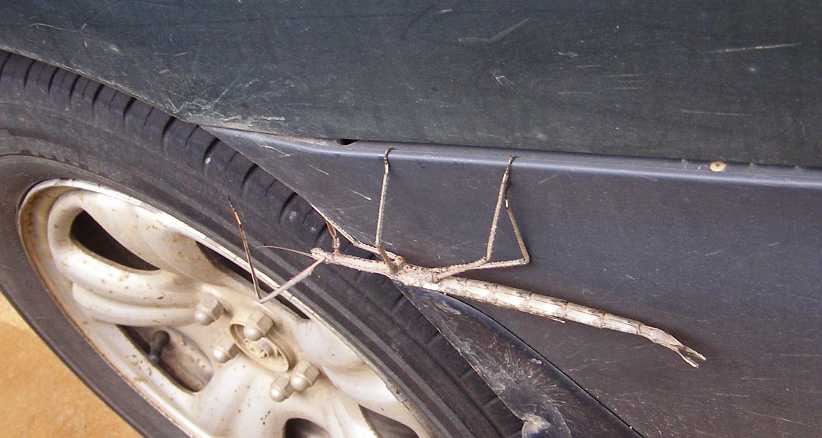
Stick insect. These are strange creatures and this one has grown to maturity so that means he’s escaped being eaten by using his camouflage well for some time.
These are called ‘phasmatodeas’ and you don’t see them very often. Just how he perched on my car I have no idea, just one of those things that happen.
The change of season was now well with us and this is one part of the country where Autumn colours are seen in abundance. Over coming weeks I would be in the area again and enjoying the natural spectacle for the short time before Winter’s cold would bring its drabness.
And I still had to get some jobs done!
No, you always grease the squeakiest wheel, don’t you? So I fixed the broken fan in Sandra’s Falcon.
Work was back on stream after a two-weekend break and it would keep me busy. Of course, it would bring sights to see and even some excitement over the next few months. One person I interviewed in January at Glen Innes had this really nice Charger:
Late Charger. Chrysler Australia carried over the ‘Charger’ name to their sportiest model in the Valiant line-up. This one carries 6-pack decals but has only a 4-bbl on its 265 Hemi 6 engine.
This was on an assignment where I was working out of town a bit, so some places were interesting to visit in themselves. This one, for instance:
Farm with a view. With the high country background, this farm driveway had a pleasant outlook.
‘High country’ is a comparative term, of course. The Glen Innes to Guyra area is the most highly elevated part of the Great Dividing Range in Northern New South Wales, but it has its peak at about 1,400 metres – or 4,600 feet. It does snow here a couple of times most Winters.
And what they do get is wind! Just a week later I was in the same area and noticed a whole row of trees on a ridge had blown down…
Trees laid flat. Look closely and you’ll see that there are trees lying down right across the ridge in this picture, the result of a huge windstorm.
…and were lying flat across the hillside. I had to get a better look at these on my way home from Armidale:
Felled tree. Completely uprooted and sent crashing to the ground, this gum tree would turn into firewood over the next couple of seasons. It’s also broken branches off other trees as it fell.
And more… Tons of soil attached to the root system was no match for the wind, recent wet weather had probably made it easier too.
These were near Guyra, and I was working in the Armidale area again two weeks later. From there I headed across country to Dave’s again as he was now moving off the farm and I thought I’d help with some of the work. The Forester was more at home on this road than the van had been, but the afternoon sun was a problem with the dust at times…
Sun and dust. This is the Bundarra-Barraba Road, wider than the Linton-Bonnay Road into Dave’s farm. But traffic here raises more dust and the road heads to the West, so the sun can be bad.
I got there and several family members were also assisting, there was a lot to do:
The container. A 40’ container was being used to store a lot of Dave’s gear, while machinery was being moved to a neighbour’s property for storage.
Accumulated over years, the collection of machinery, tools, spare parts and so on had nowhere to go other than into storage as Dave and Peg were going to be living in a caravan for some time as they looked for a new home base. I helped out by taking a few things home, too, Dave said I could have them but I told him they were still his if he ever needed them.
After a day and a half there I headed home, where my joblist was no shorter. By now I had removed the engine from the white Forester but that job languished because of the damage to the power steering mount lugs. It would have been nice to put that engine into the trailer, but…
Engine and trailer. Sandra had busied herself on one of her visits cutting out the wisteria bush and loading the rubbish into the trailer.
Until I got rid of the wisteria rubbish I couldn’t do anything else with the trailer. Just move it every time I had to mow the lawn.
Two weeks later I arranged my work to enable me to take another trip to Sydney. I had to have some discussion with a friend about a book we’re co-operating on, and I planned in visits with a few friends. Just opposite where we had the Post Office at Moonbi there’s a place where Mopars are seen in numbers, this day he had two VE Valiants visiting…
VE Valiants. The VE was pretty much unchanged from the US Dodge Dart of the same year, we could have them with either a 225 slant or a 273 LA V8. Both of these are slant 6-powered but with the 160hp 2-bbl carby option.
Of course I went to Bob Britton’s again. I spent a night or two there and caught up on what he was doing with his latest projects. We also rolled out the coupe so I could get better pics of it:
Rennmax coupe. A lot of people comment on what a good looking car this is, but Bob dislikes driving it in its enclosed form.
Another angle of the coupe. Of course I pitched in and helped with a bit more of the stripping of the Corolla that was contributing to the next project, a Lotus 7 type of car with the engine at the rear…
Coupe and Corolla. Dusty but still shapely, the coupe is not quite complete, but the stripping of the Corolla in the background is nearly done.
All modern cars, of course, have highly integrated electronic systems. This is the biggest bugbear Bob strikes with these projects and he has to rely on electronic experts to sort out the changes that have to be made to the wiring. A part of all of this is keeping the original instrumentation, so fitting the dash array into his cars is a part of the build…
DEash incorporated. Bob’s first steps to putting the original Corolla dash instruments into the newest car.
While I was in Sydney this time I once again paid a visit to Dave Mawer’s workshop, the source of a lot of race car engineering at Orangeville. I was surprised to find another old friend there:
John O’Brien rebuilding. John built and raced this car through the seventies but sold it and moved to Victoria. Now he’s back and has repurchased it so he can put it back to its original glory.
John won the New South Wales Clubman Championship with this car and was always a hot contender. The class those days was limited to 1,300cc pushrod engines and he had the old-style Corolla engine complying with those rules. Much of the bodywork of this car was hand-formed aluminium.
While in that part of the world I also went over the Blue Mountains to catch up with another race-car builder (and Clubman racer) of the sixties and seventies, Brian Rawlings, but I had to be back at work at Tamworth on Saturday morning and time started to slip away. For the second time in a week I drove up the Putty Road…
Putty Road. The confines of some stretches of the Putty Road are like this, other places it opens up, the lack of traffic makes it attractive to me.
…past the Grey Gums Cafe again…
Grey Gums. An earlier trip when I took Max to Sydney in the same car. I was too early for the Grey Gums this morning.
… having grabbed a couple of hours sleep along the road. I had my breakfast at Singleton and pressed on to the work at Tamworth, another night spent at Bob’s place and then home. Summer was coming to an end now and the first throes of autumn were with us. Over the following weeks I spent more time with Sandra and didn’t make much impact on my joblist, One extra job was added to the list, in fact:
Falcon balancer. Sandra’s Falcon had its harmonic balancer separating, so that was another job to be done. It also meant I had to buy a new puller kit.
An assignment at Glen Elgin, near Glen Innes, in wet weather led to some interesting times.
No shooting. It doesn’t look like a ‘residential area’, does it? My job entails finding people wherever I’m sent and there are homes in the strangest of places at times.
The rain had started pelting down in the morning and by mid-afternoon creeks were rising…
Creeks rising. Persistent rain in a season when there’d been a bit of wet weather and the creeks started to flow at higher than normal levels.
…and I would have to be careful not to get stuck out in this country. This was as far as I was able to get that day:
Impassable. I didn’t even try to get through this one, it was time to turn around…
As I got back closer to the highway that would take me back to Glen Innes for the night I was confronted by a tree fallen across the road:
Road blocked. This fallen tree blocked my path only a mile or so from the highway.
I had just made arrangements to come back and see a young bloke the next day a mile or so back from this point so I returned to his place. Like anyone living in this kind of country, he had a chainsaw and cleared the path pretty quickly.
A comparison of this pic…
Grass evidence. Overnight the rains kept coming and – judging by the grass clinging to the fences – this crossing had seen at least three feet of water over it since my passage the day before.
…with the first one shows that the rain had certainly poured down and that this road was cut in several places overnight. But now the sun was coming out, the rain had moved on and I could get on and complete the job.
Skies clearing. After rain like that it’s always good to see the clouds breaking up. The road ahead was now clear and the outlook brighter.
I quite enjoy driving through the back-roads in this country, where some unusual sights are sometimes seen and where you meet people who live a different life to those in the towns. You also find some unusual creatures at times:
Stick insect. These are strange creatures and this one has grown to maturity so that means he’s escaped being eaten by using his camouflage well for some time.
These are called ‘phasmatodeas’ and you don’t see them very often. Just how he perched on my car I have no idea, just one of those things that happen.
The change of season was now well with us and this is one part of the country where Autumn colours are seen in abundance. Over coming weeks I would be in the area again and enjoying the natural spectacle for the short time before Winter’s cold would bring its drabness.
And I still had to get some jobs done!
Thread Starter
|
Captain
Joined: Oct 2005
Posts: 570
Likes: 8
From: The Summit, Queensland, Australia
Carrying on from a wet end to March, 2017, April remained wet. From the front verandah of my farmhouse home at Dalveen I watched as the rain fell and the water filled the dams and ran across the surface as everything was soaked.
One reason I had to be very glad of this was that I’d had to drain my water-supply tank. The house had a tank holding about 6,000 gallons feeding from the roof of the house, with a 1,000 gallon tank up on the hill to provide water pressure to the house. A Honda pump was used every few weeks to make sure the top tank was kept near full.
Not long after my return from America, however, I found that a dead possum had been flushed through the pipe from the house and was in the gauze-covered filler to the tank. It had been dead for some time, I would say since the previous heavy rains, and had to wait until it decomposed enough to fit through the bends to pop up onto the tank.
It takes little imagination to understand that I would immediately drain the tank. Not only drain it, but syphon the dregs from the very bottom of the tank. Then, after the next rain, I chlorinated it. And drained and syphoned it again while I lived off the water in the top tank. And now it was raining…
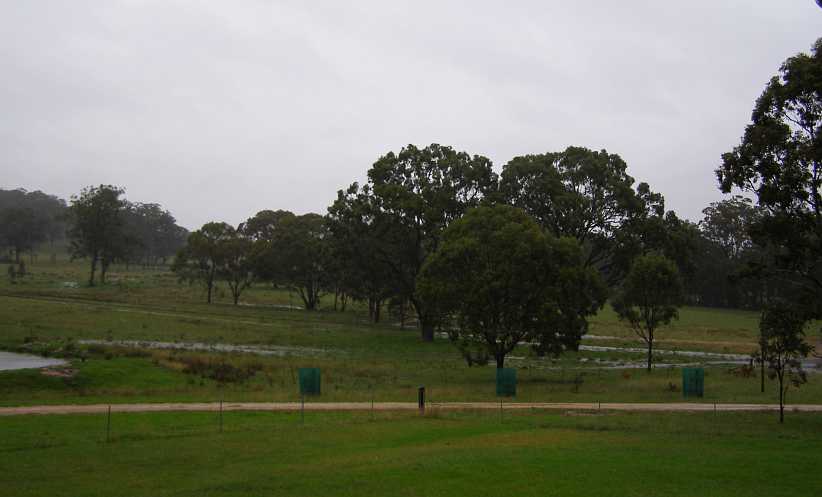
Rainy season. Sheets of rainwater spread out over the paddocks as the rain just kept coming down.
Rain like this was tank-filling rain and cleansing rain. Oh, yes, and it now only entered those pipes via newly-installed gauze filters which prevented such things happening again.
The neighbouring farm has a huge dam and as they water crops from it they sometimes see its level drop to very low levels. Now we all saw it fill right up:
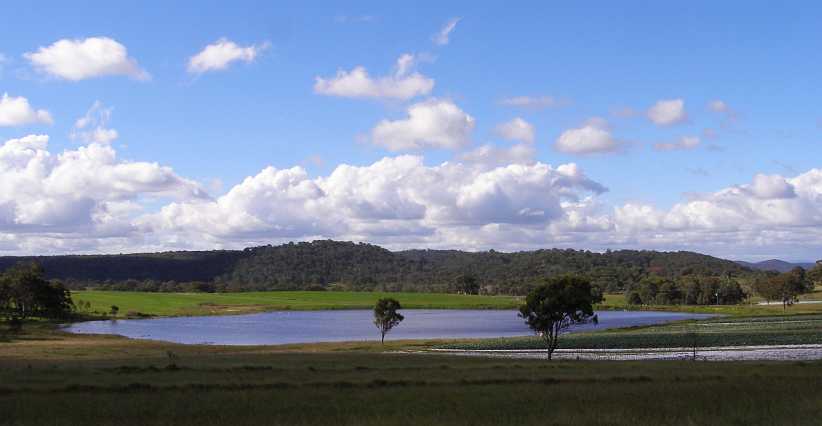
Dam full. This dam looks great when it’s full, you come around a bend and it’s right there in your line of sight. Now it was truly full.
Work the following weekend was in an area close to where I’d had the tree block my path. And still the water lay around and blocked my path…
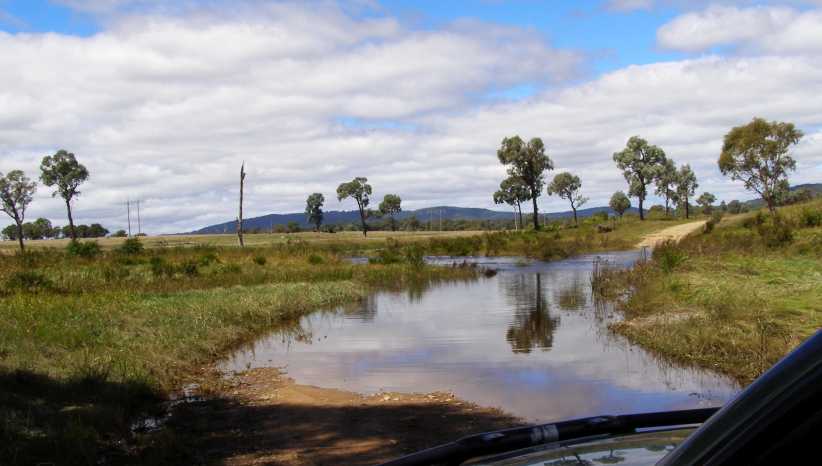
Dundee flooding. Not worth the risk of trying to get through, I had to find another way around this one.
…and the farm dams were all full and grass mostly green in the area:
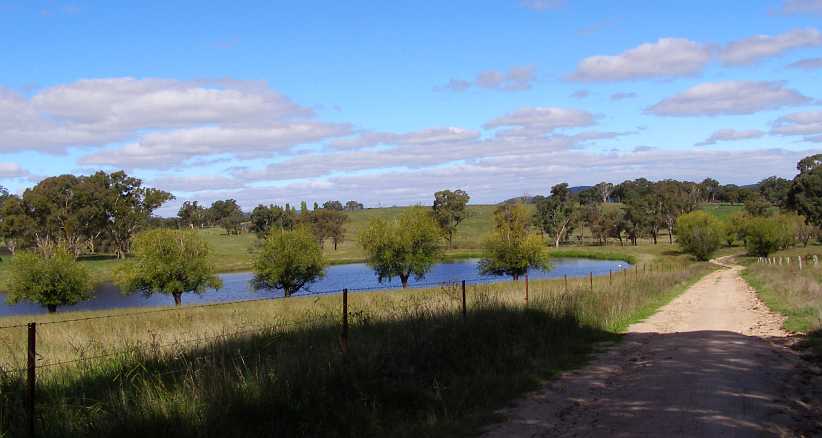
Looking good. With the dry Winter season just around the corner, people here were glad to have their dams topped up. Drives like this were commonplace this weekend.
I mentioned the change of seasons and the colours, this is just South of Glen Innes where poplars have been planted in large numbers:
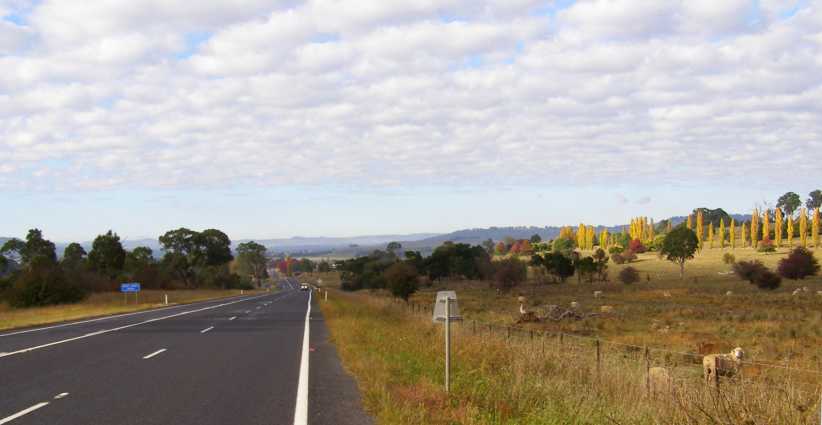
Poplars. While most native trees in Australia aren’t so colourful in Autumn, the imported trees like the poplars off to the right certainly add colour.
Places like this tend to see people who think laterally. So if you want a fishpond that won’t leak its water out, an aluminium boat which kept water out in its former life should suffice, shouldn’t it?
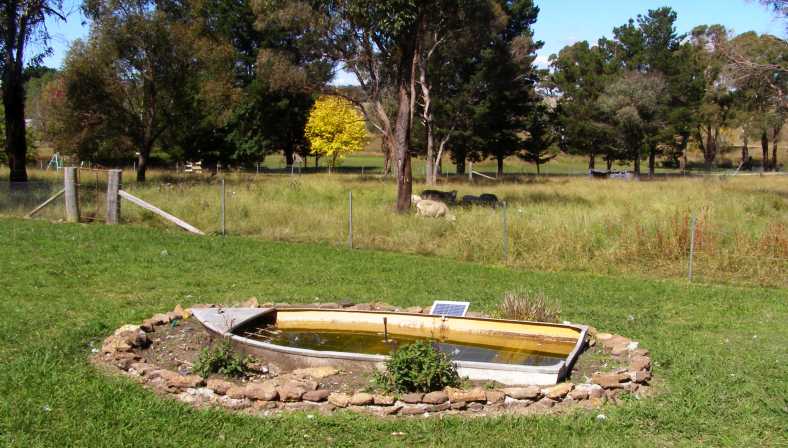
Boat pond. If nothing else it would be a conversation piece among visitors.
Back at Dalveen during the week a couple of old Austins pulled into the rest area. The front one is an Australia-only Austin Freeway, which featured a 6-cylinder version of the BMC B-series engine while the older car is an Austin Cambridge A50. Note that there’s a couple of campers in the background, as there usually is, while there’s a bit more Autumn colour alongside the railway line…
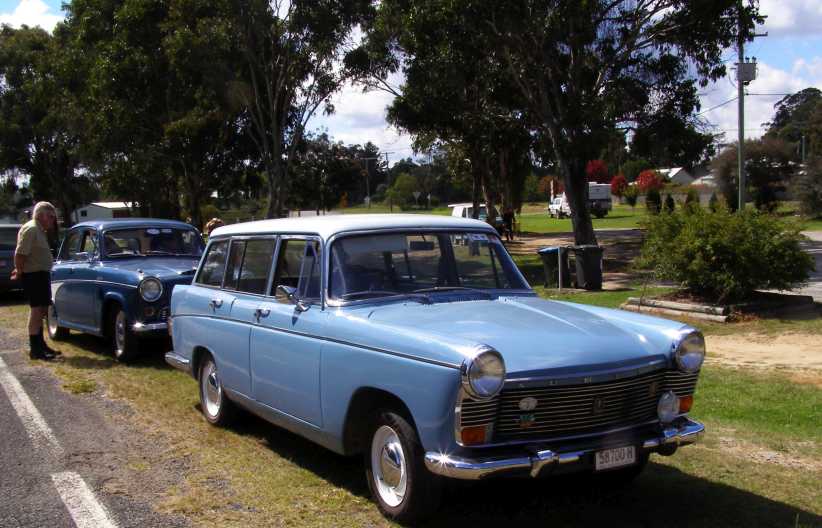
Austins at rest. Returning to their homes during the week following a Club outing over the Easter weekend, these Austins have been nicely restored.
With all that was going on I had my fingers in many pies. Still not getting much of my own work done, and spending time with Sandra in Toowoomba, somehow I found time to help out my nephew with a machine he had in his workshop:
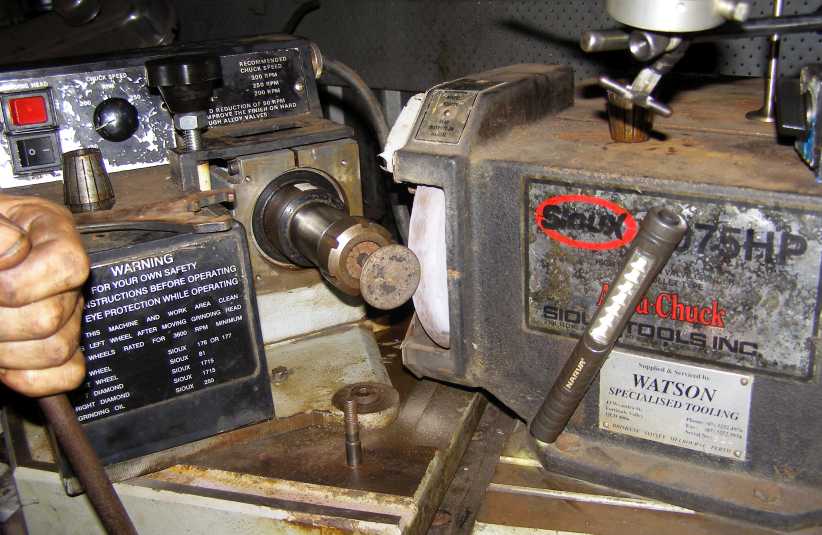
Valve facing machine. Ben had been trying for years to get this machine fixed – without success.
He explained to me that one electronics expert after another had looked at it, usually saying, “It’s not something I can fix, but I know someone who can.” And the ‘someone’ always came up with the same story. Until one day a bloke came along and said, “Yeah, right, I can do that. I’ll take the controller home and fix it and bring it back in a few days.”
Ben was ecstatic at that. But that bloke, and the controller he took away, haven’t been seen since!
I suggested that a friend of mine at Dalveen, David Gay, might be enough of an eccentric electronics genius to do the job. And sure enough he did…
Valve facer wiring. Using terms like ‘potentiometer’ and other things I don’t remember or understand, David did some internet research and then tried a few alternatives to achieve what nobody else could.
…and after a couple of weeks he had it all made up and for very little money was able to give it back for return to Ben turning at the right speeds as shown on the dial. And it’s still in use today.
Along with this I periodically applied a little time to the dismantling of that white Forester. It remained on the trailer and bit by bit I kept on removing parts so I could ultimately dispose of the skeleton:
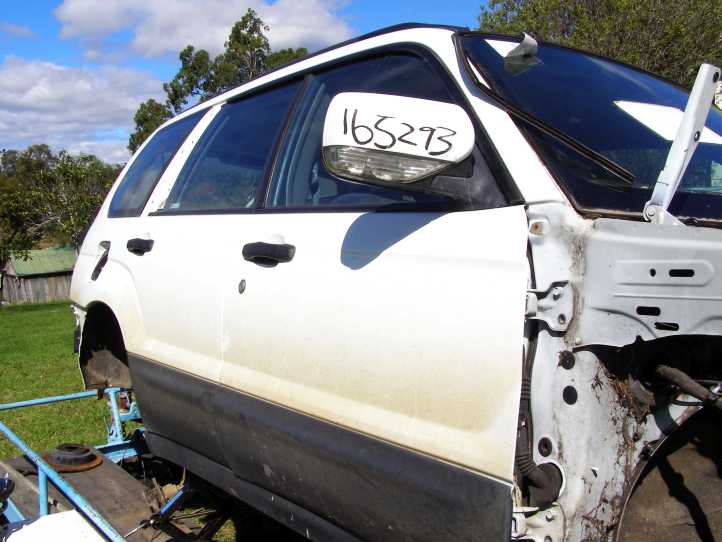
White Forester on trailer. Leaving the wreck on the trailer made it easy to get underneath and undo things.
A couple of weeks later I was given an assignment at Grafton, which was not unknown, but a little off my regular beaten path. I planned this as an opportunity to pay Norm a visit at Meerschaum Vale and to return the valve facing machine to Ben. And to do some sightseeing…
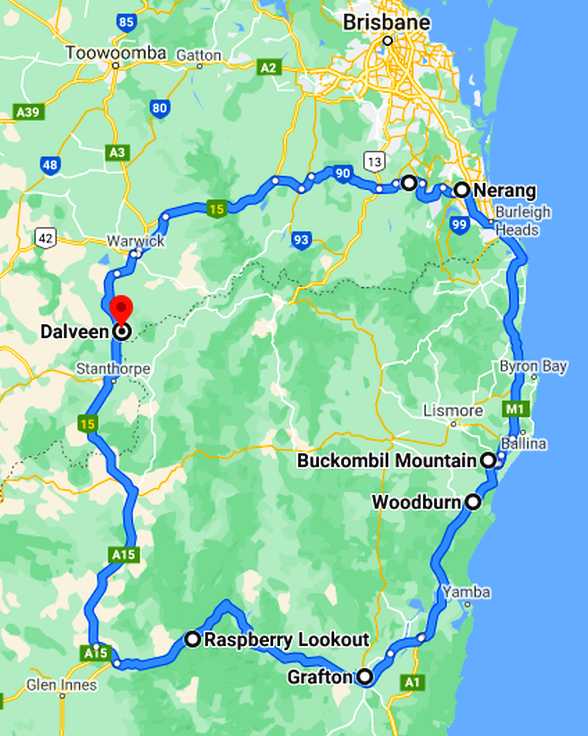
…with my regular stop at the Raspberry Lookout at the top of the Gibraltar Range being the first diversion:
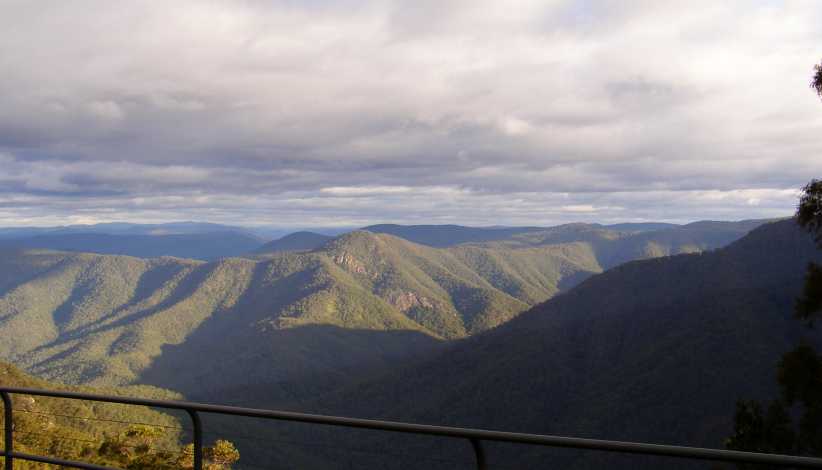
Late outlook. It was late in the day on the Friday I stopped at the Raspberry Lookout, the rugged scenery being part in the shadow of clouds and partly in the stark late-afternoon sun.
It’s a small rest area at the end of a one-kilometre drive through the bush, the amenities are basic…
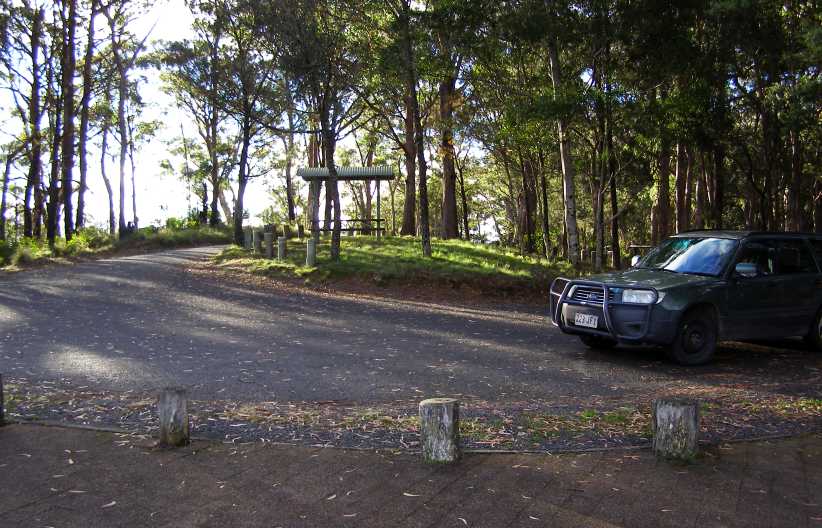
Basic amenities. A small shelter with picnic table, a grassed lawn, there’s a basic toilet in the distance as well.
…but well-suited to an afternoon tea stop. Before leaving I’d discussed with Sandra and her sister about this spot and also the Boundary Falls rest area about a kilometre away on the other side of the highway. I’d never been in there before but went there this time:
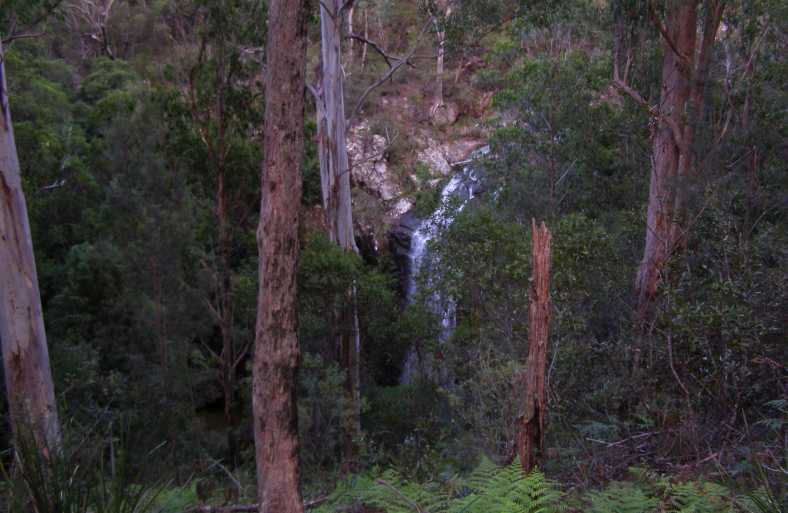
Boundary Falls. The waterfall had plenty of flow after all the rain. The rest area on this side of the highway is a little bigger than the one at Raspberry Lookout.
The highway is the Gwydir and through this country you can get a couple of different vistas over the valleys. I have always like travelling this route…
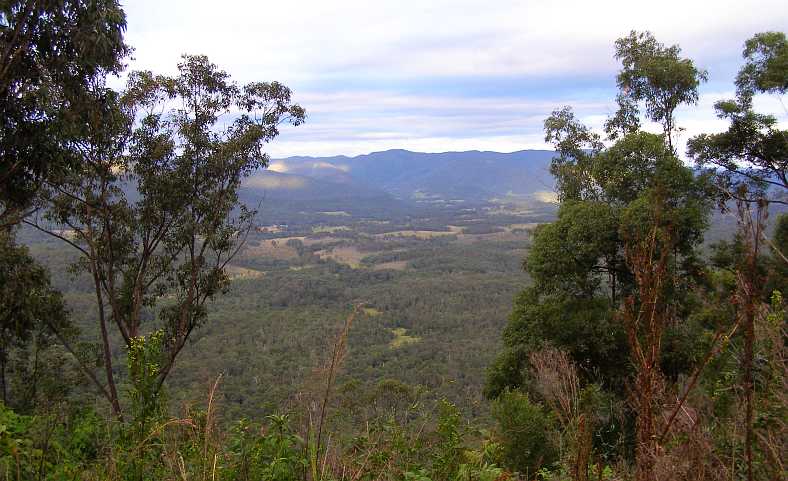
Gwydir view. Looking out over a part of the Clarence River Valley, this is the sort of sight you can get at some points along this highway before descending off the range towards Jackadgery.
…though this stretch is relatively new. It was only in the 1960s that it replaced a road which followed the valley in which Dalmorton and Newton Boyd are found, alongside the Mann River, which flows into the Clarence further down.
After completing my assignment in Grafton I was on the road early on Monday morning as I was going to visit Norm and Ben. This is the time of year when morning mists abound, but this view of the emerging sun was, I thought, a bit special…
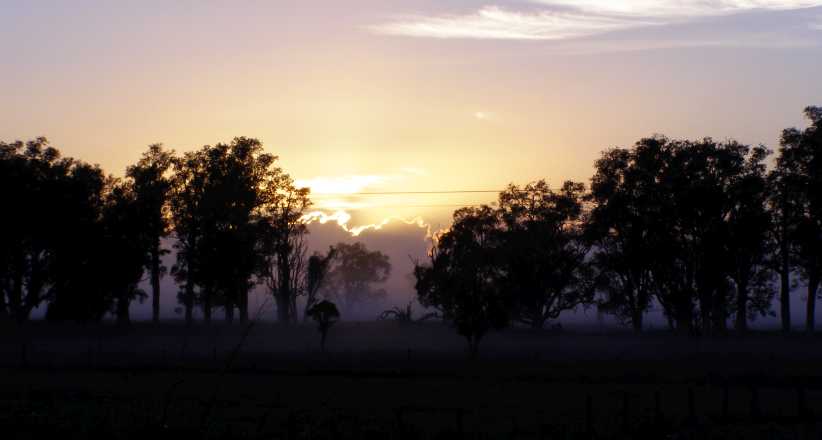
Clouded sunrise. With morning mist and low cloud in the East, the sunrise was with me for a little while as I proceeded up the Pacific Highway.
After about an hour on the road I got to Woodburn, where I stopped to get breakfast. The old highway through there (now bypassed) had the shops on one side and lawns and picnic tables on the river side. The bridge there has been replaced in recent times and was getting the full attention of the sun:
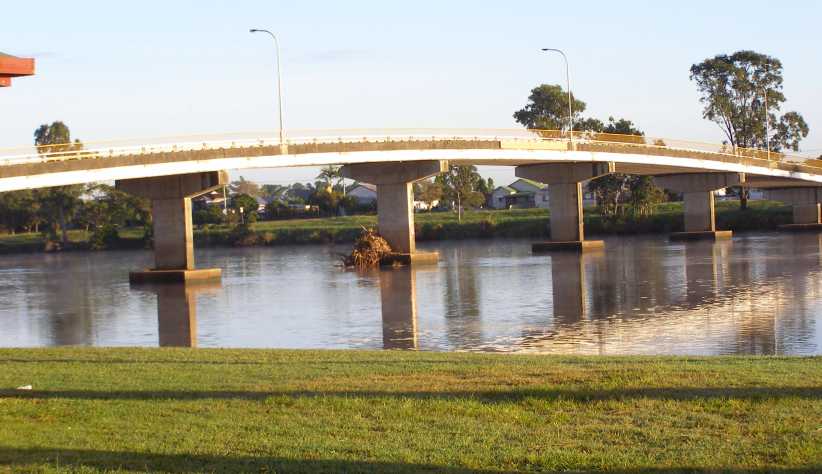
Woodburn bridge. Crossing the lower Richmond River, flotsam caught on the pylons speak of recent heavy flows.
From Woodburn it isn’t far to Norm’s place, but Broadwater comes first and there I was forced to pull up to check out this trailer being towed by an Austin Healey:
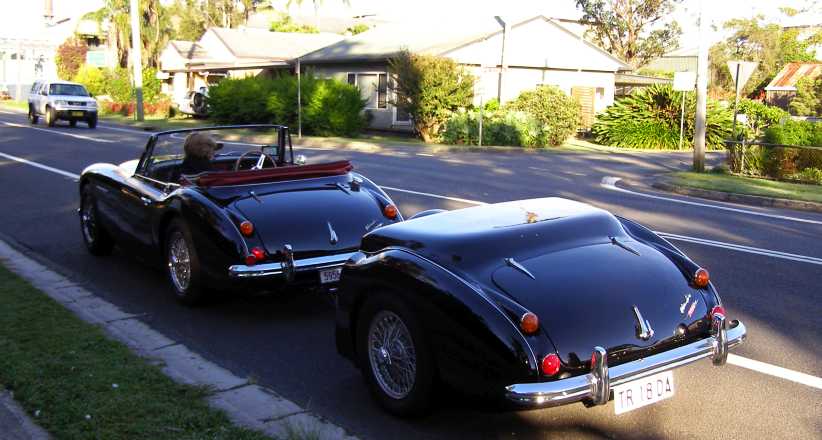
Austin Healey trailer. I particularly liked the wire wheels, while the practicality of the upper lid as well as the conventional one makes it more useful.
It was probably returning from one of the inevitable Car Club rallies that move from state to state each Easter.
It was still early, so I didn’t rush up to Norm’s place. He’s on the climb up the Buckombil hill at Meerschaum Vale and we have common interests in the automotive world, though mainly on the Peugeot side. In recent weeks a neighbour of his had given him this little beauty…
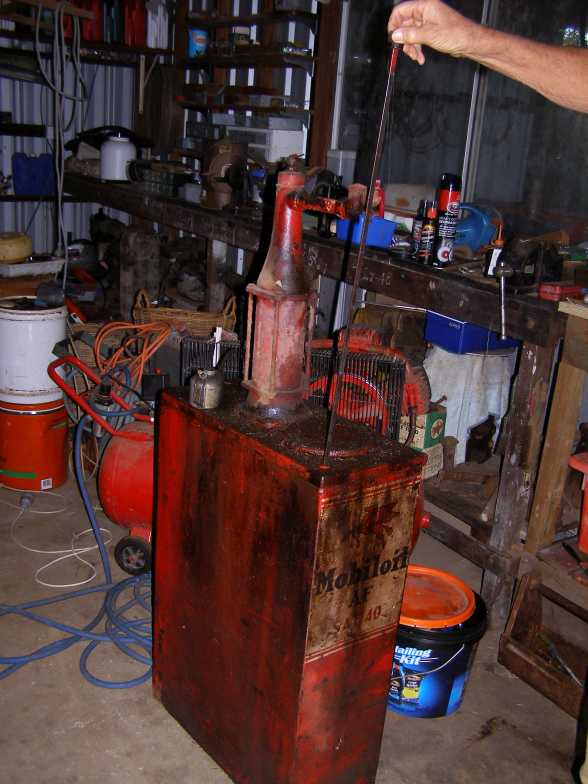
Classic Mobiloil. Norm demonstrates the dipstick for this oil dispensing unit, though it’s unlikely it will ever again see any SAE 40 as per its label.
…which will be another conversation piece for years to come.
From there it was about 125kms to Ben’s place and then a few more to his friend Brad’s place where they were just back from some weekend racing. Ben had been having one of his early races in a Hyundai Excel…
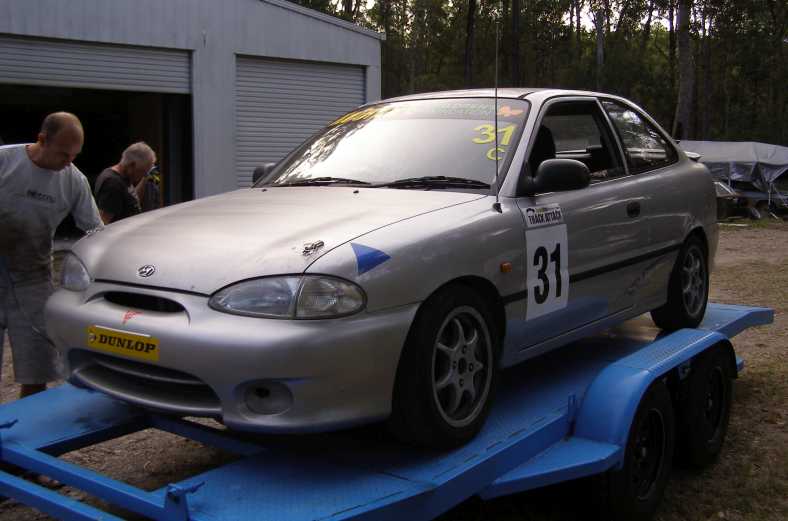
Ben and Hyundai. For a brief time Ben raced this Hyundai, front wheel drive being quite different to his usual race mount…
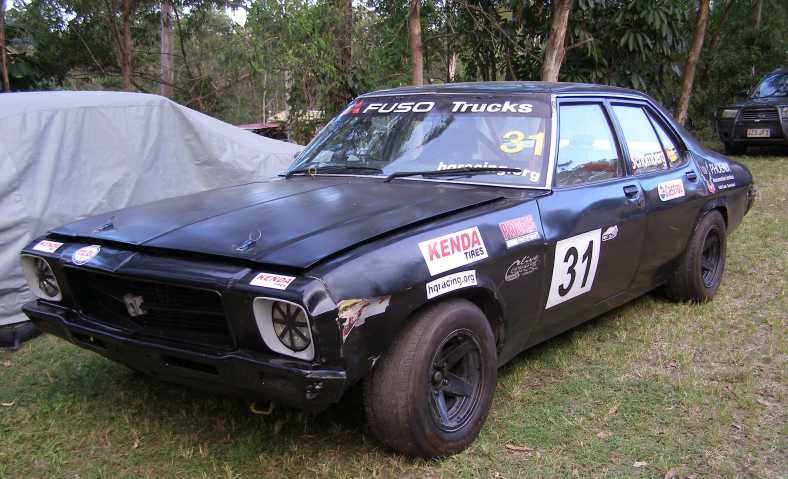
Ben’s HQ Holden. …the HQ Holden, which runs a 202 engine with a single-choke carby and 3-speed gearbox and is highly developed so not slow at all.
…and was soon to sell it on as he was simply too busy to be racing two cars.
When I got home I managed to spend a little time working on the first project with the van to make it comply with Australian rules – replace the amber parking lights with white ones.
I was pretty keen to not actually add lights, so finding that Jeeps from the early nineties faced the same problem with the same headlights as the van had, I bought a pair of their Hella 7” x 5” headlights which had the parking light globe inside the headlight. Fitted with a nice LED globe it was fairly impressive – when I’d done the necessary wiring changes, of course:
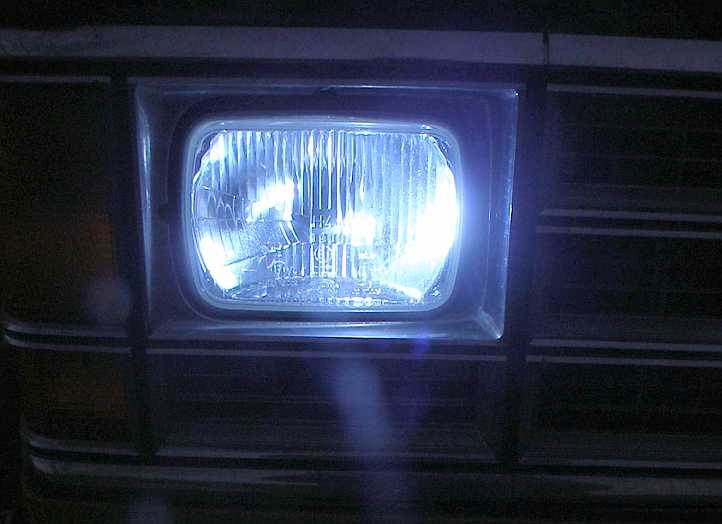
New parking lights. By changing the headlights I was able to complete my first step towards complying with the local rules.
A week further along I was working around Glengallan and Allora just past Warwick. I was able to base myself at Sandra’s for this weekend, but the recent rain was still having an influence:
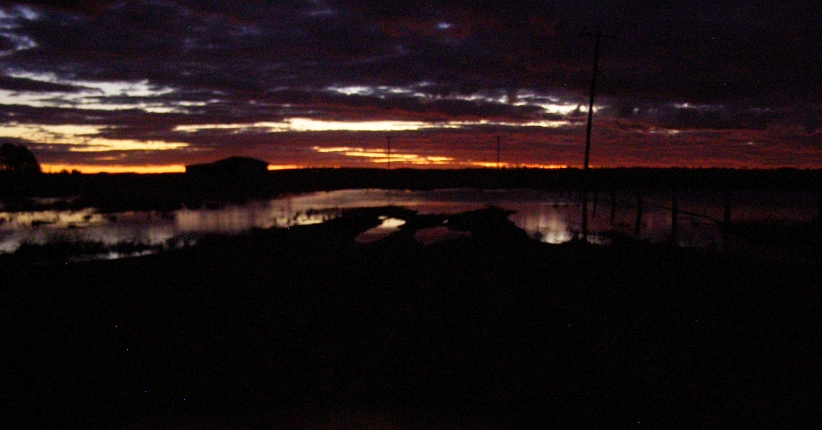
Glengallan gloom. With the Autumn sunset over some low-lying ground, I felt this was good enough reason to leave the rest of the assignment until the next day.
During the following week I spotted this unusual sight on the side of the road about ten miles from home: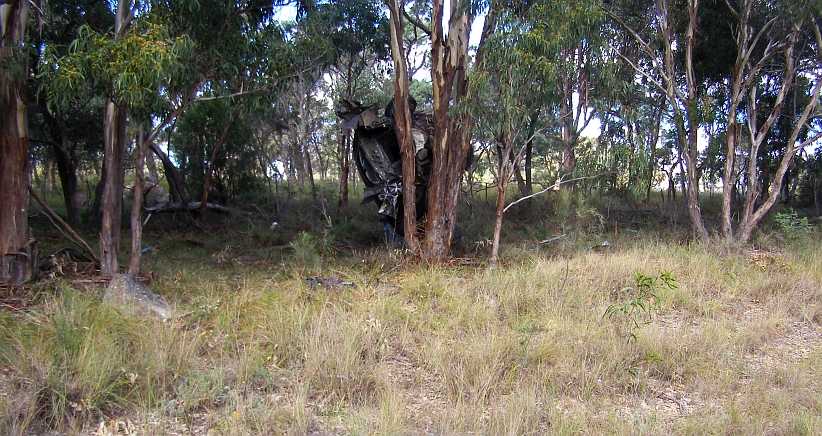
Commodore wreck. How did that get there? I had to stop and take a good look at all of this, my curiosity had to be satisfied.
Enquiring among locals I learned this had been there well over a week, the crash having happened in the height of the wet weather. But I figured it was worth having a close look to analyse the whole incident.
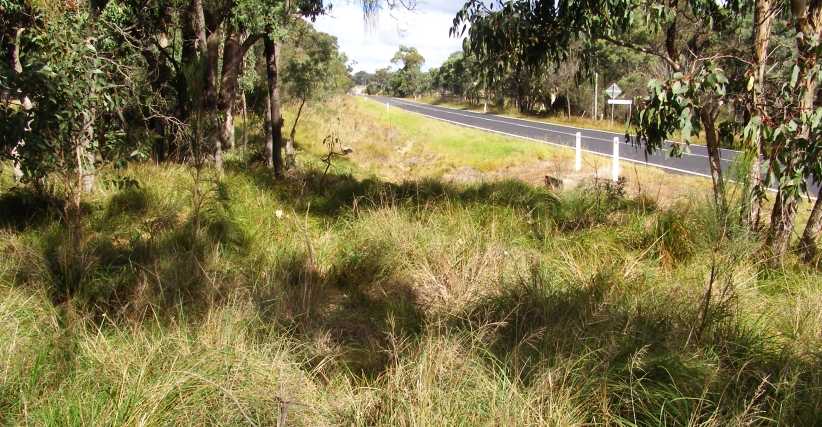
Culvert a clue. We’re looking here at the path followed, with the car coming towards the camera. The culvert shows us that there’s a drain there, the car has come off the road and launched itself when it went into that drain at high speed.
Once in flight the occupants were probably terrified, there were trees everywhere and it hit the first one over ten feet off the ground:
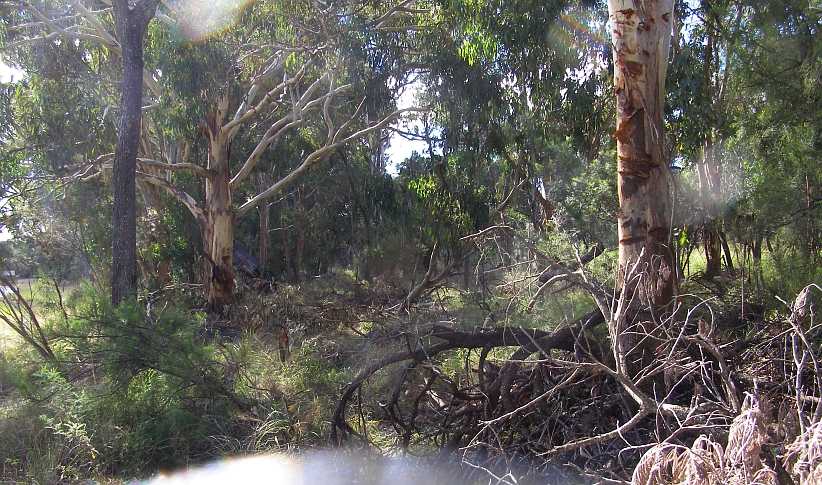
Trees hit. Two trees here show serious markings from being hit by the car at speed. The one on the right came first, no doubt twisting and turning the Commodore in its trajectory, while the second appears to have inflicted serious damage to the vehicle.
Smaller trees were flattened, large trees lost branches and lots of bark, with the car finally coming to rest on its nose with what was left of its rear high up against another tree:
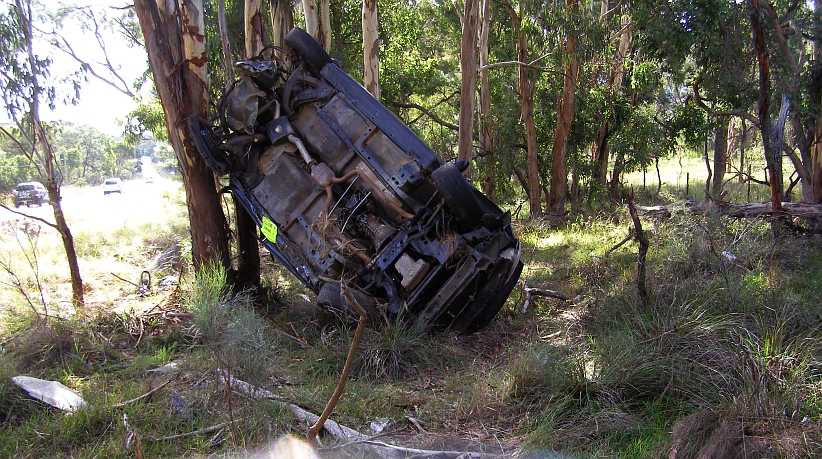
Resting place. Bent, broken and forgotten, the remains of the Commodore here displays its shredded rear tyre, while closer inspection showed that other tyres were far from fully-treaded.
The occupants, you ask? They weren’t badly hurt. They had, I was told, been seen skylarking and ‘doing donuts’ in town earlier, which might account for the shredded tyre.
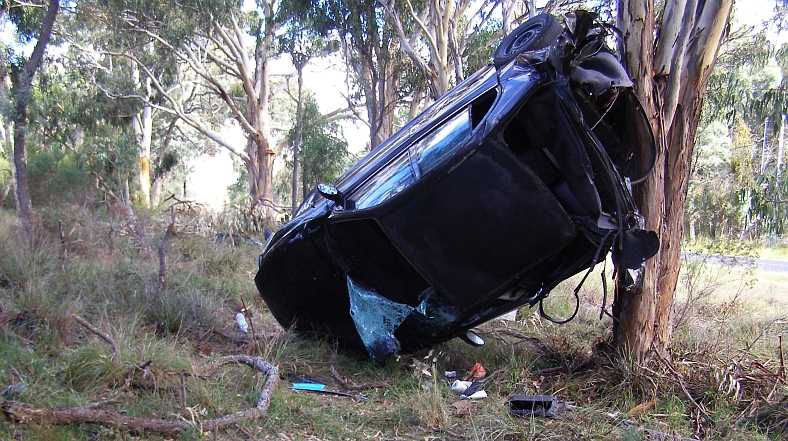
Final result. The rear end has been crushed right in, the bootlid was off in the bush elsewhere while the passenger area has held up well.
It was a good display of the value of safety belts, but one wonders just what the driver was ‘on’ to have been driving so quickly with such lousy tyres in the rain. The transmission was broken off too, I noted at the time, so the forces at play were very serious.
And so Autumn started to run itself away. Notice that my joblist wasn’t making much progress? I was still struggling with the mental exercise of working out how I’d overcome the van’s turn indicator compliance and I still needed to get back to work on the silver Forester.
And, of course, the onset of Winter meant that daylight hours were getting shorter…
One reason I had to be very glad of this was that I’d had to drain my water-supply tank. The house had a tank holding about 6,000 gallons feeding from the roof of the house, with a 1,000 gallon tank up on the hill to provide water pressure to the house. A Honda pump was used every few weeks to make sure the top tank was kept near full.
Not long after my return from America, however, I found that a dead possum had been flushed through the pipe from the house and was in the gauze-covered filler to the tank. It had been dead for some time, I would say since the previous heavy rains, and had to wait until it decomposed enough to fit through the bends to pop up onto the tank.
It takes little imagination to understand that I would immediately drain the tank. Not only drain it, but syphon the dregs from the very bottom of the tank. Then, after the next rain, I chlorinated it. And drained and syphoned it again while I lived off the water in the top tank. And now it was raining…
Rainy season. Sheets of rainwater spread out over the paddocks as the rain just kept coming down.
Rain like this was tank-filling rain and cleansing rain. Oh, yes, and it now only entered those pipes via newly-installed gauze filters which prevented such things happening again.
The neighbouring farm has a huge dam and as they water crops from it they sometimes see its level drop to very low levels. Now we all saw it fill right up:
Dam full. This dam looks great when it’s full, you come around a bend and it’s right there in your line of sight. Now it was truly full.
Work the following weekend was in an area close to where I’d had the tree block my path. And still the water lay around and blocked my path…
Dundee flooding. Not worth the risk of trying to get through, I had to find another way around this one.
…and the farm dams were all full and grass mostly green in the area:
Looking good. With the dry Winter season just around the corner, people here were glad to have their dams topped up. Drives like this were commonplace this weekend.
I mentioned the change of seasons and the colours, this is just South of Glen Innes where poplars have been planted in large numbers:
Poplars. While most native trees in Australia aren’t so colourful in Autumn, the imported trees like the poplars off to the right certainly add colour.
Places like this tend to see people who think laterally. So if you want a fishpond that won’t leak its water out, an aluminium boat which kept water out in its former life should suffice, shouldn’t it?
Boat pond. If nothing else it would be a conversation piece among visitors.
Back at Dalveen during the week a couple of old Austins pulled into the rest area. The front one is an Australia-only Austin Freeway, which featured a 6-cylinder version of the BMC B-series engine while the older car is an Austin Cambridge A50. Note that there’s a couple of campers in the background, as there usually is, while there’s a bit more Autumn colour alongside the railway line…
Austins at rest. Returning to their homes during the week following a Club outing over the Easter weekend, these Austins have been nicely restored.
With all that was going on I had my fingers in many pies. Still not getting much of my own work done, and spending time with Sandra in Toowoomba, somehow I found time to help out my nephew with a machine he had in his workshop:
Valve facing machine. Ben had been trying for years to get this machine fixed – without success.
He explained to me that one electronics expert after another had looked at it, usually saying, “It’s not something I can fix, but I know someone who can.” And the ‘someone’ always came up with the same story. Until one day a bloke came along and said, “Yeah, right, I can do that. I’ll take the controller home and fix it and bring it back in a few days.”
Ben was ecstatic at that. But that bloke, and the controller he took away, haven’t been seen since!
I suggested that a friend of mine at Dalveen, David Gay, might be enough of an eccentric electronics genius to do the job. And sure enough he did…
Valve facer wiring. Using terms like ‘potentiometer’ and other things I don’t remember or understand, David did some internet research and then tried a few alternatives to achieve what nobody else could.
…and after a couple of weeks he had it all made up and for very little money was able to give it back for return to Ben turning at the right speeds as shown on the dial. And it’s still in use today.
Along with this I periodically applied a little time to the dismantling of that white Forester. It remained on the trailer and bit by bit I kept on removing parts so I could ultimately dispose of the skeleton:
White Forester on trailer. Leaving the wreck on the trailer made it easy to get underneath and undo things.
A couple of weeks later I was given an assignment at Grafton, which was not unknown, but a little off my regular beaten path. I planned this as an opportunity to pay Norm a visit at Meerschaum Vale and to return the valve facing machine to Ben. And to do some sightseeing…
…with my regular stop at the Raspberry Lookout at the top of the Gibraltar Range being the first diversion:
Late outlook. It was late in the day on the Friday I stopped at the Raspberry Lookout, the rugged scenery being part in the shadow of clouds and partly in the stark late-afternoon sun.
It’s a small rest area at the end of a one-kilometre drive through the bush, the amenities are basic…
Basic amenities. A small shelter with picnic table, a grassed lawn, there’s a basic toilet in the distance as well.
…but well-suited to an afternoon tea stop. Before leaving I’d discussed with Sandra and her sister about this spot and also the Boundary Falls rest area about a kilometre away on the other side of the highway. I’d never been in there before but went there this time:
Boundary Falls. The waterfall had plenty of flow after all the rain. The rest area on this side of the highway is a little bigger than the one at Raspberry Lookout.
The highway is the Gwydir and through this country you can get a couple of different vistas over the valleys. I have always like travelling this route…
Gwydir view. Looking out over a part of the Clarence River Valley, this is the sort of sight you can get at some points along this highway before descending off the range towards Jackadgery.
…though this stretch is relatively new. It was only in the 1960s that it replaced a road which followed the valley in which Dalmorton and Newton Boyd are found, alongside the Mann River, which flows into the Clarence further down.
After completing my assignment in Grafton I was on the road early on Monday morning as I was going to visit Norm and Ben. This is the time of year when morning mists abound, but this view of the emerging sun was, I thought, a bit special…
Clouded sunrise. With morning mist and low cloud in the East, the sunrise was with me for a little while as I proceeded up the Pacific Highway.
After about an hour on the road I got to Woodburn, where I stopped to get breakfast. The old highway through there (now bypassed) had the shops on one side and lawns and picnic tables on the river side. The bridge there has been replaced in recent times and was getting the full attention of the sun:
Woodburn bridge. Crossing the lower Richmond River, flotsam caught on the pylons speak of recent heavy flows.
From Woodburn it isn’t far to Norm’s place, but Broadwater comes first and there I was forced to pull up to check out this trailer being towed by an Austin Healey:
Austin Healey trailer. I particularly liked the wire wheels, while the practicality of the upper lid as well as the conventional one makes it more useful.
It was probably returning from one of the inevitable Car Club rallies that move from state to state each Easter.
It was still early, so I didn’t rush up to Norm’s place. He’s on the climb up the Buckombil hill at Meerschaum Vale and we have common interests in the automotive world, though mainly on the Peugeot side. In recent weeks a neighbour of his had given him this little beauty…
Classic Mobiloil. Norm demonstrates the dipstick for this oil dispensing unit, though it’s unlikely it will ever again see any SAE 40 as per its label.
…which will be another conversation piece for years to come.
From there it was about 125kms to Ben’s place and then a few more to his friend Brad’s place where they were just back from some weekend racing. Ben had been having one of his early races in a Hyundai Excel…
Ben and Hyundai. For a brief time Ben raced this Hyundai, front wheel drive being quite different to his usual race mount…
Ben’s HQ Holden. …the HQ Holden, which runs a 202 engine with a single-choke carby and 3-speed gearbox and is highly developed so not slow at all.
…and was soon to sell it on as he was simply too busy to be racing two cars.
When I got home I managed to spend a little time working on the first project with the van to make it comply with Australian rules – replace the amber parking lights with white ones.
I was pretty keen to not actually add lights, so finding that Jeeps from the early nineties faced the same problem with the same headlights as the van had, I bought a pair of their Hella 7” x 5” headlights which had the parking light globe inside the headlight. Fitted with a nice LED globe it was fairly impressive – when I’d done the necessary wiring changes, of course:
New parking lights. By changing the headlights I was able to complete my first step towards complying with the local rules.
A week further along I was working around Glengallan and Allora just past Warwick. I was able to base myself at Sandra’s for this weekend, but the recent rain was still having an influence:
Glengallan gloom. With the Autumn sunset over some low-lying ground, I felt this was good enough reason to leave the rest of the assignment until the next day.
During the following week I spotted this unusual sight on the side of the road about ten miles from home:
Commodore wreck. How did that get there? I had to stop and take a good look at all of this, my curiosity had to be satisfied.
Enquiring among locals I learned this had been there well over a week, the crash having happened in the height of the wet weather. But I figured it was worth having a close look to analyse the whole incident.
Culvert a clue. We’re looking here at the path followed, with the car coming towards the camera. The culvert shows us that there’s a drain there, the car has come off the road and launched itself when it went into that drain at high speed.
Once in flight the occupants were probably terrified, there were trees everywhere and it hit the first one over ten feet off the ground:
Trees hit. Two trees here show serious markings from being hit by the car at speed. The one on the right came first, no doubt twisting and turning the Commodore in its trajectory, while the second appears to have inflicted serious damage to the vehicle.
Smaller trees were flattened, large trees lost branches and lots of bark, with the car finally coming to rest on its nose with what was left of its rear high up against another tree:
Resting place. Bent, broken and forgotten, the remains of the Commodore here displays its shredded rear tyre, while closer inspection showed that other tyres were far from fully-treaded.
The occupants, you ask? They weren’t badly hurt. They had, I was told, been seen skylarking and ‘doing donuts’ in town earlier, which might account for the shredded tyre.
Final result. The rear end has been crushed right in, the bootlid was off in the bush elsewhere while the passenger area has held up well.
It was a good display of the value of safety belts, but one wonders just what the driver was ‘on’ to have been driving so quickly with such lousy tyres in the rain. The transmission was broken off too, I noted at the time, so the forces at play were very serious.
And so Autumn started to run itself away. Notice that my joblist wasn’t making much progress? I was still struggling with the mental exercise of working out how I’d overcome the van’s turn indicator compliance and I still needed to get back to work on the silver Forester.
And, of course, the onset of Winter meant that daylight hours were getting shorter…
Last edited by Ray Bell; Oct 12, 2020 at 04:45 PM.
Thread Starter
|
Captain
Joined: Oct 2005
Posts: 570
Likes: 8
From: The Summit, Queensland, Australia
While the weather was closing in and Winter brought cold nights, it also brought a new slant on some of the sights to be seen. Whether that be the browned grasses as frost causes die-back, or mists and fogs hanging about, it still left most days as sunny and temperate in our part of the world.
Early in June I was sent to the Gold Coast and the rain persisted. There are many parts of the Gold Coast and the adjacent Tweed Coast which have great views of the hinterland and this was one of them, probably enhanced by the mists of the day…
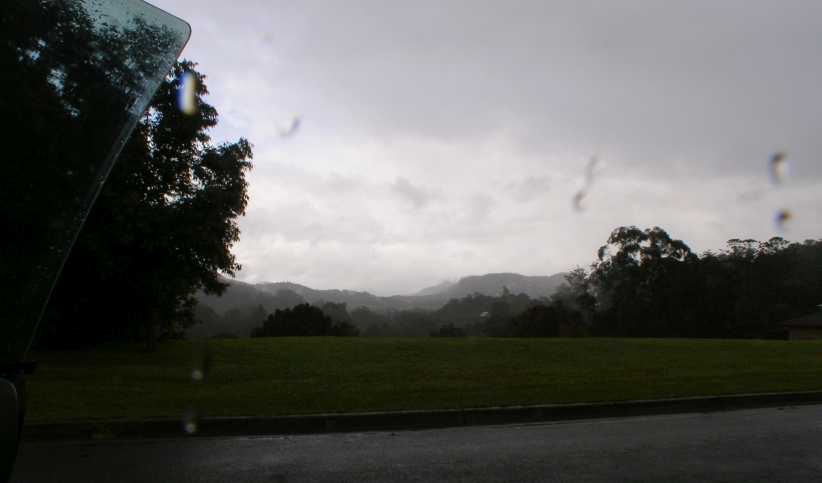
Hinterland view. From a currumbin suburban street, this view was enhanced by the inclement conditions.
The big surprise of that weekend, however, was on the way home. I often take the road through Bidadabba, a narrow and twisting path which cuts of a few kilometres of the journey. Coming up from a low level creek crossing just before rejoining the main road I wondered what this bloke was doing, when I saw going past I stopped for a closer look:
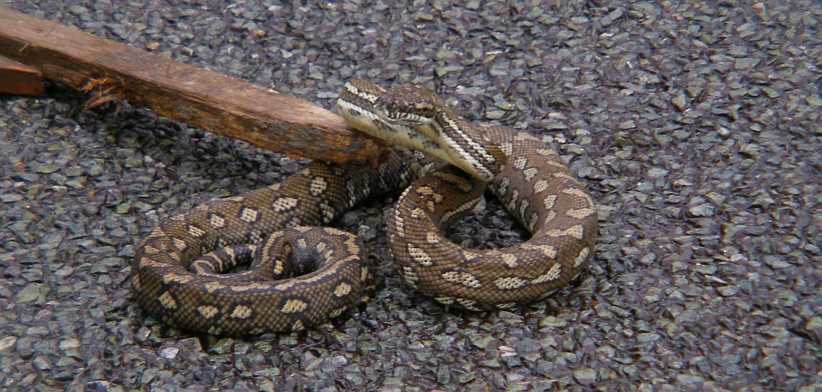
Snake. This snake was on the road and the other bloke was trying to catch and bag it.
This snake had come out of hiding at the wrong time and was going to be caught…
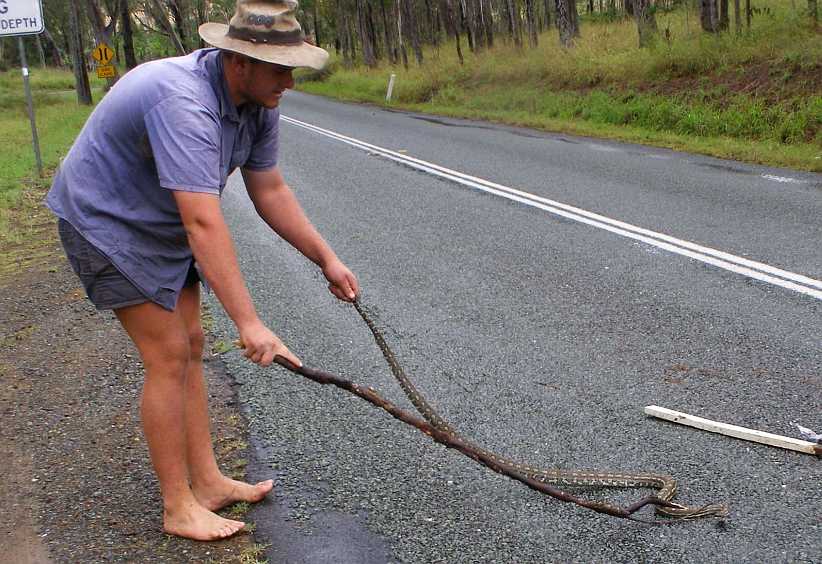
Catching the snake. I wonder how safe this bloke was with no shoes or long trousers on. Only his toes indicate any concern for his safety.
…with very basic equipment picked up on the side of the road. Soon the snake was captured:
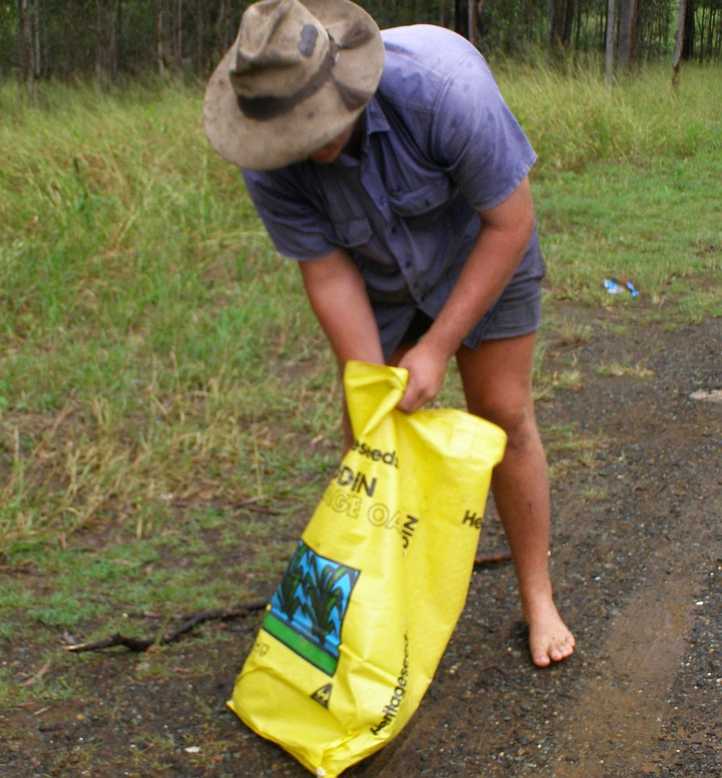
Snake bagged. In a short time the snake was captured and wrapped up in this bag.
And so that weekend came to a conclusion. The next one led me to a Valiant-owner’s place, where he had a nice coupe locked away…
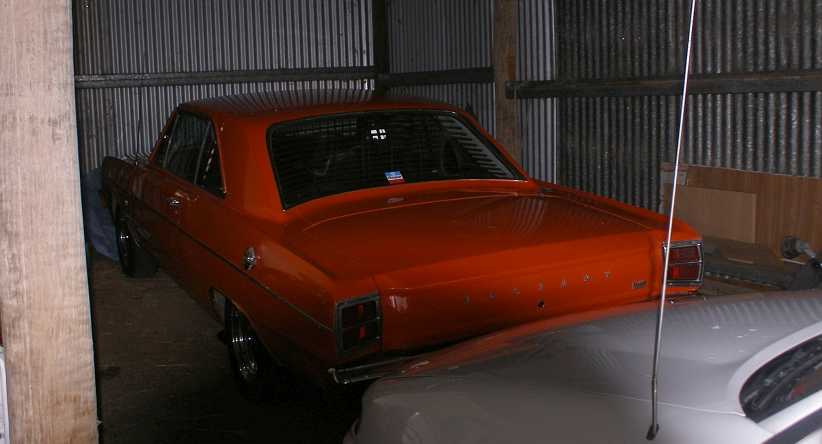
Valiant coupe. These are highly prized among Australian Valiant owners, their rear bodywork being unchanged from the US models while the front is the same as Australian 4-doors in the VF and VG models.
…and some rather rough-looking sedans of various models. This one is a VF, the last of the slant 6 models, and there’s a VH mostly obscured behind it, the first model with the bigger body Chrysler Australia built on the floor pan of the VE, VF and VG models:
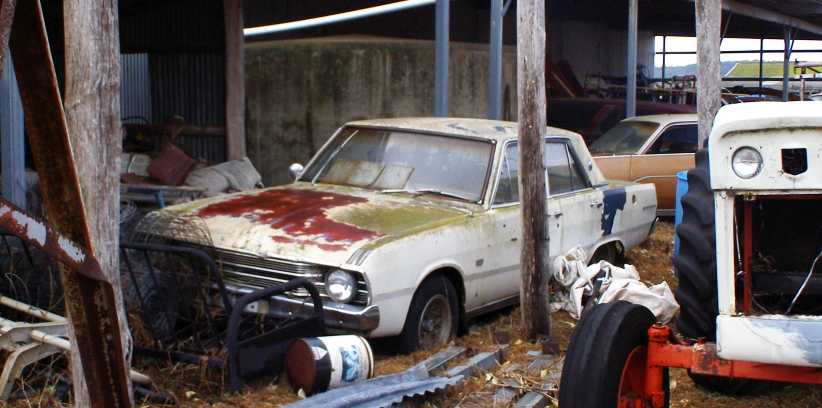
VF roughy. The VF looked a bit sad, the VH has a vinyl roof and a lot of rust problems.
There were some showers in the afternoon and I caught this rainbow. I believe it’s different to the normal rainbow being refraction through the distant rain. This means, apparently, that it might not have all the usual rainbow colours and it’s truncated at the cloud. I also believe it’s not likely to have any pots of gold…
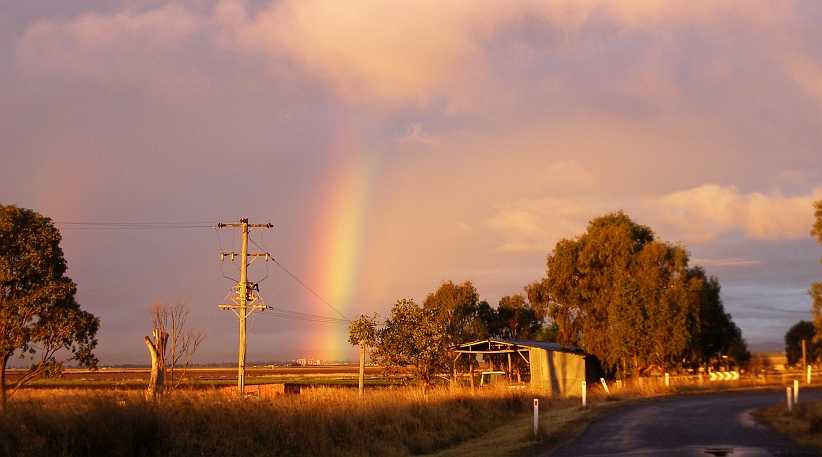
Rainy rainbow. Out on the flat country West of Clifton the afternoon sun and a shower combined for this display.
I was up early on the Saturday morning two more weekends on for another run to Grafton, this time capturing the view from Raspberry Lookout in the morning sun:
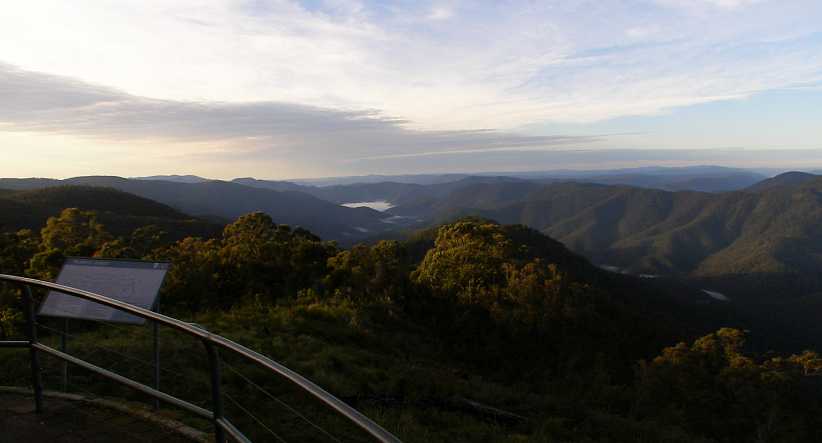
Early morning Raspberry. Mists in the valleys and sharp contrasts in lighting of the ridges show that this is an early morning picture.
And the mists were prolific in the Upper Clarence Valley as I cruised down the Gibraltar Range:
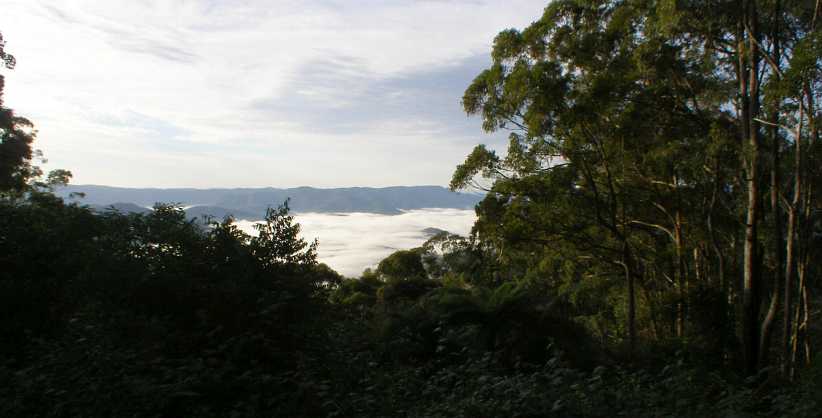
Valley mists. Between the trees you can catch sights on this great drive along the Gwydir Highway, especially early in the morning.
I hadn’t been taking notice, apparently, as this was the first time I realised that the Jackadgery bridge had been replaced. This morning I couldn’t miss it…
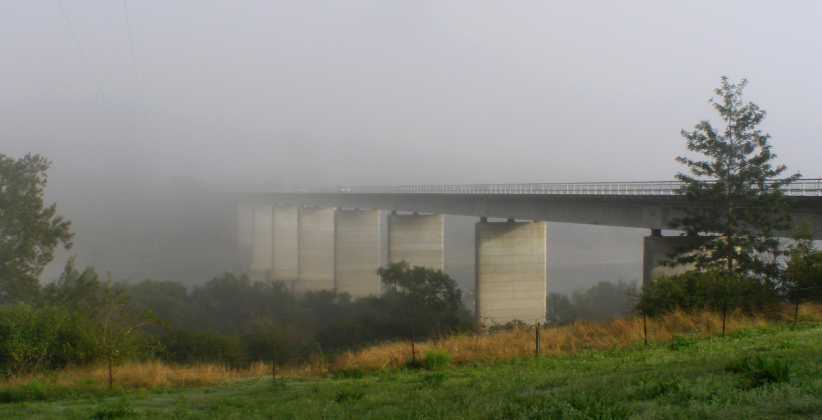
Jackadgery in fog. This bridge is quite high over the Clarence River, the fog caused me to stop at the adjacent Rest Area to get a pic. The ‘centre’ of Jackadgery is just the other end of the bridge, a caravan park and small store.
And bridge works continued to show themselves. The Grafton bridge is unique in Australia in having railway tracks on the lower level and the road on top. It’s been too narrow for some time now and finally a replacement (or supplementary?) bridge is to be built alongside it. This was the first I’d seen of it:
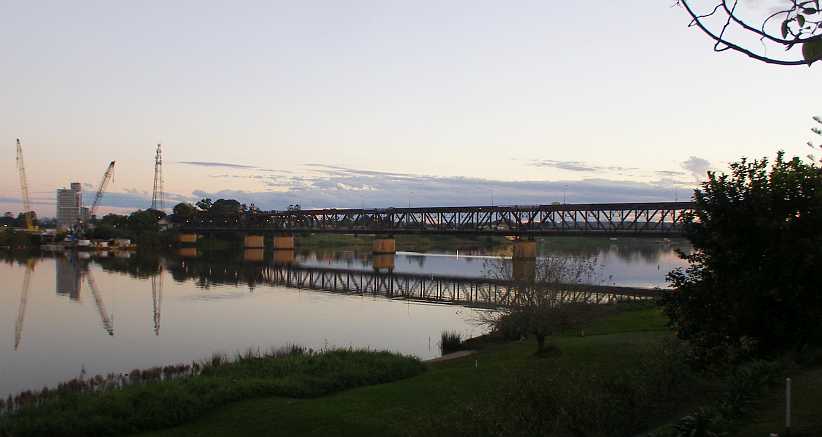
Grafton bridge beginnings. The quiet waters of the Clarence reflect the old bridge and the cranes set up to build the new one. The one on the far left is in the yard where the pre-formed concrete sections were being cast.
During the following week at home we were visited by the biggest flock of ducks I saw while I lived there…
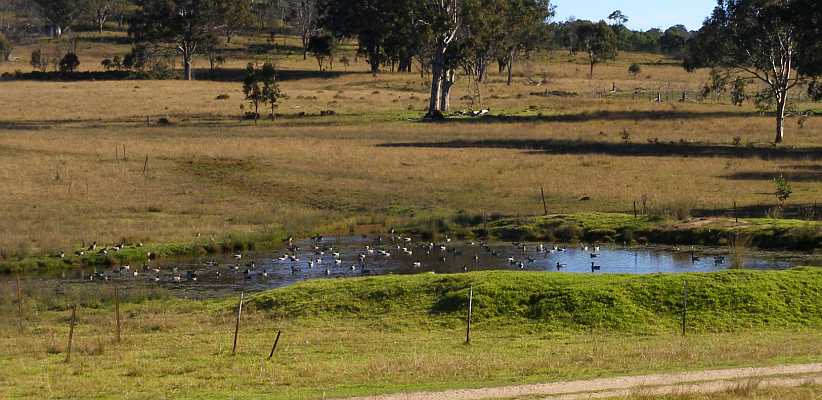
Ducks on dam. The dam’s still full and the ducks flocked in this day in large numbers.
…but that didn’t distract me from getting on with the job of stripping down the white Forester:
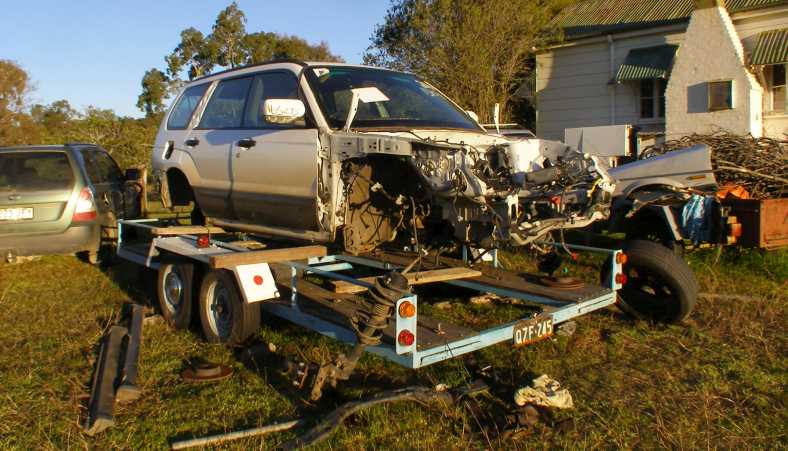
Stripping continues. Now I had the shell sitting on boards across the trailer, more and more parts were taken from the shell.
The Lismore area was my next assignment. The outstanding sight this weekend was this macadamia farm:
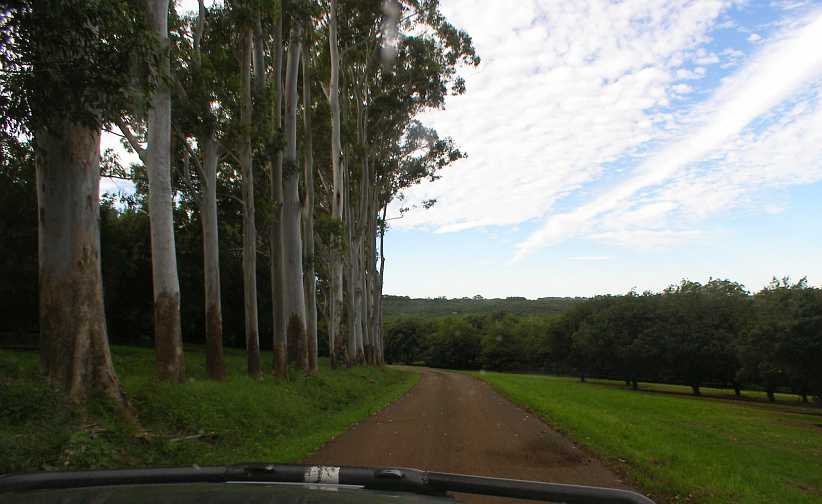
Well-established. While the plantation of macadamia trees was orderly and well-kept, the sight of these tall gum trees lining the driveway showed that the owners cared about their property.
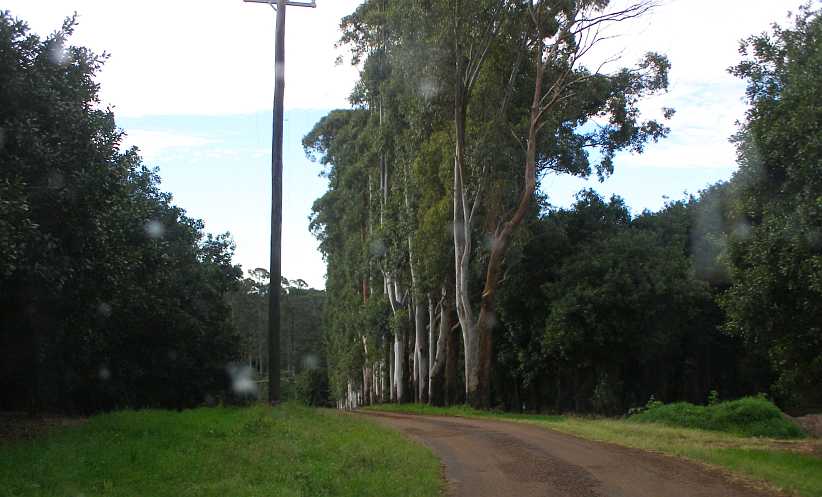
Great driveway. The gum trees seem to be shielding the macadamia trees alongside the drive.
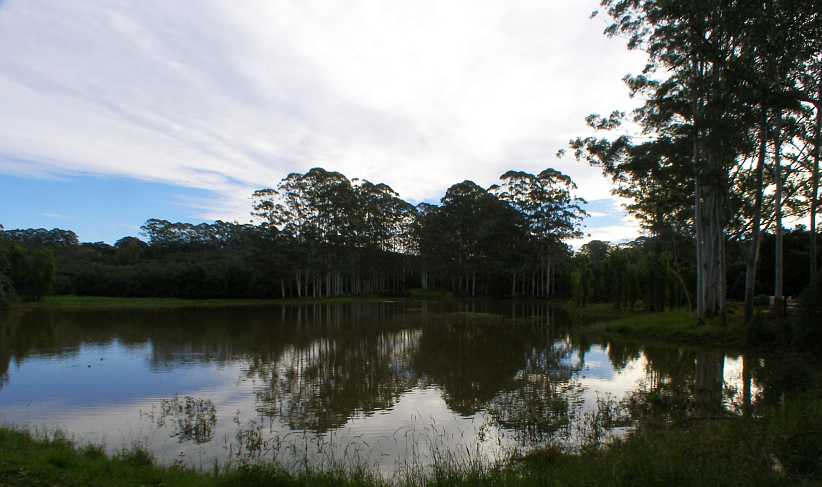
Reflective. This dam was also surrounded by a combination of macadamias and the tall gum trees, the reflections completing the picture.
It was such a nice area in which to work and this place was really the icing on the cake. Back in Lismore the company had booked me into the Comfort Inn Centrepoint motel and I hated the place!
I’d asked them to never put me in there again after the previous time they’d sent me there but something went wrong. Overnight I went onto Trip Advisor and found a really nasty review of the place in which the girl involved had complained about the cramped bathroom. She wasn’t wrong!
Cramped bathroom. There’s no room to spare here, is there? There’s only just enough room to stand there as you shut the door, in fact.
She also complained about various items being dirty, about the fact that the office closes at 7pm and she described the carpet on the stairs as looking like “…it came out of a barn.” For me the stench was probably the worst bit, especially as cigarette smoke is captured by he shape of the building.
Once again I headed home via the Gold Coast and called in on Ben. He’d had a bit of a victory in his HQ racer…
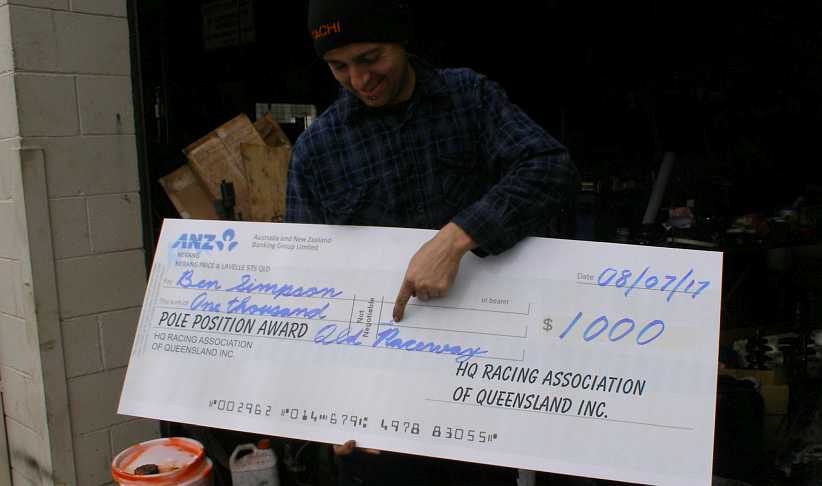
Ben’s big cheque. Here Ben is pointing to the word ‘cents’ written in very small letters.
…over this weekend. After getting the fastest lap in practice he’d won the annual 1-hour race at Queensland Raceway, a race which requires a driver change. Getting way out in front in his own car in the first half, he’d handed it over to his co-driver, then stepped into a friend’s car which was running second and drove it home from there.
I was in that area again the following weekend and noted this further example of the ‘hinterland views’ of the Gold Coast and Tweed areas. This is from a hillside street in a Tweed suburb, with Mount Warning prominent in the distance:
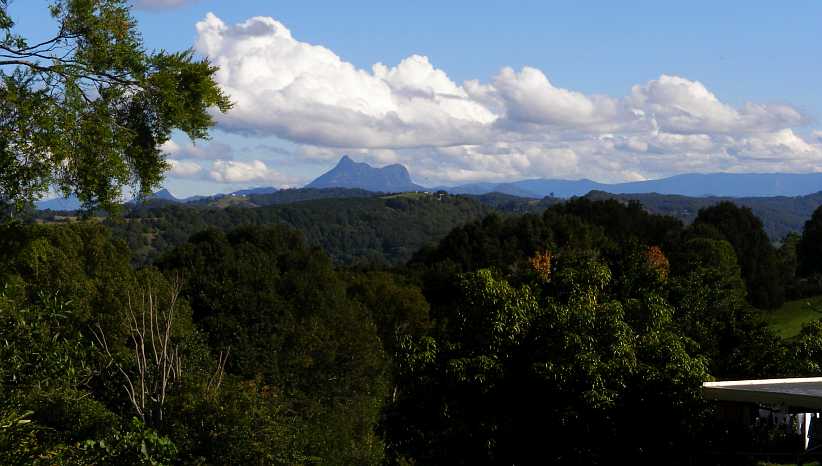
Mount Warning. Named by Captain James Cook during his 1770 run up the East Coast of Australia, Mount Warning is the first point in Australia to see the sun each morning.
The last weekend of July saw me all the way down at Coffs Harbour, a place which doesn’t appeal to me at all. I took the back road, the Orara Way, out of there and stopped specifically to get a shot of this flood warning sign. Around this bend the road drops right down low to cross the river and at times the water gets very deep.
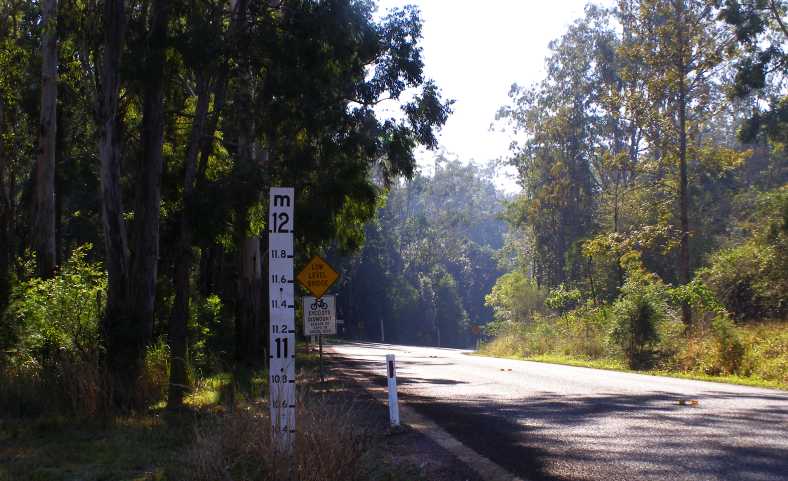
Low level bridge. If the water was 10 metres deep, not even high enough for the bottom of this scale, it would be 33 feet deep at the bridge.
To join Sandra on an outing the following weekend, the first weekend in August, I arranged my work in a suburb to the West of Brisbane. When I went to the local shops to get some lunch I saw this nicely restored Valiant station wagon: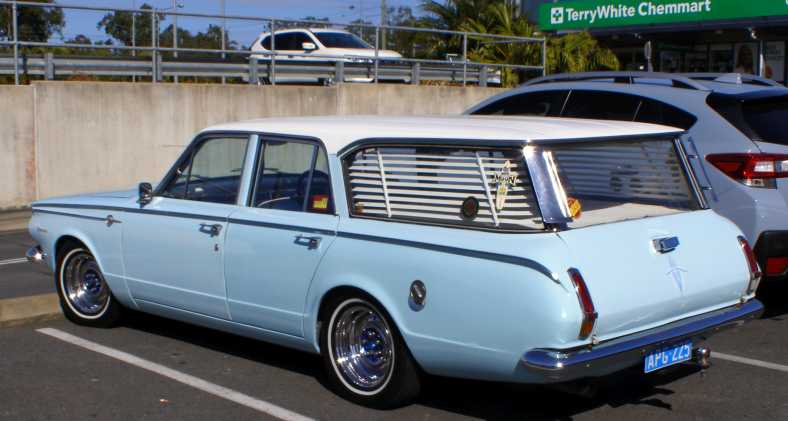
AP6 Safari Wagon. The best looking of the early Valiants, I feel, the AP6 was on the market in 1966.
The ‘AP6’ nomenclature stems from ‘Australian Production’ with this being regarded as the sixth in the line. AP1, AP2 and AP3 were all Chrysler Royals – remodeled from 1954 Plymouth models between 1956 and 1963 – while the AP5 brought the designation to the Valiant model prior to this one.
The AP6 had a classy grille, a bit different to the US models:
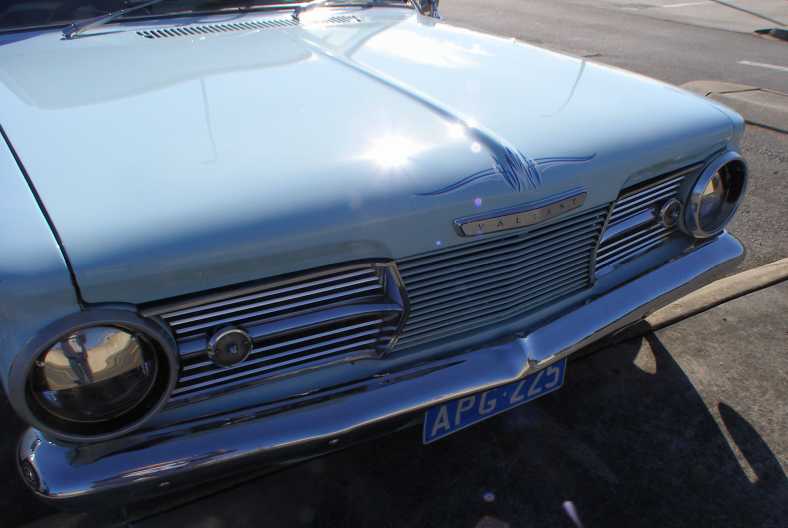
Classy grille. Chrysler Australia put their own stamp on this design, the grille being a bit different to the US models and looking very neat.
It was quite the day for finding cars to photograph. One person I interviewed had a Plymouth utility from the fifties and a similar year model Vauxhall utility too:
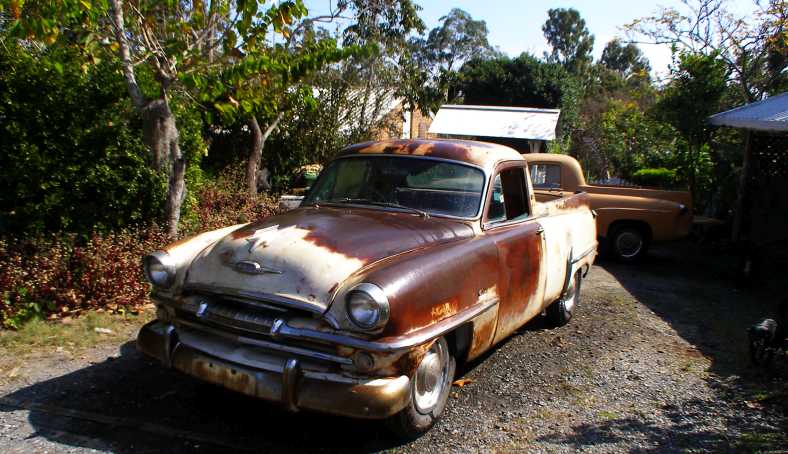
Plymouth and Vauxhall utilities. The Plymouth is a flathead 6 while the Vauxhall is ohv but a bit smaller.
August is the coolest month of the year, usually, but it’s the last month of Winter too. Afternoons are starting to lengthen, giving longer working hours. I was still trying to work out exactly how I’d overcome a couple of small issues with the van’s preparation and I still had a Forester engine change to do.
Just when would I get these jobs done?
Early in June I was sent to the Gold Coast and the rain persisted. There are many parts of the Gold Coast and the adjacent Tweed Coast which have great views of the hinterland and this was one of them, probably enhanced by the mists of the day…
Hinterland view. From a currumbin suburban street, this view was enhanced by the inclement conditions.
The big surprise of that weekend, however, was on the way home. I often take the road through Bidadabba, a narrow and twisting path which cuts of a few kilometres of the journey. Coming up from a low level creek crossing just before rejoining the main road I wondered what this bloke was doing, when I saw going past I stopped for a closer look:
Snake. This snake was on the road and the other bloke was trying to catch and bag it.
This snake had come out of hiding at the wrong time and was going to be caught…
Catching the snake. I wonder how safe this bloke was with no shoes or long trousers on. Only his toes indicate any concern for his safety.
…with very basic equipment picked up on the side of the road. Soon the snake was captured:
Snake bagged. In a short time the snake was captured and wrapped up in this bag.
And so that weekend came to a conclusion. The next one led me to a Valiant-owner’s place, where he had a nice coupe locked away…
Valiant coupe. These are highly prized among Australian Valiant owners, their rear bodywork being unchanged from the US models while the front is the same as Australian 4-doors in the VF and VG models.
…and some rather rough-looking sedans of various models. This one is a VF, the last of the slant 6 models, and there’s a VH mostly obscured behind it, the first model with the bigger body Chrysler Australia built on the floor pan of the VE, VF and VG models:
VF roughy. The VF looked a bit sad, the VH has a vinyl roof and a lot of rust problems.
There were some showers in the afternoon and I caught this rainbow. I believe it’s different to the normal rainbow being refraction through the distant rain. This means, apparently, that it might not have all the usual rainbow colours and it’s truncated at the cloud. I also believe it’s not likely to have any pots of gold…
Rainy rainbow. Out on the flat country West of Clifton the afternoon sun and a shower combined for this display.
I was up early on the Saturday morning two more weekends on for another run to Grafton, this time capturing the view from Raspberry Lookout in the morning sun:
Early morning Raspberry. Mists in the valleys and sharp contrasts in lighting of the ridges show that this is an early morning picture.
And the mists were prolific in the Upper Clarence Valley as I cruised down the Gibraltar Range:
Valley mists. Between the trees you can catch sights on this great drive along the Gwydir Highway, especially early in the morning.
I hadn’t been taking notice, apparently, as this was the first time I realised that the Jackadgery bridge had been replaced. This morning I couldn’t miss it…
Jackadgery in fog. This bridge is quite high over the Clarence River, the fog caused me to stop at the adjacent Rest Area to get a pic. The ‘centre’ of Jackadgery is just the other end of the bridge, a caravan park and small store.
And bridge works continued to show themselves. The Grafton bridge is unique in Australia in having railway tracks on the lower level and the road on top. It’s been too narrow for some time now and finally a replacement (or supplementary?) bridge is to be built alongside it. This was the first I’d seen of it:
Grafton bridge beginnings. The quiet waters of the Clarence reflect the old bridge and the cranes set up to build the new one. The one on the far left is in the yard where the pre-formed concrete sections were being cast.
During the following week at home we were visited by the biggest flock of ducks I saw while I lived there…
Ducks on dam. The dam’s still full and the ducks flocked in this day in large numbers.
…but that didn’t distract me from getting on with the job of stripping down the white Forester:
Stripping continues. Now I had the shell sitting on boards across the trailer, more and more parts were taken from the shell.
The Lismore area was my next assignment. The outstanding sight this weekend was this macadamia farm:
Well-established. While the plantation of macadamia trees was orderly and well-kept, the sight of these tall gum trees lining the driveway showed that the owners cared about their property.
Great driveway. The gum trees seem to be shielding the macadamia trees alongside the drive.
Reflective. This dam was also surrounded by a combination of macadamias and the tall gum trees, the reflections completing the picture.
It was such a nice area in which to work and this place was really the icing on the cake. Back in Lismore the company had booked me into the Comfort Inn Centrepoint motel and I hated the place!
I’d asked them to never put me in there again after the previous time they’d sent me there but something went wrong. Overnight I went onto Trip Advisor and found a really nasty review of the place in which the girl involved had complained about the cramped bathroom. She wasn’t wrong!
Cramped bathroom. There’s no room to spare here, is there? There’s only just enough room to stand there as you shut the door, in fact.
She also complained about various items being dirty, about the fact that the office closes at 7pm and she described the carpet on the stairs as looking like “…it came out of a barn.” For me the stench was probably the worst bit, especially as cigarette smoke is captured by he shape of the building.
Once again I headed home via the Gold Coast and called in on Ben. He’d had a bit of a victory in his HQ racer…
Ben’s big cheque. Here Ben is pointing to the word ‘cents’ written in very small letters.
…over this weekend. After getting the fastest lap in practice he’d won the annual 1-hour race at Queensland Raceway, a race which requires a driver change. Getting way out in front in his own car in the first half, he’d handed it over to his co-driver, then stepped into a friend’s car which was running second and drove it home from there.
I was in that area again the following weekend and noted this further example of the ‘hinterland views’ of the Gold Coast and Tweed areas. This is from a hillside street in a Tweed suburb, with Mount Warning prominent in the distance:
Mount Warning. Named by Captain James Cook during his 1770 run up the East Coast of Australia, Mount Warning is the first point in Australia to see the sun each morning.
The last weekend of July saw me all the way down at Coffs Harbour, a place which doesn’t appeal to me at all. I took the back road, the Orara Way, out of there and stopped specifically to get a shot of this flood warning sign. Around this bend the road drops right down low to cross the river and at times the water gets very deep.
Low level bridge. If the water was 10 metres deep, not even high enough for the bottom of this scale, it would be 33 feet deep at the bridge.
To join Sandra on an outing the following weekend, the first weekend in August, I arranged my work in a suburb to the West of Brisbane. When I went to the local shops to get some lunch I saw this nicely restored Valiant station wagon:
AP6 Safari Wagon. The best looking of the early Valiants, I feel, the AP6 was on the market in 1966.
The ‘AP6’ nomenclature stems from ‘Australian Production’ with this being regarded as the sixth in the line. AP1, AP2 and AP3 were all Chrysler Royals – remodeled from 1954 Plymouth models between 1956 and 1963 – while the AP5 brought the designation to the Valiant model prior to this one.
The AP6 had a classy grille, a bit different to the US models:
Classy grille. Chrysler Australia put their own stamp on this design, the grille being a bit different to the US models and looking very neat.
It was quite the day for finding cars to photograph. One person I interviewed had a Plymouth utility from the fifties and a similar year model Vauxhall utility too:
Plymouth and Vauxhall utilities. The Plymouth is a flathead 6 while the Vauxhall is ohv but a bit smaller.
August is the coolest month of the year, usually, but it’s the last month of Winter too. Afternoons are starting to lengthen, giving longer working hours. I was still trying to work out exactly how I’d overcome a couple of small issues with the van’s preparation and I still had a Forester engine change to do.
Just when would I get these jobs done?
Last edited by Ray Bell; Oct 13, 2020 at 12:27 PM.
Thread Starter
|
Captain
Joined: Oct 2005
Posts: 570
Likes: 8
From: The Summit, Queensland, Australia
Spring might promise warmth and sunshine, but sometimes it suffers from a slow delivery.
The Spring of 2017 had some of that about it in the mountain country where I lived, but down on the Coastal fringe it wasn’t so bad. I was awaiting the better weather to get stuck into my joblist and concentrating on keeping up the work assignments through the last of August and when September came.
A good friend was getting on with some of his jobs at home and one day I dropped in there. He hadn’t used his cement mixer in a while and the tyres needed to be pumped up. He did that and we went inside for morning tea, but when we went outside again there was an unusual sight:
Unwanted balloon. The tyre has split so that the tube could emerge and grow under the newly-inflated pressure.
A work assignment on the outskirts of Armidale introduced me to a man who was a bit of a collector, and though his car…
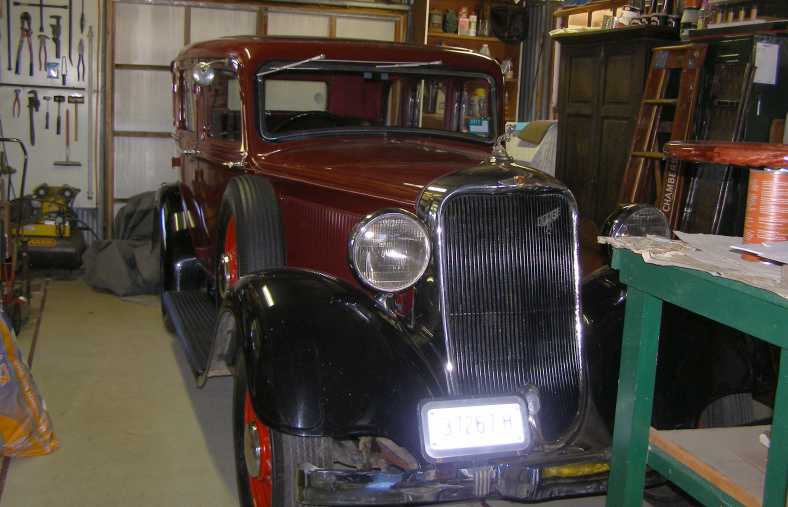
1933 Dodge. Obviously many long hours have gone into restoring this dodge sedan.
…was a nicely collectable model, and he’d got it looking good outside and under the bonnet…
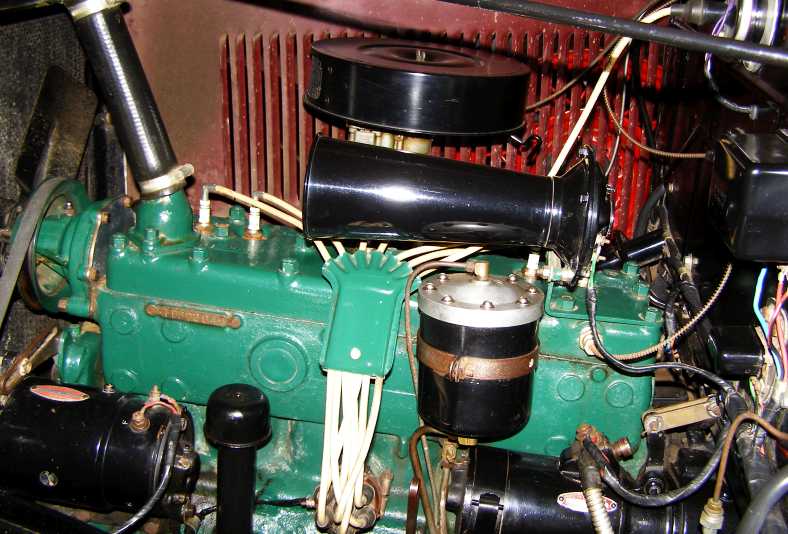
Flathead six. The presentation extends to the engine bay, too, where more effort has been expended.
…but his interest in things of yesteryear extended to collecting and restoring old signage. Of particular interest to me was the smallest sign on the right as I had spent a lot of time in Parramatta Park when I was very young and never seen those steam engines:
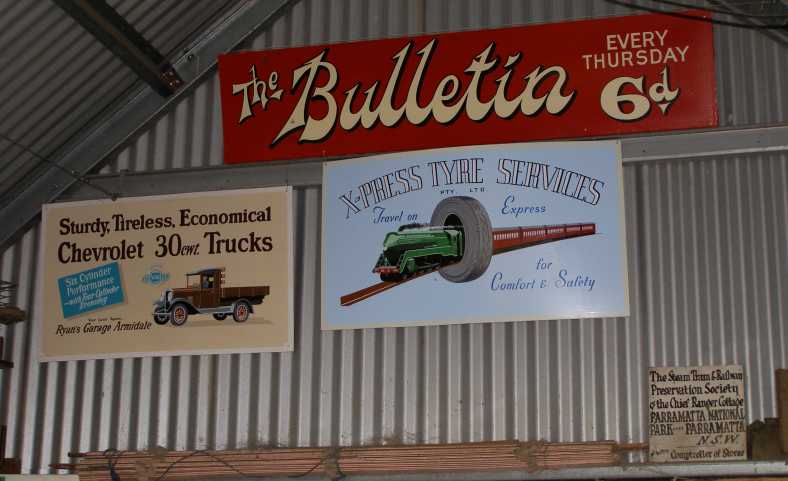
Old signs. ‘The Bulletin’ was a news magazine with a literary side which went back to the mid-1800s and was famous for fostering the careers of poets in Australia.
It was quite late as I drove home that night, having waited for my pizza to be made in Armidale before setting off. And as I drove through Glen Innes I couldn’t understand how this got there:
Lounge in the main street. How does a loung – missing its cushions – finish up on the median strip?
The next weekend I was again down near the coast at a place called Dunoon. As I stayed at Lismore, I found myself looking around the Lismore Swap Meet where I spotted a Peugeot 203 fuel cap sitting among a lot of unrelated items. I asked if they knew what it was and this led to a discussion about Peugeot items I wanted to find. “I’d like to find a 403 gearbox,” I told the stall holder’s friend, to which he replied that he had one.
After completing my assignment I went around to this bloke’s home on the road to Kyogle and picked up the gearbox I wanted for not much money. While I was there he invited me inside and I got to see some of his wife’s artwork…
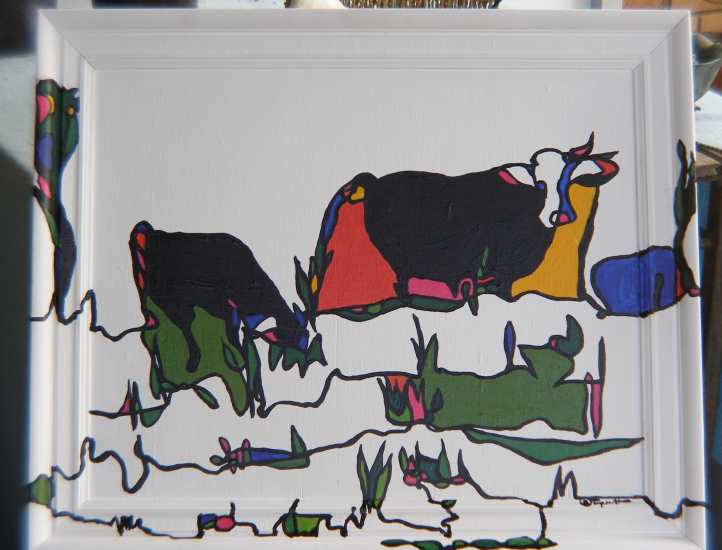
Expanded art. The lady didn’t stop at the edge of the canvas but continued her painting around the frame.
…and his own car models:
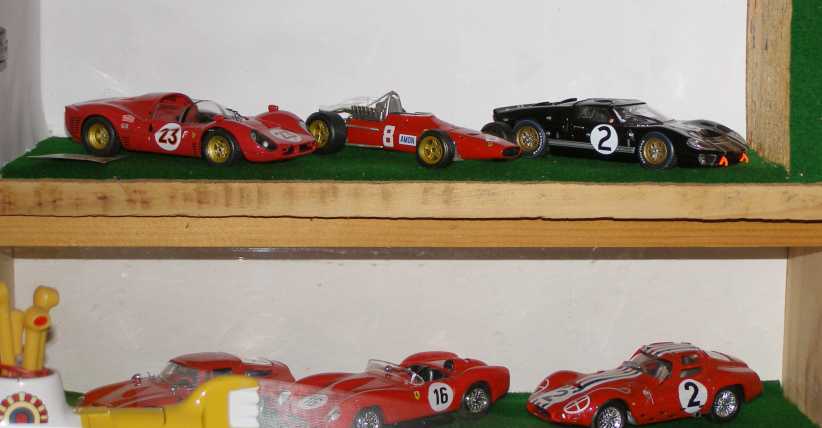
Racing models. A Ferrari P3, V12 F1 Ferrari and the Le Mans-winning Ford fill the top row, I think the car at the lower left is a Ferrari while the middle one is certainly a Testa Rossa. The multi-striped car is Lucky Casner’s 1963 Le Mans Maserati.
It was a Monday trip home, I had all day and I wanted to take advantage of that to divert my path through the Lions Road – a road maintained by the Lions Clubs – which presents travellers with some interesting road as well as some nice views. Here is my path:
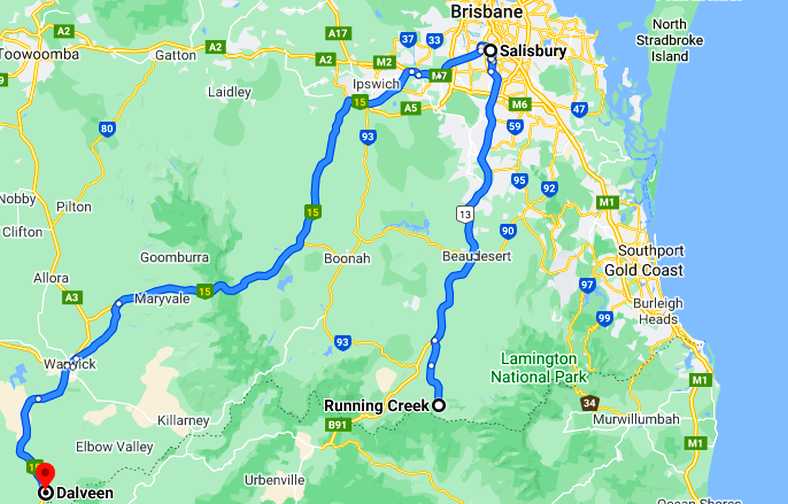
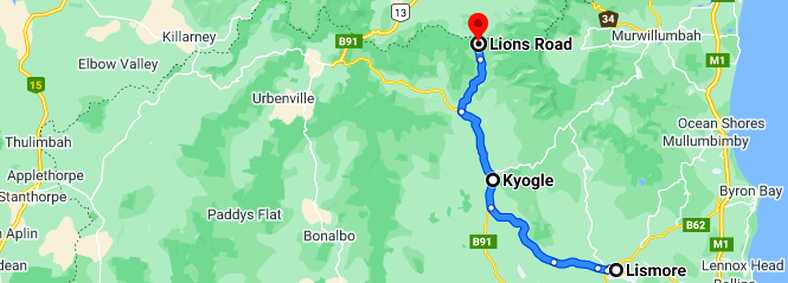
Note here that the Google maps won’t recognise a stretch of the Lions Road so I’ve had to do two maps.
And it’s not as if there wasn’t problems with the road itself, anyway. For some months I’d been seeing a sign at the start of the road as I drove by saying there was a major diversion. This was caused by a bridge collapse, so the diversion became a part of my path and it took me over a twisty gravel road for some distance. The views prevailed, however:
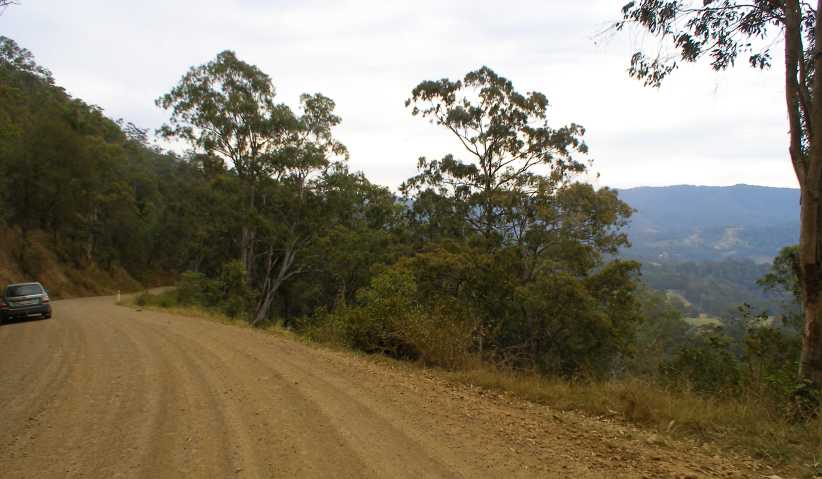
Lions Road diversion. Going around a different set of hills, this road was gravel rather than bitumen.
There was also some fire activity, probably a major burn-off to prevent more dangerous bushfires when summer brought much higher temperatures and risks:
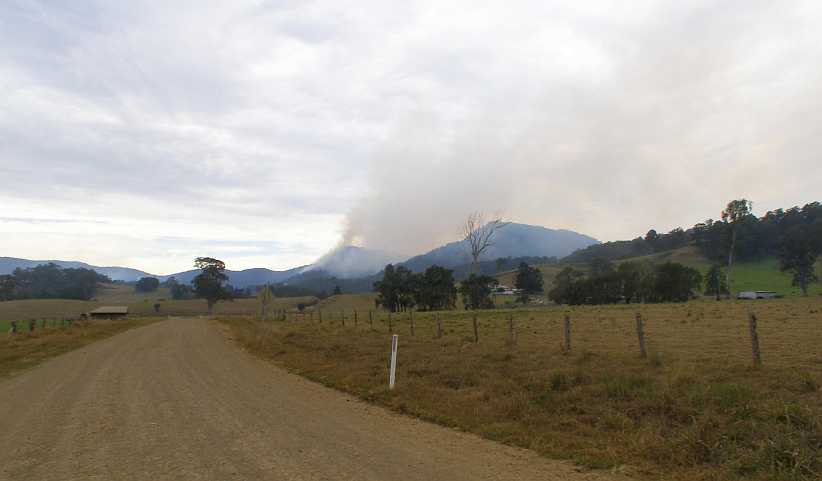
Fires in the hills. I drove by lonely farms and wondered if that smoke would prove to give me problems further on.
Eventually I made my way along the Beaudesert Road and into the place in Salisbury where I had three wheels to pick up. These were from a 1940 Ford and I wanted them a distant future project I’d been collecting bits for over some years. When I got there I found some unusual cars for Australia…
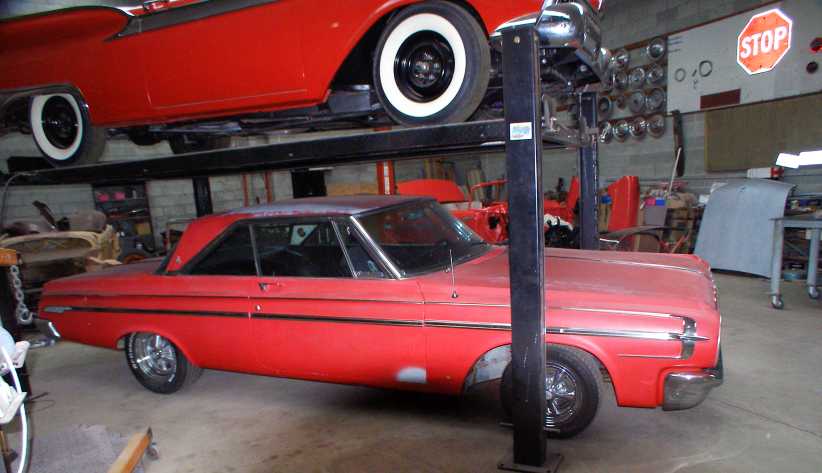
1964 Polara. Recently imported, this 2-door Polara and the 2-door Ford on the hoist were both rare cars in Australia.
…as they were 2-door models which were never sold here. Without straining my memory banks, I would say that no 2-door American cars were marketed in Australia after 1950 or so save for the Studebaker Hawks. Some Thunderbirds were privately imported but beyond that such things were very unusual, just as lower trim levels were the norm. In the ‘64 Dodges sold here, for instance, they were all fitted with 318 Poly engines, 727 automatics and had 440 model trim. Heaters were an option, just about the only option.
With that diversion it was getting on in the day and I was in peak-hour traffic as I headed West along the Cunningham Highway.
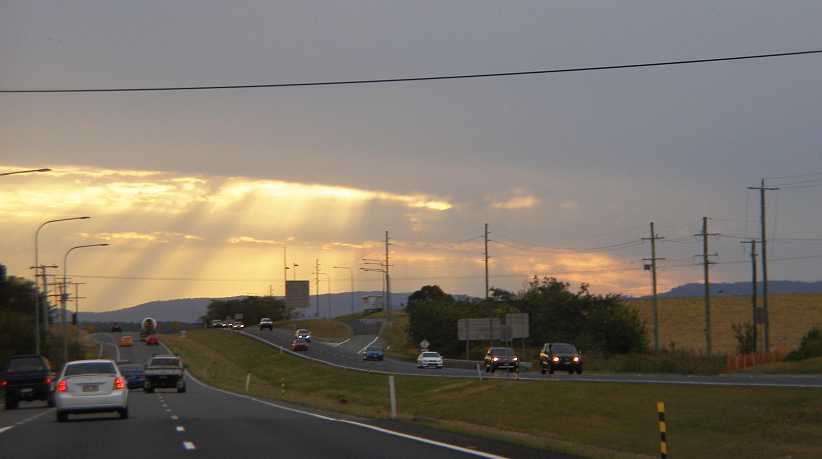
Cloudy display. People rushing home in a Westerly direction this day saw this display of the sun’s rays coming through the clouds.
Though they took up a lot of available space in the Forester, the three wheels with tyres and the Peugeot gearbox got home safely:
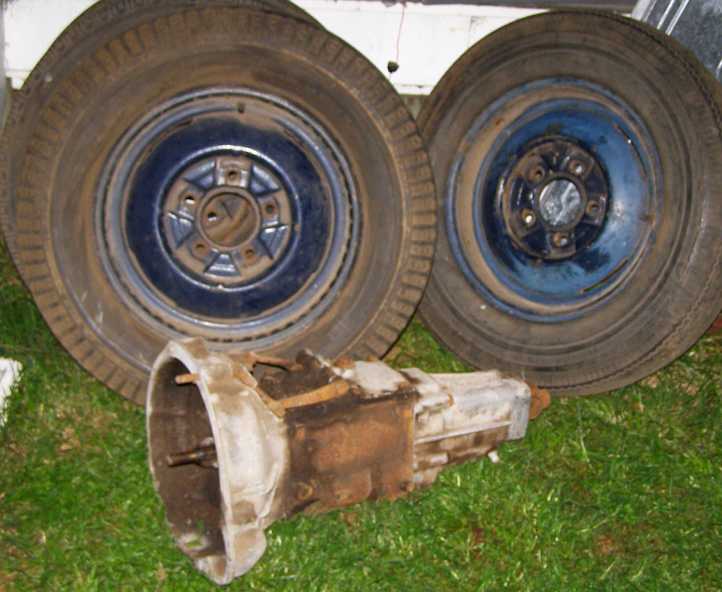 [/url]
My booty. Components for very different projects, the Ford wheels dwarf the Peugeot gearbox after being unloaded.
I was back down along the road through Woodenbong the following weekend, the early Saturday morning sun in my eyes but lighting up the mists lying in the valleys. This pic was taken just before Woodenbong:
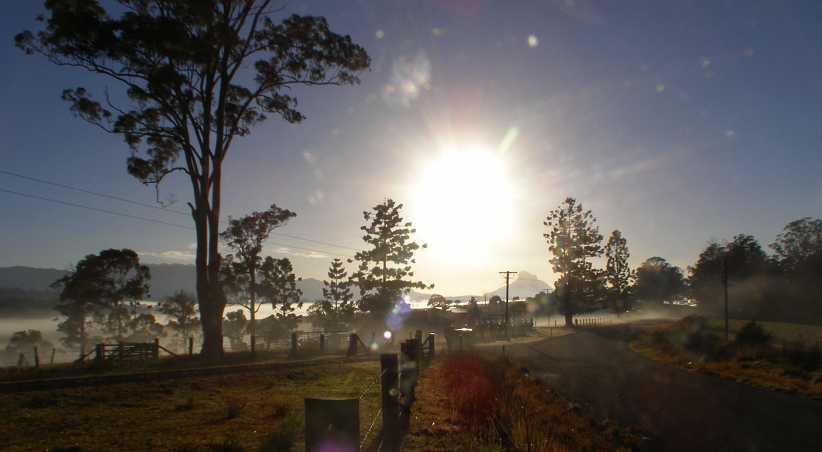
Mount Lindesay sunrise. The morning sun tries to silhouette the extinct volcano we know as Mount Lindesay as I drive once again to Lismore.
Now it was breeding season for the plovers and I encountered a very full nest of them:
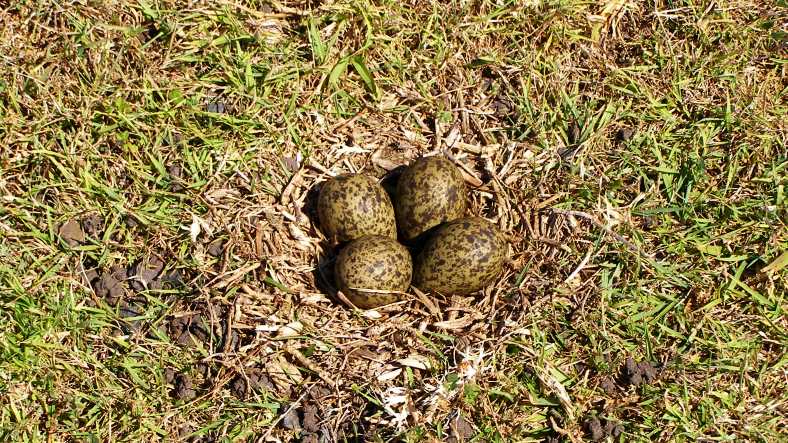
Plover eggs. The risky breeding methods of the plover never cease to make me wonder. Eggs laid in the grass while their protection methods seem so strange.
The plover, when humans come near the ‘nest’ walk away, squawking. They are trying to make intruders think that they have nothing there to protect. Until you get too close, then they turn on you, swooping in attack mode. When the chick hatch their protective measure when danger looms is for the chicks – at the parents’ warning call – is to be very still hiding in the grass while the parent birds fly around trying to draw the attention of predators.
It doesn’t always work, it surprises me that plovers survive to become the next generation of parent birds – and to cry out their plaintive cry. Described by one Australian poet with the words: “The plover, whose cry is like passion with pain…”
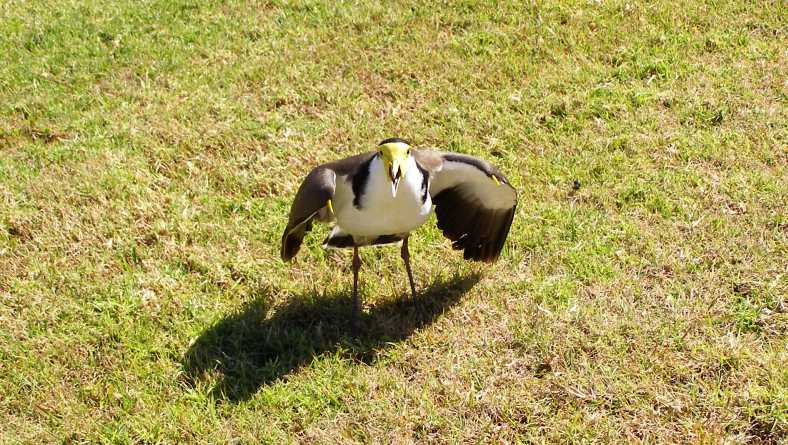
Parent plover. She – or he – looks angry and dangerous when they turn on you as you get too close. Note the barbs on the wings.
And after work that day I was treated to this colourful display over Lismore:
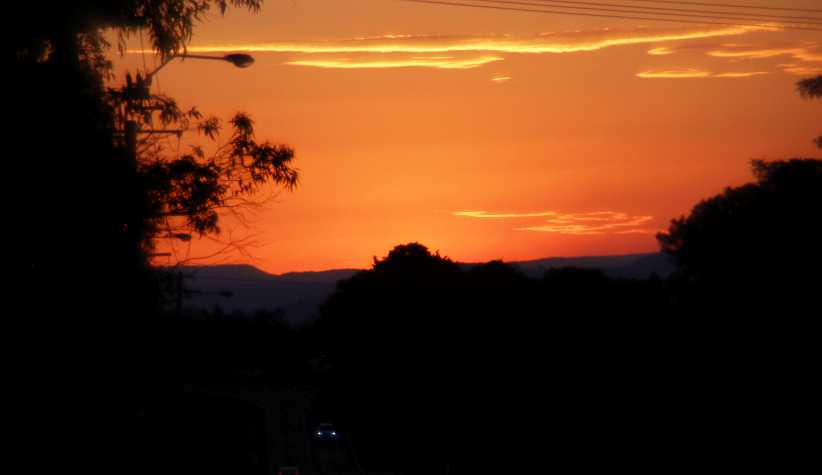
A red sky. Looking across Lismore from Goonellabah, the coming of evening was lit up with the colours of this unusually strong sunset.
During the following week as I spent time with Sandra in Toowoomba, we took a drive together to visit her mother in Ipswich. As was the usual thing, we stopped off at the fruit shop called ‘The Big Orange’ and I caught this photo of the last model of Australian Valiant, the CM. Sandra’s Falcon is the next car the other side of it.
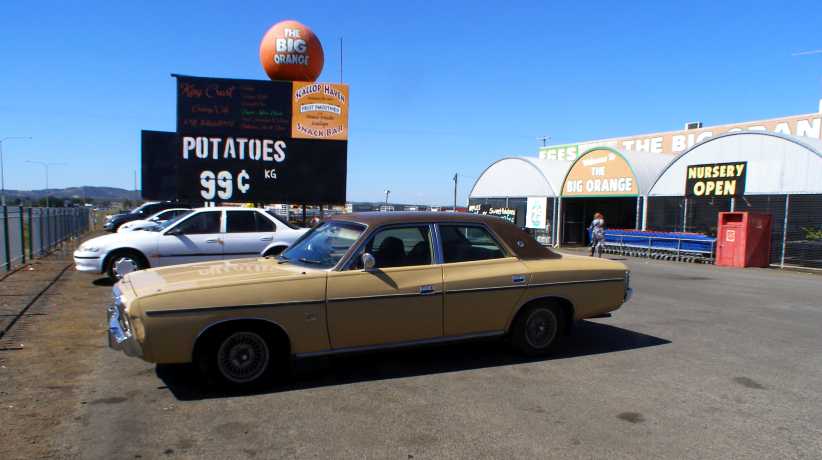
Aussie Valiant. The last model before Chrysler Australia was sold to Mitsubishi, this one has the 265 Hemi 6 engine. I spoke briefly to the owner before we continued our trip home.
Back at Dalveen I found there was a crazy bird, a blue wren, which spent time every day flying into the (closed) windows at the back of my kitchen. I tried to get a photo:
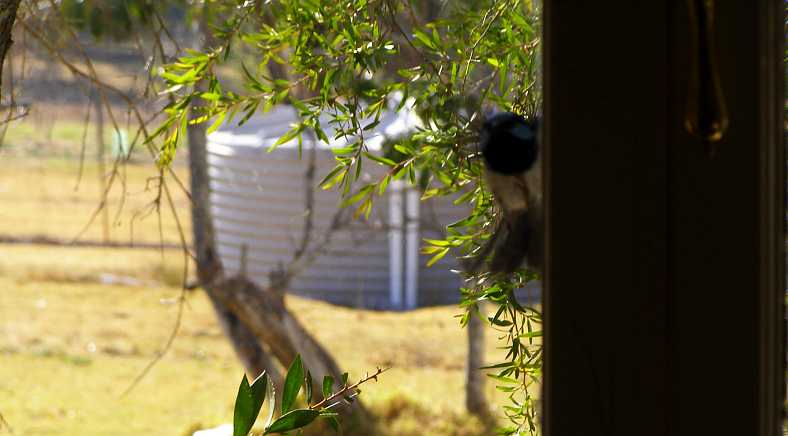
Crazy bird. I was glad the glass held up as this wren repeatedly crashed into the window as it passed the time of day.
As September wound down, the first month of our Spring, I planned in another trip to Sydney to catch up with old friends.
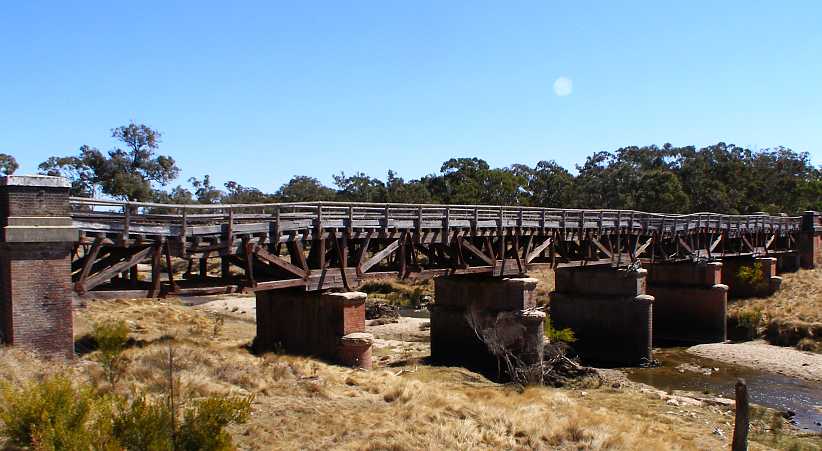
Old railway bridge. Look closely at this picture and you’ll see that several spans are in danger of collapsing. The line hasn’t been used for many years.
The bridge is just across the border on the New Engand Highway and crosses Tenterfield Creek. I just know that one day I’ll drive by and it will have given way.
Further along in the trip I slipped off the New England to take the Thunderbolts Way. Though it starts much further to the North-West, I joined it at Uralla and it took me to Gloucester, then Bucketts Way led me to the Pacific Highway, the main road to Sydney. It’s a good diversion as it carries very little traffic and virtually no trucks. So this much of my route was different to ones I’d mentioned previously:
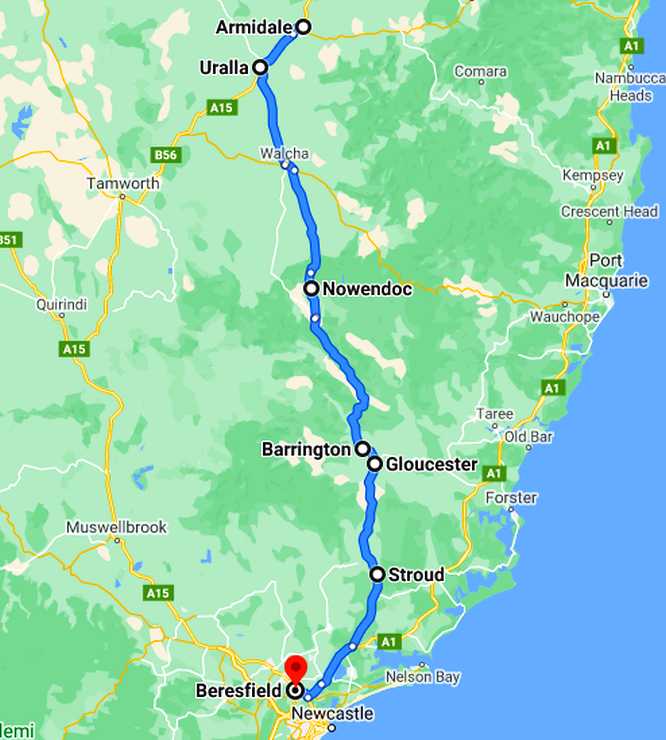
An overnight ‘camp’ in the car saw me on this part of the route very early. Again, mists in the valleys predominate as the early sun created reflections on the camera’s lens:
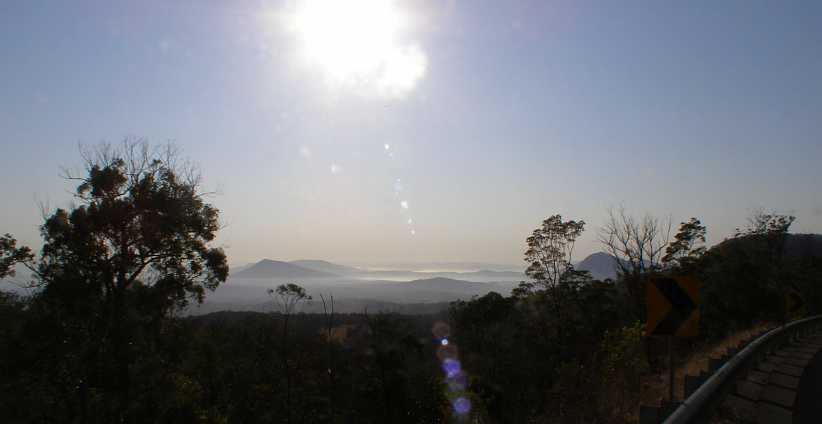
Thunderbolts view. ‘Thunderbolt’ was a bushranger who tried to outfox the law in this area 150 years ago, I suppose he caught sights like this from his (stolen) horses.
This road goes through some very sparsely inhabited country and it was only four years before this trip that Malcolm Naden was finally captured. Naden was a murderer who was living off the land between Nowendoc and Gloucester, breaking into holiday homes people had in the bush and using all of his skills to stay one step ahead of the police for over two years. Finally he was caught out by electronic devices set in one of those homes.
Nearer to Nowendoc I captured this spectacular sight over top of the grazing country which supports some of the few local families:
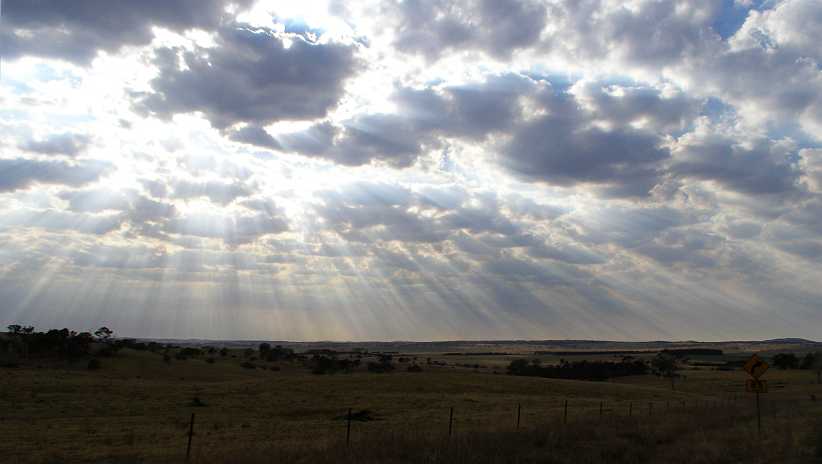
Spectacular sight. The morning sun breaking through the gaps in the clouds over top of a browned off area of frost-bitten paddocks which awaited Spring’s warmth to green up.
One of the features of this road is its steep climbs and drops, one of them leading to this lookout which impresses me as giving a view that looks just like what you see out the window of a plane:
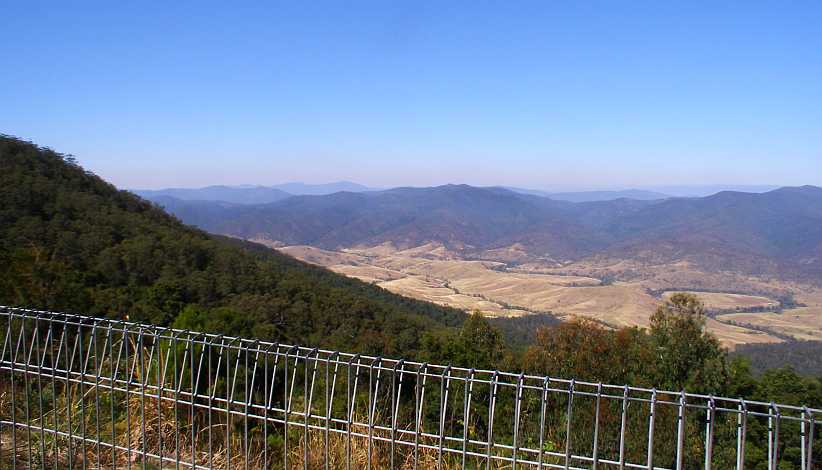
Carson’s Pioneer Lookout. Eric Carson forged through this wilderness with old trucks to take out logs for milling at Gloucester. This lookout honours his memory though the country down there looks very dry.
The local Rotarians have added to the lookout with the provision of this brass plaque which helps you know where you are in the world when you stop to admire the views…
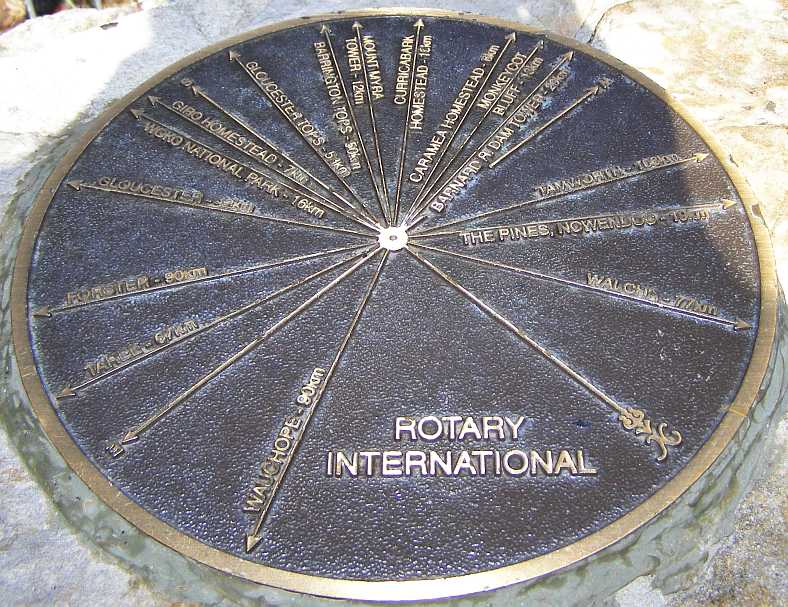
Straight lines? None of the roads here are straight at all, so distances shown bear no relationship to how far it is to drive to any of these places.
Recalling how many delapidated places I photographed in America, it’s only fair that I throw in this picture of a house near Stroud which has seen better (much better!) days…
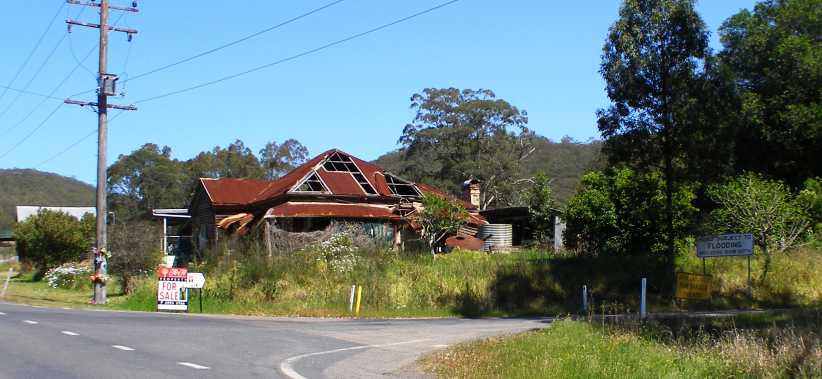
Old house. With rusty roofing blowing off in parts, some collapse of the verandah, vines growing up to pull the place down and a whole yard full of jungle, anyone looking to buy it would be unlikely to be thinking of living in it.
I was soon on the freeway and looking for a late breakfast. I also made a stop at a wrecking yard at Raymond Terrace to pick up a couple more of the Hella headlights I wanted from a Jeep to give me spares for the ones I’d fitted to the van. But otherwise I just headed straight to Bob Britton’s place.
Bob was to be one of the ‘old timers’ present at the get-together which had drawn me to make this trip. I stopped off at his place and spent the night there. He was busily working away on his next car – an open-wheeler with a BMW engine in the front – and alongside of it was the Corolla-engined rear-mounted car based on the Lotus 7 chassis. It was basically awaiting the electronics expert’s attention at this stage.
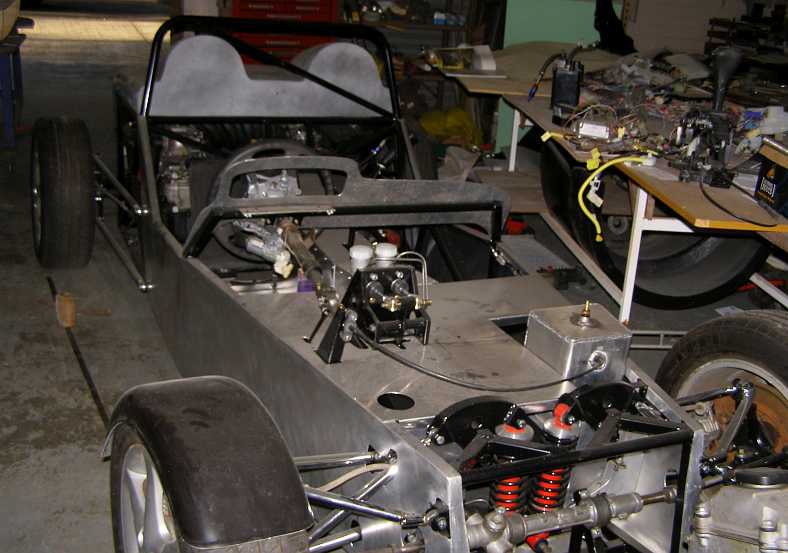
Corolla-powered car. Essentially finished, the pushrod front suspension can clearly be seen and the twin ‘headrest’ forms of the engine cover are just a couple of features different to a Lotus 7.
We had a good evening, dining together and talking about his projects and some of the histories of his original cars dating back to 1961.
And, of course, the reasons he had for building his next car...
The Spring of 2017 had some of that about it in the mountain country where I lived, but down on the Coastal fringe it wasn’t so bad. I was awaiting the better weather to get stuck into my joblist and concentrating on keeping up the work assignments through the last of August and when September came.
A good friend was getting on with some of his jobs at home and one day I dropped in there. He hadn’t used his cement mixer in a while and the tyres needed to be pumped up. He did that and we went inside for morning tea, but when we went outside again there was an unusual sight:
Unwanted balloon. The tyre has split so that the tube could emerge and grow under the newly-inflated pressure.
A work assignment on the outskirts of Armidale introduced me to a man who was a bit of a collector, and though his car…
1933 Dodge. Obviously many long hours have gone into restoring this dodge sedan.
…was a nicely collectable model, and he’d got it looking good outside and under the bonnet…
Flathead six. The presentation extends to the engine bay, too, where more effort has been expended.
…but his interest in things of yesteryear extended to collecting and restoring old signage. Of particular interest to me was the smallest sign on the right as I had spent a lot of time in Parramatta Park when I was very young and never seen those steam engines:
Old signs. ‘The Bulletin’ was a news magazine with a literary side which went back to the mid-1800s and was famous for fostering the careers of poets in Australia.
It was quite late as I drove home that night, having waited for my pizza to be made in Armidale before setting off. And as I drove through Glen Innes I couldn’t understand how this got there:
Lounge in the main street. How does a loung – missing its cushions – finish up on the median strip?
The next weekend I was again down near the coast at a place called Dunoon. As I stayed at Lismore, I found myself looking around the Lismore Swap Meet where I spotted a Peugeot 203 fuel cap sitting among a lot of unrelated items. I asked if they knew what it was and this led to a discussion about Peugeot items I wanted to find. “I’d like to find a 403 gearbox,” I told the stall holder’s friend, to which he replied that he had one.
After completing my assignment I went around to this bloke’s home on the road to Kyogle and picked up the gearbox I wanted for not much money. While I was there he invited me inside and I got to see some of his wife’s artwork…
Expanded art. The lady didn’t stop at the edge of the canvas but continued her painting around the frame.
…and his own car models:
Racing models. A Ferrari P3, V12 F1 Ferrari and the Le Mans-winning Ford fill the top row, I think the car at the lower left is a Ferrari while the middle one is certainly a Testa Rossa. The multi-striped car is Lucky Casner’s 1963 Le Mans Maserati.
It was a Monday trip home, I had all day and I wanted to take advantage of that to divert my path through the Lions Road – a road maintained by the Lions Clubs – which presents travellers with some interesting road as well as some nice views. Here is my path:
Note here that the Google maps won’t recognise a stretch of the Lions Road so I’ve had to do two maps.
And it’s not as if there wasn’t problems with the road itself, anyway. For some months I’d been seeing a sign at the start of the road as I drove by saying there was a major diversion. This was caused by a bridge collapse, so the diversion became a part of my path and it took me over a twisty gravel road for some distance. The views prevailed, however:
Lions Road diversion. Going around a different set of hills, this road was gravel rather than bitumen.
There was also some fire activity, probably a major burn-off to prevent more dangerous bushfires when summer brought much higher temperatures and risks:
Fires in the hills. I drove by lonely farms and wondered if that smoke would prove to give me problems further on.
Eventually I made my way along the Beaudesert Road and into the place in Salisbury where I had three wheels to pick up. These were from a 1940 Ford and I wanted them a distant future project I’d been collecting bits for over some years. When I got there I found some unusual cars for Australia…
1964 Polara. Recently imported, this 2-door Polara and the 2-door Ford on the hoist were both rare cars in Australia.
…as they were 2-door models which were never sold here. Without straining my memory banks, I would say that no 2-door American cars were marketed in Australia after 1950 or so save for the Studebaker Hawks. Some Thunderbirds were privately imported but beyond that such things were very unusual, just as lower trim levels were the norm. In the ‘64 Dodges sold here, for instance, they were all fitted with 318 Poly engines, 727 automatics and had 440 model trim. Heaters were an option, just about the only option.
With that diversion it was getting on in the day and I was in peak-hour traffic as I headed West along the Cunningham Highway.
Cloudy display. People rushing home in a Westerly direction this day saw this display of the sun’s rays coming through the clouds.
Though they took up a lot of available space in the Forester, the three wheels with tyres and the Peugeot gearbox got home safely:
[/url]My booty. Components for very different projects, the Ford wheels dwarf the Peugeot gearbox after being unloaded.
I was back down along the road through Woodenbong the following weekend, the early Saturday morning sun in my eyes but lighting up the mists lying in the valleys. This pic was taken just before Woodenbong:
Mount Lindesay sunrise. The morning sun tries to silhouette the extinct volcano we know as Mount Lindesay as I drive once again to Lismore.
Now it was breeding season for the plovers and I encountered a very full nest of them:
Plover eggs. The risky breeding methods of the plover never cease to make me wonder. Eggs laid in the grass while their protection methods seem so strange.
The plover, when humans come near the ‘nest’ walk away, squawking. They are trying to make intruders think that they have nothing there to protect. Until you get too close, then they turn on you, swooping in attack mode. When the chick hatch their protective measure when danger looms is for the chicks – at the parents’ warning call – is to be very still hiding in the grass while the parent birds fly around trying to draw the attention of predators.
It doesn’t always work, it surprises me that plovers survive to become the next generation of parent birds – and to cry out their plaintive cry. Described by one Australian poet with the words: “The plover, whose cry is like passion with pain…”
Parent plover. She – or he – looks angry and dangerous when they turn on you as you get too close. Note the barbs on the wings.
And after work that day I was treated to this colourful display over Lismore:
A red sky. Looking across Lismore from Goonellabah, the coming of evening was lit up with the colours of this unusually strong sunset.
During the following week as I spent time with Sandra in Toowoomba, we took a drive together to visit her mother in Ipswich. As was the usual thing, we stopped off at the fruit shop called ‘The Big Orange’ and I caught this photo of the last model of Australian Valiant, the CM. Sandra’s Falcon is the next car the other side of it.
Aussie Valiant. The last model before Chrysler Australia was sold to Mitsubishi, this one has the 265 Hemi 6 engine. I spoke briefly to the owner before we continued our trip home.
Back at Dalveen I found there was a crazy bird, a blue wren, which spent time every day flying into the (closed) windows at the back of my kitchen. I tried to get a photo:
Crazy bird. I was glad the glass held up as this wren repeatedly crashed into the window as it passed the time of day.
As September wound down, the first month of our Spring, I planned in another trip to Sydney to catch up with old friends.
Old railway bridge. Look closely at this picture and you’ll see that several spans are in danger of collapsing. The line hasn’t been used for many years.
The bridge is just across the border on the New Engand Highway and crosses Tenterfield Creek. I just know that one day I’ll drive by and it will have given way.
Further along in the trip I slipped off the New England to take the Thunderbolts Way. Though it starts much further to the North-West, I joined it at Uralla and it took me to Gloucester, then Bucketts Way led me to the Pacific Highway, the main road to Sydney. It’s a good diversion as it carries very little traffic and virtually no trucks. So this much of my route was different to ones I’d mentioned previously:
An overnight ‘camp’ in the car saw me on this part of the route very early. Again, mists in the valleys predominate as the early sun created reflections on the camera’s lens:
Thunderbolts view. ‘Thunderbolt’ was a bushranger who tried to outfox the law in this area 150 years ago, I suppose he caught sights like this from his (stolen) horses.
This road goes through some very sparsely inhabited country and it was only four years before this trip that Malcolm Naden was finally captured. Naden was a murderer who was living off the land between Nowendoc and Gloucester, breaking into holiday homes people had in the bush and using all of his skills to stay one step ahead of the police for over two years. Finally he was caught out by electronic devices set in one of those homes.
Nearer to Nowendoc I captured this spectacular sight over top of the grazing country which supports some of the few local families:
Spectacular sight. The morning sun breaking through the gaps in the clouds over top of a browned off area of frost-bitten paddocks which awaited Spring’s warmth to green up.
One of the features of this road is its steep climbs and drops, one of them leading to this lookout which impresses me as giving a view that looks just like what you see out the window of a plane:
Carson’s Pioneer Lookout. Eric Carson forged through this wilderness with old trucks to take out logs for milling at Gloucester. This lookout honours his memory though the country down there looks very dry.
The local Rotarians have added to the lookout with the provision of this brass plaque which helps you know where you are in the world when you stop to admire the views…
Straight lines? None of the roads here are straight at all, so distances shown bear no relationship to how far it is to drive to any of these places.
Recalling how many delapidated places I photographed in America, it’s only fair that I throw in this picture of a house near Stroud which has seen better (much better!) days…
Old house. With rusty roofing blowing off in parts, some collapse of the verandah, vines growing up to pull the place down and a whole yard full of jungle, anyone looking to buy it would be unlikely to be thinking of living in it.
I was soon on the freeway and looking for a late breakfast. I also made a stop at a wrecking yard at Raymond Terrace to pick up a couple more of the Hella headlights I wanted from a Jeep to give me spares for the ones I’d fitted to the van. But otherwise I just headed straight to Bob Britton’s place.
Bob was to be one of the ‘old timers’ present at the get-together which had drawn me to make this trip. I stopped off at his place and spent the night there. He was busily working away on his next car – an open-wheeler with a BMW engine in the front – and alongside of it was the Corolla-engined rear-mounted car based on the Lotus 7 chassis. It was basically awaiting the electronics expert’s attention at this stage.
Corolla-powered car. Essentially finished, the pushrod front suspension can clearly be seen and the twin ‘headrest’ forms of the engine cover are just a couple of features different to a Lotus 7.
We had a good evening, dining together and talking about his projects and some of the histories of his original cars dating back to 1961.
And, of course, the reasons he had for building his next car...
Thread Starter
|
Captain
Joined: Oct 2005
Posts: 570
Likes: 8
From: The Summit, Queensland, Australia
The next morning there was a bit more work done with Bob working to get the body shape finished. The genesis of this car was that someone gave him a wrecked BMW 318 and that was a good size engine to use in creating a car in the style of Formula 1 cars at the end of the front-engined era, the late fifties.
Bob’s purpose was to build a really good-looking example, all in keeping with making it into an efficient car for the purpose. Of course, it will never race, it’s a design and construction exercise to keep him busy, but the effort he puts in is just as if it were for racing. There are equipment shortcuts in some areas to keep the cost down, but no shortfall in the mental challenge he takes on.
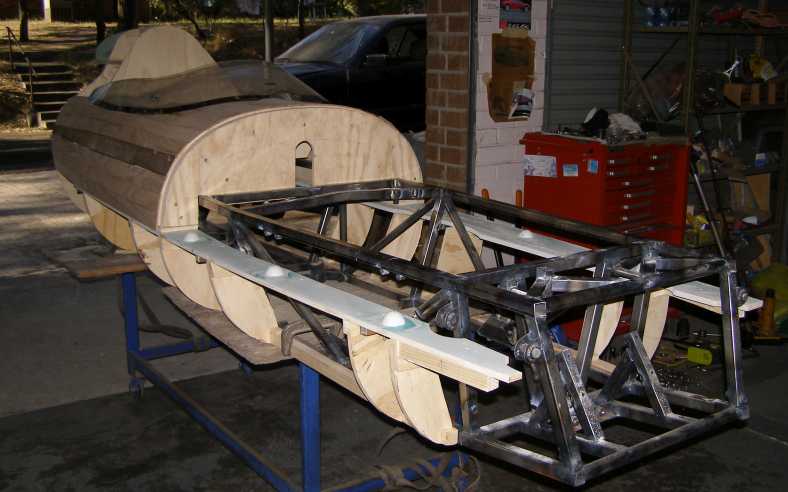
Taking shape. With the basic chassis, with suspension mounts etc attached, the woodwork has begun to make the ‘buck’ from which the fibreglass body mold will be taken.
Bob would tell me how he’d be working on a car during the day with a problem, or challenge, facing him as he looks ahead at the next stage. Whether that be in the design and drawing stage or when cutting and welding the metal, he’d mull over it, then when he went to bed at night he’d keep on thinking about it and by morning he’d usually have an answer.
One such problem was in being able to locate the top half of the front of the body on the lower half, a means of seating it in place. In the end he came up with those round lumps you see alongside the chassis – the shape taken from the egg tray in the refrigerator door and molded in fibreglass.
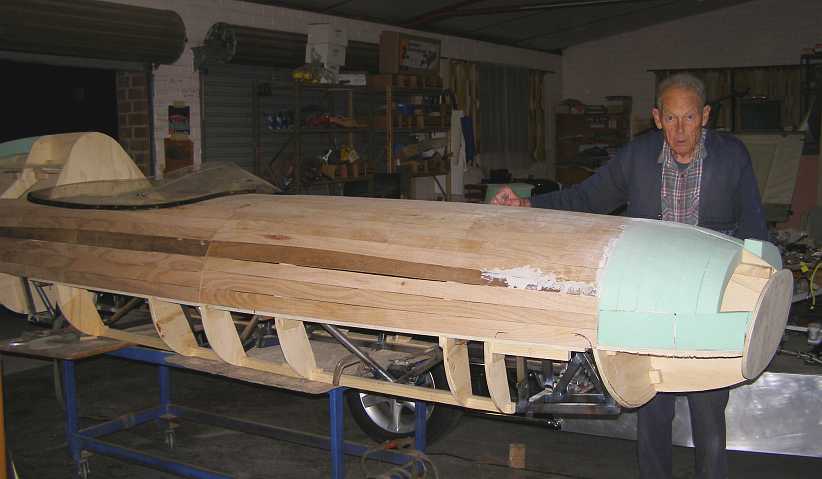
Frontal section. Bob was making good progress with the buck, using a foam which could be sanded into shape for the tighter sections. Filler would eventually cover the gaps in the timber.
Of course he had other things to do, living alone as he does. His few acres of back and front yard quickly accumulates broken sticks and branches from the many gum trees, these need to be picked up so he can mow the lawn, and three evenings a week he would go off to the nursing home to visit his wife, who was suffering from terminal dementia. His daughters took that responsibility the other nights.
And he had his day to day friends…
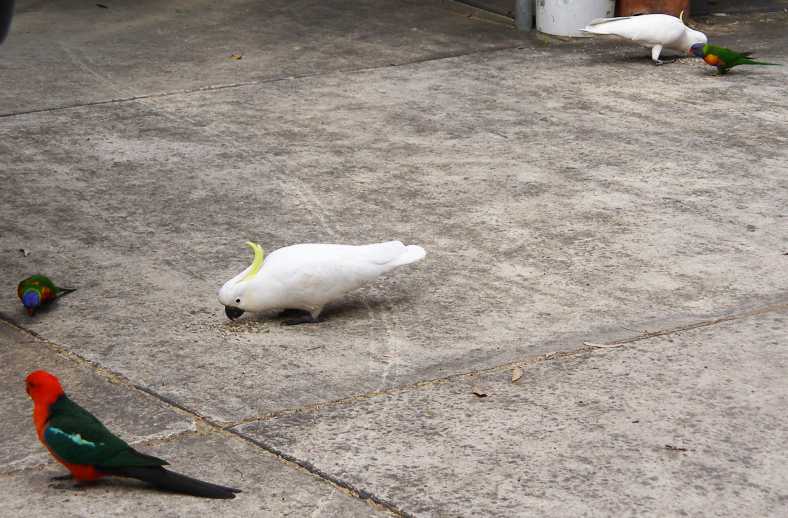
Friendly birds. A visit to Bob’s would not be complete if the birds didn’t come in for feeding. Two sulphur-crested cockatoos, two lorikeets and a king parrot are here sharing the spoil.
One of Bob’s closest friends is Ray Eldershaw. This day were were to go to Ray’s place in Baulkham Hills where he was hosting a group of motor sporting people from both speedway and road racing.
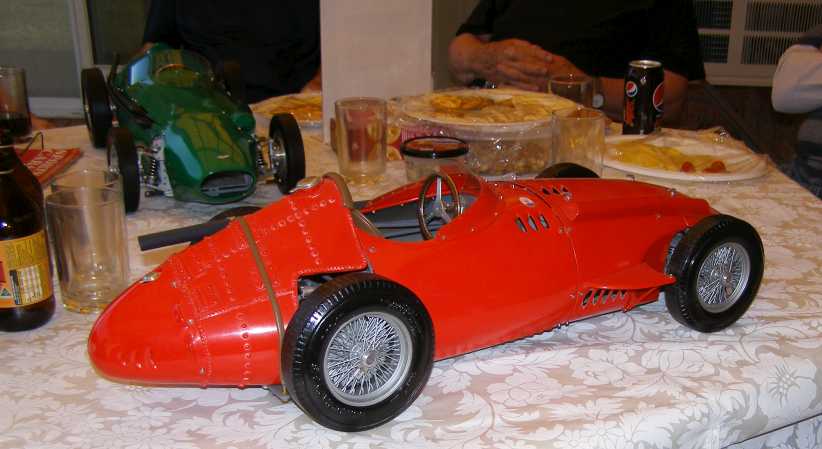
Maserati model. This day some scratch-built models were brought along, the red one here is a Maserati 250F, the green one an Aston Martin from that company’s very brief foray into Grand Prix racing.
Bob Williamson is the self-appointed historian for Buckle cars. Bill Buckle designed and built these Ford Zephyr-powered fibreglass GT cars around 1960 as a part of a much broader involvement in automotive assembly and sales. Bob had this model of the Buckle Motors assembly factory which was situated in Punchbowl, a South-Western suburb of Sydney:
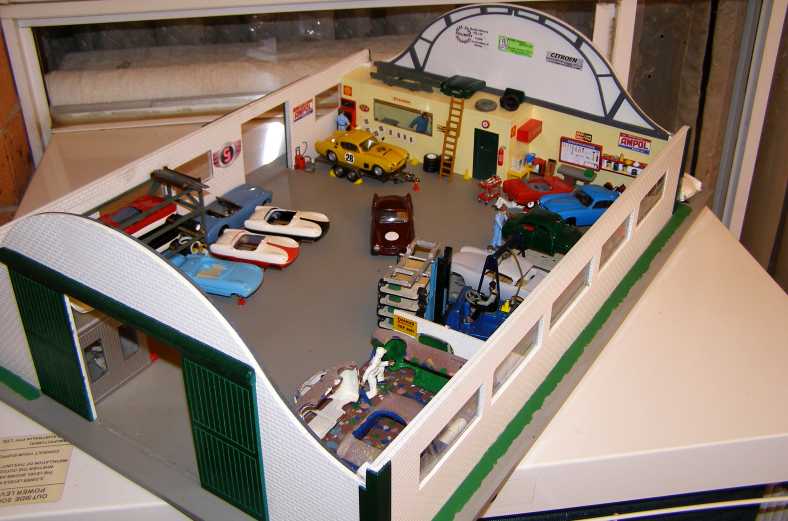
Buckle factory. Displaying what the factory was like at a time when Buckle was assembling Goggomobiles, building the Buckle coupes and when Bill was racing his own coupe.
The model is a great rendition of what things were like at the time. The second picture shows a Buckle coupe and Goggomobile dart on display outside the factory,
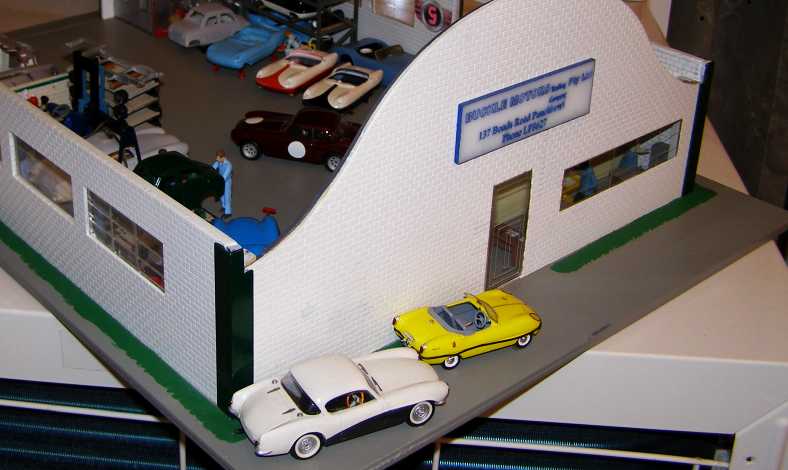
Street display. The Buckle coupe and Goggomobile Dart displayed at the front entry would have ensured passers-by knew what was going on inside.
And looking closely inside, workers continue assembly while chassis units are stacked off to one side, the chassis on top being for the Buckle and the platform chassis complete with suspension and power units from Germany being for the Goggos – little sedans as seen here, also for the Darts and he Buckle-designed coupes not shown.
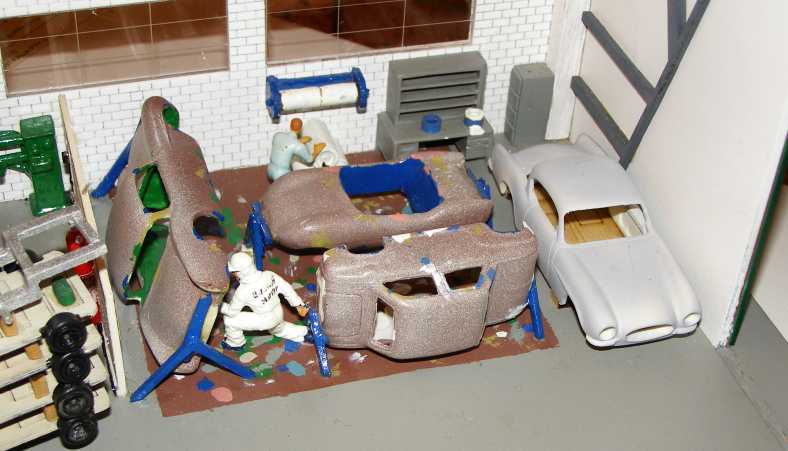
Assembly area. Activity here as a Buckle coupe, a Goggo Dart and a Goggo sedan receive attention.
Another corner of the shop where the cars are more complete. I am somewhat bewildered by the presence of the blue sports car in the background. It doesn’t appear to be a topless Buckle nor is it a Healey or MG, and it doesn’t look complete. A mystery.
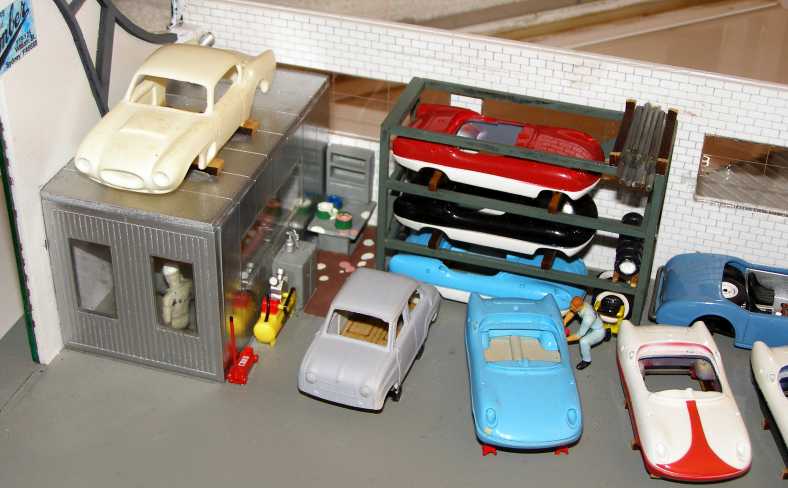
Spray booth. A car receives attention inside the spray booth while it’s clear that every possible nook and cranny is used for storage of bodies and parts.
The attention to detail was really good and those present all appreciated seeing the modelmaker’s work. We all nibbled on the available eats and drank some soft drinks and coffee as the hours drifted along in the conversation.
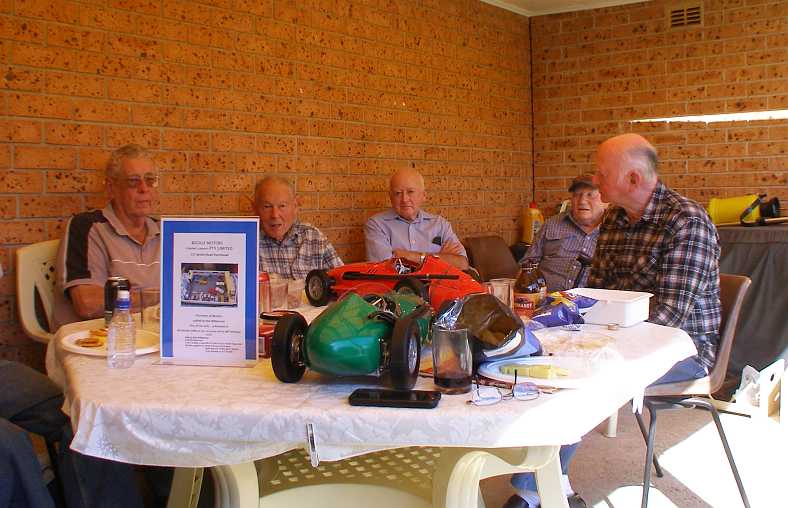
Around the table. At the right is Ray Eldershaw, who was a meticulous engine builder in the racing world in the early sixties. Beside him is former race mechanic Stuart Randall while Bob sits between the two I can’t identify.
After some more work at Bob’s and another night there I headed North again. Work for me that weekend was around Tamworth so I would be able to stay with Bob and Elaine Abberfield.
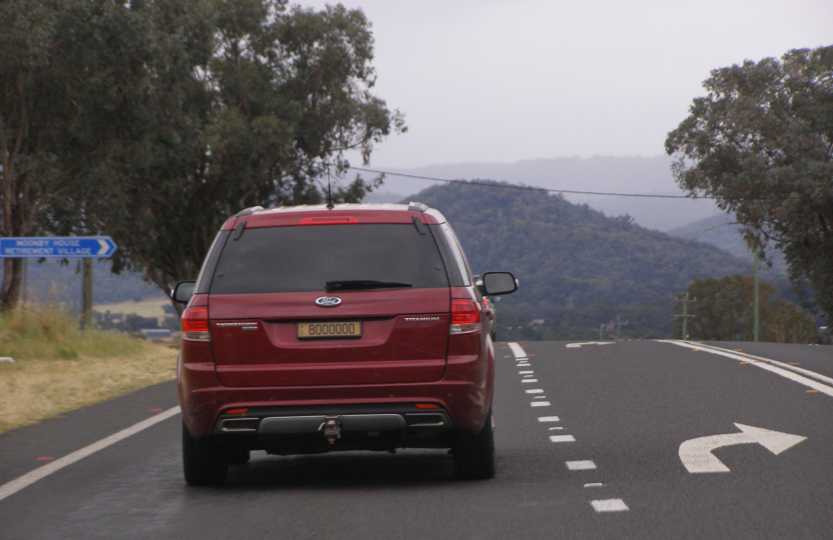
Moonbi view. I actually took this pic because of the numberplate on the car ahead, but beyond the car is the hill which dominates the valley in which Moonbi lies.
That hill was mostly on Peter Ballard’s property. He was a fairly quiet man, but one day in 1990 he was a bit more boisterous than usual when he came into our Post Office. During the conversation he proclaimed strongly that he owned that hill. An hour later an ambulance went screaming by.
Tragically, Peter was doing a job on a truck using a power drill and was electrocuted.
Once I was home again I started fidgeting around. Those headlights I’d picked up at Raymond Terrace as spares for the ones in the van started to appeal to me as a better way of doing the headlights on my Valiant, so I sized them up:
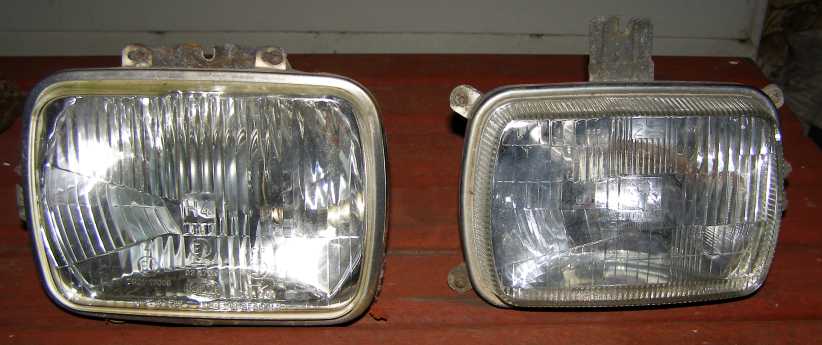
Lighting improvement. There were three reasons for looking at this. First would be better lighting from the bigger light, second was better availability in the case of breakage and finally to take over the parking light responsibility.
The regular parking lights and indicators on the VG Valiant (also on the VF) are on the top of the front mudguard. The blinkers are white, as was allowed those days, and very difficult to see on a sunny day. Moving the parking light to the headlight would enable me to put an amber globe into the original location to improve the indicator’s visibility.
And the weeks rolled by, different destinations each weekend to give variety…
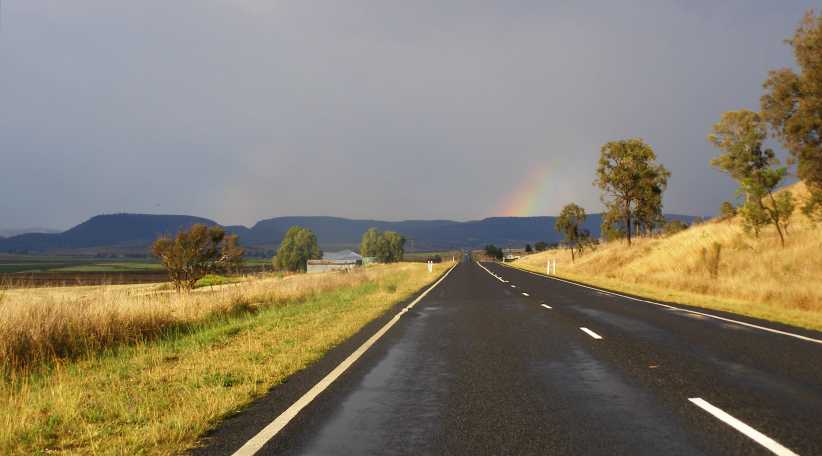
Freestone Road and a rainbow. This is a road out of Warwick which I take as a shortcut whenever I head towards Brisbane or the Gold Coast. This was a Gold Coast trip and it was to be a weekend of rainbows.
…and sights to see. The Cunninghams Gap road provided the next rainbow:
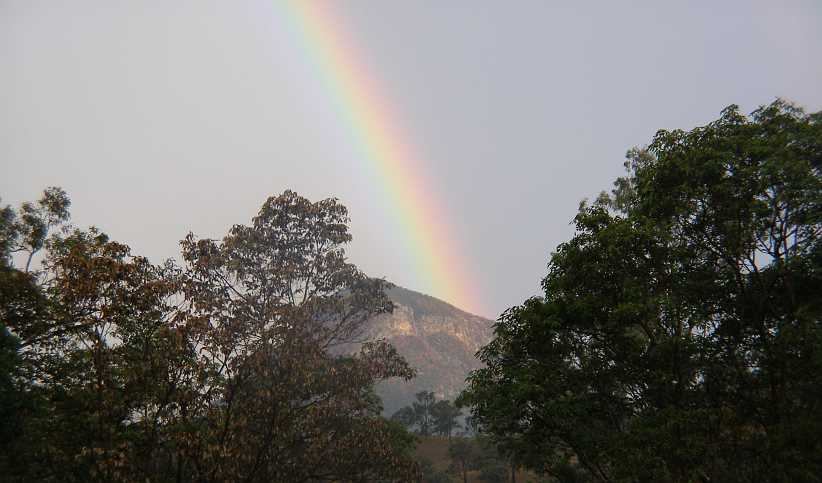
Rainbow on the Great Divide. Very old volcano country like this has shafts of rock sticking up, but the rainbow is seen less frequently.
The Gold Coast/Tweed Heads area is disproportionately a dormitory area for retirees from Sydney and Melbourne. Lots of them are gardeners and they live in comfortable homes in places like Banora Point. There are those who enjoy the view and those who are a part of the view, or that’s the way I tend to put it. These are a part of the view:
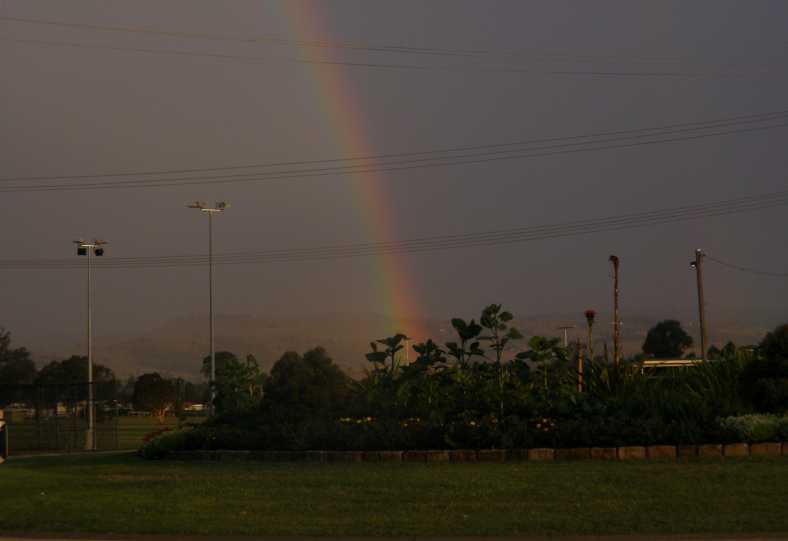
Gardens, grasslands and another rainbow. This rainbow is over one of the well-manicured gardens adjacent to an open area, the hills in the background are for those who enjoy the view.
I was starting to get serious about getting the van on he road. It was now thirty years old, the age it had to be to use on the road in Australia with left hand drive. One of my main concerns was to do with how I would get the new wiring to the rear lights and I had come to the conclusion that it had to go underneath the van. I took this photo of the inside of the outer box-section of the body behind the driver’s seat:
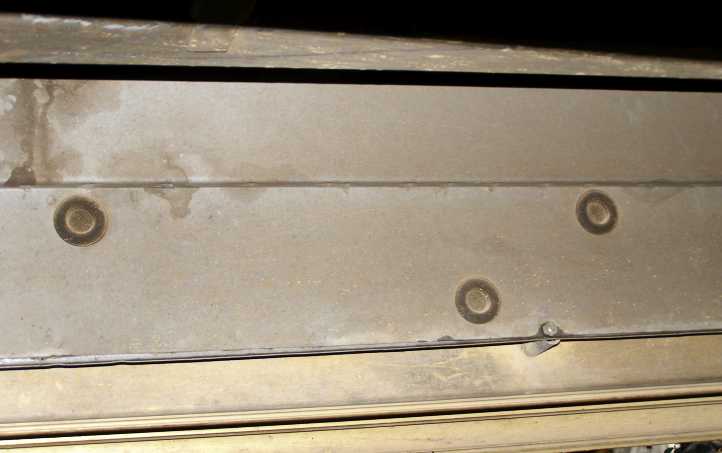
Under the van. Those rubber plugs gave me ideas about bringing the wiring through from the front and then up into the wall of the van for the balance of the distance to the rear.
I had to give Sandra some help, however, and as I waited to cross the highway which runs through Toowoomba I snapped this shot of an early-seventies Valiant coupe:
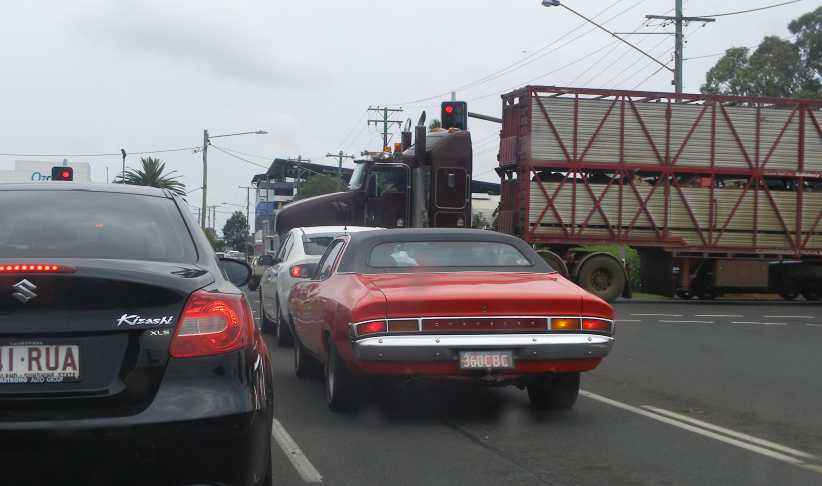
Chrysler by Chrysler. This is from the first couple of years of the enlarged Valiant range using most of the original ’68 Dart platform. The coupe in this model, as in the American models, rides on a longer wheelbase. The numberplate seems to indicate that it has the 360 engine and is the upmarket ‘Chrysler by Chrysler’ model.
Sandra had told me over the phone that her brakes were a problem in the Falcon and we found the reason why:
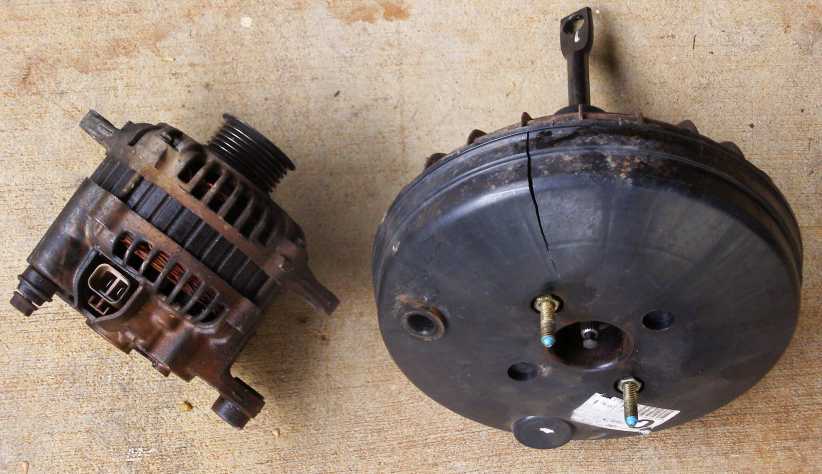
Power booster and alternator. Plastic power boosters may be cheaper but suffer from constant heat cycling. And the alternator had suffered too, its problem being that leakage from the power steering had led to severe wear of its slip rings.
Plastic power booster, I couldn’t believe it! And the exhaust system on that side of the engine pouring heat into it. I noted that the exhaust system’s heat shield – which seems to be a pretty good heat shield, by the way – stopped short of shielding the whole manifold. It cut out just ahead of the area where the power booster is, and for no apparent reason.
Later I would notice that models ten years newer had a more complete heat shield. Here’s the comparison:
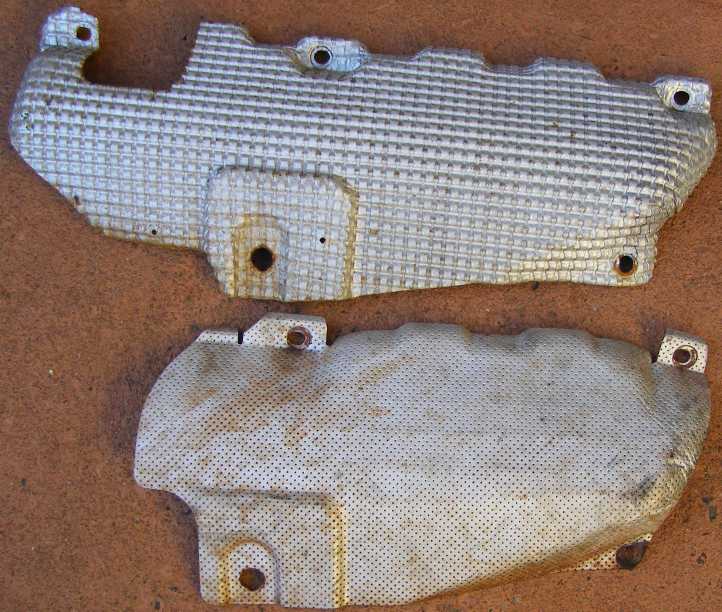
Heat shield comparison. It’s clear here that the earlier heat shield was just too short to do the job.
When you see it fitted, and the proximity of the plastic power booster, you wonder why it wasn’t done that way in the first place:
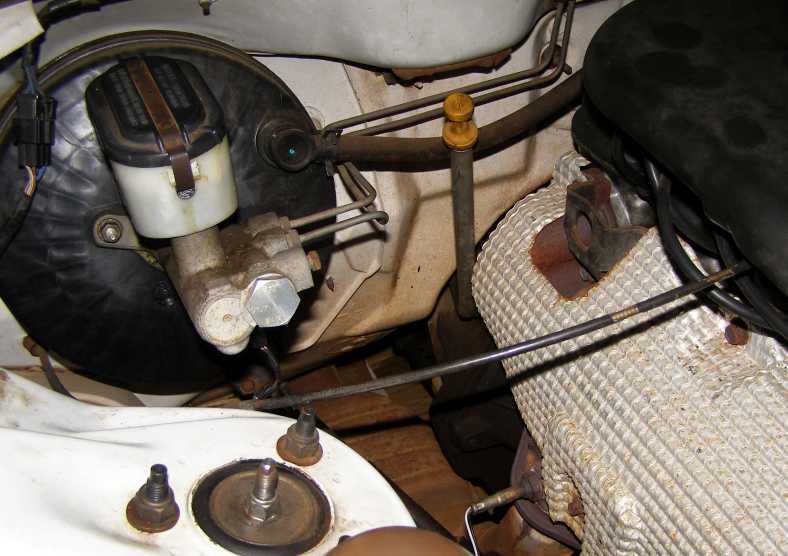
Much more protection. This will be much better at keeping the heat away from the booster.
Back at Dalveen another interesting vehicle arrived at the rest area:
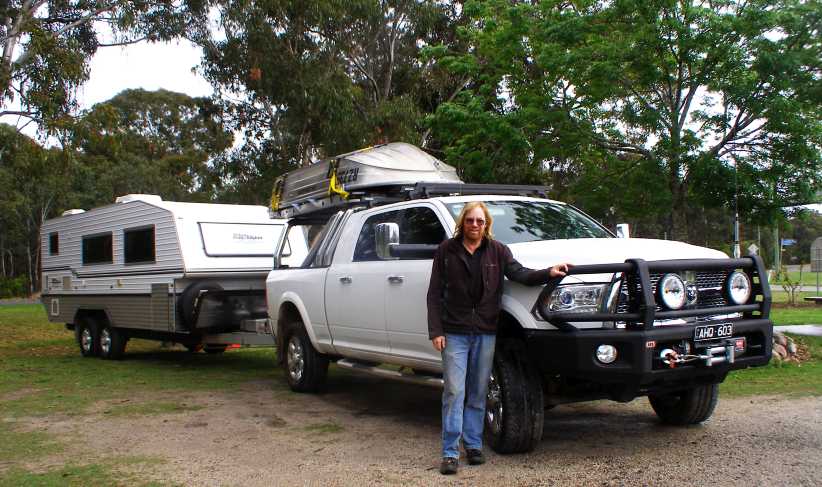
RAM and caravan. This RAM owner was formerly working in the engineering department at General Motors-Holden but in his retirement was touring the country.
RAMs were still pretty rare on our roads in 2017. Some were being imported by specialty importers, with conversion to right hand drive being done in the Philipines. As was this one. Today they are marketed here.
Towards the end of October I did an assignment in Lismore and then went straight to Inverell…
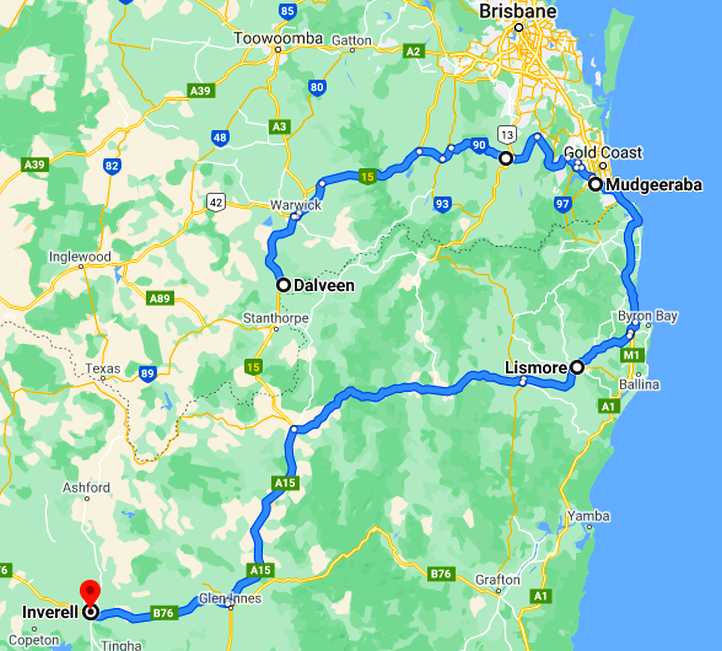
…where I had a ‘procedure’ to have a Basal Cell Carcinoma cut out from beside my left eye:
BCC removed. This is fairly common here after years of exposure to the sun. It would be okay to uncover by the end of the week.
She gave me a full-body skin check at the same time and found no further immediate problems but recommended I apply some creams to my arms, hands and face. I must get around to doing that some time.
And then there was a 135km drive back to Dalveen where I spotted this family of ducks right on the road leading out of the little village to the farm…
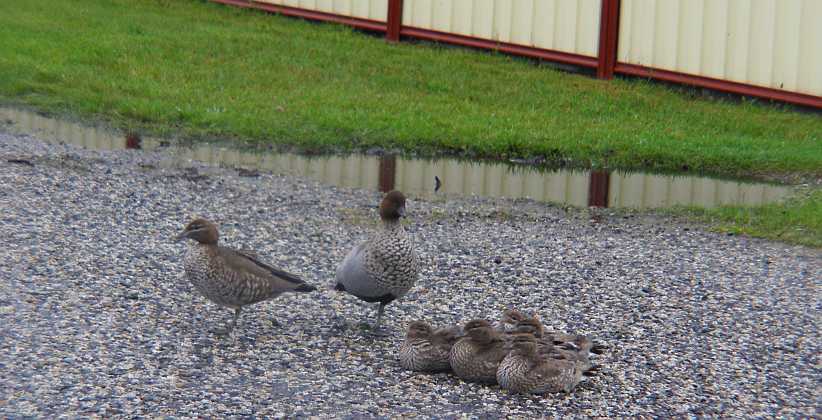
Ducks at Dalveen. Five ducklings sit on the road while their parents seem unconcerned about my presence.
…and then I headed for Toowoomba to spend more time with Sandra. During this visit she showed me photos of the Valiant station wagon she used to have. It was the same model as the one I’m doing up, but she had it over thirty years ago. She also reckons it saved her life when she ran off the road and rolled it with all her children on board:
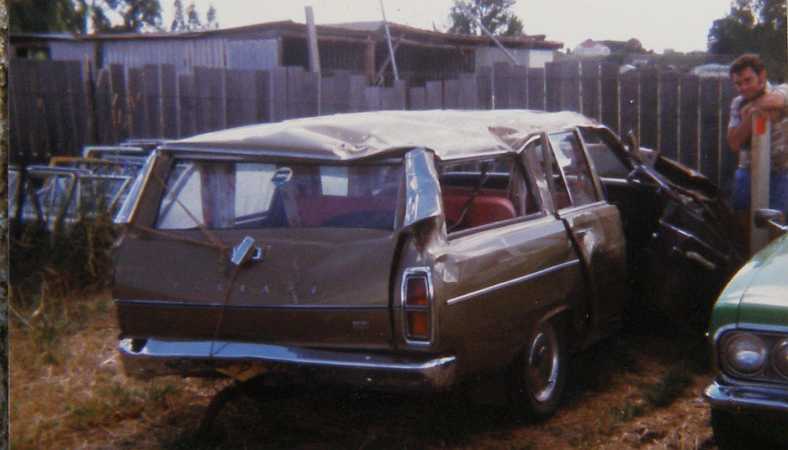
Sandra’s wrecked Valiant. This is all that remained after her crash on the New England Highway in Northern New South Wales. Her former husband is inspecting the car.
The first weekend of November, 2017, I worked at Lismore once again. It was to finish up an interesting weekend, driving home through heavy rain all the way from Lismore through Kyogle and Woodenbong. Most of this road is very twisty, also almost deserted much of the time, so I drove through the rain and the dark with the radio on.
There were storm warning messages coming over the radio, an especially fierce storm was advancing on Stanthorpe and would pass from there to Warwick at about the time I got there. I decided to stop at Killarney, which was not in the path of the storm and where I had phone signal and could get in touch with Sandra and let her know I was out of danger.
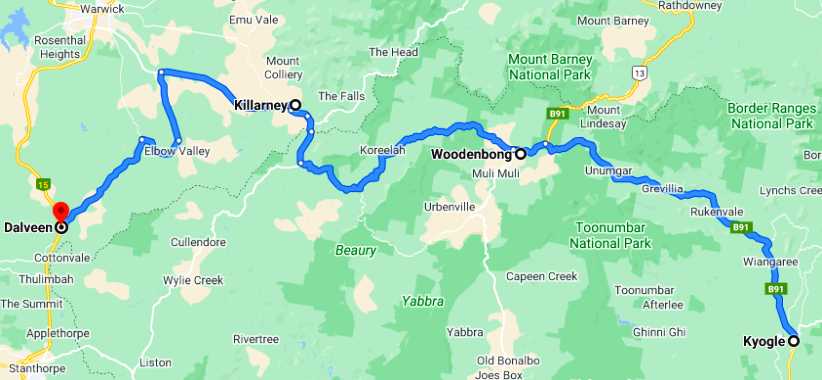
At night it was unusual for me to not go home via Warwick, but the risk of ’roo strikes on the alternative road – which was a little shorter – was very real in the dark. But this night I figured that it might help me avoid the tail of the storm and I carefully picked my way along the narrow bitumen and the gravel sections and got home fine.
What I didn’t know was that I wouldn’t have if I’d gone the other way…
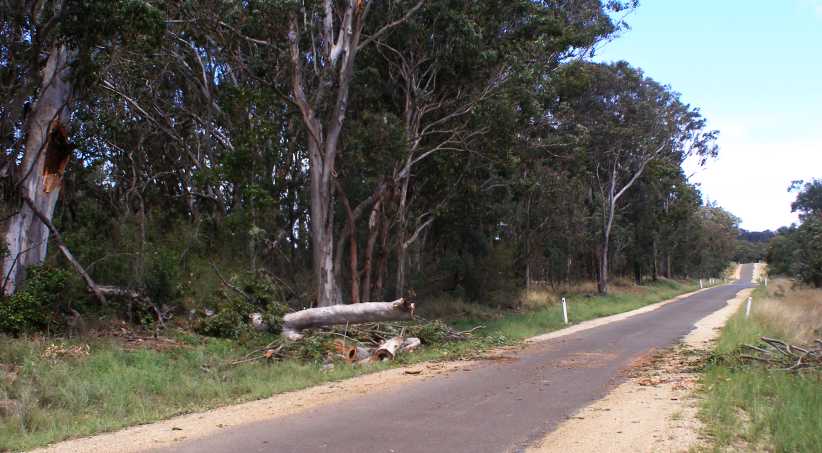
Tree cut up. This was the tree, only a quarter of a mile from home, which I avoided being stopped by when I drove home via the back road.
…there was a tree down within sight of our driveway. I found it like this the next morning when I drove up to Dalveen to get my mail. Had I gone that way I would have been out in the rain trying to find someone to cut through this tree rather than comfortably sitting in my lounge to do my paperwork, then heading for the waterbed.
After working at Grafton again the following weekend I headed up to Brisbane to see Max now he and Christine had accepted the offer from his daughter to move in with her so she could look after them. One reason I was doing so was to take Max around to visit Jim Bertram, who was another top-line race mechanic in the fifties and sixties.
Jim is a real fan of the Singer marque, one of the Rootes Group cars (Hillman, Humber, Sunbeam, Singer, Talbot) and raced one (and courted his wife in it) in the late forties and early fifties. Now he had created a nice little sports car based on a Singer from that time:
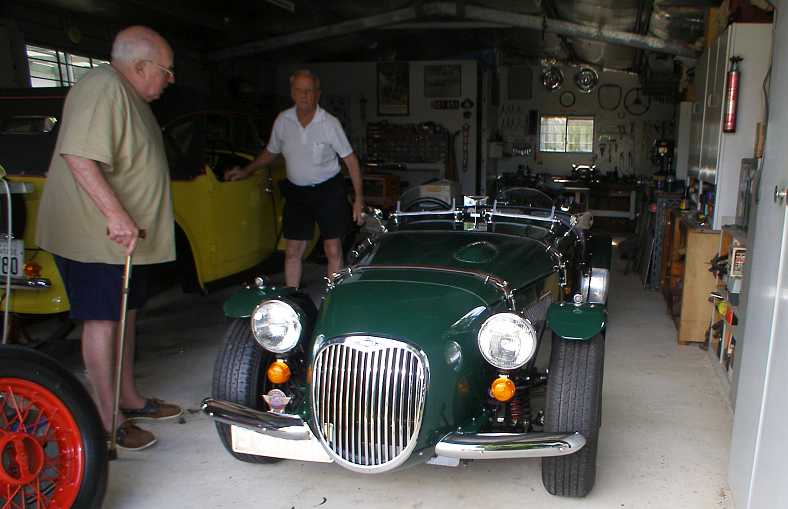
Max and Jim. Both in their eighties, Max listens as Jim explains about his new creation. In the background is a genuine Singer from the forties.
Jim has used the grille from a late-fifties Singer Gazelle sedan and shaped the car from there back. Every part of the car required some of his craftsmanship and it’s a striking and sensible little car.
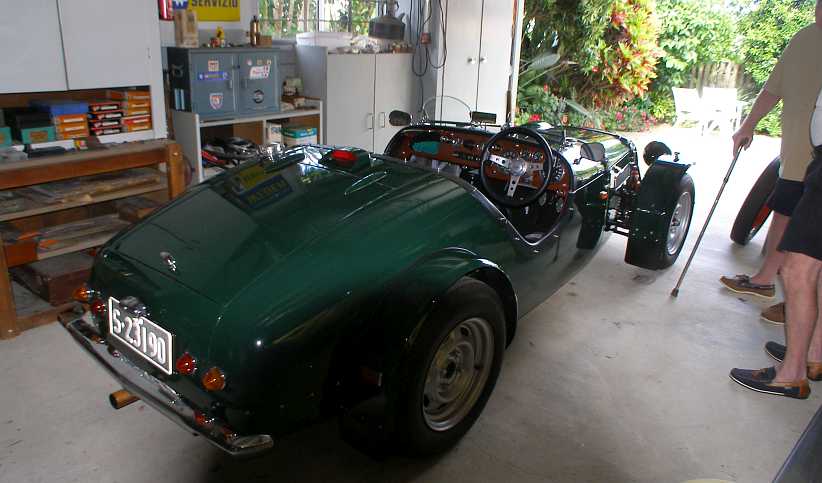
Rear view. The cycle-guards has left Jim free to style the body freely. There’s a sizeable boot, too.
The engine bay gleams with polished aluminium and brass:
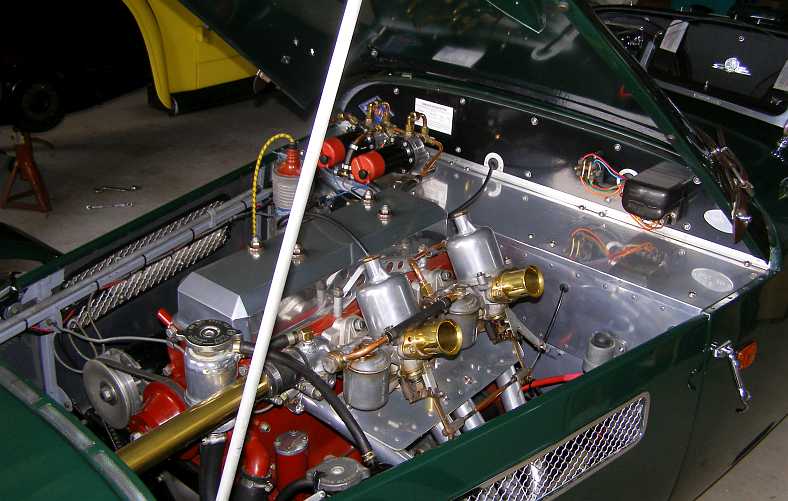
Engine bay. Two SU carbrettors dominate the view in the engine bay, while there are two SU fuel pumps up on the scuttle. Jim made these engines go better than MG engines of the same period.
Studying that photo gives a good indication of the workmanship and finish Jim has put into the car, even to the extent that he’s made an alloy pulley for the generator. It’s all just a work of art.
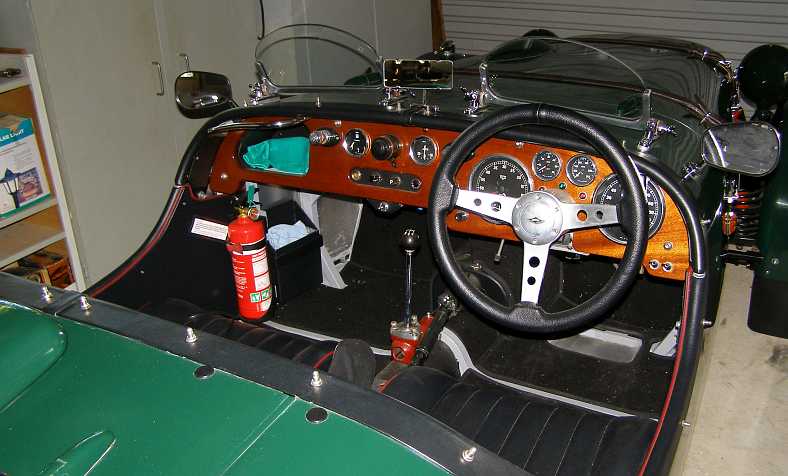
Interior. The traditional wooden dash is fitted with all the gauges and switches that Jim needs to keep on top of the machinery around him.
We were now halfway through November and I still had a joblist at home. But I was enjoying myself and seeing sights. Little did I know that in another year I would be under a lot of stress…[/i]
Bob’s purpose was to build a really good-looking example, all in keeping with making it into an efficient car for the purpose. Of course, it will never race, it’s a design and construction exercise to keep him busy, but the effort he puts in is just as if it were for racing. There are equipment shortcuts in some areas to keep the cost down, but no shortfall in the mental challenge he takes on.
Taking shape. With the basic chassis, with suspension mounts etc attached, the woodwork has begun to make the ‘buck’ from which the fibreglass body mold will be taken.
Bob would tell me how he’d be working on a car during the day with a problem, or challenge, facing him as he looks ahead at the next stage. Whether that be in the design and drawing stage or when cutting and welding the metal, he’d mull over it, then when he went to bed at night he’d keep on thinking about it and by morning he’d usually have an answer.
One such problem was in being able to locate the top half of the front of the body on the lower half, a means of seating it in place. In the end he came up with those round lumps you see alongside the chassis – the shape taken from the egg tray in the refrigerator door and molded in fibreglass.
Frontal section. Bob was making good progress with the buck, using a foam which could be sanded into shape for the tighter sections. Filler would eventually cover the gaps in the timber.
Of course he had other things to do, living alone as he does. His few acres of back and front yard quickly accumulates broken sticks and branches from the many gum trees, these need to be picked up so he can mow the lawn, and three evenings a week he would go off to the nursing home to visit his wife, who was suffering from terminal dementia. His daughters took that responsibility the other nights.
And he had his day to day friends…
Friendly birds. A visit to Bob’s would not be complete if the birds didn’t come in for feeding. Two sulphur-crested cockatoos, two lorikeets and a king parrot are here sharing the spoil.
One of Bob’s closest friends is Ray Eldershaw. This day were were to go to Ray’s place in Baulkham Hills where he was hosting a group of motor sporting people from both speedway and road racing.
Maserati model. This day some scratch-built models were brought along, the red one here is a Maserati 250F, the green one an Aston Martin from that company’s very brief foray into Grand Prix racing.
Bob Williamson is the self-appointed historian for Buckle cars. Bill Buckle designed and built these Ford Zephyr-powered fibreglass GT cars around 1960 as a part of a much broader involvement in automotive assembly and sales. Bob had this model of the Buckle Motors assembly factory which was situated in Punchbowl, a South-Western suburb of Sydney:
Buckle factory. Displaying what the factory was like at a time when Buckle was assembling Goggomobiles, building the Buckle coupes and when Bill was racing his own coupe.
The model is a great rendition of what things were like at the time. The second picture shows a Buckle coupe and Goggomobile dart on display outside the factory,
Street display. The Buckle coupe and Goggomobile Dart displayed at the front entry would have ensured passers-by knew what was going on inside.
And looking closely inside, workers continue assembly while chassis units are stacked off to one side, the chassis on top being for the Buckle and the platform chassis complete with suspension and power units from Germany being for the Goggos – little sedans as seen here, also for the Darts and he Buckle-designed coupes not shown.
Assembly area. Activity here as a Buckle coupe, a Goggo Dart and a Goggo sedan receive attention.
Another corner of the shop where the cars are more complete. I am somewhat bewildered by the presence of the blue sports car in the background. It doesn’t appear to be a topless Buckle nor is it a Healey or MG, and it doesn’t look complete. A mystery.
Spray booth. A car receives attention inside the spray booth while it’s clear that every possible nook and cranny is used for storage of bodies and parts.
The attention to detail was really good and those present all appreciated seeing the modelmaker’s work. We all nibbled on the available eats and drank some soft drinks and coffee as the hours drifted along in the conversation.
Around the table. At the right is Ray Eldershaw, who was a meticulous engine builder in the racing world in the early sixties. Beside him is former race mechanic Stuart Randall while Bob sits between the two I can’t identify.
After some more work at Bob’s and another night there I headed North again. Work for me that weekend was around Tamworth so I would be able to stay with Bob and Elaine Abberfield.
Moonbi view. I actually took this pic because of the numberplate on the car ahead, but beyond the car is the hill which dominates the valley in which Moonbi lies.
That hill was mostly on Peter Ballard’s property. He was a fairly quiet man, but one day in 1990 he was a bit more boisterous than usual when he came into our Post Office. During the conversation he proclaimed strongly that he owned that hill. An hour later an ambulance went screaming by.
Tragically, Peter was doing a job on a truck using a power drill and was electrocuted.
Once I was home again I started fidgeting around. Those headlights I’d picked up at Raymond Terrace as spares for the ones in the van started to appeal to me as a better way of doing the headlights on my Valiant, so I sized them up:
Lighting improvement. There were three reasons for looking at this. First would be better lighting from the bigger light, second was better availability in the case of breakage and finally to take over the parking light responsibility.
The regular parking lights and indicators on the VG Valiant (also on the VF) are on the top of the front mudguard. The blinkers are white, as was allowed those days, and very difficult to see on a sunny day. Moving the parking light to the headlight would enable me to put an amber globe into the original location to improve the indicator’s visibility.
And the weeks rolled by, different destinations each weekend to give variety…
Freestone Road and a rainbow. This is a road out of Warwick which I take as a shortcut whenever I head towards Brisbane or the Gold Coast. This was a Gold Coast trip and it was to be a weekend of rainbows.
…and sights to see. The Cunninghams Gap road provided the next rainbow:
Rainbow on the Great Divide. Very old volcano country like this has shafts of rock sticking up, but the rainbow is seen less frequently.
The Gold Coast/Tweed Heads area is disproportionately a dormitory area for retirees from Sydney and Melbourne. Lots of them are gardeners and they live in comfortable homes in places like Banora Point. There are those who enjoy the view and those who are a part of the view, or that’s the way I tend to put it. These are a part of the view:
Gardens, grasslands and another rainbow. This rainbow is over one of the well-manicured gardens adjacent to an open area, the hills in the background are for those who enjoy the view.
I was starting to get serious about getting the van on he road. It was now thirty years old, the age it had to be to use on the road in Australia with left hand drive. One of my main concerns was to do with how I would get the new wiring to the rear lights and I had come to the conclusion that it had to go underneath the van. I took this photo of the inside of the outer box-section of the body behind the driver’s seat:
Under the van. Those rubber plugs gave me ideas about bringing the wiring through from the front and then up into the wall of the van for the balance of the distance to the rear.
I had to give Sandra some help, however, and as I waited to cross the highway which runs through Toowoomba I snapped this shot of an early-seventies Valiant coupe:
Chrysler by Chrysler. This is from the first couple of years of the enlarged Valiant range using most of the original ’68 Dart platform. The coupe in this model, as in the American models, rides on a longer wheelbase. The numberplate seems to indicate that it has the 360 engine and is the upmarket ‘Chrysler by Chrysler’ model.
Sandra had told me over the phone that her brakes were a problem in the Falcon and we found the reason why:
Power booster and alternator. Plastic power boosters may be cheaper but suffer from constant heat cycling. And the alternator had suffered too, its problem being that leakage from the power steering had led to severe wear of its slip rings.
Plastic power booster, I couldn’t believe it! And the exhaust system on that side of the engine pouring heat into it. I noted that the exhaust system’s heat shield – which seems to be a pretty good heat shield, by the way – stopped short of shielding the whole manifold. It cut out just ahead of the area where the power booster is, and for no apparent reason.
Later I would notice that models ten years newer had a more complete heat shield. Here’s the comparison:
Heat shield comparison. It’s clear here that the earlier heat shield was just too short to do the job.
When you see it fitted, and the proximity of the plastic power booster, you wonder why it wasn’t done that way in the first place:
Much more protection. This will be much better at keeping the heat away from the booster.
Back at Dalveen another interesting vehicle arrived at the rest area:
RAM and caravan. This RAM owner was formerly working in the engineering department at General Motors-Holden but in his retirement was touring the country.
RAMs were still pretty rare on our roads in 2017. Some were being imported by specialty importers, with conversion to right hand drive being done in the Philipines. As was this one. Today they are marketed here.
Towards the end of October I did an assignment in Lismore and then went straight to Inverell…
…where I had a ‘procedure’ to have a Basal Cell Carcinoma cut out from beside my left eye:
BCC removed. This is fairly common here after years of exposure to the sun. It would be okay to uncover by the end of the week.
She gave me a full-body skin check at the same time and found no further immediate problems but recommended I apply some creams to my arms, hands and face. I must get around to doing that some time.
And then there was a 135km drive back to Dalveen where I spotted this family of ducks right on the road leading out of the little village to the farm…
Ducks at Dalveen. Five ducklings sit on the road while their parents seem unconcerned about my presence.
…and then I headed for Toowoomba to spend more time with Sandra. During this visit she showed me photos of the Valiant station wagon she used to have. It was the same model as the one I’m doing up, but she had it over thirty years ago. She also reckons it saved her life when she ran off the road and rolled it with all her children on board:
Sandra’s wrecked Valiant. This is all that remained after her crash on the New England Highway in Northern New South Wales. Her former husband is inspecting the car.
The first weekend of November, 2017, I worked at Lismore once again. It was to finish up an interesting weekend, driving home through heavy rain all the way from Lismore through Kyogle and Woodenbong. Most of this road is very twisty, also almost deserted much of the time, so I drove through the rain and the dark with the radio on.
There were storm warning messages coming over the radio, an especially fierce storm was advancing on Stanthorpe and would pass from there to Warwick at about the time I got there. I decided to stop at Killarney, which was not in the path of the storm and where I had phone signal and could get in touch with Sandra and let her know I was out of danger.
At night it was unusual for me to not go home via Warwick, but the risk of ’roo strikes on the alternative road – which was a little shorter – was very real in the dark. But this night I figured that it might help me avoid the tail of the storm and I carefully picked my way along the narrow bitumen and the gravel sections and got home fine.
What I didn’t know was that I wouldn’t have if I’d gone the other way…
Tree cut up. This was the tree, only a quarter of a mile from home, which I avoided being stopped by when I drove home via the back road.
…there was a tree down within sight of our driveway. I found it like this the next morning when I drove up to Dalveen to get my mail. Had I gone that way I would have been out in the rain trying to find someone to cut through this tree rather than comfortably sitting in my lounge to do my paperwork, then heading for the waterbed.
After working at Grafton again the following weekend I headed up to Brisbane to see Max now he and Christine had accepted the offer from his daughter to move in with her so she could look after them. One reason I was doing so was to take Max around to visit Jim Bertram, who was another top-line race mechanic in the fifties and sixties.
Jim is a real fan of the Singer marque, one of the Rootes Group cars (Hillman, Humber, Sunbeam, Singer, Talbot) and raced one (and courted his wife in it) in the late forties and early fifties. Now he had created a nice little sports car based on a Singer from that time:
Max and Jim. Both in their eighties, Max listens as Jim explains about his new creation. In the background is a genuine Singer from the forties.
Jim has used the grille from a late-fifties Singer Gazelle sedan and shaped the car from there back. Every part of the car required some of his craftsmanship and it’s a striking and sensible little car.
Rear view. The cycle-guards has left Jim free to style the body freely. There’s a sizeable boot, too.
The engine bay gleams with polished aluminium and brass:
Engine bay. Two SU carbrettors dominate the view in the engine bay, while there are two SU fuel pumps up on the scuttle. Jim made these engines go better than MG engines of the same period.
Studying that photo gives a good indication of the workmanship and finish Jim has put into the car, even to the extent that he’s made an alloy pulley for the generator. It’s all just a work of art.
Interior. The traditional wooden dash is fitted with all the gauges and switches that Jim needs to keep on top of the machinery around him.
We were now halfway through November and I still had a joblist at home. But I was enjoying myself and seeing sights. Little did I know that in another year I would be under a lot of stress…[/i]
Last edited by Ray Bell; Dec 7, 2020 at 08:39 AM.
Thread Starter
|
Captain
Joined: Oct 2005
Posts: 570
Likes: 8
From: The Summit, Queensland, Australia
Another week went by with not much to remark on. I would spend a lot of time during this period musing over how to do things with both the Forester engine and the van modifications, looking at things, doing small things, and then head off to Sandra’s for a couple of days and nights before going back home. All the necessary things had to be done, too. Shopping, cooking, washing to ensure I had clothes to wear to work and so on.
In other words, I was pretty busy, but mostly treading water. I needed to make more progress. And I kept taking photos of odd things I saw, like this oddity in Warwick one day:
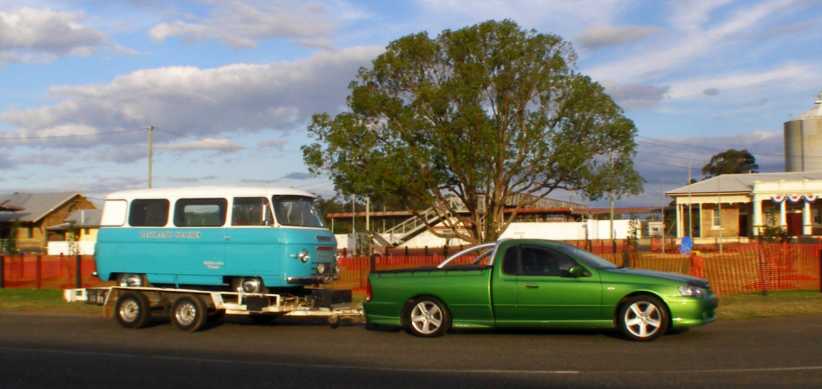
Incongruous mix. The old Commer van, from the late fifties or early sixties, makes such a contrast with the Holden Commodore utility towing it.
The Commer had a Hillman engine and underpinnings from the large-car line of the Rootes Group, the Humber. It always looked odd to me with those small wheel arches and the wheels so far inboard, but they sold well in England and they had reasonable acceptance in Australia before Chrysler put them out of their misery.
The next weekend I headed off to the Tweed Heads area again, my return on Sunday afternoon was at a time which enabled me to get near Cunningham’s Gap – the point at which the main highway inland from the Gold Coast and Brisbane – crosses the Great Dividing range just when this shot of a sunset over the Gap was fairly spectacular:
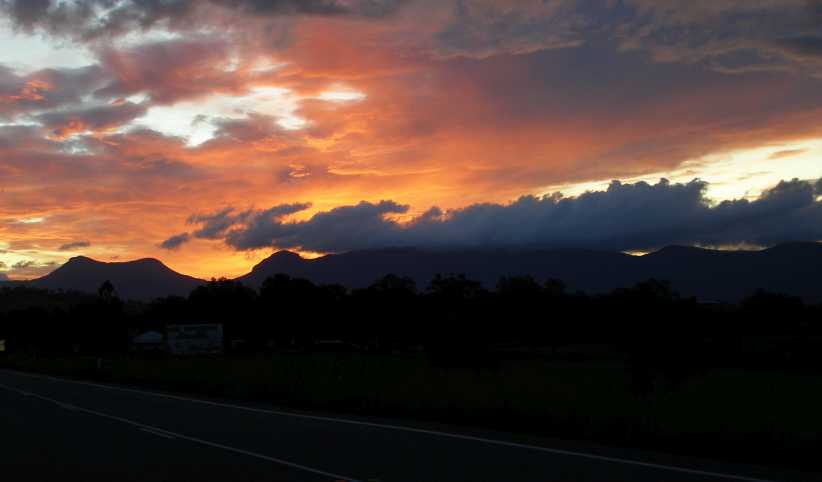
Cunningham’s Gap sunset. The stark contrast in the clouds make this a worthwhile picture. It’s a stiff climb to get over the range, by the way.
I always counted on being home an hour after topping that climb. The next week I was running a bit earlier in the same spot so the sun was higher, the shot is very different, but it’s the same mountain profile taken from a closer spot…
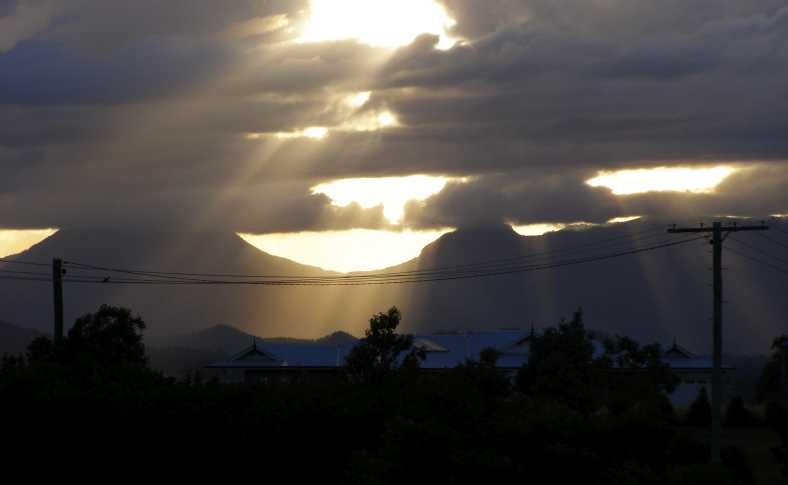
Different. Yes, I do like to get pics with the sun’s rays beaming through gaps in the clouds. Cunningham’s Gap again, but up a bit closer and a bit earlier.
Time to look again at the issue I had to deal with on that Forester’s poor damaged block:
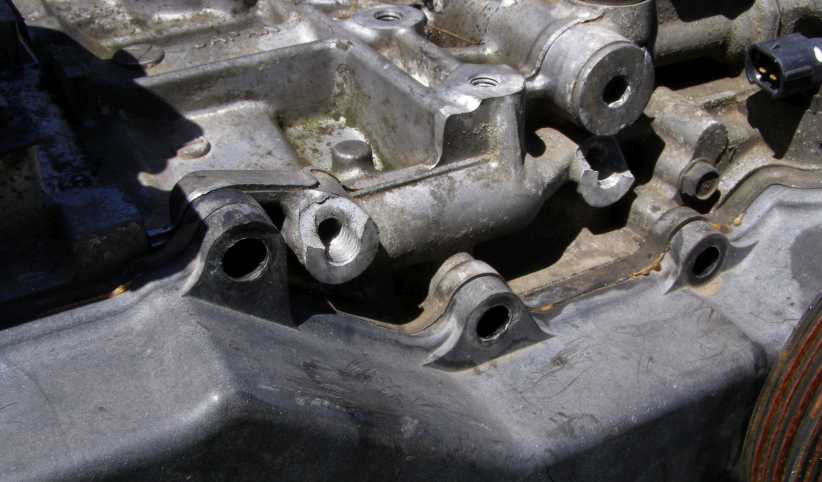
Damage to cylinder block. The lugs where the two front bolts for the power-steering pump have been ripped out show up here. They were 8mm bolts.
I had now figured out what to do. I would be relying on the three bolts which hold that section of the plastic timing belt cover in place. These are only 6mm bolts, but here I have enlarged the holes to 12mm (from the 100 the factory made them for stepped bolts to fit in there) and the plan was to get some steel spacers made and they would be more stable at the 12mm diameter to provide extra support for a bracket I’d use to mount the pump.
As I was attacking this little job on my joblist I was working the engine as it sat inside a wheel on the grass. I ground the end off an 8mm tap to make it so it would cut thread right to the bottom of the damaged holes and therefore give me the prospect of putting bolts in there far enough to get some purchase.
I had been going over all of this in my mind. I pondered the thought of drilling the holes in further, but what if I struck an oil gallery, which would mean oil would be pumped out around the bolt? No, just getting the thread to the bottom of the existing hole was the best I could do. And as I did this I was actually lying down in the grass so I could see what I was doing, and I chanced to look up under the manifold and saw…
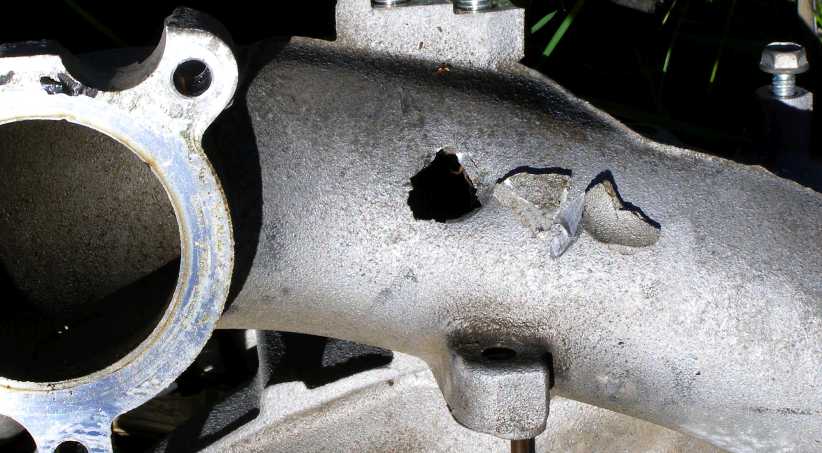
Further damage! This hole had been punched into the inlet manifold as the power steering pump had been ‘relocated’ by the crash. The bits were down in the ports, right behind the valve heads.
…that the whole job was about to get a little harder. The manifold had to come off, I had to vacuum out the bits which had finished up I the ports. And while I was doing this I found some wires in the loom around the manifold which had been torn and broken. The joblist was growing at about the same rate as I was making progress!
But there was an interruption to this one day when water no longer came from the kitchen tap. And all the other taps. After searching around I went up on the hill to check the water tank which supplies pressure to the house – and found it empty! It had been almost full a few days earlier, so I figured there must be a leak somewhere, but looking everywhere disclosed no wet ground, no leaking pipes. I got the agents to get a plumber out to check and they got nowhere too.
I started carrying drums of water up from the big tank below the house, which was full, as I was reluctant to allow valuable water to flow freely into a system which leaked. I shut off the valve at the top tank and pumped water up there, only turning it on when I needed it for my shower.
A couple of local working weekends helped me catch up a little, but on the third weekend in December I was back to the Tweed. But this time closer to Murwillumbah, which meant that the shortest path was the very-twisty path through Woodenbong and Kyogle, then continuing to wind around through Kunghur, Mt Burrell and Uki (which was actually where I was working) to the accommodation booked for me at Murwillumbah.
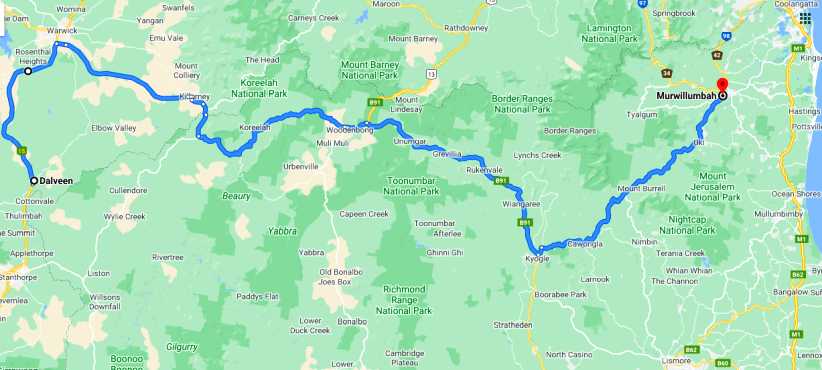
As I was beginning to have more and more problems with chemical sensitivity – principally perfumes and deodorants – I phoned the motel and asked them not to use any in the room. And to leave the key under the mat so I could get there late without disturbing them. Of course the room was loaded with the stuff which eats at my eyes and throat after a while. And arriving at 11pm meant it was too late to leave everything open long enough for it all to clear.
And just when you thought my troubles for the weekend were over…
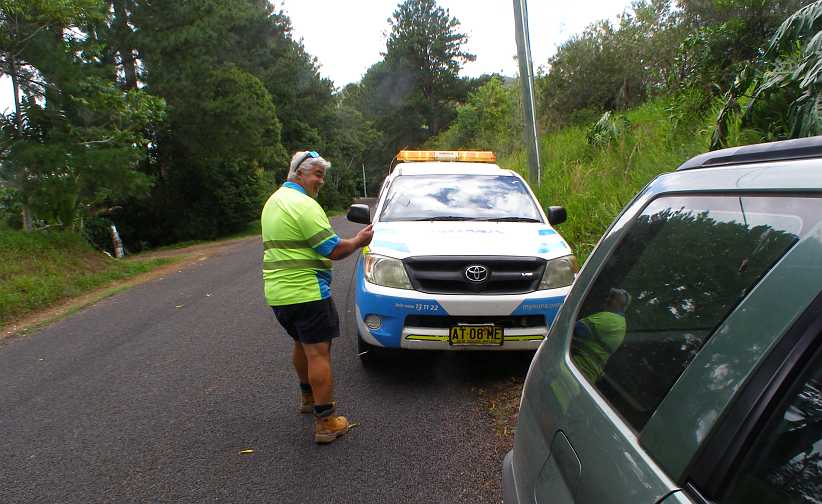
Locked out! I had to wait about an hour for this kind gentleman from the NRMA to come and unlock the Forester for me using the tool he’s holding.
…I locked myself out of the car. It was short work for the NRMA man to get the door open for me, but it took a while for him to get there. I was working, by the way, in an area where I had to drive from house to house, not in a closely-settled area. And it was in an area of lush growth, so I was there among the shrubs and trees, which at least was shady.
Back at home in the previous week when I’d been looking under the house for a water leak I’d grazed my back when I was under a very low part of the floor. Later in the evening, back at the motel, I could feel a lump there and it started to concern me. At 3:30 in the morning I woke up and it was irritating me, an hour or so later I went to the local hospital and the doctor solved the problem…
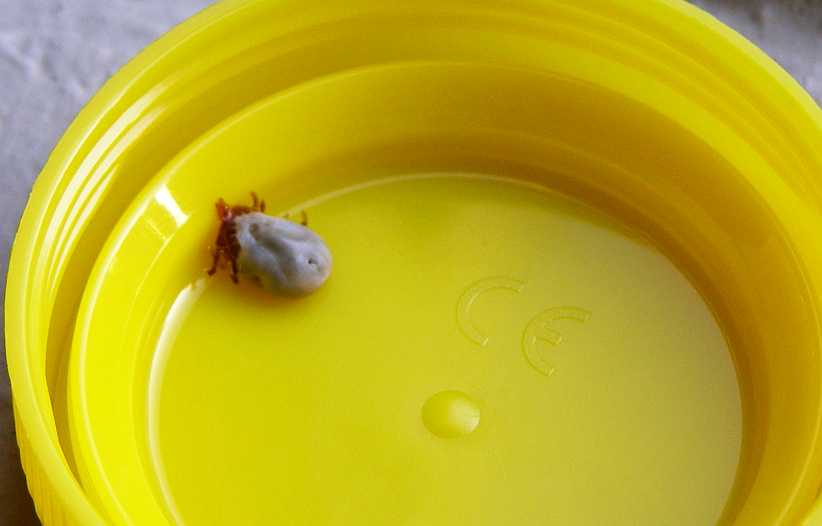
The big tick. This is most of the tick the doctor removed. Some of its legs came off as he removed it, but he got all of those out too.
…because he could readily see a tick sucking away at my blood in the wound. He gave it a dose of liquid nitrogen and then got it out of there, he also gave me antibiotics just in case. I was able to get back to work on Sunday just fine.
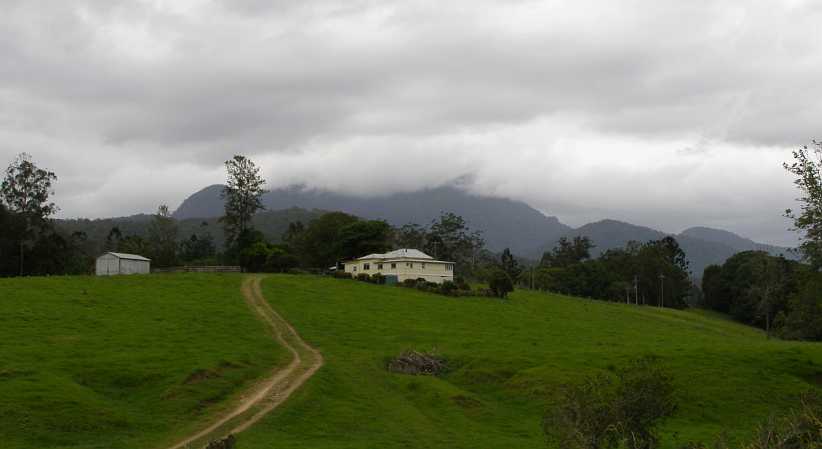
Farm and cloud. Not a bad area to live in – apart from ticks, I suppose. The low clouds over the nearby mountains add to the picture.
The area became more rural the further I went. Older houses were typical, but some were not so old:
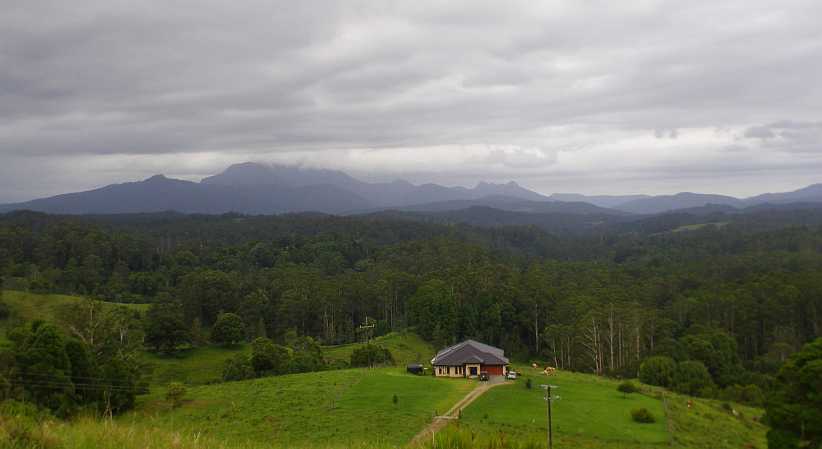
Downhill drive. It’s a steep drive going down to this newer home, but it’s certainly a nice setting and clearly built there to take advantage of the views.
I got the job finished, enjoying working in such a picturesque area, and headed back home on that twisty road as darkness fell. Then I had to start thinking once again about getting the Silver Forester mobile again.
Additional motivation for this was the fact that the green one was developing some growling noises in the gearbox, so I wanted the silver one on the road to enable me to fix the green one. And as the clutch plate in the silver one was badly worn, and the one on the replacement engine had rusted onto the flywheel while it had been out in the weather all those months, I had to look for another one.
I quickly found that replacement clutch plates for my model were expensive, about $200 just for the friction plate. Talking to Ben led me to go to see Jim Berry, who runs a one-man business called Race Clutch Australia, to see if he had any bright answers. His recommendation was to fit the slightly smaller plate from the Liberty (Legacy in America). I was concerned that the original is reckoned to be marginal, so a smaller plate would be even more so.
“It will be okay,” Jim assured me. And when I got the original engine out and took the clutch apart there were more problems and I took it to him for a look. Here was where his many years of experience came to the fore as he explained that all the problems these cars experience stem from an issue with the way the pressure plate is made.
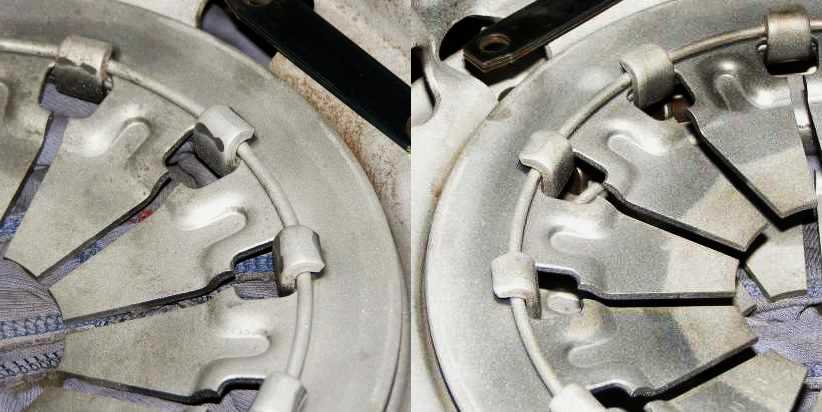
Clutch fix. On the right is the pressure plate as made by Exedy, with the pieces which fold up to locate the fulcrum ring bent through 90 degrees. On the left is Jim’s modification which traps it properly.
With use the fulcrum ring begins to move and the diaphragm itself floats, going off-centre by a small amount. In turn this creates an out-of-centre movement for the throwout bearing and leads to its early demise. Here’s how it looks:
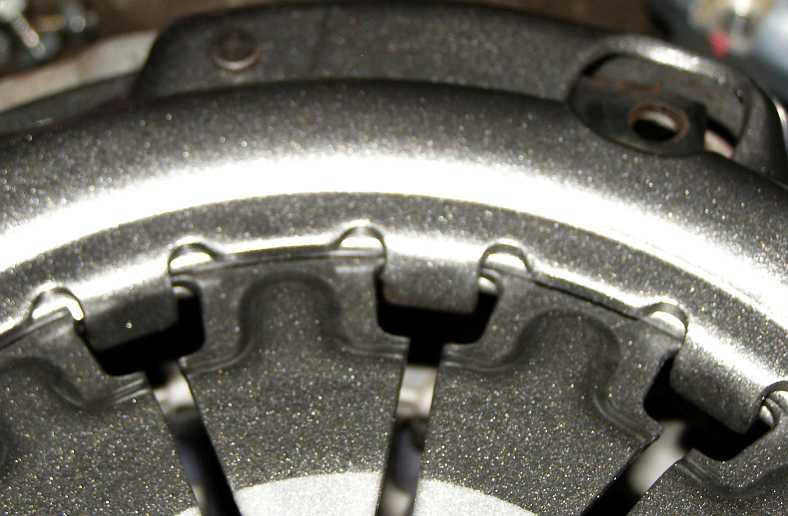
[b]Diaphragm moved.[b] You can clearly see here how the diaphragm has moved, this is the problem with Subaru clutches.
I was getting ever-closer to putting the engine in. In preparation for the difficult part of lining up the spigot shaft while slipping the engine in I had to find a way to get the front of the gearbox up a little higher than it normally sits. And remembering I had to do this all by myself – lifting the engine with my engine crane, of course – I schemed up a way to do this:
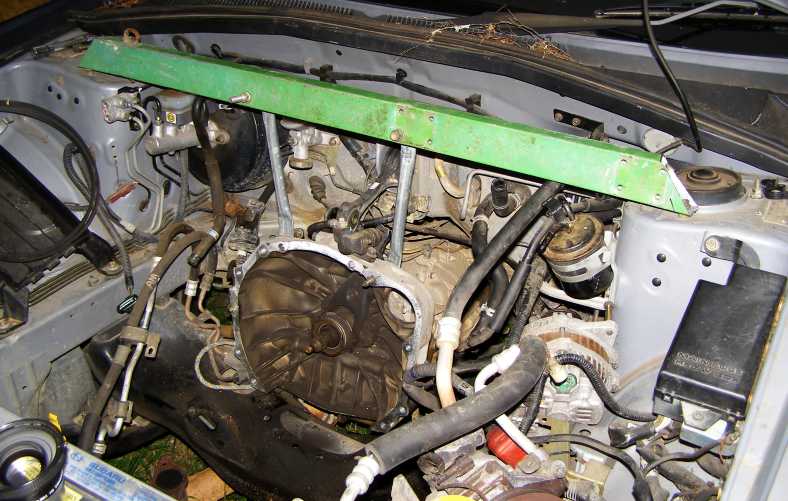
Gearbox lifter. A piece of old rectangular tube from the tip, flatten and drill a couple of pieces of leftover round tube braces from the old satellite dish, a couple of spare bolts and I had the gearbox firmly held in place so the engine would slide onto it easily.
Then the machine shop got around to machining up those spacers for me…
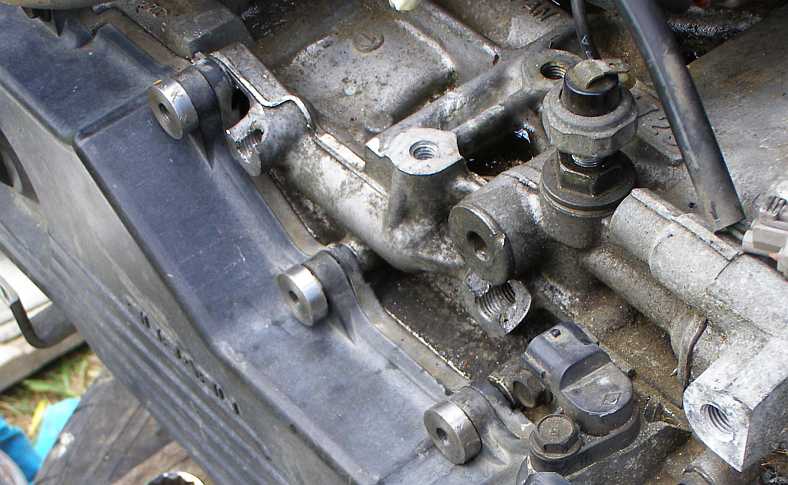
Spacers in place. Of course I’d need longer bolts, easily fixed, and these were made to put the outer face of the spacers in line with the most protrudent broken lug on the block.
…which came up very nicely. But there was more. I had to find 8mm bolts the right length to go into the holes in which I’d cleaned the thread the whole way. Additionally, I needed bolts which were the same diameter for their whole length, something very few Japanese bolts are. Peugeot start motor bolts did the trick, they’re the ones marked blue here:
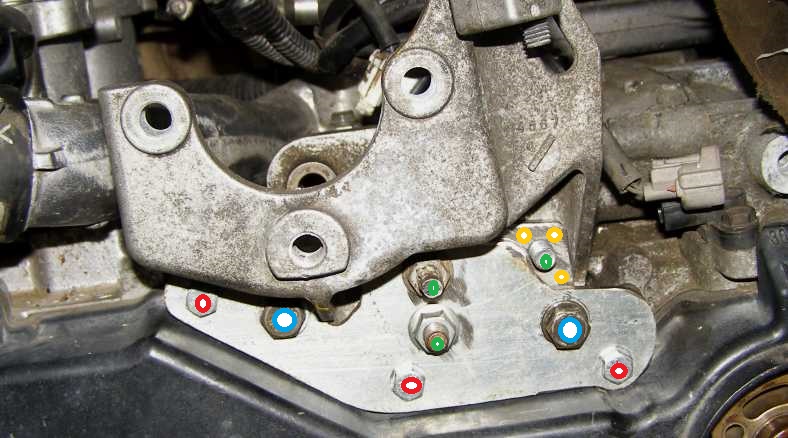
Mount complete. The flat piece held firmly in place by the three 6mm bolts are marked in red, the job of the flat piece is to brace the main bolts so they can’t move under the forces of the belt driving the power-steering pump.
With the difference in the distance to the face of the second lug I had to put a piece of aluminium in there to make up that gap – marked in yellow. It’s firmly held in place to the pump’s mounting bracket by two bolts with nuts and one bolt which simply screws into a thread I cut in the aluminium spacer piece. These three bolts are marked in green.
And it worked! The pump is still holding firmly in there after another 50,000 miles.
With the silver Forester running I used it for a trip to Sydney for a book launch. Naturally I stayed a night at Bob Britton’s and caught up with his progress with the cars he was creating…
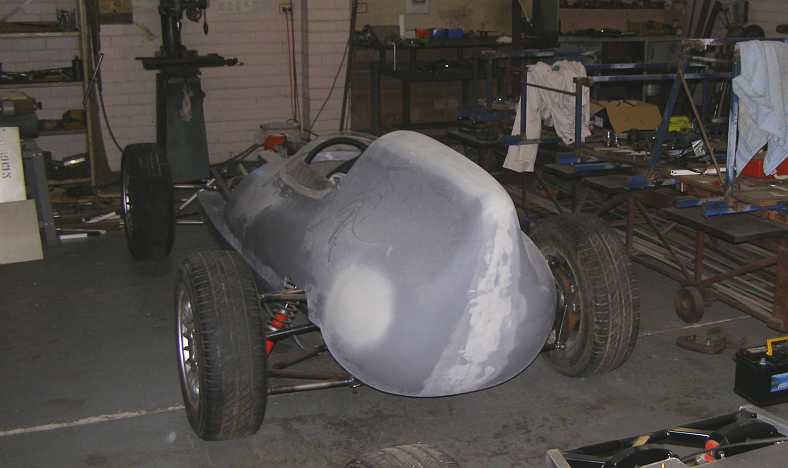
Fibreglass tail. By this time Les Puklowski had transformed the shape into fibreglass panels for the BMW-powered car.
Bob had also truncated the inlet manifold and created a plenum for it which would fit within the lines of the body. Note also that the clutch pedal is in place, while the universal joint in the steering column is just visible in the slot in the firewall as the shaft diverts around the right hand side of the engine:
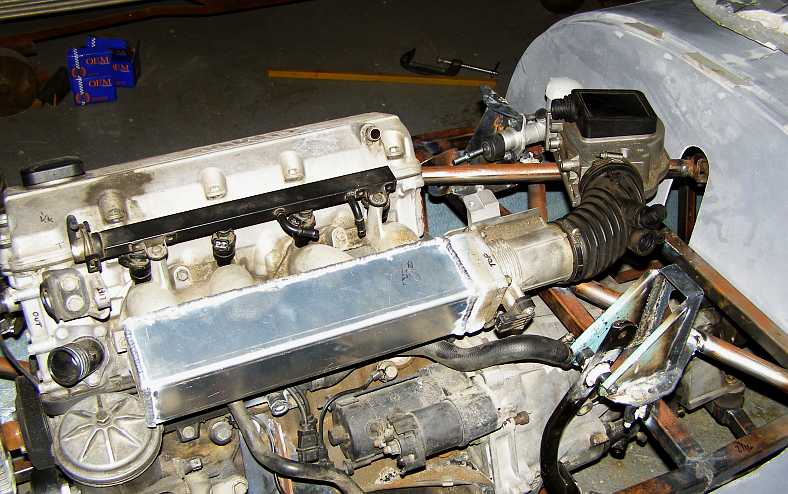
Inlet plenum. Some neat alloy welding and the inlet tracts have been shortened to keep it all within the body line.
More of the suspension was completed, the steeering, the rockers and coil spring/damper units all coming together in the short time since my last visit.
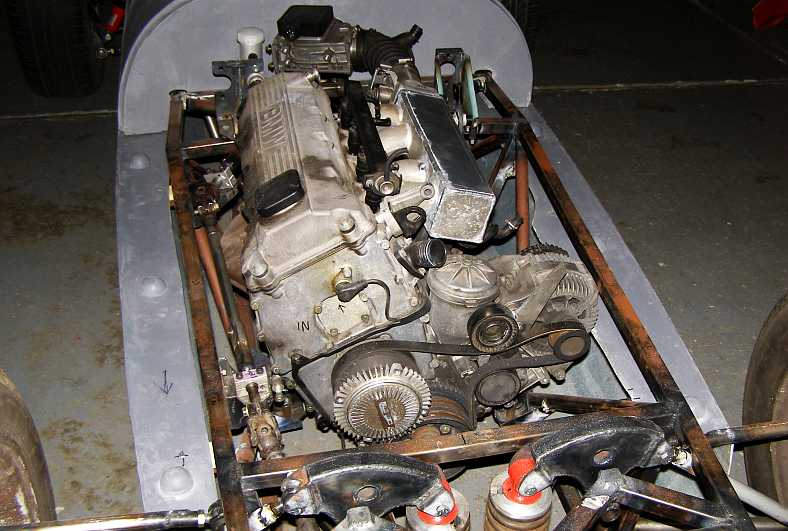
Fitted in. The neat way Bob has designed things to fit within his sleek bodywork is evident here. The chassis still has to be sandblasted and painted, of course.
There was still a little work going on with the Corolla-powered car, too. It was soon to be sent away for its electronics to be hooked up by an expert.
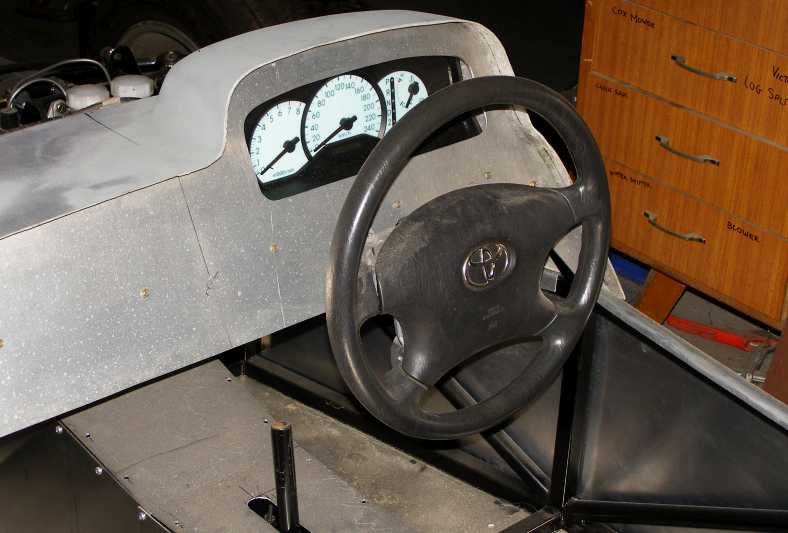
Corolla dash. No longer roughly fitted in with plywood, the dash of this car was starting to look neater.
I worked at Armidale on the way home and then at Tweed heads the following weekend. While I was in that area I dropped in to the home my youngest brother built at Currumbin to see his daughter and her children, who now lived there as my brother’s widow had moved elsewhere and remarried.
Two of the children. The eldest of my brother’s grandchildren was out for the day, as was their mum. This pair were at home with their dad.
Robert built this home on ten acres and had barely finished it when he learned he had Glioblastoma Multiforme. The little girl here was conceived and born in the first half of the 20 months he had left to live and was his little treasure and he was so delighted when she had the same blue eyes as he had.
The end of January was soon upon us and a little car show near home saw a happy bunch of people showing off their polished steeds, like this early post-war Mopar:
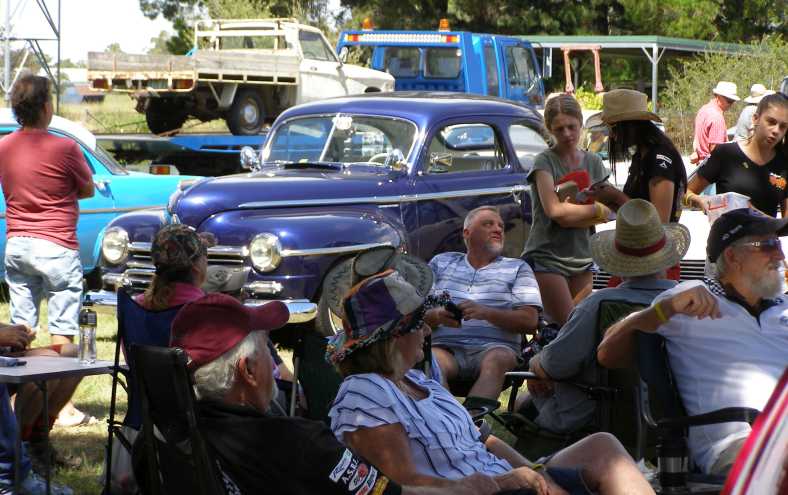
Car show. Members of local car clubs relax in whatever shade they can find on a mid-summer day at Stanthorpe beside the Plymouth and a Holden from 1962-3.
Because Jim Berry had explained to me that there was a better answer to the clutch issue than we’d been able to set up for the silver Forester, and because I was going to get the engine out to change the gearbox, I had him make this up for me in readiness. Little did I realise how long it would actually take me to get that job done.
Work was there every weekend after a brief break at the end of the year. The second week in February I again worked closer to Sandra’s, the job being at a place called Nobby:
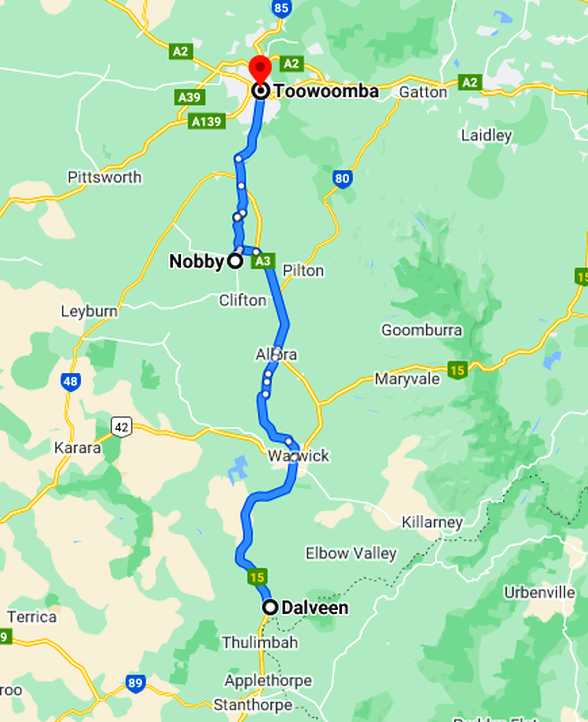
Apart from getting to spend extra nights with Sandra that week it meant I was to learn more about the problems the farmers growing sunflowers have with tourists.
It seems that Oriental tourists, or backpackers on work visas, can’t stay out of the flowers. They walk into the paddocks and damage the plants, even taking the flowers for themselves. In general they make life difficult for farmers who find life difficult enough.
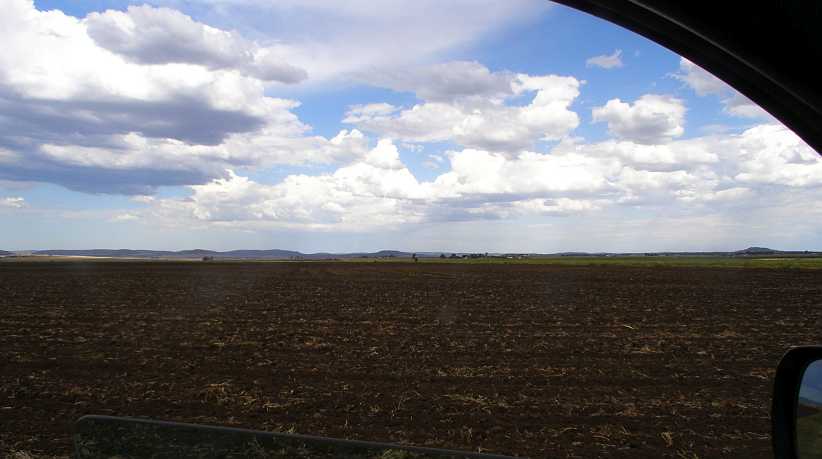
Darling Downs ploughed. This part of the Darling Downs has some great soil for cropping, a wide variety of crops successfully growing in paddocks like this, which will probably grow sorghum, maize or even wheat.
I had another mystery to solve with the silver car…
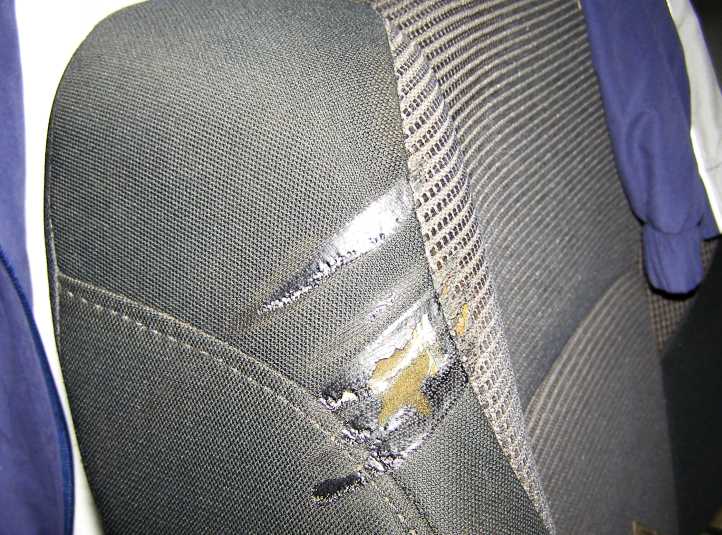
Seat burns. What has caused these burns on the seat? I could not recall anything happening to them. A mystery.
…and I puzzled over it for some time. Then early one afternoon I saw a wisp of smoke coming from the seat as the car sat where I normally parked it near the back of the house.
Mystery solved! The driver’s external mirror was acting like a magnifying glass as the sun reached its hottest. The mirror on that side I’d had to replace after a ’roo strike the first week I had it on the road. I had replaced it with a plastic mirror I cut from one of several pieces of the material and screwed it in place, but in so doing it was deformed so it created a magnifier for the sun to do its damage.
I put in one of the seats from the white wreck.
I had made a significant bit of progress with my joblist by getting this car back on the road, but I now had the gearbox change ahead of me for the green car. And I hadn’t done much towards getting the van ready at all…
In other words, I was pretty busy, but mostly treading water. I needed to make more progress. And I kept taking photos of odd things I saw, like this oddity in Warwick one day:
Incongruous mix. The old Commer van, from the late fifties or early sixties, makes such a contrast with the Holden Commodore utility towing it.
The Commer had a Hillman engine and underpinnings from the large-car line of the Rootes Group, the Humber. It always looked odd to me with those small wheel arches and the wheels so far inboard, but they sold well in England and they had reasonable acceptance in Australia before Chrysler put them out of their misery.
The next weekend I headed off to the Tweed Heads area again, my return on Sunday afternoon was at a time which enabled me to get near Cunningham’s Gap – the point at which the main highway inland from the Gold Coast and Brisbane – crosses the Great Dividing range just when this shot of a sunset over the Gap was fairly spectacular:
Cunningham’s Gap sunset. The stark contrast in the clouds make this a worthwhile picture. It’s a stiff climb to get over the range, by the way.
I always counted on being home an hour after topping that climb. The next week I was running a bit earlier in the same spot so the sun was higher, the shot is very different, but it’s the same mountain profile taken from a closer spot…
Different. Yes, I do like to get pics with the sun’s rays beaming through gaps in the clouds. Cunningham’s Gap again, but up a bit closer and a bit earlier.
Time to look again at the issue I had to deal with on that Forester’s poor damaged block:
Damage to cylinder block. The lugs where the two front bolts for the power-steering pump have been ripped out show up here. They were 8mm bolts.
I had now figured out what to do. I would be relying on the three bolts which hold that section of the plastic timing belt cover in place. These are only 6mm bolts, but here I have enlarged the holes to 12mm (from the 100 the factory made them for stepped bolts to fit in there) and the plan was to get some steel spacers made and they would be more stable at the 12mm diameter to provide extra support for a bracket I’d use to mount the pump.
As I was attacking this little job on my joblist I was working the engine as it sat inside a wheel on the grass. I ground the end off an 8mm tap to make it so it would cut thread right to the bottom of the damaged holes and therefore give me the prospect of putting bolts in there far enough to get some purchase.
I had been going over all of this in my mind. I pondered the thought of drilling the holes in further, but what if I struck an oil gallery, which would mean oil would be pumped out around the bolt? No, just getting the thread to the bottom of the existing hole was the best I could do. And as I did this I was actually lying down in the grass so I could see what I was doing, and I chanced to look up under the manifold and saw…
Further damage! This hole had been punched into the inlet manifold as the power steering pump had been ‘relocated’ by the crash. The bits were down in the ports, right behind the valve heads.
…that the whole job was about to get a little harder. The manifold had to come off, I had to vacuum out the bits which had finished up I the ports. And while I was doing this I found some wires in the loom around the manifold which had been torn and broken. The joblist was growing at about the same rate as I was making progress!
But there was an interruption to this one day when water no longer came from the kitchen tap. And all the other taps. After searching around I went up on the hill to check the water tank which supplies pressure to the house – and found it empty! It had been almost full a few days earlier, so I figured there must be a leak somewhere, but looking everywhere disclosed no wet ground, no leaking pipes. I got the agents to get a plumber out to check and they got nowhere too.
I started carrying drums of water up from the big tank below the house, which was full, as I was reluctant to allow valuable water to flow freely into a system which leaked. I shut off the valve at the top tank and pumped water up there, only turning it on when I needed it for my shower.
A couple of local working weekends helped me catch up a little, but on the third weekend in December I was back to the Tweed. But this time closer to Murwillumbah, which meant that the shortest path was the very-twisty path through Woodenbong and Kyogle, then continuing to wind around through Kunghur, Mt Burrell and Uki (which was actually where I was working) to the accommodation booked for me at Murwillumbah.
As I was beginning to have more and more problems with chemical sensitivity – principally perfumes and deodorants – I phoned the motel and asked them not to use any in the room. And to leave the key under the mat so I could get there late without disturbing them. Of course the room was loaded with the stuff which eats at my eyes and throat after a while. And arriving at 11pm meant it was too late to leave everything open long enough for it all to clear.
And just when you thought my troubles for the weekend were over…
Locked out! I had to wait about an hour for this kind gentleman from the NRMA to come and unlock the Forester for me using the tool he’s holding.
…I locked myself out of the car. It was short work for the NRMA man to get the door open for me, but it took a while for him to get there. I was working, by the way, in an area where I had to drive from house to house, not in a closely-settled area. And it was in an area of lush growth, so I was there among the shrubs and trees, which at least was shady.
Back at home in the previous week when I’d been looking under the house for a water leak I’d grazed my back when I was under a very low part of the floor. Later in the evening, back at the motel, I could feel a lump there and it started to concern me. At 3:30 in the morning I woke up and it was irritating me, an hour or so later I went to the local hospital and the doctor solved the problem…
The big tick. This is most of the tick the doctor removed. Some of its legs came off as he removed it, but he got all of those out too.
…because he could readily see a tick sucking away at my blood in the wound. He gave it a dose of liquid nitrogen and then got it out of there, he also gave me antibiotics just in case. I was able to get back to work on Sunday just fine.
Farm and cloud. Not a bad area to live in – apart from ticks, I suppose. The low clouds over the nearby mountains add to the picture.
The area became more rural the further I went. Older houses were typical, but some were not so old:
Downhill drive. It’s a steep drive going down to this newer home, but it’s certainly a nice setting and clearly built there to take advantage of the views.
I got the job finished, enjoying working in such a picturesque area, and headed back home on that twisty road as darkness fell. Then I had to start thinking once again about getting the Silver Forester mobile again.
Additional motivation for this was the fact that the green one was developing some growling noises in the gearbox, so I wanted the silver one on the road to enable me to fix the green one. And as the clutch plate in the silver one was badly worn, and the one on the replacement engine had rusted onto the flywheel while it had been out in the weather all those months, I had to look for another one.
I quickly found that replacement clutch plates for my model were expensive, about $200 just for the friction plate. Talking to Ben led me to go to see Jim Berry, who runs a one-man business called Race Clutch Australia, to see if he had any bright answers. His recommendation was to fit the slightly smaller plate from the Liberty (Legacy in America). I was concerned that the original is reckoned to be marginal, so a smaller plate would be even more so.
“It will be okay,” Jim assured me. And when I got the original engine out and took the clutch apart there were more problems and I took it to him for a look. Here was where his many years of experience came to the fore as he explained that all the problems these cars experience stem from an issue with the way the pressure plate is made.
Clutch fix. On the right is the pressure plate as made by Exedy, with the pieces which fold up to locate the fulcrum ring bent through 90 degrees. On the left is Jim’s modification which traps it properly.
With use the fulcrum ring begins to move and the diaphragm itself floats, going off-centre by a small amount. In turn this creates an out-of-centre movement for the throwout bearing and leads to its early demise. Here’s how it looks:
[b]Diaphragm moved.[b] You can clearly see here how the diaphragm has moved, this is the problem with Subaru clutches.
I was getting ever-closer to putting the engine in. In preparation for the difficult part of lining up the spigot shaft while slipping the engine in I had to find a way to get the front of the gearbox up a little higher than it normally sits. And remembering I had to do this all by myself – lifting the engine with my engine crane, of course – I schemed up a way to do this:
Gearbox lifter. A piece of old rectangular tube from the tip, flatten and drill a couple of pieces of leftover round tube braces from the old satellite dish, a couple of spare bolts and I had the gearbox firmly held in place so the engine would slide onto it easily.
Then the machine shop got around to machining up those spacers for me…
Spacers in place. Of course I’d need longer bolts, easily fixed, and these were made to put the outer face of the spacers in line with the most protrudent broken lug on the block.
…which came up very nicely. But there was more. I had to find 8mm bolts the right length to go into the holes in which I’d cleaned the thread the whole way. Additionally, I needed bolts which were the same diameter for their whole length, something very few Japanese bolts are. Peugeot start motor bolts did the trick, they’re the ones marked blue here:
Mount complete. The flat piece held firmly in place by the three 6mm bolts are marked in red, the job of the flat piece is to brace the main bolts so they can’t move under the forces of the belt driving the power-steering pump.
With the difference in the distance to the face of the second lug I had to put a piece of aluminium in there to make up that gap – marked in yellow. It’s firmly held in place to the pump’s mounting bracket by two bolts with nuts and one bolt which simply screws into a thread I cut in the aluminium spacer piece. These three bolts are marked in green.
And it worked! The pump is still holding firmly in there after another 50,000 miles.
With the silver Forester running I used it for a trip to Sydney for a book launch. Naturally I stayed a night at Bob Britton’s and caught up with his progress with the cars he was creating…
Fibreglass tail. By this time Les Puklowski had transformed the shape into fibreglass panels for the BMW-powered car.
Bob had also truncated the inlet manifold and created a plenum for it which would fit within the lines of the body. Note also that the clutch pedal is in place, while the universal joint in the steering column is just visible in the slot in the firewall as the shaft diverts around the right hand side of the engine:
Inlet plenum. Some neat alloy welding and the inlet tracts have been shortened to keep it all within the body line.
More of the suspension was completed, the steeering, the rockers and coil spring/damper units all coming together in the short time since my last visit.
Fitted in. The neat way Bob has designed things to fit within his sleek bodywork is evident here. The chassis still has to be sandblasted and painted, of course.
There was still a little work going on with the Corolla-powered car, too. It was soon to be sent away for its electronics to be hooked up by an expert.
Corolla dash. No longer roughly fitted in with plywood, the dash of this car was starting to look neater.
I worked at Armidale on the way home and then at Tweed heads the following weekend. While I was in that area I dropped in to the home my youngest brother built at Currumbin to see his daughter and her children, who now lived there as my brother’s widow had moved elsewhere and remarried.
Two of the children. The eldest of my brother’s grandchildren was out for the day, as was their mum. This pair were at home with their dad.
Robert built this home on ten acres and had barely finished it when he learned he had Glioblastoma Multiforme. The little girl here was conceived and born in the first half of the 20 months he had left to live and was his little treasure and he was so delighted when she had the same blue eyes as he had.
The end of January was soon upon us and a little car show near home saw a happy bunch of people showing off their polished steeds, like this early post-war Mopar:
Car show. Members of local car clubs relax in whatever shade they can find on a mid-summer day at Stanthorpe beside the Plymouth and a Holden from 1962-3.
Because Jim Berry had explained to me that there was a better answer to the clutch issue than we’d been able to set up for the silver Forester, and because I was going to get the engine out to change the gearbox, I had him make this up for me in readiness. Little did I realise how long it would actually take me to get that job done.
Work was there every weekend after a brief break at the end of the year. The second week in February I again worked closer to Sandra’s, the job being at a place called Nobby:
Apart from getting to spend extra nights with Sandra that week it meant I was to learn more about the problems the farmers growing sunflowers have with tourists.
It seems that Oriental tourists, or backpackers on work visas, can’t stay out of the flowers. They walk into the paddocks and damage the plants, even taking the flowers for themselves. In general they make life difficult for farmers who find life difficult enough.
Darling Downs ploughed. This part of the Darling Downs has some great soil for cropping, a wide variety of crops successfully growing in paddocks like this, which will probably grow sorghum, maize or even wheat.
I had another mystery to solve with the silver car…
Seat burns. What has caused these burns on the seat? I could not recall anything happening to them. A mystery.
…and I puzzled over it for some time. Then early one afternoon I saw a wisp of smoke coming from the seat as the car sat where I normally parked it near the back of the house.
Mystery solved! The driver’s external mirror was acting like a magnifying glass as the sun reached its hottest. The mirror on that side I’d had to replace after a ’roo strike the first week I had it on the road. I had replaced it with a plastic mirror I cut from one of several pieces of the material and screwed it in place, but in so doing it was deformed so it created a magnifier for the sun to do its damage.
I put in one of the seats from the white wreck.
I had made a significant bit of progress with my joblist by getting this car back on the road, but I now had the gearbox change ahead of me for the green car. And I hadn’t done much towards getting the van ready at all…
Thread Starter
|
Captain
Joined: Oct 2005
Posts: 570
Likes: 8
From: The Summit, Queensland, Australia
Armidale in New South Wales is a university town as well as a hub for provision of services to rural areas. Its population of around 25,000 people includes a lot of academics, of course, and there’s a shifting population of students.
I frequently get to work there – or in the near vicinity where many have decided to live a little way out of town on a few acres. And such was the case one weekend at the end of Summer, with one of my respondents having a large number of chickens roaming on their lawns as well as this peacock and peahen:
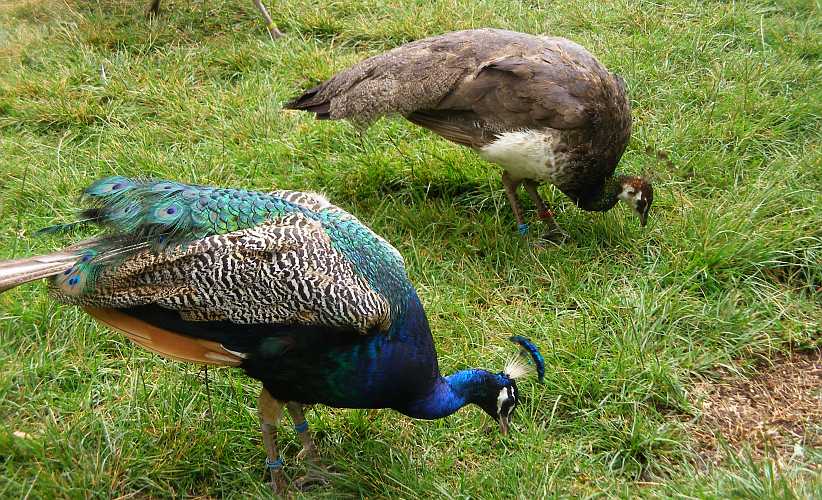
Brilliant colours. The iridescence in the feathers of the peacock made it a ‘must do’ to photograph it while it was up close.
Another place just up the road had different ideas about what to do with their plot of ground, forming a motorcycle course with jumps and other motocross-style challenges. But they’d added a bit of their own flavour to it with the infusion of cars like this…
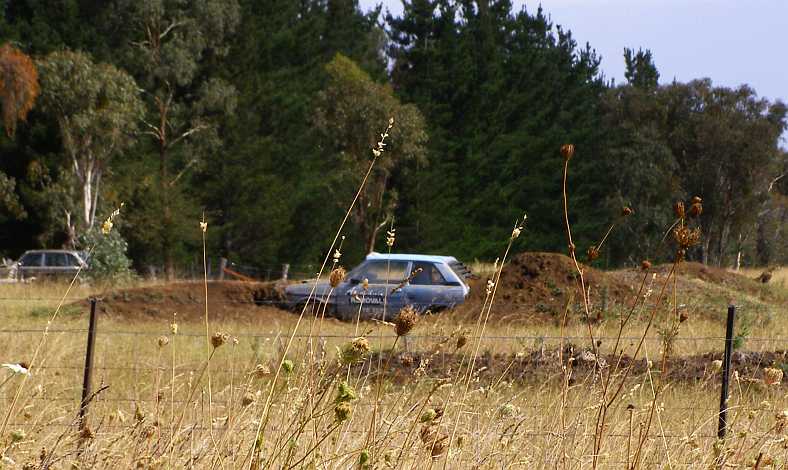
Cars in the scenery. At least two cars were used for this purpose on this property.
The strange thing about this trip was seeing the everpresent poplar trees already turning on their autumnal change:
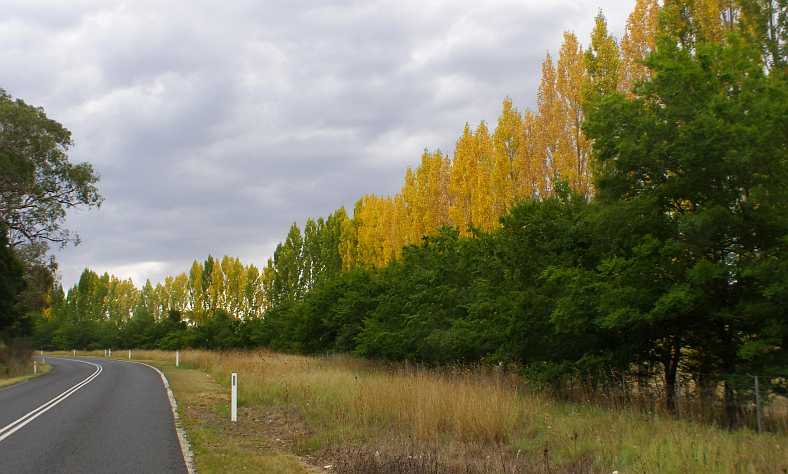
Early autumn? Normally this change of colour is still a month or so away, but not so with this line of trees this year.
My trip to visit Sandra took me past this wreck, apparently having happened over the weekend:
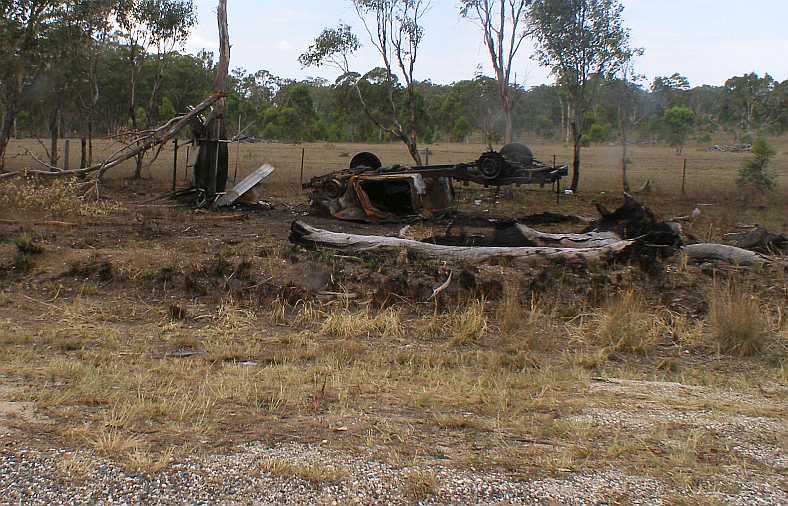
Crash and burn. I guess the driver of this Falcon one-tonner survived as I’d heard or read nothing of this crash on the back road to Warwick.
During this period I’d had to plan in a trip a little further from home as my mother’s youngest brother had died. My father’s death in 2008 had been the last of his family and now all of mum’s family were gone, though one of dad’s brother’s widow remained (and still does at the time of writing).
The funeral service was to be held at Taree in the NSW mid-North coast region, the area where he and most of both families had grown up. The burial would be at the same cemetery as both of my parents lie at rest, at a long-forgotten area named Failford just off the Pacific Highway near Nabiac. It’s a quiet little bush cemetery surrounded by trees and scrub and full of old (and very old) headstones of the kind which attract people doing family histories. And there are some new ones.
I arranged my work for the coming weekend at Grafton, which would allow me to travel towards home up the coast road and thus visit more people and see different scenery, while the downward trip was via Thunderbolts Way until Nowendoc, then across a much less-used gravel road to Mt George and thence secondary roads into Taree.
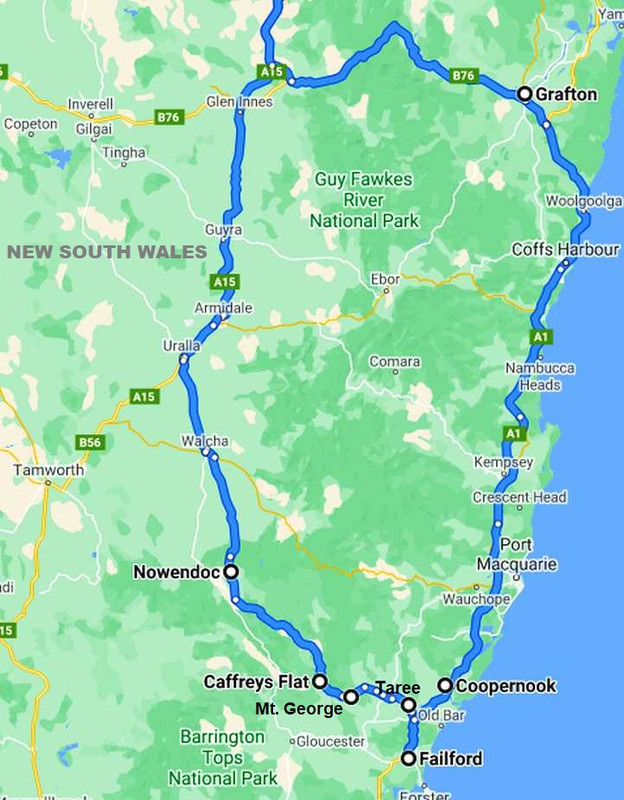
I was in contact at the same time with someone who wanted to look at pickups with a view to buying them, but we established on the phone that he wanted to make a lot of money out of them by quickly re-selling and was not going to offer me anything like a decent price.
I got away the night before the funeral and slept in the car near Uralla, so after descending the mountain from Nowendoc I was driving into the sun. Readers will recall I mentioned that Malcolm Nadin, the ‘Australia’s Most Wanted’ murderer, was ranging through this country while on the loose …
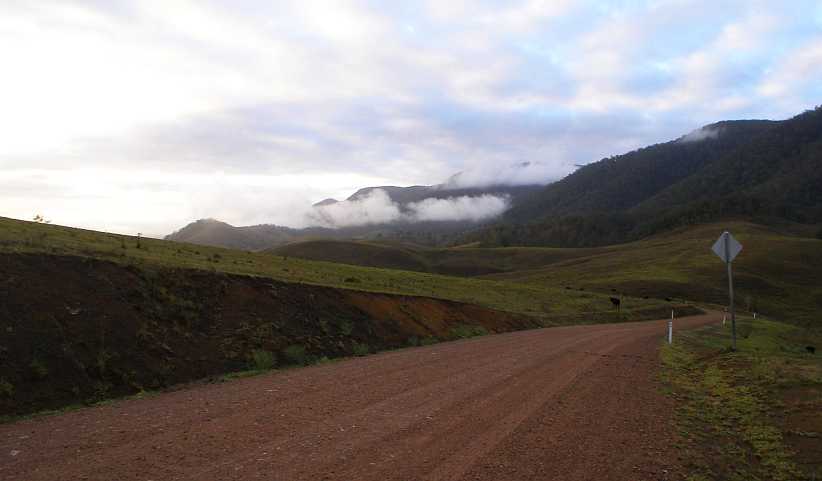
Lonely road. Only a few remote farms are found along this road as it descends from the higher country to the lower coastal area.
…and it made me concerned for a couple I had once met there.
About ten years earlier I had been driving through here early on a Monday morning and suffered a flat tyre. The spare had a slow leak, so it was flat. I jacked the car up and awaited help from a passer-by, killing the time by doing some paperwork for my job. But after a couple of hours the temptation to walk and find a farmhouse overcame me.
I’d been there in a dip in the road all this time looking over the immediate crest to a grid on a crest perhaps half a mile away and thinking that there might be a farm somewhere not too far beyond that grid, so I began my walk. But, to my surprise, I found a farm gate just over that immediate crest, only 150 yards or so from where I was parked!
It was still a bit of a walk to the house, the drive curving around and climbing steeply for about a mile before I found the dogs barking at me and the nice couple inviting me in for a cup of tea and some cake. Then we went back to the car and attacked the tyre with a hand pump enabling me to drive on, stopping again about five miles further on at the next farm to use some compressed air to make sure there was enough pressure in the tyre.
A year or two later I was going that way again and took them a cake I’d bought on the way.
There was no time to stop this trip, however, even if they were up and about at this early hour. I made it to the funeral service and then drove out to the cemetery I know so well:
St Peters Close. From the highway, the cemetery is shrouded by thick bush, tall gum trees creating a peaceful atmosphere.
The name of the street always brings a smile to my face. Apparently it got that name many years ago, but I only saw it on a sign (now missing!) about fifteen years ago.
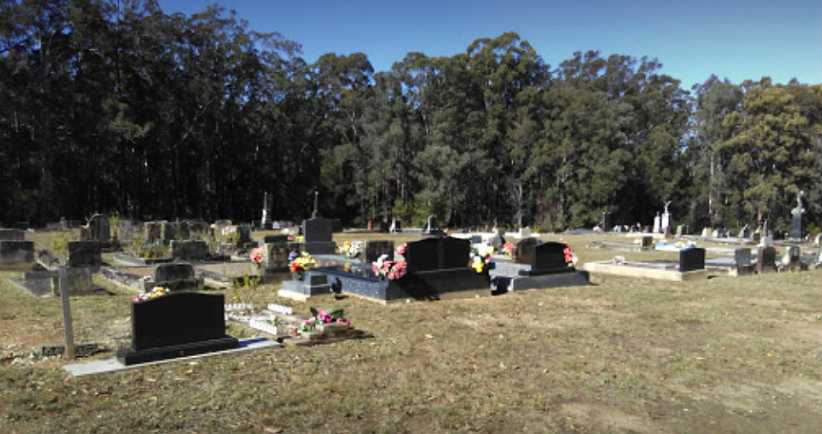
Bush cemetery. This photo shows the surroundings, looking over the graves at the upper end. The one at the left is my parents’ final resting place.
So my uncle was buried just two gravesites from my mother, the one in between having been reserved by my older sister, who has no plans to take up residence there any time soon:
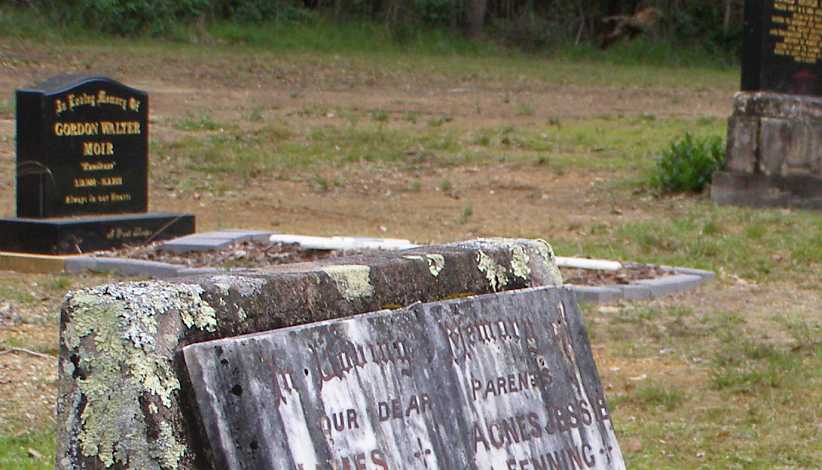
Headstones. Looking over the headstone for my father’s grandparents we see here the headstone my cousins have had erected for their father.
From there I headed back to my cousin Rhonda’s place in Taree where we had some snacks then I drove off to Coopernook to begin my trip to Grafton to work. Coopernook is where my father spent much of his childhood, while at this time another cousin, Ricky, owned a service station/cafe there. I had a look at his latest purchase locked away in the back of the building:
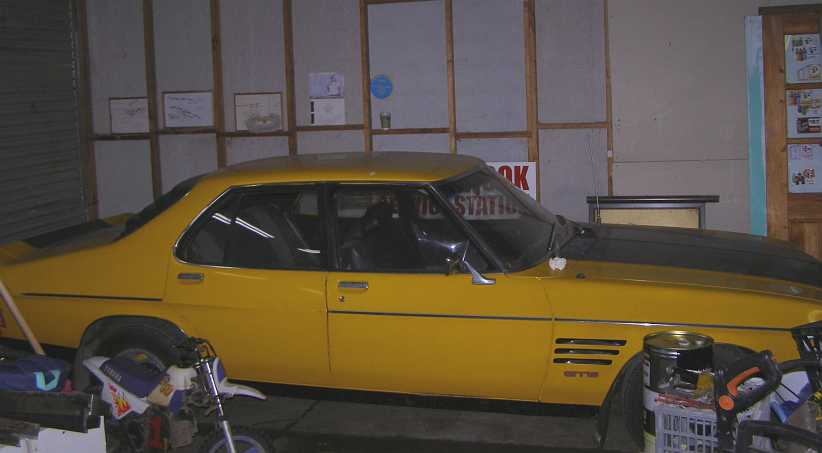
4-door Monaro. This is a classic car now, built in the early seventies by Holden offering 4-door high performance with either the locally-designed and built 308 or a 350 Chev engine.
In Grafton I got some ‘progress’ pics of the new bridge over the Clarence River:
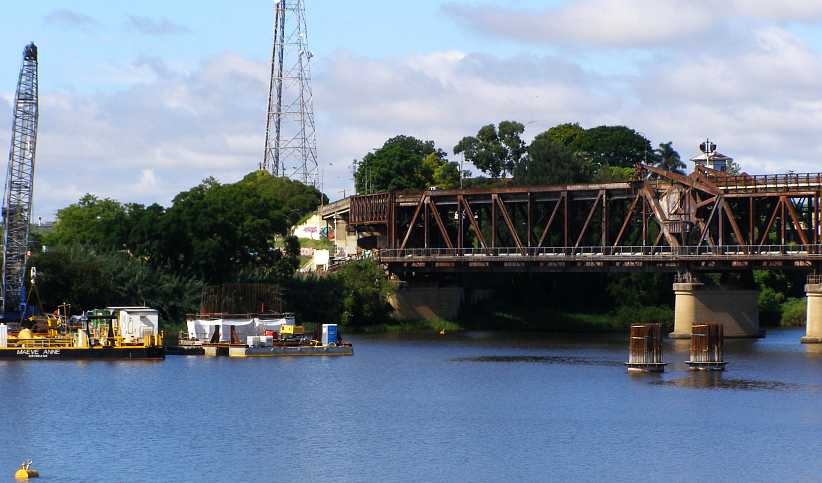
Bridge progress. Work at this stage was mostly underwater, I guess, while this pic shows the sharp turning the road takes on the old bridge to be clear of the railway on the lower deck.
If this was a through-highway the job would have been done long ago, but Grafton is just off the highway and this road is a link between the highway and the Southern part of the town, and the main city area. It still sees heavy peak-hour traffic but during most of the day the traffic isn’t heavy – Grafton is a city of about 19,000 people with another 30,000 living in smaller communities and on farms within its local government jurisdiction.
The other end. This shows what the 1930s roadbuilders were up against when they had to get the old road away from the railway.
After completing that assignment I took my regular route home up the Gibraltar Range and along the New England Highway. A visit to Sandra during the middle of the week was followed by taking time on the Friday to spend a little time with these smiling dental students…
Dental students. Australian universities train a lot of medical and dental students from Asian countries. They venture out from the regular campus to do practical work in public hospitals.
…who over a number of weeks were charged with completing a root canal job on a tooth I would otherwise have lost. This was through the dental clinic at the Stanthorpe hospital.
Not my best pose! With the shield in place to prevent too much debris from the drill going into my mouth, I await the students’ attention to the poor tooth.
That job was completed satisfactorily so the tooth didn’t have to be pulled.
At Warwick there’s a racing circuit and drag strip as well as other sporting venues (equestrian, motorcycle and automotive) on land bequeathed to the community in 1905 by Arthur Morgan. Morgan Park Raceway - https://www.morganparkraceway.com.au...ceway-circuit/ - was the venue for racing the next weekend and I had time to drop around as I was working locally.
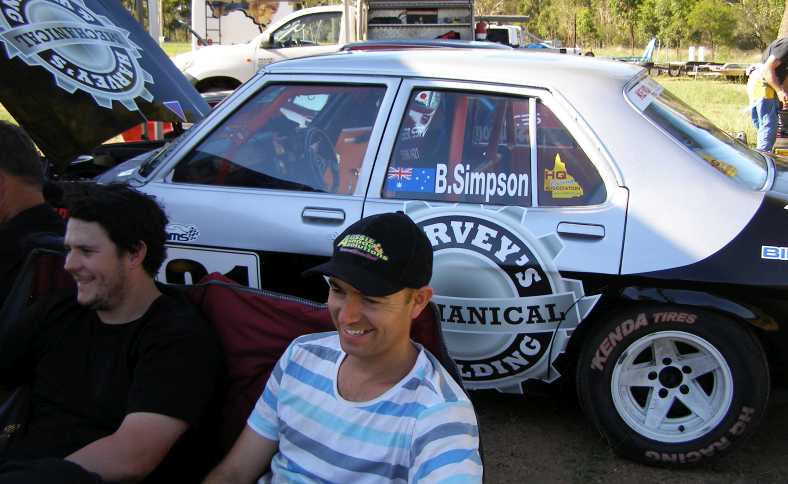
Ben and his HQ Holden. My nephew Ben relaxes near his HQ Holden race car. These cars are restricted to a single-choke carburettor on their 202ci engine and the standard 3-speed gearbox.
Ben builds a lot of engines for this category of racing and has achieved a lot of success over several years racing in it. But his car wasn’t the only one I looked over…
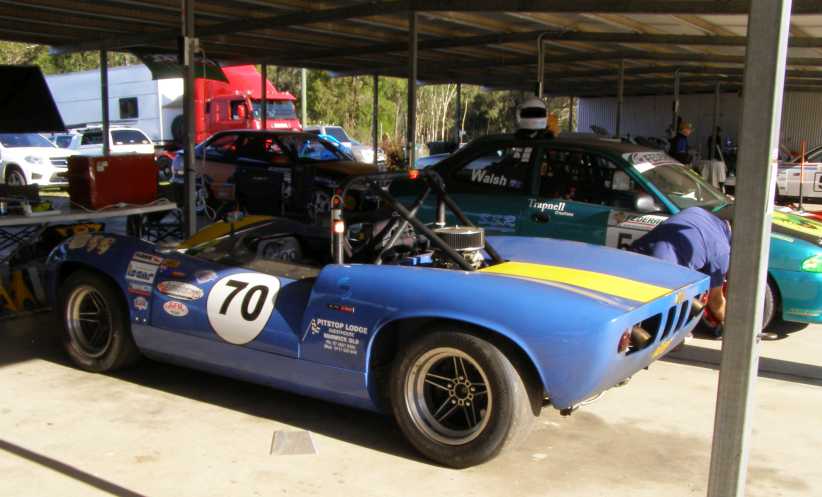
Lola T70. I was surprised to see this Lola there, a car well-known in the old Can-Am days of the sixties. A single 4-choke carburettor belies a low-performing engine, however.
…and it was an interesting break from work for me to wander around there for a while. One thing which stood out was the presence of articulated pantechnicons to carry some of the cars. Whatever happened to the simple 4-wheeled trailers we used to use?
During the next week we saw rail workers coming through Dalveen. This railway line goes on another forty miles or so to the New South Wales border and in the time I’d lived there I’d only seen about five trains on it – including the tourist trains run by the local rail heritage group most long weekends. But the line is maintained, I’m told, because there’s a large military ordnance establishment near the end of the line.
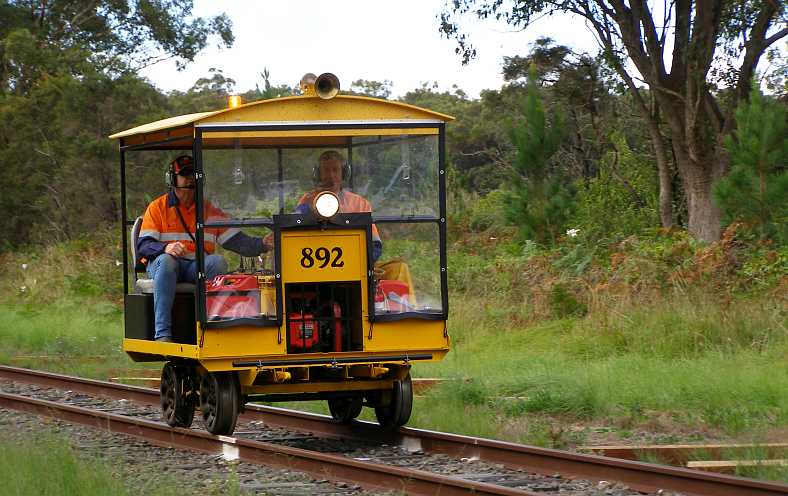
Rail workers arrive. These workers travelled through in these personnel-carrying devices, but they had some heavy lifting gear accompanying them as they were going to replace all the aging sleepers.
“Sleepers” would translate to “ties” in America and I was to learn that they would be starting their task at the far end of the line and working back through our area to Warwick over a few weeks. In fact, I was to get to know the overseer of the gang fairly well in that time.
After another trip to visit Sandra, I would be working the following weekend in some fairly rough country just outside of Tenterfield, right near the border. It was another of those areas where houses are few and far between and you meet some interesting people. And see some interesting sights:
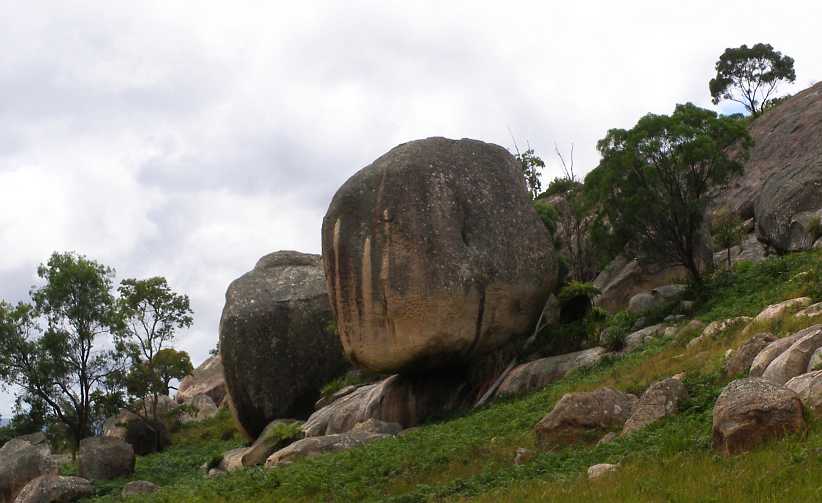
Boulder country. Granite boulders proliferate here, many have been dislodged and rolled to the bottom of the hills. But some resist that temptation.
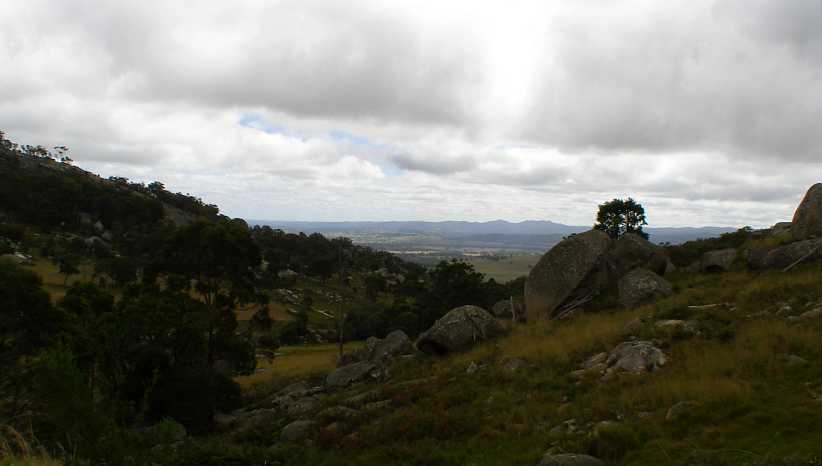
Looking past the boulders. Between the hills there’s a glimpse of some flatter country and more distant hills. This area sits at about 2,700 feet altitude and is a part of the Great Dividing Range.
The first weekend of April saw me again working closer to the coast in Northern New South Wales. While I was working at Lismore, I headed through Casino on the way home and for the first time noted this mini railway:
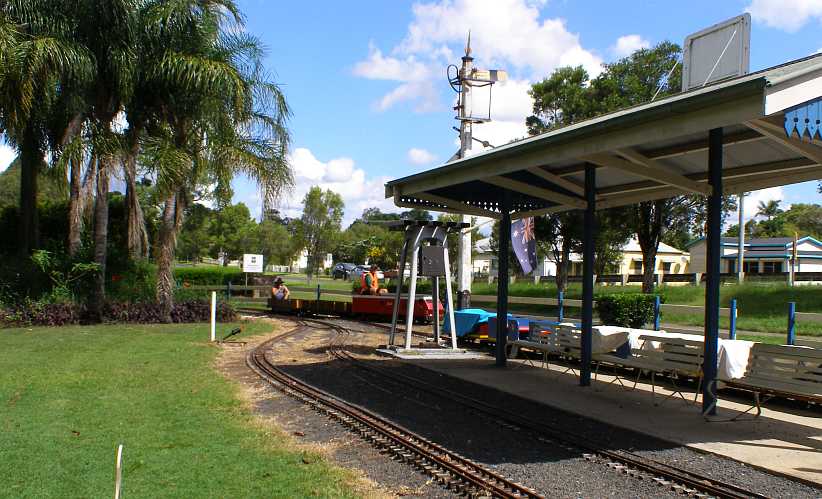
Casino mini-railway. Tucked away in a corner of the North of Casino is this little rail setup with trains people can ride on.
Run by the Pacific Coast Railway Society, the layout features 7¼” and 5” tracks (the larger is about one-eighth of real size) which cover over two miles, riding the distance among the lakes and gardens of the Jabiru Geenebeunga Wetlands behind the local golf course. It also runs alongside the original Casino railway station and there’s a museum to be visited.
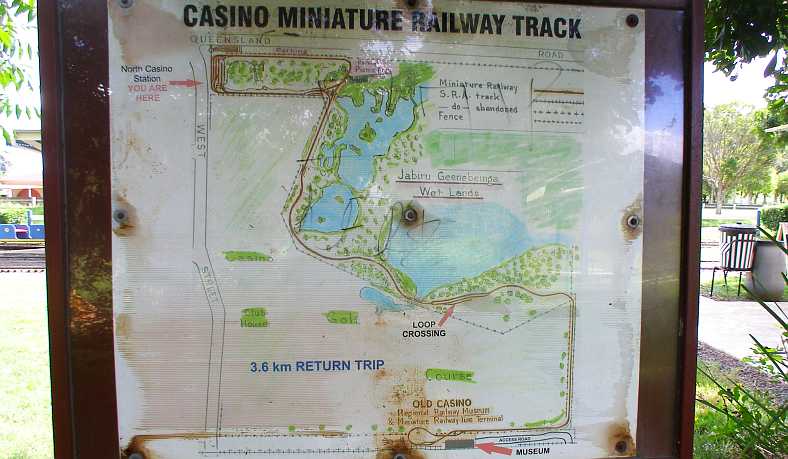
Rail layout. This sign gives all the details, it looks pretty good to me and I’d like to go have a ride around it some day.
I knew darkness would beat me so I didn’t stop long that day, heading off through Kyogle and seeing Mt Lindesay as the sunset lit up the clouds behind it…
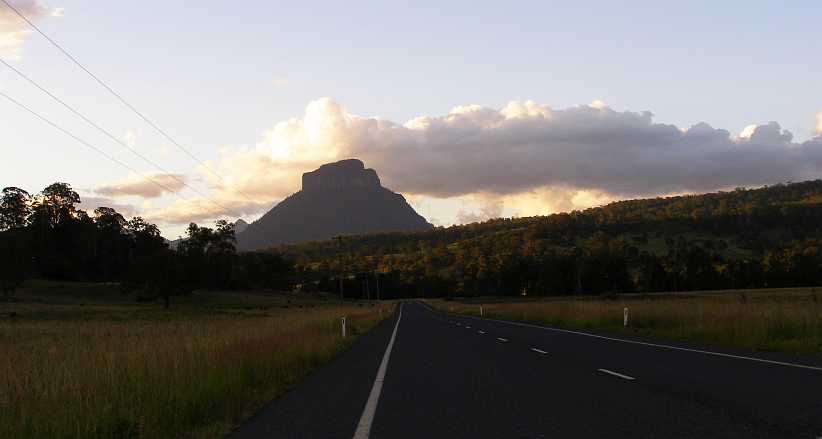
Mount Lindesay and the sunset. The clouds reflected the sunset coming from the left, I was back on the road I enjoy driving so much.
Home again at Dalveen and the warmer weather was coming to an end…
I frequently get to work there – or in the near vicinity where many have decided to live a little way out of town on a few acres. And such was the case one weekend at the end of Summer, with one of my respondents having a large number of chickens roaming on their lawns as well as this peacock and peahen:
Brilliant colours. The iridescence in the feathers of the peacock made it a ‘must do’ to photograph it while it was up close.
Another place just up the road had different ideas about what to do with their plot of ground, forming a motorcycle course with jumps and other motocross-style challenges. But they’d added a bit of their own flavour to it with the infusion of cars like this…
Cars in the scenery. At least two cars were used for this purpose on this property.
The strange thing about this trip was seeing the everpresent poplar trees already turning on their autumnal change:
Early autumn? Normally this change of colour is still a month or so away, but not so with this line of trees this year.
My trip to visit Sandra took me past this wreck, apparently having happened over the weekend:
Crash and burn. I guess the driver of this Falcon one-tonner survived as I’d heard or read nothing of this crash on the back road to Warwick.
During this period I’d had to plan in a trip a little further from home as my mother’s youngest brother had died. My father’s death in 2008 had been the last of his family and now all of mum’s family were gone, though one of dad’s brother’s widow remained (and still does at the time of writing).
The funeral service was to be held at Taree in the NSW mid-North coast region, the area where he and most of both families had grown up. The burial would be at the same cemetery as both of my parents lie at rest, at a long-forgotten area named Failford just off the Pacific Highway near Nabiac. It’s a quiet little bush cemetery surrounded by trees and scrub and full of old (and very old) headstones of the kind which attract people doing family histories. And there are some new ones.
I arranged my work for the coming weekend at Grafton, which would allow me to travel towards home up the coast road and thus visit more people and see different scenery, while the downward trip was via Thunderbolts Way until Nowendoc, then across a much less-used gravel road to Mt George and thence secondary roads into Taree.
I was in contact at the same time with someone who wanted to look at pickups with a view to buying them, but we established on the phone that he wanted to make a lot of money out of them by quickly re-selling and was not going to offer me anything like a decent price.
I got away the night before the funeral and slept in the car near Uralla, so after descending the mountain from Nowendoc I was driving into the sun. Readers will recall I mentioned that Malcolm Nadin, the ‘Australia’s Most Wanted’ murderer, was ranging through this country while on the loose …
Lonely road. Only a few remote farms are found along this road as it descends from the higher country to the lower coastal area.
…and it made me concerned for a couple I had once met there.
About ten years earlier I had been driving through here early on a Monday morning and suffered a flat tyre. The spare had a slow leak, so it was flat. I jacked the car up and awaited help from a passer-by, killing the time by doing some paperwork for my job. But after a couple of hours the temptation to walk and find a farmhouse overcame me.
I’d been there in a dip in the road all this time looking over the immediate crest to a grid on a crest perhaps half a mile away and thinking that there might be a farm somewhere not too far beyond that grid, so I began my walk. But, to my surprise, I found a farm gate just over that immediate crest, only 150 yards or so from where I was parked!
It was still a bit of a walk to the house, the drive curving around and climbing steeply for about a mile before I found the dogs barking at me and the nice couple inviting me in for a cup of tea and some cake. Then we went back to the car and attacked the tyre with a hand pump enabling me to drive on, stopping again about five miles further on at the next farm to use some compressed air to make sure there was enough pressure in the tyre.
A year or two later I was going that way again and took them a cake I’d bought on the way.
There was no time to stop this trip, however, even if they were up and about at this early hour. I made it to the funeral service and then drove out to the cemetery I know so well:
St Peters Close. From the highway, the cemetery is shrouded by thick bush, tall gum trees creating a peaceful atmosphere.
The name of the street always brings a smile to my face. Apparently it got that name many years ago, but I only saw it on a sign (now missing!) about fifteen years ago.
Bush cemetery. This photo shows the surroundings, looking over the graves at the upper end. The one at the left is my parents’ final resting place.
So my uncle was buried just two gravesites from my mother, the one in between having been reserved by my older sister, who has no plans to take up residence there any time soon:
Headstones. Looking over the headstone for my father’s grandparents we see here the headstone my cousins have had erected for their father.
From there I headed back to my cousin Rhonda’s place in Taree where we had some snacks then I drove off to Coopernook to begin my trip to Grafton to work. Coopernook is where my father spent much of his childhood, while at this time another cousin, Ricky, owned a service station/cafe there. I had a look at his latest purchase locked away in the back of the building:
4-door Monaro. This is a classic car now, built in the early seventies by Holden offering 4-door high performance with either the locally-designed and built 308 or a 350 Chev engine.
In Grafton I got some ‘progress’ pics of the new bridge over the Clarence River:
Bridge progress. Work at this stage was mostly underwater, I guess, while this pic shows the sharp turning the road takes on the old bridge to be clear of the railway on the lower deck.
If this was a through-highway the job would have been done long ago, but Grafton is just off the highway and this road is a link between the highway and the Southern part of the town, and the main city area. It still sees heavy peak-hour traffic but during most of the day the traffic isn’t heavy – Grafton is a city of about 19,000 people with another 30,000 living in smaller communities and on farms within its local government jurisdiction.
The other end. This shows what the 1930s roadbuilders were up against when they had to get the old road away from the railway.
After completing that assignment I took my regular route home up the Gibraltar Range and along the New England Highway. A visit to Sandra during the middle of the week was followed by taking time on the Friday to spend a little time with these smiling dental students…
Dental students. Australian universities train a lot of medical and dental students from Asian countries. They venture out from the regular campus to do practical work in public hospitals.
…who over a number of weeks were charged with completing a root canal job on a tooth I would otherwise have lost. This was through the dental clinic at the Stanthorpe hospital.
Not my best pose! With the shield in place to prevent too much debris from the drill going into my mouth, I await the students’ attention to the poor tooth.
That job was completed satisfactorily so the tooth didn’t have to be pulled.
At Warwick there’s a racing circuit and drag strip as well as other sporting venues (equestrian, motorcycle and automotive) on land bequeathed to the community in 1905 by Arthur Morgan. Morgan Park Raceway - https://www.morganparkraceway.com.au...ceway-circuit/ - was the venue for racing the next weekend and I had time to drop around as I was working locally.
Ben and his HQ Holden. My nephew Ben relaxes near his HQ Holden race car. These cars are restricted to a single-choke carburettor on their 202ci engine and the standard 3-speed gearbox.
Ben builds a lot of engines for this category of racing and has achieved a lot of success over several years racing in it. But his car wasn’t the only one I looked over…
Lola T70. I was surprised to see this Lola there, a car well-known in the old Can-Am days of the sixties. A single 4-choke carburettor belies a low-performing engine, however.
…and it was an interesting break from work for me to wander around there for a while. One thing which stood out was the presence of articulated pantechnicons to carry some of the cars. Whatever happened to the simple 4-wheeled trailers we used to use?
During the next week we saw rail workers coming through Dalveen. This railway line goes on another forty miles or so to the New South Wales border and in the time I’d lived there I’d only seen about five trains on it – including the tourist trains run by the local rail heritage group most long weekends. But the line is maintained, I’m told, because there’s a large military ordnance establishment near the end of the line.
Rail workers arrive. These workers travelled through in these personnel-carrying devices, but they had some heavy lifting gear accompanying them as they were going to replace all the aging sleepers.
“Sleepers” would translate to “ties” in America and I was to learn that they would be starting their task at the far end of the line and working back through our area to Warwick over a few weeks. In fact, I was to get to know the overseer of the gang fairly well in that time.
After another trip to visit Sandra, I would be working the following weekend in some fairly rough country just outside of Tenterfield, right near the border. It was another of those areas where houses are few and far between and you meet some interesting people. And see some interesting sights:
Boulder country. Granite boulders proliferate here, many have been dislodged and rolled to the bottom of the hills. But some resist that temptation.
Looking past the boulders. Between the hills there’s a glimpse of some flatter country and more distant hills. This area sits at about 2,700 feet altitude and is a part of the Great Dividing Range.
The first weekend of April saw me again working closer to the coast in Northern New South Wales. While I was working at Lismore, I headed through Casino on the way home and for the first time noted this mini railway:
Casino mini-railway. Tucked away in a corner of the North of Casino is this little rail setup with trains people can ride on.
Run by the Pacific Coast Railway Society, the layout features 7¼” and 5” tracks (the larger is about one-eighth of real size) which cover over two miles, riding the distance among the lakes and gardens of the Jabiru Geenebeunga Wetlands behind the local golf course. It also runs alongside the original Casino railway station and there’s a museum to be visited.
Rail layout. This sign gives all the details, it looks pretty good to me and I’d like to go have a ride around it some day.
I knew darkness would beat me so I didn’t stop long that day, heading off through Kyogle and seeing Mt Lindesay as the sunset lit up the clouds behind it…
Mount Lindesay and the sunset. The clouds reflected the sunset coming from the left, I was back on the road I enjoy driving so much.
Home again at Dalveen and the warmer weather was coming to an end…
Last edited by Ray Bell; Oct 25, 2020 at 03:22 AM.