


help suspension!!


Thread Starter
|
THE ULTI-MOD


Joined: Jan 2007
Posts: 19,797
Likes: 36
From: Union NJ
 RE: help suspension!!
umm not sure what you mean hydra, but the only people that have ever worked on the truck are me and my dad(with the exception of the ball joint recall work) so i dont think a mechanic screwed it up on me

All Star
Joined: Sep 2006
Posts: 868
Likes: 0
From: Oshawa, ON, Canada
RE: help suspension!!
no problem shtr..
I'm gonna replace my shocks and prolly those jouncers too once I start working again this spring, pretty sure my shocks are original with 270,000 km on them.. I know I have one blown (or on its last leg), i get wierd bounces on the highway... I've yet to decide if its right rear or front left..
I'm gonna replace my shocks and prolly those jouncers too once I start working again this spring, pretty sure my shocks are original with 270,000 km on them.. I know I have one blown (or on its last leg), i get wierd bounces on the highway... I've yet to decide if its right rear or front left..
Thread Starter
|
THE ULTI-MOD
Joined: Jan 2007
Posts: 19,797
Likes: 36
From: Union NJ
RE: help suspension!!
the fronts tend to go first especially if you have the tow package w/ the heavier duty rear shocks
at least on mine i think the fronts are shot (at 72000 i think they lasted plenty long enough for the origional shocks) if you want to chekc them take the shochk off and pull and push on it if you can compress nad extend it by hand then they are shot
at least on mine i think the fronts are shot (at 72000 i think they lasted plenty long enough for the origional shocks) if you want to chekc them take the shochk off and pull and push on it if you can compress nad extend it by hand then they are shot
All Star
Joined: Sep 2006
Posts: 868
Likes: 0
From: Oshawa, ON, Canada
RE: help suspension!!
I don't want to take out the shocks unless I'm gonna replace them... and I'm gonna replace all 4 when I do..
i replaced just the rears on my moms VW last summer, and now the thing feels like a boat on the highway.. hit a big bump and the back sticks, but the front bounces two or three times..
i replaced just the rears on my moms VW last summer, and now the thing feels like a boat on the highway.. hit a big bump and the back sticks, but the front bounces two or three times..
Thread Starter
|
THE ULTI-MOD
Joined: Jan 2007
Posts: 19,797
Likes: 36
From: Union NJ
RE: help suspension!!
yea well i cant afford to do all four so im just going to check and replace the fronts if they are bad, but honestly the backs hold up pretty good as long as you dont tow often
Thread Starter
|
THE ULTI-MOD
Joined: Jan 2007
Posts: 19,797
Likes: 36
From: Union NJ
RE: help suspension!!
that is what i am hoping and that if i replace them and the shocks that i will then be ok for anothe 70k or so but well see ill update you guys this weekend

Hall Of Fame


Joined: Jun 2005
Posts: 14,228
Likes: 19
From: Riverton, UT
If the front end height measument isn't set then it sits too close and hits the bump stops ripping them appart. This happends if it is set to low and not at 73mm. Here is the service manual. You measure to the knucle in the middle of the Tortion Bar to the gound then to the center of the hub.
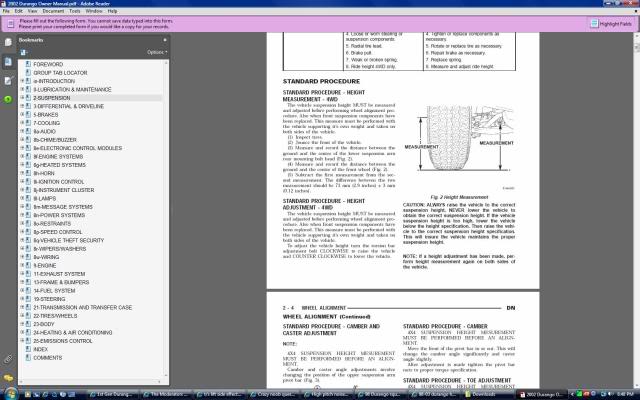
STANDARD PROCEDURE
STANDARD PROCEDURE - HEIGHT
MEASUREMENT - 4WD
MEASUREMENT - 4WD
The vehicle suspension height MUST be measured
and adjusted before performing wheel alignment procedure.
Also when front suspension components have
been replaced. This measure must be performed with
the vehicle supporting it’s own weight and taken on
both sides of the vehicle.
(1) Inspect tires.
(2) Jounce the front of the vehicle.
(3) Measure and record the distance between the
ground and the center of the lower suspension arm
rear mounting bolt head (Fig. 2).
(4) Measure and record the distance between the
ground and the center of the front wheel (Fig. 2).
(5) Subtract the first measurement from the second
measurement. The difference between the two
measurement should be 73 mm (2.9 inches) ± 3 mm
(0.12 inches).
and adjusted before performing wheel alignment procedure.
Also when front suspension components have
been replaced. This measure must be performed with
the vehicle supporting it’s own weight and taken on
both sides of the vehicle.
(1) Inspect tires.
(2) Jounce the front of the vehicle.
(3) Measure and record the distance between the
ground and the center of the lower suspension arm
rear mounting bolt head (Fig. 2).
(4) Measure and record the distance between the
ground and the center of the front wheel (Fig. 2).
(5) Subtract the first measurement from the second
measurement. The difference between the two
measurement should be 73 mm (2.9 inches) ± 3 mm
(0.12 inches).
STANDARD PROCEDURE - HEIGHT
ADJUSTMENT - 4WD
ADJUSTMENT - 4WD
The vehicle suspension height MUST be measured
and adjusted before performing wheel alignment procedure.
Also when front suspension components have
been replaced. This measure must be performed with
the vehicle supporting it’s own weight and taken on
both sides of the vehicle.
To adjust the vehicle height turn the torsion bar
adjustment bolt CLOCKWISE to raise the vehicle
and COUNTER CLOCKWISE to lower the vehicle.
and adjusted before performing wheel alignment procedure.
Also when front suspension components have
been replaced. This measure must be performed with
the vehicle supporting it’s own weight and taken on
both sides of the vehicle.
To adjust the vehicle height turn the torsion bar
adjustment bolt CLOCKWISE to raise the vehicle
and COUNTER CLOCKWISE to lower the vehicle.
CAUTION: ALWAYS raise the vehicle to the correct
suspension height, NEVER lower the vehicle to
obtain the correct suspension height. If the vehicle
suspension height is too high, lower the vehicle
below the height specification. Then raise the vehicle
to the correct suspension height specification.
This will insure the vehicle maintains the proper
suspension height.
NOTE: If a height adjustment has been made, perform
height measurement again on both sides of
the vehicle.
Fig. 2 Height Measurement
suspension height, NEVER lower the vehicle to
obtain the correct suspension height. If the vehicle
suspension height is too high, lower the vehicle
below the height specification. Then raise the vehicle
to the correct suspension height specification.
This will insure the vehicle maintains the proper
suspension height.
NOTE: If a height adjustment has been made, perform
height measurement again on both sides of
the vehicle.
Fig. 2 Height Measurement
DN
WHEEL ALIGNMENT 2 - 3
WHEEL ALIGNMENT (Continued)
STANDARD PROCEDURE - CAMBER AND
CASTER ADJUSTMENT
CASTER ADJUSTMENT
NOTE:
4X4 SUSPENSION HEIGHT MESUREMENT
MUST BE PERFORMED BEFORE AN ALIGNMENT. , but thanks for the info good to know