


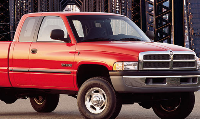
just curious... towing numbers


Administrator


Joined: Apr 2010
Posts: 87,453
Likes: 4,218
From: Clayton MI

Mainly by engine size, type of driveline, and hitch installed. Not to mention tires, gear ratios, and probably a dozen other things.
How much over are you talking? I am sure there is a built in 'fudge factor'..... but, I wouldn't press it. Smoked transmission is one of the probable results.
How much over are you talking? I am sure there is a built in 'fudge factor'..... but, I wouldn't press it. Smoked transmission is one of the probable results.

Thread Starter
|
Professional
Joined: Feb 2009
Posts: 155
Likes: 0
From: Trevor, WI
I read that the 2nd gen ram with the 5.2 and 5.9 with auto tranny's are rated for pulling a little over 7000lbs. just wondeirng if pulling that much is ok, or a little too much stress.


Professional
Joined: Apr 2010
Posts: 237
Likes: 0
Near I can figure I once had close to 9K behind my 01 1500, it pulled it but I wouldn't do it again. Heck I wouldn't even think of doing it again. At the time the only mods I had were a monster trans cooler and a pep boys hitch.
ETA, and that was with a standard ball, none of that fancy weight distribution stuff. I often wonder how I made it to this age.
ETA, and that was with a standard ball, none of that fancy weight distribution stuff. I often wonder how I made it to this age.
Last edited by ghost4321; May 25, 2010 at 09:31 PM.

Grand Champion
Joined: Apr 2010
Posts: 5,011
Likes: 6
From: Meeker, CO
In addition to grinding the guts out of your automatic transmission and risking your neck when you find out the hard way about brake system heat dissipation limits, a trailer that's too heavy (tongue or gross weight) or improperly balanced (and especially if it's heavy behind the axle) is eventually going to take control of the vehicle's direction. That's a very ugly experience.
And this is where the rub comes. If you push it and know you're pushing it you're going to do everything you can to make sure that you get the weight distribution "right". But a trailer behind a tow vehicle on the highway is not a static machine; the instantaneous angles and loads at the hitch are determined by the grade, camber, and imperfections in the road as well as the air around the trailer (cross-winds, pressures around/vortices behind large vehicles, etc). All the care you took to get things "right" while the vehicle was parked on level ground stays on that patch of level ground and doesn't follow you to where you're running 65MPH down-grade on a lumpy rutted road with a cross wind and an 85MPH semi blowing past.
Living in the Rockies we used to be able to very easily pick out the tourists whose trailers had made believers out of them. First hint: You've been smelling their brakes for the last five miles. Second hint: the wheelbase of the tow vehicle is less than 65% of the distance between the tow vehicle's rear axle and the trailer's front axle. Third hint: 45MPH on the level portions of a 75MPH interstate and drifting toward or partially onto the right shoulder when big rigs pass. Confirmation: White knuckles on the steering wheel and a female passenger with eyes wide as saucers who appears to be prepared to jump out.
The smart thing to do if you want to move a heavier/longer trailer: Put a cute cap on that receiver hitch and buy a fifth-wheel.
And this is where the rub comes. If you push it and know you're pushing it you're going to do everything you can to make sure that you get the weight distribution "right". But a trailer behind a tow vehicle on the highway is not a static machine; the instantaneous angles and loads at the hitch are determined by the grade, camber, and imperfections in the road as well as the air around the trailer (cross-winds, pressures around/vortices behind large vehicles, etc). All the care you took to get things "right" while the vehicle was parked on level ground stays on that patch of level ground and doesn't follow you to where you're running 65MPH down-grade on a lumpy rutted road with a cross wind and an 85MPH semi blowing past.
Living in the Rockies we used to be able to very easily pick out the tourists whose trailers had made believers out of them. First hint: You've been smelling their brakes for the last five miles. Second hint: the wheelbase of the tow vehicle is less than 65% of the distance between the tow vehicle's rear axle and the trailer's front axle. Third hint: 45MPH on the level portions of a 75MPH interstate and drifting toward or partially onto the right shoulder when big rigs pass. Confirmation: White knuckles on the steering wheel and a female passenger with eyes wide as saucers who appears to be prepared to jump out.
The smart thing to do if you want to move a heavier/longer trailer: Put a cute cap on that receiver hitch and buy a fifth-wheel.
Administrator
Joined: Apr 2010
Posts: 87,453
Likes: 4,218
From: Clayton MI
The smart thing to do if you want to move a heavier/longer trailer: Put a cute cap on that receiver hitch and buy a fifth-wheel.
And make sure it is mounted to a truck that has the tow rating. Just a hitch isn't going to improve your brakes/transmission/etc.
And make sure it is mounted to a truck that has the tow rating. Just a hitch isn't going to improve your brakes/transmission/etc.
Trending Topics
Thread Starter
|
Professional
Joined: Feb 2009
Posts: 155
Likes: 0
From: Trevor, WI
In addition to grinding the guts out of your automatic transmission and risking your neck when you find out the hard way about brake system heat dissipation limits, a trailer that's too heavy (tongue or gross weight) or improperly balanced (and especially if it's heavy behind the axle) is eventually going to take control of the vehicle's direction. That's a very ugly experience.
And this is where the rub comes. If you push it and know you're pushing it you're going to do everything you can to make sure that you get the weight distribution "right". But a trailer behind a tow vehicle on the highway is not a static machine; the instantaneous angles and loads at the hitch are determined by the grade, camber, and imperfections in the road as well as the air around the trailer (cross-winds, pressures around/vortices behind large vehicles, etc). All the care you took to get things "right" while the vehicle was parked on level ground stays on that patch of level ground and doesn't follow you to where you're running 65MPH down-grade on a lumpy rutted road with a cross wind and an 85MPH semi blowing past.
Living in the Rockies we used to be able to very easily pick out the tourists whose trailers had made believers out of them. First hint: You've been smelling their brakes for the last five miles. Second hint: the wheelbase of the tow vehicle is less than 65% of the distance between the tow vehicle's rear axle and the trailer's front axle. Third hint: 45MPH on the level portions of a 75MPH interstate and drifting toward or partially onto the right shoulder when big rigs pass. Confirmation: White knuckles on the steering wheel and a female passenger with eyes wide as saucers who appears to be prepared to jump out.
The smart thing to do if you want to move a heavier/longer trailer: Put a cute cap on that receiver hitch and buy a fifth-wheel.
And this is where the rub comes. If you push it and know you're pushing it you're going to do everything you can to make sure that you get the weight distribution "right". But a trailer behind a tow vehicle on the highway is not a static machine; the instantaneous angles and loads at the hitch are determined by the grade, camber, and imperfections in the road as well as the air around the trailer (cross-winds, pressures around/vortices behind large vehicles, etc). All the care you took to get things "right" while the vehicle was parked on level ground stays on that patch of level ground and doesn't follow you to where you're running 65MPH down-grade on a lumpy rutted road with a cross wind and an 85MPH semi blowing past.
Living in the Rockies we used to be able to very easily pick out the tourists whose trailers had made believers out of them. First hint: You've been smelling their brakes for the last five miles. Second hint: the wheelbase of the tow vehicle is less than 65% of the distance between the tow vehicle's rear axle and the trailer's front axle. Third hint: 45MPH on the level portions of a 75MPH interstate and drifting toward or partially onto the right shoulder when big rigs pass. Confirmation: White knuckles on the steering wheel and a female passenger with eyes wide as saucers who appears to be prepared to jump out.
The smart thing to do if you want to move a heavier/longer trailer: Put a cute cap on that receiver hitch and buy a fifth-wheel.
Are they a "laboratory number" of sorts? Meaning that they are developed in perfect conditions? and somewhat unrealistic? or just specific number that is good to follow?
Administrator
Joined: Apr 2010
Posts: 87,453
Likes: 4,218
From: Clayton MI
I am sure the engineers have very good reasoning behind the ratings. But, being it is a corporation, and one of the cardinal rules is "Cover Your ***"..... There is probably a bit of a fudge factor built in there..... I wouldn't press it any harder than about 5% of rated weight though.

Record Breaker
Joined: Jun 2008
Posts: 1,669
Likes: 4
From: The Buckeye State... OHIO
when your *** starts to pucker up a bit when stopping at a red light... its a good sign you're a little over loaded anywhere from 7,000-10,000# with a 1500, 9,000-15,000# with a 2500, and 12,000-20,000# with a properlly equiped 3500.. this all depends on engine.. brake.. frame.. and tranny combinastions.. along with brake and suspension upgrades

